Billboards in Oneida, TN
No Minimum Spend. No Long-Term Contracts. Just Results.
Trusted by Leading Brands


Billboard advertising
in Oneida has never been easier



How much is a billboard in Oneida?
Why Choose Blip for Billboard Advertising in Oneida
Blip lets you launch fast in Oneida on U.S. 27 and SR 63—ideal for reaching repeat local drivers without traditional buying hurdles.
Set flexible budgets in Oneida and pay only when your ad blips, so you can test local retail or service messaging with control.
Use dayparting with Blip in Oneida to hit 6-9 a.m. commuters and Thu-Sun Big South Fork visitors when they’re on the road.
No contracts means Oneida campaigns can shift with school traffic, hunting season, or summer trail weekends—pause or scale anytime.
Track real-time analytics in Oneida to see what works on the U.S. 27 core vs. recreation routes toward Brimstone and Pickett.
Blip’s creative tools make it easy to build clear, road-ready ads for Oneida drivers—perfect for quick reads on rural corridors.
Frequently Asked Questions About Billboard Advertising in Oneida
How much does a billboard cost in Oneida, Tennessee with Blip?
With Blip, billboard advertising in Oneida can fit a wide range of budgets because you only pay when your ad actually appears. Each “blip” is a 7.5-to-10-second display on a rotating digital billboard, and pricing starts at just $0.01 per display. Your daily budget guides Blip’s algorithm as it bids for open ad slots, helping you get the most reach for what you spend.
Where can I advertise with Blip in Oneida, Tennessee?
Oneida’s travel patterns center on a small number of important routes, and that concentration is helpful because it makes placement strategy easier. U.S. 27 is the spine of daily movement through Oneida, and State Route 63 is the critical westbound connector linking Oneida with Campbell County and Interstate access. Roads feeding recreation assets toward Big South Fork, Historic Rugby, Brimstone Recreation, and Pickett CCC Memorial State Park also carry valuable traffic.
Is billboard advertising in Oneida, Tennessee good for local businesses?
Oneida is a small city of roughly 3,500-4,000 residents, but it carries far more advertising weight than its size suggests because it functions as a practical retail and service hub for a broader Scott County market of about 21,500 people. More than 9 in 10 workers in rural Scott County commute by car, truck, or van, which is exactly the kind of mobility pattern that strengthens out-of-home advertising. In practical terms, that means roadway exposure is one of the most dependable ways to build daily reach.
What kind of traffic and audience does Oneida, Tennessee billboards reach?
Daily life in this part of Tennessee is strongly car-oriented, so repeated trips on U.S. 27 and State Route 63 create the kind of frequency that billboard campaigns need. Oneida also reaches a mix of working adults, families, retirees, regional shoppers, and outdoor tourists. That means a billboard here can influence not just residents inside city limits, but also people who come into town for groceries, banking, healthcare, schools, automotive services, dining, cabins, and recreation.
When is the best time to run a billboard campaign in Oneida, Tennessee with Blip?
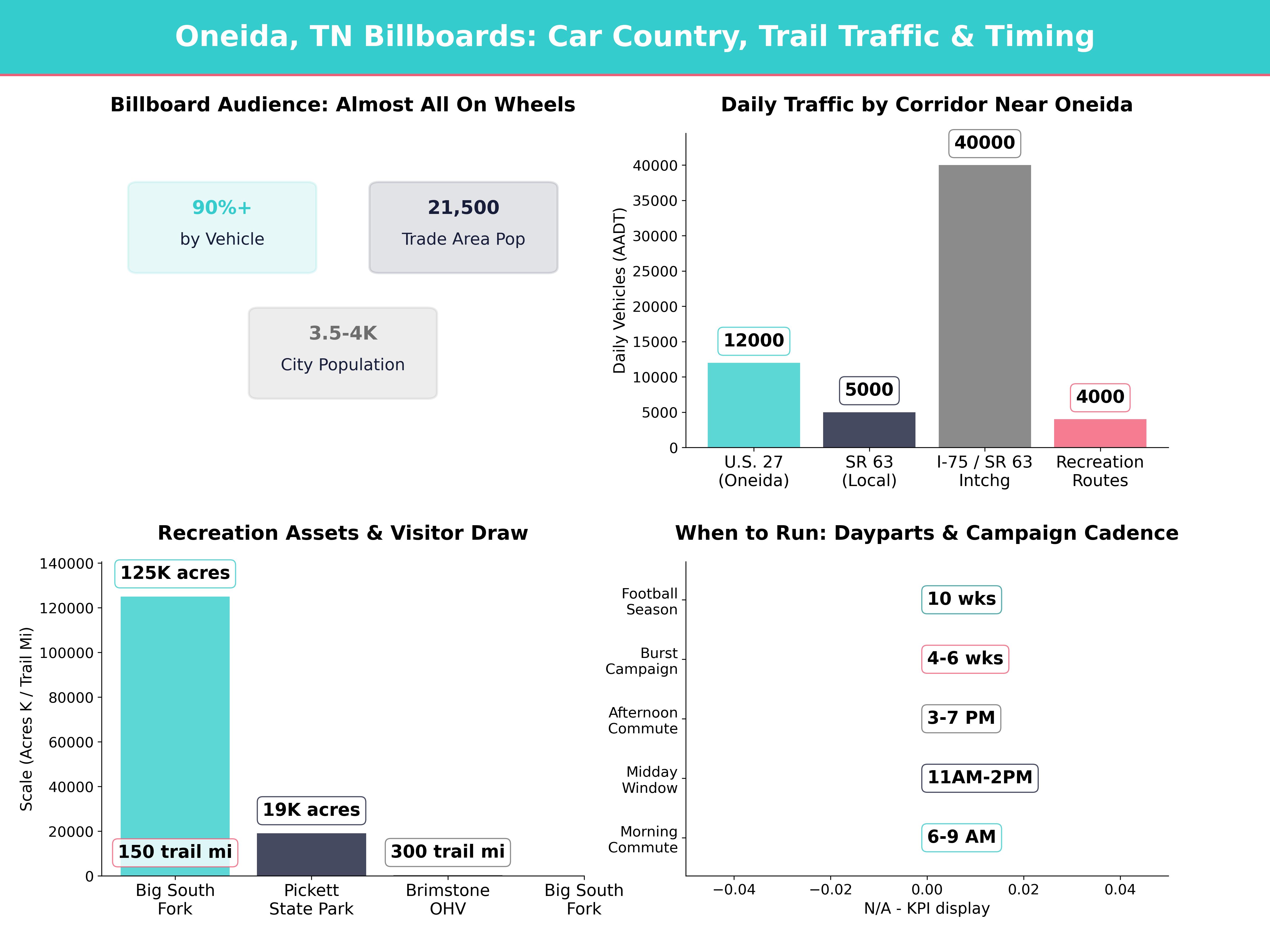
Oneida rewards advertisers who think seasonally, and the audience mix changes by month. From March through May, traffic shifts as hiking, camping, home improvement, and outdoor recreation pick up, while Memorial Day through Labor Day is a strong summer visitor season. Fall is also useful because school resumes in August, high school football creates about 10 weeks of Friday-night attention, and hunting and foliage travel rise during September, October, and November.
Do I need a contract to advertise with Blip in Oneida?
No, Blip has no long-term contracts or minimum commitments. You can start, pause, or stop your campaign at any time.
How fast can I launch a billboard campaign with Blip in Oneida?
You can have your campaign live in minutes. Create a free account, select your locations, set your budget, upload your design, and start running once approved.
Where can I advertise with Blip in Oneida?
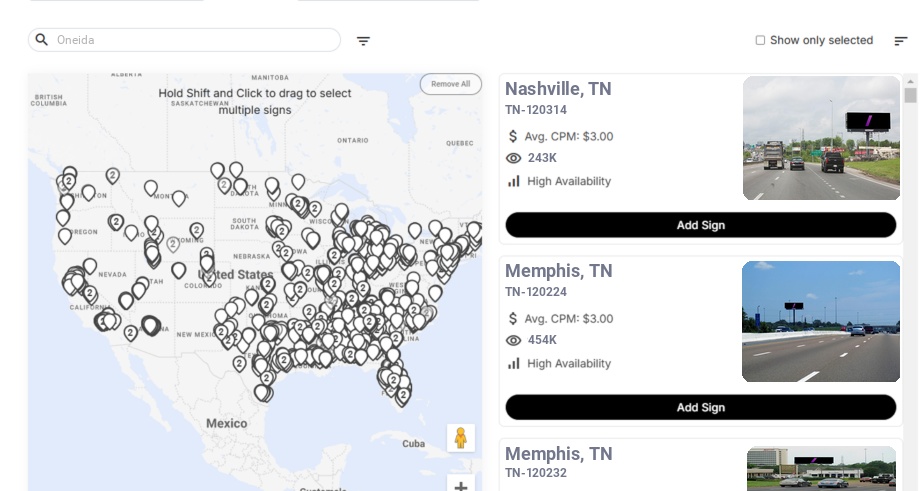
Blip has digital billboards in Oneida. You can browse available locations on a map, choose the ones that fit your audience, and start advertising right away.
Still have questions? Launch a campaign in minutes — no contracts, no commitments.
Start Your CampaignOneida Billboard Advertising Guide
Oneida is a small city of roughly 3,500-4,000 residents, but it carries far more advertising weight than its size suggests because it functions as a practical retail and service hub for a broader Scott County 21,500 people. Daily life in this part of Tennessee is strongly car-oriented, with more than 90% of work trips made by car, truck, or van, so repeated trips on U.S. 27 and State Route 63 create the kind of frequency that billboard campaigns need.
Oneida Market Overview
Oneida sits in a stable, rural trade area where visibility matters because many trips repeat week after week. Scott County had about 22,200 residents in 2010 and about 21,600 in 2020, which is a decline of roughly 600 people, or about 3% over the decade. That is not the story of explosive population growth, but it is a strong story for message retention, because in a flatter market we often win by becoming familiar, trusted, and easy to remember.
What Oneida’s population profile means for advertisers
When we advertise in Oneida, we are usually reaching a mix of working adults, families, retirees, and regional shoppers rather than a fast-turnover newcomer market. Oneida itself remains the area’s main commercial concentration point, and it also draws everyday traffic from surrounding communities in Scott County and from Kentucky to the north. That means a billboard here can influence not just residents inside city limits, but also people who come into town for groceries, banking, healthcare, schools, automotive services, and dining.
More than 9 in 10 workers in rural Scott County commute by car, truck, or van, which is exactly the kind of mobility pattern that strengthens out-of-home advertising. Public transportation is present regionally through East Tennessee Human Resource Agency, but Oneida does not function like a transit-first market with a fixed-route urban bus grid. In practical terms, that means roadway exposure is one of the most dependable ways for us to build daily reach.
Economic signals that support billboard campaigns in Oneida
The local economy is built less on corporate headquarters and more on everyday essentials. Employment and spending are supported by education, healthcare, local government, manufacturing, retail, construction, and outdoor recreation, with statewide context available through the Tennessee Department of Economic and Community Development and the Tennessee Department of Labor and Workforce Development. That mix favors advertisers with straightforward offers and clear utility.
In Oneida, the categories that usually fit billboard advertising best include the following types of businesses.
- Healthcare and personal services: These businesses benefit from repeat visibility among residents who make recurring trips into town for appointments and errands.
- Automotive, powersports, and fuel-related businesses: These advertisers match a market where driving is essential and recreation traffic brings in additional vehicle-heavy audiences.
- Retail, grocery, furniture, and home improvement: These businesses can use billboards to stay top of mind in a trade area where shoppers often compare a small number of familiar local options.
- Restaurants, quick-service food, and convenience stores: These advertisers can convert nearby drivers quickly, especially when copy is directional and timely.
- Tourism and lodging: These categories gain value from weekend and seasonal traffic heading to outdoor destinations.
Why frequency matters more than pure scale in Oneida
In a market this size, we should think less about mass reach in the abstract and more about useful repetition. A Oneida driver may pass the same corridor several times each week, and that repeated exposure can do more for recall than a broader but less relevant buy in a larger city. Because the market is relatively uncluttered, strong creative and consistent scheduling can stand out faster than advertisers often expect.
Key Traffic Corridors for Oneida Billboards
Oneida’s travel patterns center on a small number of important routes, and that concentration is helpful because it makes placement strategy easier. Instead of spreading our message across dozens of disconnected urban arterials, we can focus on the roads that consistently carry local errands, school trips, commuter movement, and recreation traffic. The best published roadway context comes from the Tennessee Department of Transportation.
U.S. 27 through Oneida
U.S. 27 is the spine of daily movement through Oneida. TDOT traffic count maps show that commercial stretches of U.S. 27 in and around town generally operate in the five-figure range, with many segments around 10,000-14,000 AADT. That is meaningful volume for a rural market, and it is especially valuable because much of it is made up of people conducting recurring, practical trips.
This corridor is usually the best fit for the following advertiser groups.
- Retail and grocery brands: These advertisers benefit from frequent exposure to local households making routine weekly trips.
- Medical, dental, and pharmacy providers: These advertisers can reach residents heading into Oneida for core services.
- Restaurants and convenience stores: These businesses can convert drivers quickly when the billboard gives a clear location cue or distance cue.
- Financial services, insurance, and legal services: These advertisers benefit from long-term familiarity in a trust-based market.
State Route 63 between Oneida and I-75
State Route 63 is the critical westbound connector linking Oneida with Campbell County and Interstate access. Near Oneida, TDOT counts on SR 63 are commonly in the 4,000-6,000 AADT range, and the regional traffic opportunity grows dramatically when that travel meets I-75, where nearby segments can exceed 40,000 AADT. This is the corridor we should watch when we want to influence both local drivers and travelers moving between the interstate and the northern Cumberland Plateau.
This route is especially useful for the following campaign goals.
- Regional pull campaigns: These campaigns work well for retailers, medical providers, and service businesses that want customers from beyond Oneida itself.
- Lodging and tourism offers: These campaigns can intercept visitors before they fully commit to where they will fuel, eat, sleep, or stop.
- Auto repair, tire, towing, and roadside services: These advertisers perform well when they are visible on routes that connect rural destinations to interstate travel.
Recreation routes toward Big South Fork, Rugby, and Pickett
Roads feeding recreation assets, including State Route 297 and the approach roads toward Big South Fork, Historic Rugby, Brimstone Recreation, and Pickett CCC Memorial State Park 5,000 vehicles per day, but the intent level is much higher. A driver on these routes is often actively looking for cabins, campgrounds, fuel, food, off-road supplies, or a nearby attraction.
For that reason, lower-volume recreation corridors can still outperform broader commuter corridors for certain businesses.
- Cabins, campgrounds, and short-term rentals: These advertisers benefit because travelers are close to decision points and often still choosing where to stay or stop.
- Powersports dealers, repair shops, and accessory sellers: These businesses match the needs of ATV and side-by-side visitors.
- Restaurants, coffee shops, and convenience retail: These advertisers can win impulse stops, especially on Thursday through Sunday traffic flows.
Audience Segments in Oneida and Scott County
Oneida is not a one-audience market. We can reach daily local drivers, weekend recreation visitors, school-connected families, and cross-border shoppers with different creative and different timing. The key is to match each segment to the right route and the right message.
Daily commuters, errand traffic, and local households
The first audience is the everyday Oneida and Scott County driver. Because car commuting accounts for 90%+ of work trips, and because rural errands often bundle multiple stops into a single drive, these residents see the same corridors repeatedly. That makes billboards especially useful for businesses that want steady top-of-mind awareness rather than a one-time click.
This audience is ideal for the following categories.
- Primary care, urgent care, dental, and vision services: These categories benefit from repeated reminder messaging.
- Banks, insurance agencies, and tax services: These businesses gain from familiarity and local trust.
- Grocery, furniture, home improvement, and telecom offers: These categories perform well when copy emphasizes convenience, value, or location.
Outdoor tourists and weekend visitors
Outdoor tourism is one of Oneida’s biggest advertising advantages. Big South Fork covers about 125,000 acres and offers more than 150 miles of trails, while Brimstone Recreation promotes more than 300 miles of off-road trails. Historic Rugby dates to 1880, and Pickett CCC Memorial State Park 19,000 acres. Those are substantial destination assets for a market this size.
When we advertise to this segment, we should think beyond traditional tourism brands.
- Cabins, campgrounds, and RV-friendly lodging: These businesses can attract visitors who have not finalized every stop in their trip.
- Fuel stations, convenience stores, and restaurants: These advertisers can intercept travelers close to purchase moments.
- Powersports rentals, repair, and gear: These categories are highly relevant to Brimstone-bound traffic.
- Regional attractions and local events: These campaigns work well when they emphasize what is nearby and what is open now.
Students, families, and workforce trainees
Oneida and Scott County generate consistent school-related traffic. Oneida’s city school system adds 3 campuses, Scott County Schools 6 schools, and TCAT Oneida/Huntsville serves the region from 2 campuses. That means school calendars influence local routines across at least 9 K-12 campuses, plus postsecondary workforce training.
This audience matters for more than back-to-school advertisers.
- Family dining, youth programs, and healthcare: These advertisers benefit from school-year routine and after-school movement.
- Career education and hiring campaigns: These messages fit the market because workforce training and local employment are practical priorities.
- Retail and service promotions: These campaigns work well around August school start, sports seasons, and holiday breaks.
Cross-border shoppers and regional service seekers
Oneida also serves people who do not live in the city itself. Drivers from surrounding Tennessee communities and from Kentucky often come into town for services that are not available closer to home. For advertisers, that means a Oneida billboard can function as a regional invitation rather than a city-only tactic.
This segment is especially useful for advertisers selling products or services with higher trip value, such as medical specialists, furniture, legal services, larger-ticket retail, or destination dining.
Seasonal and Timing Opportunities for Oneida Campaigns
Oneida rewards advertisers who think seasonally. We do not need to run the same message all year if the audience mix changes by month. Instead, we can align campaigns with weather, school patterns, and recreation demand.
Spring in Oneida
From March through May, traffic begins to shift as hiking, camping, home improvement, and outdoor recreation pick up. This is a strong time for landscaping, HVAC, garden centers, farm and feed, automotive maintenance, and clinics promoting spring appointments. It is also a good time for tourism brands to re-enter the market before the summer rush builds.
Spring creative works best when it feels practical and forward-looking. Messages about trail access, cabin booking, seasonal menus, outdoor gear, or home projects fit the mood of the market well.
Summer visitor season
From Memorial Day through Labor Day, Oneida benefits from travelers heading to outdoor destinations promoted by Tennessee Vacation, Brimstone Recreation, Historic Rugby, and Tennessee State Parks Thursday-Sunday scheduling because that is when many regional visitors are in motion.
Summer is a particularly strong season for the following categories.
- Lodging and attractions: These businesses can use directional messaging and urgency-based availability messaging.
- Fuel, convenience, and quick-service food: These advertisers benefit from impulse purchases close to the road.
- Auto, tire, and powersports services: These businesses match the needs of long-drive and trail-focused travelers.
Fall in Oneida
Fall is one of the most useful advertising seasons in this market. School resumes in August, high school football creates about 10 weeks of regular-season Friday-night attention, and hunting and foliage travel rise during September, October, and November. Seasonal activity tracked by the Tennessee Wildlife Resources Agency adds even more movement from outdoor audiences.
This is when we should consider campaigns for restaurants, outerwear, sporting goods, auto care, healthcare, home heating, churches, community events, and holiday pre-promotion. Fall creative can also borrow from the region’s visual identity, including hardwood color, trail imagery, pickup trucks, cabins, and family gatherings.
Holiday and winter timing
From November through December, local retail, gift buying, dining, and charitable campaigns become more relevant. In January and February, the market shifts back toward essential services, including tax prep, healthcare, fitness, legal services, and HVAC. Winter weather on the Plateau can also make convenience-oriented messaging more persuasive, especially for businesses that emphasize easy access, delivery, or quick service.
A practical approach in Oneida is to plan in 4-6 week bursts rather than treat every campaign as a year-round buy. That keeps messaging timely and makes budget changes easier when tourism or school traffic changes.
Billboard Design Tips for the Oneida Market
In Oneida, creative should feel local, useful, and immediately readable. This is not a market where vague luxury branding usually does the heaviest lifting. We generally perform better when we show people exactly what we offer, where we are, and why the stop is worth the drive.
Use route-driven, practical copy
Because Oneida traffic is roadway-centered, directional language matters. Phrases like “On U.S. 27,” “Ahead on 63,” “Next Right,” or “2 miles ahead” can be more persuasive here than abstract brand slogans. The same is true for local contact cues, including the 423 area code, town names, and simple location references.
Price-led and offer-led copy also tends to fit the market.
- Healthcare: “Walk-ins Welcome on U.S. 27” is stronger than a general awareness line with no action.
- Restaurants: “Hot Breakfast, Exit Toward Oneida” gives drivers a clearer next step.
- Retail and services: “Financing Available,” “Open 7 Days,” or “Now Hiring” often match local decision-making better than image-only branding.
Use imagery that feels native to the Plateau
Oneida sits in an outdoor-oriented, Appalachian market, so visuals that reflect the region usually feel more credible. Forests, rock formations, cabins, trail machines, local food, schools, work trucks, and family imagery often resonate better than polished big-city lifestyle scenes. When we advertise to recreation travelers, side-by-sides, trail gear, or rustic lodging imagery can signal relevance quickly.
For community-facing campaigns, we should also respect the market’s tone. Straightforward, friendly, and trustworthy visuals often outperform edgy or overly ironic creative.
Design for weather, distance, and quick reads
The Cumberland Plateau can deliver gray skies, rain, fog, and lower-contrast winter light, so high-contrast layouts matter. Dark backgrounds with one bright accent color, or light backgrounds with bold dark typography, usually read well. We should keep logos large, limit text, and make sure the main promise is readable in a 7.5-10-second display window.
Oneida is also a market where numbers do real work. Mileage, pricing, phone numbers, hours, and days can all increase clarity when they are relevant. We should not add numbers just to add numbers, but we should absolutely use them when they help a driver make a decision.
Regional Strategies Around Oneida
A strong Oneida campaign usually works best when we divide the market into practical sub-areas. The same creative does not need to run everywhere, and in many cases it should not. We can often improve response by matching board selection to local intent.
Oneida’s U.S. 27 commercial core
The commercial core along U.S. 27 is our best all-purpose zone. This is where we should prioritize broad-reach campaigns for retail, dining, healthcare, telecom, insurance, and financial services. If our goal is steady local frequency, this is usually the first area to test.
We should also use this zone for campaigns that need repeated visibility among residents, such as hiring, school enrollment, or ongoing community awareness.
South toward Huntsville
Traffic moving toward Huntsville connects with county services, schools, and work trips. This area is useful for legal, financial, healthcare, and public-facing service advertisers that want to catch people on practical weekday travel. It can also be useful for civic campaigns and local event promotion.
Westbound on State Route 63 toward I-75
This corridor is our regional bridge. If we want to pull in travelers from outside Scott County, or if we want to capture pass-through traffic before it reaches Oneida, SR 63 is often the smart play. Businesses that depend on destination traffic, including lodging, larger retail, medical services, and tourism, can justify stronger positioning here.
Northbound toward Winfield
Northbound traffic gives us access to cross-border movement and a broader rural trade area. This sub-area works well for fuel, grocery, healthcare, furniture, and any service category that can pull customers from communities beyond Oneida. Messaging should emphasize convenience, stock, pricing, and location rather than brand theater.
Recreation approaches and weekend traffic zones
Boards on or near recreation approaches should use distinct creative. We should speak directly to visitors with messages about cabins, food, trail access, group lodging, supplies, or “open now” convenience. A tourist-facing board does not need to look like a commuter-facing board, and treating those audiences separately usually improves efficiency.
Using Blip Tools in Oneida
Oneida is the kind of market where flexible planning can create an advantage. We do not always need a giant, fixed campaign to be effective. Instead, we can use Blip’s controls to align with local traffic patterns and seasonal intent.
Daypart around how Oneida actually moves
For commuter-facing campaigns, we should often emphasize 6-9 a.m. and 3-7 p.m. windows, when work and school traffic are more concentrated. For restaurants, healthcare, and service businesses, 11 a.m.-2 p.m. can also be useful. For recreation and hospitality advertisers, we should usually shift more budget toward Thursday through Sunday, especially in spring, summer, and fall.
Scale budgets by season, not habit
Oneida does not need the same spending pattern every month. We can run a 2-week commuter test for a local service brand, then expand into a 4-week summer tourism push if the corridor mix looks promising. That is especially helpful in a market where school traffic, hunting season, and trail tourism all change audience composition.
Compare corridor intent with analytics
Real-time reporting helps us evaluate whether U.S. 27, SR 63, or recreation-oriented placements are actually doing the job we need. A higher-traffic board is not always the better board if the audience intent is less relevant. In Oneida, the difference between “more cars” and “better customers” can be significant.
Refresh creative without friction
Because local timing matters, creative refreshes matter too. We can rotate a tourism version, a hiring version, and a value-offer version without rebuilding an entire traditional schedule. That flexibility is especially useful in a market where weather, school calendars, and weekend travel can quickly change what people care about.
Getting Started with Billboard Rental in Oneida
Renting a billboard in Oneida should start with a clear objective, not with a random map pin. We will make better choices if we first decide whether we want local frequency, regional pull, tourism capture, or immediate directional response. Once that goal is clear, the right boards usually become much easier to identify.
Start with one primary campaign goal
We should choose the job we want the billboard to do.
- If we want local awareness, we should start with U.S. 27 boards in the Oneida commercial area.
- If we want regional draw, we should look harder at SR 63 and the I-75 connection.
- If we want visitor spending, we should focus on routes tied to Big South Fork, Brimstone, Rugby, and Pickett travel.
A single campaign can serve more than one purpose, but the first objective should still lead the plan.
Evaluate Oneida boards like a local driver would
Before we rent, we should think through the route from the driver’s perspective.
- Direction of travel matters because a board should speak to the lane and destination we actually want to influence.
- Decision distance matters because restaurants, fuel, and impulse retail usually need to be close enough to act on quickly.
- Read conditions matter because curves, elevation changes, weather, and rural lighting can affect visibility.
- Intent matters because a lower-volume board on a recreation route can outperform a busier commuter board for tourism offers.
As a rule of thumb, if our business depends on a turnoff or a short detour, we should prioritize boards that appear within about 1-5 miles of that action point.
Expect rural billboard planning to reward clarity
In Oneida, the best billboard is not always the biggest-sounding opportunity. We often get stronger results from a well-matched location and a direct message than from chasing the broadest possible impression count. This is a relationship-driven market, so repeated exposure, recognizable wording, and simple offers usually beat complicated campaigns.
Why a self-serve approach is useful in Oneida
Traditional billboard buying often works best for brands that can commit to long blocks, fixed plans, and slower creative cycles. Oneida, however, is a market where flexibility can matter more. We may want to lean into a fall sports window, push harder during a summer ATV weekend, or pause and refine after a short test.
That is where Blip can simplify the process for us. We can choose boards on the map, launch with a manageable budget, watch results in real time, and adjust creative or timing without waiting through the rigid cycles that often come with conventional outdoor contracts. In a market defined by repeat drivers, seasonal visitors, and practical buying behavior, that kind of control helps us stay relevant and efficient from the first blip onward.