Billboards in Jonesboro, AR
No Minimum Spend. No Long-Term Contracts. Just Results.
Trusted by Leading Brands


Billboard advertising
in Jonesboro has never been easier
How much is a billboard in Jonesboro?
Why Choose Blip for Billboard Advertising in Jonesboro
Blip lets you launch Jonesboro billboards fast, reaching I-555 and US-49 commuters without the hassle of a long-term buy.
Set any budget with Blip in Jonesboro and focus on Red Wolf, Johnson, or Highland traffic that fits your spend.
Daypart Jonesboro ads for A-State game days, class changes, or hospital peaks to hit students, fans, and visitors when they're moving.
No contracts means you can test Jonesboro corridors near St. Bernards, NEA Baptist, or campus and shift if results change.
Track Jonesboro performance in real time with Blip, then adjust creative and timing for back-to-school, weekends, or commuter rushes.
Use Blip's creative tools to build bold Jonesboro ads with simple directions like 'Exit 42' or 'Across from A-State'.
Frequently Asked Questions About Billboard Advertising in Jonesboro
How much does a billboard cost in Jonesboro, Arkansas with Blip?
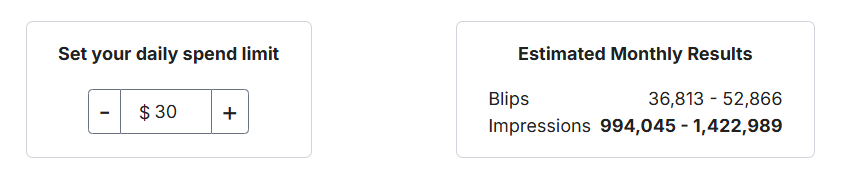
With Blip, you control exactly what you spend on Jonesboro billboards by setting a daily budget that can be as small or as large as you like. Every blip is a 7.5 to 10-second ad on rotating digital billboards in Jonesboro, Arkansas, and you only pay for the individual blips you receive. Costs vary based on when and where your ad appears and on advertiser demand, so you can choose prime times or stretch your budget by targeting off-peak hours.
Where can I advertise with Blip in Jonesboro, Arkansas to reach the most traffic?
Jonesboro’s traffic is funneled through a few primary routes, which should guide where we focus digital billboard impressions. The I-555 / US-63 corridor, US-49, and major city arterials like Red Wolf Boulevard / Johnson Avenue, South Caraway Road, E. Highland Drive, and Stadium Boulevard / Nettleton Avenue all see heavy daily traffic. Choosing boards along these routes is the foundation of smart Jonesboro billboard advertising.
What kind of audience will my Blip ads reach in Jonesboro, Arkansas?
Jonesboro sits at the center of one of the fastest-growing hubs in Northeast Arkansas, with a young, mobile population, a major university, and strong healthcare and manufacturing sectors. Recent estimates show Jonesboro’s population growing to just under 79,000–80,000 residents, and the broader metro area is home to roughly 135,000–140,000 people. That means your billboard can reach a mix of local residents, regional commuters, and visiting families.
When is the best time to run Blip billboards in Jonesboro, Arkansas?
Morning and evening rush periods are strong windows for service businesses, health and wellness, and time-sensitive offers. For students, late afternoon to late night dayparts are best, while healthcare messages can work well from mid-morning to late afternoon when hospital and clinic corridors are busiest. Jonesboro also has predictable spikes around back-to-school, home games, graduation weekends, and holiday shopping.
Why should I use Blip for billboard advertising in Jonesboro, Arkansas instead of a traditional buy?
Jonesboro is not a one-size-fits-all market, and Blip’s tools let us adjust live rather than being locked into a single display or schedule. This flexibility makes it easier to test a city-core-only approach versus a regional corridors plus city core approach and see which combination drives more response. By pairing data-driven scheduling with locally resonant creative, you can generate measurable results without the rigidity or cost of traditional billboard buys.
Do I need a contract to advertise with Blip in Jonesboro?
No, Blip has no long-term contracts or minimum commitments. You can start, pause, or stop your campaign at any time.
How fast can I launch a billboard campaign with Blip in Jonesboro?
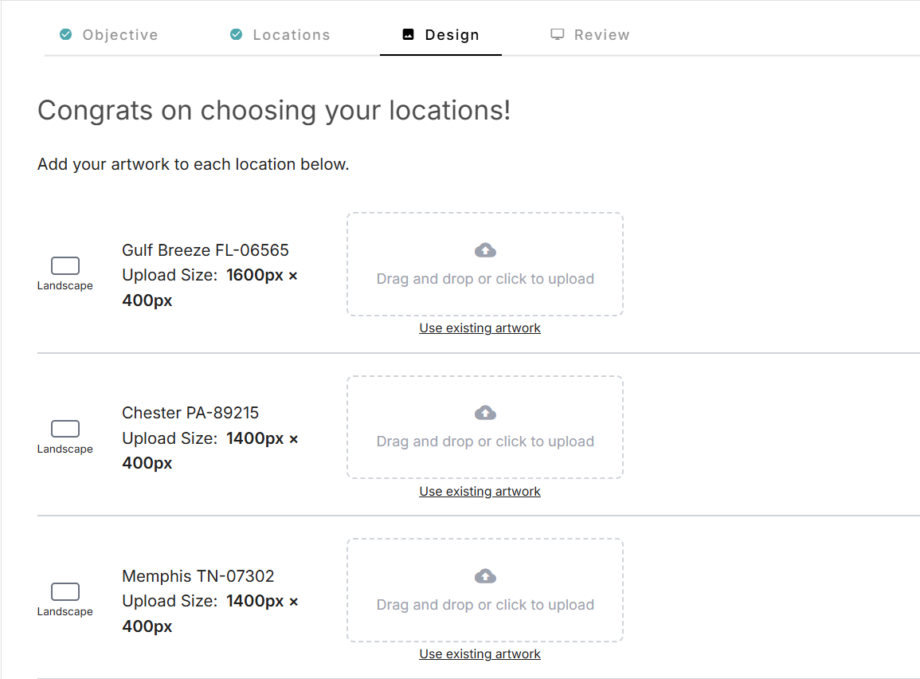
You can have your campaign live in minutes. Create a free account, select your locations, set your budget, upload your design, and start running once approved.
Where can I advertise with Blip in Jonesboro?
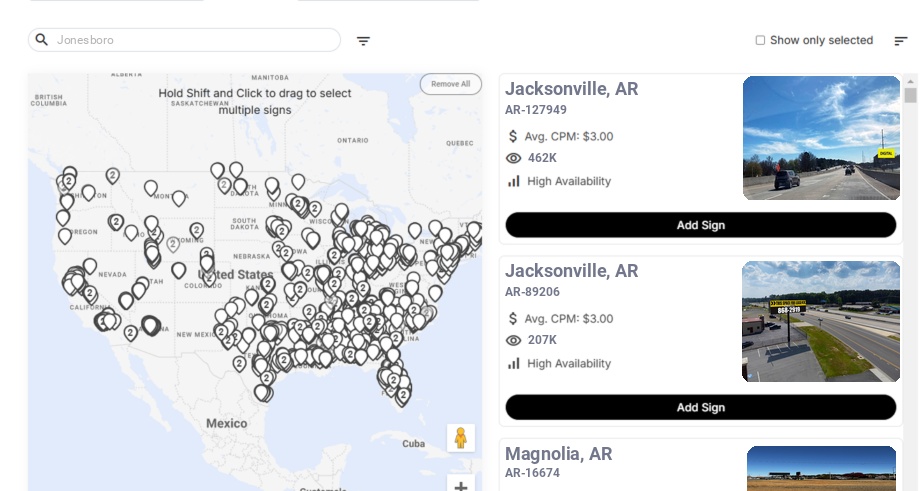
Blip has digital billboards in Jonesboro. You can browse available locations on a map, choose the ones that fit your audience, and start advertising right away.
Still have questions? Launch a campaign in minutes — no contracts, no commitments.
Start Your CampaignJonesboro Billboard Advertising Guide
Jonesboro, Arkansas sits at the center of one of the fastest‑growing hubs in Northeast Arkansas. With a young, mobile population, a major university, and strong healthcare and manufacturing sectors, it offers billboard advertisers a powerful mix of local residents, regional commuters, and visiting families. Using Blip, we can tap into these audiences flexibly—by time of day, location, and budget—if we understand how the city actually moves and lives and how to place Jonesboro billboards where they matter most.
Understanding the Jonesboro Market
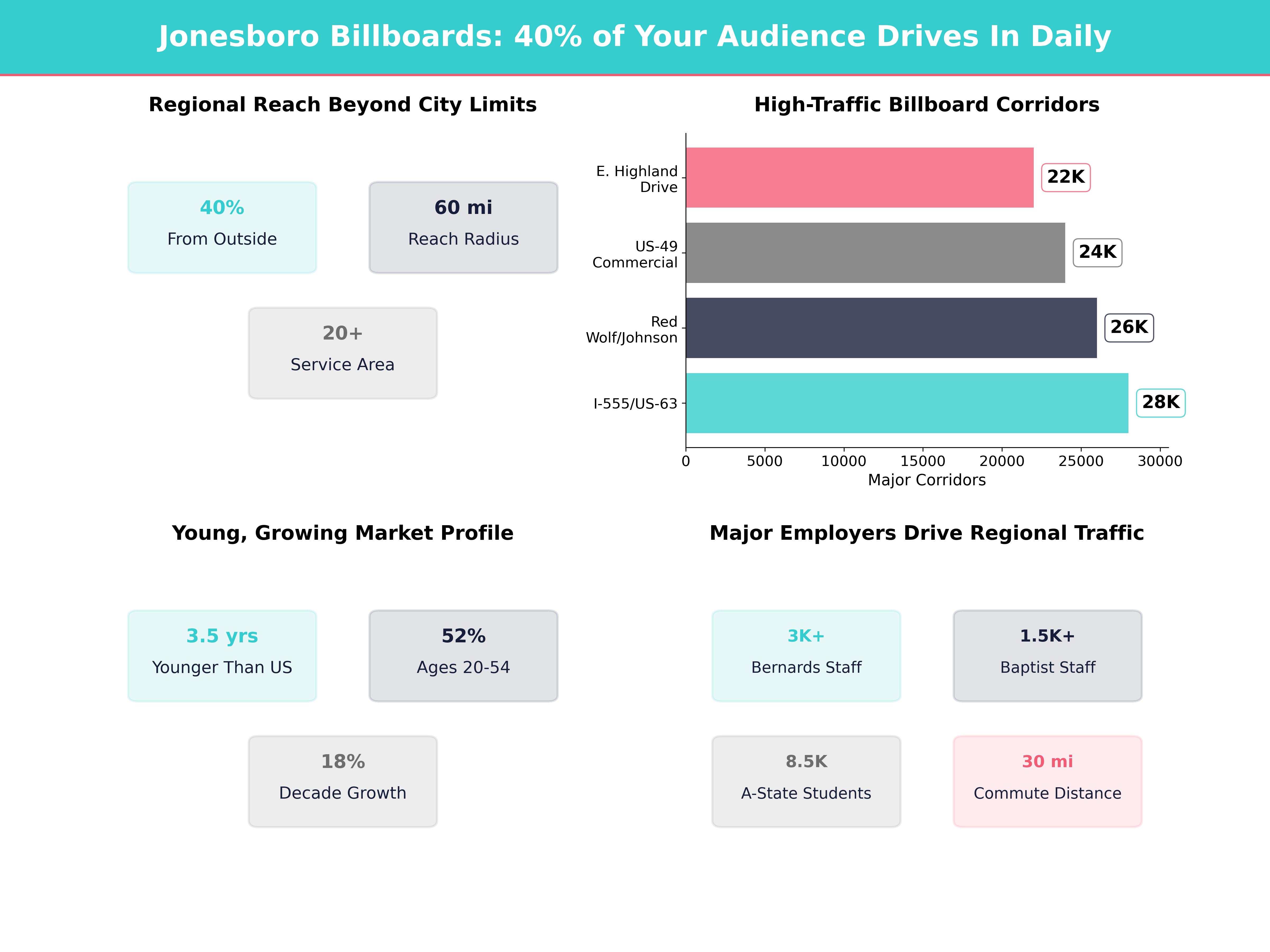
Jonesboro is the largest city in Northeast Arkansas and the seat of Craighead County. Recent city and regional estimates show Jonesboro’s population growing from roughly 67,000 in 2010 to just under 79,000–80,000 residents today, an increase of around 17–20% over about a decade. The broader Jonesboro metropolitan area (Craighead and Poinsett Counties) is home to roughly 135,000–140,000 people, and the daytime population swells as workers and visitors commute in from neighboring counties.
That means roughly 1 in 3–4 people you reach on a Jonesboro billboard are likely coming from outside the city limits but still use its roads, stores, and services regularly, especially on workdays and weekends. For brands considering Jonesboro billboard advertising, this blend of local and regional eyeballs makes every impression more valuable.
Key characteristics of the market:
-
Young, working-age population
Local demographic profiles from the City of Jonesboro and regional planning studies show:- A median age in the low‑ to mid‑30s, about 3–4 years younger than the U.S. median.
- Roughly 50–55% of residents between 20 and 54, and about 25–30% under age 20.
- Around 30–35% of adults holding some college or a bachelor’s degree or higher, driven by the presence of the university and medical sector.
This skews the audience toward: - Young families with children
- College students and recent grads
- Healthcare and industrial workers in shift-based jobs
-
Economic anchors: university, healthcare, manufacturing
Major employers include:- Arkansas State University (A‑State), which reports roughly 14,000–15,000 students across its system, with around 8,000–9,000 enrolled on the main Jonesboro campus in a typical fall term and several thousand faculty and staff on and around campus (Arkansas State University).
- Large healthcare systems like St. Bernards Healthcare (more than 3,000 employees across its hospital and clinics, serving hundreds of thousands of patient encounters each year) and NEA Baptist Memorial Hospital (part of a regional system with more than 1,500 employees in the Jonesboro area).
- Major manufacturers and logistics firms in food processing, beverage, packaging, and conveyor equipment manufacturing clustered in industrial parks along I‑555 and the city’s eastern and southern edges. Local business data from the Jonesboro Regional Chamber of Commerce highlights manufacturing and distribution as two of the largest private‑sector employment bases, with thousands of jobs across multiple plants and warehouses.
-
Regional draw
Jonesboro functions as a retail, entertainment, education, and medical hub for a wide rural catchment area across Craighead, Greene, Poinsett, Lawrence, and Mississippi counties. Hospital systems and A‑State athletics routinely attract visitors from 30–60 miles away. Regional studies referenced by the Jonesboro Metropolitan Planning Organization (MPO) indicate that a significant share—often 35–45%—of daily trips on the city’s major corridors originate outside the city limits. This means a high share of visitors drive in for:- Doctor appointments and hospital visits
- Shopping and dining
- A‑State athletics and events
- Weekend entertainment
For advertisers, this regional pull means billboards in Jonesboro can reach both everyday locals and a steady stream of out‑of‑town visitors in a single buy.
Helpful local resources for understanding the market include the City of Jonesboro, Craighead County, the Jonesboro Regional Chamber of Commerce, local planning documents from the Jonesboro MPO, and tourism information from Visit Jonesboro.
For advertisers using Blip, this mix suggests campaigns that speak both to everyday locals (commuters, grocery shoppers, students) and to visitors who come in from smaller communities for specific needs (specialty medical services, big-box shopping, or sports). Matching your creative to how these groups use Jonesboro billboards day‑to‑day will make your impressions more effective.
Key Traffic Corridors and Placement Strategy
Jonesboro’s traffic is funneled through a few primary routes, which should guide where we focus digital billboard impressions. Traffic counts published by the Arkansas Department of Transportation and local planning agencies routinely show annual average daily traffic (AADT) in the tens of thousands on the city’s main highways and arterials. Choosing boards along these routes is the foundation of smart Jonesboro billboard advertising.
1. I‑555 / US‑63 Corridor
- I‑555 (continuation of US‑63) is the main connector between Jonesboro and the Memphis region, tying in commuters, freight, and visitors. Recent AADT counts near Jonesboro often range from about 24,000–32,000 vehicles per day on key segments, with higher peaks approaching the city’s main interchanges.
-
This corridor is ideal for:
- Regional brands drawing customers from multiple counties
- Healthcare, education, and auto dealers
- Tourism and entertainment messaging timed around weekends
Because I‑555 links Jonesboro with communities like Trumann and Marked Tree and ultimately to I‑55 toward Memphis, boards here can easily reach audiences from a 50–75‑mile radius.
2. US‑49 North–South Spine
-
US‑49 runs through Jonesboro and links it with communities like Paragould to the north and Wynne/Forrest City to the south. On busy stretches near Jonesboro’s commercial areas, daily volumes frequently hit 20,000–28,000 vehicles.
-
A high percentage of out‑of‑town shoppers and healthcare patients use this route, heading toward retail and hospital clusters.
-
Great for:
- Retail centers, restaurants, and quick‑service food
- “Next exit” or “just 5 miles ahead” directional creative
- Weekend, event-based campaigns
When you’re planning billboard rental in Jonesboro to reach both medical and retail traffic, US‑49 is one of the most efficient corridors to prioritize.
3. Major City Arterials
Inside the city, several roads see heavy local traffic and function as daily lifelines for residents:
-
Red Wolf Boulevard / Johnson Avenue – Main corridor serving A‑State, retail centers, and dining. AADT counts on these segments often exceed 22,000–30,000 vehicles per day, with spikes on game days and during back‑to‑school weeks. Strong exposure to:
- College students and staff
- Shoppers visiting big-box retailers and restaurants
- South Caraway Road – Popular for retail and dining, with typical daily traffic in the mid‑teens to low‑20,000s. It serves major shopping centers and chain restaurants.
- E. Highland Drive (AR‑18) – A key east–west corridor tying residential neighborhoods to retail districts, with many segments carrying 18,000–25,000 vehicles daily.
- Stadium Boulevard / Nettleton Avenue – Connects residential zones, schools, churches, and shopping, with steady all‑day volumes driven by school schedules and commuter flows.
When we plan Blip campaigns, it’s often wise to:
- Prioritize city arterials for local, everyday businesses (restaurants, gyms, salons, clinics) that rely on repeat visits from the 70%+ of trips that stay within the city and immediate surroundings.
- Use I‑555/US‑49 for regional reach (auto, higher education, real estate, hospitals, attractions) where an estimated 30–40% of drivers are coming from outside Jonesboro on any given weekday.
Because Blip lets us choose specific boards and adjust budgets by location, we can easily test a “city core only” approach versus a “regional corridors plus city core” approach and see which combination drives more response. This kind of flexible billboard rental in Jonesboro lets you refine your spend over time instead of locking everything into one long‑term static placement.
Commuter and Movement Patterns to Target
Understanding when and how people move across Jonesboro helps us schedule Blips for maximum impact. Regional commuting profiles compiled by the Jonesboro MPO and local workforce reports show that thousands of workers flow into Jonesboro each weekday from surrounding counties.
Workday Commuters
- A significant portion of Jonesboro’s workforce is employed in healthcare, education, manufacturing, retail, and logistics. Local employment snapshots show healthcare and social assistance alone accounting for roughly 15–20% of jobs in the Jonesboro area, with manufacturing contributing another 12–15%.
- Many employees live in nearby towns and commute into Jonesboro daily, especially along I‑555 and US‑49. It’s common for major employers to draw staff from 20–40 miles away, including communities in Greene, Poinsett, and Mississippi counties.
-
Morning and evening rush‑periods (roughly 6:30–9:00 a.m. and 4:00–6:30 p.m.) are strong windows for:
- Service businesses (auto repair, quick oil changes, banking)
- Health and wellness (urgent care, dental, gyms)
- Time-sensitive offers (limited‑time promotions, today-only sales)
With Blip’s scheduling, we can bid higher or run more frequent Blips during these commuter peaks and dial back later at night or mid‑day, depending on budget. This is where data‑driven Jonesboro billboard advertising can outperform a traditional, always‑on schedule that doesn’t account for when local roads are actually busiest.
Students and Campus Traffic
Arkansas State University’s student population (roughly 13,000–14,000) plus faculty and staff form a highly concentrated audience with:
- Frequent car trips between campus, apartments, and retail (especially along Red Wolf Boulevard, Johnson Avenue, and Aggie Road areas). A‑State reports that thousands of students live off‑campus in nearby apartments and neighborhoods, generating multiple car trips per day.
-
Heavy traffic during:
- Start and end of semesters (August–September and December–January), when move‑in/move‑out and orientation activities are heaviest.
- Game days and special events, when football and basketball games can draw crowds in the 10,000–30,000 range over a weekend depending on the event.
- Weekday afternoons and evenings, when classes, labs, and extracurriculars overlap with dining and shopping.
Advertisers targeting this group—student housing, local eateries, coffee shops, tech and phone retailers, nightlife, and tutoring—should:
- Emphasize late afternoon to late night dayparts (2:00–10:00 p.m.), when students are most active off campus.
- Ramp budgets for back‑to‑school, move‑in weekends, and homecoming or bowl seasons, when A‑State’s calendar shows spikes in visitor numbers (parents, alumni, and fans). Calendars and attendance information can be monitored via Arkansas State University.
Healthcare and Hospital Visitors
Jonesboro serves as a medical hub, with thousands of patients and visitors coming from surrounding counties every week.
- Hospital districts around St. Bernards and NEA Baptist see high volumes of traffic, much of it from out‑of‑town visitors unfamiliar with the city. Local health‑system data and community benefit reports often note six‑figure annual patient visit totals and a service area that spans 20+ counties in Northeast Arkansas and Southeast Missouri.
-
Great opportunities for:
- Hotels and short‑term rentals
- Restaurants, pharmacies, and urgent cares
- Legal services and healthcare-adjacent businesses
Since healthcare visits are often scheduled during weekdays, mid‑morning to late afternoon (roughly 9:00 a.m.–4:00 p.m.) can be a productive window for these messages, when hospital parking lots and clinic corridors are busiest. Placing billboards in Jonesboro along the routes that feed these hospital districts helps visitors find nearby services quickly.
Seasonality and Event-Driven Opportunities
Jonesboro’s annual rhythm creates predictable spikes in traffic and attention that we can leverage with flexible Blip campaigns. Local event calendars from Visit Jonesboro, Arkansas State University, and the City of Jonesboro make it easy to anticipate when the city’s traffic and hotel occupancy will rise.
University Calendar
On the A‑State campus alone, the academic year cycles support multiple high‑impact windows:
- August–September: Student move‑in and the start of the academic year; thousands of students arrive or return to Jonesboro over a 1–2 week period. Retail corridors near campus typically see noticeable jumps in sales and traffic during this time.
- October–November: Football and fall events; home games and family weekends bring in waves of parents and alumni, often pushing hotel occupancy well above typical fall averages.
- April–May: Spring events and graduation; ceremony weekends can bring several thousand visiting family members to town, increasing spending on dining, shopping, and lodging.
We can schedule heavier impression volumes for these months if our business targets students, parents, or education-adjacent markets (tech, fashion, moving/storage, banking).
Sports and Entertainment
A‑State athletics, high school sports, and local festivals bring spikes in visitors:
- A‑State football games at Centennial Bank Stadium can draw crowds in the 15,000–20,000 range on bigger matchups.
- Basketball games, concerts, and special events at venues like the First National Bank Arena and city parks attract thousands of attendees across a weekend.
- Community events highlighted by Visit Jonesboro’s calendar and the City of Jonesboro events listings often draw visitors from a 30–60‑mile radius.
We can align ad bursts with game days and event weekends, particularly on routes leading to the A‑State campus and major venues, and use short‑run, high‑frequency Blip schedules (e.g., 2–3 days of heavier spend around a big weekend). For many advertisers, this kind of event‑focused billboard rental in Jonesboro produces fast, trackable surges in traffic.
Retail and Holiday Cycles
Jonesboro is a shopping destination for many outlying towns, so the usual retail peaks are amplified:
- Back‑to‑school (late July–early September), when local and regional families outfit students and college move‑ins. Retailers often report double‑digit percentage sales increases versus off‑peak summer weeks.
- Black Friday and holiday shopping (late November–December), when traffic at major centers along Highland Drive, Caraway Road, and Red Wolf Boulevard surges. Parking counts and in‑store traffic data frequently show weekend volumes 1.5–2x normal.
- Tax refund season (February–April), important for auto, furniture, and electronics, as many households make big‑ticket purchases with returns.
During these windows, consider:
- Increasing daily budgets.
- Running more urgent, offer-driven creative (e.g., “This Weekend Only,” “Ends Sunday,” “Early Bird Specials”).
Crafting Creative That Resonates Locally
Jonesboro audiences respond best to clear, direct messages that respect their time on the road. Because many viewers are local or regional, we can lean on place-based language and familiar landmarks to make our Jonesboro billboard advertising feel relevant.
1. Keep It Simple and Bold
Given typical highway speeds of 40–65 mph around the city:
- Limit text to 6–8 words or 1–2 short lines. Studies on outdoor readability often show that drivers have only 6–8 seconds to absorb a message, so clarity is critical.
- Use large, high-contrast fonts (white or yellow text on dark backgrounds works well).
- Highlight one main benefit or offer, not multiple.
Examples tailored to Jonesboro:
- “New on Red Wolf Blvd – 24/7 Gym”
- “Next Exit: Family Dental – Same‑Day Appointments”
- “Jonesboro’s Fastest Oil Change – 10 Minutes Away”
2. Use Local Cues and Directions
Many drivers know the city by its key roads and districts. Simple directional cues are effective:
- “Left on Caraway – Beside Target”
- “2 Miles Ahead on Highland Dr.”
- “Across from A‑State Stadium”
This is particularly useful for visitors from small towns who rely on signs more than navigation apps, especially older demographics and those traveling for medical appointments. Placing these local cues on well‑traveled billboards in Jonesboro increases the odds that new customers can actually find your location.
3. Appeal to Students and Young Families
With a young demographic and a large campus presence:
- Emphasize value, convenience, and speed—for example, “Meal Deals Under $10” or “Walk‑In, No Appointment Needed.”
- Feature young adults and families in visuals, reflecting the fact that roughly 25–30% of residents are under 20 and thousands more are in their 20s on the A‑State campus.
-
Use straightforward calls to action like:
- “Order Online, Pickup in 15 Minutes”
- “Text JONESBORO to 12345 for 10% Off”
4. Align Creative With Timing
Because Blip allows dayparting, we can match messages to the time of day:
- Morning (6–10 a.m.): Coffee, breakfast, healthcare, auto service (“Before Work”), banking (“On the Way to the Office”).
- Midday (10 a.m.–3 p.m.): Errands, shopping, medical appointments, lunch specials—especially relevant to hospital visitors and shift workers grabbing midday meals.
- Evening (3–9 p.m.): Family dining, takeout, entertainment, fitness, student offers—targeting after‑work and post‑class crowds.
Example:
- Morning creative: “Need Coffee? Exit Now – Drive‑Thru Open”
- Evening creative on the same board: “Kids Eat Free Tonight – Exit Now”
Using Blip’s Flexibility to Outperform Traditional Buys
Jonesboro is not a one-size-fits-all market. Different corners of the city attract different segments, and Blip’s tools let us adjust live rather than being locked into a single display or schedule. For advertisers exploring billboard rental in Jonesboro for the first time, this flexibility reduces risk and makes it easier to experiment.
Key tactics:
1. Dayparting by Audience
- Commuters & professionals: Heavier buys 6:30–9:00 a.m. and 4:00–6:30 p.m. on I‑555 and city arterials, capturing the bulk of the 20,000–30,000 daily vehicles moving along key corridors.
- Students: Focus on 11:00 a.m.–11:00 p.m. along Red Wolf Boulevard, Johnson Avenue, and routes near campus, when class changes and evening activities concentrate student traffic.
- Family shoppers: Increase impressions late afternoons and weekends along Highland Drive and Caraway Road, when family trips to big‑box stores and restaurants peak.
2. Micro‑Seasonal Campaigns
Instead of a static 4–8 week flight, we can:
-
Run 3–5 day bursts around:
- Home games, concerts, local festivals.
- In‑store sales or grand openings.
- Tax refund weekends or back‑to‑school events.
- Pause or reduce spend during historically slower days for your business (for example, mid‑week periods when your internal sales data shows 10–20% lower volume).
3. Geographic A/B Testing
We can test two strategies:
- Cluster A: Boards on Red Wolf / Johnson / Campus area where A‑State, apartments, and student‑focused retail concentrate.
- Cluster B: Boards on I‑555 / US‑49 / Highland where regional traffic and suburban retail mix.
Run each cluster for 1–2 weeks and track:
- Store traffic by ZIP code.
- Website visits from local IP ranges.
- Redemption of unique promo codes by location.
Then reallocate more budget to the higher-performing set of boards. Over time, this approach clarifies which Jonesboro billboards consistently drive revenue for your specific business type.
Industry-Specific Ideas for Jonesboro Advertisers
Because of Jonesboro’s distinct economic profile, some sectors have particularly strong opportunities.
Retail and Restaurants
Jonesboro’s role as a retail hub for Northeast Arkansas means:
- Shoppers from a multi‑county area travel into Jonesboro for big‑box and specialty retail, concentrating along Highland Drive, Caraway Road, and Red Wolf Boulevard.
- Many retailers experience their highest traffic Fridays through Sundays, when weekend visitors and local families combine.
Spotlight offers that appeal to:
- Students (discounts with student ID, late‑night hours).
- Families (kids’ menus, drive‑thru, curbside).
- Regional visitors (clear directions from major highways such as “Off Exit 42 on I‑555”).
Campaign idea:
- Weekdays: “Lunch Special $9.99 – 2 Miles on Highland Dr.”
- Weekends: “Shop & Dine Near A‑State – Exit Red Wolf Blvd.”
Healthcare and Wellness
With thousands of healthcare workers and patients in the city each day:
-
Promote:
- Same‑day appointments, urgent care, walk‑in clinics.
- Specialty practices drawing from multiple counties (orthopedics, cardiology, pediatrics).
- Ancillary services (pharmacies, physical therapy, home health).
- Use trusted language and visuals, emphasize ease of access and short wait times, and include simple directional cues from I‑555 or US‑49 (“5 Minutes from NEA Baptist,” “Across from St. Bernards”).
Education and Training
In addition to A‑State, the region includes technical and vocational training centers and K‑12 districts:
-
A‑State, community colleges, trade schools, and training centers can:
- Target working adults during commuting times with upskilling and degree completion messaging.
- Target teens and parents on weekends and evenings with program highlights and financial aid messages.
- Local school calendars, accessible through district sites and KAIT Region 8 News or The Jonesboro Sun, help pinpoint testing seasons, enrollment periods, and graduation events.
Example:
- “Finish Your Degree in Jonesboro – Evening Classes Available”
- “Train for High‑Demand Jobs – Apply by Sept. 1”
Automotive
With tens of thousands of vehicles using I‑555, US‑49, and Highland Drive every day:
-
Dealers, service centers, tire shops, and quick lube services can:
- Focus on commuters coming in from surrounding towns.
- Use highly directional creative on I‑555/US‑49 (“Exit in 2 Miles – Over 300 Trucks in Stock”).
- Run seasonal rotations (winter safety checks, summer AC service, pre‑trip inspections) timed with local weather patterns and holiday travel periods reported by outlets like KAIT Region 8 News.
For these businesses, a smart mix of regional corridors and in‑town Jonesboro billboards can keep your brand top‑of‑mind during every stage of the vehicle ownership cycle.
Home Services and Real Estate
With ongoing residential growth in and around Jonesboro—reflected in steady increases in housing permits and subdivision development reported by the City of Jonesboro and the Jonesboro Regional Chamber of Commerce:
- Real estate agents and builders can spotlight new subdivisions and developments within 10–15 miles of city center.
-
Home services (HVAC, roofing, lawn care, pest control) can:
- Highlight locally owned status and years in business.
- Use ZIP‑targeted tracking (via inquiries and calls) to measure which corridors generate leads, especially in rapidly growing neighborhoods in east and south Jonesboro.
Measuring and Optimizing Campaign Performance
To get the most from digital billboards in Jonesboro, we should approach campaigns as evolving experiments rather than one‑time buys.
1. Define Clear Local Metrics
Before launching, choose 1–2 primary metrics such as:
- Calls from local area codes (e.g., 870).
- Walk‑in traffic compared to prior weeks or the same month last year.
- Coupon or promo code redemptions tied specifically to “Jonesboro” messaging.
- Online orders or form fills from the Jonesboro region (based on ZIPs in Craighead, Greene, Poinsett, Lawrence, and Mississippi counties).
2. Use Trackable Offers and URLs
- Unique URLs like
YourSite.com/Jonesboroor/AState. - Distinct promo codes (e.g., JBR10, ASTATE5) to attribute redemptions.
- “Show this screen for X% off” offers for mobile visitors who see the billboard and search you—especially powerful given that smartphone adoption in Arkansas exceeds 80%, with younger demographics approaching near‑universal usage.
3. Adjust Creative and Scheduling in Real Time
Based on performance over 1–2 weeks:
- Retire underperforming creatives and double down on layouts that produce calls, visits, or redemptions.
- Shift more budget to the time windows (and specific boards) that coincide with measurable lifts in business activity—e.g., if Friday evening impressions correlate with a 15–20% sales bump, lean into that pattern.
- Lean on local trends and news coverage from outlets like KAIT Region 8 News and The Jonesboro Sun to tailor timely messaging (weather events, school schedules, major community news).
Local Regulations and Practical Considerations
Outdoor advertising in Jonesboro is governed at multiple levels:
- City of Jonesboro – Sign ordinances, zoning rules, and local permitting (see the City of Jonesboro official site and its planning and zoning pages).
- Craighead County – Rules affecting signs in unincorporated areas (via Craighead County government).
- State-level highway and safety regulations for boards on or near state routes and interstates, administered by the Arkansas Department of Transportation.
When you run campaigns through Blip, the inventory you select is already compliant with relevant regulations, but these rules still matter when you’re:
- Aligning your messaging with local expectations and aesthetics, particularly in corridors with stricter design standards or scenic protections.
- Planning long‑term campaigns in areas with tighter sign controls where additional permits or design adjustments may be needed.
- Coordinating billboard campaigns with on‑premise signage and storefront branding so that your locations are easy to identify and compliant.
Bringing It All Together
Jonesboro’s combination of a young population, a major university, robust healthcare facilities, and its role as a regional retail hub makes it a highly efficient market for digital billboards—if we tailor our strategy to how people really live and move:
- Use I‑555 and US‑49 to reach commuters and regional visitors among the 20,000–30,000 vehicles traveling those routes daily.
- Focus on campus and retail corridors to capture students and daily shoppers who drive Red Wolf, Johnson, Caraway, Highland, Stadium, and Nettleton multiple times per week.
- Align dayparts with commuters, students, families, and hospital visitors using local traffic and event patterns.
- Build concise, high-contrast creative that references local roads and landmarks.
- Take advantage of Blip’s flexibility to test, measure, and continuously optimize.
By pairing data-driven scheduling with locally resonant creative, we can use Blip in Jonesboro to generate measurable results—more feet through doors, more calls, and more awareness—without the rigidity or cost of traditional billboard buys. Thoughtful use of Jonesboro billboards turns the city’s busy corridors into an always‑on, highly targeted channel for local and regional growth.