Billboards in Van Buren, AR
No Minimum Spend. No Long-Term Contracts. Just Results.
Trusted by Leading Brands


Billboard advertising
in Van Buren has never been easier
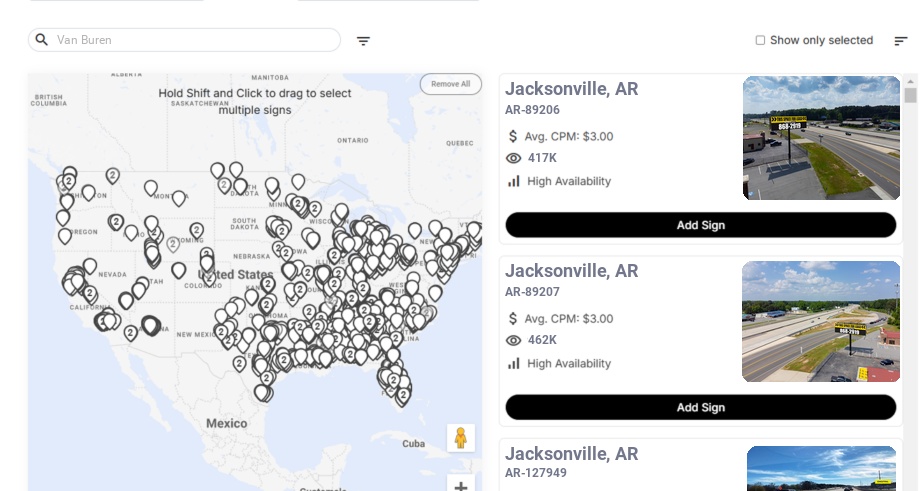



How much is a billboard in Van Buren?
Why Choose Blip for Billboard Advertising in Van Buren
Blip lets you launch Van Buren billboards fast on I-40 and I-540, reaching commuters, truckers, and Fort Smith travelers without a long setup.
Set a daily budget for Van Buren and Blip keeps you on track, so you can test ads during school drop-off and I-40 rush hours with no waste.
No contracts means you can boost Van Buren campaigns for downtown festivals, then pause after the weekend and move on when traffic shifts.
Use real-time analytics to see what works on Van Buren's I-40 corridor and around the Arkansas River crossing, then adjust creative instantly.
Blip's creative tools make it easy to build bold, readable ads for Van Buren drivers in 7.5-second bursts, from Exit 5 offers to school-season promos.
Frequently Asked Questions About Billboard Advertising in Van Buren
How much does a billboard cost in Van Buren, Arkansas with Blip?
With Blip, you control exactly what you spend on Van Buren billboards by setting a daily budget that can be as modest or ambitious as you’d like, and Blip automatically keeps your campaign within that limit. Each ad plays for 7.5 to 10 seconds on digital billboards in Van Buren, Arkansas, and you only pay per “blip,” so your total cost is simply the sum of the individual displays you receive. Prices vary based on where and when your ads run and current advertiser demand, giving you flexibility to target peak times or stretch your budget further.
Where can I advertise with Blip in Van Buren, Arkansas to reach the most drivers?
Van Buren sits directly on Interstate 40, a national freight and travel corridor, so boards along I-40 can reach both local commuters and through-traffic. The I-540 / US-71 connectors tie Van Buren to Fort Smith and other regional destinations, while local surface streets near schools, grocery stores, and big-box retail create frequent repeat exposure. With Blip, you can choose boards along I-40 for broad reach or closer to neighborhoods and retail for high frequency among local households.
When is the best time to run Van Buren, Arkansas billboard ads with Blip?
Weekday rush hours from 6:30–9:00 a.m. and 3:30–6:30 p.m. are especially valuable because they can account for a large share of weekday traffic. Midday is strong for lunch specials, auto services, banking, and doctor or dental visits, while evenings and weekends can work well for entertainment, dining, shopping, and travel-related offers. With Blip, you can carve budgets by time blocks and run the right creative at the right time.
Who should advertise on Van Buren, Arkansas billboards with Blip?
Van Buren’s market includes working families, commuters to Fort Smith and beyond, blue-collar and trades professionals, travelers and tourists, and Spanish-speaking residents. The area has strong representation from manufacturing, logistics, and trades, while the historic downtown and I-40 bring in visitors making quick decisions about where to stop. Bilingual or Spanish-first creative can also be effective for businesses targeting the local Hispanic and Latino population.
What kind of message works best on Van Buren, Arkansas billboards?
Drivers on I-40 and local Van Buren streets typically have 4–8 seconds to absorb your message, so simplicity and local relevance win. The page recommends using local geography cues, making the benefit instantly obvious, and keeping headlines to 7 words or fewer when possible. High-contrast designs, one primary image, one headline, and a clear call-to-action help the message stand out at highway speeds.
Do I need a contract to advertise with Blip in Van Buren?
No, Blip has no long-term contracts or minimum commitments. You can start, pause, or stop your campaign at any time.
How fast can I launch a billboard campaign with Blip in Van Buren?
You can have your campaign live in minutes. Create a free account, select your locations, set your budget, upload your design, and start running once approved.
Where can I advertise with Blip in Van Buren?
Blip has digital billboards in Van Buren. You can browse available locations on a map, choose the ones that fit your audience, and start advertising right away.
Still have questions? Launch a campaign in minutes — no contracts, no commitments.
Start Your CampaignVan Buren Billboard Advertising Guide
Nestled on the north bank of the Arkansas River at the crossroads of I‑40 and I‑540, Van Buren Fort Smith
Understanding the Van Buren Market
Van Buren combines small‑town roots with regional connectivity:
-
Population base
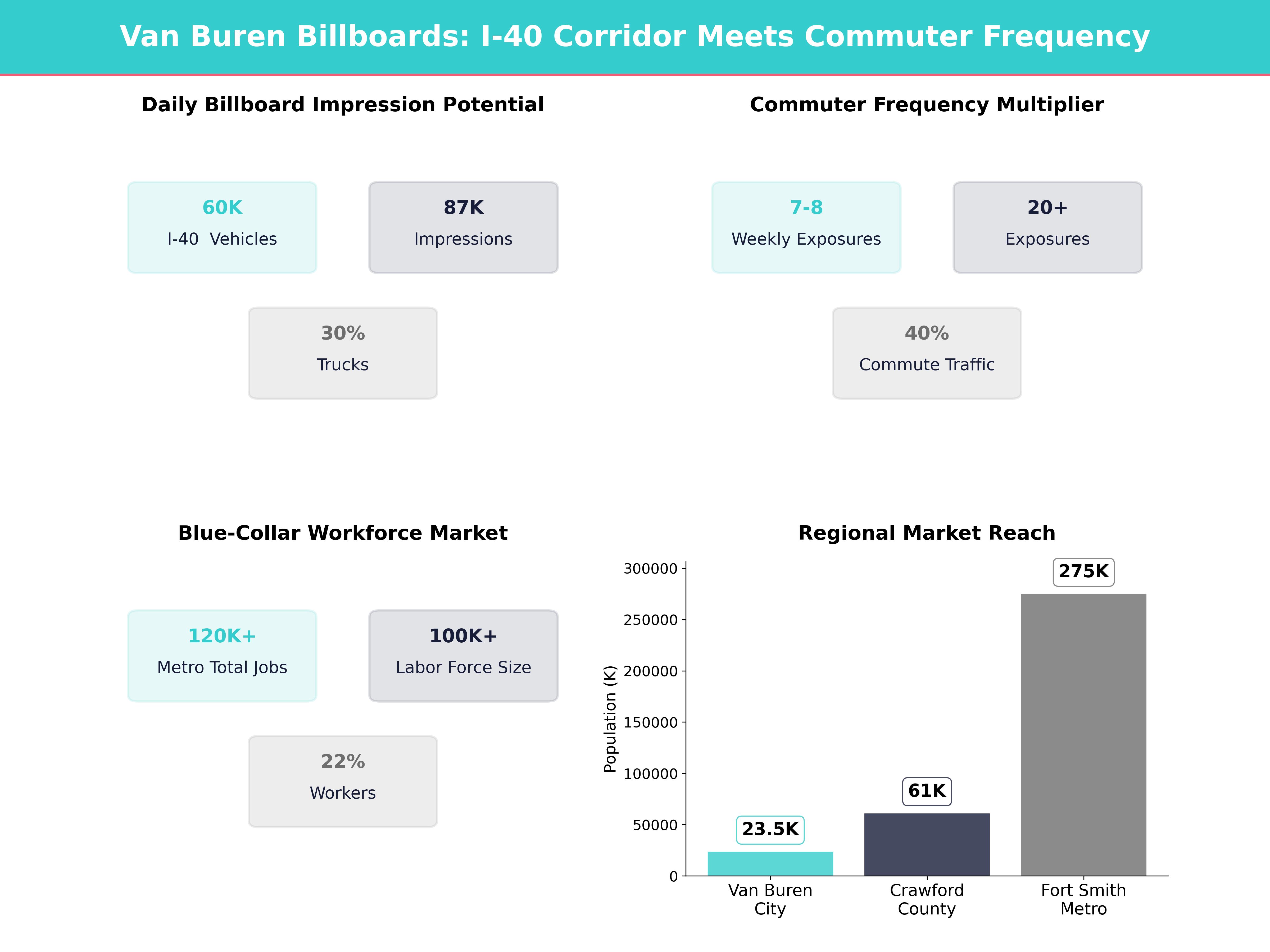
- City of Van Buren 23,000–24,000 residents.
- Crawford County: roughly 60,000–62,000 residents.
- Fort Smith metro (Sebastian + Crawford counties and nearby): about 270,000–280,000 people.
- In many recent estimates, around 25–27% of residents in the Fort Smith–Van Buren area are under age 18, and the median age in the area trends in the mid‑30s, meaning we are speaking primarily to working families, young professionals, and established tradespeople.
- Typical household sizes in this part of Arkansas average around 2.6–2.8 people per household, which favors family‑oriented messaging.
-
Local economic anchors
- Major employers include manufacturing, logistics, retail, and healthcare in both Van Buren and nearby Fort Smith 120,000+ jobs across all sectors.
- Many residents work in or commute to Fort Smith—Fort Smith itself has a population around 85,000–90,000—tying Van Buren closely to that city’s economic rhythms, healthcare network, and news coverage from outlets like the Southwest Times Record and 5NEWS.
- The Van Buren School District serves roughly 5,000–5,500 students across multiple campuses, creating strong weekday patterns around school start and dismissal times and a built‑in base of families, staff, and event traffic.
- Median household incomes in the immediate area typically fall in the $48,000–55,000 range, which supports value‑driven offers (discounts, bundles, financing) while still allowing room for discretionary spending in dining, recreation, and vehicles.
-
Regional draw
- Van Buren sits directly on Interstate 40, a national freight and travel corridor. A mix of long‑haul truckers, regional business travelers, and vacationers filters through daily. The Fort Smith–Van Buren section of I‑40 links directly to Oklahoma City (~180 miles west) and Little Rock (~150 miles east), making it a natural stop‑over market.
- The historic downtown, with its restored Main Street and depot, attracts tourists via riverboat excursions and events promoted by Explore Van Buren Arkansas Tourism. Seasonal events and festivals can draw thousands of attendees over a single weekend, spiking demand for food, lodging, and retail.
- Nearby Fort Smith adds additional visitor volume through attractions and events spotlighted by the Fort Smith Convention & Visitors Bureau and business activity supported by the Fort Smith Regional Chamber of Commerce.
For advertisers, this means we are not only talking to 23,000 people; we are intercepting a much larger, constantly refreshing audience of commuters and travelers who may not be reachable through purely local channels, making smart use of Van Buren billboards a powerful part of a regional media mix.
Traffic Patterns and Where Your Message Will Be Seen
The value of Van Buren billboards is driven by a few key roadways and predictable movement patterns:
-
I‑40 Corridor
- I‑40 is one of the country’s primary east–west interstates, carrying heavy through‑traffic plus local and regional commuters. Across Arkansas, average daily traffic on I‑40 commonly ranges from 40,000 to 75,000 vehicles per day, with higher counts near urban nodes.
- Arkansas Department of Transportation ( ARDOT 50,000–70,000 vehicles per day near the Fort Smith–Van Buren area, translating conservatively to 75,000–100,000 daily impressions when you factor in 1.5–1.7 people per vehicle.
- Traffic peaks: commuter windows of 6:30–9:00 a.m. and 3:30–6:30 p.m., with elevated weekend traffic as leisure travelers pass through. In many highway markets, these peak windows can represent 35–45% of all weekday volume, making them premium times for dayparted campaigns.
-
I‑540 / US‑71 and regional connectors
- These routes connect Van Buren to Fort Smith and northern Arkansas, including access toward Northwest Arkansas and the I‑49 corridor.
- They channel both work commuters and shoppers heading toward major retail clusters on each side of the river. Typical regional connector routes can see 15,000–30,000 vehicles per day, depending on the specific segment.
- Because the Fort Smith metro has a labor force well over 100,000 workers, even a modest share commuting through Van Buren produces tens of thousands of monthly impressions for commuter‑oriented messaging.
-
Local surface streets
- Major arterials near schools, grocery stores, auto services, and big‑box retail (e.g., Walmart, home improvement centers) capture highly repetitive local trips: the same residents may pass your message 5–10 times per week, especially if they live, work, and shop within a few miles of the sign.
- This repetition is ideal for frequency‑based objectives: brand recall, service reminders, and “top‑of‑mind” campaigns, where studies consistently show that 5–7 exposures in a short period dramatically increase unaided brand awareness.
- School traffic alone can add hundreds to a few thousand vehicle trips per day around campuses during drop‑off and pick‑up windows, reinforcing campaigns that target families and youth activities.
With Blip, we can choose boards along I‑40 to behave like regional reach media, and boards near key intersections, neighborhoods, or big‑box clusters to behave like hyper‑local frequency media. The same platform lets us blend both for efficient billboard rental in Van Buren that serves multiple objectives at once.
Who You’re Talking To: Key Audience Segments
Van Buren’s composition suggests distinct audience segments we can plan around:
-
Working families
- Household sizes tend to be larger than national averages, with local averages around 2.6–2.8 people per household and a notable share of homes with children present.
- In many nearby Arkansas communities, roughly 55–60% of households are owner‑occupied, indicating rooted families who respond well to offers that build long‑term relationships (healthcare, banking, home services).
- Messaging for family‑oriented offers (grocery, restaurants, healthcare, kids’ activities) should emphasize value, convenience, and proximity: “5 minutes off I‑40,” “Kids eat free on Tuesdays,” or “Walk‑in spots available today.”
-
Commuters to Fort Smith and beyond
- Thousands of residents cross the river daily for work, contributing to metro‑wide commute flows. Average commute times in similar Arkansas metros tend to run around 18–22 minutes, which keeps Van Buren comfortably within a daily drive radius.
- They encounter boards in consistent time windows, making daypart targeting extremely effective (e.g., “Tonight only” dinner offers in the afternoon drive).
- Because commuters repeat the same route 20+ times per month, even modest daily Blip budgets can translate into dozens of impressions per individual over a campaign flight.
-
Blue‑collar and trades professionals
- The area has strong representation from manufacturing, logistics, and trades, with industrial and transportation jobs accounting for an estimated 20–25% of local employment.
- The Fort Smith–Van Buren zone supports several large distribution, manufacturing, and transportation employers, many of which routinely recruit CDL drivers, welders, machine operators, and warehouse staff.
- For B2B and recruitment campaigns, visuals showing real workers, PPE, tools, and clear hourly wage or benefit info (“$23/hr + benefits”) often outperform generic branding and can boost response rates by 20–30% compared with wage‑free messages.
-
Travelers and tourists
- Visitors are drawn by historic downtown, nearby outdoor recreation (Ozark foothills, rivers, lakes), and regional road‑trippers using I‑40. Arkansas welcomes tens of millions of visitors annually, and I‑40 is one of the key arteries feeding that traffic.
-
They’re typically making quick, en‑route decisions on where to stop within 1–15 miles:
- Gas and charging
- Dining
- Lodging
- Attractions and antique shopping
- National travel research consistently shows that 30–40% of road‑trip stops are decided within minutes of the exit, making real‑time directional and offer‑based billboard messaging especially powerful.
- Messages should prioritize exit numbers, distance, and clear value propositions (“Exit 5, 2 miles ahead”).
-
Spanish‑speaking residents
- The Fort Smith–Van Buren region includes a significant Hispanic and Latino population, commonly estimated around 15–20% of residents in some nearby communities.
- Bilingual or Spanish‑first creative can powerfully differentiate service businesses, churches, healthcare providers, and education services. In many markets with similar demographics, bilingual ads can see 10–30% higher engagement from Hispanic audiences compared with English‑only messages.
- Examples include Spanish‑language headlines for legal aid, insurance, dentistry, or immigration services that clearly signal cultural competence and accessibility.
When we build campaigns, we should assign each creative concept to one primary segment and locate/daypart accordingly rather than trying to speak to everyone with a single design. This is where targeted Van Buren billboard advertising can outperform more generic, untargeted approaches.
Timing Your Campaign: When Impressions Are Most Valuable
Not all impressions in Van Buren are equal; certain times of day and days of week offer more opportunity for specific objectives.
-
Weekday rush hours
- 6:30–9:00 a.m.: Best for coffee, breakfast, quick‑service restaurants, morning appointments, day‑trip tourism (“Stop in Van Buren today”), and workforce recruitment.
- 3:30–6:30 p.m.: Ideal for family dining, retail stops on the way home, healthcare urgent care, and last‑minute promotions (“Sale ends 7 p.m. tonight”).
- In many commuter corridors, these combined windows can account for 35–45% of total weekday traffic, so concentrating budget here can significantly increase impressions per dollar.
-
Midday
- 11:00 a.m.–2:00 p.m.: Local employees on lunch, school pickups, and daytime errands.
- Strong for lunch specials, auto services, banking, and doctor or dental visits. For many retail and service businesses, 20–30% of daily transactions occur in this window.
-
Evenings and nights
- 6:30–10:00 p.m.: Entertainment, dining, gyms, and next‑day reminders (“Schedule your oil change tomorrow”).
- Later night impressions may skew toward long‑haul truckers and shift workers; this can be attractive for 24‑hour services, truck stops, and hospitality. Long‑haul truck traffic on I‑40 can represent 25–35% of total vehicles, magnifying the value of overnight visibility for relevant offers.
-
Weekends
- Daytime: More regional shopping and road‑trip traffic; great for furniture, cars, powersports, DIY retailers, and tourism. Many retailers see 30–40% of weekly sales on Saturday and Sunday alone.
- Sunday: Frequently a strong day for churches, restaurants, and family recreation promotions, especially in communities with high church attendance and family‑centric routines.
With Blip, we can carve budgets by time blocks. For example:
- A local restaurant might allocate 70% of budget to weekday 3–7 p.m. and weekend lunchtime, when they see the highest ticket counts.
- A church might concentrate 80–90% of budget on Friday–Sunday with heavier rotation on Saturday night and early Sunday morning when families are deciding where to attend services.
- A truck stop or hotel might distribute impressions more evenly across 24 hours but double up on Friday and Sunday travel peaks, when weekend and weekly‑cycle truck traffic spikes.
Seasonal Opportunities Unique to Van Buren
Seasonality in the Van Buren–Fort Smith area is predictable and highly relevant for rotating digital creatives.
-
School year cycles
- Back‑to‑school (late July–August): Retail, clothing, school supplies, healthcare checkups, and youth activities can cluster creative during these six to eight peak weeks. Local families may spend several hundred dollars per student during this season, making promotions around bundles and discounts especially compelling.
- During the year: Sports seasons, band events, and school programs at Van Buren School District and nearby districts like Fort Smith Public Schools create surges in family travel around campuses and stadiums, often drawing hundreds to thousands of attendees per event.
- Summer: Day camps, swim lessons, and youth programs can use billboards to capture parental planning decisions that often cluster in late spring and early summer.
-
Tourism and events
-
Spring and fall are prime times to promote:
- Historic Main Street events, festivals, and arts activities highlighted by Explore Van Buren
- Outdoor recreation and scenic drives promoted by Arkansas Tourism and regional calendars maintained by the Fort Smith Convention & Visitors Bureau.
- We can schedule creative to ramp up 2–4 weeks before major events and run heavier during event weekends. Short, intense flighting around marquee events can deliver tens of thousands of incremental impressions to high‑intent visitors.
-
Spring and fall are prime times to promote:
-
Weather and climate
- Hot, humid summers with many days at or above 90°F make A/C services, HVAC, pools, indoor entertainment, and cold‑drink promotions especially compelling from June through September.
-
Spring storms and occasional winter weather (freezing rain, snow, hail) create windows for:
- Roofing, restoration, and insurance services.
- Auto repair and tire shops.
- With Blip, we can keep evergreen creative running but briefly layer in weather‑specific designs for 7–14 days after major storms, when claims, repairs, and emergency purchases typically spike.
-
Retail and holiday
- Tax season (February–April): Accounting, car dealers, furniture, and big‑ticket purchases benefit when many households receive refunds—refunds that often average in the low‑to‑mid‑thousands of dollars.
- Hunting and outdoor seasons: Great for sporting goods, ATV and boat dealers, and outfitters, capitalizing on regional interest in outdoor recreation and access to nearby public lands.
- November–December: Gift shopping, restaurants, and non‑profits’ year‑end giving campaigns. Many retailers draw 20–30% of annual sales during the holiday period, making a strong billboard presence particularly valuable.
Digital scheduling means we do not need a single static message all year; we can pre‑build several seasonal creatives and turn them on/off as needed without print costs or installation delays.
Crafting High‑Impact Creative for Van Buren Drivers
Drivers on I‑40 and local Van Buren streets typically have 4–8 seconds to absorb your message. In this market, simplicity and local relevance win.
We recommend:
-
Use local geography cues
- Mention I‑40, specific exits, or “before the river”/“across the river.”
-
Examples:
- “Exit 5 • Next Right”
- “1 Mile After I‑40 Bridge”
- “Historic Downtown Van Buren • 3 Miles”
- Including distance and exit numbers is especially important for travelers, who may be deciding between multiple exits within 10–20 miles.
-
Make the benefit instantly obvious
- Lead with the strongest value: “Oil Change in 15 Minutes,” “Rooms from $79,” or “Free Estimates Today.”
- Avoid long taglines; keep to 7 words or fewer when possible. Studies of roadside readability show that legibility drops sharply once headlines exceed 7–9 words.
- Use numbers wherever possible—prices, minutes, miles—as they are processed more quickly than long phrases at highway speeds.
-
Design for contrast and legibility
- High‑contrast color combinations (e.g., dark background with white or yellow type) can improve recall by 20–30% versus low‑contrast designs.
- Use one primary image, one headline, and one call‑to‑action. Overcrowded designs disappear at highway speeds and may as well be invisible.
- Aim for large type sizes that remain legible from 400–600 feet away on highway‑speed boards.
-
Incorporate community‑specific tone
- This is a relationship‑driven region. Friendly, straightforward language beats overly slick slogans.
- References to local schools, local sports, the Arkansas River, Ozark foothills, or regional pride tend to resonate. Sponsoring events promoted on the City of Van Buren Crawford County channels can be reinforced with aligned billboard messaging.
-
Use bilingual creative where it makes sense
- For services targeting Hispanic residents, consider alternating English and Spanish creatives or using bilingual headings.
- For example: “Dentistry You Can Trust / Odontología de Confianza.”
- In similar markets, bilingual campaigns can increase inbound calls and form fills from Spanish‑speaking households by 10–25%, particularly in healthcare, legal services, and education.
-
Drive to a trackable action
-
Even if customers ultimately walk in, we can improve measurement by:
- Using a short URL or unique promo code.
- Promoting a specific phone number or landing page.
- Encouraging “Exit 5 – Search ‘[Brand] Van Buren’ now.”
- Many local businesses see 10–30% lifts in branded search volume during and immediately after strong billboard flights when they include clear calls‑to‑action.
-
Even if customers ultimately walk in, we can improve measurement by:
Because digital boards are flexible, we can A/B test multiple versions (different offers, images, or headlines) and track which ones correspond with noticeable lifts in calls, web traffic, or foot traffic.
Using Blip’s Tools Strategically in Van Buren
Blip’s platform allows us to tailor campaigns finely to the rhythms of Van Buren and the I‑40 corridor:
-
Location targeting
- Choose boards along I‑40 for broad reach to travelers and the full metro.
- Choose boards closer to neighborhoods, schools, and local retail for high frequency among local households.
-
If you serve both, we can allocate, for example:
- 60% of budget on interstate boards for reach.
- 40% on local boards for repetition and brand reinforcement.
- For many brands, a blended approach can boost both reach and frequency enough to produce 5–15% lifts in store traffic during a campaign.
-
Dayparting
- Run breakfast/lunch creative only from 6 a.m.–2 p.m.
- Run dinner or “tonight only” offers from 3 p.m.–9 p.m.
- Turn off low‑value hours for businesses that are closed to stretch a given budget further; reallocating spend away from closed hours can effectively increase impressions per business‑open hour by 20–40%.
-
Budget flexibility
-
Because Blip sells exposure by the “blip” instead of long‑term fixed contracts, we can:
- Start with small daily budgets (e.g., $10–$20/day) during testing.
- Increase spend during high‑impact periods like back‑to‑school, tax refund season, or major events highlighted by Explore Van Buren Fort Smith Convention & Visitors Bureau.
- Pause or scale down quickly if circumstances change.
- Many small businesses find that even modest tests—such as $300–$600 over a few weeks—are enough to detect directional shifts in calls or visits.
-
Because Blip sells exposure by the “blip” instead of long‑term fixed contracts, we can:
-
Creative rotation
-
Rotate multiple creatives automatically:
- One design for commuters (“On Your Way Home? Stop at…”)
- One for tourists (“Exit Now for Historic Downtown Van Buren”)
- One for price‑ or promotion‑driven messaging.
- We can set certain creatives to appear only at particular times or days.
- Rotating 3–5 creatives allows us to test which messages produce stronger business outcomes, then push more budget behind the winners.
-
Rotate multiple creatives automatically:
This control lets us treat each sign not simply as a static asset, but as a dynamic, programmable channel that follows the daily and seasonal life of Van Buren. It also means billboard rental in Van Buren can be scaled up or down quickly instead of being locked into a single long‑term contract.
Strategy Ideas by Industry
Below are practical ways different types of advertisers can exploit local dynamics:
-
Restaurants and QSR
- Focus on boards within 5–10 minutes’ drive of your location; most diners are unwilling to drive more than 5–7 miles off their main route.
- Use dayparting: breakfast/lunch/dinner creatives with time‑specific offers.
-
Highlight:
- “Kids Eat Free Tuesday”
- “Truck Parking Available”
- “Locally Owned Since [Year]” to tap into community pride.
- Many quick‑service restaurants that pair billboards with timely offers can see 5–10% increases in same‑store sales during active flights.
-
Auto dealers and service centers
- Interstate boards to capture travelers in need of quick repairs or oil changes; breakdowns and maintenance‑related stops are common along long stretches like I‑40.
- Local boards for repeat exposure to residents, who account for the majority of long‑term service and repeat purchases.
-
Rotate:
- Maintenance offers during weekdays.
- Big‑ticket promotions on weekends and during tax refund months when auto purchases historically rise.
- Including clear price points (“Oil Change $49,” “Payments from $299/mo”) can increase response compared with generic service messages.
-
Healthcare and dental
- Emphasize convenience and accessibility: “Same‑Day Appointments,” “Walk‑Ins Welcome,” “Open Late,” or “Open Saturdays.”
- Aim for high‑frequency impressions on local commuter routes and streets near clinics, hospitals, or urgent care centers.
- Consider bilingual messaging where appropriate; bilingual healthcare ads can be particularly effective in reaching the Hispanic community and improving appointment volume by 10–20% in similar markets.
- Tie messaging to seasonal needs: sports physicals before school, flu shots in fall, allergy treatment in spring.
-
Tourism, attractions, and downtown merchants
- Use boards east and west of Van Buren on I‑40 to intercept travelers before they reach competing exits.
-
Messaging examples:
- “Historic Downtown Van Buren – Exit [X]”
- “Antiques & Boutiques • Next Exit”
- “Riverfront Dining • 5 Minutes Off I‑40”
- Coordinate campaigns with festivals and events promoted by Explore Van Buren Southwest Times Record or 5NEWS.
- Attractions that align billboard flights with marquee event weekends can see noticeable upticks in attendance, particularly among out‑of‑town visitors who may represent 20–40% of total event crowds.
-
Employment and workforce recruitment
- Aim heavy frequency on weekday morning and afternoon commutes, when workers are thinking about their jobs.
- Use big, bold wage and benefit details: “Starting at $21/hr • Benefits Day 1.”
- Consider creative variations targeting specific skill sets (CDL drivers, welders, CNAs), and place them near industrial parks, logistics corridors, or healthcare hubs.
- Employers that switch from generic recruitment ads to wage‑specific billboards frequently report higher application volumes and better‑qualified leads.
-
Local government, civic, and non‑profits
- Use boards to drive awareness for events, safety campaigns, and public services, coordinated with digital and social announcements from the City of Van Buren Crawford County.
- Time campaigns around city initiatives, elections, or county notices, and reinforce public‑safety messaging (seatbelt use, impaired driving awareness, severe‑weather readiness).
- For fundraisers or awareness drives, run short, intensive bursts (7–14 days) with clear calls‑to‑action (“Text VANBUREN to [Shortcode]”). Concentrated campaigns can significantly lift event attendance or donation volume during the focused window.
Measuring and Improving Campaign Performance
While billboards don’t provide click‑through rates, we can still build a data‑driven feedback loop:
-
Establish baselines
-
Before launching, record:
- Average weekly sales or leads for at least 4–8 weeks.
- Website sessions and “near me” search impressions for your brand.
- Call or form‑fill volume.
- If you operate multiple locations (Van Buren, Fort Smith, or beyond), track data by location so you can compare performance near the billboard footprint versus locations without billboard support.
-
Before launching, record:
-
Sync with campaign windows
- Run an intensive 2–4 week Blip flight with distinct start and end dates.
-
Track changes in:
- Store visits (if you have POS or footfall data).
- Website and map search traffic from Van Buren and nearby ZIP codes.
- Inbound calls and bookings.
- Many advertisers aim for a 5–15% lift in key metrics during a test flight to indicate that the message and placement are working.
-
Use trackable elements
- Dedicated promo codes (“BILLBOARD10”).
- Billboard‑only phone numbers or extensions.
- Landing pages with URLs unique to the board creative.
- Simple questions at checkout (“How did you hear about us?”) with a “billboard” option—capturing even 5–10% of buyers citing billboards helps validate the channel.
-
Iterate creative
- If a strong offer or headline correlates with noticeable lift, lean into similar messaging and test variations.
- If an image or message underperforms, revise or replace it quickly; there’s no printing cost to change digital creative.
- Over several flights, we can refine toward the best‑performing combinations of message, board location, and time‑of‑day, steadily improving return on ad spend.
By combining the inherent reach of Van Buren’s high‑traffic corridors with Blip’s precision tools and basic tracking methods, we can create campaigns that are not only visible but measurably effective. This approach turns billboards in Van Buren into accountable, optimizable media rather than just static branding.
Van Buren’s position on I‑40, its close relationship with Fort Smith, and its mix of local families, workers, and travelers make it far more than a “small town” market. With thoughtful targeting, clear and locally tuned creative, and smart use of Blip’s scheduling tools for Van Buren billboard advertising and flexible billboard rental in Van Buren, we can turn every day’s traffic flow into consistent, profitable attention for your brand.