Billboards in Pine Bluff, AR
No Minimum Spend. No Long-Term Contracts. Just Results.
Trusted by Leading Brands


Billboard advertising
in Pine Bluff has never been easier



How much is a billboard in Pine Bluff?
Why Choose Blip for Billboard Advertising in Pine Bluff
Blip lets you launch Pine Bluff billboards fast, reaching I-530/US 65 commuters without contracts or slow buys.
Set a Pine Bluff budget that fits your goals, then let Blip keep spend on track for UAPB fans, students, and shift workers.
Daypart your Pine Bluff ads for morning I-530 rush or 4-7 p.m. drives, when the city sees its heaviest traffic.
Track Pine Bluff results in real time and shift bids as traffic changes on US 79, US 63, or during UAPB game weekends.
Use Blip's creative tools to build simple, bold Pine Bluff ads that stand out for local commuters, families, and healthcare traffic near Jefferson Regional.
Frequently Asked Questions About Billboard Advertising in Pine Bluff
How much does a billboard cost in Pine Bluff, Arkansas with Blip?
With Blip, you decide how much you want to spend each day, and our system automatically keeps your campaign within that budget. You’ll pay per “blip,” a 7.5 to 10-second ad display on rotating digital Pine Bluff billboards, so you only pay for the exposure you actually receive. The price of each blip depends on when and where you choose to show your ad and on local advertiser demand, giving you a flexible way to match your budget and goals.
Where can I advertise with Blip in Pine Bluff, Arkansas?
The main connection to Little Rock is I‑530 / US 65, and ARDOT counts near Pine Bluff commonly show 24,000–30,000 vehicles per day. US 79 and US 63 also tie Pine Bluff to Stuttgart, Fordyce, and other southeast Arkansas communities, with daily traffic often ranging between 10,000 and 18,000 vehicles near town. In-town arterials near UAPB and Jefferson Regional are especially valuable for reaching younger audiences, staff commuters, patients, and family members.
What kinds of people do Pine Bluff, Arkansas billboards reach with Blip?
Pine Bluff is majority African American, with roughly 75–76% Black, 20–21% White, and approximately 3–4% combined Hispanic/Latino, multiracial, and other groups. The median age is in the mid-30s, and the city has strong segments of students and young adults, family households, and a substantial population age 65+. More than 85–90% of households have access to at least one vehicle, and typical commute times fall in the 18–22 minute range.
When is the best time to run billboards in Pine Bluff, Arkansas with Blip?
Weekday mornings from 6:00–9:00 a.m. are good for school drop-offs and commuting, while the evening commute from 4:00–7:00 p.m. is the heaviest local visibility. Midday works well for lunch breaks and healthcare visits, and weekends are strong for shopping, errands, and Sunday church traffic. Blip also allows you to selectively bid for specific hours of the day, so you can align spend with Pine Bluff’s daily rhythms.
How much should I budget for Pine Bluff, Arkansas billboard advertising with Blip?
Small businesses might start with $10–$20 per day targeted to one or two key corridors and specific dayparts. For category leaders, allocating $50–$100+ per day across multiple boards can create near-constant regional presence during core hours. For a retailer or event push, the page notes that a campaign can run $15/day normally and then ramp to $60–$80/day for seven days around a big promotion.
Do I need a contract to advertise with Blip in Pine Bluff?
No, Blip has no long-term contracts or minimum commitments. You can start, pause, or stop your campaign at any time.
How fast can I launch a billboard campaign with Blip in Pine Bluff?
You can have your campaign live in minutes. Create a free account, select your locations, set your budget, upload your design, and start running once approved.
Where can I advertise with Blip in Pine Bluff?
Blip has digital billboards in Pine Bluff. You can browse available locations on a map, choose the ones that fit your audience, and start advertising right away.
Still have questions? Launch a campaign in minutes — no contracts, no commitments.
Start Your CampaignPine Bluff Billboard Advertising Guide
Pine Bluff, Arkansas, gives us a rare combination of regional reach, small-city intimacy, and strong highway visibility. When we plan a digital billboard campaign here, we can speak to everyday local life—commuters, students, plant workers, families—and still tap travelers moving between southeast Arkansas and the Little Rock metro. Below, we’ll walk through how to turn Pine Bluff’s unique patterns, numbers, and places into a thoughtful, effective Blip campaign, and how to get more from Pine Bluff billboards as part of your broader local marketing mix.
Understanding the Pine Bluff Market
Pine Bluff is the principal city of southeast Arkansas and the county seat of Jefferson County 41,000, while Jefferson County totals around 67,000 residents. Despite a long-term population decline (down from about 55,000 residents in 2000, a drop of roughly 25% over two decades), Pine Bluff still anchors a broader trade area that pulls consumers from surrounding rural counties such as Cleveland, Lincoln, and Arkansas Counties. When you add in these neighboring areas, local business and civic leaders often plan for an effective regional population of 90,000–100,000 people who regularly come into town for work, shopping, healthcare, and education, which is exactly the audience we can tap with well-placed billboards in Pine Bluff.
Key structural facts that influence billboard strategy:
-
Major corridors:
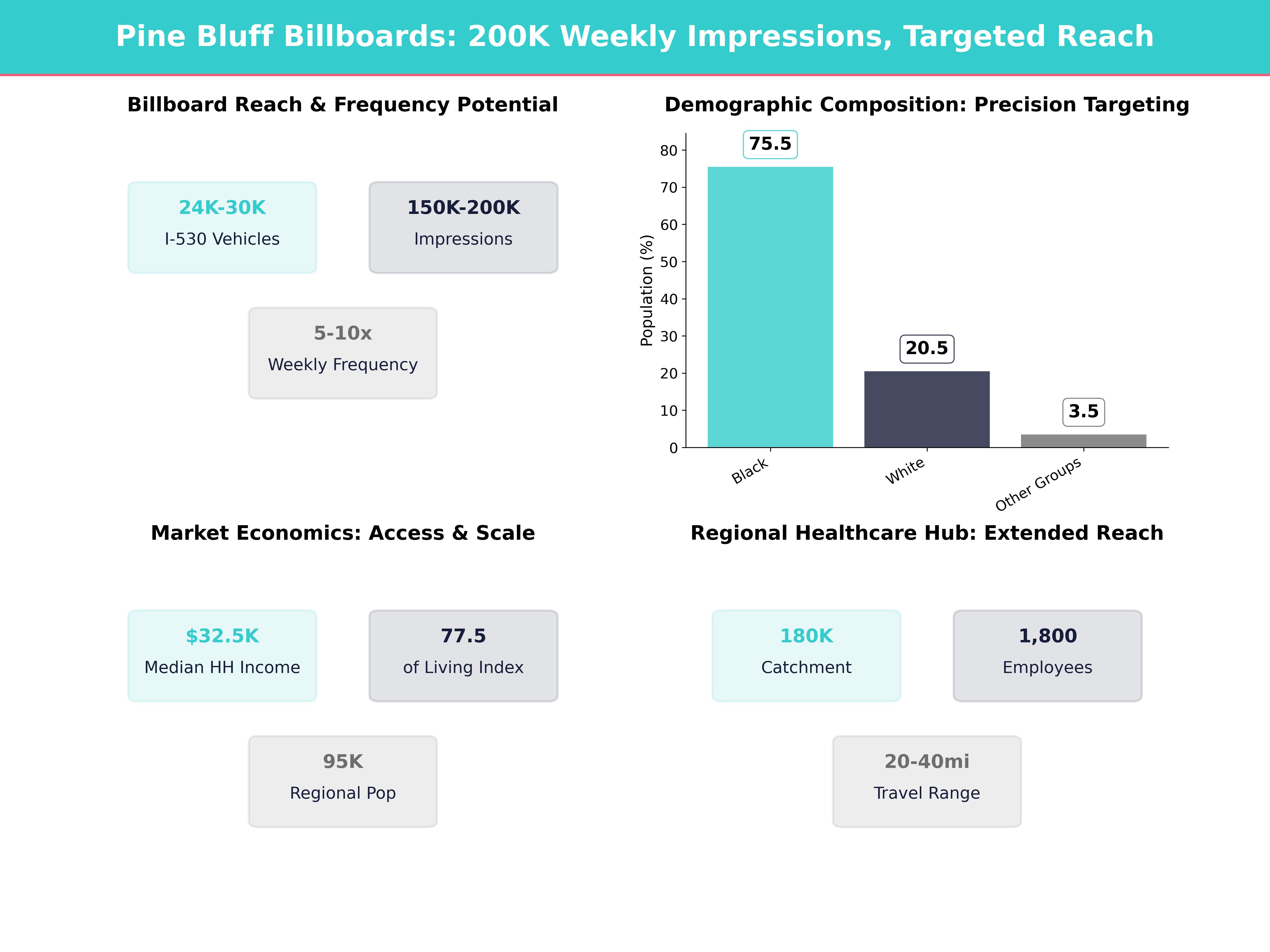
- I‑530 / US 65 connects Pine Bluff to Little Rock (about 45 miles away) and carries a large share of commuter and through-traffic. Arkansas Department of Transportation (ARDOT) counts along I‑530 near Pine Bluff show roughly 24,000–30,000 vehicles per day, meaning a single well-positioned board can easily clear 150,000–200,000 weekly vehicle impressions. You can explore statewide traffic counts through Arkansas Department of Transportation
- US 79 and US 63 tie Pine Bluff to Stuttgart, Fordyce, and other southeast Arkansas communities. On key segments closer to town, daily traffic typically ranges from 10,000–18,000 vehicles, with lower but still valuable counts as you move into rural stretches.
- These routes support both local and long-distance drivers—excellent for businesses that serve travelers and regional customers, such as fuel, QSR, auto service, and destination retail.
-
Economic anchors:
- The University of Arkansas at Pine Bluff (UAPB) enrolls around 2,500–2,700 students plus several hundred faculty and staff. UAPB home football games regularly draw 5,000–10,000 fans to campus, and homecoming weekends can push combined visitor counts even higher; details are regularly updated on UAPB and its athletics pages.
- Major employers include Jefferson Regional, which employs more than 1,800 team members across hospital and clinic operations and serves a multi-county population estimated at 180,000+; state and local government; corrections facilities; paper and wood products; and logistics. You can find more employer and industry context through the Pine Bluff Regional Chamber of Commerce.
- This mix means we can segment messaging by worker shifts, student schedules, and appointment-driven traffic.
-
Media environment:
- Local news outlets like the Pine Bluff Commercial and Arkansas Democrat-Gazette – Pine Bluff coverage cover a tight-knit, news-attentive community. Little Rock TV stations such as KATV, KARK, THV11, and FOX16 also provide regular Jefferson County coverage.
- In markets this size, out-of-home usually commands a disproportionately high share of local ad spend; national out-of-home research suggests OOH captures only about 4–5% of ad budgets but can deliver 25–30% of total ad impressions. That imbalance is even more pronounced in smaller cities with limited digital clutter, so clear billboard creative can quickly become a familiar “landmark” in daily routines, especially when you use Pine Bluff billboard advertising to reinforce messages people also see in local news and social channels.
When we plan Blip campaigns in Pine Bluff, we’re working in a market where repetition and location become powerful very quickly. A modest budget, used smartly, can generate high-frequency local exposure—often reaching the same core residents 5–10+ times per week when boards are placed along key commute paths.
Demographics and Audience Insights
To design effective billboard creatives, we should align with who actually lives and works in Pine Bluff.
Based on recent local and state demographic summaries:
-
Race and ethnicity
- Pine Bluff is majority African American: roughly 75–76% Black, 20–21% White, and approximately 3–4% combined Hispanic/Latino, multiracial, and other groups. Jefferson County as a whole is about 55–60% Black and 35–40% White, so city boards skew more heavily toward Black audiences than rural county routes.
- Campaigns that feature diverse, locally resonant imagery and community-focused messaging tend to perform better than generic stock visuals, especially when at least 50–60% of faces and visuals reflect the majority audience.
-
Age profile
- The median age in Pine Bluff is in the mid‑30s, roughly 3–4 years younger than many rural Arkansas counties but older than major college towns. Around 24–26% of residents are under 18, 55–58% are ages 18–64, and roughly 17–18% are 65+.
-
We see three strong segments:
- Young adults and students (18–29) around UAPB and early-career workers.
- Family households in their 30s and 40s, often juggling childcare, school, and work commutes.
- A substantial population 65+, many with established local loyalties and healthcare needs.
-
Income and cost of living
- Median household income in Pine Bluff is in the low- to mid‑$30,000s, compared with roughly $55,000–$60,000 for Arkansas overall and $70,000+ nationally. In some neighborhoods, median incomes fall below $25,000, while pockets near regional employers and in nearby communities like White Hall
- Unemployment in Jefferson County has typically run 1–2 percentage points above the national average in recent years, with some year-to-year variability.
- The cost of living index for Pine Bluff is often estimated at 75–80 (where 100 equals the U.S. average), meaning everyday expenses can be 20–25% lower than national norms. That makes moderately higher-ticket local services (auto, healthcare add-ons, home improvement) realistic purchases for many working families, especially when framed with accessible payment options.
-
Housing and lifestyle
- Owner-occupancy in Pine Bluff is in the 50–55% range, with 45–50% of households renting—higher rental share than many suburban Arkansas communities but typical for a regional hub city.
- More than 85–90% of households have access to at least one vehicle, and typical commute times fall in the 18–22 minute range, indicating daily driving is a norm and reinforcing consistent billboard exposure.
- Church, high school sports, and community events play an outsized role in social life. Pine Bluff and Jefferson County support dozens of active congregations and multiple high schools (e.g., Pine Bluff School District, White Hall School District, Watson Chapel School District
Practical implications for creative:
- Feature local people and places—small cities are highly attuned to authenticity. Photos of familiar locations like downtown projects listed on the City of Pine Bluff site or parks and attractions promoted by Explore Pine Bluff will resonate more strongly than anonymous skylines and help your Pine Bluff billboard advertising feel rooted in the community.
- Lead with simple, concrete benefits: “$0 down,” “Same-day appointments,” “Under 30-minute oil change,” etc. In markets where roughly 1 in 5 residents lives below the poverty line, clear value messaging is critical.
- Highlight support for local schools, teams, and churches to build trust and recall (“Proud supporter of UAPB Lions,” “Supporting Pine Bluff Zebras Athletics”).
- Use larger fonts and bold color contrast, assuming drivers may be older and visibility needs to be excellent.
Traffic Patterns and High-Value Corridors
To get the most out of Blip’s location controls, we should align campaigns with Pine Bluff’s real-world traffic flows.
Key corridors and their marketing value:
-
I‑530 / US 65 North–South Spine
- The main connection to Little Rock and a central commuter route. ARDOT counts near Pine Bluff commonly show 24,000–30,000 vehicles per day, giving weekly exposure potential of 168,000–210,000 vehicle trips on a single segment.
- Morning (6:30–9:00 a.m.) and evening (4:00–6:30 p.m.) flows tend to spike by 30–40% over mid-day volumes, especially on weekdays.
-
Ideal for:
- Commuter services (fuel, coffee, quick breakfast, auto repair)
- Recruitment ads for employers in both Pine Bluff and the Little Rock region
- Healthcare, banking, and insurance building multi-day familiarity
-
US 79 and US 63
- Support regional traffic to and from Stuttgart, Fordyce, and other smaller communities. Depending on the segment, daily traffic often ranges between 10,000 and 18,000 vehicles near town and 4,000–9,000 in rural stretches.
-
These roads are heavily used by agricultural, timber, and industrial traffic, making them ideal for:
- Farm and ag services
- Equipment sales and maintenance
- Rural healthcare clinics, banks, and credit unions
- Destination retail and restaurants trying to pull in out-of-town customers
-
In-town arterials near UAPB and Jefferson Regional
- Near-campus routes, especially around UAPB and key residential corridors, capture younger audiences and staff commuters. UAPB alone adds 2,500+ students plus hundreds of staff and faculty traveling these streets daily during the academic year.
- Near Jefferson Regional, accessed through central Pine Bluff streets, we reach patients, family members, and hundreds of healthcare workers moving in and out across multiple shifts; Jefferson Regional reports managing tens of thousands of outpatient visits annually on its website.
-
Ideal for:
- Food and coffee near shift changes
- Pharmacies, urgent care, specialty clinics
- Student-oriented offers (wireless, apartments, quick-service restaurants)
When choosing boards and setting Blip schedules, we should think in terms of daily rituals: the drive to work, school drop-offs, weekend shopping trips to big-box centers, and Sunday church routes. National traffic studies show that about 60–70% of weekly vehicle miles are tied to these recurring habits; the more closely our boards sit on these predictable paths, the fewer impressions we need to generate meaningful results. This is where thoughtfully chosen billboards in Pine Bluff can repeatedly intersect with the same residents at the same times every week.
Dayparting: When Pine Bluff Is Paying Attention
Blip allows us to selectively bid for specific hours of the day. In Pine Bluff, daily rhythms are shaped by shift work, commuting, and church and sports schedules.
We generally see:
-
Weekday mornings (6:00–9:00 a.m.)
- School drop-offs, commuting into Pine Bluff or toward Little Rock. Public schools in and around Pine Bluff serve several thousand students, with many families making similar routes every weekday.
- Good for: coffee shops, breakfast/QSR, fuel, auto services, healthcare reminders (“Call today for same-week appointments”), and recruitment.
-
Midday (11:00 a.m.–2:00 p.m.)
- Lunch breaks, errands, healthcare visits. Healthcare systems like Jefferson Regional and numerous clinics generate consistent mid-day traffic from appointments and procedures.
- Good for: restaurants, medical and dental offices, banks/credit unions, and retail sales.
-
Evening commute (4:00–7:00 p.m.)
- Heaviest local visibility; many residents passing the same boards daily. In many smaller markets, 35–40% of daily traffic passes between 3:00 and 7:00 p.m.
- Good for virtually all categories: grocery, family entertainment, home services, financial services, and recurring brand campaigns.
-
Late evening (7:00–10:00 p.m.)
- Less commuter volume but more leisure trips, especially on Thursdays–Saturdays.
- Good for: restaurants, bars, movies, events, and promotions tied to weekend activities.
-
Weekends
- Saturday late morning to early evening (10:00 a.m.–6:00 p.m.) is prime for shopping and errands; many retailers report 25–35% of weekly sales on Saturdays alone.
- Sunday mornings are heavily driven by church attendance—local congregations jointly attract thousands of attendees weekly—ideal for restaurants (after-church dining), family attractions, and community message campaigns.
Daypart strategy examples:
- A local car wash might run heavy frequency Fridays and Saturdays 8:00 a.m.–4:00 p.m. with weather-based creative (“Sunny weekend? Get your shine on.”), concentrating when forecasted highs exceed 80°F and rain chances fall below 20%.
- An HVAC company might concentrate spend on weekday evenings during hot spells (“Tonight’s low: 78°. Sleep cool—call before 7 p.m.”), aligning with Arkansas summer nights that routinely stay above 70°F.
- A church or nonprofit could focus on Thursday–Sunday with event reminders and service times, peaking on Fridays and Saturdays during revival weeks, festivals, or concerts promoted by Explore Pine Bluff.
Seasonality and Local Events
Pine Bluff’s climate and calendar are key to timely messaging.
-
Climate
- Average July high temperatures regularly reach the low to mid‑90s°F, with humidity often pushing heat index values above 100°F for many afternoons each summer.
- Winter highs hover in the 50s°F, with nights frequently dipping into the 30s°F but only a few days per year of hard freezes.
- Severe weather (thunderstorms, tornado risk) clusters in spring and late fall, and heavy rainfall can create periodic flooding threats along river areas around the Arkansas River and nearby lowlands.
Advertising implications:
-
Spring (March–May)
- Strong for: tax season offers, lawn and garden, home improvement, HVAC tune‑ups, graduation-related services, and sports-related promotions.
- Outdoor spending tends to ramp up; statewide tourism statistics show that Arkansas welcomes millions of spring visitors, and southeast Arkansas shares in that lift. This is a good moment to promote local attractions and events featured on Arkansas.com’s Pine Bluff page.
-
Summer (June–August)
- Focus on: cooling services, water and electric utilities promotions, summer sales, tourism to lakes and rivers, and back‑to‑school lead-in. Nearby recreation areas and lakes marketed by Explore Pine Bluff see heavy weekend use.
- Youth activities and camps are also timely—Pine Bluff parks and community programs promote seasonal opportunities through the City of Pine Bluff site and social channels.
-
Fall (September–November)
- Back-to-school and college-focused messaging (UAPB, high schools).
- Hunting and outdoor recreation promotions as seasons open in surrounding timber and agricultural lands.
- Healthcare campaigns (flu shots, checkups) and holiday layaway/financing. Hospitals and clinics often push flu and vaccine messaging from late September through November as rates start to climb.
-
Winter (December–February)
- Holiday retail, churches’ seasonal services, end-of-year auto sales, New Year’s fitness and wellness pushes, and heating-related services.
- Some retailers can see 20–30% of annual sales in November–December; focused billboard bursts during this period can meaningfully impact year-end numbers.
Local events and institutions:
- University of Arkansas at Pine Bluff – UAPB football games, homecoming, and campus events bring surges of student, alumni, and visitor traffic. Homecoming weekends can add several thousand extra visitors to the city, impacting hotel and restaurant demand.
- Local festivals and fairs – The city and regional tourism organizations list community festivals, concerts, and civic activities through the City of Pine Bluff, Pine Bluff Regional Chamber of Commerce, and Explore Pine Bluff. Events at venues like the Pine Bluff Convention Center, highlighted on its official site, routinely draw hundreds to thousands of attendees.
- High school sports – Friday night football and basketball seasons significantly impact local traffic and attention. A single high school football game in the region can attract 1,000–3,000 spectators, amplifying pre- and post-game visibility on nearby boards.
With Blip, we can load multiple seasonal creatives in advance and schedule them to “flip” on specific dates—Back-to-School, Black Friday, or the week before a UAPB homecoming, for example—without changing the overall campaign structure. This makes it easy to align billboard rental in Pine Bluff with the city’s busiest weeks and most important local traditions.
Creative Best Practices for Pine Bluff
Effective digital billboard design in Pine Bluff should respect both rural driving conditions and the pace of in-town traffic.
Key recommendations:
-
Keep it ultra-simple
- Aim for 7 words or fewer of primary text; eye-tracking research on roadside advertising shows recall drops sharply when messages exceed 8–10 words.
- Use one central call-to-action: “Exit 45 – Turn Right” or “Call Today: 870‑XXX‑XXXX.”
- Drivers on US 65 or I‑530 often travel 55–70 mph, leaving only 3–6 seconds of reading time at typical viewing distances.
-
Use high contrast and big type
- White or bright text over dark backgrounds (navy, deep green, black) reads well in bright Arkansas sun and during rainy or overcast days.
- Avoid thin fonts; use bold, sans-serif typefaces and keep your logo large enough to be recognized in under 1 second.
-
Show real local relevance
- Feature Pine Bluff landmarks, local neighborhoods, or genuine Arkansas scenery rather than generic city skylines. Consider visuals tied to attractions listed on Arkansas.com’s Pine Bluff page or Explore Pine Bluff.
- Including “Pine Bluff,” “Jefferson County,” or nearby town names in the copy (“Now serving Pine Bluff & White Hall”) increases resonance and helps out-of-town drivers understand proximity, making your Pine Bluff billboards feel like part of the landscape rather than generic highway signs.
-
Highlight value and convenience
- With median incomes in the low‑$30Ks and roughly 1 in 5 residents below the poverty line, audiences are price- and convenience-sensitive.
-
Strong phrases:
- “Payments as low as…”
- “Same-day service”
- “No appointment needed”
- “Just 5 minutes off I‑530”
-
Tailor to community culture
- Faith communities are influential; respectful, values-driven messaging performs well.
- Support for local schools, UAPB, and youth sports can lift brand favorability. Sponsorship mentions (“Proud sponsor of Pine Bluff youth sports” or “Partnering with UAPB students”) connect well in a town where a high share of residents attend or follow these institutions.
- Avoid messaging that feels dismissive of small-town or rural lifestyles.
-
Use multiple creatives strategically
-
With Blip, we can rotate several pieces:
- A brand ad for everyday visibility.
- A promotion ad for specific sales or offers.
- A recruitment ad during hiring pushes.
- Rotating 2–4 designs keeps the board fresh while reinforcing core branding elements (logo, colors, tagline). National OOH data often shows campaigns with 2–4 creative variations outperform single-creative campaigns on recall by 10–20%.
-
With Blip, we can rotate several pieces:
Budgeting and Bidding Strategy with Blip
Pine Bluff is significantly more affordable than large metro markets, which means relatively modest budgets can still generate strong share of voice, especially when you treat Pine Bluff billboard advertising as a consistent, always-on channel rather than just a one-time splash.
A general framework:
-
Entry-level local visibility
- Small businesses might start with $10–$20 per day targeted to one or two key corridors and specific dayparts (e.g., morning and evening weekday commutes).
- Depending on competition and times selected, this can deliver from 50–300+ blips per day on a single board, translating into 5,000–20,000 weekly impressions in a focused area.
-
Aggressive local dominance
- For category leaders (hospitals, regional banks, auto dealers), allocating $50–$100+ per day across multiple boards can create near-constant regional presence during core hours.
- Over a 30-day period, this can yield hundreds of thousands of impressions, enough to make your message nearly unavoidable for regular commuters.
-
Event or promotion surges
- Temporarily increasing bids during the two weeks before a big sale, opening, or event allows us to saturate local attention without maintaining that spend year-round.
- For instance, a retailer might run $15/day normally (roughly 450–900 blips over a typical month on a single board), then ramp to $60–$80/day for seven days around Black Friday or a grand opening, pushing exposure up by 3–5x for that window.
Practical tips:
- Start with a focused geographic cluster and limited hours to learn what works, then expand. In a city the size of Pine Bluff, 2–4 well-chosen boards can cover most daily routines for a large portion of residents.
- Compare weekday vs. weekend performance and reallocate budget based on foot traffic or call volume; many service businesses see 20–30% more calls Monday–Wednesday, while retail and dining spike Thursday–Saturday.
- Use multiple creatives to A/B test simple changes: price point vs. no price point, phone number vs. website, etc., and look for 10–15%+ shifts in your primary KPI before declaring a winner.
Approaching your spend this way turns billboard rental in Pine Bluff into a controllable, testable investment instead of a fixed, inflexible line item.
Category-Specific Opportunities
Different industries can leverage Pine Bluff’s structure and Blip’s flexibility in unique ways.
Healthcare and Wellness
- With Jefferson Regional and various clinics serving a broad rural catchment, Pine Bluff is a healthcare hub for an estimated 180,000+ residents across multiple counties.
-
Use boards near hospital corridors and key arterials to promote:
- Same-day clinics and urgent care
- Specialty services (cardiology, orthopedics, women’s health)
- Seasonal campaigns: flu shots in fall, wellness checks in early spring, and sports physicals before school seasons
- Emphasize access and convenience: “Just 8 minutes from downtown,” “Walk-ins welcome,” or “Evening hours available.” Many patients travel 20–40 miles for care, so highlighting drive time and easy parking matters.
Auto Dealers, Services, and Fuel
- Many households rely heavily on their vehicles; with regional commuting and limited transit, reliable transportation is critical. In similar Arkansas communities, over 90% of workers commute by car.
-
Promote on I‑530 and US 65 leading into town:
- “Next Right – Pine Bluff’s Truck Headquarters”
- “Oil Change in 30 Minutes – No Appointment”
-
Time higher-intensity campaigns around:
- Tax refund season (February–April), when many dealers report 15–25% sales uplifts.
- Back-to-school and end-of-year clearance periods, which often account for a large share of annual volume.
Education and Recruitment
- UAPB, K‑12 districts, healthcare systems, and corrections facilities are all major employers and educational providers. Combined, they represent thousands of jobs and students.
-
Use billboard campaigns to:
- Promote degree programs and enrollment deadlines for UAPB and local technical schools.
- Support recruitment for nursing, teaching, law enforcement, and skilled trades—fields that often have dozens to hundreds of open positions regionally each year.
- Reach both local residents and commuters from adjacent counties using boards on US 79, US 63, and I‑530.
Financial Services
- Banks, credit unions, and tax preparers can win by making financial services feel approachable and local—especially in a market where many households fall in the $20,000–$50,000 annual income range.
-
Strong creative angles:
- “Auto loans as low as X% APR”
- “Keep your checking account local—Pine Bluff branches near you”
- “File today, get your refund fast – located off I‑530 Exit …”
- Tie messages to key financial moments: tax season, back-to-school, and year-end holiday budgeting.
Retail, Food, and Entertainment
- High visibility for national chains on the main corridors, local restaurants, and regional attractions such as museums, cultural centers, and recreation promoted by Explore Pine Bluff.
-
Plays that work especially well:
- Exit-based directional ads (“Exit now – BBQ 2 minutes ahead”) with clear distances like “0.5 miles on right.”
- Lunch and dinner promos timed to specific hours (11:00 a.m.–2:00 p.m., 4:00–8:00 p.m.), especially near major employers and along I‑530.
- Seasonal entertainment such as bowling, movies, concerts at venues like the Pine Bluff Convention Center
Integrating with Local Media and Community
Billboards in Pine Bluff are most effective when synced with how people get information locally.
Connection points:
-
Local government and civic channels
- The City of Pine Bluff and Jefferson County sites, along with city social pages, set the tone for local priorities: safety, downtown development, community events, and infrastructure.
- Associating campaigns with safety, community improvement, and civic pride (“Supporting downtown revitalization,” “Partnering with local schools for safer routes”) can increase trust and align your brand with visible city initiatives.
-
Local news
- The Pine Bluff Commercial and regional TV coverage from Little Rock stations regularly highlight stories on economic development, education, health, and public safety.
- Advertisers who echo or amplify themes covered in the news—such as new job announcements, healthcare expansions, or school improvements—can feel more “in the conversation” and relevant to current community concerns.
-
Tourism and events
- Tourism and visitor-focused information is coordinated through outlets like Explore Pine Bluff and Arkansas.com’s Pine Bluff page.
- If you’re marketing attractions, hotels, restaurants, or events, sync your billboard bursts with event calendars listed on these sites to catch peaks in visitor arrivals.
-
Churches and nonprofits
- Faith-based organizations and nonprofits are central to social life and support networks. Pine Bluff hosts numerous community programs—food drives, back-to-school supply campaigns, health fairs—often coordinated in partnership with local churches and civic groups.
- Businesses that visibly sponsor local efforts and mention that support in their creative (“Helping feed 500 local families this season,” “Partnering with Pine Bluff churches for school supplies”) often see enhanced goodwill.
Blip lets us adapt creative rapidly; we can add a “Proud sponsor of…” line for a short window around a big community initiative or event, then revert to standard branding afterward, ensuring messages stay timely without redesigning entire campaigns. This agility is a major advantage of digital billboards in Pine Bluff over static signs or slower-moving media.
Measuring and Refining Your Pine Bluff Campaign
Because Pine Bluff is a tighter market, shifts in calls, foot traffic, and web activity are often easier to tie back to campaigns than in very large metros. With a city population around 41,000, even a 5–10% change in your core customer activity can be noticeable.
Simple measurement steps:
-
Before launch
- Capture baseline metrics: average daily calls, website visits from the Pine Bluff area, walk-in counts, or coupon redemptions for at least 2–4 weeks.
- Identify a clear primary KPI (e.g., calls, walk-ins, or form fills) and record typical daily and weekly ranges.
-
During campaign
- Use unique promo codes or dedicated URLs (“/pinebluff”) in your billboard creative. Even a simple vanity URL can help you attribute 10–30% of new inquiries more accurately.
- Ask callers and in-store customers a one-time question: “How did you hear about us?” and log “billboard” responses. In markets this size, you may see distinct jumps from just a few dozen additional monthly mentions.
-
After 4–6 weeks
- Compare metrics against baseline, adjusting for seasonality and known events (tax season, holidays, back-to-school).
- If you see strong lift in specific periods (e.g., Friday evenings, weekday mornings), increase Blip bids for those windows; if other periods underperform, reduce spend there. Shifting 20–40% of your budget into top-performing hours can noticeably improve ROI.
-
Creative iteration
-
Test one major change at a time:
- Version A: focus on price.
- Version B: focus on speed or convenience.
- Run each design for at least 2 weeks in similar time slots, then compare KPI changes. Look for differences of 10% or more before declaring a winner to avoid chasing noise.
-
Test one major change at a time:
By continually learning from performance and tailoring locations, times, and messages, we can create Pine Bluff campaigns that not only deliver impressions, but also convert into measurable business outcomes.
With its combination of strong regional role, defined commuter routes, and tight-knit community culture, Pine Bluff is a place where thoughtful, locally attuned digital billboard campaigns can stand out quickly—and where Blip’s flexibility gives us the tools to match our advertising to the rhythms of real life in southeast Arkansas. When you approach Pine Bluff billboard advertising as an ongoing, data-informed effort rather than a one-off buy, billboard rental in Pine Bluff can become one of the most reliable drivers of awareness and response in your overall marketing strategy.