Billboards near West Memphis, AR
No Minimum Spend. No Long-Term Contracts. Just Results.
Trusted by Leading Brands


Billboard advertising
near West Memphis has never been easier



How much is a billboard near West Memphis?
Why Choose Blip for Billboard Advertising near West Memphis
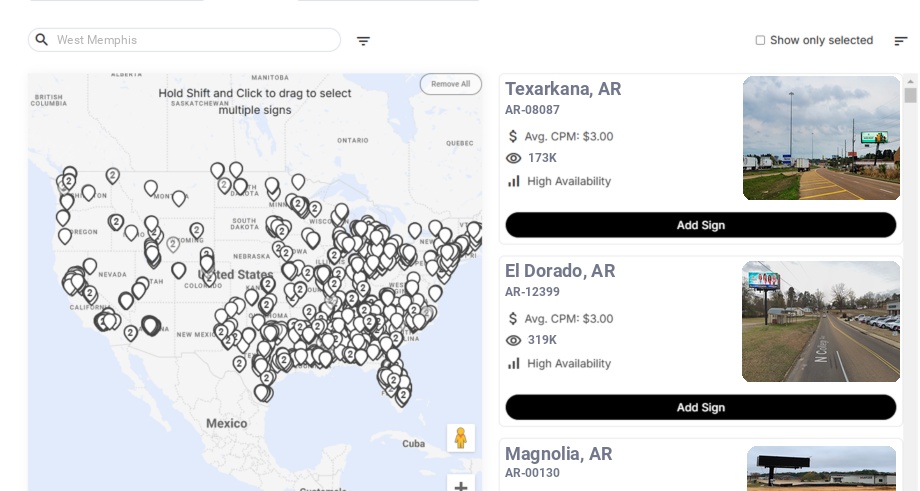
Blip's self-serve map lets you launch in West Memphis fast and reach I-40/I-55 drivers without sales calls.
Set flexible budgets in West Memphis and pay only when your ad blips, so you can test the Marion corridor near the Mississippi River crossing.
Daypart around West Memphis commuter peaks—6-9 a.m. and 3-7 p.m.—to hit workers, truckers, and cross-river traffic when it matters.
No contracts means you can pause or shift your West Memphis campaign for Southland Casino weekends, Memphis events, or seasonal traffic spikes.
Blip's real-time analytics help you optimize West Memphis ads as traffic shifts on US 64, US 79, and AR 77.
Use Blip's creative tools to build bold West Memphis billboards that stand out at highway speed with simple, high-contrast copy.
Frequently Asked Questions About Billboard Advertising near West Memphis
How much does a billboard cost in West Memphis with Blip?
Pricing starts at just $0.01 per display, and the cost per blip can change based on time of day, location, and advertiser demand. Blip only charges you when your ad actually appears as a 7.5-to-10-second blip on a rotating digital billboard serving the West Memphis area. There are no minimums or contracts, so you can set, adjust, or pause spending whenever you want.
Where can I advertise with Blip in West Memphis?
The market near West Memphis is anchored by the I-40/I-55 Mississippi River crossing, and Blip can reach local residents, cross-river commuters, casino visitors, regional shoppers, and long-haul interstate traffic with just 3 well-placed screens serving the West Memphis area. Our inventory is especially close to the market, with 3 digital billboards in nearby Marion, only 4.3 miles from West Memphis and all within 10 miles of the city. That combination of proximity, highway concentration, and daily vehicle dependence makes billboard advertising near West Memphis efficient for both branding and direct-response campaigns.
What kind of traffic can Blip reach near West Memphis?
No routes matter more near West Memphis than Interstate 40 and Interstate 55. According to Arkansas Department of Transportation traffic maps, interstate segments around the I-40/I-55 split and bridge approaches commonly range from roughly 40,000 to more than 70,000 vehicles per day, depending on the exact segment. On I-55 north of the split near Marion, daily traffic commonly lands around 30,000 to 40,000 vehicles.
Why is West Memphis a good market for billboard advertising with Blip?
The market near West Memphis is unusually strong for billboard advertising because it sits at one of the most important travel gateways in the Mid-South, anchored by the I-40/I-55 Mississippi River crossing. The local market also benefits from its direct connection to the broader Memphis metro, and the Arkansas side functions as one of that metro’s western gateways. For advertisers, that means our boards near West Memphis can do two jobs at once: they can build repetition with local households, and they can intercept regional traffic moving between Arkansas and Tennessee.
When is the best time to run billboards in West Memphis with Blip?
Spring is one of the strongest billboard seasons serving the West Memphis area, and summer is especially good for highway-driven advertising because the area sits on a national east-west route. Morning runs from about 6 to 9 a.m. and evening return periods from about 3 to 7 p.m. are usually the best starting points when we want commuter-heavy exposure. Friday afternoon through Sunday evening can also be effective for entertainment traffic, late afternoon and evening for restaurants and gaming, and back-to-school creative in late July and August.
Do I need a contract to advertise with Blip near West Memphis?
No, Blip has no long-term contracts or minimum commitments. You can start, pause, or stop your campaign at any time.
How fast can I launch a billboard campaign with Blip near West Memphis?
You can have your campaign live in minutes. Create a free account, select your locations, set your budget, upload your design, and start running once approved.
Where can I advertise with Blip near West Memphis?
Blip has digital billboards near West Memphis. You can browse available locations on a map, choose the ones that fit your audience, and start advertising right away.
Still have questions? Launch a campaign in minutes — no contracts, no commitments.
Start Your CampaignWest Memphis Billboard Advertising Guide
The market near West Memphis 3 well-placed screens serving the West Memphis area. Our inventory is especially close to the market, with 3 digital billboards in nearby Marion, only 4.3 miles from West Memphis and all within 10 miles of the city. That combination of proximity, highway concentration, and daily vehicle dependence makes billboard advertising near West Memphis efficient for both branding and direct-response campaigns.
West Memphis area market overview
Population, trade area, and regional scale near West Memphis
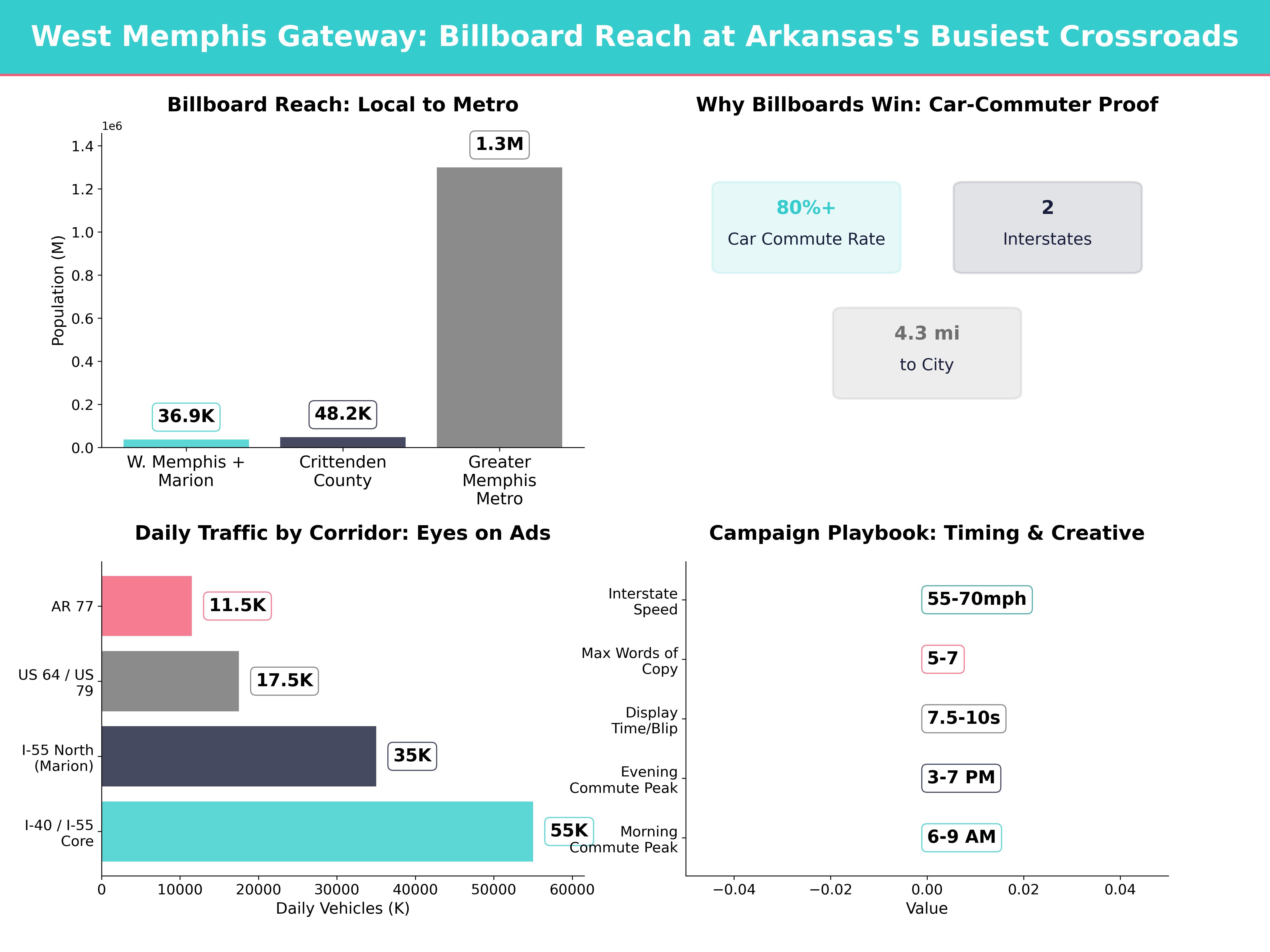
The West Memphis area is compact on paper, but it participates in a much larger consumer economy. West Memphis 24,520 residents at the 2020 Census, while nearby Marion had 12,345 residents, giving the two-city cluster a combined local base of 36,865 people. Crittenden County 48,163 residents, which matters because many trips serving the West Memphis area begin or end outside the city limits.
The local market also benefits from its direct connection to the broader Memphis Greater Memphis Chamber promotes a regional population of roughly 1.3 million, and the Arkansas side functions as one of that metro’s western gateways. For advertisers, that means our boards near West Memphis can do two jobs at once: they can build repetition with local households, and they can intercept regional traffic moving between Arkansas and Tennessee.
A few market facts make that scale easy to visualize: The West Memphis area has 3 Blip digital billboards serving it today; those billboards are in Marion, just 4.3 miles from West Memphis; all of that inventory sits within 10 miles of the city; West Memphis Marion together total 36,865 residents; Crittenden County 48,163 residents; and the broader Memphis region reaches about 1.3 million people.
Economy, employers, and commuting behavior serving the West Memphis area
The economy serving the West Memphis area is broader than many advertisers first assume. It includes logistics, gaming, hospitality, education, healthcare, warehousing, and cross-river professional employment. Southland Casino Hotel $320 million transformation, which added a 20-story, 300-room hotel tower and expanded the destination appeal of the Arkansas side of the state line.
Education and workforce development also reinforce year-round traffic. Arkansas State University Mid-South serves the West Memphis area, while the nearby University of Memphis enrolls more than 21,000 students. Healthcare and professional trips move eastward toward the Memphis Medical District Collaborative, St. Jude Children’s Research Hospital, and Downtown Memphis Commission
Just as important, the market is highly auto-dependent. Recent survey patterns for the city and county show that well over 80% of workers commute by car, truck, or van. That is exactly why billboard advertising works so well near West Memphis. The audience is already on the road, and it repeats the same routes day after day.
We also like the market because it blends local and regional trip purposes. A single campaign can reach local residents handling errands, school trips, and shopping, Arkansas commuters traveling toward Memphis jobs, Tennessee visitors heading toward Southland, truck traffic on the interstate system, and event-driven visitors moving between the riverfront, Downtown Memphis, and the Arkansas side.
West Memphis area key traffic corridors
Interstate corridors near West Memphis that drive billboard value
No routes matter more near West Memphis than Interstate 40 Interstate 55 Arkansas Department of Transportation 40,000 to more than 70,000 vehicles per day, depending on the exact segment.
That is valuable for two reasons. First, those are high-volume roads by any regional standard. Second, the traffic mix is unusually diverse. We are not just reaching local commuters. We are also reaching truck drivers, regional business travelers, weekend visitors, and cross-country motorists moving through the Mississippi River crossing.
On I-55 north of the split near Marion, daily traffic commonly lands around 30,000 to 40,000 vehicles. That corridor is especially useful when we want to build frequency with repeat travelers serving the West Memphis area, because many workers and shoppers use it over and over through the week.
Marion connectors and local approach roads serving West Memphis
The Marion side of the market matters because it is where local traffic and interstate traffic begin to overlap. US 64 US 79 15,000 to 20,000 vehicles per day on key segments, while AR 77 8,000 to 15,000 vehicles per day. These are not just feeder roads. They are the practical decision corridors for households moving between neighborhoods, schools, retail stops, and the interstate entrances that serve West Memphis.
That distinction is important. Interstate boards tend to deliver broad reach and speed. Connector roads tend to deliver more local intent. When we want to advertise healthcare, banking, grocery, auto service, schools, furniture, or home services, local approach roads near Marion can work especially well because they catch people closer to daily decision points.
Why these corridors matter for campaigns near West Memphis
Our Marion inventory works because it sits close to the market without needing to sit inside the city itself. A billboard just 4.3 miles from West Memphis can still capture the same audience, especially when route choice is constrained by bridges, interstates, and a limited number of strong commercial approaches. It also helps that Downtown Memphis is only about 8 to 10 miles away, which keeps the Arkansas side connected to Tennessee employment, tourism, and event traffic.
For advertisers, we generally think about corridor strategy this way:
- I-40 is strong for regional exposure, freight traffic, and broad awareness.
- I-55 is strong for commuter repetition and state-line movement.
- US 64/US 79 are strong for local shopping and everyday household traffic.
- AR 77 is useful for neighborhood-serving and suburban-oriented campaigns.
Audience segments near West Memphis
Commuters and logistics workers in the West Memphis area
The first audience we can reach near West Memphis is the daily commuter. Because more than 80% of workers in the city and county travel by car, truck, or van, roadside exposure aligns closely with how the market behaves. Many of those trips are local, but a meaningful share are cross-river trips into Memphis employment centers, including Downtown, the medical district, warehouse zones, and the airport corridor.
This is also a freight-heavy market. The convergence of 2 major interstates near the Mississippi River means many vehicles are commercial, delivery-related, or long-distance. That makes the West Memphis area especially useful for fuel and convenience brands, truck services, legal services, healthcare clinics, staffing firms, auto dealers, QSR and restaurant offers, and business-to-business services that want repetition with drivers.
Morning runs from about 6 to 9 a.m. and evening return periods from about 3 to 7 p.m. are usually the best starting points when we want commuter-heavy exposure.
Tourists, entertainment visitors, and event traffic serving West Memphis
The second major audience is tourism and entertainment traffic. Southland Casino Hotel 300-room hotel gives the Arkansas side overnight visitation that did not exist at the same scale before the property’s 20-story expansion. That makes the market relevant for restaurants, nightlife, hotels, rideshare-related services, retail, and any business that benefits from evening or weekend traffic.
The Tennessee side broadens that tourism base even further. Memphis Travel Graceland, Beale Street FedExForum, AutoZone Park, and the riverfront. A few venue numbers show why those trips matter:
- FedExForum seats 18,119 for basketball.
- Simmons Bank Liberty Stadium 58,325 seats.
- AutoZone Park seats about 10,000.
- Big River Crossing spans 1 mile across the Mississippi River.
- Memphis International Airport typically handles more than 4 million passengers a year.
Those visitors do not all stay on one side of the river. Many cross between Arkansas and Tennessee for lodging, entertainment, food, events, and gaming. That is exactly why billboard campaigns near West Memphis can reach more than just residents.
Students, families, and value-oriented households near West Memphis
The third audience is the local household economy. Families serving the West Memphis area move constantly between school, work, sports, shopping, and healthcare. West Memphis School District and Marion School District anchor weekday travel patterns, while Arkansas State University Mid-South and the University of Memphis contribute student traffic, faculty commutes, and parent visits.
The size of that education audience is meaningful. The University of Memphis alone has more than 21,000 students, and many students, staff, and families move through the same bridge and interstate system that serves the West Memphis area. For advertisers selling apartments, financial services, healthcare, wireless, quick dining, furniture, and back-to-school products, that seasonal student cycle matters.
We also see strong potential with value messaging. The local market often responds well to practical offers, convenience language, and straightforward calls to action. Households near West Memphis are frequently driving with purpose, so campaigns tied to price, location, speed, and trust can perform especially well.
Seasonal opportunities near West Memphis
Spring and summer timing in the West Memphis area
Spring is one of the strongest billboard seasons serving the West Memphis area. Weather improves, event calendars pick up, tax refunds arrive, and people travel more often for shopping, home improvement, and entertainment. Memphis in May brings extra regional visibility to the market, and baseball season at AutoZone Park adds another stream of event-related travel.
Summer is especially good for highway-driven advertising because the West Memphis area sits on a national east-west route. Families, tourists, and road-trippers moving along I-40 and I-55 increase the value of broad-awareness creative. Weather also matters. Average July highs in the market are around 90°F, so bright, high-contrast creative tends to hold up better than muted palettes in the summer sun.
We often like these summer timing windows: weekday commuter bursts from 6 to 9 a.m. and 3 to 7 p.m., Friday afternoon through Sunday evening for entertainment traffic, late afternoon and evening for restaurants and gaming, and back-to-school creative in late July and August.
Fall and holiday opportunities near West Memphis
Fall brings a different mix of demand. School resumes, college schedules normalize, football traffic returns, and families settle into more repeatable routines. That benefits healthcare, education, retail, insurance, banking, and service businesses. Sports also matter. Simmons Bank Liberty Stadium University of Memphis academic calendar restores student and family travel patterns.
Holiday season is especially useful for the West Memphis area because it blends local shopping, casino entertainment, hospitality, and cross-river visits. Campaigns for gifting, dining, entertainment, and elective services can perform well from November through December. Winter weather is milder than in many inland markets, with average January highs around 50°F, so roads remain active even outside peak tourism periods.
Digital scheduling is helpful here because we can adapt to holiday shopping weekends, weather-driven retail bursts, open enrollment deadlines, bowl games and winter sports, and year-end promotions at entertainment venues near West Memphis.
Billboard design tips for the West Memphis area
Design for interstate speed near West Memphis
Most of the high-value traffic serving the West Memphis area is moving quickly. On the interstate network, drivers are often traveling at 55 to 70 mph, which means the creative has to be simple. We generally recommend 5 to 7 words of primary copy, one strong visual, and one unmistakable brand cue. If the message needs a paragraph to work, it usually needs a different medium.
This market especially rewards clear utility-based headlines. Good creative themes near West Memphis often include fast food or fuel convenience, location-based offers such as “next exit,” trust and urgency for legal or medical advertisers, entertainment and nightlife cues for evening traffic, and clear value framing for retail and services.
We also recommend avoiding QR codes on highway-focused creative. A board gets only 7.5 to 10 seconds of display time per blip, and the audience is driving, not browsing.
Use creative that matches the West Memphis and Delta-to-Memphis mindset
The geography here has a distinct visual and emotional character. The Mississippi River, the bridge crossings, Delta landscapes, logistics traffic, and Memphis music culture all shape how the market feels. Creative that reflects that local identity usually performs better than generic national art.
We often see strong fit with bold blues, blacks, golds, and whites for gaming and entertainment, brighter reds, yellows, and whites for fast service and retail value, river, bridge, skyline, or road imagery for directional relevance, and warm, practical language for family-oriented or community-facing brands.
The market also responds well to specificity. Because so many trips serve an actual destination, directional language can be powerful. A restaurant, casino, clinic, retailer, or attraction can benefit from copy that emphasizes convenience, proximity, or ease of access near West Memphis.
Regional strategies serving the West Memphis area
Marion billboard strategy for repeated reach near West Memphis
Because our inventory is clustered in Marion, we recommend thinking of these units as a frequency engine for the West Memphis area. Their 4.3-mile proximity means they can repeatedly reach residents, workers, and visitors who move through the same few access points every week. That is ideal for campaigns that need recognition over time rather than just one-time awareness.
This approach works especially well for hospitals and urgent care, personal injury and legal brands, casinos and entertainment, furniture and mattress retailers, staffing and trade schools, auto services, and local service businesses that benefit from repeated name recognition.
Corridor-based strategy near West Memphis by trip purpose
We usually divide the market into three practical zones.
First, we have the interstate gateway zone, centered on I-40 and I-55. This is where we focus when we want reach, freight exposure, or regional awareness.
Second, we have the Marion connector zone, where US 64, US 79, and AR 77 capture more local decision traffic. This is where we focus when we want to influence errands, shopping, schools, and neighborhood-serving behavior.
Third, we have the cross-river destination zone, which includes trips toward Southland, Downtown Memphis, riverfront destinations, and the airport/medical districts. This is where directional or event-timed creative becomes most useful.
When we combine those ideas, a simple strategy emerges:
- Use interstate-heavy schedules for brand awareness and visitor capture.
- Use commuter dayparts for everyday services.
- Use evening and weekend schedules for entertainment and dining.
- Use connector-oriented boards for practical local conversion.
Commercial district and cross-river strategy serving West Memphis
The West Memphis area is one of those rare markets where state-line movement is a normal part of life. That creates a strong opportunity for advertisers that want to speak to both convenience and destination. An Arkansas-side business can emphasize easy access for Tennessee drivers, while a Memphis-side business can use near-West-Memphis boards to catch Arkansas residents before they cross the river.
This is particularly effective for entertainment near West Memphis, Memphis attractions seeking Arkansas visitors, healthcare providers serving patients from both states, and regional retailers trying to stay top-of-mind before purchase decisions.
Blip tools for campaigns near West Memphis
Flexible scheduling and budgets for the West Memphis area
Blip’s platform fits the West Memphis area because the market naturally breaks into clear travel windows. We can choose the 3 Marion billboards on a map, set a daily budget, and concentrate spend where it matters most, such as 6 to 9 a.m. for commuters, 3 to 7 p.m. for return traffic, or Friday and Saturday evenings for gaming and entertainment demand.
That flexibility matters because advertisers serving the West Memphis area do not always need an all-day, all-month buy. A clinic may only want weekday commute hours, and a restaurant may want evenings. A casino-adjacent brand may want weekends, and a retailer may want back-to-school or holiday bursts. With digital buying, we can match the schedule to the real rhythm of the market.
Testing and optimization near West Memphis
Blip is also useful when we want to test different messages in a compact market. Because the inventory serving West Memphis is close together, we can compare creative themes quickly. One version might stress value, another might stress convenience, and another might stress entertainment. Real-time analytics help us see which approach deserves more budget.
The economics are accessible too. Pricing starts at $0.01 per display, so even smaller advertisers can begin with a focused test near West Memphis and scale up after they learn what resonates.
Getting started with billboard rental near West Memphis
What we should evaluate before renting a billboard near West Memphis
The best place to start is with the travel behavior we want to intercept. Before launching a campaign, we recommend answering four questions. Are we trying to reach daily commuters, regional pass-through traffic, tourists, or local families? Do we need frequency over time, or do we need broad reach as quickly as possible? Is our offer strongest during morning, afternoon, evening, or weekend travel? Does our message make sense at highway speed, or does it need a slower local approach road?
For the West Memphis area, we generally evaluate each location through these lenses: distance from the target destination, traffic type on the corridor, direction of travel, commute versus leisure timing, and whether the creative is built for quick recognition.
Because our boards are in Marion, just 4.3 miles from West Memphis, many advertisers find they can reach the market effectively without needing a face inside the city.
Why renting near West Memphis is simpler with Blip
Traditional billboard buying often involves sales calls, fixed proposals, and less flexibility once a campaign is live. That can be frustrating in a market where timing matters as much as location. Near West Memphis, traffic patterns change by daypart, event calendar, weather, and season, so we prefer an approach that lets us adjust quickly.
With Blip, we can launch a campaign without long-term contracts, monitor performance, change artwork, revise schedules, and pause or expand based on actual results. That makes it easier to start small, learn the market, and build toward a stronger campaign.
For most advertisers serving the West Memphis area, a smart launch plan looks like this:
- Pick the primary audience segment.
- Choose the Marion billboards that best match that traffic flow.
- Build one short, high-contrast creative concept.
- Run it during the most relevant dayparts first.
- Review the data, then expand the winning message.
That process is especially effective near West Memphis because the market is concentrated, route choice is predictable, and billboard visibility aligns closely with how people actually move.