Billboards in Roland, AR
No Minimum Spend. No Long-Term Contracts. Just Results.
Trusted by Leading Brands


Billboard advertising
in Roland has never been easier
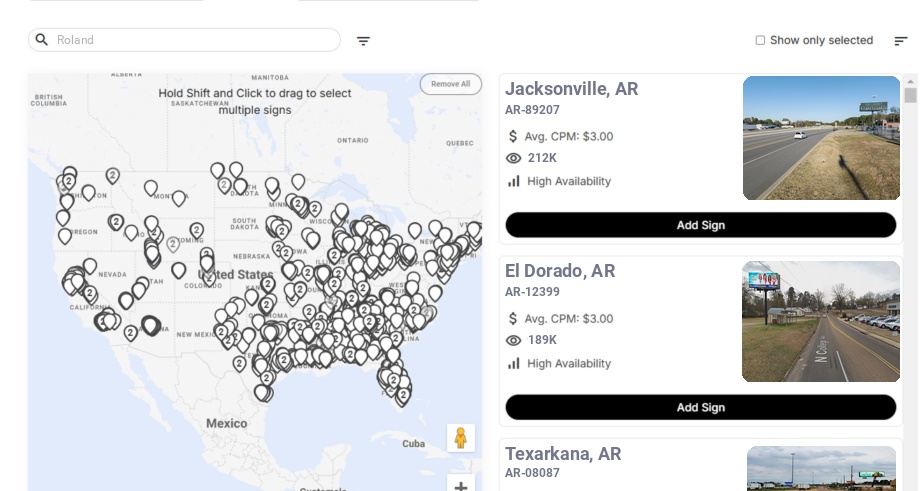



How much is a billboard in Roland?
Why Choose Blip for Billboard Advertising in Roland
Blip makes Roland billboard buys self-serve, so you can launch fast on I-430 or Highway 10 commuter routes without broker delays.
Roland budgets stay flexible with Blip—test west Pulaski County traffic, then scale what works near Lake Maumelle and Pinnacle Mountain.
Use dayparting in Roland to hit 6-9 a.m. commuters on Highway 300 and weekend recreation traffic headed to local parks.
No contracts in Roland means you can pause or pivot for the 10-day Arkansas State Fair or other seasonal surges anytime.
Blip's real-time analytics help Roland advertisers track which I-40, I-430, or Cantrell-area messages drive the most response.
Create and update Roland billboard art quickly with Blip tools, tailoring offers for Little Rock shoppers, commuters, and outdoor visitors.
Frequently Asked Questions About Billboard Advertising in Roland
How much does a billboard cost in Roland, Arkansas with Blip?
With Blip, billboard advertising in Roland can be surprisingly affordable because you only pay when your ad actually displays. Pricing starts at just $0.01 per display, and you choose a daily budget while Blip’s algorithm bids for open ad slots. Costs can change based on time of day, location, and advertiser demand.
Where can I advertise with Blip in Roland, Arkansas?
Roland, Arkansas gives us a smart billboard market because it sits at the edge of west Pulaski County’s suburban growth, outdoor recreation traffic, and Little Rock’s larger commuter economy. The community sits in ZIP Code 72135, northwest of Little Rock, south of Maumelle, and within practical reach of North Little Rock and Conway. Most billboard campaigns in Roland are really trying to influence movement across west Pulaski County and the capital-region commuter belt.
What traffic corridors work best for billboard advertising in Roland, Arkansas with Blip?
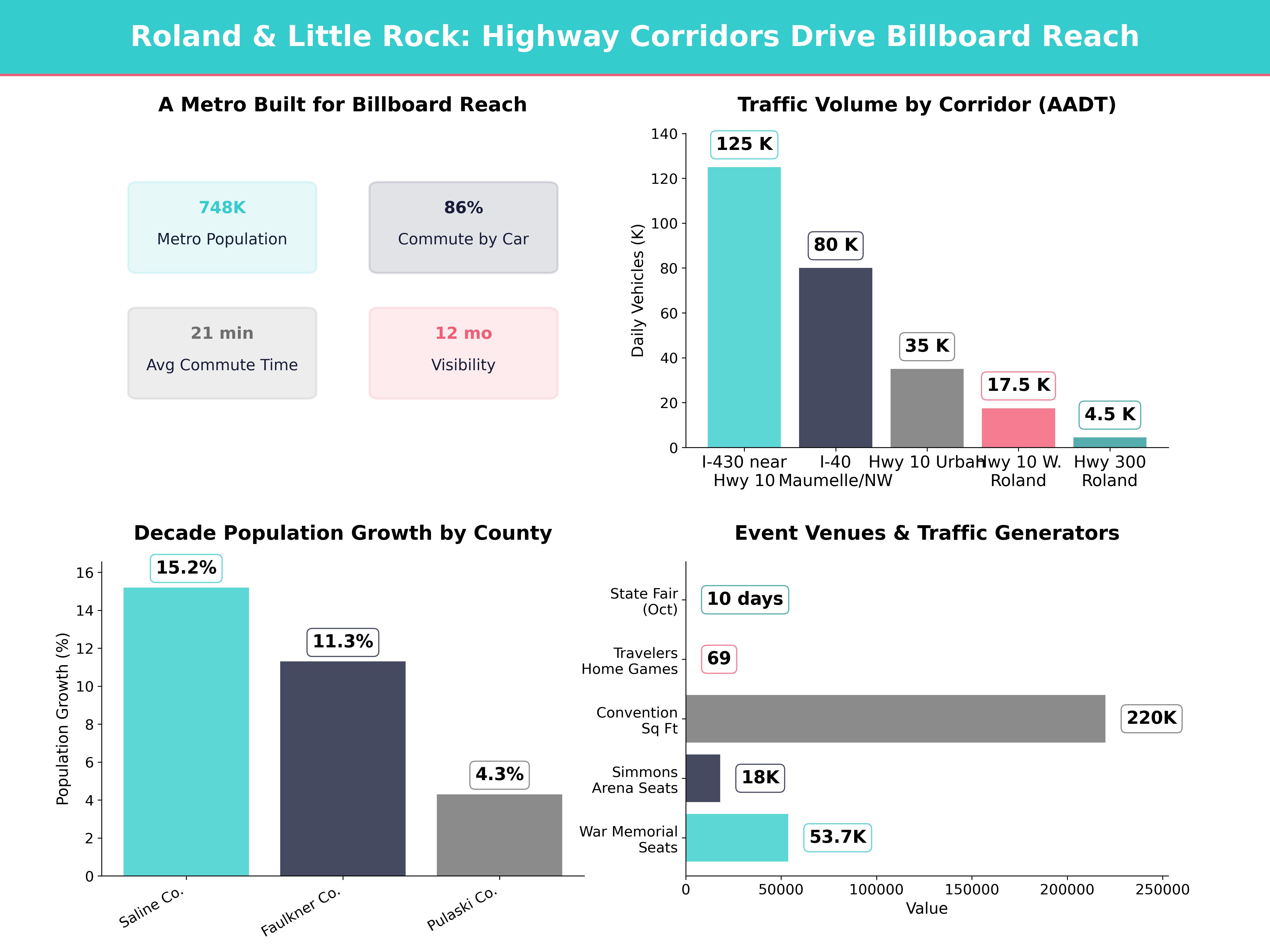
Interstate 430 near the Highway 10 interchange typically carries more than 120,000 vehicles per day, with nearby segments often landing in the 120,000 to 130,000 AADT range. Highway 10 near I-430 and west Little Rock commercial nodes commonly falls in the 30,000 to 40,000 AADT range, while Highway 300 around Roland is often in the 3,000 to 6,000 AADT range. Interstate 40 through Maumelle and northwest Pulaski County commonly carries about 70,000 to 90,000 vehicles per day, depending on the segment.
Who does billboard advertising in Roland, Arkansas reach best?
Roland is effective because it is not dependent on one audience, and we can build campaigns around several overlapping groups that move through the same road network at different times. With roughly 86% of Pulaski County workers commuting by car, truck, or van, roadside media reaches commuters and household decision-makers who make recurring decisions about groceries, banking, healthcare, childcare, fuel, restaurants, and home repair. The area also reaches outdoor recreation traffic, students, educators, healthcare professionals, and eventgoers.
When is the best time to run Blip billboards in Roland, Arkansas?
Spring is one of Roland’s strongest seasonal windows because the nearby Wye Mountain area is known for daffodil season, and Pinnacle Mountain State Park and Lake Maumelle become more active as weather improves. Summer favors family, recreation, and lifestyle campaigns, while fall is the most versatile season for many Roland advertisers because school routines return, football and campus activity intensify, and the Arkansas State Fair runs for 10 days each October. Winter remains useful across all 12 months of the year, especially for retail, medical, financial, and home-improvement brands.
Do I need a contract to advertise with Blip in Roland?
No, Blip has no long-term contracts or minimum commitments. You can start, pause, or stop your campaign at any time.
How fast can I launch a billboard campaign with Blip in Roland?
You can have your campaign live in minutes. Create a free account, select your locations, set your budget, upload your design, and start running once approved.
Where can I advertise with Blip in Roland?
Blip has digital billboards in Roland. You can browse available locations on a map, choose the ones that fit your audience, and start advertising right away.
Still have questions? Launch a campaign in minutes — no contracts, no commitments.
Start Your CampaignRoland Billboard Advertising Guide
Roland, Arkansas gives us a smart billboard market because it sits at the edge of west Pulaski County’s suburban growth, outdoor recreation traffic, and Little Rock’s larger commuter economy. Even though Roland is a small unincorporated community, it benefits from the scale of Pulaski County, which had 399,125 residents in 2020, and the broader Little Rock- North Little Rock Conway metro, which had 748,031 residents. The area is strongly car-oriented, and recent ACS estimates show that roughly 86% of Pulaski County workers commute by car, truck, or van, which keeps roadside advertising highly relevant. We also get a valuable mix of everyday local trips, west Little Rock retail runs, and leisure traffic tied to Pinnacle Mountain State Park, Lake Maumelle, and the region’s event venues.
Roland, Arkansas Market Overview
Roland works best when we think of it as a trade area rather than a city limit. The community sits in ZIP Code 72135, northwest of Little Rock, south of Maumelle Conway. That matters because most billboard campaigns in Roland are really trying to influence movement across west Pulaski County and the capital-region commuter belt.
The population base around Roland is large enough to support both broad awareness and niche local campaigns. In 2020, Little Rock had 202,591 residents, North Little Rock 64,591, and Maumelle 19,251. Pulaski County grew by 4.3% from 2010 to 2020, while nearby counties expanded even faster, with Faulkner County 11.3%, and Saline County up 15.2% over the same decade. For advertisers, that pattern tells us that Roland can tap both established central-city demand and growing suburban and exurban household movement.
Economically, Roland benefits from being plugged into Arkansas’s capital-region job market. UAMS employs more than 11,000 people, and the Port of Little Rock 2,600-acre industrial park that supports logistics, manufacturing, and B2B traffic. Major institutions such as Baptist Health, Arkansas Children’s, Dillard’s, and Acxiom Promenade at Chenal, Outlets of Little Rock, and Park Plaza, we get a market where billboard impressions can repeatedly influence dining, healthcare, home services, retail, and real estate decisions.
Commuting behavior is especially important here. Recent ACS estimates put Pulaski County’s average one-way commute at about 21 minutes, which is long enough for repeated message exposure but short enough that directional, immediate-call-to-action creative can still work. Because Roland residents and nearby households often drive to west Little Rock for shopping, school, appointments, and work, roadside media stays in front of the same decision-makers week after week.
Key Traffic Corridors for Roland, Arkansas Billboards
Roland’s billboard value comes from a few specific corridors that connect local residents to the larger metro. We should look at these roads as different audience tools rather than interchangeable inventory.
Interstate 430 and the West Little Rock Gateway
According to traffic count data from the Arkansas Department of Transportation 120,000 vehicles per day, with nearby segments often landing in the 120,000 to 130,000 AADT range. That makes I-430 the highest-scale awareness corridor available to businesses trying to reach Roland-adjacent consumers.
This corridor works especially well when we want fast reach across affluent west Little Rock and northwest Pulaski County. We usually prioritize I-430 for healthcare providers, legal services, auto dealers, colleges, large retail brands, insurance agencies, and employers with active recruiting needs. Because it functions as a western bypass around the metro, it also helps regional advertisers reach both northbound and southbound flow instead of depending on one neighborhood.
Highway 10 and Cantrell Road for Roland Commuters
Highway 10, also known as Cantrell Road through much of west Little Rock, is the practical everyday route for many Roland-area households. ARDOT counts on the urbanized side of Highway 10 commonly fall in the 30,000 to 40,000 AADT range near I-430 and west Little Rock commercial nodes. As the corridor moves farther west toward Roland, volumes typically step down into the 15,000 to 20,000 AADT range, but the audience becomes more local and purchase-ready.
That shift is useful. Higher-volume Highway 10 segments are excellent for restaurants, urgent care, banks, fitness brands, and retail centers that need mass awareness. Lower-volume segments closer to Roland are often better for home builders, landscapers, roofers, septic services, churches, schools, veterinarians, and destination businesses because the message reaches people who are more likely to actually live nearby.
Highway 300 and the Roland Precision Audience
Arkansas Highway 300 3,000 to 6,000 AADT range, depending on the segment. That smaller count can still be highly valuable because the audience is geographically concentrated and more likely to care about local offers.
We generally like Highway 300 strategy for businesses that need precision over raw volume. Examples include custom home builders, land brokers, boat storage, propane providers, equestrian services, local restaurants, event venues, and home-improvement specialists. If our goal is immediate local response from west Pulaski County households, Highway 300 often delivers stronger relevance than a busier but less targeted urban route.
Interstate 40, Maumelle, and Northwest Pulaski Extensions
Roland campaigns do not have to stop at Roland. Interstate 40 through Maumelle 70,000 to 90,000 vehicles per day, depending on the segment, while corridors such as Highway 365 and Maumelle-area connectors often sit in the 20,000 to 30,000 AADT band. Those roads help us extend a Roland message into the broader commuter and logistics shed.
This strategy is especially useful when we want to pull from Maumelle, Conway-bound traffic, or industrial and service workers who travel between job sites and residential suburbs. Regional healthcare systems, family attractions, quick-service restaurants, home services, and larger retailers often benefit from combining Roland-adjacent boards with I-40 or Maumelle placements for broader frequency.
Audience Segments We Can Reach Around Roland, Arkansas
Roland is effective because it is not dependent on one audience. We can build campaigns around several overlapping groups that move through the same road network at different times.
Roland Commuters and Household Decision-Makers
Our biggest dependable audience is the everyday commuter and household planner. With roughly 86% of Pulaski County workers commuting by car, truck, or van, roadside media reaches people who make recurring decisions about groceries, banking, healthcare, childcare, fuel, restaurants, and home repair. In a place like Roland, where many trips require a vehicle and errands are often bundled together, billboard frequency matters.
This segment is especially important for businesses in west Little Rock because Roland residents regularly travel east for services and shopping. Campaigns tied to Little Rock School District, Pulaski County Special School District, and North Little Rock School District calendars also benefit from this pattern, since family schedules intensify from August through May.
Outdoor Recreation and Weekend Traffic Near Roland
Roland sits close to some of central Arkansas’s strongest outdoor assets. Lake Maumelle spans about 8,900 acres, Pinnacle Mountain State Park rises to 1,011 feet, and the Big Dam Bridge stretches 4,226 feet across the Arkansas River. Nearby destinations such as Two Rivers Park, Maumelle Park, and trail networks add steady weekend traffic from families, cyclists, hikers, paddlers, and day-trippers.
That audience is excellent for outdoor brands, restaurants, breweries, real estate, storage, automotive services, and health-and-wellness advertisers. It is also useful for local businesses that want to position themselves as part of the west Pulaski lifestyle rather than just another errand stop.
Students, Educators, and Healthcare Professionals
Roland also benefits from the metro’s education and medical concentration. UAMS alone employs more than 11,000 people, and the region is also anchored by University of Arkansas at Little Rock UA - Pulaski Tech, and University of Central Arkansas in Conway, a city of 64,134 residents. These institutions create year-round demand for apartments, healthcare services, food delivery, financial products, technology, continuing education, and professional recruiting.
For billboard strategy, this means Roland can support more than rural-residential messaging. We can also speak to upwardly mobile professionals, graduate students, faculty, nurses, medical staff, and parents of college-age students who move between suburban housing and institutional job centers.
Eventgoers, Convention Visitors, and Entertainment Audiences
The greater Little Rock market creates a sizeable event audience that Roland advertisers can tap when campaigns expand beyond purely local boards. Simmons Bank Arena seats roughly 18,000, War Memorial Stadium 53,727, Dickey-Stephens Park holds about 7,200, and the Statehouse Convention Center offers approximately 220,000 square feet of meeting and exhibit space. Add in the Bill and Hillary Clinton National Airport River Market District, and the Clinton Presidential Center
This audience matters most for entertainment, hospitality, tourism, restaurants, museums, family attractions, and high-visibility brand campaigns. If our business in Roland depends on visitors who are already in central Arkansas for something else, event-linked billboard timing can be very efficient.
Seasonal and Timing Opportunities in Roland, Arkansas
Roland is not a market where we should run one message the same way all year. The best campaigns respond to event cycles, school calendars, recreation patterns, and state-government traffic.
Spring in Roland, Arkansas
Spring is one of Roland’s strongest seasonal windows. The nearby Wye Mountain area is known for its daffodil season, and Pinnacle Mountain State Park and Lake Maumelle become more active as weather improves. Little Rock Marathon weekend in March adds another burst of traffic and visibility, centered on 26.2-mile and 13.1-mile race distances that bring runners and spectators into the capital region.
Spring also overlaps with state-government movement. The Arkansas General Assembly has 135 members and holds regular sessions beginning in January of odd-numbered years and fiscal sessions beginning in February of even-numbered years. That pattern brings lawmakers, staff, lobbyists, media, and advocacy groups into the Little Rock area, which can lift demand for hospitality, restaurants, transportation services, and issue-oriented messaging.
Summer in Roland, Arkansas
Summer favors family, recreation, and lifestyle campaigns. Arkansas Travelers baseball gives us 69 home games each season, and weekend traffic rises around boating, camping, and cycling destinations. This is a strong period for restaurants, cold beverages, attractions, outdoor retailers, healthcare clinics, pest control, lawn care, and family entertainment.
Summer is also a good time to target movers and homeowners. Households often tackle relocation, renovation, fencing, roofing, and landscaping projects during late spring and summer, which fits Roland’s mix of acreage living and suburban spillover.
Fall in Roland, Arkansas
Fall is the most versatile season for many Roland advertisers. School routines return in August, football and campus activity intensify, and the Arkansas State Fair runs for 10 days each October. War Memorial Stadium 53,727-seat capacity, and cooler weather boosts visitation to outdoor destinations.
This is the season when we often see strong performance from retail, healthcare enrollment campaigns, higher education, political advertising, home services, hunting and outdoor categories, and holiday pre-promotion. For brands that serve both locals and visitors, fall usually deserves one of the largest annual billboard pushes.
Winter and Holiday Timing in Roland, Arkansas
Winter in central Arkansas is milder than many surrounding regions, so billboard visibility remains useful across all 12 months of the year. Holiday shopping helps west Little Rock retail centers like Promenade at Chenal, Outlets of Little Rock, and Park Plaza, while medical, financial, tax, and home-improvement brands can also win by catching year-end planning behavior.
We often like winter for testing too. Because outdoor recreation traffic softens somewhat after peak fall weekends, we can learn which commuter-heavy placements deliver the best weekday efficiency before larger spring and summer pushes.
Billboard Design Tips for the Roland, Arkansas Market
Roland responds best to creative that feels local, practical, and visually clean. We should design for a market that blends wooded acreage, lake recreation, and west Little Rock convenience.
Use Roland, Arkansas Visual Cues That Feel True to the Area
Creative usually resonates more here when it reflects the outdoor-suburban identity of the market. Imagery tied to water, tree cover, trails, boats, trucks, patios, family recreation, and hill-country scenery often feels more authentic than slick downtown-only visuals. Referencing familiar destinations such as Lake Maumelle, Pinnacle, Cantrell, Chenal, or Maumelle can also improve relevance when the offer truly matches the geography.
This is a good place for color palettes that feel natural but still high-contrast. Deep blues, forest greens, warm neutrals, and bright whites often fit the area well, especially for home services, healthcare, recreation, and real estate. If we need a more premium tone, west Little Rock style cues usually outperform hard-edged urban creative.
Write for Roads in the Roland Area That Move Fast
Drivers in the Roland market are often moving at 45 to 65 mph, especially on Highway 10, Highway 300 approaches, I-430, and I-40. That means our copy needs to communicate the offer almost instantly. We usually do better with one strong headline, one visual focal point, and one action, such as a URL, a short brand name, or a directional cue.
Location-specific lines tend to work well here. Messages such as “Urgent Care Off Cantrell,” “Boat Storage Near Lake Maumelle,” or “Custom Homes in 72135” feel more useful than generic slogans because they connect with how people actually navigate the area.
Match the Offer to Roland, Arkansas Intent
The best Roland creative reflects why people are on that road. A weekday I-430 commuter may respond to convenience, speed, and professionalism, while a Saturday driver headed toward Pinnacle Mountain State Park may be more open to food, recreation, or leisure offers. We should not use the exact same message for every screen if the travel intent changes.
This is also a market where trust signals matter. Family-owned language, local testimonials, years in business, or recognizable place names can be especially effective for contractors, medical providers, financial services, churches, schools, and real estate brands.
Regional Strategies Across Roland, Arkansas and Greater West Pulaski County
Roland campaigns perform best when we divide the geography into practical zones and assign each zone a job.
Roland and Highway 300 for Local Precision
We should treat Roland and Highway 300 as the place for high-intent local messaging. Lower traffic counts, often around 3,000 to 6,000 AADT, are offset by strong relevance. This is where we focus on acreage homeowners, nearby families, recreation users, and rural-suburban service needs.
West Little Rock and Highway 10 for Everyday Consumer Demand
West Little Rock gives us higher frequency and more retail energy. Highway 10 volumes in the 30,000 to 40,000 AADT range near major commercial nodes make this zone ideal for healthcare, dining, apparel, grocery, and service categories. It is also where many Roland households actually spend money, even if they live outside Little Rock proper.
Maumelle and I-40 for Northwest Expansion
The Maumelle 70,000 to 90,000 AADT range, this zone works well for regional brands, logistics-related employers, education campaigns, and family destinations that want to pull from both Pulaski and Faulkner County movement.
Downtown Little Rock and North Little Rock for Events and Visitors
When we want visibility tied to conventions, concerts, sports, and tourism, we should extend into downtown Little Rock, and North Little Rock 18,000 at Simmons Bank Arena, 7,200 at Dickey-Stephens Park, and 220,000 square feet at the Statehouse Convention Center support campaigns for hotels, dining, attractions, and regional brand awareness.
Using Blip Tools Effectively in Roland, Arkansas
Blip is especially useful in a market like Roland because we can shape campaigns around actual local movement instead of buying broad coverage we do not need. We can daypart weekday commuter boards for 6:00 to 9:00 a.m., and 4:00 to 7:00 p.m., while reserving weekend-heavy creative for recreation corridors from 9:00 a.m. to 6:00 p.m. That makes it easier to align a message with roadway intent.
We can also rotate creative by corridor. One version can emphasize convenience for I-430 commuters, another can focus on local trust for Highway 300, and a third can lean into outdoor lifestyle for Lake Maumelle and Pinnacle traffic. Because Blip provides real-time performance feedback, we can quickly learn whether west Little Rock, Maumelle, or Roland-local boards are doing the most work for our goals.
Budget flexibility is another advantage here. Roland advertisers often do not need a massive all-market buy on day one. We can start with a tight cluster of boards, test results, then expand around spring recreation, the 10-day Arkansas State Fair, or a major concert run at Simmons Bank Arena. When we need fresh creative, Blip’s artwork tools also make it easier to localize messaging without slowing down the campaign.
Getting Started with Billboard Rental in Roland, Arkansas
Getting started in Roland is simpler when we begin with the audience, not the board. Because Roland is a small community inside a much larger metro trade area, the “best” billboard depends on whether we want local response, commuter scale, or regional visitor awareness.
How We Evaluate Billboard Locations in Roland, Arkansas
We usually evaluate Roland-area billboard rentals using a few practical filters.
- We identify whether our goal is local action or broad awareness, because Highway 300 and I-430 serve very different jobs.
- We match the board to the direction of travel that matters most, since an eastbound commuter board can perform differently from a westbound leisure board.
- We compare weekday and weekend patterns, because Roland has a real split between commuter traffic and outdoor recreation traffic.
- We look at what happens after the billboard, including retail centers, medical campuses, event venues, or turnoffs toward Lake Maumelle and Pinnacle.
- We choose locations that align with our offer’s buying window, since an immediate lunch message works differently from a long-consideration real estate message.
What to Expect from Billboard Rental in Roland, Arkansas
Traditional billboard buying can feel slow and rigid, especially in smaller markets where inventory is often packaged in bundles. Blip makes the process more practical for Roland because we can choose boards on a map, set a budget that fits our goals, and adjust timing without long commitments. We only pay when the ad displays, with pricing that starts at $0.01 per display, and each ad play lasts about 7.5 to 10 seconds.
That flexibility is useful in Roland because the market rewards testing. We may find that a high-volume I-430 board is best for brand lift, while a closer Highway 10 or Highway 300 board is better for local response. With Blip, we can compare those outcomes, refine creative, and scale into the placements that fit our actual customers.
A Practical First Campaign for Roland, Arkansas
A strong first Roland campaign usually includes 2 to 3 creative versions and a focused set of boards. We can run one commuter message, one local-destination message, and one seasonal or event-based version. After the first week or two, we can use performance data to shift spend toward the strongest screens, times, and messages.
For most advertisers, the winning mindset is simple. We should treat Roland as a gateway market with multiple layers, including local households, west Little Rock shoppers, Maumelle commuters, and central Arkansas recreation traffic. When we align the right road, the right timing, and the right local message, billboard rental in Roland becomes a highly efficient way to build visibility and drive action.