Billboards in Cherokee, IA
No Minimum Spend. No Long-Term Contracts. Just Results.
Turn heads and spark curiosity with digital magic on Cherokee billboards. Blip lets you launch flexible, budget-friendly campaigns on billboards in Cherokee, Iowa, giving your message screen time exactly when you want it—no long contracts, just pure visibility.
Trusted by Leading Brands


Billboard advertising
in Cherokee has
never been easier
HERE'S HOW IT WORKS
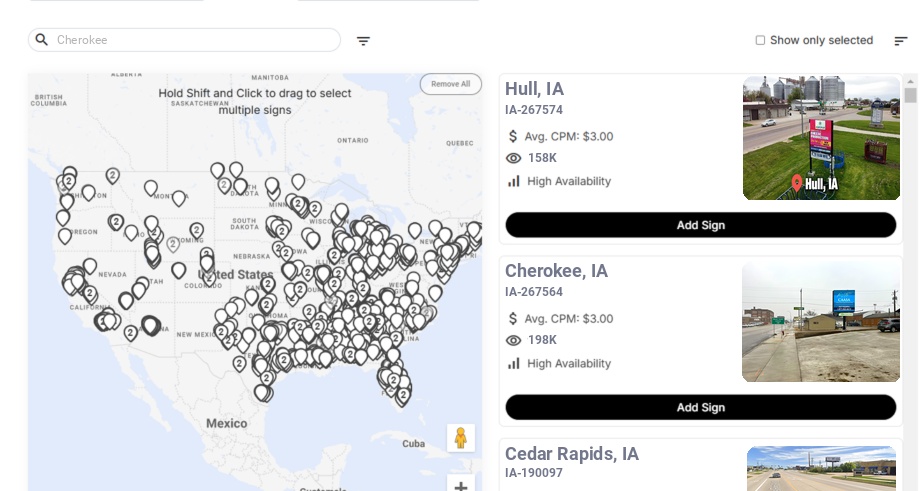
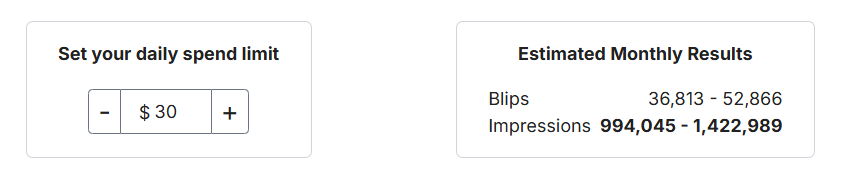
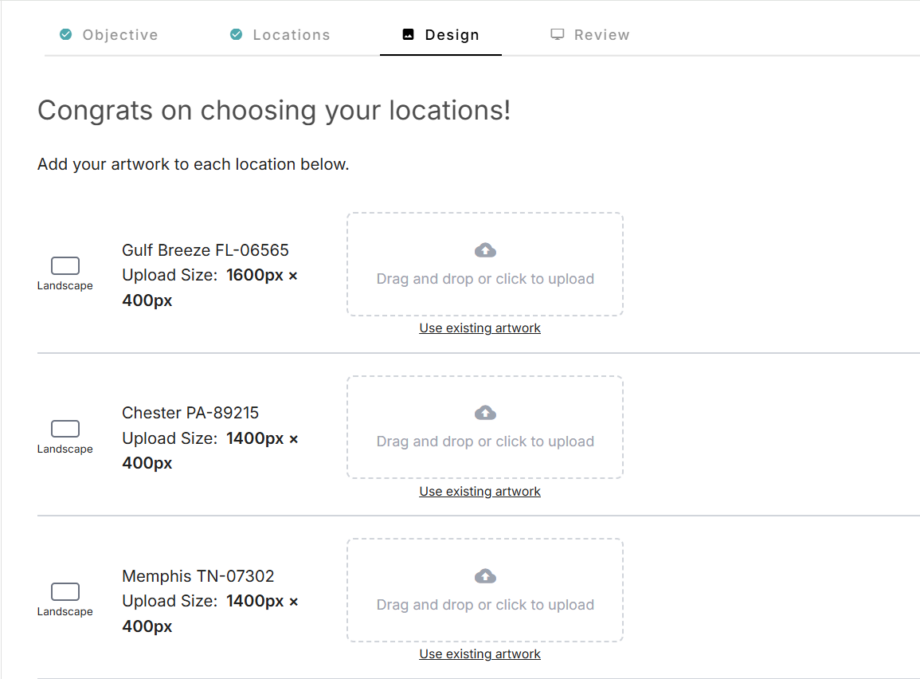
How much is a billboard in Cherokee?
Billboards in other Iowa cities
Cherokee Billboard Advertising Guide
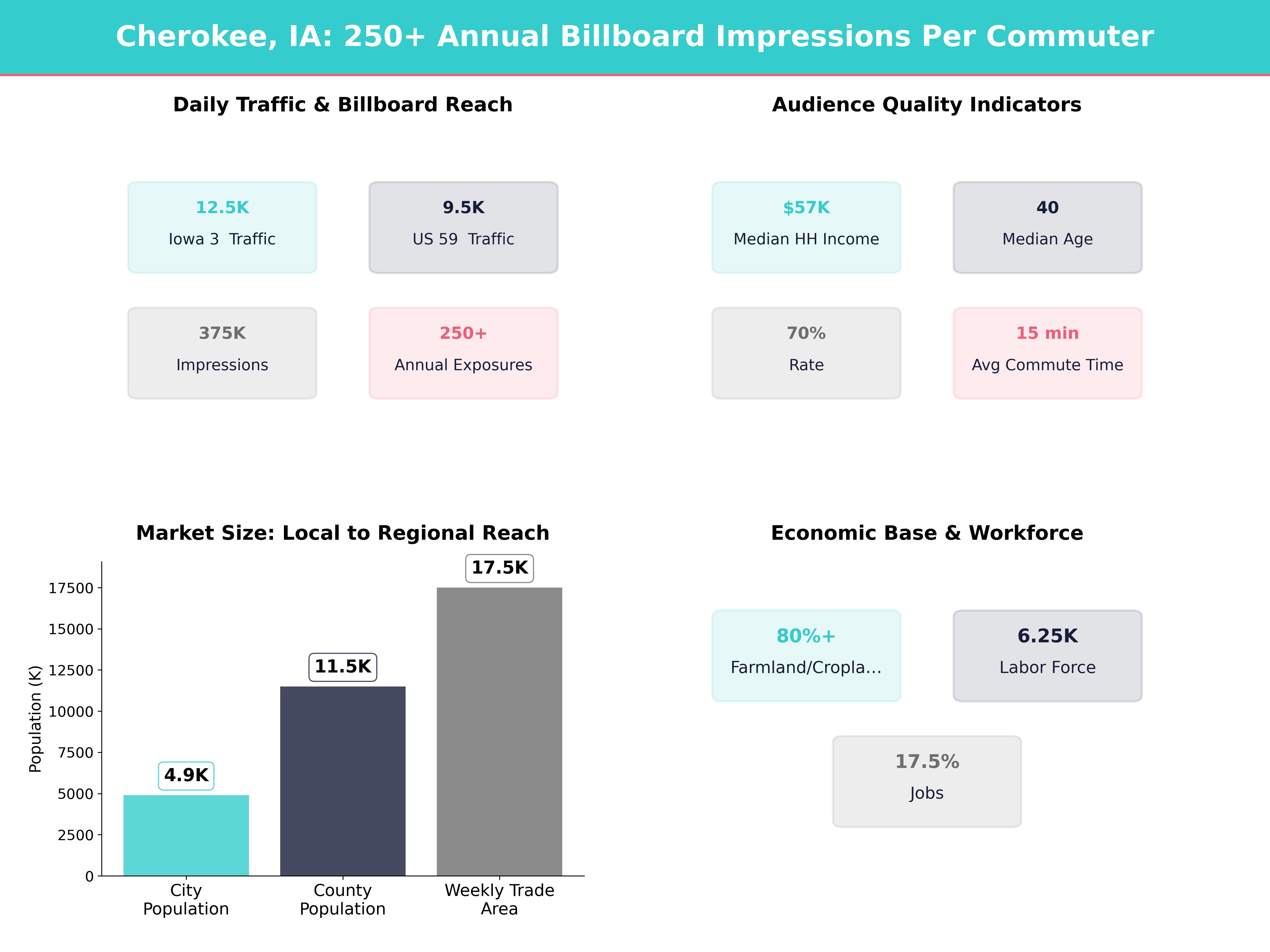
Cherokee, Iowa, offers advertisers a rare blend of small‑town loyalty and regional reach. With roughly 4,900 residents in the city itself and about 11,500 in Cherokee County, businesses can use digital Cherokee billboards here to stay top‑of‑mind with locals while also capturing thru‑traffic moving between Sioux City Storm Lake (pop. ~11,000), and northwest Iowa’s smaller communities. Local retail, healthcare, and service businesses draw a trade area that routinely exceeds 15,000–20,000 people on a typical week, and event weeks can push that even higher. Using Blip, we can match our creative, timing, and placement to the way people in Cherokee actually live, work, shop, and drive, making Cherokee billboard advertising an efficient extension of your existing local marketing.
Understanding the Cherokee Market
Cherokee sits at the junction of Iowa Highway 3 (east–west) and U.S. Highway 59 (north–south), the two main arteries through town. According to Iowa Department of Transportation traffic counts cited in City of Cherokee Cherokee County planning documents, typical average annual daily traffic (AADT) on these corridors in and near Cherokee runs in the range of:
- Iowa 3 through Cherokee: approximately 8,000–10,000 vehicles per day
- U.S. 59 through Cherokee: approximately 6,000–7,500 vehicles per day
- Approaches into town from the east and west on Iowa 3: 5,000–7,000 vehicles per day
If we conservatively estimate 1.4 people per vehicle, that equates to:
- 11,000–14,000 daily travelers on Iowa 3 through town
- 8,400–10,500 daily travelers on U.S. 59 through town
For a city under 5,000 residents, this means a well‑placed digital board can generate 3–5 times the city’s population in daily impressions, or roughly 300,000–450,000 impressions per month per board when we factor in commuters from surrounding towns and farmsteads. That level of exposure makes billboards in Cherokee a practical option for both small businesses and regional brands looking for cost‑effective reach.
Key local context:
-
Population & age:
- City of Cherokee: ≈ 4,900 residents
- Cherokee County: ≈ 11,500 residents
- Median age: mid‑40s, with about 22–24% under age 18, roughly 55–60% aged 18–64, and around 18–20% age 65+, according to summaries used by Cherokee Area Economic Development.
- This skews slightly older than many urban areas, which increases demand for healthcare, home services, banking, and senior care.
-
Households & income:
- Roughly 2,100–2,200 households in the city.
- Average household size around 2.2–2.3 people.
- Median household income for Cherokee County is typically reported in the $55,000–$60,000 range, with a meaningful share of dual‑income families and stable, long‑tenure homeowners.
-
Employment & commuting:
- County labor force: roughly 6,000–6,500 workers, according to regional workforce data referenced by Cherokee Area Economic Development.
- Average one‑way commute time around 15 minutes, meaning many residents pass the same corridors twice daily, 5+ days per week.
- Approximately 70–75% of workers drive alone to work, 9–12% carpool, and a small share work from home.
-
Economic base: As Cherokee Area Economic Development notes, the area is anchored by agriculture, food processing, manufacturing, healthcare, and education. County estimates often show:
- 15–20% of jobs in manufacturing and industrial sectors
- 15–20% in healthcare and social assistance
- 10–15% in education and public administration
- 10–15% in retail trade and hospitality
-
Major employers:
- Cherokee Regional Medical Center 200+ staff and serving tens of thousands of patient visits per year.
- Agricultural operations, grain facilities, and ag‑related services across the county.
- Local manufacturing and industrial businesses in and near the city.
- Cherokee Community School District, with 1,000+ students and 100+ certified staff, plus other school districts and public agencies.
- Regional pull: Cherokee functions as a service hub for smaller towns within a 20–30 mile radius, including Aurelia, Marcus, Meriden, Cleghorn, and Washta. Local officials and Cherokee Chamber of Commerce & Tourism materials highlight that the city routinely serves a trade area estimated at 15,000–20,000 people for healthcare, groceries, farm supplies, banking, and dining. On major event weekends, total visitor volume can surge by 20–40% over normal levels, which further increases the value of Cherokee billboards placed on these busy corridors.
For advertisers, this means:
- We’re not just talking to 4,900 residents; we’re speaking to a regional trade area that can easily reach 15,000–20,000 people in a typical week, with hundreds of thousands of weekly ad impressions available on the main corridors.
- Household vehicle ownership is high—often 2+ vehicles per household—so campaigns reach key decision‑makers repeatedly.
- Our billboard messaging should reflect a practical, value‑driven audience focused on family, work, farming, and community.
Useful local resources for planning:
- City of Cherokee
- Cherokee Chamber of Commerce & Tourism – event calendars and business listings
- Cherokee County, Iowa – county‑wide economic and community data
- Local news: Cherokee Chronicle Times
- Cherokee Community School District – school calendars, athletics schedules, and community activities that drive family travel patterns
Key Audience Segments and What to Say to Them
Even in a small market, we can think in terms of distinct audience segments and tune our creative accordingly. In Cherokee County, roughly 60–65% of households are family households, and about 70% of residents live in owner‑occupied housing, which supports long‑term loyalty and repeat exposure for Cherokee billboard advertising campaigns.
1. Local Families and Workers
- Who they are: Parents, school staff, healthcare workers, industrial and ag employees, and small‑business owners. With 1,000+ K–12 students in the Cherokee Community School District and hundreds more in nearby districts, school‑age families are a major driver of weekday traffic on Iowa 3 and U.S. 59.
-
When they’re on the road:
- Morning drive: 6:30–8:30 a.m. (school start times around 8:10–8:20 a.m. and hospital/plant shifts starting near 7:00 a.m.)
- Lunch: 11:30 a.m.–1:00 p.m.
- Evening: 4:00–6:30 p.m. (commute plus youth sports and activities)
-
What resonates:
- Clear savings: “Save 15% this week,” “Kids eat free Tuesdays,” “Oil change $39.95”
- Community connection: “Proud to support Cherokee Braves,” “Thank you Cherokee healthcare workers”
- Time‑sensitive offers: “Today only,” “Ends Saturday,” “This weekend”
- Convenience: Roughly 60–70% of local workers drive less than 20 minutes to work, so “quick stop” and “on your way home” language fits real behavior.
Messaging ideas:
- “Local first, always. Shop downtown Cherokee this weekend.”
- “New at the clinic: Same‑day appointments. Call today.”
- “Busy week? Order online, pick up in Cherokee.”
2. Agricultural & Rural Customers
Agriculture remains one of Cherokee County’s foundational sectors. County data summarized by Cherokee Area Economic Development points to:
-
Hundreds of active farms across the county, with well over 80% of land in farms and cropland.
-
Farm sizes frequently exceeding 300–500 acres, with many operations managing multiple properties.
-
Who they are: Farmers, agribusiness employees, and rural households in Cherokee and neighboring counties. A large share of these residents live outside city limits but rely on Cherokee for inputs, banking, healthcare, and supplies.
-
When they’re on the road:
- Heavier traffic in planting (April–May) and harvest (September–October) seasons, when machinery and grain trucks move daily.
- Morning and early evening trips to co‑ops, equipment dealers, and suppliers, often between 6:00–9:00 a.m. and 3:00–7:00 p.m.
-
What resonates:
- Reliability and uptime: “24/7 emergency service,” “Same‑day parts delivery”
- Price and financing: “0% for 36 months on select equipment,” “Prepay discounts available”
- Local expertise: “Serving Cherokee County farms for 40+ years”
- Volume and capacity messaging (e.g., “Drying capacity X,000 bushels/day”) for co‑ops and elevators on or near Iowa 3.
Messaging ideas:
- “Seed, feed, and fuel – all in one stop on Hwy 3.”
- “Breakdown? Call us first – on‑farm repair, 24/7.”
- “Lock in your fall fertilizer price by August 31.”
3. Healthcare and Senior‑Care Audiences
With Cherokee Regional Medical Center 15–20% of local employment, and adults ages 65+ represent nearly 1 in 5 residents—far above typical metro shares.
- Who they are: Patients and caregivers traveling into Cherokee from across the county; older residents and their adult children. Cherokee Regional Medical Center 15,000+ people, resulting in tens of thousands of outpatient and ER visits annually.
-
When they’re on the road:
- Weekdays from 8:00 a.m.–5:00 p.m., with peaks around 8–10 a.m. and 3–5 p.m. as appointment blocks start and end.
- Family members often travel evenings and weekends to visit assisted‑living and long‑term‑care residents.
-
What resonates:
- Access: “Walk‑in clinic open 7 days,” “Same‑day imaging,” “Lab results in 24 hours”
- Trust and outcomes: “Orthopedic care right here in Cherokee,” “Board‑certified specialists in town”
- Convenience and closeness: “Care close to home—no long drive to Sioux City,” saving 60–90 minutes round‑trip for many patients.
- Senior‑friendly messages: “Ground‑level access,” “Free parking,” “Transportation available.”
Messaging ideas:
- “New in Cherokee: Outpatient physical therapy – no referral needed.”
- “Considering assisted living? Schedule a tour this week.”
- “Skip the ER wait – visit our urgent care today.”
4. Regional Visitors & Event‑Goers
Cherokee draws visitors for events and recreation, highlighted by:
- Cherokee PRCA Rodeo – typically draws 6,000–8,000 total attendees over several days each June, according to event and Cherokee Chamber promotions.
- Cherokee County Fair 3,000–5,000 visitors over its run, with especially heavy traffic on weekend evenings and concert nights. Check the fair schedule via Cherokee County, Iowa and local announcements.
- Cherokee Jazz & Blues Festival – January music event that brings hundreds of visitors downtown across multiple venues.
- Seasonal festivities and parades promoted via the Chamber & Tourism site, including holiday lighted parades, downtown promotions, and youth sports tournaments that can add hundreds of extra visitors in a single weekend.
These events create spikes in traffic on Iowa 3 and U.S. 59. On major weekends, hotel occupancy can approach near‑full capacity, and restaurants often report double‑digit percentage increases in sales compared with average weeks. For brands planning billboard rental in Cherokee, aligning heavier spend with these signature event periods can significantly increase campaign impact.
With Blip, we can schedule campaigns to run heavily:
- The week before and during key events (e.g., increasing spend by 50–100% over your normal daily budget)
- During evening hours when concerts, rodeo performances, and parades occur—often 6:00–10:00 p.m.
Message ideas:
- “Welcome Rodeo Fans – Dinner & Drinks 2 blocks north!”
- “Jazz & Blues Weekend: Stay, Shop, and Dine in Cherokee.”
- “Fair Special: $5 off with this photo – show at checkout.”
Timing Your Blip Campaign Around Cherokee’s Calendar
Blip’s ability to choose specific dates, days of week, and times of day is especially powerful in a community with distinct seasonal rhythms. Local climate data referenced in city and county plans shows:
- Average January highs in the 20s (°F) and lows in the single digits
- Average July highs in the 80s (°F)
These swings shape when people are out, what they buy, and how noticeable your digital board is, which is crucial when planning Cherokee billboard advertising throughout the year.
Seasonal Patterns to Leverage
-
Winter (Dec–Feb):
- Shorter days (sunset around 4:45 p.m. in December) and earlier darkness mean illuminated digital boards stand out.
- Focus on indoor services (healthcare, auto service, home repair), holiday shopping, and tax prep.
- Use high‑contrast creative for low‑visibility conditions (white or bright yellow text on dark backgrounds).
- Consider heavier frequency around pay periods and holiday events promoted by the Cherokee Chamber.
-
Spring (Mar–May):
- Pre‑planting and planting season for farmers, with more activity at ag suppliers; many co‑ops see double‑digit percent increases in traffic versus winter months.
- Home improvement and landscaping ramp up as weather warms and snow risk drops.
- Promote seasonal services: HVAC tune‑ups, roofing, lawn care, garden centers, and healthcare checkups.
-
Summer (Jun–Aug):
- Peak tourism and event season (rodeo, fair, youth sports). Youth leagues and tournaments can bring dozens of extra teams and hundreds of visiting families to town.
- Emphasize dining, lodging, recreation, and retail.
- Consider extended evening schedules (e.g., 6:00–10:00 p.m.) to catch event crowds and families out after dark.
-
Fall (Sep–Nov):
- Back‑to‑school and high school sports; Friday night football at Cherokee Community School District can draw hundreds of fans per game.
- Harvest season for agriculture, with long days on the road for farmers hauling grain.
- Great time for campaigns tied to school spirit and local football games.
- Promote pre‑winter vehicle service, home weatherization, flu shots, and medical checkups.
Daypart Recommendations
We can tailor Blip schedules to common Cherokee travel patterns:
-
6:30–9:00 a.m. (Morning Commute)
- Best for coffee shops, breakfast specials, healthcare reminders, and ag‑related supply runs.
- Captures school drop‑offs, hospital staff, plant workers, and commuters heading to industrial sites.
-
11:00 a.m.–1:00 p.m. (Lunch & Midday)
- Ideal for restaurants, retail, banking, and quick‑service offers.
- Many local workers have 30–60 minute lunch breaks; messages like “Ready in 10 minutes” resonate.
-
3:00–6:30 p.m. (Afternoon & Evening)
- Capture school pickups, after‑work shopping, youth sports, and service‑business traffic.
- This period can account for 30–40% of daily traffic on key corridors.
-
Event Evenings (6:00–10:00 p.m. on select days)
- Perfect for campaigns tied to rodeo nights, festivals, concerts, or sports events.
- Use countdown language (“Tonight,” “This weekend only”) to turn visitors into customers.
With Blip, we might run 100% of our budget during just a few high‑value hours each day rather than spreading impressions across low‑impact times. For example, focusing on 4 hours of peak travel can yield 2–3x more impressions per dollar than running 24/7 at low bid levels, especially when you are testing new Cherokee billboards or creatives.
Choosing Locations and Commuter Patterns
While specific digital billboard locations will vary, most inventory serving Cherokee will cluster along:
- Iowa Highway 3 – main east–west spine through town and to/from Marcus, Meriden, and Aurelia.
- U.S. Highway 59 – north–south route leading toward Sibley (north) and Denison (south).
- Commercial clusters and city entries where drivers slow down near stoplights or turns—particularly near hospital access roads, school zones, and downtown entrances highlighted by the City of Cherokee
Think about:
-
Direction of travel:
- If your business is east of town, prioritize boards facing westbound traffic coming into Cherokee in the morning and evening.
- If you’re in the downtown area, choose placements that speak to both inbound and outbound local drivers in the 15‑minute commuter shed.
-
Trip purpose:
- Boards on the edges of town capture longer‑distance travelers planning fuel, food, or lodging stops; these can represent 20–30% of daily traffic, especially during event seasons.
- Boards near commercial corridors and downtown are ideal for in‑town shopping, medical, or service‑based calls to action.
-
Drive times:
- The average commute time for Cherokee County residents is around 15 minutes, meaning many drivers pass the same boards twice daily, up to 250+ times per year. Consistent messaging builds strong recall, which is why sustained billboard rental in Cherokee can be so effective over time.
Using Blip’s location tools, we can create campaigns that:
-
Prioritize a small number of high‑relevance boards to increase frequency, aiming for 10–20 impressions per person per week in your core audience.
- Run different creatives on different faces depending on the direction of travel or proximity to your location (for example, “Next Right” vs. “2 Miles Ahead on Hwy 3”).
Creative Best Practices for a Small‑Town, High‑Repeat Audience
In a market like Cherokee, people will see your message again and again over months or even years. That’s an opportunity to build familiarity—but it demands clear, disciplined artwork. Remember that at 55 mph, drivers have roughly 5–8 seconds to process your message.
Design for Quick, Rural‑Highway Reads
-
Limit to 7–10 words of main text.
- Use large, bold fonts; avoid thin or script fonts that blur at a distance.
- Ensure very high contrast: dark background/light text or vice versa.
- Use one dominant image or icon, not a collage.
- Keep logos large enough to be recognized in under 1 second.
Effective layout example:
- Top line: “TIRED? SKIP COOKING.”
- Middle, large: “DINNER IN DOWNTOWN CHEROKEE”
- Bottom: “2 blocks north of Hwy 3 • Open ’til 9”
Emphasize Location and Simplicity
Because Cherokee is compact—roughly 4–5 square miles—people orient by landmarks:
- “Across from the hospital”
- “On Hwy 3 next to the co‑op”
- “Just south of the courthouse square”
Instead of listing a full address, emphasize how to get there in 3–4 words. On a typical highway board, each additional line of text can reduce recall by 10–20%, so prioritize one clear direction or landmark.
Use Multiple Creatives for “Storytelling”
Blip lets us upload several creatives and rotate them. In a small market, we can use that rotation to tell a simple “story” and build familiarity over time.
Creative A:
- “Need a New Doctor?”
- “Same‑day appointments in Cherokee”
Creative B:
- “Need a New Doctor?”
- “Accepting most major insurance”
Creative C:
- “Need a New Doctor?”
- “Call today: 555‑1234”
Over several weeks, regular commuters may see each of these dozens of times, reinforcing your message from awareness to action.
Hyper‑Local Imagery and Language
People in Cherokee respond to authenticity:
- Use local photos (main street, countryside, facility exterior) rather than generic stock where possible.
- Reference Cherokee or local schools explicitly: “Serving Cherokee families since 1995,” “Proud supporter of Cherokee Braves & Braves softball.”
- Incorporate seasonal cues tied to local life: harvest, rodeo, school sports, fair week, and holiday parades promoted by the Cherokee Chamber.
- Mention time savings relevant to local drives: “5 minutes from downtown,” “2 minutes off Hwy 59.”
Sample Strategies by Business Type
To make the possibilities concrete, here are tailored approaches we can implement with Blip in Cherokee.
Local Retail or Restaurant
Goal: Increase visits from locals and event‑goers.
-
Target times:
- 11:00 a.m.–1:30 p.m. for lunch
- 4:30–8:30 p.m. for dinner or shopping evenings
- Extra impressions during rodeo and fair dates when visitor counts can be 20–40% above normal
-
Creative set:
- Creative 1: “Lunch in Cherokee – Ready in 10 minutes.”
- Creative 2: “Rodeo Special: Free dessert with entrée – Tonight only.”
- Creative 3: “Shop Local Saturday – 20% off with this photo.”
-
Blip tactic:
- Run higher bids on event days and slightly lower bids on ordinary weekdays to keep budget steady but visible year‑round. For instance, you might allocate 60–70% of your monthly budget to 8–10 key event and payday weekends, and the remaining 30–40% to a light, always‑on presence.
Healthcare Provider or Clinic
Goal: Boost awareness and fill appointment slots.
-
Target times:
- Weekdays 7:00–10:00 a.m. and 3:00–6:00 p.m. when most clinic and hospital visits begin or end.
-
Creative set:
- “Walk‑In Clinic – Open 7 Days a Week in Cherokee.”
- “Sports Physicals – Same‑Week Appointments Available.”
- “New Patients Welcome – Call 555‑1234.”
-
Blip tactic:
- Concentrate impressions around back‑to‑school (July–September) and winter illness peaks (December–February), when urgent‑care and primary‑care visits typically rise by 20–30%.
- Use directional boards near Cherokee Regional Medical Center
Ag Services, Equipment, or Co‑op
Goal: Stay top‑of‑mind during high‑value seasons.
-
Target times:
- Planting (April–May) and harvest (September–October), early morning and late afternoon (6:00–9:00 a.m. and 3:00–7:00 p.m.).
-
Creative set:
- “Fertilizer, Seed, and Fuel – On Hwy 3 in Cherokee.”
- “24/7 Service Truck – Call When You’re Stuck.”
- “Prepay by Aug 31 – Ask About Discounts.”
-
Blip tactic:
- Invest heavily in 60–90‑day seasonal bursts, potentially putting 70–80% of your annual billboard budget into these windows.
- Maintain a lighter, brand‑only presence the rest of the year with 1–2 short messages (“Your Cherokee County Farm Partner”) to keep recall high among year‑round patrons.
Professional Services (Banking, Insurance, Legal, Real Estate)
Goal: Build trust and name recognition over time.
-
Target times:
- Weekdays during commuting and lunch hours (7:00–9:00 a.m., 11:00 a.m.–1:00 p.m., 4:00–6:00 p.m.).
-
Creative set:
- “Need a Home Loan? Decisions Made Here in Cherokee.”
- “[Agency Name] – Protecting Cherokee Families Since 1980.”
- “Thinking of Selling? Call the Cherokee Market Experts.”
-
Blip tactic:
- Run always‑on, low‑daily‑budget campaigns for steady exposure, with short bursts (higher budgets) around key times such as tax season, spring home‑buying (March–June), or end‑of‑year insurance reviews.
- Aim for 10–15 impressions per adult resident per month in your primary trade area to keep your brand top‑of‑mind, using Cherokee billboards as a consistent visual anchor for your brand.
Measuring and Optimizing with Blip
Even in a smaller market like Cherokee, we can and should manage digital billboard campaigns with data in mind. Because overall impression volumes are lower than in large metros, small changes in response—just a few extra customers per week—can produce strong ROI.
Practical ways to track impact:
-
Website & search traffic:
- Watch for lifts in direct traffic and searches for your business name during flight dates, using your web analytics tools. A 10–20% rise in branded searches during a focused Blip campaign is common in small markets.
-
Offer codes tied to boards:
- Use simple, unique phrases like “Mention CHEROKEE3 for $5 off” to attribute responses. Even 5–10 redemptions per week can justify modest daily ad spends for many local businesses.
-
Staff feedback:
- Ask new customers, “How did you hear about us?” and track how often “billboard” or “sign on Hwy 3” is mentioned. In many rural markets, 15–30% of new customers will cite signage as a key factor.
-
Call tracking numbers:
- If phone calls are key, use a dedicated local number on your board and monitor call volumes. Track average weekly calls before vs. during your Blip campaign.
With Blip’s flexible budget controls, we can:
- Start with a small daily spend (enough for maybe 30–100 blips per day, depending on bids and demand), then scale up on days or weeks where we see results.
- A/B test creatives by running two designs at similar schedules and adjusting toward the higher‑performing one over several weeks. If one creative yields 20–30% more redemptions or calls, reallocate most impressions to that design.
- Align spend with local pay cycles (for example, first and middle of the month) and event calendars from the Cherokee Chamber of Commerce & Tourism and City of Cherokee
By aligning our creative, timing, and placement with how people in Cherokee really move and live—from daily commutes along Iowa 3 and U.S. 59 to big annual draws like the PRCA Rodeo and Cherokee County Fair