Billboards in Le Mars, IA
No Minimum Spend. No Long-Term Contracts. Just Results.
Trusted by Leading Brands


Billboard advertising
in Le Mars has never been easier
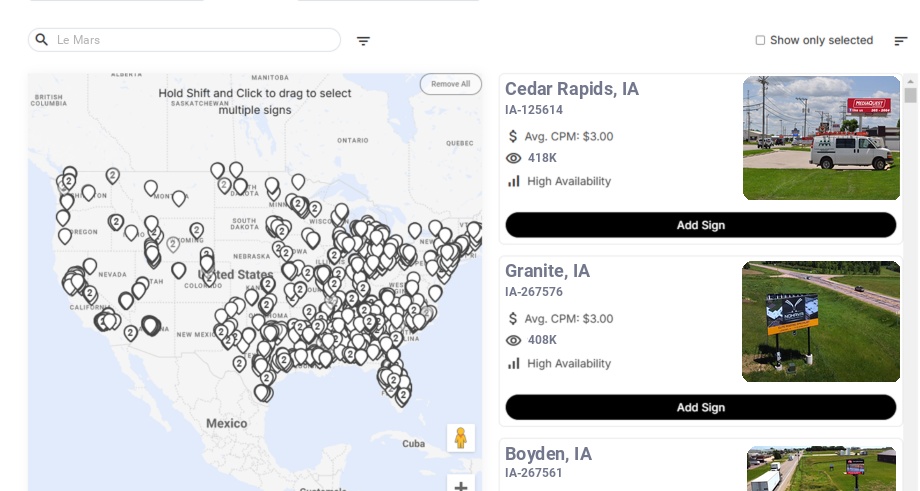



How much is a billboard in Le Mars?
Why Choose Blip for Billboard Advertising in Le Mars
-
Blip lets Le Mars advertisers launch fast on US-75 and IA-3, reaching commuters and rural shoppers without traditional sign-rental hassles.
-
In Le Mars, set budgets that flex for Ice Cream Days or the Plymouth County Fair, so you pay more only when traffic spikes.
-
Use Blip's dayparting in Le Mars to hit 6-9 a.m. commuters and 4-8 p.m. family traffic, not low-value overnight hours.
-
No contracts means Le Mars businesses can test billboard ads, track real-time results, and scale what works for Blue Bunny visitors and locals.
-
Blip's creative tools help Le Mars ads stay clear and local—swap messages for downtown events, harvest season, or Sioux City-bound traffic in minutes.
Frequently Asked Questions About Billboard Advertising in Le Mars
How much does a billboard cost in Le Mars, Iowa with Blip?
With Blip, you control exactly what you spend on Le Mars billboards by setting a daily budget that can be as small or as large as you like. Each “blip” is a brief 7.5 to 10-second ad on digital billboards in Le Mars, Iowa, and you only pay for the individual blips you receive. Your total cost is simply the sum of those displays over time, and prices per blip vary based on when and where your ad runs and current advertiser demand.
Where can I advertise with Blip in Le Mars, Iowa?
Le Mars gives advertisers a rare combination of small-town community cohesion, strong regional draw, and year-round traffic from manufacturing, agriculture, and tourism. Key corridors include US-75 for commuters and regional freight, IA-3 for east-west traffic, and downtown routes near the courthouse and Blue Bunny Visitor Center. Blip can concentrate impressions on specific boards and times aligned with these traffic flows instead of spreading spend thinly across the entire day.
Who sees Le Mars, Iowa billboards from Blip?
In Le Mars, billboard advertising can reach more than just the city’s 10,500–11,000 residents. The audience also includes Plymouth County residents, nearby small-town commuters, and regional visitors traveling from the Sioux City metro, which is only about 25 miles south. Traffic from work, school, shopping, and tourism creates repeated exposure on the same routes.
When is the best time to run Blip billboards in Le Mars, Iowa?
Blip’s ability to control when your ad shows is especially powerful in Le Mars because traffic is tied to commuting, shift work, and events. Morning hours are best for commuters and school traffic, midday for lunch and errands, afternoon for parents and school pickup, and evening for dining and weekend planning. With Blip, you can allocate a higher share of your budget to the windows that matter most to your business.
How does seasonality affect billboard advertising in Le Mars, Iowa?
Le Mars is not a flat market, and traffic spikes with tourism, agriculture, and school cycles. Ice Cream Season brings consistent summer visitor traffic, Ice Cream Days and the Plymouth County Fair draw large crowds, and planting, harvest, and holiday shopping all create additional demand. Digital billboards let you adjust creative and timing as those seasonal patterns change.
Do I need a contract to advertise with Blip in Le Mars?
No, Blip has no long-term contracts or minimum commitments. You can start, pause, or stop your campaign at any time.
How fast can I launch a billboard campaign with Blip in Le Mars?
You can have your campaign live in minutes. Create a free account, select your locations, set your budget, upload your design, and start running once approved.
Where can I advertise with Blip in Le Mars?
Blip has digital billboards in Le Mars. You can browse available locations on a map, choose the ones that fit your audience, and start advertising right away.
Still have questions? Launch a campaign in minutes — no contracts, no commitments.
Start Your CampaignLe Mars Billboard Advertising Guide
Le Mars gives us a rare combination for digital billboards: small‑town community cohesion, strong regional draw, and year‑round traffic from manufacturing, agriculture, and tourism. When we plan campaigns here, we’re not just reaching 10,000+ local residents—we’re intercepting workers, visitors, and shoppers from across northwest Iowa and the Sioux City

Market Overview: Why Le Mars Works for Digital Billboards
Le Mars is the Plymouth County seat and a regional hub in northwest Iowa. According to the City of Le Mars, the community has a population in the 10,500–11,000 range, while Plymouth County has roughly 25,000–26,000 residents spread across its towns and rural areas. Yet the realistic advertising reach for Le Mars billboard advertising is much larger:
- The Sioux City metropolitan area, only about 25 miles south, has well over 80,000 residents in the city proper and more than 145,000–160,000 residents in the broader metro, feeding regular traffic up and down US‑75.
- Daily commuting, freight, and regional retail traffic connect Le Mars to neighboring communities such as Orange City, Remsen, Kingsley, and Cherokee, adding thousands of non‑resident trips through town each week for work, school, and shopping.
Le Mars is also branded as the “Ice Cream Capital of the World,” home to Wells Enterprises/Blue Bunny
- A resident audience that repeatedly passes the same signs, often multiple times per day on work, school, and shopping trips.
- A tourism audience that spikes during specific months and events and can add thousands of extra vehicles per day on core corridors during peak weekends.
- A regional audience that travels through Le Mars for work, healthcare, government services, and shopping, often from 20–40 miles away.
Digital billboards let us adapt to each of those audience types by time of day, day of week, and season, rather than committing to a static, one‑size‑fits‑all message.
Audience & Demographics: Who We’re Reaching
When we design campaigns for Le Mars, it helps to think in concentric circles and to ground decisions in real data about age, income, and work patterns.
-
Core local residents (Le Mars city limits)
- Population: ~10,500–11,000 residents within city limits according to City of Le Mars.
- Median age is mid‑30s, with a strong presence of young families: roughly one‑quarter to one‑third of residents are under 18, and a sizable share are 25–44, the prime child‑rearing and spending years.
- Household composition tends to be family‑oriented, with more than half of households typically classified as family households in Midwestern cities of this size.
- The local economy is heavily influenced by manufacturing (Wells Enterprises is one of the largest private employers in northwest Iowa), agriculture, healthcare, education, and small retail/service businesses.
- Typical small‑city income levels in Iowa place many households in the $50,000–$90,000 range, with a meaningful segment of dual‑income families who are making frequent local purchasing decisions for food, healthcare, home services, and kids’ activities.
-
Plymouth County and surrounding small towns
- County population: about 25,000–26,000 residents, with Plymouth County government, courts, and services concentrated in Le Mars.
- Rural residents and small‑town households in this ring often depend on Le Mars for groceries, healthcare, auto service, and high‑school‑level activities, leading to frequent trips. It’s common for many of these residents to enter Le Mars multiple times per week.
- In comparable Iowa counties, 50–70% of workers commute outside their home community, many traveling 10–30 minutes each way. That pattern supports high billboard frequency along main commuter routes.
- This audience is highly reachable with repeated billboard impressions on the same commute routes, especially along US‑75, IA‑3, and key arterials feeding into town.
-
Regional & tourism traffic
- Visitors are drawn by Blue Bunny attractions, the historic downtown, Le Mars Area Chamber of Commerce events like Ice Cream Days, and regional attractions like the Plymouth County Fair.
- Major events can temporarily double or even triple typical daily visitor volumes downtown. For example, local fair reports often cite total fair‑week attendance in the tens of thousands, and popular summer weekends routinely fill local hotels and parking near the Blue Bunny Visitor Center.
- Day‑trippers from Sioux City and neighboring counties increase traffic volumes on US‑75 and IA‑3 during weekends and special events. Even modest‑sized events that draw 3,000–5,000 extra visitors over a weekend can translate into thousands of added daily vehicle trips across a handful of key corridors.
What this implies for messaging:
- Family‑focused creative resonates. With a demographic skew toward families and school‑age kids, creative that speaks to family budgets, safety, health, and activities performs well.
- Value and practicality sell. In similar Iowa markets, surveys show that more than 60% of consumers cite price and convenience as top drivers of local purchase decisions; clean, direct offers (“$5 Lunch Special,” “Free Estimates,” “Same‑Day Appointments”) line up with that mindset.
- Local identity matters. In tightly knit communities, local brands and references consistently outperform generic ones. Using the “Ice Cream Capital of the World” theme, “Plymouth County,” or local schools and events in your copy helps ads feel like part of the community conversation rather than outside noise.
Traffic Patterns & Key Corridors
Understanding how people move through Le Mars is crucial for scheduling and creative. The Iowa DOT traffic maps
-
US‑75 (north–south)
- Primary route for commuters between Le Mars and Sioux City, as well as regional freight traffic linking northwest Iowa communities.
- Average Annual Daily Traffic (AADT) counts on US‑75 near Le Mars are commonly in the low‑ to mid‑five‑figure range, with many segments carrying an estimated 10,000–15,000 vehicles per day and higher counts nearer to interchanges and commercial clusters.
- Even if only half of those vehicles belong to unique individuals, that still represents 5,000–7,500 potential daily eyeballs per direction before you factor in passengers.
-
Strong for:
- Commuter‑focused messaging (healthcare, jobs, education, service businesses).
- Time‑sensitive offers (limited‑time sales, restaurant specials).
- Regional brands drawing from multiple towns up and down the corridor.
-
IA‑3 (east–west)
- Connects Le Mars to Remsen, Cherokee, and other smaller communities to the east and west.
- Typical AADT values on IA‑3 near Le Mars frequently fall between 6,000 and 10,000 vehicles per day, depending on the exact segment.
-
Ideal for:
- Rural and ag‑oriented messaging targeted at producers and ag‑service workers traveling into town.
- Retail and services that local residents plan trips around (hardware, automotive, farm supply, healthcare).
-
Downtown & near‑downtown routes
- Streets feeding into the historic downtown, the courthouse, and the Blue Bunny Visitor Center see slower but denser traffic, especially during lunch hours, early evenings, and weekends.
- During major events such as Ice Cream Days, downtown traffic volumes can surge far above typical weekday levels, with blocks around Central Avenue and the visitor center effectively becoming pedestrian‑priority zones.
-
Perfect for:
- Walk‑in businesses (restaurants, boutiques, attractions).
- Wayfinding (“2 Blocks Ahead on Central Ave,” “Turn Left at 1st St NE”).
- Event reminders and countdowns keyed to specific days and times.
We can use Blip to concentrate impressions on specific boards and times aligned with these traffic flows instead of spreading spend thinly across the entire day, making billboard rental in Le Mars more efficient and accountable.
Local Seasonality: Timing Campaigns Around Le Mars Life
Le Mars is not a “flat” market; we see distinct spikes in traffic and local attention tied to tourism, agriculture, and school cycles. Major patterns to build around include:
-
Ice Cream Season (late May – early September)
- Blue Bunny and the “Ice Cream Capital of the World” brand drive consistent visitor traffic all summer. Visitor counts at the Blue Bunny Visitor Center and related attractions reach their highest levels between Memorial Day and Labor Day, with peak weekends drawing thousands of visitors.
- The annual Ice Cream Days celebration, promoted by the Le Mars Area Chamber of Commerce, packs the town with thousands of visitors over several days in June. Lodging often reaches or approaches capacity, and restaurant wait times grow, indicating significant incremental demand.
-
Strategy:
- Increase blips in late afternoons, evenings, and weekends when visitors are downtown and local families are out.
- Emphasize dining, retail, attractions, and lodging offers with simple, time‑bound calls to action.
- Use geo‑anchored messaging (“1 Minute from the Blue Bunny Parlor”) to catch tourists who are already navigating the city.
-
Plymouth County Fair (late July)
- The Plymouth County Fair draws tens of thousands of attendees over its multi‑day run and is often described locally as one of the largest free fairs in Iowa.
- On peak days, fairgrounds traffic can exceed typical daily city traffic in the surrounding neighborhood, with many families making multiple trips over the week.
-
Strategy:
- Start teasing 3–4 weeks out (“Get Your Fair Specials Here,” “Book Your Service Before Fair Week”) to catch planning behavior.
- Run heavier schedules during fair week with messages tailored to families, youth, and ag businesses, and include clear directions from US‑75 or IA‑3 to your business.
-
Agricultural calendar
- Planting (April–May) and harvest (September–October) bring long hours and heavy traffic from farm operators and suppliers. In many Iowa counties, farm equipment and grain trucks can add hundreds of extra large‑vehicle trips per day on key routes during peak weeks.
-
Strategy:
- For ag and equipment businesses: front‑load messages 2–4 weeks before planting/harvest (“Pre‑Season Discounts End May 1,” “Prepare Your Combine Before Harvest Rush”) when farmers are making purchasing decisions.
- For restaurants and convenience stores: advertise grab‑and‑go meals, coffee, and fuel around early mornings (5–8 a.m.) and late evenings (7–10 p.m.), matching typical farm workdays that often exceed 12 hours during busy seasons.
-
School year & sports seasons
- The Le Mars Community School District and Gehlen Catholic Schools
- Back‑to‑school periods and major sports seasons prompt concentrated purchasing for clothing, supplies, physicals, and extracurricular fees.
-
Strategy:
- Align campaigns promoting youth services, tutoring, healthcare, and local sponsorships with back‑to‑school (August) and major sports seasons (fall and winter).
- Use school‑themed creative (“Proud to Support Le Mars Athletics”) to build goodwill and align with the community’s strong support for school activities.
-
Holiday retail (November–December)
- Local residents often prioritize in‑town shopping and services, especially when winter weather—snow, ice, and sub‑freezing temperatures—discourages longer drives to larger cities.
- Many small Iowa communities see holiday season retail sales rise 20–40% above typical monthly averages, with special events and promotions driving spikes on weekends.
-
Strategy:
- Push strong local‑support and gift‑oriented messaging (“Shop Local in Le Mars,” “Gift Cards Available Today”).
- Increase evening and weekend impressions when families are out for events, church activities, and shopping, and use countdown‑style messages (“3 Days Left for Christmas Specials”) to prompt action.
Crafting Effective Creative for Le Mars
Because digital billboards reach drivers at high speed, we aim for simple, bold, and hyper‑relevant messages. In Le Mars, a few local nuances can boost performance:
-
Lean into “Ice Cream Capital of the World” as a mental landmark
- Use references like “Just Past the Ice Cream Capital Welcome Sign” or “2 Miles from Blue Bunny” when giving directions.
- Visitor‑oriented businesses can mention “While You’re in Le Mars…” to frame offers as part of the trip experience, especially when you know hundreds or thousands of out‑of‑town visitors are in the city for an event weekend.
-
Use community and county language
- Phrases like “Serving Plymouth County Since 1995,” “Le Mars Families Trust Us,” or “Local Care, Local People” resonate strongly in a tightly knit area where many residents have lived in or near the community for 10+ years.
- Sponsorship‑style creatives tied to events (fair, school activities, Ice Cream Days) can build long‑term brand equity, especially when you maintain visibility across multiple years so families repeatedly associate your name with the event.
-
Show real people and real places
- Photos of local‑looking families, ag operations, or recognizable Le Mars scenery (courthouse, downtown, farm landscapes) can create an instant sense of familiarity and trust.
- Avoid overly generic stock imagery if possible; even small local details—like a visible “Le Mars” sign, a familiar church steeple, or a local sports jersey color—can noticeably improve recall.
-
Design for speed and distance
- Limit text to 6–8 words when possible and keep key phrases at 3–5 words.
- Use large fonts and high‑contrast colors that stay readable in sun, snow, and twilight; winter glare off snowbanks can reduce legibility for low‑contrast designs.
- Feature one main idea per creative: one offer, one call to action, one logo. Multi‑message boards consistently test worse in driver recall studies than single‑focus designs.
-
Weather‑aware messaging
- Northwest Iowa’s winters can be harsh, with multiple snow events and extended stretches of below‑freezing temperatures most years, while summer heat waves can push heat indices well above 90°F.
-
Seasonal examples:
- Winter: “Stay Safe – Free Winter Tire Checks This Week”
- Summer: “Cool Off: $1 Off Any Ice Cream Treat Today”
- We can swap these creatives automatically with Blip instead of reprinting static vinyl, letting you pivot when local forecasts from outlets like KLEM 1410 AM / 96.9 FM
Dayparting & Scheduling: Matching Impressions to Daily Life
Blip’s ability to control when your ad shows is especially powerful in a market where traffic is tied to commuting, shift work, and events. Local patterns in towns of this size often show clearly defined peaks:
Morning (6–9 a.m.)
- Dominated by commuters, school traffic, and farm operations. In school months, it’s common for local arterials to see a 20–30% jump in volume during the hour before first bell.
-
Best for:
- Coffee shops, breakfast spots, convenience stores.
- Service businesses prompting planning behavior (“Call Us Today for a Free Quote”).
- Recruitment ads (“Hiring Day Shift – Apply This Morning”) when employers want to catch workers before they clock in.
Midday (11 a.m.–2 p.m.)
- Lunchtime peak plus errand trips; many shift‑based workers in manufacturing and healthcare cycle through lunch at staggered times, maintaining steady volumes.
-
Best for:
- Restaurants, quick‑service food, and same‑day services.
- Health, dental, and auto shops promoting “Walk‑In” or “Same‑Day” options that can be scheduled over a lunch break.
Afternoon school & shift change (3–6 p.m.)
- Parents picking up kids, workers heading home, early event traffic. On school days, you often see pronounced surges right after final bell and again around 5 p.m.
-
Best for:
- Family‑oriented offers.
- Fitness, after‑school programs, and youth services.
- Retail promotions and “Tonight Only” deals that prompt a stop on the way home.
Evening (6–10 p.m.)
- Prime for entertainment, dining, and weekend planning. Weeknights are often steadier in smaller cities than in large metros, but Fridays and Saturdays can see clear spikes for dining and events.
-
Best for:
- Restaurants, bars, movie theaters, and special events.
- Brand‑building campaigns that benefit from repeated exposure over weeks to the same audience.
With Blip, we can allocate a higher share of your budget to two or three of these windows that matter most to your business rather than paying for low‑value impressions at 2 a.m. when traffic volumes can fall to a small fraction of daytime levels. This kind of precise dayparting is one of the main advantages of digital Le Mars billboard advertising over traditional, all‑day static placements.
Aligning With Local Media & News Cycles
Le Mars residents still rely heavily on local news outlets, which shape what people are thinking and talking about. Pairing billboard schedules with local news cycles can keep your message timely:
- Le Mars Daily Sentinel covers city government, schools, and community events, often driving conversations about taxes, public projects, and school activities.
- KLEM 1410 AM / 96.9 FM
- Sioux City Journal covers regional stories that influence Le Mars residents, especially around business, healthcare systems, and politics that affect the entire metro and neighboring counties.
Consider:
- Running issue‑specific campaigns when related topics are in the news (for example, healthcare ads during flu‑season coverage, ag financing offers when crop prices or farm policy lead the headlines, or local legal/financial services when tax or regulatory changes are prominent).
- Timing job‑recruitment or expansion announcements to coincide with press coverage and complement it with billboard impressions, so residents hear your name in multiple channels within the same 24–72‑hour period.
- Coordinating with the Le Mars Area Chamber of Commerce event calendar so your billboard messages reference festivals, parades, or fairs that are already being promoted in local media.
Using Blip’s Flexibility in a Smaller Market
In a community the size of Le Mars, efficient use of budget is critical. Blip’s on‑demand buying model lets us act more like a local media planner than a static‑sign renter when it comes to billboards in Le Mars:
-
Start small, scale strategically
- Many advertisers begin with modest daily budgets focused on one or two boards and a few key dayparts—often mornings and late afternoons on US‑75 or IA‑3.
- As we see which times and creatives drive calls, web visits, or store traffic (for example, a 20–30% bump in Google searches for your brand on days you run heavier schedules), we can gradually increase your bids in those specific windows.
- Because you’re buying impressions rather than long‑term leases, you can test different spend levels without committing to multi‑month static contracts, making billboard rental in Le Mars accessible even for smaller advertisers.
-
Rotate multiple creatives
- Run different messages for weekdays vs. weekends, or for commuter traffic vs. tourist‑heavy days.
- Test variants: one ad with a price‑driven offer and another focused on benefits or community values; track which coincides with higher call volumes or in‑store mentions.
- Swap in event‑specific creatives for a short burst (“Fair Week Special,” “Ice Cream Days Sale”) and revert to general branding afterward, matching spend to the weeks when events can add thousands of extra visitors.
-
Geo‑calibrated campaigns
- If you draw customers from both Le Mars and Sioux City, we can emphasize different offers or messages at boards oriented toward each travel direction.
- For example, northbound US‑75 traffic coming from Sioux City might see “Le Mars Exit – Shop Local Boutiques Downtown,” while southbound boards could highlight “On Your Way to Sioux City? Stop in Le Mars First – Save on [Your Category].”
- For IA‑3, creatives can spotlight ag services and rural‑focused messaging, reflecting the higher share of farm and small‑town traffic on that route.
Example Campaign Approaches for Le Mars
To illustrate how all of this comes together, here are sample strategies we might deploy:
-
Local Restaurant Near Downtown
- Target: Families, visitors downtown, and workers looking for lunch or dinner.
-
Tactics:
- Daypart: 11 a.m.–2 p.m. and 4–8 p.m., heavier on Fridays and Saturdays when dining traffic peaks.
- Summer creative: “Hungry After Blue Bunny? 2 Blocks Ahead on Central Ave.”
- Off‑season creative: “Kids Eat Free Tuesday Nights – Downtown Le Mars.”
- Increase budget 2–3x during Ice Cream Days and Plymouth County Fair week, when visitor counts can spike into the thousands per day, and track whether daily ticket counts or average check size increase on high‑impression days.
-
Ag Equipment Dealer Serving Plymouth & Nearby Counties
- Target: Farmers and ag businesses traveling on IA‑3 and US‑75.
-
Tactics:
- Heavy flight in February–April: “Pre‑Season Planter Service – Book by April 1.” Focus on early‑morning (6–9 a.m.) and early‑evening (5–8 p.m.) impressions, matching typical farmer schedules.
- Another flight in August–October: “Harvest Ready? 24/7 Break‑Down Support.” Use clear phone numbers or short URLs for emergency calls.
- Layer messaging around local ag events and field days promoted through KLEM 1410 AM / 96.9 FM
-
Healthcare Clinic or Dental Practice
- Target: Families, commuters from surrounding towns, and older adults.
-
Tactics:
- Steady year‑round presence for brand trust: “Same‑Day Appointments in Le Mars – Call Today.”
- Seasonal creatives: back‑to‑school physicals in August (“Sports Physicals – Walk In Today”), flu shots in fall (“Flu Shots Now Available in Le Mars”), sports injury treatment during football and basketball seasons.
- Align campaigns with peak local media coverage about health topics in sources like the Le Mars Daily Sentinel or Sioux City Journal, so your ads reinforce stories people are already seeing.
-
Local Retailer or Service Business Competing With Sioux City
- Target: Residents weighing whether to shop locally or drive to the city.
-
Tactics:
- Messaging: “Skip the Drive to Sioux City – Save Time, Shop Local in Le Mars.”
- Promote perks: free delivery in Plymouth County, extended hours, or price‑match guarantees. In markets where a majority of residents live within a 10‑minute drive of main shopping areas, time savings alone can be a powerful differentiator.
- Weekend‑heavy schedule when shopping trips are planned, with additional impressions during major local events (Ice Cream Days, holiday parades) that bring in out‑of‑town visitors who might be persuaded to buy locally instead of stopping at national chains on the highway.
By grounding our billboard strategy in Le Mars’ real traffic flows, community rhythms, and regional role, we can use Blip to act with the precision of a big‑city media plan—without the big‑city budget. When we align creative, timing, and location with how people actually live and move through the “Ice Cream Capital of the World,” digital Le Mars billboards become one of the most visible and flexible tools in the local marketing mix, and Le Mars billboard advertising becomes a reliable driver of awareness and foot traffic for businesses of all sizes.