Billboards in Milford, IA
No Minimum Spend. No Long-Term Contracts. Just Results.
Trusted by Leading Brands


Billboard advertising
in Milford has never been easier
How much is a billboard in Milford?
Why Choose Blip for Billboard Advertising in Milford
-
Blip lets you launch Milford billboard ads fast on US-71, reaching lake-bound drivers as they head into the Iowa Great Lakes.
-
Set a flexible budget in Milford and only pay for the blips you want, ideal for summer spikes and quieter off-season weeks.
-
Use Milford dayparting to hit 7-9 a.m. and 4-6 p.m. commuter rushes, plus Friday-Sunday visitor traffic to the lakes.
-
No contracts means you can test Milford campaigns for Okoboji tourists, then shift creative when Memorial Day to Labor Day traffic surges.
-
Track Milford results in real time and optimize for destination-bound traffic on US-71, IA-86, and local school routes.
-
Blip's creative tools make it easy to swap Milford ads for lake weekends, trail users, or local families with quick, clear messages.
Frequently Asked Questions About Billboard Advertising in Milford
How much does a billboard cost in Milford, Iowa with Blip?
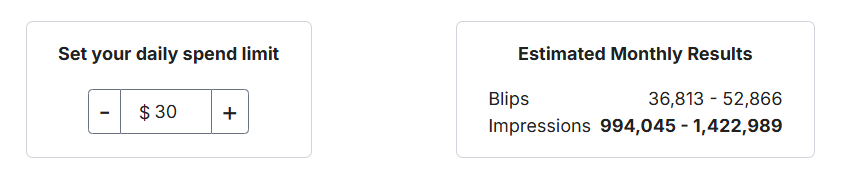
With Blip, you set your own daily budget, and your brief 7.5–10 second “blips” on digital billboards in Milford, Iowa run only as often as your budget allows. Each blip is individually priced based on when and where it appears, plus real-time advertiser demand, so you only pay for the exposure you actually get. Start small, adjust your budget anytime, and test how powerful flexible, pay-per-blip advertising can be.
Where can I advertise with Blip in Milford, Iowa to reach the most traffic?
Milford sits directly on the main approach to the lakes, and traffic has been trending upward over the last decade as tourism grows. U.S. Highway 71 near Milford typically carries about 12,000–14,500 vehicles per day during non-peak periods, and summer Fridays and Saturdays can push daily volumes into the 15,000–18,000 range. Iowa Highway 86 and local routes also capture resort, school, work, and retail traffic.
What makes Milford, Iowa billboards effective for Blip campaigns during the summer?
Milford’s unique edge is its proximity to the Iowa Great Lakes, which draws hundreds of thousands of visitors each year and can swell the effective population during the core summer weeks. Daily traffic volumes and ad impressions can effectively double or more on peak weekends compared to off-season weekdays, especially on US-71. A single well-placed digital billboard can rack up tens of thousands of impressions per summer weekend.
Who will see my Milford, Iowa billboard ads with Blip?
Milford is speaking to a stable, civically engaged audience with solid incomes, plus a fast-turnover visitor audience during tourism months. The town has just over 3,300 residents, and Dickinson County has a strong share of seasonal and recreational properties that increase warm-weather population. Visitors often come from Sioux City, Des Moines, Minneapolis, Omaha, and Sioux Falls, typically within a 2–4 hour radius.
When is the best time to run a billboard in Milford, Iowa with Blip?
Weekday volumes on key approaches to Milford often show clear peaks between 7:00–9:00 a.m. and 4:00–6:00 p.m., when work and school trips overlap. Friday afternoon through Sunday evening brings a noticeable bump from leisure traffic, and peak-season Saturdays can carry 10–20% more traffic than midweek days. Blip’s ability to schedule campaigns by hour and day lets you concentrate budgets into the busiest windows.
Do I need a contract to advertise with Blip in Milford?
No, Blip has no long-term contracts or minimum commitments. You can start, pause, or stop your campaign at any time.
How fast can I launch a billboard campaign with Blip in Milford?
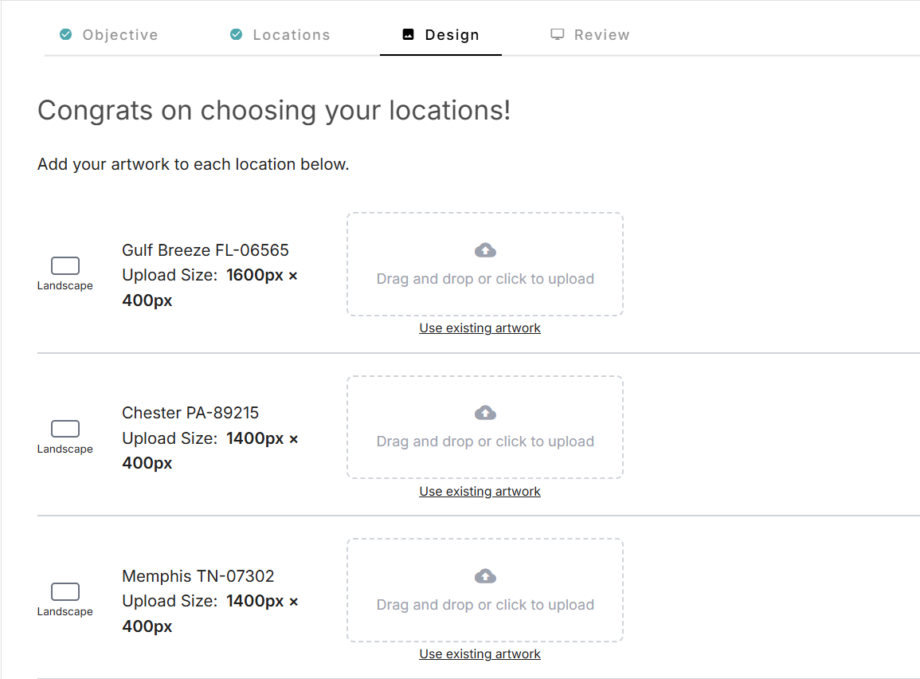
You can have your campaign live in minutes. Create a free account, select your locations, set your budget, upload your design, and start running once approved.
Where can I advertise with Blip in Milford?
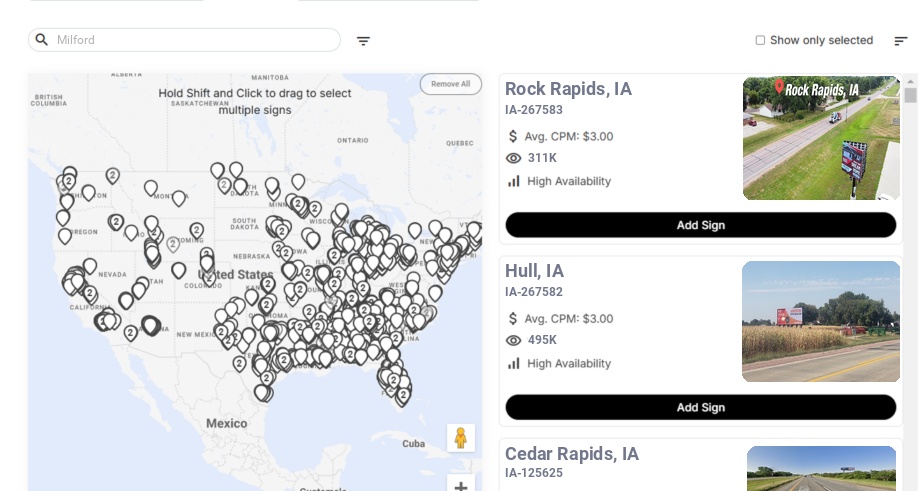
Blip has digital billboards in Milford. You can browse available locations on a map, choose the ones that fit your audience, and start advertising right away.
Still have questions? Launch a campaign in minutes — no contracts, no commitments.
Start Your CampaignMilford Billboard Advertising Guide
Milford may look like a small town on the map, but it sits at the gateway to one of the Midwest’s busiest lake destinations. When we design digital billboard campaigns here, we’re really talking to two overlapping markets: a tight‑knit local community of just over 3,300 residents and a massive seasonal influx of visitors heading to the Iowa Great Lakes. That combination makes Milford an unusually powerful place to use Blip’s flexibility in timing, location, and creative rotation, and explains why Milford billboards consistently punch above their weight in terms of reach and visibility.

Milford at a Glance: Market Overview
Milford is located in Dickinson County, at the southern edge of the Iowa Great Lakes region. A few key data points set the stage for our billboard strategy and help explain the strong performance of billboards in Milford:
-
Population
- Milford’s official 2020 population is 3,321 residents, up from 2,474 in 1990 and roughly 2,900 in 2000—an increase of about 15–20% over the last two decades and more than 34% over three decades.
- Dickinson County’s 2020 population is 17,703 residents, with population holding steady to slightly growing in recent years while many rural Iowa counties are flat or declining.
- Milford accounts for nearly 1 in 5 Dickinson County residents, making it a key hub on the south side of the lakes and a natural focal point for Milford billboard advertising.
-
Age and household dynamics
- The median age in Dickinson County is in the 42–45 range, several years older than Iowa’s statewide median in the upper 30s. Roughly 25–30% of residents are 60+, reflecting strong retiree and second‑home populations.
- At the same time, about 20–23% of residents are under 18, supported by stable school enrollment in the Okoboji Community School District
- Average household size in the area is roughly 2.3–2.4 people per household, and more than 70–75% of occupied housing units are owner‑occupied, indicating a rooted, long‑term local base.
- Dickinson County also has a high share of seasonal and recreational properties: in many lake‑adjacent census tracts, 30–40% of housing units are classified as seasonal or occasional‑use homes, which dramatically increases warm‑weather population without inflating the year‑round resident count.
-
Income and spending power
- Dickinson County’s median household income is in the $65,000–$70,000 range, roughly 5–10% higher than the Iowa statewide median.
- Per‑capita income in the county runs in the mid‑$40,000s, among the stronger figures for non‑metro counties in Iowa.
- Visitor and second‑homeowner spending is substantial. Tourism reports for the Iowa Great Lakes area estimate tens of millions of dollars in annual direct visitor spending in Dickinson County alone, with strong categories including lodging, dining, recreation, and retail.
- This mix of higher‑than‑average resident incomes plus significant out‑of‑area visitor spending supports campaigns for discretionary categories like dining, recreation, home improvements, vehicles, and professional services, all of which can benefit from well‑timed Milford billboards along key corridors.
-
Key local anchors
- Education & community: Okoboji Community School District 1,000–1,100 student range across its schools, with strong participation in athletics and activities that draw families into town multiple times per week.
- Government & services: City information, utility notices, and community updates are centralized at the City of Milford, while county‑level resources such as public health, elections, and emergency management are available via Dickinson County.
- Healthcare: Regional medical services are anchored by providers such as Lakes Regional Healthcare in nearby Spirit Lake, drawing patients from across Dickinson County and neighboring counties.
- Trails and recreation: The popular multi‑use trail network coordinated by the Dickinson County Trails Board adds to Milford’s appeal for cyclists, walkers, and runners.
- Local news and media: Residents follow outlets like the Dickinson County News, KUOO Campus Radio, and regional sites like Explore Okoboji
For advertisers, this means we’re speaking to a stable, civically engaged audience with solid incomes, and—crucially—an additional, fast‑turnover visitor audience during tourism months that can easily swell the effective population in the core summer weeks to several times the year‑round base. In this environment, even a small amount of strategic billboard rental in Milford can deliver meaningful market coverage.
Traffic Patterns and Prime Billboard Moments
Billboard performance in Milford is driven far more by vehicle counts and trip purposes than by resident population alone. Milford sits directly on the main approach to the lakes, and traffic has been trending upward over the last decade as tourism grows, which is why billboards in Milford can rival placements in larger regional markets for exposure during peak months.
-
U.S. Highway 71 (US‑71)
- According to recent Iowa Department of Transportation traffic counts, US‑71 near Milford typically carries about 12,000–14,500 vehicles per day (Average Annual Daily Traffic) during non‑peak periods.
- On summer Fridays and Saturdays, day‑of‑week counts can climb 20–40% above the annual average, pushing peak‑season daily volumes into the 15,000–18,000 vehicles per day range on segments feeding into the lakes.
- Over a 3‑month core summer window (roughly 90 days), that can translate into 1.3–1.6 million vehicle trips passing key digital billboard locations.
-
Iowa Highway 86 (IA‑86) and local routes
- IA‑86, west of the lakes, generally runs in the 5,000–7,000 vehicles per day range, with higher weekend spikes tied to resort and campground traffic.
- Local collectors and city streets in Milford handle a substantial share of school, work, and retail traffic. For example, school‑adjacent streets can see pronounced peaks during arrival and dismissal times, with hundreds of vehicles per hour at the busiest moments.
- Because a significant proportion of IA‑86 and US‑71 traffic is “destination‑bound” rather than through‑traffic, advertisers benefit from motorists who are actively making decisions about where to stop, shop, and stay.
What this implies for Blip campaigns:
-
Commuter windows
- Weekday volumes on key approaches to Milford often show clear peaks between 7:00–9:00 a.m. and 4:00–6:00 p.m., when work and school trips overlap. These windows can account for 30–40% of weekday traffic.
- Run heavier schedules in these blocks to reach local workers, school traffic, and service vehicles.
- Use these slots to promote everyday needs—groceries, banking, healthcare, auto services, and local retail—where consistent, repeated impressions drive habit and loyalty.
-
Weekend and evening spikes
- Friday afternoon through Sunday evening sees a noticeable bump from leisure traffic. On sunny peak‑season weekends, traffic volumes can be 1.2–1.5× higher than a typical weekday.
- Focus these times on restaurants, entertainment, attractions, lodging, and nightlife, when both locals and visitors are deciding how to spend their discretionary time and money.
-
Directional and “last‑chance” messaging
- Because US‑71 is a main corridor into the Iowa Great Lakes, a large share of drivers are en route to a specific destination rather than simply passing through. Research in roadside advertising consistently shows that clear, near‑term directional cues (e.g., “Next Right”) significantly increase response rates versus generic branding alone.
- Calls‑to‑action like “Next Right,” “2 Miles Ahead,” or “Turn at Milford” are especially effective for gas, food, bait, groceries, and family activities that benefit from spontaneous decision‑making.
Blip’s ability to schedule campaigns by hour and day aligns perfectly with these patterns. We can concentrate budgets into the hours when the highway is busiest with our best‑fit audience instead of paying equally for low‑value times, effectively increasing impressions per dollar in your core target windows and improving the ROI of your Milford billboard advertising.
Seasonal Tourism and the Iowa Great Lakes Advantage
Milford’s unique edge is its proximity to the Iowa Great Lakes. The broader region—centered around Spirit Lake and Okoboji—draws hundreds of thousands of visitors each year, with some tourism estimates topping 1,000,000 visitor days during a strong season when you account for day‑trippers, week‑long guests, and seasonal homeowners. This surge is exactly why Milford billboards are so valuable for brands that depend on tourism and seasonal demand.
Local tourism organizations like the Iowa Great Lakes Area Chamber of Commerce and Okoboji Tourism Committee highlight:
- Peak visitor season: roughly Memorial Day through Labor Day, with July and early August often representing the highest hotel occupancy rates and lake usage.
- Major draw: outdoor recreation on West Okoboji Lake, East Okoboji Lake, Spirit Lake, and related chains; plus attractions like Arnolds Park Amusement Park, which can host thousands of guests per day on busy summer weekends.
- Strong shoulder seasons: May, September, and early October for events, fishing, and fall color. Weekend events during these periods can push hotel occupancy into the 70–90% range, keeping traffic and spending elevated outside the classic summer window.
Tourism spending in Iowa’s northwest counties runs into the hundreds of millions of dollars annually, and Dickinson County consistently ranks among the top non‑metro tourism counties in the state. That spending is heavily concentrated within a 15–20 minute drive of Milford.
What this means for advertisers:
-
Summer multipliers
- Daily traffic volumes and ad impressions can effectively double or more on peak weekends compared to off‑season weekdays, especially on US‑71.
- A single well‑placed digital billboard can rack up tens of thousands of impressions per summer weekend, reaching both the local base and a rotating influx of high‑spending visitors (vacation budgets, lake home improvements, dining out).
- Many lake visitors spend $100–$300 per day per travel party on food, entertainment, fuel, and retail, making even small changes in capture rate highly valuable.
-
Visitor profile
- Many visitors drive in from Sioux City, Des Moines, Minneapolis, Omaha, and Sioux Falls, typically within a 2–4 hour radius.
- Travel parties often consist of families or groups of 3–6 people traveling in one or two vehicles, amplifying the value of each impression.
- They are primed to spend on experiences (boat rentals, concerts, amusement parks, bars and restaurants) and convenience (groceries, gas, lake gear, forgotten items). Impulse‑driven categories see meaningful lifts when paired with strong roadside visibility.
-
Event‑driven surges
- Big weekend events around Okoboji or Arnolds Park—concert series, holiday fireworks, fishing tournaments, classic car shows—can spike traffic and lodging demand.
- Coordinating your Blip schedule with event calendars published by the Chamber, tourism sites, and local media such as Explore Okoboji
Using Blip, we can:
- Run aggressive schedules from late May through August, particularly Friday–Sunday, then taper to maintenance levels in off‑season while still maintaining brand presence.
- Launch short, intense bursts around specific festivals or holiday weekends (e.g., 4th of July, Memorial Day, Labor Day) without committing to month‑long static placements.
- Swap creative mid‑season to reflect changing offers, sold‑out dates, or new events in real time—critical when events sell out or weather shifts plans at the last minute. This kind of agility is a major advantage of digital billboard rental in Milford versus traditional static boards.
Crafting Creative That Resonates in Milford
Great creative is especially important on digital billboards, where exposure time is often 6–10 seconds and most drivers are moving at 45–55 mph on approaches to Milford. In Milford and the Iowa Great Lakes area, a few local nuances shape how we design artwork and get the most from Milford billboard advertising:
Design for fast‑moving traffic
-
Use 5–7 words max in your main headline; studies of roadside readability show comprehension drops sharply beyond 8–9 words at highway speeds.
- Aim for one dominant visual: a product shot, your logo, or a strong lifestyle image (a family on the lake, a boat on the water, a burger close‑up).
- Keep font sizes large and high‑contrast: white or yellow on dark blue, black, or rich green backgrounds routinely test better for legibility than low‑contrast color combinations.
- Avoid clutter: limit secondary text to one short line, and rely on your logo or URL for brand recall.
Lean into the lake lifestyle
Themes and visuals that perform well locally include:
- Water and recreation: lakes, boats, paddleboards, marinas, fishing, and trail access along the Dickinson County Trails.
- Family fun: kids at the amusement park, mini‑golf, ice cream, casual dining—especially imagery that mirrors scenes at Arnolds Park Amusement Park and nearby attractions.
- Relaxation and escape: sunsets over the lake, bonfires, cozy cabins, and patios with lake views.
For example:
-
“BEER • BURGERS • LAKE VIEWS – EXIT MILFORD”
- “RAINY DAY? INDOOR FUN 5 MINUTES AHEAD →”
Speak to both locals and visitors
We can rotate different creatives to address each audience and use Blip’s scheduling tools to show the most relevant message at the right time:
-
Local‑focused slides
- “LOCALLY OWNED SINCE 1985 – SERVICE YOU KNOW & TRUST”
- “MILFORD FAMILIES SAVE 20% THIS WEEKEND – SHOW THIS AD”
- “ASK ABOUT OUR MILFORD LOYALTY DISCOUNT”
-
Visitor‑focused slides
- “FIRST TIME IN OKOBOJI? START WITH US – EXIT MILFORD”
- “FUEL, SNACKS, BAIT – NEXT RIGHT IN MILFORD”
- “RAINY DAY PLAN B – FAMILY FUN 3 MINUTES AHEAD”
Because Blip lets us run multiple creatives in the same campaign, we can A/B test headlines or imagery and gradually shift more budget to the best‑performing designs over a 2–4 week window, then refresh again for the next season. This testing approach works especially well for advertisers running multiple billboards in Milford and comparing performance by message, time of day, or audience.
Smart Targeting With Blip: When and Where to Run
While we won’t detail the platform mechanics, it’s important to understand how Milford’s geography and rhythms guide our scheduling strategy.
Dayparting: Match the message to the moment
-
Morning (6:00–10:00 a.m.)
- Focus on coffee shops, breakfast spots, gas stations, convenience stores, and work‑related services (contractors, equipment rental, auto repair). Morning commuters and early‑departing lake visitors make up a disproportionately high share of weekday trips in this window, often 25–30% of the day’s traffic.
- Use short, urgency‑driven headlines: “COFFEE AHEAD,” “TOOL RENTAL TODAY,” “OIL CHANGE BEFORE THE LAKE.”
-
Midday (10:00 a.m.–3:00 p.m.)
- Target tourist activities (boat rentals, amusement parks, museums, shopping districts, trails) and lunch traffic. Families often make midday decisions about secondary stops, especially if weather alters lake plans.
- Messaging like “RAIN OR SHINE FUN” or “LAKE GEAR YOU FORGOT” captures mid‑trip decisions.
-
Evening (3:00–9:00 p.m.)
- Emphasize restaurants, bars, family entertainment, and lodging as people decide where to eat and how to spend the evening.
- Example: “DINNER ON THE PATIO – 5 MINUTES FROM HERE” or “ROOMS AVAILABLE TONIGHT – EXIT MILFORD.”
-
Late night (after 9:00 p.m.)
- Narrower use: late‑night dining, emergency services (ER/urgent care), and hospitality.
- Even if overall volumes are lower, the share of visitors staying overnight or seeking specific late‑night options can be high, making each impression more targeted.
Weekly and seasonal pacing
-
Weekdays (Mon–Thu)
- Heavier weight on local services and employment ads, when residents are commuting or running errands and visitor volumes are lower than weekends.
- Great for banks, insurance, medical practices, home services, and local government notices from the City of Milford or Dickinson County.
- Employers can focus on early‑morning and late‑afternoon commute times to reach job seekers.
-
Weekends (Fri–Sun)
- Increase frequency for tourism‑driven campaigns, restaurant specials, events, and retail promotions. Peak‑season Saturdays can carry 10–20% more traffic on key corridors than midweek days, magnifying your reach.
- Align messaging with lakeside events promoted through the Iowa Great Lakes Area Chamber of Commerce and Iowa Great Lakes tourism.
-
Off‑season (roughly November–April)
- Lake traffic drops significantly, but core local activity—school, healthcare, essential retail—remains stable.
- Lower competition on boards can provide strong share of voice for branding campaigns at a lower effective cost per thousand impressions.
- Local businesses can dominate visibility during winter, when messaging is more about trust, reliability, and essentials rather than pure recreation.
Industry-Specific Ideas for Milford Advertisers
Different sectors can take advantage of Milford’s mix of local and visitor traffic in specific ways. Regardless of sector, the same principles of smart Milford billboard advertising apply: clear calls‑to‑action, strong visuals, and timing that matches audience behavior.
Restaurants, Bars, and Coffee Shops
- Use distance callouts: “2 MINUTES AHEAD,” “NEXT RIGHT IN MILFORD,” “BEFORE THE LAKE TURN.” Research on roadside advertising consistently shows that adding distance indicators improves stop‑through rates, especially when drivers are within 1–5 miles of the business.
- Rotate time‑sensitive offers: lunch specials in midday slots, happy hour in late afternoon, late‑night food after 9 p.m. on Fridays and Saturdays.
- Feature signature items in visuals: a local burger, pizza, or a recognizable patio view overlooking the lakes or a busy Milford corner.
- During peak season, consider pairing billboard messaging with mentions or sponsorships on local outlets like KUOO Campus Radio or Explore Okoboji
Tourism, Attractions, and Experiences
- Coordinate with lake event calendars from Iowa Great Lakes Area Chamber and Iowa Great Lakes tourism, as well as local event listings on Explore Okoboji
- Run short, high‑frequency bursts for special weekends (concerts, tournaments, festivals) rather than spreading impressions thin all month. A 3–5 day heavy push can outperform a lightly sprinkled 30‑day flight for event‑driven goals.
- Use FOMO‑style lines: “ONLY THIS WEEKEND,” “LIMITED SEATS,” “LAST CHANCE THIS SUMMER.”
- Highlight weather‑proof activities for days when conditions limit lake time: arcades, indoor attractions, museums, and shopping.
Retail and Services (Local and Regional)
-
For hardware, auto parts, farm & ranch, and home goods, emphasize convenience and savings:
- “BUY IT HERE, USE IT AT THE LAKE – EXIT MILFORD”
- “LOCALS SAVE 10% – ASK ABOUT OUR MILFORD DISCOUNT.”
- Many visitors arrive to find they forgot essentials or need quick fixes (grills, tools, sporting goods, lawn and dock supplies). Capture that demand with messages tailored to “forgotten items” and “fix it before you hit the lake.”
- In off‑season, run branding campaigns focused on “Your Hometown [Category] Store” to stay top-of-mind year‑round and reinforce that you serve both Milford and lake residents.
Hiring and Workforce Campaigns
With a modest but tight labor pool, many employers around Milford compete for similar workers. Dickinson County’s unemployment rate often sits in the 2–4% range, indicating a relatively tight labor market:
- Feature starting wage or salary clearly (e.g., “$18–$22/HR”), as billboard viewers have only a few seconds to absorb the key benefit.
- Use short URLs or QR‑style domains to track interest (“WorkAt[Brand].com”) and monitor how many applications come in during your billboard flight dates.
- Daypart toward commuter windows and early evenings, when potential applicants are driving to and from existing jobs.
- Consider timed pushes aligned with high school and college graduation dates, promoted via local media such as the Dickinson County News.
Real Estate, Builders, and Lake Home Services
- Target spring and early summer heavily, when buyers and second‑home shoppers are active. Listings and showings often spike from April through July, paralleling rising lake visitation.
- Highlight unique local advantages: “5 MIN TO WEST OKOBOJI,” “YEAR‑ROUND LAKE LIVING,” or “DOCK‑READY LOTS NEAR MILFORD.”
- Promote services for lake homeowners—docks, landscaping, remodeling, roofing, HVAC—right as visitors are noticing what their property needs.
- Include simple, memorable URLs or phone numbers, since real estate decisions often involve follow‑up research after the drive.
Healthcare and Public Services
-
For clinics, dental offices, and hospitals, emphasize access and wait times:
- “URGENT CARE • SHORT WAITS • EXIT MILFORD.”
- “SAME‑DAY APPOINTMENTS • NEW PATIENTS WELCOME.”
- Tie seasonal messaging to community rhythms—back‑to‑school physicals, flu shots, sports injuries, and summer safety.
- Local governments and organizations can announce public meetings, safety campaigns, or seasonal reminders (e.g., boating safety, trail etiquette, school start dates) with clear, simple visuals and URLs back to the City of Milford, Dickinson County, or public health pages linked from those sites.
- Emergency and safety messages can be especially impactful during holiday weekends, when visitor volumes and on‑water activity peak.
Measuring and Optimizing Your Milford Campaign
Even in a smaller market, we should treat billboard advertising as a measurable, optimizable channel. Whether you are testing Milford billboards for the first time or adding Milford placements to a regional buy, tracking response lets you refine spend over time.
Here are practical ways to track and improve performance:
-
Use dedicated URLs or phone numbers
- Create a unique landing page (e.g.,
yourbrand.com/milford) and track visits during your Blip flight. Look for spikes in traffic that correspond to your highest‑frequency billboard hours. - Use a call tracking number visible only on your billboard creative and monitor call volume by day and time.
- Create a unique landing page (e.g.,
-
Time‑bound offers
- “Mention this sign for 10% off through Sunday” or “Show this ad image on your phone” allows you to compare in‑store code redemptions against your impression schedule.
- Compare redemption patterns between peak‑season and off‑season flights to understand how visitor traffic versus local traffic performs for your category.
-
Align with local news and events
- Monitor local outlets like the Dickinson County News, KUOO, and Explore Okoboji
- Adjust your creative and timing to piggyback on what people are already thinking about—graduations, tournaments, holiday weekends, major concerts, and community initiatives.
-
Seasonal creative refreshes
-
Plan at least 3–4 creative variations per year:
- Winter: local essentials, comfort, service reliability, and year‑end or new‑year offers
- Spring: preparation and upgrades (boats, homes, vehicles, landscaping)
- Summer: lakes, experiences, visitors, and extended hours
- Fall: back‑to‑school, home projects, health check‑ups, and off‑season deals for locals
- Aim for each creative to run long enough—2–4 weeks—to build recognition, but not so long that it feels stale to daily commuters.
-
Plan at least 3–4 creative variations per year:
Blip’s flexibility in budget, timing, and creative rotation is especially powerful in a market like Milford, where traffic volumes and audience composition change dramatically between January and July. By grounding your decisions in local data—traffic counts on US‑71, tourism seasonality around the Iowa Great Lakes, and community rhythms reflected in local schools and media—you can turn a small‑town gateway into a big‑impact billboard strategy that reaches both year‑round residents and the region’s high‑value visitors, while making every dollar of your billboard rental in Milford work as efficiently as possible.