Billboards in Solon, IA
No Minimum Spend. No Long-Term Contracts. Just Results.
Trusted by Leading Brands


Billboard advertising
in Solon has never been easier
How much is a billboard in Solon?
Why Choose Blip for Billboard Advertising in Solon
-
Blip lets Solon advertisers launch fast on Iowa Highway 1 to reach commuters headed to Iowa City, Coralville, and North Liberty.
-
No contracts or minimums in Solon mean you can test Lake Macbride summer traffic, then shift budgets for Hawkeye game days.
-
Use Blip dayparting in Solon to hit 6-9 a.m. and 4-7 p.m. drives on Iowa 1, when car-heavy traffic is highest.
-
Track Solon campaigns in real time and reallocate spend toward I-80 Coralville or I-380 Cedar Rapids if they perform best.
-
Blip's creative tools help Solon ads stand out with clean, high-contrast designs for winter roads, lake weekends, and campus traffic.
Frequently Asked Questions About Billboard Advertising in Solon
How much does a billboard cost in Solon with Blip?
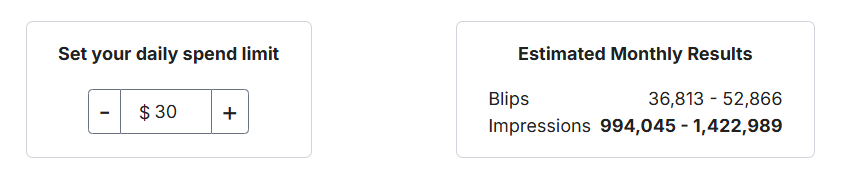
With Blip, the cost of billboard advertising in Solon is flexible and easy to control. You set a daily budget, and Blip’s algorithm uses it to bid on open ad slots, so you only pay when your ad actually displays. Each “blip” is a 7.5-to-10-second spot on a rotating digital billboard, with prices starting at just $0.01 per display.
Where can I advertise with Blip in Solon, Iowa?
Solon’s travel patterns revolve around a few corridors that connect the city to jobs, shopping, healthcare, campus activity, and recreation. Iowa Highway 1 is the primary local spine for Solon, and Interstate 80 in Coralville and Interstate 380 toward Cedar Rapids are major nearby routes for broader reach. Nearby routes serving Lake Macbride and Iowa City-facing areas are also valuable depending on your audience.
Why is Solon, Iowa a good market for Blip billboard ads?
Solon is a small Iowa city with an outsized billboard opportunity because it sits inside a fast-growing, highly mobile corridor between Iowa City, Coralville, North Liberty, and Cedar Rapids. The city had 3,018 residents in 2020, but the practical audience across the nearby five-city market reaches 258,353 residents. Solon is also strongly vehicle-oriented, with 0 fixed-route local transit lines in the city itself.
When is the best time to run billboard ads in Solon, Iowa with Blip?
Summer is one of the strongest billboard seasons in Solon because Lake Macbride State Park becomes a major draw from Memorial Day through Labor Day. Late August through November is another prime window because the University of Iowa fall semester brings students back and football traffic picks up. Winter can also be a strong period for urgent care, pharmacy, tire and auto service, HVAC, plumbing, grocery, insurance, and holiday retail campaigns.
How do I target commuters and local drivers in Solon, Iowa with a billboard?
Solon is a market where timing can materially improve efficiency. We can daypart Iowa 1 boards for southbound morning commutes from about 6 to 9 a.m., then emphasize northbound return traffic from about 4 to 7 p.m. Because Solon is car-dependent in practical terms, roadside media reaches people where daily decisions actually happen, which is in the car.
Do I need a contract to advertise with Blip in Solon?
No, Blip has no long-term contracts or minimum commitments. You can start, pause, or stop your campaign at any time.
How fast can I launch a billboard campaign with Blip in Solon?
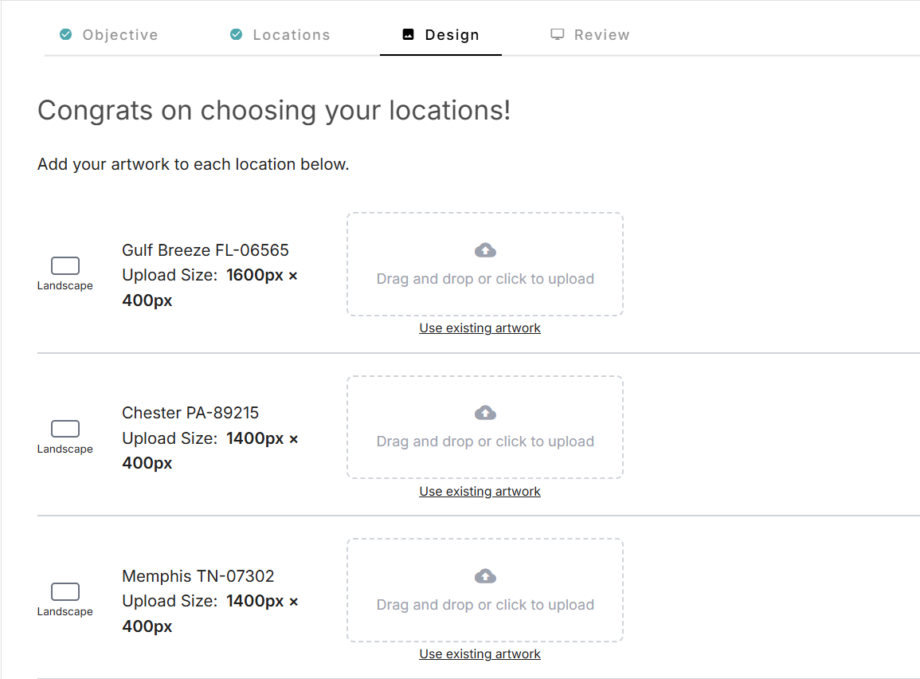
You can have your campaign live in minutes. Create a free account, select your locations, set your budget, upload your design, and start running once approved.
Where can I advertise with Blip in Solon?
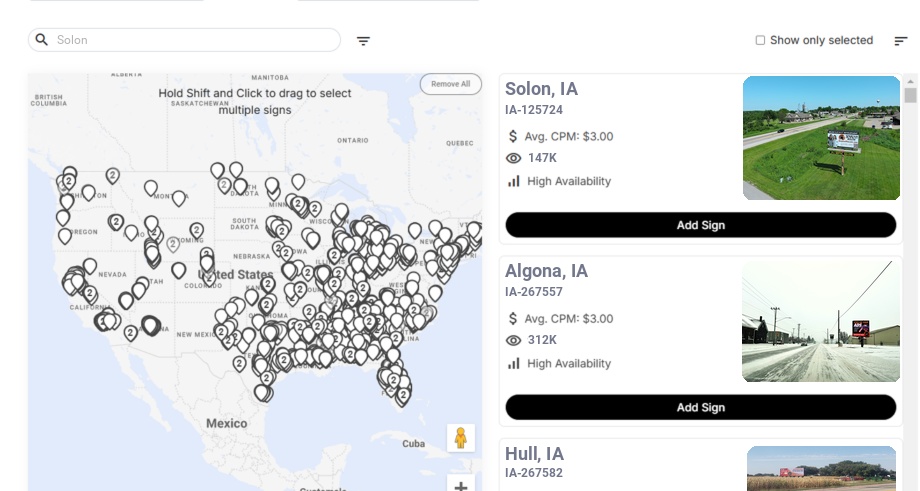
Blip has digital billboards in Solon. You can browse available locations on a map, choose the ones that fit your audience, and start advertising right away.
Still have questions? Launch a campaign in minutes — no contracts, no commitments.
Start Your CampaignSolon Billboard Advertising Guide
Solon Coralville North Liberty, and Cedar Rapids, serving a 152,854-person Johnson County and a 258,353-resident five-city market. The city had 3,018 residents in 2020, but nearby cities within an easy drive bring the practical audience far higher, to 258,353 residents across those five communities alone.
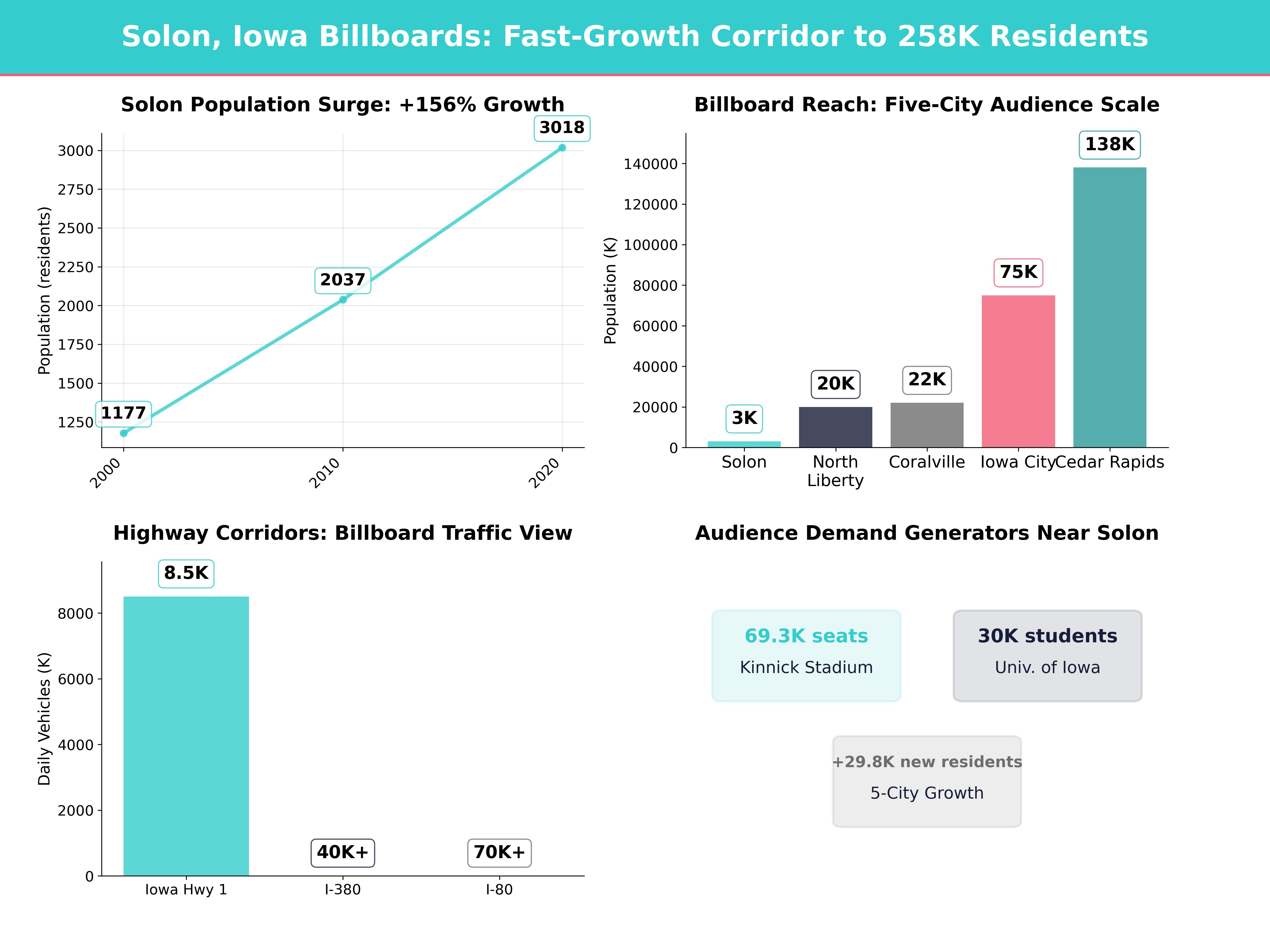
Solon is also strongly vehicle-oriented, with 0 fixed-route local transit lines in the city itself, so roadside media reaches people where daily decisions actually happen, which is in the car. When we add summer recreation at Lake Macbride State Park, which spans 2,180 acres and centers on an 812-acre lake, fall Iowa Hawkeyes traffic at Kinnick Stadium 69,250 seats, and year-round university and healthcare movement, including the University of Iowa's roughly 30,000 students, Solon becomes a smart market for efficient digital billboard campaigns.
Solon Market Overview
Growth in Solon and the surrounding corridor
Using population tables from the Iowa Data Center, we can see that Solon grew from 1,177 residents in 2000 to 2,037 in 2010, and then to 3,018 in 2020. That means Solon added 1,841 residents in 20 years, which is a 156.4% increase. From 2010 to 2020 alone, the city added 981 residents, or 48.2%.
That local growth matters even more because Solon sits in a larger, expanding consumer shed. Johnson County grew from 130,882 residents in 2010 to 152,854 in 2020, which was a 16.8% increase. Nearby North Liberty reached 20,479 residents in 2020, up from 13,374 in 2010, for a 53.1% increase.
Coralville 22,318 residents in 2020, up from 18,907, which was an 18.0% increase. Iowa City 74,828 residents in 2020, up from 67,862, for a 10.3% increase. Cedar Rapids reached 137,710 residents in 2020, up from 126,326, for a 9.0% increase.
Those nearby cities are important for billboard advertisers because Solon does not function as an isolated small town. Solon, Iowa City, Coralville, and North Liberty together total 120,643 residents. When we add Cedar Rapids, the nearby five-city market reaches 258,353 residents, and those cities together added 29,847 residents from 2010 to 2020.
Economy, mobility, and what they mean for advertisers in Solon
The Solon market is supported by durable regional anchors, including the University of Iowa, University of Iowa Health Care, University of Iowa Research Park, Downtown Iowa City Iowa River Landing, and the broader employment base represented by the Cedar Rapids Metro Economic Alliance. The university alone enrolls about 30,000 students, which keeps demand elevated for food, housing, healthcare, retail, financial services, entertainment, and professional services.
Solon’s location gives us reach into several job centers at once. The city is roughly 10 to 15 miles from North Liberty, Coralville, and Iowa City, and roughly 20 to 25 miles from Cedar Rapids, depending on destination and route. That creates repeated commuter exposure across the week.
Mobility is especially favorable for billboards because Solon is car-dependent in practical terms. The city has 0 fixed-route local transit lines, and the fixed-route systems operated by Iowa City Coralville the University of Iowa do not directly serve Solon. Johnson County SEATS provides demand-response transportation, but everyday commuting, errands, youth activities, healthcare trips, and recreation travel still happen overwhelmingly by personal vehicle.
For advertisers, that means our audience spends meaningful time on roads where digital billboards can build both frequency and action.
Key Traffic Corridors Around Solon
Solon’s travel patterns revolve around a few corridors that connect the city to jobs, shopping, healthcare, campus activity, and recreation. When we understand how each route behaves, we can match our creative and timing to the right audience.
Iowa Highway 1 through Solon and toward Iowa City
Iowa Department of Transportation traffic maps show that Iowa Highway 1 is the primary local spine for Solon, with traffic counts generally in the 7,000 to 10,000+ AADT range between Solon and the urban edge southward, depending on segment. This is the route many residents use to reach Iowa City, Coralville-area destinations, and university-related trips.
This corridor is especially strong for advertisers that need repeated local frequency.
- Restaurants, convenience stores, and service businesses benefit because commuters are making immediate stop-or-go decisions on the way home.
- Healthcare, dental, and appointment-based businesses benefit because the route captures residents heading toward Iowa City medical and professional districts.
- Home services, banks, insurance agencies, and local retailers benefit because Iowa 1 reaches the stable household audience that defines Solon’s core customer base.
Interstate 80 in Coralville, west of Solon
According to Iowa DOT counts, the busiest segments of Interstate 80 through Coralville run above 70,000 AADT. That volume makes I-80 the scale corridor for Solon-area campaigns. It connects our message to regional shopping, hotel, dining, and event traffic while still serving local residents on regular cross-town trips.
This corridor works well when we want reach beyond Solon itself.
- Regional retail and dining brands benefit because I-80 serves traffic headed to Coral Ridge Mall, Iowa River Landing, and Coralville’s hotel and restaurant clusters.
- Tourism, entertainment, and event advertisers benefit because visitors entering the Think Iowa City
- Legal, healthcare, and higher-consideration services benefit because long-exposure interstate traffic helps build broad awareness across Johnson County and beyond.
Interstate 380 through North Liberty and toward Cedar Rapids
Iowa DOT traffic maps also show that busier Interstate 380 segments near North Liberty carry more than 40,000 AADT. This route is the north-south connector between the Iowa City area and Cedar Rapids, and it is especially valuable for labor-market campaigns, regional services, and businesses with customers on both ends of the corridor.
This corridor is ideal for advertisers with a wider service area.
- Employers and recruiters benefit because I-380 captures workers moving between Johnson County and the Cedar Rapids metro.
- Auto dealers, home improvement brands, and B2B services benefit because the route serves a broad cross-section of suburban households and trade workers.
- Travel and airport-related businesses benefit because it is an access route for people heading toward The Eastern Iowa Airport.
Recreation approaches west and north of Solon
Not every valuable Solon audience is a commuter audience. Solon also sits near Lake Macbride State Park, which spans 2,180 acres and centers on an 812-acre lake. Nearby routes serving Lake Macbride and the Coralville Lake recreation area become much more important from late spring through early fall.
These approaches are excellent for time-sensitive local offers.
- Restaurants, ice cream shops, coffee stops, and convenience retail benefit because weekend visitors often decide where to stop on the way to or from the lake.
- Sporting goods, marine, campground, and recreation brands benefit because the audience is already in an outdoor mindset.
- Urgent care, pharmacies, towing, and automotive services benefit because they can reach travelers during high-movement leisure periods.
Solon Audience Segments
Commuters and regional households in Solon
The foundational Solon audience is the daily commuter and household shopper. Solon’s own population is 3,018, but the real opportunity comes from repeated circulation between Solon, Iowa City, Coralville, North Liberty, and Cedar Rapids. The four-city Johnson County cluster totals 120,643 residents, and the five-city corridor totals 258,353. That is large enough for both local service advertisers and regional brands.
We should think of Solon households as practical, route-based consumers. They are often deciding among healthcare providers, schools, grocery trips, youth activities, restaurants, banks, contractors, and weekend plans while they drive. Billboards work well here because they intercept everyday intent, not just passive awareness.
University, healthcare, and student audiences around Solon
The University of Iowa creates a second, highly valuable audience layer. With about 30,000 students, the campus expands demand for apartments, furniture, telecom, banking, apparel, dining, entertainment, medical care, and convenience retail. University of Iowa Health Care also pulls patients, staff, students, and visitors from throughout eastern Iowa, which broadens the useful audience far beyond Solon residents.
Sports traffic amplifies that opportunity. Kinnick Stadium 69,250, so home football weekends create reliable spikes in travel, dining, retail, and lodging demand. For many advertisers, those weekends are some of the most efficient times to buy high-visibility boards on I-80, Iowa 1, and Iowa City approaches.
Families, schools, and homeowners in the Solon market
Solon’s growth pattern tells us a lot about its household makeup. A city that grows 48.2% in a single decade is attracting families, homebuyers, and residents making long-term investments in the community. The Solon Community School District reinforces that household focus, and school calendars shape traffic patterns for parents, students, and local businesses.
This audience is ideal for:
- Home services, because homeowners in growing communities regularly need HVAC, plumbing, roofing, landscaping, and remodeling help.
- Healthcare and family services, because parents make recurring decisions about clinics, dental care, vision care, childcare, and extracurriculars.
- Financial and professional services, because growing family markets respond well to trust-based local branding.
Outdoor recreation and weekend visitors near Solon
Through Think Iowa City Lake Macbride State Park gives Solon an outdoor recreation identity that many inland small towns do not have.
That matters because recreational traffic behaves differently from commuter traffic. Weekend visitors are more open to spontaneous spending, food and drink stops, event attendance, and experience-based purchases. If we sell fun, convenience, or immediacy, Solon’s recreation audience can be very responsive.
Seasonal Opportunities in Solon
Summer in Solon brings lake traffic and community events
Summer is one of the strongest billboard seasons in Solon. Lake Macbride State Park becomes a major draw from Memorial Day through Labor Day, and those 2,180 acres of parkland create recurring weekend traffic from across the region. This is a strong window for restaurants, convenience retail, recreation brands, auto services, and local attractions.
July also matters because of Solon Beef Days, which brings additional community attention and visitor movement. We can use that period for hyper-local branding, limited-time offers, and community-centered creative that feels timely rather than generic.
Fall in Solon is shaped by football, move-in, and the academic cycle
Late August through November is another prime window. The University of Iowa fall semester brings students back, parents visit, leases turn over, and football traffic picks up. With 69,250 seats at Kinnick Stadium 6 or 7 home football weekends can create significant spillover demand for dining, parking-related services, entertainment, apparel, and retail.
This is the season when we should lean into game-day relevance, college-town energy, and route-based calls to action near Iowa City, Coralville, and I-80.
Winter in Solon favors essentials, healthcare, and strong visual contrast
Winter weather changes the advertising mix, but it does not reduce the usefulness of billboards. In colder months, Solon-area drivers are still traveling to work, school, medical appointments, and shopping nodes in Coralville and Iowa City. Winter is often a strong period for urgent care, pharmacy, tire and auto service, HVAC, plumbing, grocery, insurance, and holiday retail campaigns.
Creative also matters more in winter because gray skies, early darkness, and snow glare reward simple, high-contrast designs. In Solon, clarity often beats complexity from November through February.
Spring in Solon is a reset season for services and family spending
Spring is a strong re-entry period for home improvement, landscaping, outdoor retail, graduation-related spending, and family activity planning. It is also a good time to move from awareness to action as roads clear, people resume longer errands, and households start booking warm-weather services.
For Solon advertisers, spring is an ideal testing season because we can learn whether our best response comes from commuters, lake traffic, or university-driven demand before the summer peak arrives.
Billboard Design Tips for Solon
Creative themes that fit Solon best
Solon sits at the intersection of small-town trust, university spillover, and outdoor recreation. Because of that mix, our best creative usually feels practical, local, and visually clean rather than flashy or overly urban. Messaging that emphasizes convenience, reliability, and familiarity tends to fit better here than abstract brand statements.
We usually get the strongest local resonance when creative reflects one of three mindsets.
- The family-and-homeowner mindset responds to trust markers such as local service, fast scheduling, clear pricing, and nearby locations.
- The commuter mindset responds to urgency, convenience, and directional relevance.
- The recreation-and-visitor mindset responds to fun, food, comfort, and easy stops.
Messaging approaches that work in the Solon market
Because many impressions happen on Iowa 1, I-80, and I-380, our copy should reflect route-based decision making. Place names matter in this market. Solon drivers know the difference between Solon, North Liberty, Coralville, Iowa City, and Cedar Rapids, so those names can make an ad feel instantly more relevant.
We should favor message structures such as these.
- Destination-led messages work well because they tie the ad to where the driver is already going.
- Benefit-led local offers work well because families and commuters often want to know what problem we solve right now.
- Season-led messages work well because Solon traffic changes so much between lake season, football season, and winter service season.
A practical example is to pair a strong benefit with a recognizable local cue. A line that references Lake Macbride, game day, Coralville shopping, or Iowa City appointments will usually feel more grounded than a generic statewide message.
Color and image choices that feel right for Solon
Summer creative can lean into blues, greens, bright whites, and outdoor imagery because the area’s recreation identity is real. Fall creative can use black-and-gold adjacent palettes, crisp typography, and energetic layouts that nod to Iowa Hawkeyes season without relying on licensed marks. Winter creative should use bold contrast, larger type, and less visual clutter because weather conditions reduce the value of intricate artwork.
We should also use recognizable imagery with discipline. A lake, trail, truck, patio meal, family activity, or clean storefront can feel very natural in Solon. Generic skyline imagery usually feels disconnected from the market.
Regional Strategies Around Solon
Solon proper and the Iowa 1 approach
If our goal is local frequency, the Solon strategy should start with Iowa 1 and close-in approaches. This is where we repeatedly reach residents traveling to school, work, appointments, and routine shopping. These placements are especially effective for local restaurants, service businesses, clinics, banks, and real estate-related advertisers.
This part of the market is about repetition, not just raw scale. A smaller but highly relevant audience can outperform a larger one when the message matches an everyday local need.
North Liberty and Coralville as the scale-up strategy for Solon campaigns
When we want broader reach, we should extend west toward North Liberty and Coralville 20,479 and 22,318 residents in 2020, and they sit on stronger retail and interstate corridors than Solon itself. This is where we scale Solon campaigns into regional shopping, dining, healthcare, and entertainment behavior.
Placements around Coral Ridge Mall, Iowa River Landing, and I-80 help us reach both residents and visitors. For many advertisers, this is the best place to combine Solon relevance with metro-level traffic.
Iowa City targeting for campus, medical, and downtown demand
Iowa City 74,828 residents in 2020 plus the student and visitor population generated by the University of Iowa. If we need students, faculty, healthcare traffic, downtown dining demand, or event audiences, Iowa City-facing boards are often the right complement to Solon-area frequency.
This strategy is especially effective for apartment marketing, urgent care, specialty medical services, dining, live events, retail, and professional services that rely on a younger or more mobile customer base.
Cedar Rapids expansion for recruiting and northbound regional reach
Cedar Rapids is the largest nearby city, at 137,710 residents in 2020, and it adds a different audience profile to the mix. Northbound expansion works well for employers, trade schools, healthcare systems, industrial suppliers, home services, and businesses recruiting across county lines.
If our service area extends into the Cedar Rapids metro or our labor pool does, then I-380 boards can turn a Solon campaign into a true corridor strategy.
Using Blip Tools in Solon
Dayparting and budget control for Solon travel patterns
Solon is a market where timing can materially improve efficiency. We can daypart Iowa 1 boards for southbound morning commutes from about 6 to 9 a.m., then emphasize northbound return traffic from about 4 to 7 p.m. We can also shift spending toward Friday afternoons and weekend windows during lake season, or toward Saturday game-day periods during football season.
This is where Blip’s flexibility is especially useful. We do not need to buy every hour equally. We can put more of our budget into the hours when Solon drivers are most likely to be moving toward our store, clinic, restaurant, or event.
Creative rotation and seasonal swaps in Solon
Solon’s audience changes meaningfully over the year, so our creative should change with it. We can run lake-oriented ads in June and July, back-to-school messages in August, football-season creative in September and October, and holiday or winter-service messaging in November and December.
That matters because the same board can serve different intents across the year. Blip makes it practical to rotate artwork without turning a local campaign into a complicated media project. Even a modest test works because pay-per-play pricing starts at $0.01 per display.
Analytics and optimization across Solon submarkets
Solon is a strong market for testing because it has several distinct audience pools packed into a compact geography. We can compare Iowa 1 commuter boards against I-80 scale boards, or North Liberty retail boards against Iowa City campus-facing boards, and then shift budget based on what actually delivers.
Real-time analytics are valuable here because the differences between corridors are meaningful. If a family-services ad is outperforming near Solon and a recruiting ad is stronger on I-380, we can optimize around those findings instead of guessing.
Getting Started with Billboard Rental in Solon
How we should choose billboard locations in Solon
When we rent a billboard in the Solon market, we should choose locations based on movement patterns, not just city names. We should prioritize boards on or near the Iowa 1 commuter path if we need repeated exposure to Solon residents.
If we need broader regional reach, we should add I-80 placements in Coralville. If we need recruiting or corridor-wide awareness, we should expand to I-380 toward Cedar Rapids. If we need summer leisure traffic, we should favor routes that intercept Lake Macbride and weekend recreation movement.
If we need student or medical audiences, we should include Iowa City-facing boards tied to campus and healthcare destinations. We should also pay attention to direction of travel, nearby exits, likely driver speed, and how close the board is to the action we want the audience to take.
What to expect when renting digital billboards around Solon
The Solon market is easier to approach when we think in corridors rather than in a single municipal boundary. The best digital options may sit on approaches into Solon, on Coralville interstates, or on North Liberty and Iowa City connectors rather than only inside Solon itself.
That is normal for a city this size, and it is often an advantage because the approach routes carry the most useful impressions. Compared with traditional billboard buying, Blip makes Solon especially approachable because we can launch quickly, test multiple routes, adjust dayparts, and refine creative without waiting through a long sales cycle or committing to a rigid long-term package.
That matters in a market where seasonality and corridor choice strongly affect results.
A practical Solon launch plan
For many advertisers, a smart Solon launch is simple.
- We can start with 1 Iowa 1 board to build local household frequency.
- We can add 1 I-80 board in Coralville to capture regional scale and shopping intent.
- We can add an I-380 board if recruiting, northbound reach, or Cedar Rapids exposure matters.
- We can run the campaign for 2 to 4 weeks, review analytics, and then shift budget toward the corridor producing the strongest response.
That approach lets us match the real Solon market, which is not just one town but a connected driving region. When we combine Solon’s growth, Johnson County momentum, lake-season travel, and university spillover with smart timing and localized creative, digital billboards can become one of the most efficient ways to stay visible across this part of eastern Iowa.