Billboards in Council Bluffs, IA
No Minimum Spend. No Long-Term Contracts. Just Results.
Trusted by Leading Brands


Billboard advertising
in Council Bluffs has never been easier
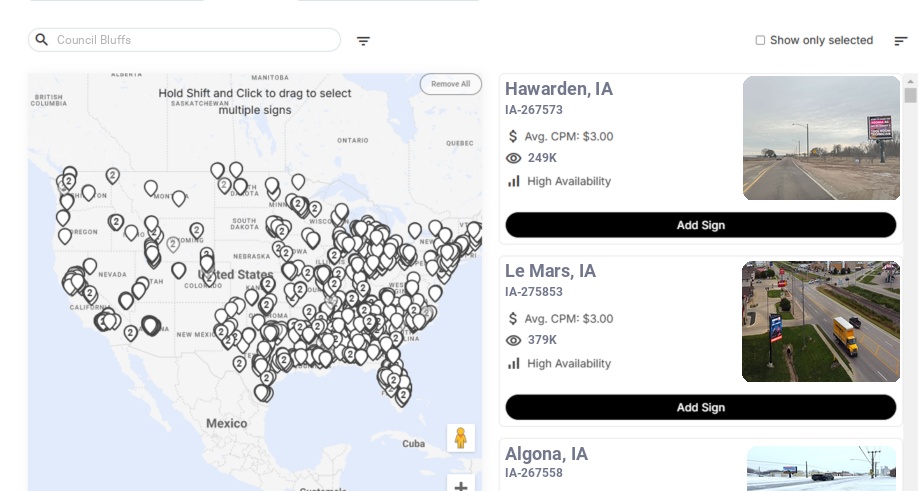



How much is a billboard in Council Bluffs?
Why Choose Blip for Billboard Advertising in Council Bluffs
Blip lets Council Bluffs advertisers launch fast on I-80/I-29 and pay only when ads play—perfect for the metro's 70,000+ daily vehicle flow.
In Council Bluffs, daypart Blip to catch 6-9 a.m. and 3:30-6:30 p.m. commuters crossing into Omaha, then shift to evening casino traffic.
No contracts in Council Bluffs means you can test Broadway, I-480, or South Expressway and move budget as traffic or events change.
Blip's real-time analytics help Council Bluffs brands see what works across commuter, visitor, and cross-river audiences—then optimize quickly.
Use Blip's creative tools to build bold Council Bluffs ads for winter fog, summer lake traffic, and visitors heading to the Mid-America Center.
Frequently Asked Questions About Billboard Advertising in Council Bluffs
How much does a billboard cost in Council Bluffs with Blip?
With Blip, billboard advertising in Council Bluffs is flexible and budget-friendly because you only pay when your ad actually appears. Each “blip” is a 7.5-to-10-second display on a rotating digital billboard, and pricing starts at $0.01 per display. Your daily budget helps Blip’s algorithm bid for open ad slots, while the cost per blip can vary based on time of day, location, and advertiser demand.
Where can I advertise with Blip in Council Bluffs?
Council Bluffs sits at one of the most strategically useful advertising locations in the Midwest. The I-80 and I-29 overlap through urban Council Bluffs regularly carries roughly 70,000 to 90,000 vehicles per day on its busiest segments, and I-480, I-680, Broadway, and Iowa 92 each reach different commuter, retail, and travel audiences. A board on the Iowa side can still influence spending decisions made across the river.
Why is Council Bluffs a good market for billboard advertising with Blip?
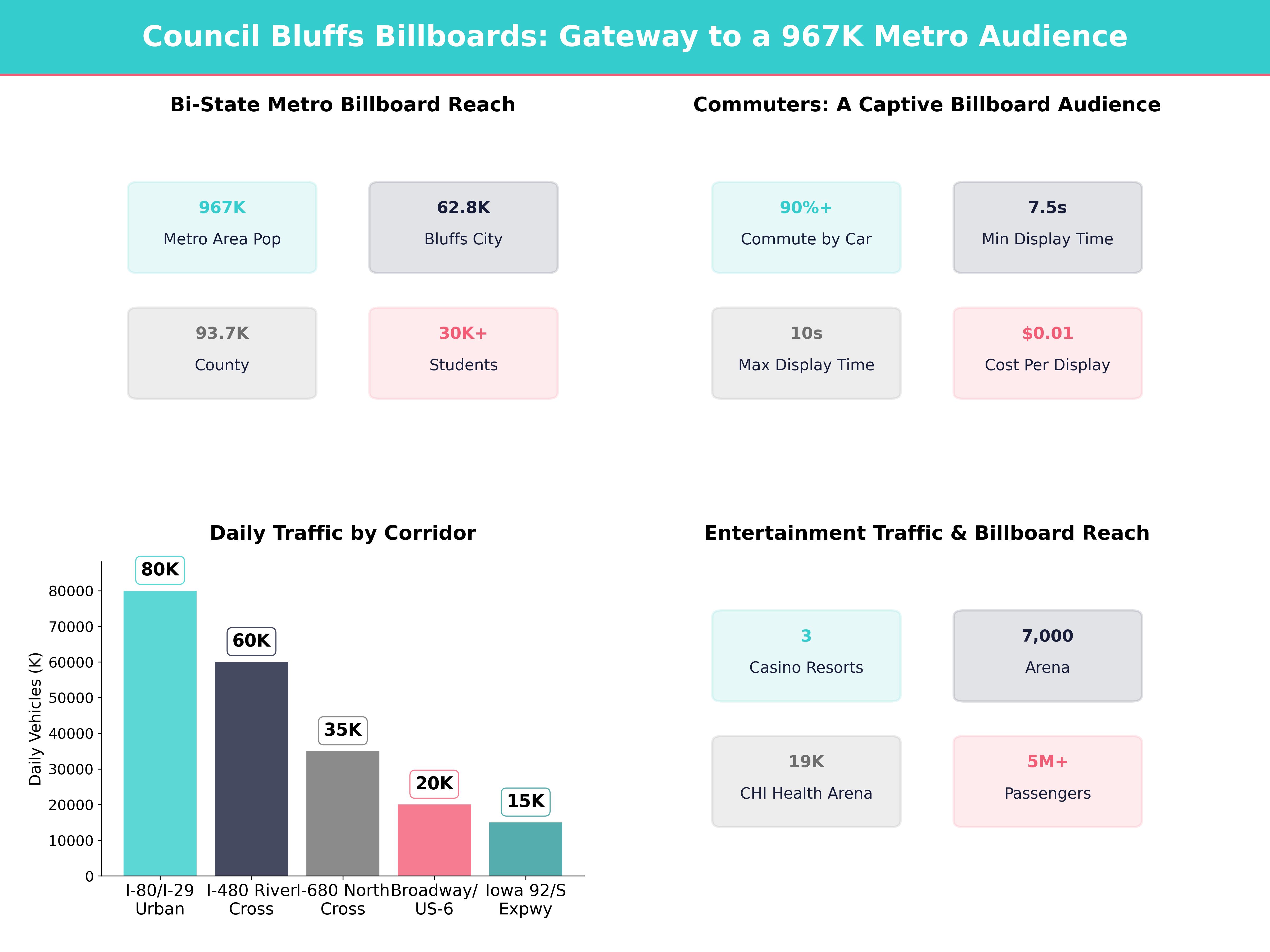
Council Bluffs gives advertisers a stable local population of 62,799 residents, a fast-moving commuter base, and nonstop regional traffic flowing between Iowa and Nebraska. More than 90% of workers in the area commute by car, truck, or van, so digital billboards can reach people where they spend real time and make real decisions. The wider Omaha-Council Bluffs metro reached 967,604, which means advertisers are speaking into a bi-state market that is far larger than the city alone.
When is the best time to run billboard ads in Council Bluffs?
Council Bluffs rewards timing discipline, and the same board can speak to very different audiences in January, June, and November. Morning commute windows around 6:00 a.m. to 9:00 a.m. and afternoon windows around 3:30 p.m. to 6:30 p.m. are obvious priorities for commuter-focused brands. Evening blocks from 7:00 p.m. to midnight can work well for casinos, restaurants, entertainment, and hospitality.
What kind of businesses work well for Council Bluffs billboard ads with Blip?
The local economy is diverse enough to support several strong billboard categories, including logistics, data infrastructure, education, hospitality, gaming, and entertainment. That mix creates billboard-friendly buying cycles for daily service buyers, regional commuters, visitors and eventgoers, plus hotels, restaurants, attractions, and healthcare providers. Recruiters, staffing firms, CDL schools, industrial suppliers, and quick-service operators can also benefit from impressions delivered outside the classic 9-to-5 pattern.
Do I need a contract to advertise with Blip in Council Bluffs?
No, Blip has no long-term contracts or minimum commitments. You can start, pause, or stop your campaign at any time.
How fast can I launch a billboard campaign with Blip in Council Bluffs?
You can have your campaign live in minutes. Create a free account, select your locations, set your budget, upload your design, and start running once approved.
Where can I advertise with Blip in Council Bluffs?
Blip has digital billboards in Council Bluffs. You can browse available locations on a map, choose the ones that fit your audience, and start advertising right away.
Still have questions? Launch a campaign in minutes — no contracts, no commitments.
Start Your CampaignCouncil Bluffs Billboard Advertising Guide
Council Bluffs gives us something billboard advertisers love: a stable local population (62,799 residents in 2020, up just 0.9% from 2010), a fast-moving commuter base, and nonstop regional traffic flowing between Iowa and Nebraska. The city had 62,799 residents in 2020, Pottawattamie County 93,667, and the broader Omaha-Council Bluffs metro reached 967,604, which means we are advertising into a bi-state market that is far larger than the city alone. Because more than 90% of workers in the area commute by car, truck, or van, digital billboards can reach people in the setting where they spend real time and make real decisions. We also benefit from year-round visitor demand driven by 3 casino resorts, major event venues, the Missouri River crossings, and nearby Omaha attractions.
Council Bluffs Market Overview
Council Bluffs sits at one of the most strategically useful advertising locations in the Midwest. We are not only speaking to residents of Council Bluffs, but also to shoppers, workers, travelers, and eventgoers moving through a shared Iowa-Nebraska economy shaped by Omaha, Carter Lake, and the wider metro (967,604 people). For advertisers, that matters because a board on the Iowa side can still influence spending decisions made across the river.
Council Bluffs demographics and growth patterns
Council Bluffs itself grew from 62,230 residents in 2010 to 62,799 in 2020, which was an increase of about 0.9%. Pottawattamie County 93,158 to 93,667 over the same decade, or about 0.5%. Those are modest numbers, but the broader Omaha-Council Bluffs metro added 102,254 residents between 2010 and 2020, which was growth of about 11.8%.
That combination is attractive for out-of-home advertising. We get a dependable base of local households in Council Bluffs, but we also tap into a much larger regional audience that continues to expand. We can use Council Bluffs boards for hyperlocal messaging, regional branding, or both at once.
What the economy means for advertisers in Council Bluffs
The local economy is diverse enough to support several strong billboard categories. Council Bluffs Area Chamber of Commerce, Google's Council Bluffs data center site Iowa Western Community College, Mid-America Center Ameristar Casino Hotel Council Bluffs Harrah's Council Bluffs, and Horseshoe Council Bluffs illustrate the local mix of logistics, data infrastructure, education, hospitality, gaming, and entertainment.
That mix creates several billboard-friendly buying cycles. We can reach:
- Daily service buyers, because local residents still need healthcare, automotive, legal, retail, and home services.
- Regional commuters, because many workers cross the river or travel through the interstate system each weekday across a metro of 967,604 people.
- Visitors and eventgoers, because Council Bluffs sits beside major casinos, arena traffic, convention demand, airport access routes, and Omaha tourism.
Why car dependence matters in Council Bluffs
Council Bluffs is an auto-oriented market. More than 9 in 10 workers commute by car, truck, or van, which means windshield time is still the dominant attention environment. Metro Transit serves the bi-state area, but the region’s scale and suburban form keep personal vehicles at the center of everyday movement.
For billboard advertisers, that means frequency matters and route context matters. A commuter who sees our message on the way to Omaha in the morning, on the way home in the evening, and again near a retail corridor on the weekend is much more likely to remember it and act.
Key Traffic Corridors in Council Bluffs
Council Bluffs is all about corridor strategy. The right board can reach local shoppers, interstate travelers, freight traffic, and Omaha-bound commuters at the same time. We should always match our placement choices to the travel pattern we want to influence.
I-80 and I-29 through Council Bluffs
According to recent traffic maps from the Iowa Department of Transportation and the Council Bluffs Interstate System project, the I-80 and I-29 overlap through urban Council Bluffs regularly carries roughly 70,000 to 90,000 vehicles per day on its busiest segments, depending on the exact location and construction phase. This is the market’s signature high-frequency corridor.
This route is especially effective for:
- Regional consumer brands, because they can build broad awareness with daily repetition.
- Hotels, casinos, and attractions, because they can catch visitors before exit decisions.
- Healthcare, legal, and insurance advertisers, because they benefit from repeated exposure to a large adult audience.
- Truck-oriented and industrial services, because the corridor includes heavy freight movement in addition to commuter traffic.
I-480 and the downtown Omaha connection
The I-480 river crossing is one of the most important Council Bluffs advertising links to downtown Omaha. Recent Nebraska Department of Transportation traffic counts generally place the bridge and adjacent approaches above 60,000 vehicles per day. That gives us access to office workers, downtown visitors, arena traffic, and people moving between central Omaha and the Iowa side.
We like this corridor for advertisers tied to:
- Professional services, because the route serves the central business district.
- Conventions and events, because it feeds access to CHI Health Center Omaha, Charles Schwab Field Omaha, and downtown hotels.
- Entertainment and dining, because people crossing here are often headed toward discretionary spending destinations.
I-680 and the north-metro approach
For north-metro reach, I-680 matters more than many advertisers realize. Traffic on the northern Missouri River crossing and nearby segments is commonly in the 30,000 to 40,000 vehicles per day range. That is lower than the core I-80/I-29 overlap, but it is still meaningful, especially for higher-income suburban households, airport trips, and north-side logistics traffic.
We generally use this corridor for:
- Regional healthcare systems, because it reaches households across a broader catchment area.
- Home improvement, furniture, and auto dealers, because shoppers on this route are often making planned purchases.
- Airport, hotel, and travel messaging, because it connects efficiently to Eppley Airfield.
Broadway, US-6, and Iowa 92 inside Council Bluffs
Not every strong board in Council Bluffs sits on an interstate. Broadway, which carries US-6 through the city, is the main local commercial spine. Recent traffic maps often show key Broadway segments above 20,000 vehicles per day. On the south side, Iowa 92, also known locally as South Expressway on key stretches, reaches 15,000+ vehicles per day in busy areas.
These local corridors are ideal when we want:
- Store visits, because they sit closer to decision points.
- Healthcare appointments, because proximity boosts response.
- Local event attendance, because the route serves neighborhoods, schools, and city destinations.
- Political and community campaigns, because they need visibility where residents actually circulate.
Before launching a long campaign, we should always review current ramp, bridge, and lane configurations through the Council Bluffs Interstate System, because ongoing interchange work can alter travel patterns and sightlines.
Audience Segments We Can Reach in Council Bluffs
The value of Council Bluffs is not just traffic volume. It is audience variety. A well-planned campaign here can reach commuters, tourists, students, families, shift workers, and regional shoppers without leaving a relatively compact geographic footprint.
Council Bluffs commuters and cross-river workers
Council Bluffs functions as part of a single 2-state labor market with Omaha. That gives us a rare advantage. We can target Iowa residents working in Nebraska, Nebraska residents visiting Iowa entertainment venues, and through-travelers using the metro as a stopover point.
This audience is especially strong for:
- Financial services, because working adults tend to be repeat viewers.
- Healthcare and urgent care, because commuters respond well to convenient, familiar brands.
- Restaurants and fuel/convenience, because boards can influence same-day stops.
- Recruiting campaigns, because employers can reach people already in motion between job centers.
Council Bluffs tourists, eventgoers, and entertainment seekers
Council Bluffs punches above its weight on visitor activity. The city has 3 casino-resort properties, the Mid-America Center 7,000-seat arena, and direct access to riverfront recreation promoted by Visit Council Bluffs CHI Health Center Omaha offers an 18,975-seat arena and 194,000 square feet of exhibit space, while Eppley Airfield handles more than 5 million passengers annually.
Family tourism is also significant. Omaha's Henry Doorly Zoo and Aquarium spans 160 acres, Lake Manawa State Park covers 1,529 acres, and Lake Manawa itself covers 772 acres. The Tom Hanafan River's Edge Park 3,000-foot Bob Kerrey Pedestrian Bridge extend the riverfront draw even further.
That makes Council Bluffs especially valuable for:
- Hotels, restaurants, bars, and attractions.
- Event ticket sales and promotions.
- Retail brands with metro-wide appeal.
- Health systems and urgent care providers, because visitors still need nearby services.
Students, families, and education-related buyers in Council Bluffs
The local education ecosystem creates dependable seasonal demand. Council Bluffs Community School District anchors K-12 family life on the Iowa side, while Iowa Western Community College, University of Nebraska Omaha, Creighton University, and the University of Nebraska Medical Center create a combined higher-education audience of more than 30,000 students in the immediate regional market.
We can use that audience for:
- Apartments, financial services, and telecom near semester starts.
- Healthcare, dental, and vision services for students and families.
- Retail, food, and entertainment during weekends and school breaks.
- Continuing education and workforce training tied to career advancement.
Industrial, logistics, and shift-based audiences in Council Bluffs
Council Bluffs is not only a commuter and tourism market. It is also a working infrastructure market. Interstate access, rail activity, warehousing, casino operations, healthcare, and data-center operations mean that a meaningful share of the audience travels outside the classic 9-to-5 pattern.
That matters because some of the best-performing campaigns here are not purely brand-oriented. Recruiters, staffing firms, CDL schools, industrial suppliers, and quick-service operators can benefit from impressions delivered early in the morning, late at night, or around shift changes.
Seasonal and Timing Opportunities in Council Bluffs
Council Bluffs rewards timing discipline. The same board can speak to very different audiences in January, June, and November. We get stronger results when we line up our campaigns with the local event calendar, school rhythm, and travel season.
Spring and summer in Council Bluffs
From May through October, outdoor activity and visitor movement increase noticeably. Lake Manawa State Park, the riverfront parks, zoo travel, youth sports, and regional events all create stronger discretionary spending patterns. June is especially important because Omaha’s major sports and convention calendar intensifies, and many travelers pass through Council Bluffs hotels, restaurants, and interstate exits.
During this window, we usually prioritize:
- Attractions, restaurants, and entertainment.
- Hotels and short-stay lodging.
- Family destinations and retail.
- Event-driven campaigns tied to concerts, tournaments, and conventions.
Back-to-school and fall timing in Council Bluffs
Late July, August, and September are ideal for school, family, and student messaging. Council Bluffs Community School District, Iowa Western Community College, and nearby Omaha campuses bring families and students back into shopping and scheduling mode. Fall also supports strong campaigns for healthcare, automotive service, legal, home improvement, and local retail.
We often shift creative in this period toward:
- Appointments and enrollment deadlines.
- Value messaging for households.
- Weekend shopping and event reminders.
- Community identity themes that feel local and practical.
Holiday and winter advertising in Council Bluffs
From November through February, weather and darkness increase the importance of high-contrast creative and concise offers. This is a good season for retail, entertainment, casino promotions, healthcare, tax services, home services, and fitness campaigns. It is also a strong time for advertisers that want to stand out against fewer competing outdoor distractions.
Because winter driving conditions can include snow, low light, and river-valley fog, we usually simplify messages even further on the fastest roadways. Clear offers, strong brand marks, and directional cues become especially valuable.
Dayparting for Council Bluffs travel habits
Council Bluffs is a strong dayparting market. Morning commute windows around 6:00 a.m. to 9:00 a.m. and afternoon windows around 3:30 p.m. to 6:30 p.m. are obvious priorities for commuter-focused brands. Evening blocks from 7:00 p.m. to midnight can work well for casinos, restaurants, entertainment, and hospitality. Friday afternoons deserve extra attention because regional leisure traffic rises before the weekend.
Council Bluffs Billboard Design Tips
Good creative in Council Bluffs should feel like it belongs to the market. We do not want generic national outdoor ads if our goal is local response. We want boards that look useful, credible, and geographically aware.
Use Council Bluffs location language that drivers recognize
In this market, geographic specificity works. Words like “Broadway,” “I-80,” “I-29,” “Lake Manawa,” “Mid-America Center,” “Downtown Omaha,” and “Next Exit” help our ad feel immediately actionable. Drivers moving fast through Council Bluffs respond well to cues that reduce decision friction.
For example, a local service business will usually perform better with “Broadway Location” or “Off I-80 Next Exit” than with a vague awareness line. Interstate users are making route decisions in real time, so directional clarity is part of the creative strategy.
Design for speed, weather, and bridge approaches in Council Bluffs
Council Bluffs boards often face high-speed traffic, variable weather, and heavy evening use. We typically favor:
- High-contrast color combinations, because they hold up better in low light and winter conditions.
- Large type and short copy, because interstates leave little reading time.
- One clear offer or idea, because clutter loses to traffic speed.
- Bold logos and simple icons, because viewers may only give us a few seconds.
On the fastest interstate placements, we usually treat the board like road signage and keep the message to about 6 words plus a logo, URL, or directional device.
Reflect the local mix of work, leisure, and value
Council Bluffs audiences often respond well to practical, value-conscious messaging. That does not mean cheap-looking creative. It means our offer should be clear. “Open Late,” “Free Parking,” “Minutes Away,” “Book Today,” and “Now Hiring” all fit the local decision environment better than abstract brand poetry.
We can also tailor imagery to the market:
- Family-focused advertisers can use active, local-looking lifestyle imagery rather than polished coastal stock photos.
- Entertainment brands can lean into nightlife, events, and riverfront energy.
- B2B and recruiting brands can use strong, straightforward language that respects working audiences.
Speak to the bi-state identity of Council Bluffs
One of the best creative moves in this market is acknowledging that Council Bluffs and Omaha operate together. Copy like “Serving Omaha + Council Bluffs,” “Metro-Wide Care,” or “Just Across the River” can widen relevance without making the ad feel generic. We should think in terms of a shared regional map, not a city limit.
Regional Strategies Across Council Bluffs
A strong Council Bluffs campaign usually works better when we divide the market into functional zones. The urban core, casino district, local retail corridors, and north-metro approaches do not behave the same way.
Downtown Council Bluffs and West Broadway
Downtown Council Bluffs and West Broadway are ideal for local visibility. This area fits:
- Healthcare and dental groups.
- Attorneys, financial services, and civic campaigns.
- Restaurants, local retail, and community events.
- Nonprofits and educational outreach tied to The 712 Initiative Union Pacific Railroad Museum
Here, familiarity and proximity matter more than sheer traffic scale. We often use these boards when we want local trust and repeated neighborhood exposure.
South Council Bluffs, I-29, and the casino corridor
South Council Bluffs has a very different personality. With interstate visibility and the cluster of 3 casino properties, this area is strong for hospitality, nightlife, quick-serve dining, injury law, hotels, convenience, and regional entertainment. It is also useful for brands that want to catch travelers before they choose where to stop.
If our business stays open late, serves visitors, or benefits from spontaneous decisions, this part of the city should be high on our list.
East Council Bluffs and the I-80 retail approach
The eastern side of Council Bluffs and the I-80 approaches are useful for destination retail, home improvement, auto sales, and regional services. This is where we can reach people arriving from farther east as well as local residents making planned shopping trips.
These placements are often strong when we need:
- Big-ticket purchase consideration.
- Weekend traffic.
- Longer drive-time awareness before a store visit.
North Council Bluffs and the I-680 connection
North-oriented placements give us reach into suburban and airport-related travel patterns. This is where healthcare systems, home services, regional retail, and travel brands can benefit from a slightly different audience mix than the core interstate overlap delivers.
Because the north corridor is less cluttered than the central urban interchange, well-designed creative can stand out efficiently.
Cross-river Council Bluffs and Omaha coordination
The smartest regional advertisers often combine Council Bluffs boards with select Omaha-facing visibility. We may start on the Iowa side because it offers strategic access to the same metro decision-makers, then add complementary placements nearer downtown Omaha, Eppley Airfield, or event venues promoted by Visit Omaha. That approach builds frequency across the actual route people travel, not just the city where our office happens to sit.
Using Blip Tools in Council Bluffs
Council Bluffs is exactly the kind of market where flexible digital buying becomes useful. Traffic patterns differ by corridor, season, and hour, so we benefit when we can test, adjust, and localize instead of locking ourselves into one rigid plan.
Test multiple Council Bluffs corridors before scaling up
We can start with a small cluster of boards along 2 or 3 different route types, such as I-80/I-29 for broad reach, Broadway for local conversion, and I-480 for downtown Omaha crossover. That lets us compare how each environment supports our goal, whether that is awareness, foot traffic, recruiting, or event turnout.
Because Blip buying is map-based and flexible, we can learn the market faster than we could through a traditional one-location commitment.
Use dayparting to match Council Bluffs behavior
Dayparting is especially useful here because the audience changes by hour. We can emphasize morning and afternoon commute periods for healthcare, recruiting, financial services, and retail. We can shift later for casinos, restaurants, bars, concerts, and hotels. We can also lean harder into weekends during summer tourism or holiday shopping periods.
This matters in Council Bluffs because commuter traffic, event traffic, and hospitality traffic do not peak at the same time.
Refresh creative for seasons, events, and sub-areas
Council Bluffs gives us a good reason to rotate artwork. We can run family and recreation messaging in summer, back-to-school offers in August, event-driven creative during convention periods, and high-contrast service messaging in winter. We can also tailor copy by zone, such as “Next Exit” on the interstate, and “Broadway Location” on local-city boards.
If we need help moving quickly, Blip’s artwork tools and templates make it easier to produce market-specific variations without slowing the campaign down.
Watch analytics and rebalance quickly
The biggest advantage in a market like Council Bluffs is speed of adjustment. If we see better performance around the casino corridor, the Broadway retail spine, or Omaha-bound commuting windows, we can shift budget accordingly. If construction, weather, or event schedules change audience flow, we can react instead of waiting out a fixed buy.
Getting Started with Council Bluffs Billboard Rental
Renting a billboard in Council Bluffs works best when we start with the audience and the action we want, not just the map pin that looks busiest. A restaurant needs a different board than a regional hospital, and a local attorney needs a different corridor than a tourism campaign.
Start with a clear Council Bluffs objective
Before we choose locations, we should define whether we want:
- Brand awareness across the metro.
- Store or office visits in Council Bluffs.
- Event attendance.
- Recruiting leads.
- Cross-river reach into Omaha commuters.
That single decision usually tells us whether to prioritize interstate scale, local retail proximity, or downtown crossover exposure.
Evaluate Council Bluffs boards by audience fit, not traffic alone
A board with higher traffic is not automatically better. We should ask:
- Is the board before or after the decision point?
- Is the audience local, regional, or pass-through?
- Is the route commuter-heavy, visitor-heavy, or neighborhood-focused?
- Is our location close enough for an immediate response?
For restaurants, clinics, and retail, boards within roughly 1 to 5 miles of the destination often make more practical sense than farther, higher-traffic placements. For branding, recruiting, or tourism, longer-range interstate visibility can be the better play.
Expect a simpler process with Council Bluffs digital billboard rental
Traditional billboard buying often involves quote requests, fixed inventory discussions, longer negotiation cycles, and less flexibility once the campaign is live. With Blip, we can choose digital inventory ourselves, set a budget that fits the test, launch quickly, and adjust without turning the process into a weeks-long media buy.
That is especially helpful in Council Bluffs, where seasonality, events, construction, and cross-river travel patterns can all change the value of a placement.
Launch, learn, and expand in Council Bluffs
We usually recommend starting with a focused test, watching performance, and then expanding the boards, hours, or creative that match our goal. Because each blip is a 7.5-to-10-second digital display and pricing starts at $0.01 per display, we can learn the Council Bluffs market without committing to a traditional long-term contract structure.
If we stay disciplined about corridor choice, local creative, and timing, Council Bluffs can deliver much more than a small-city campaign. It can give us access to a metro-scale audience with local-market efficiency.