Billboards in Sanborn, IA
No Minimum Spend. No Long-Term Contracts. Just Results.
Trusted by Leading Brands


Billboard advertising
in Sanborn has never been easier



How much is a billboard in Sanborn?
Why Choose Blip for Billboard Advertising in Sanborn
-
Blip lets Sanborn advertisers launch fast on U.S. 18 and I-86, reaching commuters and lake-bound travelers without a media buy maze.
-
In Sanborn, flexible budgets make sense for a small-town market — scale up during harvest, tourism, or school sports, then adjust anytime.
-
No contracts means Sanborn businesses can test billboard campaigns for ag, retail, or hiring without getting locked in long-term.
-
Use Blip's real-time analytics to see how Sanborn ads perform with commuters and Okoboji traffic, then tweak timing on the fly.
-
Blip's creative tools help Sanborn brands keep copy simple and bold for highway viewers on U.S. 18, where every second counts.
Frequently Asked Questions About Billboard Advertising in Sanborn
How much does a billboard cost in Sanborn, Iowa with Blip?
With Blip, you control exactly what you spend on Sanborn billboards by setting a daily budget that can be as small or as large as you like. Each “blip” is a 7.5–10 second spot on digital billboards in Sanborn, Iowa, and you only pay for the blips you receive, based on when and where your ad shows and current advertiser demand. That means your total cost is simply the sum of each individual blip over time.
Where can I advertise with Blip in Sanborn, Iowa to reach local drivers?
Sanborn lies along U.S. Highway 18, a key east-west corridor, and near Iowa Highway 86, which connects down toward the Iowa Great Lakes. According to recent Iowa Department of Transportation traffic counts, similar rural highway segments in O’Brien County see average daily traffic commonly in the 3,000–7,000 vehicles per day range, with some stretches of U.S. 18 in northwest Iowa topping 8,000 vehicles per day during peak summer months. For a local Sanborn business, the best boards are the ones closest to town and major commuter routes.
What kind of audience do Sanborn, Iowa billboards reach with Blip?
Sanborn, Iowa, gives us a classic small-town Midwest audience set at the crossroads of agriculture, commuting traffic, and regional tourism. We’re speaking to a tight-knit community of about 1,400 residents, plus thousands of weekly pass-through drivers moving between the Sioux City, Spencer, Sheldon, and Iowa Great Lakes/Okoboji areas. That combination makes Sanborn an efficient, high-attention environment for both hyper-local and regional advertisers.
When is the best time to run Sanborn, Iowa billboard ads with Blip?
In practice, the best timing depends on who you want to reach. Morning commute hours from 6–9 a.m. are good for ag workers and commuters, midday from 11 a.m.–2 p.m. fits errands and service traffic, and afternoons from 3–7 p.m. catch school pick-up and after-work travel. Seasonal surges also matter, especially late spring through summer for Iowa Great Lakes tourism and fall for harvest traffic.
What types of businesses do well on Sanborn, Iowa billboards?
High-potential categories include agriculture and ag services, automotive and equipment, healthcare and wellness, banks and insurance, education and recruitment, and tourism and recreation. In a smaller market like Sanborn, the bar to stand out is much lower than in a major metro, and a modest Blip campaign can make a business feel omnipresent. Local and regional advertisers can both benefit from the repeated exposure on roads people already drive every day.
Do I need a contract to advertise with Blip in Sanborn?
No, Blip has no long-term contracts or minimum commitments. You can start, pause, or stop your campaign at any time.
How fast can I launch a billboard campaign with Blip in Sanborn?
You can have your campaign live in minutes. Create a free account, select your locations, set your budget, upload your design, and start running once approved.
Where can I advertise with Blip in Sanborn?
Blip has digital billboards in Sanborn. You can browse available locations on a map, choose the ones that fit your audience, and start advertising right away.
Still have questions? Launch a campaign in minutes — no contracts, no commitments.
Start Your CampaignSanborn Billboard Advertising Guide
Sanborn, Iowa, gives us a classic small‑town Midwest audience set at the crossroads of agriculture, commuting traffic, and regional tourism. When we use digital Sanborn billboards here (and across northwest Iowa with Blip), we’re speaking to a tight‑knit community of about 1,400 residents, plus thousands of weekly pass‑through drivers moving between the Sioux City, Spencer, Sheldon, and Iowa Great Lakes/Okoboji areas. That combination makes Sanborn an efficient, high‑attention environment for both hyper‑local and regional advertisers—if we design the Sanborn billboard advertising
Understanding the Sanborn Market
Sanborn sits in north‑central O’Brien County, about 40 miles northeast of Sioux City and roughly 25–30 miles from major hubs like Spencer and the Iowa Great Lakes region (Arnolds Park/Okoboji). According to recent state and local estimates, Sanborn’s population is around 1,400, while O’Brien County’s population hovers near 14,000, spread across small communities such as Sheldon, Primghar Paullina.
O’Brien County is one of 99 counties in Iowa, and only about 0.4% of the state’s population lives here, which is why visibility on a major corridor like U.S. 18 matters: you’re concentrating limited but highly repetitive eyeballs instead of competing in a large metro. For brands considering billboards in Sanborn, this concentrated audience makes every impression more valuable. According to Iowa Workforce Development data, O’Brien County typically maintains an unemployment rate around 2.5–3.0%, consistently below the statewide average, meaning most working‑age adults are employed, commuting, and moving along the road network daily.
Key characteristics of the local audience:
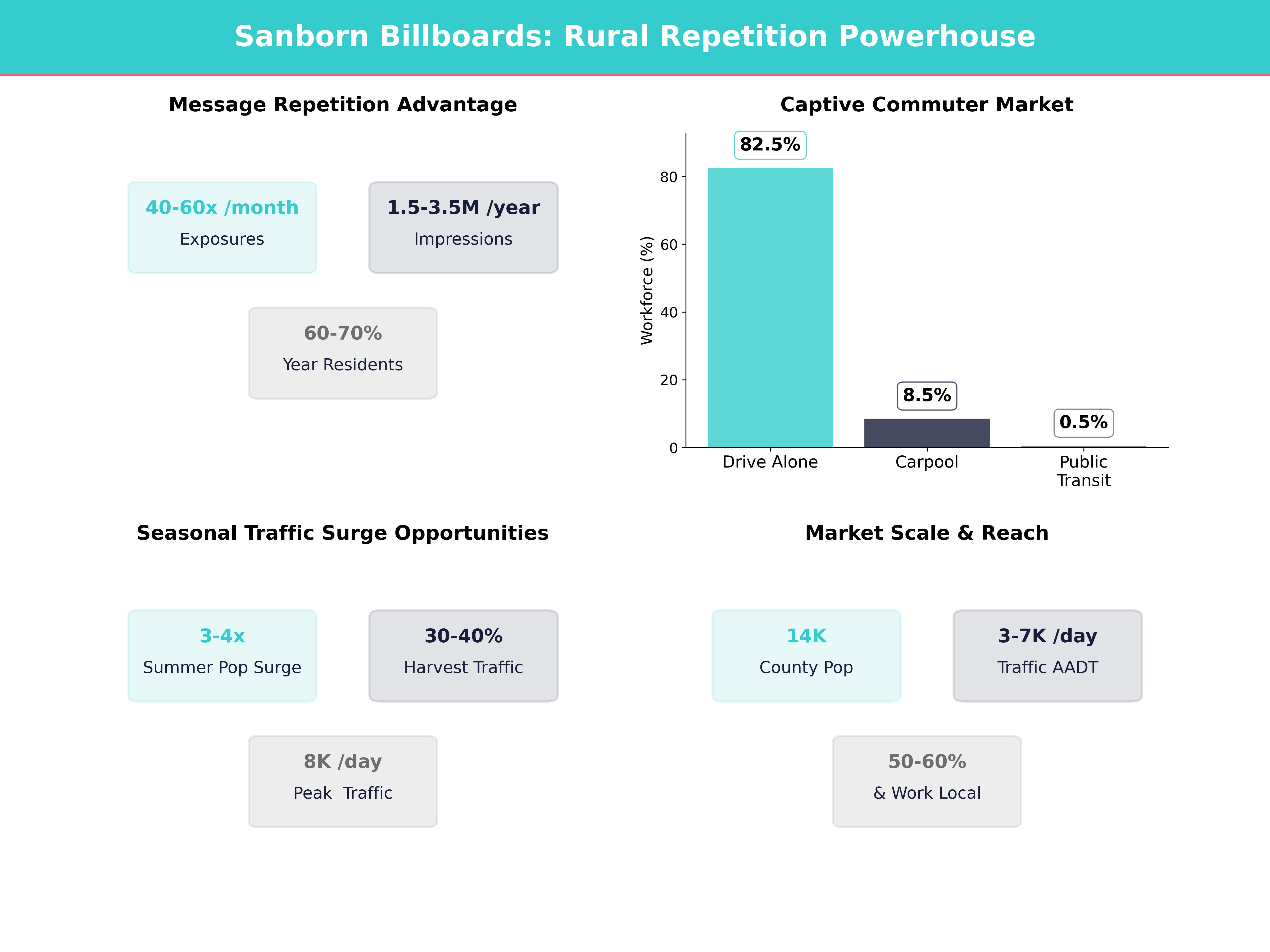
- Heavily car‑dependent: According to regional commuting profiles published by Iowa Workforce Development and local planning agencies, roughly 80–85% of northwest Iowa workers commute by driving alone, with carpooling accounting for another ~7–10% and public transit usage at well under 1%. That means nearly all working‑age adults are potential billboard viewers during commute hours, giving Sanborn billboards consistent, repeat exposure.
- Stable, community‑oriented population: Many small Iowa communities report that over 60–70% of residents have lived in the same county for 5+ years, and local schools and churches serve as long‑term anchors. In towns around Sanborn, school enrollment is steady rather than rapidly growing or shrinking. That kind of stability means message repetition and familiarity matter—local residents may pass the same sign 40–60 times per month.
- Agriculture and small business economy: O’Brien County consistently ranks among Iowa’s highly productive agricultural counties. USDA and state ag summaries show the county regularly harvesting well over 20 million bushels of corn and 10+ million bushels of soybeans per year, with hogs, cattle, and dairy also major contributors. County‑level jobs are heavily concentrated in agriculture, manufacturing, healthcare, and retail trade—often 25–30% of employment in goods‑producing sectors and another 15–20% in health and education. This mix creates strong B2B and B2C billboard opportunities, making Sanborn billboard advertising relevant for both local services and regional brands.
Useful local references for better context:
- City of Sanborn
- O’Brien County government
- Regional news: The N’West Iowa Review
- State tourism hub: Travel Iowa
- City of Sheldon
- City of Spencer
- City of Primghar
- City of Paullina
When we build creative and scheduling for Sanborn billboards, we’re talking to:
- Farmers and ag workers heading to fields, elevators, and livestock facilities—northwest Iowa counties routinely report that 10–15% of their total workforce is directly employed in agriculture, with many more in ag‑adjacent services.
- Families and retirees running errands in town—O’Brien County’s age profile skews older than the state average, with many communities where 20–25% of residents are 65+.
- Commuters traveling to nearby communities like Sheldon, Primghar, or Spencer—local school districts and employers routinely draw students and workers from a 20–30‑mile radius.
- Seasonal tourists and lake‑goers moving between the Iowa Great Lakes and points west.
Traffic Patterns and Prime Billboard Timing
Sanborn lies along U.S. Highway 18, a key east‑west corridor, and near Iowa Highway 86, which connects down toward the Iowa Great Lakes. According to recent Iowa Department of Transportation traffic counts, similar rural highway segments in O’Brien County see average daily traffic (AADT) commonly in the 3,000��7,000 vehicles per day range, with some stretches of U.S. 18 in northwest Iowa topping 8,000 vehicles per day during peak summer months (see Iowa DOT traffic resources).
On an annual basis, that means a single well‑sited digital face can easily be exposed to over 1–2 million vehicle passes per year, even in a “small” rural market. For billboard rental in Sanborn, those numbers translate into meaningful reach at a relatively low cost compared with large metros. Assuming 1.5–1.8 average occupants per vehicle (a common rural estimate), you’re looking at 1.5–3.5 million potential impressions annually on a busy segment.
In practice, that means:
- Morning commute (6–9 a.m.): Ag workers and commuters heading out of town or between small communities. In rural Iowa, 60–70% of workers typically start work between 6–9 a.m., compressing a lot of drive time into this window.
- Midday (11 a.m.–2 p.m.): Errand traffic, local service workers, and retirees. Retail and service businesses often report 25–35% of their daily in‑store traffic in this period.
- Afternoon/evening (3–7 p.m.): School pick‑up, after‑work commuting, and people heading to local events, games, or shopping. Many rural school events and high‑school sports (a major audience driver) kick off in the 5–7 p.m. window.
-
Seasonal surges:
- Late spring–summer: increased tourism traffic heading toward the Iowa Great Lakes area (Okoboji/Arnolds Park) via U.S. 18 and connecting routes. The Okoboji tourism area draws hundreds of thousands of visitors annually; local tourism organizations note that Dickinson County’s summer weekend population can swell to 3–4 times its year‑round base, with major draw sites such as Arnolds Park Amusement Park hosting well over 200,000 visits in a typical season. A portion of that traffic crosses O’Brien County, passing ideal locations for billboards in Sanborn.
- Fall: elevated truck and farm vehicle traffic during harvest months (typically September through November). Statewide grain movement data show that 30–40% of annual grain shipments occur in this 3‑month window, and local elevators often report double‑digit percentage traffic increases on nearby roadways.
With Blip’s flexible scheduling, we can align our Sanborn billboard advertising with these patterns:
- Run heavier during commute windows if we’re targeting workers, recruitment, or B2B services.
- Increase midday impressions if we’re promoting restaurants, quick‑service food, or same‑day retail offers.
- Boost summer and holiday scheduling for tourism‑oriented businesses, events, or regional attractions.
Who We’re Reaching in and Around Sanborn
While Sanborn itself is small, the effective billboard audience includes:
- Local residents: ~1,400 people in town, plus several hundred more in nearby rural areas and small settlements. In many rural Iowa towns, 50–60% of residents both live and work within the same county, which maximizes repeated exposures and makes Sanborn billboards especially effective for awareness.
- O’Brien County residents: Around 14,000 residents county‑wide. Many cross through Sanborn regularly for work, shopping, school, or church. Local school districts often enroll 500–1,500 students, each tied to families that travel for activities, sports, and errands.
-
Regional commuters: People traveling between:
- Sheldon and Primghar,
- Spencer and the Iowa Great Lakes,
- Sioux Center, Orange City, and other N’West Iowa communities.
Regional centers like Northwest Iowa Community College in Sheldon, hospitals such as Sanford Sheldon Medical Center and Spencer Hospital, and major employers pull workers from multiple counties, creating daily cross‑county traffic that regularly encounters billboards in Sanborn.
- Tourists and visitors: Particularly in late spring through early fall, tourists heading to or from the Iowa Great Lakes region pass through O’Brien County. Regional tourism entities report that Dickinson County (home of the Iowa Great Lakes) routinely welcomes several hundred thousand visitors per season, including large events and week‑long family stays.
Because of this blend, we can design campaigns for:
- Hyper‑local brands (banks, clinics, hardware stores, auto dealers, farm supply) that want dominance in a small defined market. In a town of 1,400, reaching even 800–1,000 unique residents multiple times per week can make your business feel like the default choice when they see your Sanborn billboard advertising day after day.
- Regional businesses (healthcare systems, colleges, big‑ticket retail, casinos, boat dealers, or lake resorts) that need to reach both locals and pass‑through travelers. A single board capturing 3,000–7,000 vehicles a day can put your brand in front of a big share of the area’s economically active population.
- Recruitment campaigns for manufacturing plants, co‑ops, hospitals, and school districts serving multiple communities. With unemployment typically under 3%, employers are competing for every qualified applicant—visible “Now Hiring” messaging on routes people already drive can materially increase applicant flow.
Crafting Effective Creative for a Rural Iowa Audience
In a market like Sanborn, messages must be extremely clear, honest, and quickly readable. Drivers on U.S. 18 are often going 55–60 mph, so we usually have 5–7 seconds of view time. Industry studies on out‑of‑home effectiveness show that recall drops sharply when boards exceed 10–12 words of total text, and simple, high‑contrast layouts can increase ad recall by 20–30% versus cluttered designs.
Best practices specific to Sanborn and northwest Iowa:
-
Speak the local language (literally and culturally).
- Use straightforward, plainspoken copy: “Farm loans made easy,” “Same‑day auto repair,” “Now hiring welders in Sheldon.”
- References to local landmarks, teams, or traditions (e.g., Sanborn’s railroad history, O’Brien County Fair, or local school mascots) help build trust. Local events like county fairs and high‑school sports nights routinely draw hundreds to a few thousand attendees; aligning your message with those touchpoints signals that you’re “one of us.”
- Consider including cues tied to local institutions such as the O’Brien County Fair or nearby schools like Hartley‑Melvin‑Sanborn Community Schools
-
Prioritize large, high‑contrast visuals.
- Use no more than 7–9 words of primary text.
- Large headlines and a single strong image: a tractor/combine in the field, a local family, a recognizable storefront, or a clear product image.
- High contrast color combinations (dark text on light background, or vice versa) perform best given variable weather and sun angles. In northern Iowa, winter days are often overcast—bold, saturated colors help your message stand out on Sanborn billboards in all conditions.
-
Drive to simple actions.
- Phone numbers and complex URLs are hard to read at highway speed; studies of digital billboard readability suggest that drivers retain short web addresses or simple directional cues 2–3 times better than 10‑digit phone numbers.
-
Instead, use:
- Short domains: “Visit SanbornVet.com”
- Simple prompts: “Exit at Sanborn,” “Just 10 minutes north,” “Apply in Sheldon today.”
- For regional advertisers, mention time or distance: “20 minutes east in Spencer” is more memorable than a street address and aligns with how rural drivers think about trips.
-
Highlight value and reliability.
- Rural audiences respond strongly to value, durability, and community focus. Local banks, co‑ops, and clinics often promote “Serving our community since 19XX” because it works.
- Phrases like “Locally owned since 1985,” “Serving O’Brien County farmers,” or “Trusted care close to home” can be effective credibility hooks for Sanborn billboard advertising.
-
Leverage digital flexibility.
-
With Blip, we can rotate multiple creatives. For Sanborn:
- One version for general branding.
- One version for seasonal specials (seed, fertilizer, fall tire sales, back‑to‑school).
- One version for hiring or event promotion.
- Rotating 2–4 creatives can increase engagement; national OOH case studies often show 10–20% higher response when messages are periodically refreshed versus running a single static creative.
- This makes your brand feel more active and present in the community without paying for a static, year‑round board.
-
With Blip, we can rotate multiple creatives. For Sanborn:
Seasonal Opportunities and Community Calendar
Sanborn and O’Brien County have pronounced seasonal rhythms that we should align with:
-
Winter (December–February)
- Northern Iowa averages dozens of days per winter with measurable snow and regularly sees sub‑freezing temperatures. Shorter daylight hours and potential snow/ice highlight the value of bright, high‑contrast designs.
-
Great time for:
- Auto service (tires, batteries, repair). Auto clubs and local garages often see a 20–30% spike in service calls during cold snaps.
- Healthcare (flu shots, urgent care, telehealth). Clinics and hospitals across northwest Iowa typically run seasonal flu and respiratory campaigns to manage higher winter visit volumes.
- Local retail and holiday specials, especially in November–December when many stores see 20–30% of their annual sales.
- Call attention to safety and reliability—important themes when road conditions can be challenging and when Sanborn billboards are a primary way to communicate timely offers.
-
Spring (March–May)
- Planting season for row crops; ag‑related traffic rises significantly. Many co‑ops and elevators report that grain and input deliveries can jump by 30–40% compared to winter.
-
Strong timing for:
- Farm input suppliers (seed, fertilizer, agronomy services).
- Equipment dealers and tire shops; ag dealers often push pre‑season inspection and financing during this window.
- Home improvement, roofing, and construction services, as property owners prepare for storm season.
- Messaging like “Ready for planting?” or “Fix that roof before storm season” aligns with what locals are already thinking about.
-
Summer (June–August)
- High travel and tourism season for the Iowa Great Lakes and regional fairs. Visitor data from local tourism bureaus indicate that summer can account for 50–60% of annual tourism spending in the Lakes region.
- Many community festivals, sports tournaments, and outdoor events in towns across O’Brien County and surrounding counties. County fairs, town celebrations, and baseball/softball tournaments can draw hundreds or thousands of visitors on peak days.
-
Ideal for:
- Restaurants, campgrounds, hotels, marinas, and lake‑area attractions reaching travelers passing through.
- Local events and festivals; fairs in nearby communities draw residents from all across northwest Iowa.
- Use countdown messaging: “Festival this weekend,” “Summer concert Saturday night,” or “Last week of our boat sale.”
-
Fall (September–November)
- Harvest season; significant farm equipment and grain truck traffic. In many Iowa counties, 40–50% of annual corn and soybean harvest volume is completed in a 6–8 week period, putting a lot of large equipment on the road.
-
Good time for:
- Ag lending, crop insurance, and grain marketing services, especially as producers lock in prices and plan year‑end purchases.
- Equipment maintenance and off‑season storage offers.
- Back‑to‑school messages (schools, colleges, tutoring, sports sign‑ups). Districts and community colleges often run major recruitment or enrollment campaigns in August–September.
- Pair with straightforward visuals—combine, grain bins, local fields—to make the ad feel specifically relevant to rural viewers.
To fine‑tune timing, we can cross‑reference local event calendars:
- City of Sanborn
- O’Brien County announcements and meetings
- Regional news and sports schedules from The N’West Iowa Review
- Regional radio and community updates via KIWA Radio and Explore Okoboji
Local Business Types That Can Win Big on Digital Billboards Here
In a smaller market like Sanborn, the bar to “stand out” is much lower than in a major metro. A modest Blip campaign can make a business feel omnipresent. When daily traffic is in the low‑thousands, capturing even a small share of impressions can translate to repeated exposures for a very large percentage of the local population, especially when you concentrate spend on Sanborn billboards that serve your trade area.
High‑potential categories include:
-
Agriculture and ag services
- Co‑ops, grain elevators, agronomy services, crop insurance, livestock nutrition, and equipment dealers. Regional co‑ops may serve 500–1,500 producer accounts across multiple counties.
-
Tactics:
- Emphasize service radius: “Serving O’Brien & Sioux Counties.”
- Use time‑sensitive offers tied to planting or harvest (“Pre‑pay by March 31,” “Harvest specials through November 15”).
- Promote financing or used equipment listings with rotating creative.
-
Automotive and equipment
- Auto dealers, repair shops, tire centers, small engine and implement repair. In rural areas, vehicle ownership rates often exceed 2 vehicles per household.
-
Tactics:
- Run heavier around paydays and before seasonal weather changes (e.g., October–November for winter prep).
- Highlight quick‑turn services (“Oil change today – no appointment needed”). Many customers will choose the shop they see every day on their commute.
-
Healthcare and wellness
- Local clinics, hospitals, dentists, chiropractors, eye care, and therapy services. Facilities such as Sanford Sheldon Medical Center, Spencer Hospital, and regional clinics compete for the same patients.
-
Tactics:
- Stress local access: “No need to drive to Sioux City or Sioux Falls.”
- Promote same‑day appointments, urgent care hours, or new providers.
- Highlight preventive care campaigns (flu shots in fall, sports physicals in late summer).
-
Banks, credit unions, and insurance
- Rural financial institutions thrive on trust and visibility. Many community banks in northwest Iowa have operated for 50–100+ years.
-
Tactics:
- Brand campaigns focused on longevity and community support (“Proud to serve O’Brien County since 1920”).
- Seasonal pushes for ag loans before planting and equipment loans before harvest.
- Simpler “2.XX% CD specials” or “No‑fee checking” messages when rate‑sensitive products are competitive.
-
Education and recruitment
- Area school districts, community colleges, and regional universities. Northwest Iowa Community College in Sheldon, for example, draws students from across the region and often reports enrollment in the thousands across credit and non‑credit programs.
- Employers recruiting from a multi‑county labor pool: manufacturers, health systems, co‑ops, and transportation companies.
-
Tactics:
- Run campaigns during graduation and back‑to‑school seasons, when many young adults are making decisions.
- Use clear “Now Hiring” or “Enroll Today” calls‑to‑action and mention pay/benefit highlights in as few words as possible (“Starting at $22/hr,” “$4,000 sign‑on bonus”).
-
Tourism, recreation, and entertainment
- Inns, hotels, campgrounds, marinas, restaurants, casinos, cultural attractions, and Iowa Great Lakes businesses.
-
Tactics:
- Target weekends, holiday periods, and summer vacation travel. Local tourism bureaus note that holiday weekends can produce 2–3x normal visitor volumes.
- Include directional cues (“Exit at…” or “20 minutes ahead in Okoboji”) to convert travelers.
- Feature event‑specific messages for concerts, festivals, or casino promotions in nearby communities; venues often see attendance lifts when they pair digital OOH with radio and social.
Using Blip’s Tools Strategically in a Rural Corridor
Blip’s flexibility is especially powerful in a place like Sanborn, where we want precise control without the cost of a full‑time static board. Because competition for digital inventory is lower than in large metros, local advertisers can often secure thousands of weekly impressions on relatively modest budgets, making billboard rental in Sanborn accessible to small and mid‑sized businesses.
Key strategies:
-
Geo‑focused board selection
-
Choose boards near:
- U.S. Highway 18 and other major east‑west routes.
- Key intersections used by commuters heading to Sheldon, Spencer, or the Iowa Great Lakes.
- For a local Sanborn business, emphasize boards closest to town so that 60–80% of impressions come from people who can realistically visit you in a 10–15‑minute drive.
- For regional advertisers (e.g., Okoboji businesses), prioritize boards that intercept travelers before they reach the lake region, capturing them 15–30 minutes before arrival, when they’re deciding where to eat, shop, or stay.
-
Choose boards near:
-
Dayparting and day‑of‑week targeting
- Commuter campaigns: focus impressions 6–9 a.m. and 3–7 p.m. on weekdays, when 70–80% of work trips occur.
- Retail and dining: heavier midday and early evening, especially Thursday–Saturday, which often account for 40–50% of weekly sales for many small retailers and restaurants.
- Churches or weekend events: heavier Friday–Sunday, with “Today” messaging on the event day, when last‑minute decisions are being made.
-
Budget efficiency with flexible bids
- Because there is less competition for impressions than in large cities, small daily budgets can still achieve meaningful presence. Even $10–$20 per day, focused on key hours, can generate hundreds to a few thousand daily impressions depending on board and season.
-
We can:
- Start with a modest budget to establish a baseline presence.
- Increase bids during peak seasons (harvest, summer tourism, holiday shopping) when traffic and buying activity spike.
- Lower bids or tighten hours in slower periods, still maintaining visibility.
-
Creative rotation for message testing
-
Run 2–4 creatives simultaneously:
- Version A: brand/storytelling.
- Version B: offer‑driven (“0% financing,” “Free delivery within 30 miles”).
- Version C: hiring or seasonal message.
- Version D (optional): event‑specific or countdown creative.
- Track which periods align with spikes in calls, web traffic, or store visits to understand what resonates. Even basic tracking (e.g., weekly call counts or simple Google Analytics checks) can reveal 10–30% swings tied to certain messages or time slots.
-
Run 2–4 creatives simultaneously:
Measuring Success in a Small Market
We won’t have the same data richness as a big metro, but we can still measure impact in practical ways:
-
Ask new customers how they heard about you.
- A simple “Saw our billboard?” checkbox on intake forms, job applications, or web contact forms is surprisingly effective in rural areas. Many local businesses find that 10–30% of new customers mention signage or “seeing you on the highway.”
- Train staff to ask the question consistently for a few weeks after a new campaign launches.
-
Track web and phone activity around campaign changes.
-
Note changes in call volume or website hits when:
- We launch a new creative.
- We increase summer or harvest season schedules.
- We promote a specific event or offer.
- Even if you don’t use advanced analytics, tracking weekly call counts or sales can reveal patterns—look for 5–15% lifts during weeks with heavier or more targeted Blip impressions.
-
Note changes in call volume or website hits when:
-
Monitor directional or coupon codes.
- Use short, campaign‑specific URLs or promo codes (“Mention ‘Highway 18’ for 5% off”) to attribute responses.
- For events, track RSVP or ticket sales before and after billboard flights, aiming for measurable bumps in the 10–20% range for well‑timed campaigns.
-
Watch community chatter.
-
In tight‑knit towns, feedback can be informal but telling:
- Comments at the coffee shop, feed store, or local school events.
- Mentions in local Facebook groups or local news comment sections such as those hosted by The N’West Iowa Review.
- When multiple people say “I saw your sign on 18,” that’s qualitative confirmation that your frequency and creative are working.
-
In tight‑knit towns, feedback can be informal but telling:
Putting It All Together
Sanborn’s scale is exactly what makes it powerful for billboard advertisers: a manageable, highly mobile audience that sees the same roads every day. With Blip, we can:
- Reach both local residents and regional travelers along U.S. 18, capturing thousands of daily vehicle trips and millions of annual impressions even in a rural corridor.
- Align Sanborn billboard advertising with planting, harvest, tourism, and community event cycles so that your ad speaks to what people are doing that week—not just generic branding.
- Present our brand as a stable, trusted presence through repeated exposures in a community where familiarity and reputation drive decision‑making.
- Adjust spend and scheduling in real time without long‑term commitments, allowing small and mid‑sized businesses to use billboard rental in Sanborn as a flexible, always‑on marketing tool.
When we pair Sanborn’s real‑world patterns with clear, locally grounded creative and Blip’s flexible tools, even modest campaigns can feel outsized—giving businesses, organizations, and events across northwest Iowa a powerful, modern way to stay in front of the people who matter most.