A simple way to build recognition, stay focused, and get more from the budget you already have.
When you are paying for a billboard, it is natural to want every important detail on it: your phone number, locations, latest offer, website, and a few reasons customers should choose you.
It can feel like more information means more value from every dollar. The challenge is that people only have a few seconds to take in a billboard. When too many messages compete for attention, the most important one can get lost: your business name.
Mark Watson, Senior Account Executive at Blip, has helped plan hundreds of billboard campaigns for businesses across the U.S. He has seen firsthand how much stronger a campaign can become when the goal, creative, timing, and budget all work together.
His starting point is simple: What does this billboard actually need to do?
For most businesses, the answer is not to explain everything. It is to help the right people notice your business, remember your name, and recognize it again later.
Once that goal is clear, decisions about your creative, locations, timing, and budget get much easier.
After working across different industries, markets, and budget sizes, Mark has found that strong campaigns often come back to the same four decisions.
Key Takeaways
- Keep the job of your billboard simple. Focus first on helping people notice and remember your business.
- Build around your customers’ real routines. Where and when they travel should help guide where your ads run.
- Prioritize frequency over trying to be everywhere. A focused group of boards can help the same audience see you more consistently.
- Give recognition time to build. Billboard advertising often works through repeated exposure rather than one quick impression.
- Choose a budget you can comfortably maintain. Consistency becomes easier when the campaign fits your business from the start.
Step 1: Start With One Thing You Want People to Remember
Before choosing boards or setting a schedule, get clear on the message.
Mark encourages advertisers to think of billboards primarily as an awareness tool.
That does not mean your billboard can never include an offer, website, or call to action. It means those elements should not compete with the thing you most want someone to remember.
Start with your name or logo. Then ask whether one additional piece of information would genuinely help. That might be a simple benefit, a short offer, a website, or one clear next step. Anything else should earn its place.
Mark estimates that cluttered creative can cause 20% to 30% of viewers to miss the brand name entirely. The exact impact will vary by campaign, but the lesson is useful: if someone cannot quickly tell who the ad is for, adding more information probably will not help.
Try a simple five-second test. Look at your creative and ask:
- Who is advertising?
- What is the one thing they want me to know?
- What should I remember afterward?
If any answers take too long, simplify.
Digital billboards also give you more flexibility to improve as you go. Updating creative does not require printing and installing new vinyl, so changes are easier when you learn something new.
The win: A clearer message gives every impression a better chance to build recognition.
Step 2: Follow Your Customers, Not Just the Map
Once the message is clear, think about who needs to see it.
Mark starts with the customer before he starts with available billboards.
Ask yourself where your customers drive, what their normal day looks like, when they are most likely to be on the road, and when your message would be most relevant.
The answers may point toward morning commutes, evening traffic, neighborhoods, shopping areas, business districts, or everyday errand routes.
Timing matters too. A breakfast restaurant may care much more about morning commuters than late-night drivers. An Italian ice shop may get more value from warm afternoon traffic than from showing ads first thing in the morning. A home services company may care less about one exact hour and more about staying visible along familiar routes over time.
The goal is not to run everywhere at every hour. It is to put your budget where it has the best chance to reach the people you care about.
The win: Your budget is focused around the people you actually want to reach instead of simply buying the most traffic you can find.
Step 3: Build Enough Frequency to Be Remembered
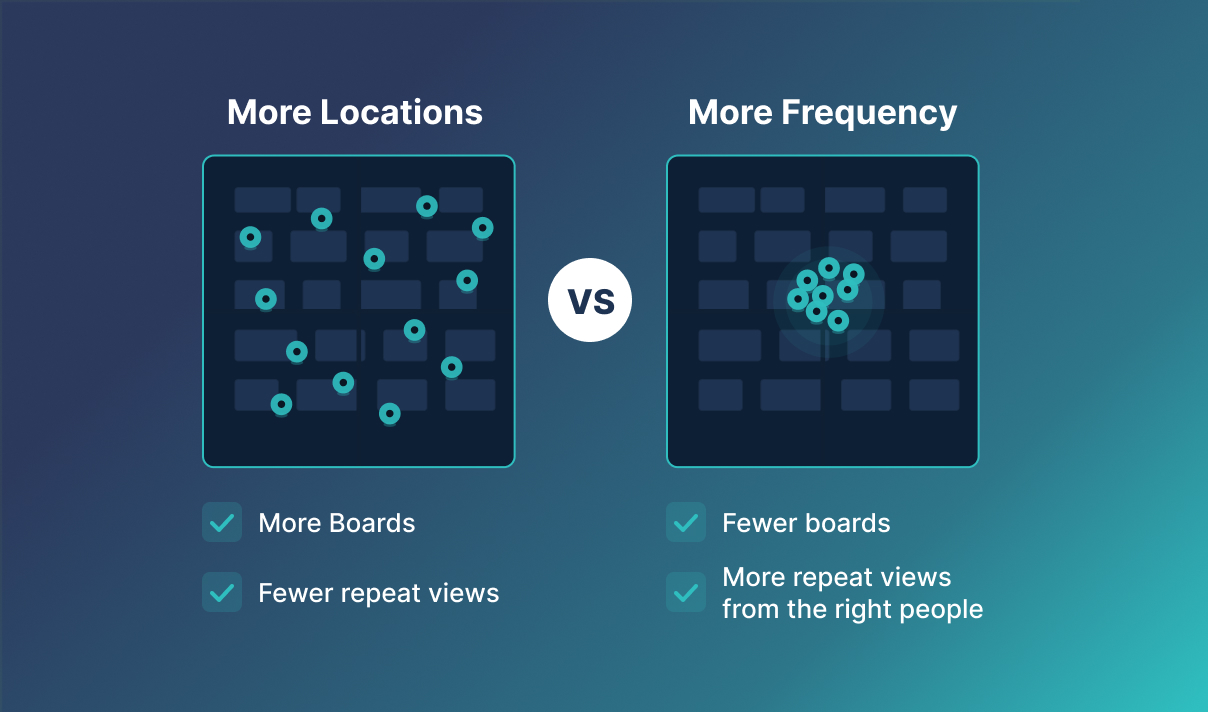
Once you know the routes that matter, another decision comes up: should you spread the budget across more boards or concentrate it on fewer locations?
When the budget is more limited, Mark often recommends focusing on a smaller group of well-chosen boards. The reason is frequency.
If someone sees your business once and never sees it again, that impression may disappear quickly. Repeated exposure is what helps a name start to feel familiar.
Mark describes the process this way:
“There’s 50 billboards in a city. We’ve honed it into five, and they’re all great. Now we can test and run on a few different ones.”
The right number of boards will depend on your market, audience, schedule, and budget. The principle matters more than a fixed number: do not spread your budget so widely that no one sees you often enough to remember you.
Mark also looks at how closely together those opportunities to see the ad may happen. If the gaps are too wide, the campaign may be covering more ground than the budget can realistically support. A tighter set of relevant locations can help build more repeated exposure along the routes your customers already use.
The win: Instead of paying to be seen a little bit everywhere, your budget can work toward building stronger familiarity with the people who matter most.
Step 4: Give Recognition Enough Time to Build
Billboard advertising is usually not about one impression creating one sale. It works by showing up again and again until the business starts to feel familiar.
That takes time.
After helping plan hundreds of campaigns, Mark often sees early signs of recognition around months two and three, with more action building later as familiarity grows.
“Month two and month three is where we start to see some brand recognition. Month five and month six is where we start to see a lot more action being taken.”
That does not mean every campaign needs to run for six months before anything happens. A grand opening, event, or short-term promotion has a very different goal from an ongoing awareness campaign.
For longer-term campaigns, consistency matters more. Before you launch, ask yourself: What budget could I comfortably keep running long enough for people to see me more than once?
A sustainable campaign can be more useful than starting with a larger budget that becomes difficult to maintain.
Blip gives you flexibility here because there are no long-term contracts or minimum spend requirements. You can choose a budget that feels comfortable for your business and adjust as you learn.
The win: You give your campaign enough runway to build familiarity without forcing your business into a commitment that does not fit.
What Happens When the Pieces Work Together
The value of this process is not any one step. It is how the steps support each other.
A clear message is easier to remember. The right locations put that message in front of relevant people. A focused set of boards can help those people see it more than once. Enough time gives that recognition a chance to build.
Mark has seen that play out with an insurance advertiser that consistently used a dog in its billboard creative.
After about a year, the company increased its spending. When Mark’s team asked why, the answer was simple:
“People tell us about the dog.”
The creative had become recognizable. Customers remembered it, which gave the business confidence to invest more over time.
The lesson is not that every billboard needs a dog. It is that consistency gives people something to recognize.
Your version might be a distinctive logo, a simple headline, a recognizable image, or the same benefit repeated over time.
You do not need to put everything on the board. You need to give people something worth remembering.
Make the Budget Fit the Goal
There is no single “right” billboard budget.
A better question is: What can this budget realistically help me accomplish?
A more focused budget may mean fewer locations, tighter hours, or a smaller geographic area. A larger budget may give you room to expand reach while still maintaining enough frequency. Neither approach is automatically better.
The goal is to make your creative, locations, timing, and budget work together instead of asking one part of the campaign to do everything.
Digital billboards make that easier because you can adjust along the way. You can change creative, refine timing, reconsider locations, or adjust your budget without being locked into every decision you made on day one.
Start with what feels comfortable. Pay attention to what you learn. Then use that information to make the next decision stronger.
Ready to Put Your Budget to Work?
Blip gives businesses of any size a flexible way to run digital billboard campaigns without long-term contracts or minimums.
Choose your budget, build your campaign, and adjust as you learn.
Frequently Asked Questions
How long should I run a billboard campaign before expecting results?
Billboards usually build recognition through repeated exposure, so results may take time. Mark often sees early signs of recognition around months two and three, with more action building around months five and six. Your timeline will depend on your business, audience, goal, budget, and how quickly customers typically make a decision.
A short-term event campaign may work on a much shorter timeline. An ongoing awareness campaign usually benefits from more consistency.
Do I need a big budget to make billboard advertising work?
Not necessarily.
What matters is how well the budget matches your goal. If your budget is more limited, focusing on a smaller number of relevant boards and hours can help build the strongest frequency without spreading your spend too thin. Start with a budget you can comfortably maintain, then adjust as you learn.
What should actually be on my billboard?
Start with your name or logo. Then choose one additional message that helps people understand or remember you: a short benefit, simple offer, website, or clear next step.
Details can live on your website, landing page, or in the search results people find after they want to learn more.
Is it better to run on more boards or show up more often on fewer boards?
It depends on your goal and budget. If spreading your budget across more boards means people only see your ad rarely, a smaller group of relevant locations may build more familiarity. If your budget supports both, expanding locations can make sense. Start where your customers travel, then build outward.
What if I am not sure which billboard locations to choose?
Start with your customer: where they live, work, shop, commute, and spend time before they need your business.
If you would rather not choose every board, Blip Optimized can help match your campaign with billboard opportunities based on your goal, target area, and budget.