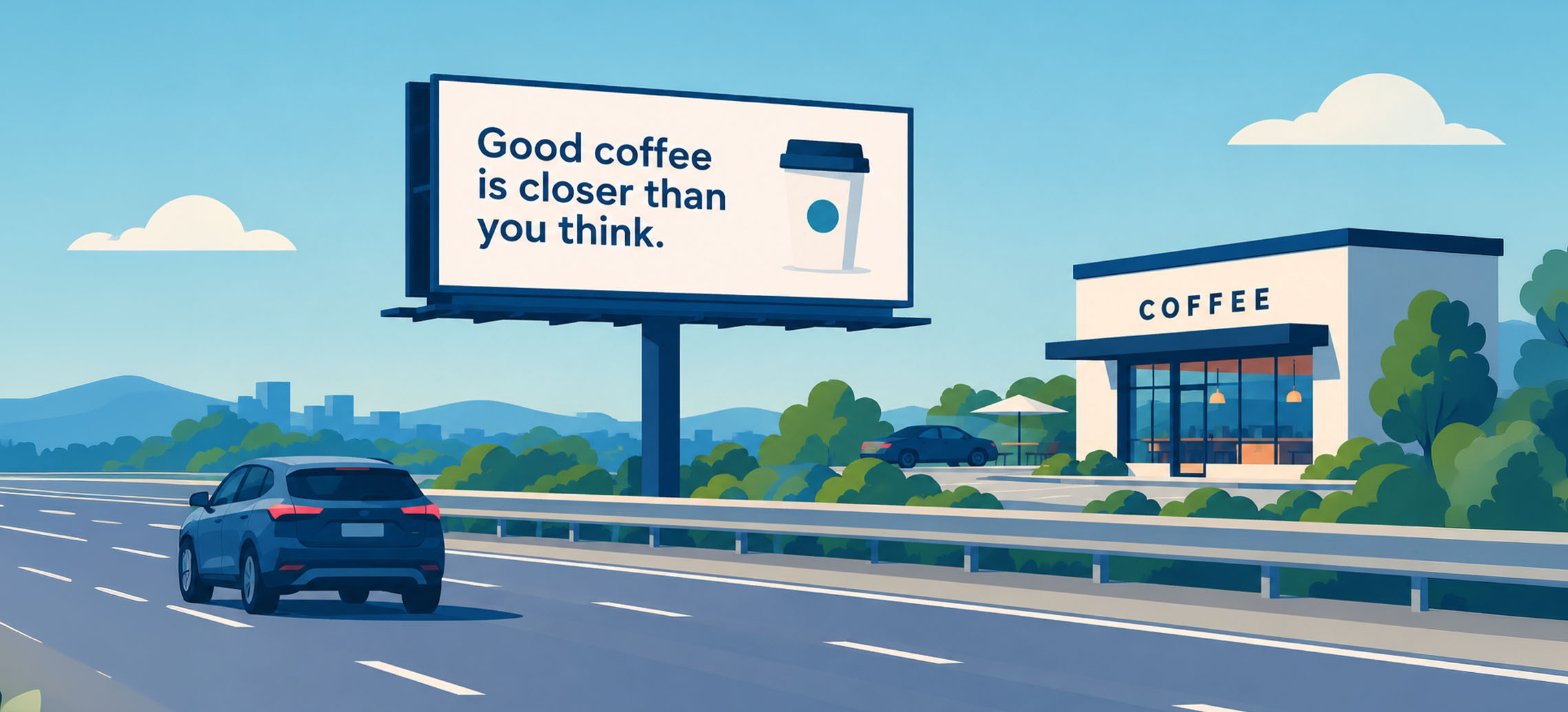
A product marketing mindset that turns a billboard test into real results across every channel.
Product teams don’t wait until something is perfect to ship it. They launch a first version, watch what happens, and improve from there.
It’s how good products get built: experimenting, but with structure.
Many small and medium business advertisers do the opposite. They treat their first billboard campaign like it has to be THE best one. They spend weeks making decisions about the creative, the audience, the location, all before spending a single dollar.
Then… they either never launch, or they launch using guesswork and have no idea what drove the result.
Supritha Shetty, Head of Product at Blip, built a testing process specifically for businesses that can’t afford to guess and need their first campaign to tell them something useful.
Key Takeaways
- Your first billboard does not have to be perfect to be a good test.
- Before launching, decide on three things: target audience, location, and message.
- Test one variable at a time based on what you already know.
- Good data is better than a good guess.
It Does Not Have to Be Perfect to Be Right
Businesses don’t want to waste money. Totally fair.
So they avoid content tests and stick with campaigns that feel familiar. The problem? Familiar doesn’t always mean effective. Without testing, you’re not protecting your budget, you’re protecting the guess.
Think of a small $1,000 test campaign less like “spending money” and more like buying an answer you can’t get any other way.
For businesses with even a little room in the budget, testing is how you find out what’s actually driving sales, visibility, and momentum.
Plus if time or money is tight, that’s even more reason to test small before you scale big.
Run It Like a Product Launch: Three Steps to a First Billboard That Tells You What to Scale
Product teams rarely release products that are perfect from the jump. Instead, they share something they can test, watch what happens, and improve from there.
The less you guess, the further your budget goes. Supritha’s three-step process gives first-time billboard advertisers a way to spend small, learn something specific about their first billboard, and make the next campaign better because of it.
1. Three Variables. Write Them Down.
Every billboard campaign (no matter the budget or business type) has exactly three variables that affect its success:
- Who you’re targeting (audience)
- Where you’re showing up (location)
- What you’re saying (messaging)
Before spending money on an ad, Supritha asks businesses to really consider these.
Take a bakery owner who knows her best customers are moms. That’s the audience.
Which billboard locations sit between where those customers live and where they run errands? That’s the location.
What kind of wording would grab her attention — humor, emotion, a straight offer? That’s the message.
Again, you don’t have to have perfect answers yet. But if you can start to define all three of these variables, you’re ready to start testing.
2. Start With Your Biggest Question Mark
Supritha recommends starting withwhat you’re least certain about.
Established businesses rarely need to test location. If you’ve been operating in a community for years, you already know where your customers live.
So, if you know your location well, test audience or messaging.
If you know who regularly shops with you, test location or messaging.
If you already know what kind of copy and images work for your ads, test location or audience.
Blip’s own marketing team often rotates billboard elements like logo placement and tone of voice. This helps the team see what actually drives people to visit the website.
The goal is to choose just one variable so you can credit (or blame) the right thing when results come in. Then you can apply that new information to the next test.
3. Spend Small, Learn Fast
Supritha recommends a $1,000 test across a single location, and running it for at least one month.
For out-of-home marketing like billboards, a two-week window isn’t enough. People need to see a billboard multiple times before it registers. A quick test won’t tell you anything useful.
Before launch: Show the sample billboard to friends, family, or colleagues unfamiliar with your brand. Ask what they noticed. Ask if they knew who it was for. This will help you find the places where your wording is confusing, especially to people who don’t have the same context that you do.
That quick gut-check will help you catch these problems before the ad goes live, 14 feet high above the freeway.
After launch: Look for shifts in behavior rather than a spike in sales. Did foot traffic increase? Did more people mention the billboard when asked how they heard about you? Did direct website visits go up?
For example, when Blip added a billboard-specific URL to our ads, we could see exactly how many people came to our site from that particular out-of-home campaign.
That’s a trackable result, built into the creative from the start.vice business might track calls or form fills during the campaign window. A local retailer might compare store traffic before and during the test.
Good Data Beats a Good Guess
A successful first campaign is one that gives you new information, even if sales aren’t the highest.
Based on what you kept the same and which of the three main variables you changed, you can gain new intel about your customers and their behavior. With every new test, you’ll narrow down towards your perfect billboard.
Over time, these findings only get more useful, as you can build on each test. You’ll stop running campaigns because they “worked before” or because a competitor is doing them.
You start running campaigns because your own data tells you to.
As Supritha puts it:
“The most effective way to manage your marketing money is to test and learn. That’s the only way you know what’s driving results for your company.”
Start a New Campaign with Blip
Frequently Asked Questions
How much should I spend on my first billboard campaign?
Supritha recommends starting with $1,000, spread across a single location. The goal is gathering enough data to know what to adjust next. A small, focused test will tell you more than a large campaign built on guesses.
How long should I run a billboard campaign before evaluating it?
At least one month, and longer if you can. As with other forms of marketing, out-of-home marketing requires people to see your ad multiple times before it sticks. A two-week test won’t give you enough information about results, regardless of budget.
How do I measure a billboard campaign if I cannot track clicks?
Look for behavioral shifts instead. Did foot traffic increase? Did more customers say “I saw your sign” when asked how they heard about you? Did direct website visits go up?
Some billboard users (including Blip ourselves!) feature a trackable URL on their billboards, so you can see who exactly visited your website from that specific billboard.
What if I do not have any previous data to guide my test?
Start with what you know about your best customers: who they are, where they live, and where they spend time. Even rough answers to those three questions are enough to run a first test. The point is to begin somewhere specific, not to wait until you have perfect information.
Should I test audience, location, or messaging first?
Test whatever you’re least certain about. If you know your geography well but haven’t validated your messaging, test messaging. If you’ve run digital ad campaigns and know what creative your customers like, test locations instead. The goal is to isolate one variable per test so you can trace results back to a single decision.