Billboards in Athens, GA
No Minimum Spend. No Long-Term Contracts. Just Results.
Turn heads in the Athens area with digital magic from Blip. Our platform puts Athens billboards at your fingertips, letting you quickly launch, control, and optimize eye-catching campaigns on billboards near Athens, Georgia with any budget.
Trusted by Leading Brands


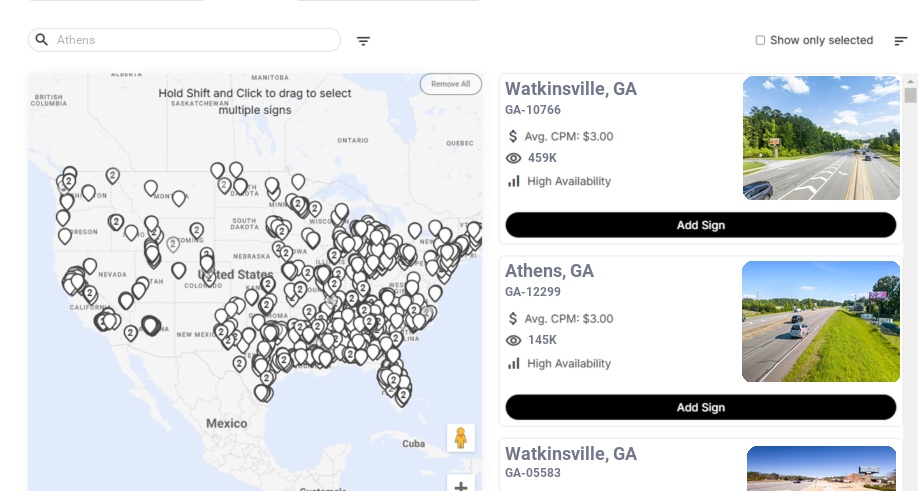
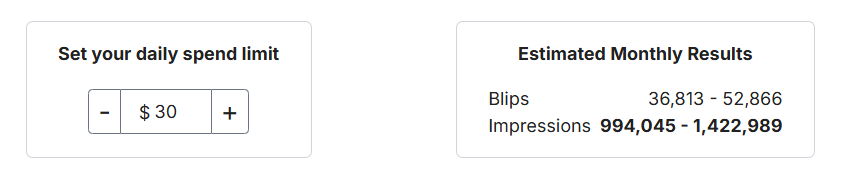
How much is a billboard in Athens?
Why Choose Blip for Billboard Advertising in Athens
Blip lets Athens, Georgia brands launch fast on US-441/GA-15 and Epps Bridge, reaching commuters and shoppers without traditional buying hurdles.
Use flexible budgets in Athens, Georgia to test game-day bursts for UGA fans, then scale up when weekend traffic and visitor demand spike.
With no contracts, Athens, Georgia advertisers can shift from student move-in season to summer resident-focused campaigns whenever the market changes.
Blip's real-time analytics help Athens, Georgia campaigns track response along Watkinsville and the Atlanta gateway, then optimize by corridor and daypart.
Create and swap billboards fast in Athens, Georgia with Blip's creative tools, tailoring ads for downtown nights, campus traffic, or Oconee County families.
Frequently Asked Questions About Billboard Advertising in Athens
How much does a billboard cost near Athens, Georgia with Blip?
Where can I advertise with Blip in Athens, Georgia?
When is the best time to run billboard ads in Athens, Georgia with Blip?
What kind of audience can billboards near Athens, Georgia reach?
Why are billboards in Athens, Georgia good for reaching shoppers and commuters with Blip?
Do I need a contract to advertise with Blip in Athens?
How fast can I launch a billboard campaign with Blip in Athens?
Where can I advertise with Blip in Athens?
Still have questions? Launch a campaign in minutes — no contracts, no commitments.
Start Your CampaignAthens Billboard Advertising Guide
Athens, Georgia is a rare mix of college town, regional shopping hub, and cultural destination. With five digital billboards serving the Athens area from nearby Watkinsville (about 5.5 miles away), we can help you reach local residents, University of Georgia students, commuters, and visitors right where they drive, shop, and play. If you’re looking for billboards near Athens that combine reach, flexibility, and precise scheduling, this guide breaks down what makes the Athens area unique and how to build digital billboard campaigns that take full advantage of Blip’s flexibility.
Understanding the Athens Area Advertising Market
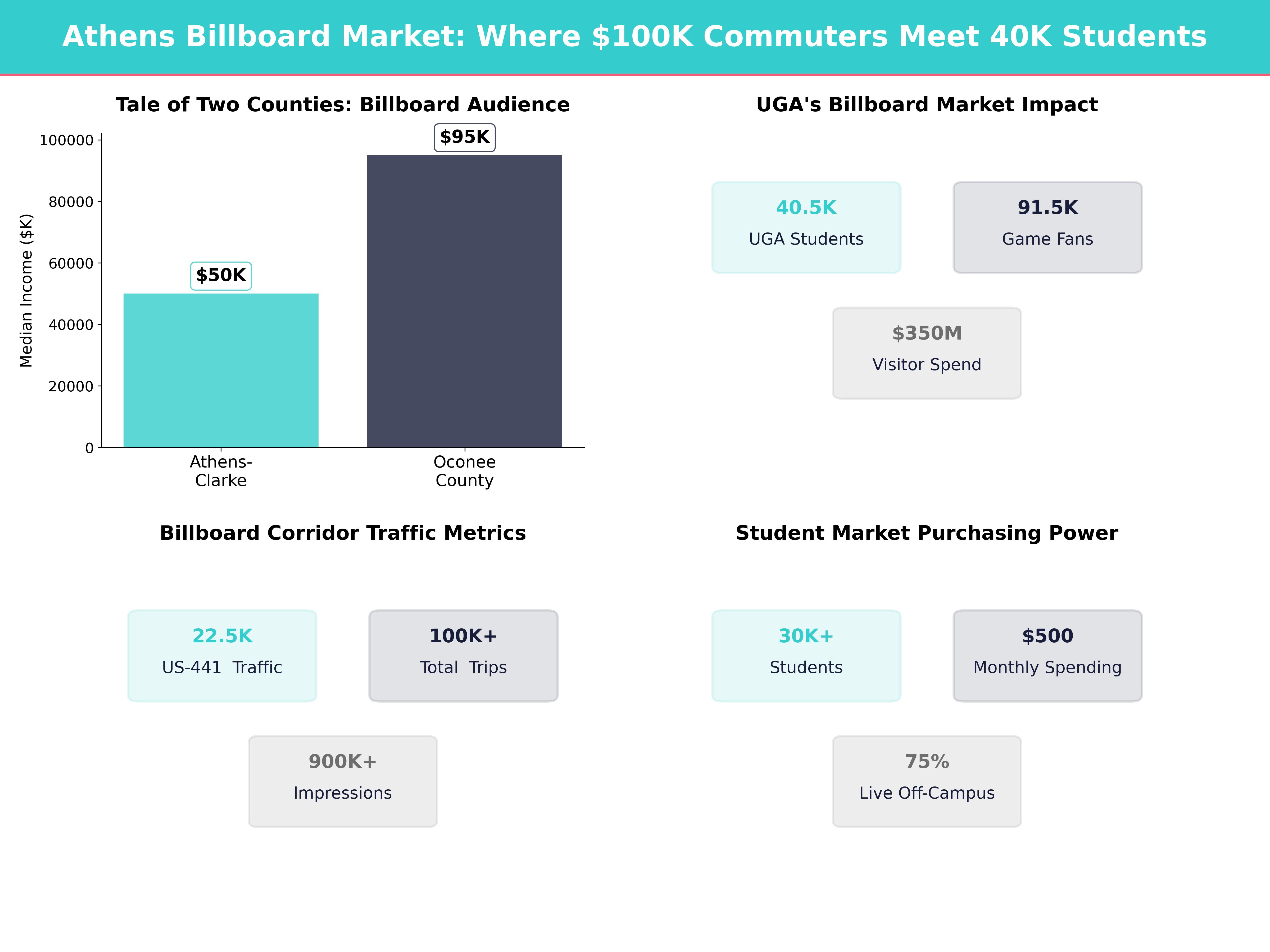
Athens is the core city of Athens-Clarke County, home to an estimated 129,000–130,000 residents in the mid‑2020s and the flagship campus of the University of Georgia. When we include surrounding counties like Oconee County, Madison, Jackson, and Oglethorpe, the broader Athens region reaches 220,000–240,000 people, giving advertisers a strong, compact market with high daily movement concentrated in a relatively small geographic area (Athens-Clarke County is only about 121 square miles). For brands exploring billboard advertising near Athens, this condensed footprint means a well-placed message can be seen repeatedly by the same high-value audiences.
Key market facts:
-
Population & growth
- Athens-Clarke County’s population grew from 116,714 in 2010 to roughly the high 120,000s by the mid‑2020s, a gain of about 10–12% over roughly a decade, outpacing many small and mid‑sized Georgia metros.
- Oconee County (home to Watkinsville) is one of Georgia’s faster-growing counties; the population climbed from about 26,000 in 2000 to more than 41,000 by the early 2020s, an increase of over 55%. According to county figures from Oconee County Government, growth continues as new subdivisions, retail centers, and schools attract higher‑income households and families.
- The Athens metro routinely adds 1,500–2,500 residents per year when you combine county‑level estimates, which means a constantly expanding pool of potential customers for local and regional brands.
-
University of Georgia impact
- UGA enrolls roughly 40,000–41,000 students (about 30,000+ undergraduates plus graduate and professional students) according to UGA reporting, making it one of the largest universities in the Southeast.
- Add in more than 10,000 faculty and staff, and UGA’s daily presence pushes the daytime population of Athens well above its residential base, especially when classes are in session.
- UGA home football games routinely bring 90,000–93,000 fans into Sanford Stadium, which has an official capacity of about 92,700, with tens of thousands more visiting downtown, Five Points, and nearby shopping corridors to watch games at bars, restaurants, and tailgate locations.
- UGA reports that its overall economic impact on the state exceeds $8 billion annually, with a significant share focused in Athens and surrounding counties—fueling demand for housing, retail, food, and entertainment year‑round.
-
Tourism & visitors
- The Athens Convention & Visitors Bureau highlights Athens as a major music, food, and arts destination. Tourism‑related reports for Athens-Clarke County show hundreds of millions of dollars in annual visitor spending (commonly in the $300–400 million per year range in recent years), supporting 3,000+ local jobs in hospitality, retail, and entertainment.
- Hotel occupancy in Athens typically spikes during fall football weekends, graduation, and major conferences at venues like The Classic Center, with many hotels selling out or approaching 90–100% occupancy on marquee weekends.
- Signature events such as AthFest Twilight Criterium tens of thousands of attendees per year, creating concentrated surges of weekend and evening traffic.
-
Economy & spending power
- Athens-Clarke County’s economy blends higher education, healthcare, government, retail, and hospitality. Local data from the Athens-Clarke County Unified Government shows that education, health services, and government account for a large share of local employment, with thousands of jobs at UGA, Piedmont Athens Regional, St. Mary’s, and public schools.
- Median household income in Athens-Clarke County is typically in the high‑$40,000s to low‑$50,000s, reflecting a mix of students, service workers, and professionals.
- Nearby Oconee County has a notably higher median household income, often reported in the $90,000–$100,000 range, almost double that of Athens-Clarke. This income gap highlights why the Watkinsville and Epps Bridge retail corridors are prime targets for upscale, family‑focused, and discretionary‑spend advertisers.
- The Athens Area Chamber of Commerce notes that the region supports thousands of small businesses along with national brands, providing a diverse competitive landscape for retail, food, healthcare, and professional services.
For billboard advertisers, this means the Athens area offers:
- A steady base of year‑round residents approaching a quarter‑million people across the trade area.
- A large, regeneration‑prone student population (roughly 10,000 new first‑year students arriving each year at UGA).
- High‑spending suburban households near Watkinsville and throughout Oconee County.
- Periodic surges of visitors driven by UGA sports, conferences, and events that can push daily visitor counts in Athens into the tens of thousands above normal baselines.
Where Our Billboards Reach Drivers Near Athens
Our five digital billboards serving the Athens area are located in and around Watkinsville, roughly 5.5 miles from downtown Athens. This puts your messages along some of the most important commuter and shopping routes flowing between Athens and Oconee County and between Athens and the Atlanta corridor, making these Athens billboards ideal for brands that need consistent regional visibility close to town.
Key corridors and why they matter:
-
Athens–Watkinsville commuter flow
- Many Oconee County residents work, study, or shop in the Athens area. Oconee County labor and commuting data indicate that well over 50% of employed residents commute out of the county daily—many into Athens-Clarke for UGA, healthcare, and retail jobs.
- Thousands of vehicles move daily between Watkinsville and Athens on routes like US‑441/GA‑15 and connecting arterials. Georgia Department of Transportation (GDOT) traffic counts along US‑441 near Watkinsville frequently register in the 20,000–25,000 average daily traffic (ADT) range, meaning your creative can be seen hundreds of thousands of times per month on a single corridor.
- When you aggregate key approach routes from Oconee and southern Athens-Clarke, you are tapping into well over 100,000 vehicle trips per day moving into, out of, and around the city.
-
Epps Bridge Parkway / Oconee Connector retail zone
- The Epps Bridge area, just outside Athens in Oconee County, has become a major regional shopping and dining hub, with power centers, big‑box stores, and restaurants serving both Athens and Oconee residents. This corridor includes national anchors, multi‑screen cinemas, and dense out‑parcel development that draw shoppers from 20–30 miles away.
- GDOT data on similar regional commercial corridors in the Athens metro typically falls between 25,000 and 35,000 ADT, and local counts on Epps Bridge Parkway and the Oconee Connector commonly land in that same band. At 30,000 ADT, your message has the potential to generate around 900,000+ impressions per month per direction of travel before considering repeat exposures.
- The Oconee Chamber of Commerce hundreds of thousands of square feet of retail space clustered in a compact, billboard‑friendly zone.
-
Gateway toward Atlanta and beyond
- Highways connecting the Athens area to State Route 316 and the Atlanta region carry a mix of commuters, visitors, and logistics traffic. Segments of SR‑316 in neighboring counties often register 40,000–50,000+ vehicles per day, a portion of which is originating in or destined for Athens-Clarke and Oconee.
- These gateways are used by UGA visitors, prospective students, touring bands, sports teams, and regional shoppers, meaning your creative can be seen by audiences from Metro Atlanta (6+ million residents) and across Northeast Georgia.
- Placing creative near these gateways helps you catch people as they arrive for events, campus visits, and game days, or as they leave town when recall and follow‑up actions (online research, reservations, app downloads) are most likely.
Because our boards are digital, we can help you:
- Reach Athens-bound traffic during the morning commute, when 7 a.m.–9 a.m. volumes regularly capture a large share of daily trips.
- Capture Athens-area shoppers during afternoon and weekend peaks, when retail districts can see double their weekday baseline traffic.
- Reinforce your brand with home-bound commuters in the evening drive, when decision‑making about dinner, errands, and leisure is at its highest.
All of this can be managed at the “blip” level—buying brief ad plays instead of full-time ownership—so you can cover multiple boards and dayparts in the Athens area efficiently, even with budgets starting in the tens of dollars per day rather than thousands. This makes billboard rental near Athens accessible for small businesses and regional brands that want to test out-of-home without long contracts.
Timing: How to Use Athens Traffic Patterns and Seasonality
The Athens area has very distinct rhythms driven by the academic calendar, sports schedules, and regional shopping habits. Using Blip’s scheduling tools, we can align your campaign to these patterns for maximum relevance.
1. Academic calendar cycles
UGA’s fall and spring terms bring tens of thousands of people back into the city within a few days, producing measurable spikes in traffic counts and mobile‑device activity.
-
Peak student presence: Late August through early May, especially:
- Move‑in and the first 4–6 weeks of the fall semester, when thousands of new students are learning local routes, neighborhoods, and brands.
- January “back‑to‑school” window for spring, when about 40,000 students return to campus within a short timeframe.
- Lower student presence: Mid‑May to early August, and during winter break, when large portions of the 18–24 population leave town or spend fewer days per week in Athens.
How to adjust campaigns:
-
Student-focused brands (housing, bars, restaurants, tutoring, gyms, retail):
- Increase impressions in the first 6–8 weeks of each semester, plus weeks leading up to finals when stress‑related spending peaks. National surveys show college students increase food delivery and coffee purchases by 10–20% during exam periods, a trend that local brands can tap into with timely creatives.
- Run awareness bursts for housing and student services in late winter and spring (January–April), when most student leases are signed and application volumes at student housing properties can climb sharply—often 50–70% of annual leasing activity happens in this window.
-
Non-student brands (home services, healthcare, financial services):
- Consider summer and winter breaks for campaigns aimed at permanent residents, when local traffic is less congested and your message competes with fewer student promotions. This is especially effective for categories like elective healthcare and remodeling, which many households plan during off‑peak academic months.
2. UGA sports and events
For Athens-area advertising, UGA football is in a league of its own:
- Home games (September–November): Expect heavy Friday–Sunday travel to and from the Athens area. Game weekends routinely bring tens of thousands of additional vehicles onto Athens-area roads, with downtown Athens and key corridors near campus reaching near‑gridlock conditions several hours before and after kickoff.
- UGA’s national profile in football means fans often travel 2–5 hours from surrounding states, staying 1–2 nights and spending heavily on food, lodging, and retail.
- Basketball, baseball, gymnastics, and other sports bring additional spikes, though on a smaller scale. The Athens Banner‑Herald and Flagpole regularly publish schedules and coverage that help locals plan around these events.
Campaign ideas:
- Game‑weekend promos: Restaurants, bars, and retailers can run Friday–Sunday bursts encouraging fans to stop “on the way in” or “after the game.” Even capturing 1–2% of incremental visitor spending on a busy weekend can translate to thousands of additional dollars for local businesses.
- Lodging and short‑term rentals can highlight weekend availability and direct booking URLs. With many hotels at or near capacity on big games, alternative lodging (vacation rentals, boutique inns, outlying hotels) can see strong response from targeted messaging.
- Sponsors and local brands can reinforce association with UGA‑adjacent messaging without needing in‑stadium media, which can cost tens of thousands of dollars per season compared to much more flexible digital billboard budgets.
Use Blip’s scheduling to buy heavier Thursdays–Saturdays in the autumn and lighter coverage mid‑week if budget is tight.
3. Daily and weekly traffic patterns
Across the Athens area, consistent patterns emerge that mirror many small metros but are intensified by the campus:
-
Morning drive (7 a.m.–10 a.m.)
- Driven by commuters into UGA, downtown, hospitals, and schools. On some corridors, 30–40% of daily traffic can occur during the morning and evening peaks combined.
- Best for: coffee shops, breakfast spots, radio/podcasts (including local stations like WUGA), financial institutions, employment branding, and B2B services.
-
Midday (11 a.m.–2 p.m.)
- Lunchtime and errand traffic from campus and nearby offices; retail centers and fast‑casual restaurants see their single largest hour of the day in this window.
- Best for: quick‑serve restaurants, medical clinics, retail specials, campus‑adjacent service promotions.
-
Afternoon/evening (3 p.m.–7 p.m.)
- School pick‑ups, commuting home, and early evening shopping. Many family‑oriented businesses report 40–50% of weekday revenue during this block.
- Best for: family dining, entertainment, fitness, grocery, and after‑work services.
-
Late evening (7 p.m.–11 p.m.)
- Concentrated around student nightlife and entertainment, especially Thursday–Saturday when bar and venue traffic can peak.
- Best for: bars, venues, delivery apps, and entertainment.
With Blip, you can daypart your campaign so your budget concentrates on the few hours per day that matter most to your audience in the Athens area.
Ready to reach your audience in Athens?
Start Your Campaign →Crafting Creative That Resonates in the Athens Area
Athens has a strong visual identity: music, arts, and college culture meet Southern charm. The city is home to legendary bands, a vibrant downtown, and public‑art projects promoted by organizations like the Athens Downtown Development Authority
1. Lean into the Athens and UGA identity (even if you’re not on campus)
Our boards serve the Athens area from nearby Watkinsville, but you are still speaking to:
- Students and staff driving to and from campus.
- Residents who identify strongly with Athens and UGA—local polls often show 70%+ of residents follow UGA sports at least casually.
- Visitors whose primary goal is “going to Athens.”
Creative tips:
- Use familiar references—“Dawg Country,” “Game Day,” “Downtown Nights,” “Five Points,” “Prince Avenue,” “Normaltown,” etc.—to make your message locally relevant.
- If your brand guidelines allow, consider red, black, and white as accent colors to connect subconsciously with UGA themes (while respecting trademarks and logos).
-
Consider simple, aspirational language:
- “Fuel up before the game.”
- “Your Athens‑area home base.”
- “Study break approved.”
2. Respect speed: keep it short and bold
On a highway near the Athens area, a driver typically has 6–8 seconds to read your message and is often traveling 45–60 mph.
We recommend:
- 7 words or fewer of primary text.
- Font sizes large enough to be read clearly from 500–700 feet, which generally means headline text occupying at least one‑third of the board’s vertical height.
- High contrast backgrounds (dark text on light background or vice versa), which can improve legibility by 20–30% in quick‑glance conditions.
Better:
- “Athens‑Area Dental Care – Same‑Day Appointments”
- “Game Day Parking – Reserve Online Now”
- “Watkinsville Retail Space – Call 706‑XXX‑XXXX”
Weaker:
- Crowded text with multiple paragraphs, bullet lists, or complex disclaimers that most drivers cannot process in under 3 seconds.
3. Use location anchors
Because our boards are in nearby Watkinsville but serving the Athens area, clarify your proposition:
- “Just 10 minutes from downtown Athens.”
- “Off Epps Bridge Parkway – Next to [Landmark].”
- “On the way to campus – Exit at [Road].”
Many drivers only act when they understand they can reach you in 10 minutes or less, so simple distance or travel‑time cues can significantly lift response.
4. Include a simple call to action
Given the prevalence of smartphones (smartphone adoption in the 18–49 age range is typically 90%+), even drivers and passengers will:
- Search your brand name later.
- Take a quick photo of the board.
- Share information with friends.
We suggest:
- A short URL or simple domain (e.g., “AthensDentist.com”).
- Or just your business name + keyword, relying on search (e.g., “Search: Classic City HVAC”).
- For time‑sensitive offers, a simple phrase like “This Weekend Only” or “Through Sunday” can prompt immediate action without overloading the creative.
Avoid long promo codes and complex instructions; focus on something someone can remember after passing a board at 45–60 mph.
Matching Your Message to Athens-Area Audiences
The Athens area is segmented. We can help you craft campaigns for each key audience.
1. Students
Demographics:
- Roughly 40,000+ UGA students in the Athens area, predominantly aged 18–24.
- A significant portion—often 70–80% of undergraduates—live off campus or commute to campus, meaning they regularly use major roads where our boards run.
- Heavy users of apps, food delivery, ride‑share, streaming, and social media; national surveys show college students spend $400–600+ per month on discretionary categories like food, entertainment, and shopping.
Messaging angles:
- Affordability: “Student discounts,” “$5 lunches,” “First month free.”
- Convenience: “On your route to campus,” “Open late,” “Walk‑in welcome.”
- Social life: “Game day HQ,” “Pre‑concert meet‑up,” “Open after the show.”
Timing:
- Focus on weekday afternoons and evenings, plus Thursday–Saturday evenings, when students are most active off campus and when local venues report their highest sales volumes.
2. Young professionals & faculty
Demographics:
- Thousands of early‑career professionals, graduate students, and faculty/staff, many associated with UGA, healthcare systems, or professional services.
- Mix of renters and homeowners with moderate to high income; median earnings for full‑time workers with a bachelor’s degree in the area often fall in the $55,000–$75,000 range.
- Many live in neighborhoods in Athens-Clarke and Oconee County and commute along the very routes where our boards run.
Messaging angles:
- Quality and reliability: banks, healthcare, professional services, local boutiques.
- Lifestyle: gyms, yoga studios, niche restaurants, craft breweries.
- Long‑term services: home buying, insurance, financial planning.
Timing:
- Morning and evening commutes plus Saturday daytime for errands and shopping, when these households typically do their weekly grocery, home improvement, and personal‑care runs.
3. Families in Oconee and surrounding counties
Demographics:
-
Oconee County and nearby suburbs have higher median incomes and a strong family presence—local school systems in the county serve thousands of K–12 students, and Oconee is consistently ranked among Georgia’s top school districts.
- Many commute into the Athens area for work, school, or shopping, creating daily cross‑county traffic flows of 10,000+ commuters.
Messaging angles:
- Family‑friendly dining, activities, and events.
- Education (tutoring, music lessons, sports leagues).
- Home services (HVAC, lawn care, remodeling, medical/dental care).
Timing:
- Weekday afternoons and early evenings, and weekend mornings/afternoons when families are running errands or heading to kids’ activities, sports practices, and church events.
Using Blip’s Flexibility to Fine-Tune Athens-Area Campaigns
Our platform is designed to let you test, learn, and scale in the Athens area without committing to a traditional, long‑term billboard contract.
1. Start small, then expand
- Begin with a modest daily budget (for example, $10–$30 per day) focused on 1–2 boards near your key trade area (for example, Epps Bridge / Watkinsville corridors).
-
Rotate 2–4 creative variations:
- Different headlines.
- Different calls to action (call vs. website vs. visit).
- Different offers (percentage discounts vs. dollar‑off vs. “no‑cost consultation”).
-
After 1–2 weeks, compare:
- Store traffic or online metrics by day and time.
- Any uptick that correlates with certain creatives or schedules.
- Basic benchmarks like changes in clicks, calls, or foot traffic of 10–20% relative to your pre‑campaign baseline.
Scale up what works by:
- Increasing your daily cap.
- Adding more boards serving the Athens area.
- Extending to additional time slots or days of the week.
- Running “burst” campaigns around key dates where you’ve seen strong results.
2. Daypart and day‑of‑week targeting
Use dayparting to maximize ROI:
- Restaurants: focus on 11 a.m.–2 p.m. and 4 p.m.–8 p.m.; heavier on Thursday–Sunday, when many eateries report 50–60% of their weekly sales.
- Healthcare and professional services: weekday morning and early afternoon, aligning with appointment times and call‑center hours.
- Entertainment and nightlife: Thursday–Saturday evenings, when downtown Athens venues often see 2–3x their weekday attendance.
- Event‑based campaigns: increase plays on the days leading up to concerts, festivals, or big games that are widely promoted by Visit Athens GA, ACCGov, the Classic Center, or local outlets like the Athens Banner‑Herald and Flagpole.
You can adjust these settings anytime, allowing you to respond quickly to new events announced by UGA, ACCGov (Athens-Clarke County Unified Government), or local venues highlighted in outlets like the Athens Banner‑Herald and Flagpole.
3. Seasonal and event bursts
Consider short, intense “burst” campaigns around:
- UGA move‑in and orientation, when thousands of families are in town over several days.
- Homecoming and rivalry games, which often generate near‑record hotel occupancy and packed downtown streets.
- Graduation weekends (December and May), when thousands of graduates and their families celebrate across restaurants, hotels, and event venues.
- Big festival or concert weekends promoted by Visit Athens GA, when multi‑day events can draw 10,000–30,000+ attendees.
A 7–10 day burst where you increase impressions and tighten targeting can generate strong recall, especially if paired with social media and local media coverage.
Ready to reach your audience in Athens?
Start Your Campaign →Sector-Specific Tips for Athens-Area Advertisers
Retail & e‑commerce
- Promote in‑store events, grand openings, and sales tied to student rushes, Black Friday, or tax refund season. Many retailers report 20–40% of annual sales in November–December alone, and student‑focused sales spikes around August and January.
- For e‑commerce brands, use creatives that emphasize fast shipping to the Athens area or “Buy online, pick up near Athens.” Click‑and‑collect and BOPIS (buy online, pick up in store) options have grown to represent 20–30% of some retailers’ digital orders, and local billboards can push awareness of nearby pickup locations.
Food & beverage
- Align creative with game days and concert nights: “Skip the wait downtown – dine with us in the Athens area.” On major event days, restaurants near corridors like Epps Bridge often report wait times 2–3x longer than normal and sales that can rival a typical weekday’s entire revenue.
- Highlight delivery and takeout for students and busy families. Third‑party delivery usage among college‑age consumers is high, with national estimates suggesting 60–70% of students order food delivery at least once per month.
Real estate, housing & student living
- Peak leasing months often fall January–April for fall move‑ins, with many properties securing 80–90% of their leases by late spring.
-
Use boards serving the Athens area to advertise:
- Virtual tours.
- Limited‑time leasing incentives (e.g., “Up to $500 gift card”).
- Proximity to campus (“10 minutes to UGA”)—for many students, commute time thresholds of 15 minutes or less strongly influence housing decisions.
Healthcare & wellness
- Emphasize accepting new patients, telehealth, or same‑day appointments. Local providers often see appointment demand spike in August–September (back‑to‑school) and January–March (new‑year health goals).
- For dental and eye care, focus on back‑to‑school seasons (late summer and early fall) and benefits year‑end, when many households use remaining insurance benefits. Practices frequently report 10–20% higher appointment volume in the last quarter of the year compared to early summer.
Higher education & recruitment
-
Colleges, technical schools, and military recruiters can use boards near the Athens area to reach:
- High school students from Oconee and surrounding counties (local school districts graduate hundreds to low thousands of seniors annually).
- Non‑traditional students commuting into the Athens area for work, who may be open to part‑time programs or certifications.
- Schedule heavier rotations around fall and spring college fairs, FAFSA deadlines, and application priority dates to catch students and parents when they’re making decisions.
Politics & advocacy
- In election cycles, Athens-Clarke and Oconee counties provide a cross‑section of urban college‑town voters and suburban/rural voters, with combined registered‑voter rolls in the tens of thousands.
-
Tailor messaging by:
- Highlighting issues relevant to students and young voters (tuition, housing, jobs), who can comprise 30–40% of the local voting‑age population in precincts near UGA.
- Addressing family and economic concerns in suburban neighborhoods, where homeownership rates and turnout levels tend to be higher.
- Time‑sensitive GOTV (get‑out‑the‑vote) or advocacy messages can ramp up sharply in the final 7–14 days before an election—periods when research shows decision‑making and turnout planning peak.
Measuring Success and Optimizing Over Time
To make the most of your spend in the Athens area, we recommend pairing your Blip activity with simple, trackable metrics.
1. Use unique, local hooks
- Dedicated URLs like “YourBrand.com/Athens.”
- “Mention this board in the Athens area for 10% off.”
- Unique phone numbers or text keywords.
- QR codes sized to be scannable from 20–30 feet for parked or low‑speed traffic (for example, near shopping centers or at intersections with longer red lights).
While not everyone will explicitly mention the billboard, these tools give you a baseline for measuring direct response. Even a 1–3% redemption rate on a billboard‑specific offer can signal strong performance in traditional OOH terms.
2. Watch your data by day and time
Compare:
- Website sessions or calls by hour and day vs. your Blip schedule.
- Store foot traffic on days when you run heavier rotations (e.g., major game weekends or event bursts).
-
Simple KPIs such as:
- Change in daily revenue.
- Change in average ticket size.
- New vs. returning customers.
Adjust your campaign:
- Shift budget toward days and times that correlate with stronger performance. For example, if Friday and Saturday evenings show 20% higher revenue when your ads run, weight more impressions into those windows.
- Retire low‑performing creative and double‑down on winners, using A/B tests that rotate two versions of a message across the same boards and time slots.
3. Combine with local media and events
- Coordinate billboard bursts with stories or ads in the Athens Banner‑Herald, Flagpole, local radio (such as WUGA), or sponsorships highlighted by Visit Athens GA.
-
Use the boards serving the Athens area to amplify your presence:
- “As seen in Flagpole.”
- “Catch us at this weekend’s festival downtown.”
- “Proud supporter of events at The Classic Center.”
The more integrated your messaging is across channels, the more memorable your brand becomes to people moving through the Athens area. Multi‑channel campaigns—billboards plus digital plus local media—are often associated with 20–30% higher brand recall than single‑channel efforts.
By understanding how the Athens area moves—between campus and suburbs, games and concerts, shopping and commuting—we can help you build a digital billboard strategy that fits your goals and budget. With five flexible digital billboards serving the Athens area from nearby Watkinsville and the ability to adjust bids, schedules, and creatives in real time, you’re not locked into a one‑size‑fits‑all buy. Whether you’re seeking billboards near Athens for a short promotion or ongoing billboard advertising near Athens for long-term branding, you can start small, learn fast, and scale what works to keep your brand in front of the people who matter most.