Billboards in Forsyth, GA
No Minimum Spend. No Long-Term Contracts. Just Results.
Trusted by Leading Brands


Billboard advertising
in Forsyth has never been easier
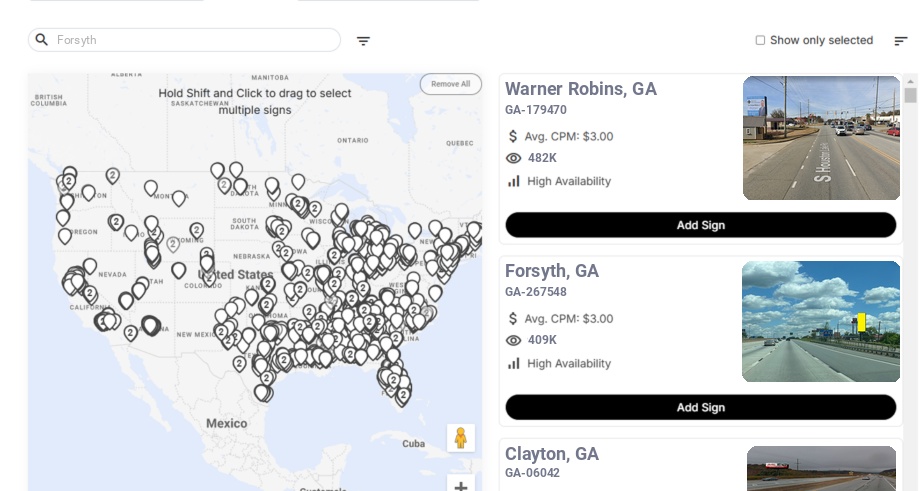
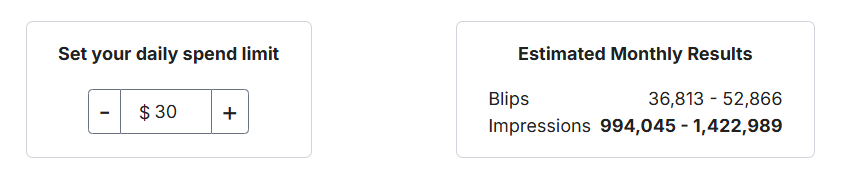
How much is a billboard in Forsyth?
Why Choose Blip for Billboard Advertising in Forsyth
Blip lets you launch fast in Forsyth on I-75, reaching 75,000-90,000 daily vehicles and the Atlanta-Macon corridor without sales calls or contracts.
Set a flexible budget for Forsyth and keep spend in check while targeting commuter peaks on I-75 and US-41 when locals drive the same routes daily.
Use dayparting in Forsyth to hit breakfast, rush hour, or holiday travel on I-75, so your ad shows when commuters and Florida-bound travelers are most likely to stop.
Track real-time results in Forsyth and shift your Blip campaign as traffic spikes for the Forsythia Festival, spring break, and holiday surges on I-75.
Blip's creative tools help you build clear, high-speed messages for Forsyth drivers: exit cues, hotel offers, and local pride copy that reads in 3-5 seconds.
Frequently Asked Questions About Billboard Advertising in Forsyth
How much does a billboard cost in Forsyth, Georgia with Blip?
With Blip, you control exactly how much you spend on Forsyth billboards by setting a daily budget that can be as small or as large as you’d like, and Blip automatically keeps your campaign within that limit. Each ad, or “blip,” is a 7.5 to 10-second display on rotating digital billboards in Forsyth, Georgia, and you only pay for the individual blips you receive. Costs vary based on when and where your ad shows and on advertiser demand, so you can tailor your schedule to match your goals and budget.
Where can I advertise with Blip in Forsyth, Georgia?
Forsyth’s biggest advertising asset is Interstate 75, where average annual daily traffic counts typically fall in the 75,000–90,000 vehicles per day range, depending on the segment and direction. Blip’s board selection tools allow us to prioritize boards directly on I‑75 for maximum traveler volume, then complement them with boards on local roads for repeated local exposure. US‑41 / GA‑18 and local arterials are also useful for more local, repeat impressions.
Who sees Forsyth, Georgia billboards on Blip?
Forsyth billboards can reach daily commuters, local families and residents, and transiting travelers. Many Monroe County residents commute to jobs in Macon, Warner Robins, or the south metro Atlanta area via I‑75 and US‑41, creating strong frequency for the same drivers. I‑75 also brings in long-distance traffic heading to and from Florida, metro Atlanta, and Middle Georgia.
When is the best time to run Blip billboards in Forsyth, Georgia?
Forsyth’s community calendar and regional travel patterns provide clear timing cues for when to increase your Blip presence. State tourism data show that Georgia’s visitor volumes spike in March–April, June–July, and the November–December holiday season, and Forsyth feels all three. The Forsythia Festival in March and spring break travel are especially strong periods for billboard advertising.
What kind of billboard messages work best in Forsyth, Georgia?
Forsyth’s drivers are typically traveling at 65–75 mph on I‑75, which means we need ultra-clear, high-impact creative. At those speeds, drivers have only 3–5 seconds to process an ad, so the page recommends keeping the message to 7 words or fewer. Best practices include big, bold typography, one dominant visual, and directional cues like “EXIT NOW” or “NEXT 2 EXITS”.
Do I need a contract to advertise with Blip in Forsyth?
No, Blip has no long-term contracts or minimum commitments. You can start, pause, or stop your campaign at any time.
How fast can I launch a billboard campaign with Blip in Forsyth?
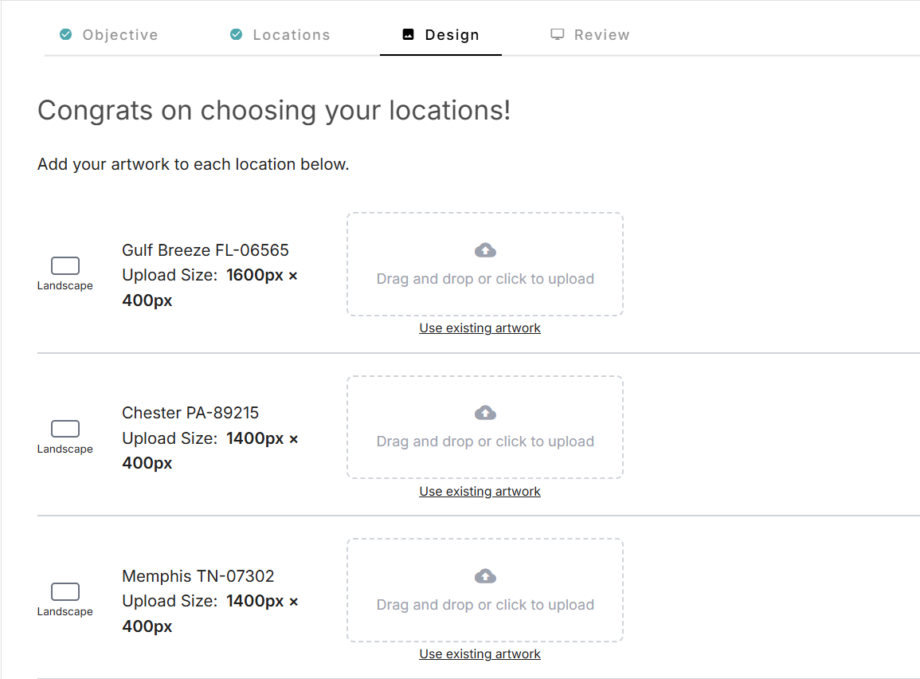
You can have your campaign live in minutes. Create a free account, select your locations, set your budget, upload your design, and start running once approved.
Where can I advertise with Blip in Forsyth?
Blip has digital billboards in Forsyth. You can browse available locations on a map, choose the ones that fit your audience, and start advertising right away.
Still have questions? Launch a campaign in minutes — no contracts, no commitments.
Start Your CampaignForsyth Billboard Advertising Guide
Forsyth, Georgia sits at a powerful crossroads of regional travel and small-town community life. With Interstate 75 Atlanta Macon, Forsyth offers advertisers a rare chance to reach both long-distance travelers and local residents with the same digital billboard strategy. When we use Blip’s flexible tools to align creative, timing, and location with how people actually move through this corridor, Forsyth becomes a high-ROI market for both local and regional campaigns—making Forsyth billboards a smart piece of any Middle Georgia media mix.
Understanding the Forsyth Market
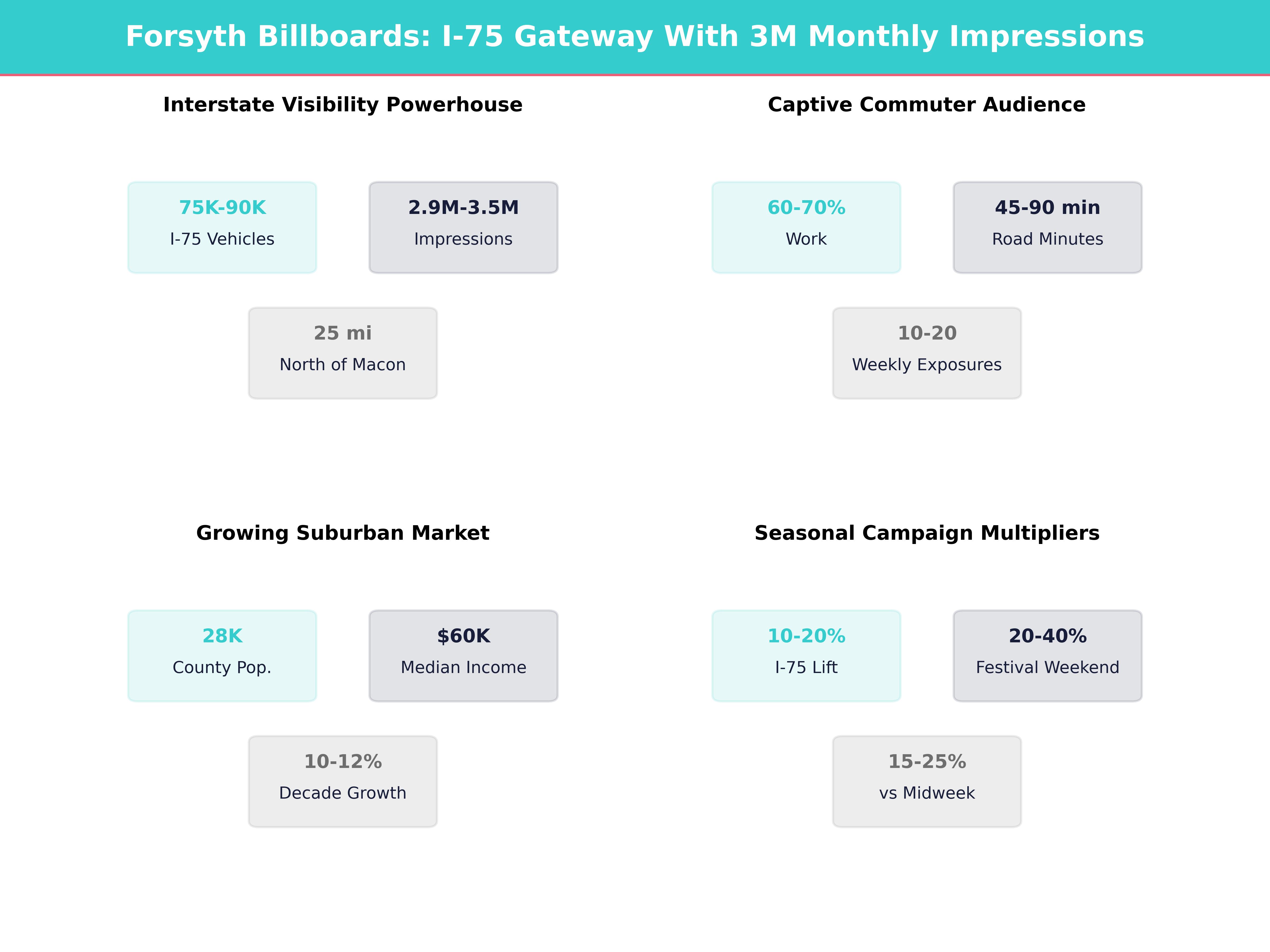
Forsyth is the county seat of Monroe County 4,200–4,300 residents, while Monroe County as a whole is home to about 28,000 residents based on recent state and local planning estimates. While that sounds “small,” the real story for advertisers is in the traffic, commuters, and visitors that pass through daily and can be reached efficiently with billboards in Forsyth.
Monroe County’s population has grown steadily—around 10–12% over the past decade—and local officials report that the county’s median household income is in the low-to-mid $60,000s, placing it above many surrounding rural counties and supporting solid local buying power. According to regional workforce data, well over half of employed residents commute outside the county for work, underscoring Forsyth’s role as a commuter hub and a natural fit for ongoing Forsyth billboard advertising that keeps your brand in front of the same drivers every weekday.
Key local context:
- Regional commuting hub: Many Monroe County residents commute to jobs in Macon, Warner Robins, and the south metro Atlanta area via I‑75 and US‑41. It’s common for residents to drive 30–60 miles daily, with one-way commutes in the 25–40 minute range. This puts your message in front of the same drivers 5 days a week, creating strong frequency for Forsyth billboards serving local employers and services.
- Visitor and traveler throughput: Forsyth is a stopping point for travelers heading to and from Florida, metro Atlanta, and Middle Georgia. Regional tourism figures for Middle Georgia show hundreds of millions of dollars in annual visitor spending, and I‑75 is the primary north–south conduit. This dramatically increases the number of unique viewers your billboard can reach versus the residential population alone.
- Local economy mix: The area includes government (county and city offices), corrections facilities, logistics and trucking, agriculture, manufacturing, and a growing base of service and hospitality businesses (hotels, fast food, sit‑down restaurants, and fuel stations). Local employment data show government, education/health services, and trade/transportation as three of the largest sectors, together accounting for well over 50% of county jobs and providing a wide range of potential advertisers for billboard rental in Forsyth.
Useful local resources to understand the community:
- City of Forsyth
- Monroe County, Georgia
- Forsyth-Monroe County Chamber of Commerce for business climate, major employers, and relocation data
- Regional tourism context via Visit Macon and Explore Georgia – Historic Heartland
- Local news and business coverage via the Monroe County Reporter and Macon-based outlets like 13WMAZ and WGXA
For advertisers, this blend of local stability plus heavy transient traffic means we can design Forsyth billboard advertising campaigns that either:
- Speak to locals (schools, healthcare, real estate, local retail, churches, public service), or
- Capture travelers (hotels, dining, attractions, auto services, tourism, regional retailers),
or efficiently do both with smart creative and scheduling.
Traffic Flows and Prime Billboard Corridors
Forsyth’s biggest advertising asset is Interstate 75. According to traffic data published by the Georgia Department of Transportation, average annual daily traffic (AADT) counts on I‑75 near Forsyth typically fall in the 75,000–90,000 vehicles per day range, depending on the precise segment and direction. Some nearby segments in Monroe County report AADT figures over 95,000 vehicles per day during peak years, which explains why Forsyth billboards on this corridor can deliver such large volumes of impressions.
Even if we conservatively assume 1.3 occupants per vehicle, that’s easily 97,500–117,000 impressions per day of raw potential exposure, or 2.9–3.5 million impressions per month on a single high-traffic stretch. During major holiday periods, GDOT data and statewide travel reports consistently show 10–20% traffic increases on I‑75 in Middle Georgia, pushing potential daily impressions even higher and making billboards in Forsyth particularly valuable for seasonal pushes.
Key corridors to consider:
-
I‑75 Northbound (toward Atlanta):
- Heavy weekday commuter traffic in the early morning (6–9 a.m.), with morning peak-hour volumes often running at 6–8% of daily traffic per hour.
- Weekend upticks from leisure travel, especially Fridays (northbound) and Sundays (return traffic), when statewide travel surveys indicate some corridors can see 15–25% more vehicles than midweek days.
- Ideal for: tourism/attractions near Atlanta or Forsyth, hotel promotions for upcoming exits, job recruiting in the Atlanta corridor, branding campaigns that leverage Forsyth billboard advertising to build awareness before drivers reach the metro area.
-
I‑75 Southbound (toward Macon and Florida):
- Strong commuter volume afternoons (3–7 p.m.), with PM peaks similar in intensity to morning peaks.
- High seasonal traffic for spring break, summer vacations, and holiday travel to Florida. State tourism data show that Georgia routinely records tens of millions of overnight visitors annually, many using I‑75 as their primary route.
- Ideal for: hotel and restaurant exits in Forsyth and Macon, gas stations, quick-service restaurants, family attractions, auto service/repairs, and emergency or urgent care locations.
-
US‑41 / GA‑18 and local arterials:
- Lower traffic counts than I‑75, often in the 5,000–15,000 vehicles per day range depending on the segment.
- More local, repeat impressions, since these roads are used heavily by residents and students rather than long-haul travelers.
- Good for: local retail and service businesses, schools and events, churches, recurring promotions, real estate, and healthcare where billboard rental in Forsyth can be focused on neighborhood-level visibility.
Blip’s board selection tools allow us to prioritize boards directly on I‑75 for maximum traveler volume, then complement them with boards on local roads for repeated local exposure. For example, a hotel can run:
- 70% of budget on I‑75 boards to capture travelers who haven’t yet chosen where to stop, and
- 30% on local surface roads to encourage repeat stays among regional business travelers and visiting friends and family.
Even a modest rotation—say 1,000–2,000 plays per day across a mix of I‑75 and local boards—can translate into tens of thousands of daily impressions in and around Forsyth.
Who You’re Reaching: Commuters, Families, and Travelers
To design creative that truly works, we should think in terms of the major audience segments moving through Forsyth:
-
Daily Commuters
- Thousands of Monroe County residents travel to Macon, Warner Robins, or the south metro Atlanta area daily. Regional data indicate that in many Middle Georgia counties, 60–70% of workers commute to a different county, and Monroe fits that pattern.
- Many commuters spend 45–90 minutes per day on the road, often on the same route. That means a commuter might see your message 10–20 times per week when you daypart around rush hours.
-
These repeated impressions make Forsyth-based billboards ideal for:
- Banking and financial services
- Insurance
- Higher education and trade schools
- Healthcare providers
- Political and public service messages
-
Local Families and Residents
- Forsyth has a strong small-town identity, with community events downtown and at local schools. Monroe County school enrollment numbers show thousands of K‑12 students across the district, pointing to a solid base of family households.
- Local median age falls in the mid‑30s to early‑40s, with a high share of working-age adults and children.
-
This creates opportunities for:
- Youth activities and sports programs
- K‑12 and private schools
- Churches and faith-based organizations
- Local retail, grocery, and professional services (dentists, attorneys, etc.)
For more on local demographics and schools, see Monroe County Schools and the Forsyth-Monroe County Chamber of Commerce.
-
Transiting Travelers
- I‑75 is a major north–south corridor linking the Midwest and Atlanta to Florida. State transportation reports show that certain I‑75 segments in Georgia carry over 100,000 vehicles per day during peak seasons.
- A significant portion of this volume is long-distance traffic; surveys of interstate travelers typically show that 70–80% of stopping decisions (for food and lodging) are made en route, within a short distance of the exit.
- Travelers are often looking for immediate needs within the next 1–2 exits.
-
High-response categories along the Forsyth stretch include:
- Hotels and motels
- Fuel and truck stops
- Fast food and casual dining
- RV and truck service
- Attractions within a 30–60 minute drive (e.g., Macon attractions highlighted by Visit Macon, outdoor recreation in Monroe County, and Middle Georgia events).
By tailoring creative to each segment, we can use Blip to rotate multiple messages for the same advertiser on the same boards, simultaneously appealing to locals, commuters, and travelers and maximizing the impact of Forsyth billboard advertising.
Seasonality and Local Events to Leverage
Forsyth’s community calendar and regional travel patterns provide clear timing cues for when to increase your Blip presence. State tourism data show that Georgia’s visitor volumes spike in March–April, June–July, and the November–December holiday season, and Forsyth feels all three.
Some recurring events and patterns:
-
Forsythia Festival (March)
The City of Forsyth hosts the annual Forsythia Festival thousands of visitors downtown for arts, crafts, food, and entertainment. Over a typical weekend, festival attendance and spillover traffic can temporarily increase downtown volumes by 20–40% compared with a normal early-spring weekend.In the weeks leading up to the festival, we can:
- Promote vendor booths, sponsors, and special offers.
- Run directional and parking messages during the event days.
- Highlight downtown businesses to capture festival traffic.
-
Spring Break & Early Summer (March–June)
Travelers heading to Florida begin increasing in March, with peaks during school spring breaks and the start of summer vacation. Georgia school calendars create rolling spring breaks that can stretch elevated travel over 4–6 weeks.Hotels, restaurants, and tourist destinations should:
- Increase budgets on I‑75 boards starting 2–3 weeks before peak travel dates.
- Emphasize quick decision drivers: “Clean Rooms,” “Free Breakfast,” “Pet Friendly,” “Kids Stay Free,” “Truck Parking,” etc.
- Plan for 10–20% increases in traffic volumes compared with off-peak months on key weekends.
-
Back-to-School (Late July–August)
Monroe County schools and nearby districts return in late summer. School system calendars typically bring 2–3 key shopping weeks for supplies and clothing.This is prime time for:
- School supplies, clothing, and local retail.
- Youth programs, clubs, and athletics registrations.
- Healthcare checkups, dentists, and eye doctors.
-
Fall Football & Festivals (September–November)
High school football, regional college football, and fall festivals drive weekend and evening travel. High school home games can draw hundreds to over a thousand spectators per game, and college game days in Macon and the wider region add further demand on I‑75.- Restaurants and sports bars can promote game-day specials.
- Churches and nonprofits can highlight fall events, trunk-or-treats, and community drives.
-
Holiday Travel (Thanksgiving, Christmas, New Year’s)
I‑75 sees a surge of long-distance traffic during major holidays. National and state travel forecasts routinely project 2–4% annual increases in holiday driving trips, with certain days (the Wednesday before Thanksgiving, the Sunday after, and days around Christmas) among the busiest of the year.- Hotels, fuel, dining, and roadside services should increase bids and frequency.
- Retailers can promote gift buying, extended holiday hours, and clearance events.
With Blip, we’re not locked into fixed, long-term schedules. We can dial budgets up for 7–10 days around key events, then scale back the rest of the month, keeping your overall costs aligned with actual opportunity and making billboard rental in Forsyth more cost-efficient.
For an up-to-date local events calendar, check the City of Forsyth Forsyth-Monroe County Chamber of Commerce.
Creative Strategies That Fit Forsyth’s Drivers
Forsyth’s drivers are typically traveling at 65–75 mph on I‑75, which means we need ultra-clear, high-impact creative. At those speeds, standard readability formulas estimate 3–5 seconds of viewing time for a billboard, and studies of digital out-of-home show that simple, high-contrast designs can improve recall by 20–40% versus cluttered creative.
Best practices for this market:
-
Keep the Message to 7 Words or Fewer
At highway speed, drivers have only 3–5 seconds to process an ad. Aim for:-
Business type + key benefit + exit info
- “HOTEL • CLEAN ROOMS • EXIT 187”
- “TIRED? STAY TONIGHT • EXIT 186”
- “HUNGRY? BBQ AHEAD • EXIT 185”
-
Business type + key benefit + exit info
-
Use Big, Bold Typography
- Sans-serif fonts, very large point sizes.
- Strong color contrast: dark text on a light background or vice versa.
- Avoid script fonts and thin lines that disappear at distance.
- Outdoor advertising guidelines often suggest that each 1 inch of letter height is legible at roughly 30–40 feet; for highway locations you want effective letter heights equivalent to 18–24 inches or more on the full-size board.
-
Feature One Dominant Visual
- For hotels: a bright, clean photo of a room or exterior.
- For restaurants: a hero image of your top-selling item.
- For services: clear iconography (tooth for a dentist, gavel for an attorney, etc.).
- Research on digital out-of-home indicates that creative with a single focal image can increase comprehension speed by up to 50% compared with multi-image layouts.
-
Directional Cues and Distance Markers
Especially effective along I‑75:- “EXIT NOW”
- “NEXT 2 EXITS”
- “EXIT 2 MILES”
- “RIGHT AT EXIT 187 – 0.5 MILES”
Consider running a sequence: one creative at “2 MILES,” a second at “NEXT EXIT,” and a third near the ramp. Even at just 1–2 plays per minute on each board, that sequence can deliver dozens of exposures per hour to the same stream of drivers as they approach your exit.
-
Local Pride Messaging
Forsyth and Monroe County have a tight-knit community. For locally focused campaigns:- Use “Forsyth,” “Monroe County,” or neighborhood-specific references in copy.
- Highlight “Locally Owned,” “Serving Monroe County Since 19XX,” or “Proud to Support [Local School Mascot].”
- Community surveys in small towns frequently show that 60–70% of residents prefer to “shop local” when given a clear choice—your billboard can reinforce that preference.
-
Weather- and Time-Sensitive Variants
While Blip doesn’t control the weather, we can schedule different creatives by time of day:- Morning commute: “COFFEE & BREAKFAST – EXIT 187”
- Evening: “TIRED? STAY TONIGHT – CLEAN HOTEL ROOMS AHEAD”
- Hot summer days, when central Georgia high temperatures regularly hit 88–95°F: “COOL OFF • ICE CREAM & SODAS • NEXT EXIT”
By designing 2–4 creative variations and rotating them using Blip, we can maintain freshness and test which messages produce the most lift in-store, strengthening the performance of Forsyth billboard advertising over time.
Using Blip’s Flexibility to Match Forsyth’s Patterns
Blip’s platform is particularly well-suited to a corridor market like Forsyth. We can use several key features to align with the way traffic flows here and to take advantage of the fact that digital billboards can change messages every 8–10 seconds, allowing many advertisers to share the same structure efficiently.
-
Dayparting (Time-of-Day Targeting)
-
Morning (5–10 a.m.):
- Coffee shops, breakfast restaurants, fuel stations.
- Healthcare reminders (checkups, flu shots), school messages.
- In many markets, morning accounts for 25–30% of daily highway trips, so this window is especially valuable for commuters.
-
Lunch (11 a.m.–2 p.m.):
- Quick-service and fast-casual dining.
- Errand-based businesses (banks, auto service, pharmacies).
-
Evening (3–8 p.m.):
- Hotels (“Stay Tonight”), family dining, grocery, churches, gyms, and entertainment.
- PM peaks commonly represent another 25–30% of daily traffic.
-
Late Night (8 p.m.–midnight):
- Hotels, 24-hour fuel stations, roadside assistance, urgent care.
- While late-night volumes are lower (often 10–15% of daily traffic), competition for attention is also lower, and intent to stop is often higher.
-
Morning (5–10 a.m.):
-
Day-of-Week Adjustments
- Weekdays: Focus on commuters and routine trips; expect stronger performance from professional services, banking, and healthcare.
- Weekends: Emphasize leisure activities, churches, and tourism offers. Saturday/Sunday can account for 25–30% of weekly traffic but a higher share of discretionary spending.
- Friday & Sunday: Peak travel days for weekend trips; great for hotel and restaurant campaigns. State travel data frequently show 5–10% higher volumes on these days versus midweek.
-
Event and Season Bursts
- Ramp up impressions 1–2 weeks before major local events like the Forsythia Festival.
- Target specific holiday weekends (Memorial Day, Independence Day, Labor Day, Thanksgiving) with higher bids, as these weekends often produce double-digit percentage increases in travel volumes compared with typical weekends.
-
Board-by-Board Budgeting
- Allocate more budget to boards closest to your exit or storefront, where a single impression is more likely to lead to an immediate visit.
- Use lower-cost impressions on boards farther away to build brand awareness.
- For many advertisers, a mix where your top 2–3 boards receive 50–60% of your spend, with the remainder distributed across secondary boards, creates a strong balance of reach and efficiency.
Because you can start with a small daily budget and adjust it at any time, it’s easy for Forsyth-area businesses to test different time slots and see which deliver noticeable changes in foot traffic or phone calls. This flexibility also makes billboard rental in Forsyth accessible to smaller businesses that may be new to out-of-home advertising.
Strategies by Industry in Forsyth and Monroe County
Below are practical, Forsyth-specific tactics for several common advertiser types, grounded in how locals and travelers actually use the market.
Hotels and Lodging
Forsyth’s cluster of hotels along I‑75 competes heavily for drive-up traffic. In a typical year, Middle Georgia hotel performance reports show occupancy rates in the 60–70% range, with summer and holiday peaks even higher. Capturing just a small share of nightly interstate traffic—say 1–2 additional rooms per night—can more than cover a modest Blip budget.
-
Run a three-part funnel:
- Awareness board 10–20 miles out: “Sleep Soon? Great Rooms Ahead – Forsyth Exit 187.”
- Decision board 2–5 miles out: “HOTEL NAME – Clean Rooms, Free Breakfast – Exit 187.”
- Final reminder near exit: “TURN RIGHT AT EXIT 187 – Then 0.3 Miles.”
-
Use short, concrete value points:
- “Free Hot Breakfast”
- “Pet-Friendly”
- “Truck & RV Parking”
- “Newly Renovated”
- “Indoor Pool” or “Free Wi‑Fi”
-
Increase bids during:
- Spring break, summer vacations, and major holidays, when interstate traffic is 10–20% higher and travelers are more likely to stop.
- Severe weather days when long-distance travelers are more likely to stop early; even a 5–10% bump in local occupancy can significantly impact revenue.
Restaurants and Food Service
The I‑75 traveler is often hungry, tired, and on a schedule. National quick-service research shows that 30–40% of highway travelers decide where to eat within 10–15 minutes of stopping, making billboards very influential.
-
Use strong callouts:
- “Kids Eat Free”
- “Drive-Thru Open Late”
- “Locally Famous BBQ – Exit 186”
- “Home-Style Southern Cooking – 2 Miles Ahead”
-
Match daypart to appetite:
- Breakfast menus in the morning, lunch specials mid-day, family meals and desserts in the evening.
- Consider adjusting bids so that 60–70% of your budget runs during your top revenue hours.
-
If you’re in or near downtown Forsyth, emphasize:
- “Historic Downtown Forsyth – Great Food & Shops – 5 Minutes Off I‑75”
- “Skip the Chains – Eat Local in Forsyth – Exit 187”
- Use imagery that differentiates from standard chains (outdoor seating, historic buildings, local landmarks).
Explore local dining and downtown amenities through the City of Forsyth and Forsyth-Monroe County Chamber of Commerce.
Auto Services, Fuel, and Trucking
With tens of thousands of vehicles passing daily, auto-related services can gain consistent business. Trucking and logistics are major sectors in Georgia, supporting hundreds of thousands of jobs statewide, and I‑75 is one of the state’s most important freight corridors.
-
Focus on urgency and proximity:
- “NEED TIRES? EXIT 2 MILES”
- “TRUCK REPAIR & PARKING – NEXT 2 EXITS”
- “DIESEL • DEF • SHOWERS – EXIT 187”
- “24/7 TOWING – CALL XXX-XXX-XXXX – EXIT 186”
-
Schedule heavier in:
- Early morning (truckers looking for fuel and inspections).
- Late afternoon/evening (drivers needing emergency repairs or overnight parking).
- Days preceding and following big holidays, when breakdowns and fatigue rise along with traffic volumes.
Local Retail & Professional Services
For businesses primarily serving Forsyth and Monroe County residents, billboards function as both brand builders and directional signs.
-
Use consistent, low-to-moderate daily budgets to generate repeated impressions. For example, even $10–$20 per day can yield hundreds to a few thousand daily plays depending on competition, building strong local familiarity over a month.
-
Highlight:
- “Forsyth’s Local [Business Type] Since 2005”
- “Serving Monroe County Families”
- Special events (“Open House Saturday,” “Tax Time Specials,” “Back-to-School Sale,” etc.)
-
Consider rotating:
- Brand/awareness creative (logo, tagline, location).
- Offer-based creative with specific dates or seasonal promotions.
Local consumer surveys often show that when residents can recall a local business by name and location, they’re 2–3 times more likely to choose it over an unknown competitor; consistent billboard presence builds that recall.
Healthcare and Public Service
Hospitals, clinics, dentists, and public agencies can build trust through repeated visibility. Healthcare utilization data typically show that families average several medical and dental visits per year, providing many chances for awareness to convert into appointments.
-
Emphasize clarity and reassurance:
- “Same-Day Appointments – Family Medicine in Forsyth”
- “Urgent Care – Open 7 Days – Exit 187”
- “Free Mammogram Screenings – Call XXX-XXX-XXXX”
-
For public agencies (county, city, schools):
-
Use boards to communicate:
- Safety campaigns (“Don’t Text & Drive,” “Buckle Up Monroe County”).
- Community alerts and major events.
- Enrollment periods for local programs (e.g., “Kindergarten Registration – Monroe County Schools”).
-
Use boards to communicate:
Local governments and agencies can coordinate messaging with information on Monroe County, Georgia City of Forsyth.
Measuring and Optimizing Campaign Performance
To get the most out of Forsyth-area billboards, we should set clear metrics and continuously refine. Industry benchmarks show that well-structured digital out-of-home campaigns can lift unaided brand awareness by 10–20% and drive 5–15% increases in store visits when aligned with strong offers and targeting.
-
Define a Simple Tracking Method
- Use unique phone numbers or simple, memorable URLs on billboard-only campaigns.
- Train staff to ask: “How did you hear about us?” and track “billboard” responses.
- Compare periods when your Blip campaign is active versus paused; even a 5–10% uptick in calls or walk-ins can justify continued investment.
-
Tie Budget to Peaks
-
Look at your own sales or foot-traffic data:
- Which days and hours are strongest?
- When do you see most out-of-town plates in your parking lot?
- Align higher Blip spending with those times to amplify existing demand.
- If weekends represent 40% of your weekly revenue but only 30% of your current ad spend, consider rebalancing.
-
Look at your own sales or foot-traffic data:
-
A/B Test Creatives
-
Run two different headlines for 1–2 weeks each:
- Version A: “Free Breakfast – Exit 187”
- Version B: “Pet-Friendly Rooms – Exit 187”
- Monitor which period coincides with higher call volume or walk-ins.
- Even small improvements—like 5% more calls during one creative test—can guide long-term messaging.
-
Run two different headlines for 1–2 weeks each:
-
Evaluate Location Mix Quarterly
- Review which boards (I‑75 vs. local arterials) coincide with stronger results.
- Shift more budget toward consistently high-performing locations.
- Many advertisers find that 20–30% of boards deliver the majority of measurable results; concentrating spend on these while still maintaining some reach can improve ROI.
Because Forsyth combines local consistency with fluctuating traveler volumes, ongoing optimization can produce meaningfully better returns over time and make your investment in Forsyth billboard advertising more predictable.
Bringing It All Together
Forsyth, Georgia may look like a small dot on the map, but from an advertising perspective it’s a high-value convergence of local loyalty and constant highway traffic. With I‑75 delivering tens of thousands of vehicles past your message every day, and a close-knit Monroe County community supporting local businesses, the opportunity for strategic digital billboard campaigns is substantial.
By leveraging Blip’s flexibility—choosing the right boards, tailoring creative to fast-moving drivers, and aligning your schedule with Forsyth’s commuting, travel, and events patterns—we can build campaigns that convert impressions into measurable business. Whether you’re a local business rooted in downtown Forsyth or a regional brand seeking travelers on the I‑75 corridor, smart, data-informed billboard planning in this market can deliver strong, scalable results and make billboard rental in Forsyth a core part of your overall marketing strategy.