Billboards near North Decatur, GA
No Minimum Spend. No Long-Term Contracts. Just Results.
Trusted by Leading Brands


Billboard advertising
near North Decatur has never been easier
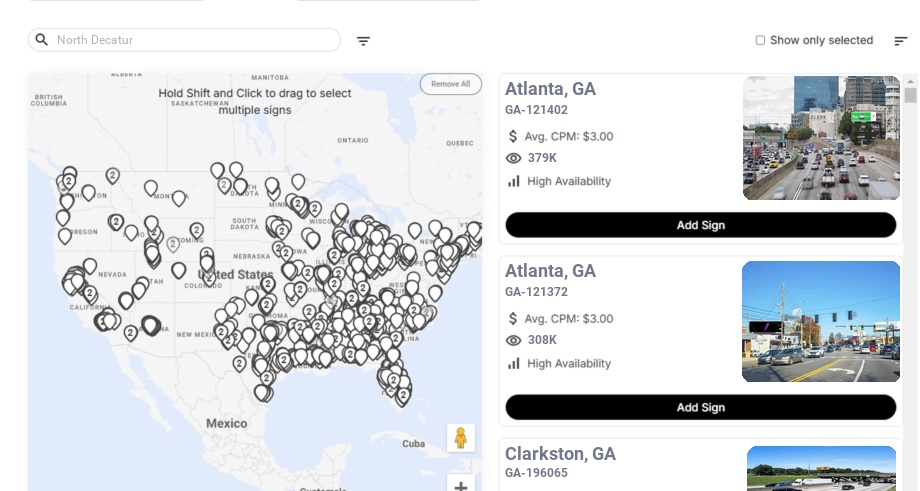



How much is a billboard near North Decatur?
Why Choose Blip for Billboard Advertising near North Decatur
Blip lets North Decatur advertisers launch fast on I-85, I-285, and North Decatur Rd commuters with self-serve control.
Set a flexible daily budget in North Decatur and reach Emory, CDC, and Decatur traffic without long-term contracts.
Daypart your North Decatur campaign for 7-10 a.m. commuters or 4-7 p.m. return traffic along Clairmont and Lawrenceville Hwy.
Track real-time results in North Decatur, then shift spend toward the corridors driving more calls from students, staff, and families.
Use Blip creative tools to tailor North Decatur billboards for flu season, back-to-school, or Decatur event weekends.
Frequently Asked Questions About Billboard Advertising near North Decatur
How much does a billboard cost near North Decatur, Georgia with Blip?
With Blip, you set your own daily budget for North Decatur billboards, so you can start small and scale up whenever you’re ready. Each “blip” is a 7.5–10 second display on a rotating digital billboard, and you only pay for the blips you receive, based on when and where your ad runs and current advertiser demand. That means billboards near North Decatur, Georgia can work for almost any marketing budget.
Where can I advertise with Blip near North Decatur, Georgia?
Our 42 digital billboards serving the North Decatur area are strategically positioned in nearby cities within roughly 10 miles. These include Decatur, Clarkston, Atlanta, and Norcross. This network offers flexible billboard rental near North Decatur without requiring you to commit to a single static board.
What kind of audience do North Decatur billboards reach?
North Decatur is a dense, highly educated in-town community just northeast of downtown Atlanta, surrounded by key employment and cultural hubs. The area includes a concentration of healthcare workers, academics, tech and office professionals, and public-sector staff. There is also strong demand for dining, entertainment, childcare, fitness, home services, and professional services.
When is the best time to run a North Decatur billboard campaign with Blip?
North Decatur area traffic is heavily shaped by work, school, and healthcare schedules, with distinct weekly rhythms that you can exploit with targeted billboard rental near North Decatur. Weekday peaks include 6:30–9:30 a.m., 3:00–4:30 p.m., and 4:00–7:00 p.m. Midday opportunity runs from 10:00 a.m.–3:00 p.m., when healthcare appointments, campus activities, and errands generate steady traffic.
What roads and traffic hotspots should I target near North Decatur, Georgia?
The North Decatur area sits between multiple high-volume corridors, including I‑285, U.S. 78 / Stone Mountain Freeway, Clairmont Road, North Decatur Road, Lawrenceville Highway, I‑85, and I‑20. Typical segments near Clarkston and Tucker on I‑285 record 150,000–190,000 vehicles per day, and core stretches of I‑85 through DeKalb and Gwinnett Counties routinely exceed 220,000–250,000 vehicles per day. These routes create strong commuter and midday exposure for billboards near North Decatur.
Do I need a contract to advertise with Blip near North Decatur?
No, Blip has no long-term contracts or minimum commitments. You can start, pause, or stop your campaign at any time.
How fast can I launch a billboard campaign with Blip near North Decatur?
You can have your campaign live in minutes. Create a free account, select your locations, set your budget, upload your design, and start running once approved.
Where can I advertise with Blip near North Decatur?
Blip has digital billboards near North Decatur. You can browse available locations on a map, choose the ones that fit your audience, and start advertising right away.
Still have questions? Launch a campaign in minutes — no contracts, no commitments.
Start Your CampaignNorth Decatur Billboard Advertising Guide
North Decatur sits at the nexus of some of metro Atlanta’s most dynamic neighborhoods, major institutions, and commuter corridors. With 42 digital billboards serving the North Decatur area from nearby Decatur, Clarkston, Atlanta, and Norcross, we can help you put timely, highly targeted messages in front of students, medical professionals, families, and intown commuters as they move through their daily routines. Whether you’re launching a new brand or scaling an established business, billboard advertising near North Decatur lets you tap into a dense, commuter-heavy audience every day.

Understanding the North Decatur Area Audience
North Decatur is a dense, highly educated in-town community just northeast of downtown Atlanta, surrounded by key employment and cultural hubs that make North Decatur billboards especially effective for reaching decision-makers.
- Population: The North Decatur CDP has roughly 18,500 residents (2020), while DeKalb County as a whole is home to about 760,000–770,000 residents. Within a 5‑mile drive of North Decatur, the daytime population climbs well above 200,000 once you factor in commuters, students, and hospital workers regularly exposed to billboards near North Decatur along their routes.
- Age mix: The area skews young adult and middle-aged, driven by proximity to Emory University and intown employment. In surrounding DeKalb County, the median age is about 36–37 years, with roughly 28–30% of residents in the key 25–44 working-age bracket—prime targets for professional services, housing, and family offerings promoted on North Decatur billboards.
- Education: DeKalb is one of Georgia’s most educated counties. Over 43–45% of adults 25+ hold a bachelor’s degree or higher, and in neighborhoods around Emory and North Decatur that share similar demographics, bachelor’s attainment frequently exceeds 60%, with 25–30% holding a graduate or professional degree.
- Income: Median household income in the North Decatur CDP is commonly reported in the $85,000–$95,000 range, compared with roughly $71,000 statewide and $69,000–$70,000 countywide. More than 30–35% of households in and near North Decatur earn $100,000+ annually, indicating a strong base of dual‑income professional households that respond well to clear, value-driven billboard advertising near North Decatur.
- Diversity: DeKalb County is a majority-minority county, with approximately 55–57% Black or African American, 5–7% Asian, 8–10% Hispanic/Latino, and a foreign-born share around 18–20%. This diversity is reflected in local restaurants, small businesses, faith communities, and cultural events, creating strong opportunities for inclusive and multicultural marketing.
Key institutions and activity centers that shape traffic and behavior near North Decatur include:
- Emory University & Emory University Hospital
Emory University enrolls more than 15,000–16,000 students across undergraduate and graduate programs and reports over 32,000 faculty and staff across the Emory Healthcare system and university. A large share of these students and employees travel daily through North Decatur Road, Clairmont Road, and Clifton Road, creating dense weekday traffic flows that can be reached efficiently with billboards near North Decatur. - U.S. Centers for Disease Control and Prevention (CDC)
The adjoining Clifton campus of the CDC and nearby agencies employ an estimated 10,000–12,000 public health professionals and contractors, many of whom commute via I‑85, North Druid Hills, and North Decatur corridors. - City of Decatur
Just 1–2 miles south, Decatur - Atlanta’s core
Downtown and Midtown Atlanta
For advertisers, this means you’re speaking to:
- A concentration of healthcare workers, academics, tech and office professionals, and public-sector staff
- Strong demand for dining, entertainment, childcare, fitness, home services, and professional services
- High receptivity to messages about education, healthcare, sustainability, and local culture, especially when they reference trusted institutions like Emory, the CDC, and the City of Decatur
Where Our Billboards Reach Near North Decatur
Our 42 digital billboards serving the North Decatur area are strategically positioned in nearby cities within roughly 10 miles, placing your brand along corridors that tens of thousands of drivers use every day. This network offers flexible billboard rental near North Decatur without requiring you to commit to a single static board:
- Decatur (about 1.3 miles away) – Reaching local residents, visitors to Decatur Square, and traffic along corridors like Scott Boulevard and Ponce de Leon Avenue. The City of Decatur
- Clarkston (about 2.2 miles away) – A dense, highly diverse community near I‑285 and U.S. 78. The City of Clarkston is often cited as one of the most diverse cities in the U.S., with residents from 40+ countries and dozens of language groups. Boards here capture regional commuters and local shoppers heading toward Decatur and Atlanta, extending the reach of billboard advertising near North Decatur.
- Atlanta (about 6.0 miles away) – Boards near key intown arteries (such as I‑20, I‑85, and major surface streets) extend your reach to people who live, work, or play in the North Decatur area. The City of Atlanta
- Norcross (about 9.9 miles away) – The City of Norcross sits along I‑85 and key commuter routes. Boards here capture northern suburban commuters from Gwinnett County—home to nearly 1 million residents—who regularly drive toward Emory, the CDC, and intown Atlanta through the North Decatur area.
By selecting these locations in Blip’s platform, you can focus impressions on drivers who live in, work in, or pass frequently through the North Decatur area, even if the boards themselves stand in the surrounding cities. This makes it easy to build a customized footprint of North Decatur billboards that match your exact trade area.
Commuting Patterns and Traffic Hotspots to Target
The North Decatur area sits between multiple high-volume corridors. According to analyses based on Georgia Department of Transportation (GDOT) traffic count data and regional planning studies from agencies like the Atlanta Regional Commission
-
I‑285 (East Perimeter near Clarkston and Tucker)
- Typical segments near Clarkston and Tucker record 150,000–190,000 vehicles per day (AADT).
- Morning inbound traffic (6:30–9:00 a.m.) and evening outbound traffic (4:00–6:30 p.m.) often operate at or near capacity, leading to extended viewing time in slowdowns.
- Key route for commuters headed to Emory/CDC, Perimeter Center, and intown jobs.
-
U.S. 78 / Stone Mountain Freeway (Clarkston area)
- Inner segments approaching I‑285 frequently record 100,000–115,000 vehicles per day.
- Major commuter link for residents of Stone Mountain, Lilburn, and Snellville traveling toward the North Decatur and Decatur areas and into Atlanta’s core, making it an important feeder for billboards near North Decatur.
-
Clairmont Road, North Decatur Road, and Lawrenceville Highway (SR 8)
- These surface corridors routinely carry 25,000–45,000 vehicles per day depending on the segment.
- High daytime volumes are tied to Emory University, Emory Decatur Hospital, nearby campuses, and retail centers such as North Decatur Station and Suburban Plaza.
-
I‑85 and I‑20 (Atlanta and Norcross boards)
- Core stretches of I‑85 through DeKalb and Gwinnett Counties routinely exceed 220,000–250,000 vehicles per day, while I‑20 east of Downtown Atlanta often records 160,000–180,000 vehicles per day.
- Many North Decatur area residents commute via these interstates to Midtown, Downtown, and Buckhead, as well as to job centers in Gwinnett and the airport area.
Using these patterns, we can align your Blip buys with:
- Morning commuter audiences heading into Emory/CDC, Midtown, or Downtown from Norcross, Tucker, Clarkston, and the eastern and northern suburbs.
- Evening return traffic moving toward North Decatur area neighborhoods, Decatur, and nearby suburbs along I‑285, U.S. 78, and surface streets.
- Midday local errand traffic, particularly near retail clusters, grocery centers, and medical campuses where appointment-driven visits keep traffic steady between 10 a.m. and 3 p.m.
Timing: When to Run Your Campaign for Maximum Impact
North Decatur area traffic is heavily shaped by work, school, and healthcare schedules, with distinct weekly rhythms that you can exploit with targeted billboard rental near North Decatur:
-
Weekday peaks
- 6:30–9:30 a.m.: Inbound professional and student commuters toward Emory, CDC, and Atlanta’s core. MARTA reports tens of thousands of weekday boardings systemwide, and many riders connect via park‑and‑ride lots along these corridors.
- 3:00–4:30 p.m.: School dismissal and early healthcare shift changes; City Schools of Decatur alone serve more than 5,000 students, and nearby DeKalb County School District schools add thousands more daily trips through the area.
- 4:00–7:00 p.m.: Traditional office commuting window, plus restaurant and retail visits. Restaurants in Decatur and along North Decatur Road see some of their highest check counts during this window.
-
Midday opportunity (10:00 a.m.–3:00 p.m.)
- Healthcare appointments, campus activities, and work-from-home errands generate steady traffic. Emory Healthcare reports millions of patient encounters annually across its system, many concentrated in late morning and early afternoon.
- Ideal for medical practices, lunch spots, grocery, home services, and same-day retail promotions.
-
Evenings and weekends
- Downtown Decatur events, Emory arts and sports, and Atlanta nightlife draw residents out of the neighborhood. The City of Decatur events calendar Discover Atlanta
- Weekend traffic patterns skew more heavily toward leisure, shopping, and family activities, with retail centers and restaurant districts seeing spikes from late morning through late evening.
With Blip’s flexible scheduling, we can translate these patterns into strategy:
- B2B and professional services: Concentrate impressions on weekday mornings (7–10 a.m.) and late afternoons (4–7 p.m.) near Atlanta and Norcross boards that capture inbound/outbound commuters related to the North Decatur area.
- Healthcare providers & clinics: Prioritize weekday mid-morning and early afternoon (9 a.m.–3 p.m.) when patients and staff are on the move near Decatur and Clarkston boards, especially around hospital and clinic clusters.
- Restaurants & entertainment: Focus on evenings (4–10 p.m.) and weekends near Decatur and Atlanta billboards that draw leisure traffic from the North Decatur area, including patrons headed to shows, games, and festivals.
- Retail & local services: Maintain a presence throughout the day, but add heavier bursts on Friday afternoon and Saturday shopping hours, when many stores see 25–35% of their weekly foot traffic.
Audience Segments to Consider in the North Decatur Area
Because the North Decatur area lies between major job centers and established neighborhoods, several high-value audience segments emerge that can be efficiently reached with North Decatur billboards:
-
Medical and Public Health Professionals
- Emory University Hospital, Emory Decatur Hospital, the CDC, and nearby clinics collectively employ tens of thousands of doctors, nurses, researchers, support staff, and public health professionals.
- Healthcare workers typically have above-average household incomes and long or irregular shifts, creating strong demand for meal delivery, childcare, fitness, financial planning, home maintenance, and quick-service medical options (urgent care, pharmacy, imaging).
-
Students and Young Professionals
- Emory University enrolls more than 15,000 students, and nearby institutions (such as Agnes Scott College in Decatur) add several thousand more, creating a critical mass of 18–34-year-olds.
- Many students live in or commute through the North Decatur area, relying on MARTA buses, campus shuttles, rideshares, and walking for last-mile travel.
- Ideal for campaigns promoting apartments and co-living, mobile apps, career services, nightlife, budget-conscious dining, and subscription services.
-
Families and Long-Term Residents
- Nearby Decatur City Schools of Decatur regularly post graduation rates above 95% and strong test scores, attracting families willing to invest in education, extracurricular activities, and home improvement.
- North Decatur and adjacent DeKalb neighborhoods also feature a significant share of homeowners—often 55–60% in nearby tracts—supporting demand for real estate, remodeling, landscaping, and financial services.
- These residents respond well to tutoring services, healthcare, after-school programs, local retail, and family-oriented entertainment.
-
Multicultural and International Communities
- Clarkston, often highlighted in national media as one of America’s most diverse small cities, has a large refugee and immigrant population, with residents from 40–50+ countries and a foreign-born share estimated above 30%.
- DeKalb County’s countywide diversity also supports multilingual outreach and culturally specific products and services.
- This creates opportunities for brands offering ethnic foods, international banking and remittance services, language schools, immigration legal assistance, and inclusive healthcare.
When planning your creative, consider:
- Including visual diversity in photos and illustrations.
- Using simple, clear language that’s easy to process quickly for non-native English speakers.
- Highlighting convenience, safety, and trust—values that cut across these segments and are especially important for healthcare, financial, and family-related services.
Message and Creative Best Practices for the North Decatur Area
In a fast-moving, knowledge-based community like the North Decatur area, clarity and relevance are critical. For digital billboards near North Decatur, we recommend:
- Lead with one bold idea
Traffic speeds on major corridors are typically 35–55 mph, and congestion can extend dwell time but not attention. Drivers have 6–8 seconds at most to absorb your message.
- Keep it to 7 words or fewer in your main headline whenever possible.
- Emphasize one core benefit: “Same-Day Urgent Care Near Emory,” “Family Dentist 5 Minutes from Decatur,” or “Pet Grooming on North Decatur Road.”
- Use high-contrast, institution-aware designs
- Leverage bold color contrasts: dark text on light backgrounds or vice versa. Strong contrast can increase legibility by 20–30% at a distance.
- Use large fonts (at least 18–24 inches tall in final print-equivalent scale); Blip’s specs translate to large digital point sizes—avoid thin scripts or all-caps blocks that are hard to read.
- Consider campus- or hospital-adjacent messaging where appropriate: “Nurses & Doctors Save 15%,” “Emory Student Discounts Here,” or “CDC Staff Welcome – Walk In Today.”
- Reference local landmarks and routes
People in the North Decatur area navigate by well-known roads and institutions, not just street numbers. Phrases like:
- “On Scott Blvd near North Decatur Rd”
- “Across from Emory Decatur Hospital”
- “Off I‑285, Exit XX toward Decatur”
help drivers mentally map your location quickly and can improve follow‑through when paired with a clear call to action (“Next Right,” “2 Miles Ahead,” “Turn at Clairmont Rd”).
- Align with local values
Residents near North Decatur tend to value education, health, sustainability, and community involvement.
- Highlight certifications, eco-friendly practices, or community sponsorships.
- For example: “Solar-Powered Dry Cleaning,” “Local Organic Grocer by Emory,” or “Proud Sponsor of Decatur Youth Sports.”
- Educational and health-related benefits (“Board-Certified Pediatricians,” “STEM-Focused Tutoring,” “Evidence-Based Therapy”) resonate strongly in a market where nearly half of adults hold college degrees.
- Use dynamic creative strategically
Because Blip allows you to rotate multiple creatives:
- Run different messages for commuters vs. weekend shoppers, shifting copy to match intent (e.g., “Walk-In Visits Before Work” on weekdays vs. “Same-Day Care All Weekend” on Saturdays and Sundays).
- Promote time-sensitive offers: “Lunch Special 11–2,” “Game Day Deals Tonight,” or “Enrollment Ends Friday.”
- A/B test two headlines—e.g., “Same-Day Dentistry” vs. “Emergency Dental Today”—and monitor which correlates with more calls, web visits, or coupon redemptions over 2–4 week intervals.
Using Local Events and Seasonality to Your Advantage
The North Decatur area benefits from a year-round calendar of cultural, academic, and community events. Tapping into these can significantly boost your billboard performance.
Helpful calendars include:
- City of Decatur
- Discover Dekalb – countywide attractions, festivals, and visitor information highlighting key draws such as Stone Mountain Park and regional sports.
- Discover Atlanta
Key seasonal patterns:
-
Spring (March–May)
- Emory’s spring semester, graduation, and festival season in Decatur and Atlanta. Graduation and move‑out periods bring thousands of visiting family members into the area over a few concentrated weeks.
- Great for campaigns around housing, moving services, graduation gifts, seasonal retail, and local attractions.
-
Summer (June–August)
- Families and students stay active in camps, summer courses, and regional travel. School calendars for City Schools of Decatur and DeKalb County School District shape camp and childcare demand.
- Highlight childcare, camps, HVAC and cooling services, home improvement, and summer dining or drink specials.
-
Fall (September–November)
- Back-to-school and Emory’s fall semester drive steady traffic. Flu shot and preventive care campaigns often peak as healthcare systems push vaccinations and checkups.
- Excellent window for educational services, tutoring, health checkups, flu shots, and sports-related promotions tied to college and professional seasons.
-
Winter (December–February)
- Holiday shopping, New Year’s resolutions, and year-end medical visits (using remaining insurance benefits). Retailers can see 20–30% of their annual sales in November–December alone.
- Emphasize retail offers, healthcare appointments, gyms, wellness services, and tax or financial planning as filing season approaches.
Because Blip campaigns can be activated or paused on demand, you can:
- Run short, high-intensity campaigns around specific festivals, sports seasons, or school milestones (back-to-school, graduation).
- Schedule creatives only during months that matter most to your business (for example, HVAC in summer and winter, tax services January–April).
- Shift budget quickly if a big event is relocated or rescheduled, or if local news changes audience priorities (e.g., health advisories, transportation changes, or new development openings).
Neighborhood-Level Targeting with Surrounding Cities
Our boards in Decatur, Clarkston, Atlanta, and Norcross allow you to reach distinct but overlapping segments of the North Decatur area audience:
-
Decatur-facing boards
- Reach residents and visitors who frequent Downtown Decatur restaurants, bars, and shops. Foot traffic in the square and along Ponce de Leon and Church Street spikes on weekends and during major events.
- Strong for family services, dining, real estate, legal and financial services, and local institutions like schools and non-profits.
-
Clarkston-facing boards
- Ideal for brands targeting multicultural consumers, budget-conscious shoppers, and commuters along I‑285 and U.S. 78.
- Effective for grocers, telecom providers, remittance and international banking services, ESL and education providers, and public health messaging that benefits from multi-language visibility.
-
Atlanta-facing boards
- Reach commuters who live in the North Decatur area but work in Midtown, Downtown, or Buckhead, as well as city residents heading east to dine or shop in Decatur and North Decatur.
- Great for professional services, employers hiring in the North Decatur area, educational institutions, and attractions that want to draw city workers out to the east side.
-
Norcross-facing boards
- Capture northern suburban residents who travel to Emory, the CDC, and intown offices through the North Decatur area.
- Perfect for high-ticket items (vehicles, home upgrades), healthcare systems with multiple locations, and services that draw from both suburbs and intown neighborhoods.
By combining these locations, you can:
- Build a 360° coverage pattern where residents see your message on the way to work, near errands, and heading home—improving recall through repeated exposures along their regular routes.
- Test which corridors deliver the strongest results for your business, then shift budget accordingly in Blip (for example, pushing more impressions to Norcross boards if you see higher call volume from northern ZIP codes).
Integrating Digital Billboards with Local Media and Online Campaigns
To maximize ROI, pair your billboard presence near North Decatur with local news and digital channels:
-
Local news outlets
- The Atlanta Journal-Constitution – metro-wide coverage; its digital and print audiences overlap heavily with area commuters and decision-makers.
- Decaturish – hyperlocal news for Decatur and surrounding neighborhoods, with strong engagement on local issues and business openings.
- Decatur Patch – community updates, events, and neighborhood news targeting residents who are particularly attuned to local happenings.
-
Cross-channel strategy tips
- Use the same core tagline and visual identity on billboards, social ads, and local news sponsorships to build familiarity. Research consistently shows that multi-channel campaigns can improve ad recall by 20–30% compared with single-channel efforts.
- Encourage billboard viewers to search a short, memorable phrase or URL that matches your online campaign, such as “North Decatur Urgent Care” or “Decatur Family Dentist.”
- Track increases in direct website traffic, branded search volume, phone calls, and online bookings in the 1–4 weeks after starting your Blip campaign or changing creatives.
Because people in the North Decatur area are highly connected and digitally savvy—smartphone ownership and broadband access are both well above national averages—consistent messaging across physical and digital channels builds trust and recall more quickly.
Measuring and Optimizing Your Campaign
While digital billboards don’t provide user-level data like online ads, we can still structure campaigns for measurable impact:
-
Define a clear conversion goal
- Calls, online bookings, coupon redemptions, foot traffic, or app installs.
- For example, a clinic might target a 10–20% increase in new patient calls over a 3‑month period.
-
Use trackable elements
- Unique landing pages (e.g., “/northdecatur” or “/emory”).
- Distinct phone numbers or promo codes (“MENTION ‘EMORY’ FOR 10% OFF”).
- QR codes for slow-traffic zones (e.g., near surface streets and intersections in Decatur) where drivers have time to scan safely while stopped.
-
Test and refine
- Rotate multiple creatives in Blip; compare outcomes week over week or month over month.
- Shift impressions toward the best-performing corridors and dayparts once you see patterns (for example, if 60% of trackable leads come from boards along I‑285, increase their share of your budget).
- Adjust messaging to emphasize the value propositions that generate the most responses (e.g., “Open Late” vs. “Same-Day Appointments”).
-
Align with real-world changes
- Monitor City of Decatur DeKalb County announcements for road work, new developments, special events, or transit changes that may shift traffic patterns.
- Check MARTA and GDOT updates for changes to bus routes, rail service, or major construction that can affect commute flows.
- Adjust board selections and scheduling to keep your campaign aligned with where people are actually driving and when congestion (and dwell time) is highest.
Putting It All Together: A Sample Strategy
To illustrate how these pieces fit, here’s an example of a well-rounded approach for a hypothetical business targeting the North Decatur area:
Business: Multi-location urgent care clinic near North Decatur Road
Goal: Increase weekday patient volume from professionals and families by 15–25% over 6 months
-
Location focus
- Decatur and Clarkston boards to capture commuters traveling between I‑285, U.S. 78, and the North Decatur area, with daily volumes exceeding 100,000 vehicles on some freeway segments.
- Select Atlanta-facing boards on routes commonly used by Emory and CDC staff, such as I‑85 and surface connectors to Clifton Road and North Druid Hills, building a strong presence of billboards near North Decatur that workers see multiple times per week.
-
Timing
- Heavy weighting on weekdays 7–10 a.m. and 3–7 p.m., when healthcare workers and office employees are commuting or bringing in family members after school.
- Lighter, consistent presence during midday (10 a.m.–3 p.m.) for appointment-related traffic and walk‑ins.
-
Creative set
- “Urgent Care Near North Decatur Rd – Walk In Today”
- “Emory & CDC Staff: Short Wait, Open Late”
- “Kids Sick? Evening & Weekend Urgent Care in the North Decatur Area”
- During flu season, rotate in: “Flu Shots Today – No Appointment Needed”
-
Measurement
- Unique phone number and URL printed on billboard creatives (e.g., “/decaturcare”).
- Front desk staff trained to ask new patients how they heard about the clinic and record responses in the practice management system.
- Week-to-week comparison of call volume and new patient visits before and after major creative updates, aiming for a sustained 10%+ lift in the target time windows.
- Compare performance by ZIP code to see which corridors (Decatur vs. Norcross vs. Clarkston) generate the highest response, then shift Blip budget accordingly.
Using Blip, they can adjust bids and schedules dynamically, increasing budget during flu season or community outbreaks and dialing back during slower months—keeping spend aligned with the times of year and dayparts when demand is highest and making the most of flexible billboard rental near North Decatur.