Billboards near Tucker, GA
No Minimum Spend. No Long-Term Contracts. Just Results.
Trusted by Leading Brands


Billboard advertising
near Tucker has never been easier



How much is a billboard near Tucker?
Why Choose Blip for Billboard Advertising near Tucker
Blip lets Tucker brands launch fast on I-285, U.S. 78, and Lawrenceville Highway—no sales calls, just self-serve control.
Set a Tucker daily budget that fits your plan and scale as commuters, shoppers, and visitors respond across the metro corridors.
Daypart your Tucker ads for rush hour, late-night shift workers, or weekend retail traffic near Norcross and Duluth.
No contracts means Tucker advertisers can test short flights tied to Stone Mountain events, holiday shopping, or hiring pushes.
Track Tucker campaign results in real time and shift spend to the boards driving the best reach on Jimmy Carter and U.S. 29.
Use Blip's creative tools to make Tucker billboards pop with local cues like I-285, Northlake, and Pleasant Hill Road.
Frequently Asked Questions About Billboard Advertising near Tucker
How much does a billboard cost near Tucker, Georgia with Blip?
With Blip, you control exactly how much you spend on Tucker billboards by setting a daily budget that can fit almost any marketing plan. Your ad appears as short 7.5–10 second “blips” on rotating digital billboards near Tucker, Georgia, and you only pay for the blips you receive. Because pricing is based on when and where you choose to run your ads, plus current advertiser demand in the Tucker area, costs stay flexible and transparent.
Where can I advertise with Blip near Tucker, Georgia?
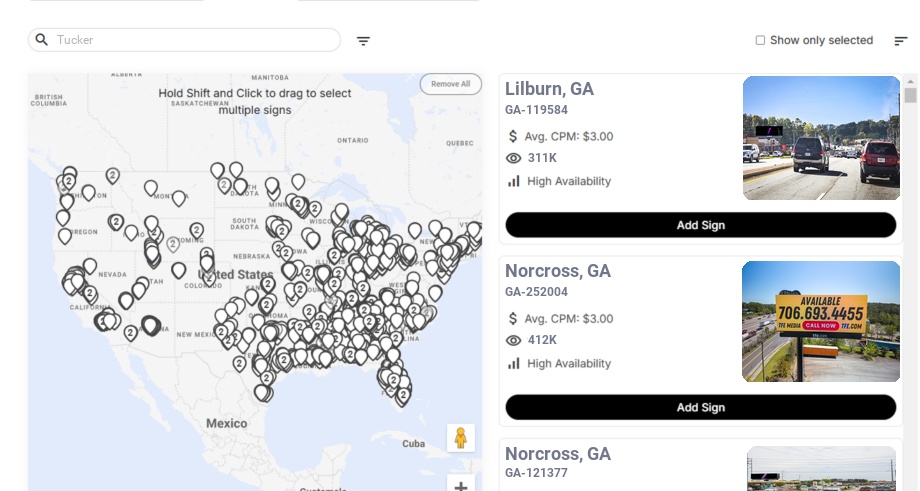
There are 25 nearby digital billboards serving the Tucker area from Clarkston, Decatur, Norcross, Lilburn, and Duluth. These boards are positioned along the key commuter and shopping corridors that residents of the Tucker area use every day. This network effectively functions as a ring of billboards near Tucker, giving you metro-scale reach while still feeling highly local to Tucker households.
What kind of audience can Blip reach in the Tucker area?
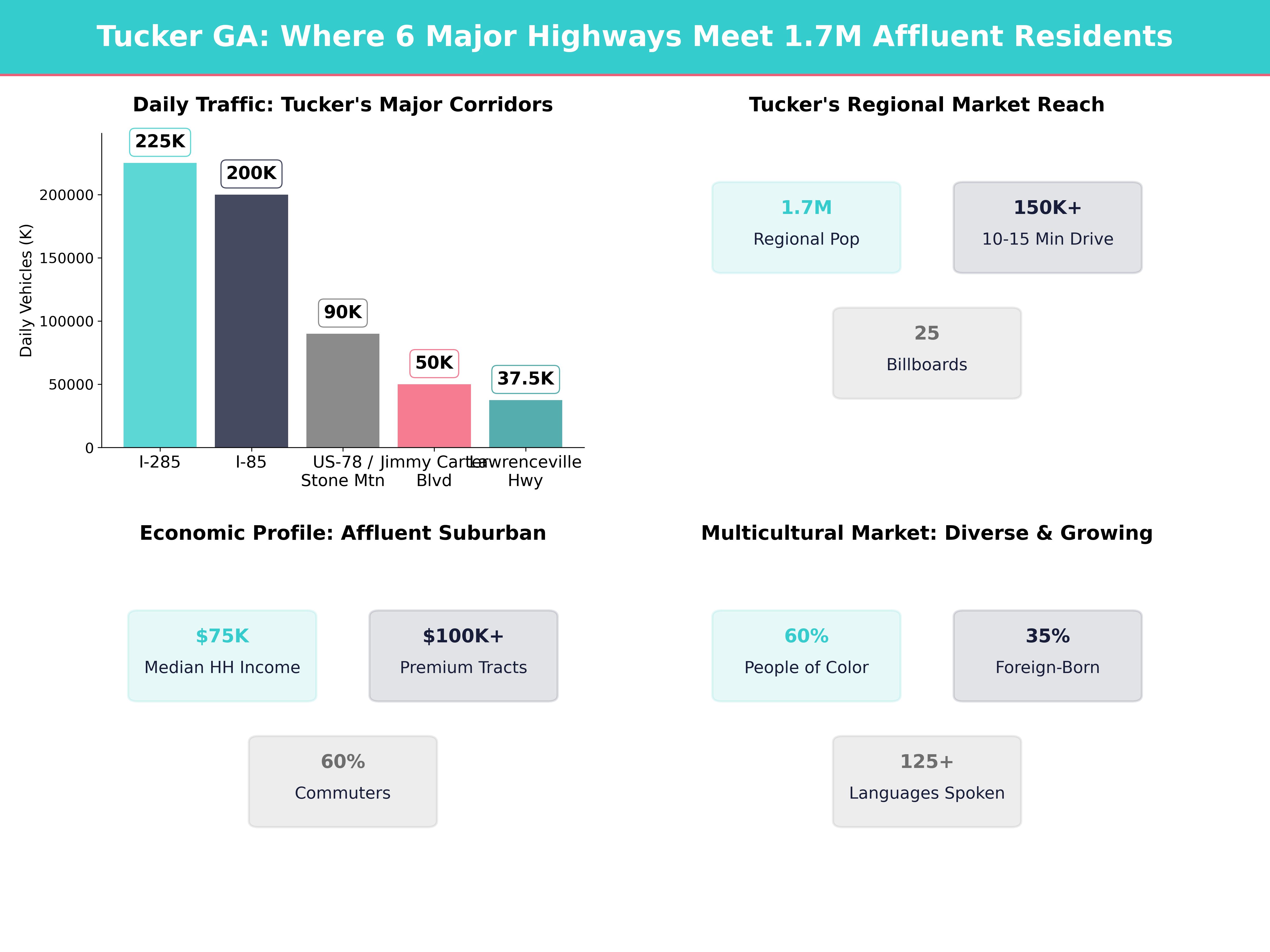
The City of Tucker reports a population of roughly 37,000 residents within city limits, with the broader northeast DeKalb and western Gwinnett area pushing the effective trade area to well over 150,000 people within a 10–15 minute drive. DeKalb County has approximately 760,000 residents, while adjacent Gwinnett County adds another 980,000+ residents, positioning the Tucker area amidst a population base of around 1.7 million people within the two counties alone. The Tucker area also combines established residential neighborhoods, light industrial corridors, and major retail hubs, making it a high-value market for both local and regional advertisers.
What are the busiest billboard corridors near Tucker, Georgia with Blip?
I-285 near Tucker often sees 200,000–250,000 vehicles per day, making it one of the busiest beltway segments in the Southeast. U.S. 78 / Stone Mountain Freeway between the Tucker area and Decatur frequently carries 80,000–100,000 vehicles per day, and I-85 near Norcross and Duluth generally sees 180,000–220,000 vehicles per day. These are high-volume routes for reaching Tucker-area commuters, shoppers, and visitors.
When is the best time to run a Tucker, Georgia billboard campaign with Blip?
Morning rush hour from 6:30–9:00 a.m. is strong for inbound traffic on I-285, I-85, and U.S. 78 as Tucker-area residents commute to employment centers. Evening from 4:00–7:00 p.m. is also valuable because traffic often spikes again to within 90–100% of morning peak levels. Midday, weekends, and late-night dayparts can also be effective depending on whether you want to reach families, shoppers, or industrial and logistics workers.
Do I need a contract to advertise with Blip near Tucker?
No, Blip has no long-term contracts or minimum commitments. You can start, pause, or stop your campaign at any time.
How fast can I launch a billboard campaign with Blip near Tucker?
You can have your campaign live in minutes. Create a free account, select your locations, set your budget, upload your design, and start running once approved.
Where can I advertise with Blip near Tucker?
Blip has digital billboards near Tucker. You can browse available locations on a map, choose the ones that fit your audience, and start advertising right away.
Still have questions? Launch a campaign in minutes — no contracts, no commitments.
Start Your CampaignTucker Billboard Advertising Guide
The Tucker, Georgia area sits at a powerful crossroads in northeast metro Atlanta, where I-285, U.S. 78, and Lawrenceville Highway funnel commuters, shoppers, and visitors every day. With 25 nearby digital billboards serving the Tucker area from Clarkston, Decatur, Norcross, Lilburn, and Duluth, we can help you reach a dense, mobile audience with flexible, data-driven campaigns tailored to this unique suburban-urban market. For advertisers seeking billboards near Tucker or exploring billboard rental near Tucker without being confined to the city limits, these nearby placements provide high-impact coverage of the same core audience.
Understanding the Tucker Area Market
The Tucker area combines established residential neighborhoods, light industrial corridors, and major retail hubs, making it a high-value market for both local and regional advertisers considering Tucker billboards or broader regional exposure.
Key market facts:
- The City of Tucker reports a population of roughly 37,000 residents within city limits, with the broader northeast DeKalb and western Gwinnett area pushing the effective trade area to well over 150,000 people within a 10–15 minute drive.
- DeKalb County, which includes Tucker, has approximately 760,000 residents, while adjacent Gwinnett County adds another 980,000+ residents, positioning the Tucker area amidst a population base of around 1.7 million people within the two counties alone.
- The Atlanta–Sandy Springs–Alpharetta metropolitan area totals about 6 million residents, making the Tucker area part of one of the largest and fastest-growing metros in the Southeast. The Atlanta Regional Commission 1.8 million more residents by 2050, an increase of about 30–35% over current levels.
- According to Explore DeKalb 13+ million visitors annually, driven by attractions such as Stone Mountain Park and major event venues, many of which are within a short drive of Tucker and its key corridors.
Economic profile:
- Median household incomes in many neighborhoods near Tucker, Northlake, and bordering Gwinnett County typically range from the mid-$60,000s to $90,000+, with some nearby census tracts in northeast Dekalb and western Gwinnett exceeding $100,000. This places a large share of the local audience in middle and upper-middle income brackets.
- DeKalb County’s gross regional product has been estimated at $40–45 billion annually, while Gwinnett’s is in a similar range, reflecting strong employment bases in healthcare, education, logistics, technology, and professional services.
- The Georgia Department of Labor consistently reports unemployment rates in DeKalb and Gwinnett that track close to or below statewide averages, often in the 3–4% range in recent years, signaling a stable labor market and steady consumer spending power.
- Major employment centers around the Tucker area include medical offices, distribution and logistics facilities, retail centers (such as Northlake-area shopping zones), and office parks. Many residents also commute to jobs in downtown Atlanta, Decatur, and Perimeter Center; regional data show that more than 60% of workers in northeast DeKalb and western Gwinnett commute to jobs outside their home city.
Useful local references for understanding the community:
- City of Tucker – local government, events, and economic development information.
- DeKalb County Government – county-level planning, business resources, and infrastructure.
- Explore DeKalb
- Explore Gwinnett – regional attractions, dining, and events drawing Tucker-area residents into Gwinnett corridors.
For advertisers, this means the Tucker area offers a rich mix of long-term residents, daily commuters, and visitors moving across county lines—perfect for campaigns that need consistent, repeated exposure on heavily traveled routes and for brands comparing different options for billboard advertising near Tucker.
Where Our Digital Billboards Are Located Around the Tucker Area
Although our boards are located in nearby cities, they are positioned along the key commuter and shopping corridors that residents of the Tucker area use every day. This network effectively functions as a ring of billboards near Tucker, giving you metro-scale reach while still feeling highly local to Tucker households.
Our 25 digital billboards serving the Tucker area are distributed within about 10 miles in:
- Clarkston (≈4.0 miles from Tucker) – Close to I-285 and the Stone Mountain Freeway (U.S. 78), capturing Tucker-area drivers making short trips toward Decatur or Atlanta. Clarkston also sits near major apartment communities and international markets, creating dense local traffic throughout the day.
- Decatur (≈5.2 miles) – A major employment, restaurant, and nightlife destination, connected via Lawrenceville Highway, Dekalb Industrial Way, and College Avenue. The City of Decatur
- Norcross (≈5.5 miles) – Positioned near I-85 and major Gwinnett County corridors where many Tucker-area commuters work or shop. The City of Norcross highlights its historic downtown, parks, and events that attract regional visitors, especially on weekends.
- Lilburn (≈5.9 miles) – Along U.S. 29 and other east-west routes between Gwinnett County and the Tucker area. City of Lilburn improvements around Main Street, City Park, and greenways have increased local event activity and corresponding traffic.
- Duluth (≈8.1 miles) – On and around I-85, Sugarloaf Parkway, and Pleasant Hill Road, which see strong flows of Tucker-area residents heading toward regional retail and entertainment. The City of Duluth and nearby Sugarloaf area regularly host concerts, festivals, and sporting events, drawing tens of thousands of visitors annually.
Relevant local partners and municipalities:
- City of Clarkston
- City of Decatur
- City of Norcross
- City of Lilburn
- City of Duluth
- Gwinnett County Government
By targeting boards on these corridors, you can intercept Tucker-area residents on their everyday journeys—commutes, school runs, shopping trips, and weekend outings—without needing boards physically inside city limits. This makes it simple to plan cost-effective Tucker billboards that still deliver strong exposure where your audience actually drives.
Traffic Patterns and High-Impact Corridors Near Tucker
To maximize reach, it helps to focus on corridors with the highest daily traffic and the strongest Tucker-area connection. According to Georgia Department of Transportation traffic data
- I-285 near Tucker (north/east side): often 200,000–250,000 vehicles per day, making it one of the busiest beltway segments in the Southeast and accounting for more than 70 million vehicle trips per year on some segments.
- U.S. 78 / Stone Mountain Freeway between the Tucker area and Decatur: frequently 80,000–100,000 vehicles per day, with volumes peaking during weekday rush hours; that’s 29–36 million vehicle trips per year.
- Lawrenceville Highway (U.S. 29) through the Tucker and Lilburn corridor: commonly 30,000–45,000 vehicles per day, depending on the segment, translating to roughly 11–16 million annual vehicle trips.
- Jimmy Carter Boulevard / Mountain Industrial Boulevard area serving Norcross, Tucker, and Stone Mountain: typically 40,000–60,000 vehicles per day, or approximately 15–22 million trips annually, with heavy mixing of commuter and commercial traffic.
- I-85 near Norcross and Duluth: generally 180,000–220,000 vehicles per day, which can exceed 65–80 million trips per year, with many commuters traveling from the Tucker area toward job centers further north and east.
- Pleasant Hill Road / Sugarloaf area (Duluth): often 40,000–55,000 vehicles per day, with strong retail and dining draw that drives especially high volumes on weekends and holiday shopping periods.
With Blip, we can concentrate your budget on these high-volume routes and specific boards that align with the audience you care about—whether that is Tucker-area households, regional commuters, or cross-county shoppers—ensuring your billboard advertising near Tucker reaches the right drivers at the right times.
Key Audience Segments in the Tucker Area
The Tucker area includes a variety of audience types. Understanding them helps inform both creative and scheduling and ensures that your billboards near Tucker are speaking to the right people with the right message.
-
Daily Commuters
- Regional commute data for metro Atlanta show average one-way commute times of 30–33 minutes, with many Tucker-area commuters spending 30–45+ minutes each way, especially those traveling via I-285 or I-85.
- More than 75% of workers in the broader Atlanta region commute alone by car, meaning road-based media remains the dominant way to reach working adults.
- These drivers are heavily exposed to digital billboards along I-285, I-85, and U.S. 78, making rush-hour impressions extremely valuable for awareness, recruiting, and service-based campaigns.
-
Suburban Families and Homeowners
- The Tucker area is known for established neighborhoods, single-family homes, and good access to parks and schools. Nearby cities such as Lilburn, Norcross, and Duluth report homeownership rates in many neighborhoods in the 60–75% range.
- Household composition data for northeast DeKalb and western Gwinnett show that roughly 30–40% of households include children under 18, creating a strong family-oriented consumer base.
- Family-oriented spending on groceries, home improvement, healthcare, after-school activities, and local services is strong; regional consumer expenditure surveys show families in metro Atlanta often spend $8,000–10,000+ per year on food, $3,000–5,000 on healthcare, and several thousand more on home services and child-related activities.
- Messaging for schools, healthcare, churches, youth programs, and home services performs particularly well when boards near Lilburn, Norcross, and the Northlake/Tucker area are used together to reinforce frequency.
-
Diverse, Multicultural Communities
- DeKalb and Gwinnett counties are among the most diverse in Georgia, with no single racial or ethnic group holding an absolute majority. In Gwinnett, people of color collectively account for well over 60% of the population, and DeKalb has similar levels of diversity.
- In many tracts near Clarkston, Norcross, and Lilburn, foreign-born residents can account for 30–40%+ of the local population, with significant communities from Africa, Asia, Latin America, and the Caribbean.
- Local school systems such as DeKalb County School District and Gwinnett County Public Schools report students speaking 100–150+ languages and dialects at home, underlining the need for culturally aware messaging.
- Campaigns that recognize cultural diversity, use inclusive imagery, or highlight multilingual offerings (e.g., “Se habla español” or Korean/Chinese/Vietnamese language support) can resonate strongly and often outperform generic creative in these corridors.
-
Industrial, Logistics, and Trades Workers
- The Mountain Industrial Boulevard and Jimmy Carter Boulevard corridors house clusters of warehouses, light manufacturing, and service businesses that support thousands of jobs in logistics, distribution, production, and field services.
- Regional employment data show that transportation and warehousing jobs in the Atlanta area have grown by more than 20–30% over the last decade, driven by e-commerce and regional distribution centers—many located along I-85 and U.S. 78.
- These corridors attract B2B buyers, tradespeople, fleet operators, and shift workers who are on the road at off-peak times (early morning, mid-day, late night).
- Advertisers offering equipment, staffing services, safety products, or commercial vehicles can effectively focus spend on non-commute dayparts to reach these workers without competing as heavily with general consumer brands.
-
Regional Shoppers and Entertainment Seekers
- Destinations across Decatur, Norcross, Duluth, and Lilburn attract Tucker-area residents for dining, shopping, and entertainment. Areas like downtown Decatur, downtown Duluth, historic Norcross, and the Pleasant Hill/Sugarloaf retail corridors host dozens of restaurants, entertainment venues, and specialty stores.
- Major shopping nodes (like Northlake, Pleasant Hill Road, and the Sugarloaf Mills area) draw consumers from tens of miles away; retail centers along I-85 in Duluth and Lawrenceville regularly see tens of thousands of visitors per weekend, especially during holiday seasons.
- According to Explore Gwinnett, Gwinnett County attracts millions of visitors annually for sports tournaments, concerts, and cultural festivals, significantly increasing weekend and evening traffic on I-85, Pleasant Hill, and Sugarloaf.
- Promotions for restaurants, retail, and live events perform well with evening and weekend scheduling around these corridors, where leisure and discretionary spending is highest.
Timing Your Blip Campaign for the Tucker Area
With flexible scheduling, we can align your digital billboard presence with real-world traffic flows near the Tucker area. This flexibility is especially helpful if you are testing billboard advertising near Tucker for the first time and want to see which dayparts drive the best response.
Weekday Rush Hours
-
Morning (6:30–9:00 a.m.)
- Heavy inbound traffic on I-285, I-85, and U.S. 78 as Tucker-area residents commute to employment centers. On some segments, GDOT data show that more than 40% of daily volume occurs during the combined morning and evening peaks.
- Ideal for B2B services, professional services, banks, healthcare, and school-related messaging when decision-makers and working adults are most alert and planning their day.
-
Evening (4:00–7:00 p.m.)
- Strong outbound and cross-suburban flows as people return to the Tucker area or head to dining and shopping in nearby cities. Traffic volumes often spike again to within 90–100% of morning peak levels.
- Great for restaurants, retail, gyms, home services, and family activities, especially if you highlight same-day or “tonight only” offers.
Midday and Off-Peak
-
10:00 a.m.–3:00 p.m.
- Increased share of retirees, stay-at-home parents, field service workers, and shift workers. In many suburban corridors, this window can still represent 25–35% of daily traffic.
- Often lower competition in digital ad slots, allowing more impressions for the same budget and making it a cost-efficient option for frequency-based campaigns.
-
Late Night (9:00 p.m.–12:00 a.m.)
- Valuable for 24-hour services, quick-serve restaurants, convenience stores, and entertainment venues.
- Industrial and logistics workers traveling at off-hours can be effectively reached around Mountain Industrial, Jimmy Carter Boulevard, and I-85, where commercial traffic remains active late into the night.
Weekends
- Weekends feature stronger retail, recreation, and dining traffic across Decatur, Norcross, Lilburn, and Duluth, with many drivers originating from the Tucker area. On retail-heavy corridors like Pleasant Hill Road and Northlake-area arterials, Saturday traffic can rival or exceed weekday averages.
- Local tourism offices such as Explore DeKalb Explore Gwinnett highlight dozens of festivals, concerts, and sports events each month, which can temporarily increase traffic by 10–30% near venues.
- Scheduling heavier weekend rotations can help event promoters, attractions, and seasonal businesses capture leisure-time spending when consumers are more open to trying new restaurants, stores, and activities.
Because we can adjust dayparts and days-of-week, you can:
- Increase bids during rush hours near the Tucker area for awareness-heavy campaigns targeting commuters.
- Shift budgets to off-peak times to stretch limited budgets while still reaching meaningful traffic volumes.
- Run short, high-frequency bursts tied to local events, sales, or holidays, aligning with spikes in traffic or consumer interest (for example, tax season, back-to-school, or major festivals listed on city event calendars).
Crafting Effective Creative for the Tucker Area
Digital billboards near the Tucker area must remain legible and compelling on high-speed roads while reflecting the community’s character. Well-designed creative helps ensure your investment in Tucker billboards produces measurable impact.
Design Basics
- Use high-contrast color combinations (e.g., dark backgrounds with light text or vice versa). Studies of out-of-home (OOH) readability consistently show that high contrast can improve recall by 20–30% compared to low-contrast designs.
- Keep to 6–8 words of main text plus a logo or simple call to action, ensuring drivers have time to absorb the message in 3–6 seconds at highway speeds.
- Prioritize a single focal point: one key message, one offer, or one brand identifier.
- Use large, bold fonts and avoid thin scripts that disappear at 65 mph; industry best practices recommend minimum letter heights equivalent to 18–24 inches on full-size boards for primary copy.
Local Relevance
Leveraging local cues builds familiarity and trust:
- Refer to well-known landmarks and corridors: I-285, U.S. 78, Northlake, Lawrenceville Highway, Jimmy Carter Boulevard, or Pleasant Hill Road.
- Highlight proximity: “Minutes from the Tucker area off LaVista,” or “Serving Tucker-area families for 20+ years.”
- Tie into local events and community rhythms promoted by sources like Tucker Observer, Decaturish, or Explore DeKalb
Diversity & Inclusion in Messaging
Given the multicultural makeup of DeKalb and Gwinnett:
- Consider bilingual or multilingual creatives on boards serving Clarkston, Norcross, and Lilburn, where immigrant communities are especially strong and where schools often report more than 50% of students speaking a language other than English at home.
- Use photography and illustrations that reflect the racial and cultural diversity of the Tucker area, including Black, Hispanic/Latino, Asian, and international communities.
- If your business offers specific language support or culturally tailored services, state it clearly; inclusive messaging can significantly improve response rates in diverse corridors.
Call to Action
Given the quick glance time on billboards:
- Use simple CTAs such as “Exit at Jimmy Carter,” “Call Now,” “Book Online,” or “Text TUCKER to 55555.”
- Avoid cluttering the artwork with multiple phone numbers or long URLs; use short URLs or brand names that are easy to remember.
- If you are directing to a physical location, pairing the CTA with a directional cue (“Next Right,” “2 Miles Ahead”) is especially effective near highway exits and can increase navigation-related recall by 15–20% compared with message-only creatives.
Geographic Targeting Strategy: Matching Boards to Business Goals
Because we have billboards clustered in multiple nearby cities, we can mix-and-match locations to match your objectives and build a custom billboard rental near Tucker plan that fits your needs and budget.
To Reach Households Primarily in the Tucker Area
-
Focus on boards that intercept:
- I-285 around Clarkston/Decatur.
- U.S. 78 corridors feeding toward the Tucker area.
- Lawrenceville Highway and Mountain Industrial Boulevard connections.
- This is ideal for local services (dentists, HVAC, independent schools, churches, gyms), which want repeated exposure to the same local residents. With average daily traffic counts in the 30,000–60,000+ range on these secondary corridors, a sustained presence can generate millions of monthly impressions.
To Attract Customers from Tucker to Another Destination
For businesses in Norcross, Duluth, Lilburn, or Decatur:
- Use boards closer to the Tucker area during the morning and early evening as people leave or return home.
- Place complementary creatives on boards nearer your location (for example, Norcross or Duluth boards) to reinforce your message as drivers approach.
- Emphasize travel time and convenience: “10 minutes from the Tucker area via I-85,” or “Just 2 exits past Jimmy Carter.” Commute studies show that people are far more willing to travel for dining or entertainment when the stated drive time is 15 minutes or less.
To Reach Cross-County Commuters
For regional employers or organizations:
- Combine I-285/Clarkston boards with I-85/Norcross and Duluth boards to follow commuters along their entire route, potentially reaching the same driver multiple times per week.
-
Stagger messages:
- Near Tucker: brand introduction (“Hiring Now – Competitive Pay”).
- Near job site city: specific CTA (“Apply Today at Exit XX”).
- In high-traffic areas where daily volumes exceed 180,000–220,000 vehicles, even a modest share of rotations can translate into hundreds of thousands of weekly impressions for your recruiting or regional brand campaign.
Strategic Campaign Ideas for the Tucker Area
Here are some practical examples of how advertisers can use our boards serving the Tucker area and structure billboard rental near Tucker that matches different business goals:
-
Local Service Launch (e.g., a New Clinic or Dental Office)
- Target boards around Clarkston, Lilburn, and Decatur that intercept drivers living near the Tucker area.
- Run a 4–6 week campaign with heavier rotation during morning and evening commutes; at typical AADT levels, this can translate into several million gross impressions over the life of the campaign.
- Creatives: “Now Open Near the Tucker Area – Same-Day Appointments,” plus a short URL and exit info.
- Layer in messaging timed to seasonal healthcare needs (back-to-school physicals, flu shots, open enrollment) to match peaks in consumer demand.
-
Restaurant or Retail Promotion in Norcross or Duluth
- Focus on I-85 and Jimmy Carter/Pleasant Hill boards that Tucker-area residents use on evenings and weekends.
- Schedule heavier on Thursdays–Sundays and during lunchtime/dinnertime dayparts, when restaurant and retail spending can account for 40–50% of weekly sales.
- Rotate creatives with varying offers: “Kids Eat Free Sunday,” “Happy Hour 4–7 p.m.,” or “Weekend Sale – Up to 40% Off.”
- Tie your promotions to local events listed on Norcross events Duluth events Explore Gwinnett to capture visitors attending concerts, festivals, and tournaments.
-
Recruiting Campaign for Industrial or Logistics Jobs
- Concentrate boards along Mountain Industrial Boulevard, U.S. 78, and I-85 near Norcross/Duluth, where industrial parks cluster.
- Increase impressions early morning (5:00–7:30 a.m.) and later at night for shift workers; in logistics-heavy corridors, off-peak hours can still maintain 50–70% of peak commercial truck volumes.
- Use bold CTAs: “Hiring Now – $20/hr + Benefits – 10 Min from the Tucker Area.”
- Coordinate messaging with job fairs promoted by the Georgia Department of Labor or local workforce agencies to boost application volume.
-
Community Event or Festival Promotion
-
Work backward from event date:
- Awareness phase: run light rotations 4–6 weeks out to build familiarity with the event name and location.
- Reminder phase: intensify exposure in the 7–10 days before the event, when intent to attend typically spikes.
- Use boards along primary approach routes (I-285, U.S. 78, I-85) with dates, a simple URL, and a clear visual theme.
- Reference local calendars like Explore DeKalb City of Tucker events
- For larger festivals that can attract 5,000–20,000+ attendees, billboard support can significantly improve awareness beyond what social media and flyers can achieve alone.
-
Work backward from event date:
-
Brand Awareness for Professional Services (Banks, Legal, Financial Advisors)
- Consistently run a presence-focused campaign across Clarkston, Decatur, and Norcross boards that reach the Tucker area’s commuting professionals.
- Focus on simple brand-building creatives emphasizing trust, longevity, and location convenience. Research in OOH marketing shows that sustained exposure over 3–6 months can markedly increase unaided brand recall compared with short, sporadic flights.
- Consider rotating seasonal messages (tax planning, home buying, back-to-school savings) keyed to local economic cycles and property tax deadlines posted by DeKalb County Government and Gwinnett County Government.
Using Data, News, and Local Context to Refine Your Campaign
To keep your campaigns relevant and timely, tap into local data sources and news:
- Monitor local news outlets like the Atlanta Journal-Constitution, Tucker Observer, and Decaturish for stories on development, transportation, and community events. Coverage of new housing, retail openings, or major employers can signal where future traffic and consumer spending will grow.
- Follow infrastructure and road projects via DeKalb County and Gwinnett County updates, as construction can shift traffic patterns and commute times—sometimes adding 5–15 minutes to typical travel times on key routes.
- Track tourism and event calendars via Explore DeKalb Duluth events Norcross events 10–30%.
- Use regional planning resources from the Atlanta Regional Commission
We can then adjust:
- Board selection to focus on routes with increased event or construction-related traffic.
- Dayparts to match changes in commuting behavior, school schedules, or seasonal daylight, such as adjusting for daylight saving time when evening visibility patterns change.
- Creative versions to highlight timely offers, limited-time events, or seasonal services, ensuring that at least 20–30% of your creatives refresh each season to keep your brand feeling current.
Bringing It All Together
The Tucker area sits at the heart of a dynamic, growing slice of metro Atlanta, with high commuter volumes, strong household incomes, and diverse, engaged communities moving daily along I-285, U.S. 78, and I-85 corridors. With 25 digital billboards strategically placed in Clarkston, Decatur, Norcross, Lilburn, and Duluth, we can help you speak directly to these audiences at the moments they are most attentive—on their daily routes near the Tucker area.
By combining:
- Smart corridor and board selection,
- Precise timing and dayparting,
- Locally relevant, inclusive creative, and
- Continuous optimization informed by local data and news,
you can build a digital billboard campaign that not only reaches large numbers of drivers near the Tucker area, but also resonates in a way that drives real-world results for your business—more calls, more store visits, more applications, and more long-term customers drawn from one of metro Atlanta’s most active suburban hubs. Whether you are seeking your first billboard rental near Tucker or scaling an existing regional presence, this network gives you the flexibility to grow efficiently and effectively.