Billboards in Lithonia, GA
No Minimum Spend. No Long-Term Contracts. Just Results.
Trusted by Leading Brands


Billboard advertising
in Lithonia has never been easier



How much is a billboard in Lithonia?
Why Choose Blip for Billboard Advertising in Lithonia
Blip lets you launch fast in Lithonia and target I-20, Panola, and Turner Hill traffic without a traditional media buy.
Use Blip-optimized campaigns in Lithonia to auto-pick billboards and timing for westbound commuters and eastbound returns on I-20.
Lithonia budgets stay flexible with Blip—start small, pause anytime, and scale around Stonecrest retail or Stone Mountain Park traffic.
Daypart Lithonia ads for weekday commuters, weekend hikers, or school-year spikes near DeKalb's 92,000+ students.
Track Lithonia performance in real time with Blip, then shift creative based on what's working along I-20 and US 278.
No contracts in Lithonia means you can test fresh creative fast with Blip's built-in tools for local routes and seasonal messages.
Frequently Asked Questions About Billboard Advertising in Lithonia
How much does a billboard cost in Lithonia with Blip?
With Blip, billboard advertising in Lithonia is designed to fit real budgets. Each “blip” is a 7.5-to-10-second display, and pricing starts at just $0.01 per display, so you can get exposure without a big upfront spend. Because cost per blip changes based on time of day, location, and advertiser demand, Blip works to stretch your budget and maximize reach.
Where can I advertise with Blip in Lithonia to reach the most drivers?
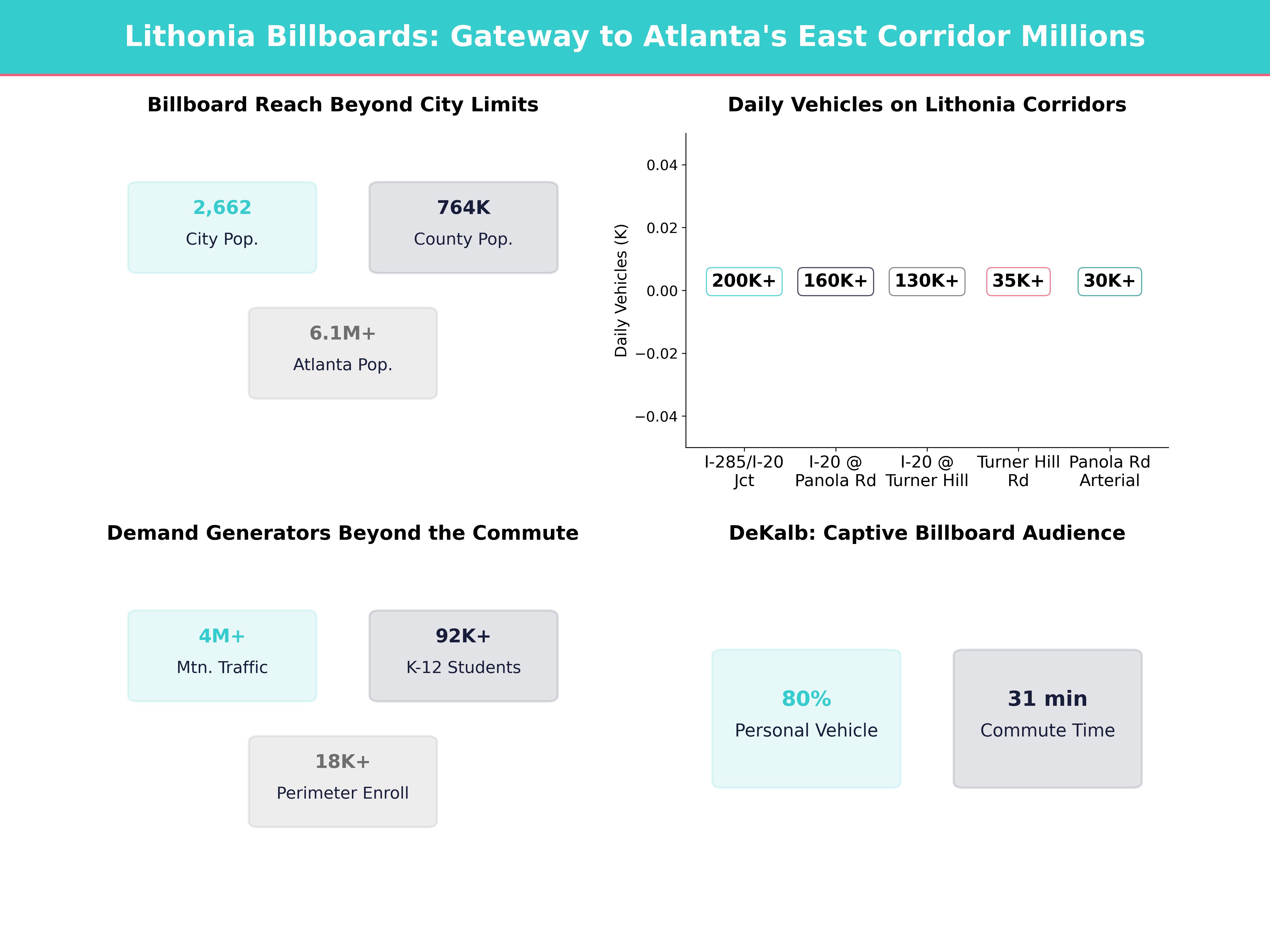
I-20 is the main billboard spine for Lithonia, with east DeKalb traffic counts generally in the 140,000 to 180,000+ AADT range depending on the segment and year. Near Panola Road, counts often exceed 160,000 vehicles per day, and near Turner Hill Road they commonly remain above 130,000 vehicles per day. The east side of I-285 also matters because near the I-20 interchange on the east side, traffic is a 200,000+ AADT environment.
Why is Lithonia a strong billboard market with Blip?
Lithonia is a strong billboard market because it gives access to a small local city, a much larger east metro trade area, and steady interstate traffic at the same time. The city itself had 2,662 residents in 2020, but it sits inside DeKalb County, which had 764,382 residents, and within metro Atlanta, which exceeds 6.1 million people. Most households in this part of the region still rely heavily on cars, which makes repeated roadway exposure especially valuable.
What kinds of people can Lithonia billboards reach around Blip placements?
For billboard advertisers, Lithonia’s most important behavioral fact is that drivers dominate the market. Recent ACS-based commuting patterns for DeKalb show that roughly 4 out of 5 workers commute by car, truck, or van, and the county’s mean travel time to work is about 31 minutes. Lithonia does not have a MARTA rail station, so roadway media stays central to how we reach residents, workers, and pass-through travelers.
When is the best time to run billboard ads in Lithonia?
Spring is one of the most useful campaign windows in Lithonia because outdoor activity rises quickly across east DeKalb. From March through May, the Arabia and Panola areas attract hikers, cyclists, and nature-oriented weekend traffic, and Discover DeKalb actively promotes those assets. Summer through back-to-school is also strong, especially about 2 to 3 weeks before the DeKalb County School District school year starts in late July or early August.
Do I need a contract to advertise with Blip in Lithonia?
No, Blip has no long-term contracts or minimum commitments. You can start, pause, or stop your campaign at any time.
How fast can I launch a billboard campaign with Blip in Lithonia?
You can have your campaign live in minutes. Create a free account, select your locations, set your budget, upload your design, and start running once approved.
Where can I advertise with Blip in Lithonia?
Blip has digital billboards in Lithonia. You can browse available locations on a map, choose the ones that fit your audience, and start advertising right away.
Still have questions? Launch a campaign in minutes — no contracts, no commitments.
Start Your CampaignLithonia Billboard Advertising Guide
Lithonia 2,662 residents in 2020, but it sits inside DeKalb County, which had 764,382 residents, and within metro Atlanta 6.1 million people. Lithonia is also about 20 miles east of Downtown Atlanta, and most households in this part of the region still rely heavily on cars, which makes repeated roadway exposure especially valuable. We also benefit from nearby destinations such as Stone Mountain Park, the Arabia Mountain National Heritage Area, and the retail-heavy City of Stonecrest
Lithonia
Why Lithonia reaches beyond its city limits
Lithonia works best when we treat it as an east metro Atlanta gateway rather than only as a small municipality. In the 2020 census, Lithonia had 2,662 residents, while DeKalb County had 764,382, which means our billboard audience is driven far more by the surrounding county and corridor traffic than by the city limit alone. Lithonia also sits inside the Atlanta Regional Commission 11-county core planning region, so local boards benefit from regional movement patterns, not just neighborhood trips. Nearby Stonecrest 2017, and that newer city identity has helped the Turner Hill and I-20 area function as an even clearer retail and service hub for eastern DeKalb.
What Lithonia’s demographics and commute habits mean for us
For billboard advertisers, Lithonia’s most important behavioral fact is that drivers dominate the market. Recent ACS-based commuting patterns for DeKalb show that roughly 4 out of 5 workers commute by car, truck, or van, and the county’s mean travel time to work is about 31 minutes. Lithonia does not have a MARTA
Why the local economy supports billboard demand
East DeKalb’s economy gives us a healthy mix of daily-need categories and destination categories. We can reach healthcare users traveling to Emory Hillandale Hospital, families connected to the DeKalb County School District, shoppers heading toward Stonecrest, and employers represented by the DeKalb Chamber of Commerce. We also benefit from year-round visitor promotion by Discover DeKalb, which keeps tourism and leisure traffic in the mix. In practice, that means Lithonia is not a one-audience market. It is a commuter market, a family market, a retail market, and a leisure market at the same time.
Key Traffic Corridors for Lithonia Billboards
I-20 through Lithonia and Stonecrest
I-20 is the main billboard spine for Lithonia. Georgia DOT traffic counts in east DeKalb generally place this corridor in the 140,000 to 180,000+ AADT range, depending on the segment and count year. Near Panola Road, counts often exceed 160,000 vehicles per day, and near Turner Hill Road they commonly remain above 130,000 vehicles per day. That volume gives us dependable reach for brands that want scale more than hyperlocal precision.
This corridor works especially well for several advertiser types. Retail and restaurants benefit because I-20 catches drivers before they decide which exit to use for food, shopping, and errands. Healthcare, legal, and education advertisers benefit because repeated weekday exposure builds recall before people need to act. Recruiting and staffing campaigns benefit because I-20 carries both local workers and longer-distance commuters moving between east metro communities and Atlanta.
I-285 and the east perimeter connection
The east side of I-285 matters even when our business is based in Lithonia because it feeds so much traffic into the area. I-285 is a 64-mile loop, and near the I-20 interchange on the east side, traffic is a 200,000+ AADT environment. That gives us a high-volume connector for drivers coming from central DeKalb, south DeKalb, Hartsfield-Jackson Atlanta International Airport
We usually get the most value from this corridor when our audience is regional rather than strictly local. Multi-location retailers, hospitals, colleges, entertainment venues, and business-to-consumer service brands all benefit from its broad catchment area.
Panola Road, Evans Mill Road, Turner Hill Road, and US 278
Local arterials around Lithonia are where we trade raw scale for stronger intent. On I-20, Exit 71 at Panola Road, Exit 74 at Evans Mill Road, and Exit 75 at Turner Hill Road structure much of the area’s practical decision-making. Georgia DOT counts typically show Panola Road near I-20 in the 30,000 to 40,000+ AADT range, Turner Hill Road in the 25,000 to 35,000+ range, and portions of US 278 / Covington Highway in roughly the 20,000 to 30,000+ range, with exact numbers varying by station and year. These roads are excellent when we need closer-to-purchase visibility.
Local healthcare, urgent care, and pharmacy campaigns benefit because many trips on these roads are purpose-driven and repeat regularly. Auto service, insurance, banking, and home services benefit because these audiences are often near their neighborhoods and more able to act soon. Retailers near Stonecrest and Turner Hill benefit because shoppers are already in destination mode and are likely to respond to exit-based messaging.
Lithonia Audience Segments We We Can Reach
Commuters and mobile professionals
Commuters are still the foundation of the Lithonia billboard audience. With roughly 80% of workers in DeKalb using personal vehicles for commuting and average travel times at about 31 minutes, weekday roadway exposure has enough duration and repetition to build memory. Westbound morning traffic and eastbound evening traffic on I-20 are especially useful when we want to reach workers heading toward Atlanta and returning home. We should think of this audience as frequency-driven, which means legal, healthcare, education, insurance, staffing, and consumer finance categories often perform well.
Families, students, and household decision-makers
Lithonia and surrounding east DeKalb neighborhoods give us a large family audience even though the city itself is small. The DeKalb County School District serves more than 92,000 students, which creates strong demand windows for back-to-school retail, pediatric care, tutoring, family dining, youth sports, and after-school programs. If we are recruiting adult learners, Georgia State University Perimeter College enrolls more than 18,000 students across its campuses, many of whom are commuters making decisions on the road. That mix makes Lithonia especially useful for practical, household-oriented brands.
Tourists, outdoor visitors, and weekend explorers
Lithonia also benefits from nearby visitor traffic that is larger than many advertisers first expect. Stone Mountain Park covers 3,200 acres and attracts more than 4 million visitors annually. The Arabia Mountain National Heritage Area spans 40,000 acres, and Panola Mountain State Park adds another 1,635 acres of protected recreation land. Those destinations bring us hikers, cyclists, families, day-trippers, and event-goers who are strong targets for restaurants, attractions, convenience retail, fuel, healthcare, lodging, and automotive services.
Healthcare users and service seekers
Healthcare is a particularly good fit in Lithonia because daily traffic is paired with local need. Emory Hillandale Hospital is a 100-bed community hospital in Lithonia, and that creates steady traffic from patients, visitors, staff, and affiliated services. Around that base, we can effectively promote urgent care, dental care, specialists, physical therapy, insurance, home health, pharmacies, and legal services. For these categories, arterial roads near neighborhood decision points can outperform broad-reach interstate boards.
Seasonal and Timing Opportunities in Lithonia
Spring and early summer in Lithonia
Spring is one of the most useful campaign windows in Lithonia because outdoor activity rises quickly across east DeKalb. From March through May, the Arabia and Panola areas attract hikers, cyclists, and nature-oriented weekend traffic, and Discover DeKalb actively promotes those assets. This is a strong period for home improvement, lawn care, allergy care, fitness, outdoor retail, and family activities. We should also remember that warmer weather increases weekend exploration, so Friday afternoon through Sunday evening becomes more valuable for leisure-focused campaigns.
Summer travel and back-to-school timing in Lithonia
From Memorial Day through Labor Day, regional family movement picks up around Stone Mountain Park, Stonecrest retail, and eastbound I-20 leisure travel. If our offer is family-friendly, this is the time to emphasize restaurants, entertainment, beverages, attractions, and retail bundles. Then, about 2 to 3 weeks before the DeKalb County School District school year starts in late July or early August, we should rotate into school supplies, pediatric care, tutoring, braces, vision care, and other household essentials. Because the district serves more than 92,000 students, that shift is meaningful and broad.
Fall events and holiday retail around Lithonia
Fall gives us both local and regional reasons to advertise. The Stone Mountain Park area’s Yellow Daisy Festival 4-day September draw, and football season keeps Friday and Saturday travel active across DeKalb and nearby Rockdale County Georgia International Horse Park in Conyers 1996. This is a strong season for restaurants, retail, live entertainment, medical services, and community events.
Winter and post-holiday opportunities in Lithonia
Winter is not a dead season in this market. Holiday travel and Stone Mountain Park seasonal programming keep family traffic alive, especially from November into early January. After the holiday rush, January and February are good for healthcare, tax services, fitness, education, and value-focused retail because we are speaking to locals with routine needs rather than only to visitors. When we use digital boards well, we can smoothly transition from festive creative to practical new-year messaging without changing our overall market footprint.
Lithonia Billboard Design Tips for Better Local Response
Use exit-based copy that matches how drivers navigate Lithonia
In Lithonia, drivers often think in exits and landmarks, not in neighborhoods alone. That means copy like “Exit 75,” “Next right at Panola,” “Near Stonecrest,” or “2 miles ahead” often feels more actionable than generic branding language. Because a Blip display is only 7.5 to 10 seconds, we should keep the idea simple and let location do some of the persuasion. On I-20, clarity beats cleverness almost every time.
Show local relevance instead of generic Atlanta imagery
We usually get stronger response when our creative looks like east DeKalb rather than a generic downtown Atlanta ad. Lithonia sits closer to granite outcrops, parks, suburban retail, and everyday family destinations than to high-rise business districts. Images that nod to Arabia Mountain National Heritage Area, Stone Mountain Park, local families, or neighborhood convenience tend to feel more authentic. We should avoid relying only on skyline visuals unless our destination is truly in central Atlanta.
Match color, offer style, and tone to the submarket
The best color and message choices depend on which part of the Lithonia market we are trying to win. For Stonecrest-area retail and dining, high-contrast colors, bold pricing, and short urgency cues often work well because the audience is already in decision mode. For healthcare, education, and home services, cleaner layouts, reassuring colors, and trust-oriented copy usually fit better. For outdoor, wellness, or community brands, palettes that echo the area’s granite gray, pine green, and sky blue can feel distinctly local without being literal.
Design for a diverse, practical audience
DeKalb County is one of Georgia’s most diverse counties, so our creative should feel inclusive in both imagery and wording. Practical value matters here. Offers such as “same-day,” “open late,” “family care,” “free consult,” or “weekend hours” are often more persuasive than abstract brand statements. If our target specifically includes multilingual households, we should keep the primary message simple and consider a bilingual version only when the offer and audience clearly justify it.
Regional Strategies Around Lithonia
Historic Lithonia and nearby neighborhoods
The historic Lithonia core is best for local repetition and neighborhood trust. This is where we should focus campaigns for churches, civic events, dentists, local clinics, contractors, real estate services, and community businesses that depend on familiarity. These placements will not match interstate scale, but they often deliver stronger relevance and better geographic efficiency.
Stonecrest and Turner Hill retail territory
The City of Stonecrest 75 are ideal when we need people to choose a restaurant, stop for retail, visit an entertainment venue, or act on a limited-time offer. This area captures residents from Lithonia, Stonecrest, unincorporated east DeKalb, Conyers
Westbound commuter reach toward Atlanta and I-285
When our goal is regional awareness, westbound I-20 is usually the first expansion step. This strategy works well for education, legal services, hospitals, recruiting, insurance, and brand campaigns that need repeated weekday exposure. Adding east-side I-285 boards can broaden the audience further because that 64-mile loop captures cross-town traffic before drivers sort into their final routes. We should think of this strategy as reach-first and recall-first.
Eastbound expansion toward Conyers, Rockdale, and Covington
Once we have covered Lithonia and Stonecrest, eastbound I-20 gives us a logical extension into Rockdale County Georgia International Horse Park and other east-corridor destinations can justify short tactical flights when event calendars spike. For many brands, this eastward extension turns a good local campaign into a real regional one.
Using Blip Tools Effectively in Lithonia
Choose manual control when the exact Lithonia corridor matters
Lithonia has a few very distinct decision zones, so manual selection is useful when location precision matters. If we need to win shoppers near Turner Hill, families near Panola, or commuters on a specific side of I-20, we can hand-pick boards that map directly to that goal. That approach is especially helpful for restaurants, clinics, events, and service businesses with a defined service radius.
Use optimization and dayparting when Lithonia audiences shift by time
Lithonia is a market where audience behavior changes sharply by hour and by day. Weekday mornings are not the same as weekday evenings, and weekend tourism does not behave like commuter traffic. That makes Blip’s scheduling tools especially valuable here. We can weight westbound morning commuting, eastbound evening return traffic, and Friday-through-Sunday leisure windows differently instead of treating all impressions as equal.
Test multiple creatives for different Lithonia audiences
We do not need one message to do every job. In Lithonia, we can run one version for commuters, one for families, and one for leisure visitors, then compare performance in real time. We can also use Blip’s artwork tools to quickly localize creative, such as swapping “Near Stonecrest” for “On the way to Arabia Mountain,” without rebuilding the whole campaign. That kind of fast testing is useful in a market where the audience mix changes from corridor to corridor.
Getting Started with Billboard Rental in Lithonia
Start with one clear Lithonia objective
Before we rent a billboard in Lithonia, we should decide what success looks like. Broad awareness, same-day store traffic, event attendance, lead generation, and hiring campaigns all need different locations and timing. If we need broad reach, we should start with I-20 and consider adding I-285. If we need immediate visits, we should prioritize Panola Road, Turner Hill Road, or other arterial placements near the destination. If we need weekend leisure traffic, we should include routes influenced by Stone Mountain Park, the Arabia Mountain National Heritage Area, and eastbound recreation travel.
Evaluate each Lithonia billboard like a local driver would
The best billboard is not always the one with the biggest traffic number. We should ask whether the board faces the correct direction, whether it is close enough to the decision point, whether the audience is local or regional, and whether the message can be understood in one glance. A healthcare office in Lithonia may prefer frequent local visibility near neighborhood routes, while a regional college may prefer high-reach commuter boards. Local fit matters as much as raw volume.
Why Blip makes Lithonia billboard rental easier
Traditional billboard buying can be slow, rigid, and hard to test. Blip makes it easier for us to launch quickly, adjust by season, refine by corridor, and learn what works before we scale. In a market like Lithonia, where commuter traffic, family traffic, and tourism traffic all behave differently, that flexibility is a major advantage. A practical way to begin is with a 2- to 4-week test across 2 or 3 corridor types, followed by a review of timing, creative, and location performance.