Billboards in Hiawassee, GA
No Minimum Spend. No Long-Term Contracts. Just Results.
Trusted by Leading Brands


Billboard advertising
in Hiawassee has never been easier
How much is a billboard in Hiawassee?
Why Choose Blip for Billboard Advertising in Hiawassee
Blip in Hiawassee lets you launch fast on U.S. 76 and GA 17/75, reaching car-dependent travelers without a rep or contract.
Set a flexible daily budget in Hiawassee and pay only when your ad runs—ideal for testing local service or Lake Chatuge traffic.
Use Blip's dayparting to hit Hiawassee's commuter rush, weekend fairgrounds crowds, and summer lake visitors at the right time.
Real-time analytics help you see what works in Hiawassee, so you can shift spend between downtown, Young Harris, and southbound routes.
Blip's creative tools make Hiawassee ads easy to tailor for older drivers, fairgoers, and mountain tourism with simple, high-contrast design.
Frequently Asked Questions About Billboard Advertising in Hiawassee
How much does a billboard cost in Hiawassee with Blip?
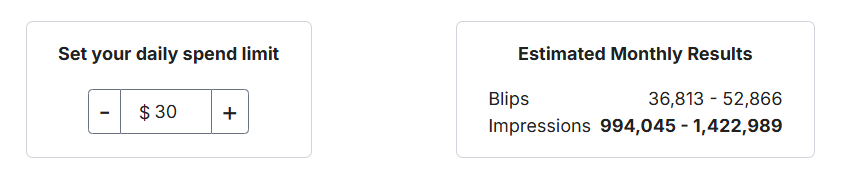
With Blip, billboard advertising in Hiawassee is designed to fit a wide range of budgets. You set a daily budget, and Blip’s algorithm uses it to bid for open ad slots on rotating digital billboards, so you only pay when your ad actually displays. Each “blip” is a 7.5-to-10-second ad, and pricing can change based on time of day, location, and advertiser demand — starting at just $0.01 per display.
Where can I advertise with Blip in Hiawassee to reach the most traffic?
The core U.S. 76 / Georgia 2 corridor through Hiawassee generally carries about 8,000 to 10,000 vehicles per day. West of Hiawassee, U.S. 76 between Hiawassee and Young Harris commonly rises into the 10,000 to 12,000 AADT range, while Georgia 17 / Georgia 75 and eastbound U.S. 76 also capture meaningful travel. These routes work well because they connect downtown, shopping, healthcare, lodging, and tourist destinations.
Why is Hiawassee a good Blip billboard market?
Hiawassee combines a small county-seat footprint of roughly 1,000 residents with a much larger mountain trade area and steady visitor flow. Hiawassee functions as the county’s commercial center for shopping, healthcare, events, and lake access, serving a broader 82,011-person four-county trade area. The area is strongly vehicle-oriented, with over 80% of workers commuting by car, truck, or van, which makes roadside media especially effective.
When is the best time to run billboards in Hiawassee?
Seasonality is a major strategic factor in Hiawassee, and we should not run the same billboard plan in January that we run in July or October. From Memorial Day through Labor Day, we get roughly 14 weeks of prime summer lake season, and fall is especially strong from late September through early November. Winter traffic is quieter, but the resident base remains and afternoon exposure can still matter.
Who should advertise in Hiawassee with Blip?
Hiawassee is a strong fit for businesses that win through repeated visibility, local familiarity, and timely decision-making. The county is older than most Georgia markets, with a median age near 56 and about 38% of residents age 65 or older, which favors healthcare, retirement-friendly services, financial planning, and home improvement. It also works well for tourism, lodging, dining, home services, and other businesses that benefit from road-based visibility.
Do I need a contract to advertise with Blip in Hiawassee?
No, Blip has no long-term contracts or minimum commitments. You can start, pause, or stop your campaign at any time.
How fast can I launch a billboard campaign with Blip in Hiawassee?
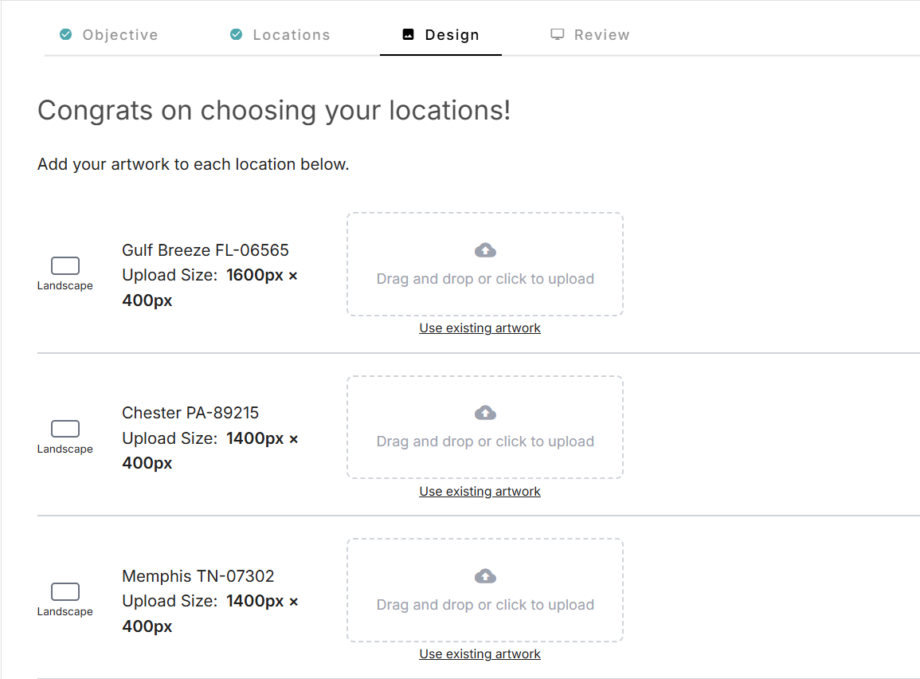
You can have your campaign live in minutes. Create a free account, select your locations, set your budget, upload your design, and start running once approved.
Where can I advertise with Blip in Hiawassee?
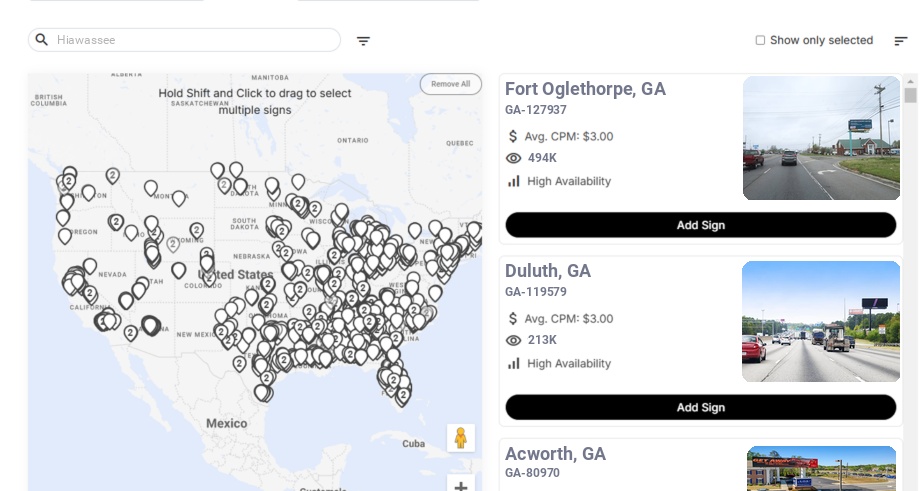
Blip has digital billboards in Hiawassee. You can browse available locations on a map, choose the ones that fit your audience, and start advertising right away.
Still have questions? Launch a campaign in minutes — no contracts, no commitments.
Start Your CampaignHiawassee Billboard Advertising Guide
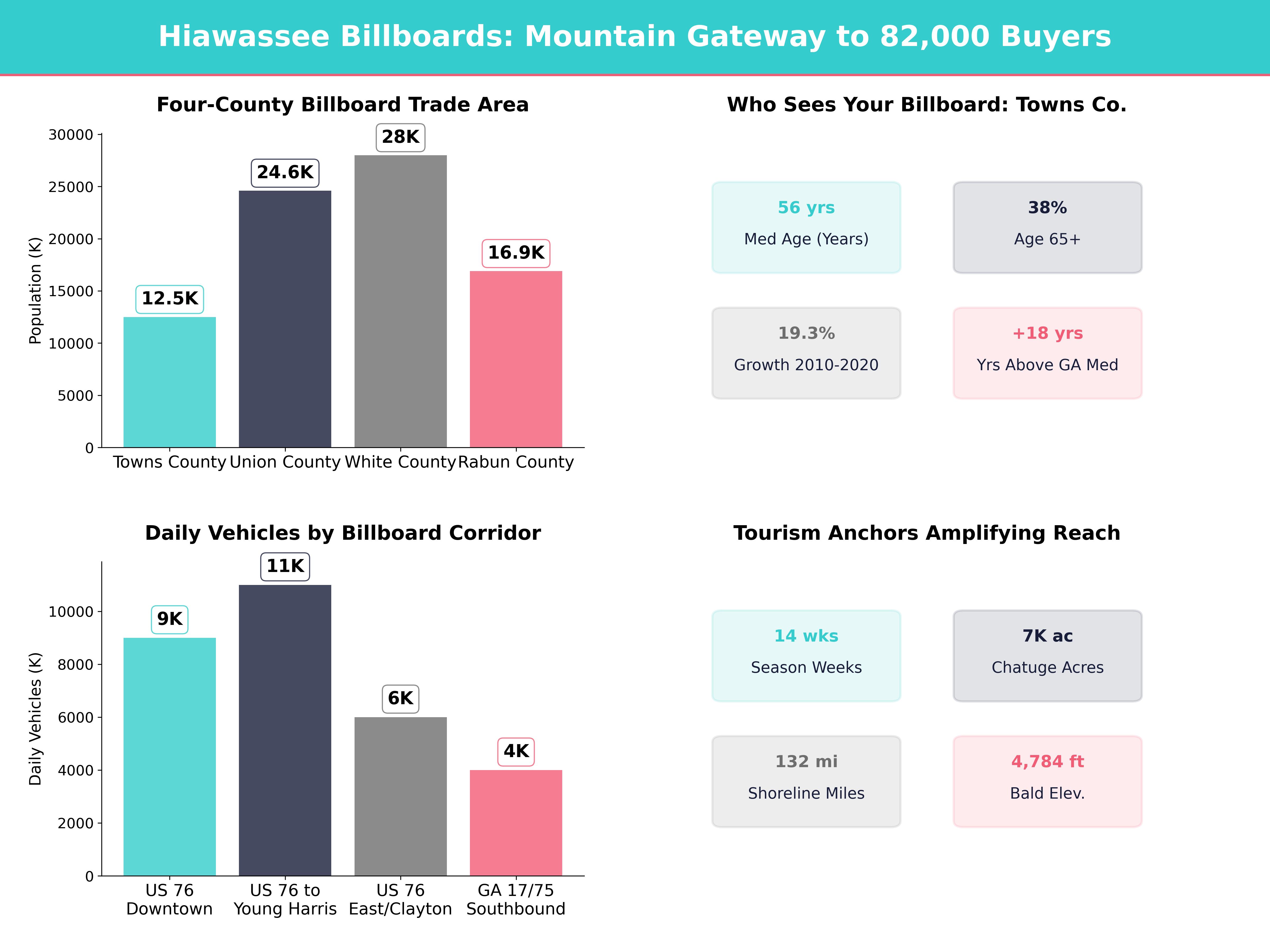
Hiawassee gives us a distinctive billboard market because it combines a small county-seat footprint of roughly 1,000 residents with a much larger mountain trade area and steady visitor flow. Towns County 12,493 residents in the 2020 Census, and Hiawassee functions as the county’s commercial center for shopping, healthcare, events, and lake access, serving a broader 82,011-person four-county trade area. The area is strongly vehicle-oriented, with over 80% of workers commuting by car, truck, or van, which makes roadside media especially effective on routes like U.S. 76 and Georgia 17/75. We also benefit from tourism drivers that many small towns do not have, including 7,000-acre Lake Chatuge, the Georgia Mountain Fairgrounds Brasstown Bald 4,784 feet.
Hiawassee Market Overview
Hiawassee works best when we think beyond the city limits. This is a small city of roughly 1,000 residents, but it serves as the practical hub for much of the northeast Georgia mountain market and for nearby western North Carolina travelers.
Hiawassee’s resident base and regional trade area
Towns County 10,471 residents in 2010 to 12,493 in 2020, which was an increase of 2,022 people or 19.3% in one decade. That is meaningful growth for a mountain county with only 172 square miles of total area. Hiawassee also pulls customers from nearby counties, including Union County 24,632 residents, White County with 28,003 residents, and Rabun County 16,883 residents. Taken together, those four North Georgia counties accounted for 82,011 residents in 2020.
That matters because many advertisers in Hiawassee are not trying to reach only local households. We are often trying to reach a drive-market audience that shops, dines, attends events, books lodging, visits physicians, and hires contractors across county lines.
Demographics and consumer behavior in Hiawassee
Towns County skews older than most Georgia markets, with a median age about 18 years above Georgia’s statewide median. Recent survey estimates place the county’s median age at about 56 years, and roughly 38% of residents are age 65 or older. For billboard advertisers, that age profile tends to favor simple creative, strong contrast, healthcare messaging, retirement-friendly services, financial planning, home improvement, and local trust cues.
The county is also highly car-dependent. Recent commuting estimates show that well over 80% of workers travel by car, truck, or van, while public transit usage is effectively 0%. Average commute times run about 26 minutes, which is long enough for repeated exposure to roadside media but short enough that location and frequency matter more than novelty.
Economic signals that matter for advertisers in Hiawassee
Hiawassee’s economy is supported by tourism, hospitality, healthcare, local government, education, retail, construction, and home services. Key institutions include Young Harris College Chatuge Regional Hospital, Brasstown Valley Resort & Spa, Towns County Schools, and the Georgia Mountain Fairgrounds Georgia Department of Labor releases have generally kept Towns County unemployment in the 3% to 4% range, which points to a relatively stable local economy rather than a distressed one.
For advertisers, the implication is straightforward. Hiawassee is a strong fit for businesses that win through repeated visibility, local familiarity, and timely decision-making, especially when consumers are already on the road.
Key Traffic Corridors in Hiawassee
Road choice matters more in Hiawassee than in many larger metros because a few corridors carry most of the meaningful daily movement, with counts generally ranging from roughly 3,000 to 12,000 vehicles per day depending on the route. When we choose boards in this market, we are really choosing which travel purpose we want to own.
U.S. 76 / Georgia 2 through downtown Hiawassee
According to segment-level traffic data from the Georgia Department of Transportation, the core U.S. 76 / Georgia 2 corridor through Hiawassee generally carries about 8,000 to 10,000 vehicles per day. This is the town’s primary commercial spine, and it ties together downtown, shopping, restaurants, healthcare, lodging, and access to the Georgia Mountain Fairgrounds
This corridor is ideal for several advertiser types.
- Restaurants, retailers, and service businesses benefit because this route captures both local errand traffic and out-of-town visitors already in buying mode.
- Healthcare providers benefit because drivers on this corridor are often headed toward appointments, pharmacies, or related errands.
- Event promoters benefit because the fairgrounds, concerts, and seasonal festivals all feed back into this route.
U.S. 76 west toward Young Harris and Blairsville
West of Hiawassee, U.S. 76 continues toward Young Harris College Blairsville 10,000 to 12,000 AADT range. The distance from downtown Hiawassee to Young Harris is only about 6 miles, and Blairsville is roughly 19 miles away, so this corridor functions as both a local commuter route and a regional shopping connector.
This corridor is especially strong for:
- Colleges, banks, grocery, and telecom brands because it reaches year-round local movement rather than only seasonal tourism.
- Medical, dental, and specialty services because residents from several communities use this route for appointments.
- Home services and real estate because it passes through residential areas, second-home territory, and a high-owner-occupied mountain market.
Georgia 17 / Georgia 75 southbound corridor
The Georgia 17 / Georgia 75 corridor connects Hiawassee with Helen, White County, and the broader southbound mountain travel market. Traffic is lower than on U.S. 76, but it is still meaningful, with many Hiawassee-area segments generally in the 3,000 to 5,000 vehicles per day range. This is a classic intent-driven route, where drivers are often headed for leisure, cabins, wineries, scenic drives, or hospitality stops.
This route is a smart fit for:
- Lodging, cabins, and resorts because travelers on Georgia 17 / 75 are often planning a stay rather than making a random stop.
- Attractions and event venues because scenic-route travelers respond well to destination cues and mileage-based calls to action.
- Auto services, fuel, and convenience retail because mountain-road travelers make practical stops as well as leisure ones.
U.S. 76 east toward Clayton and Rabun County
Eastbound U.S. 76 is the link from Hiawassee toward Clayton Rabun County 5,000 to 7,000 vehicles per day. Clayton is about 45 miles east of Hiawassee, so this is not a purely local route. It is a corridor for scenic travelers, cross-county shoppers, and regional service trips.
Advertisers that usually win here include:
- Tourism brands that want to reach travelers before they choose where to eat, stay, or stop.
- Regional healthcare systems that serve patients across multiple counties.
- Specialty retail and destination dining that can justify a slightly longer drive.
Hiawassee Audience Segments
The best Hiawassee campaigns are built around who is actually on the road. In this market, the audience changes noticeably by route, season, and daypart.
Commuters and everyday errand traffic in Hiawassee
Even in a tourism-heavy mountain town, the baseline audience is still local movement. Residents drive into Hiawassee for groceries, schools, banking, county business, dining, and healthcare. With over 80% of workers commuting by personal vehicle and average trips around 26 minutes, billboards can build strong frequency among people who make the same drives several times per week.
This audience is especially valuable for businesses that depend on repetition, including insurance agencies, dentists, pharmacies, furniture stores, churches, repair shops, and local restaurants.
Retirees, healthcare users, and homeowners around Hiawassee
Towns County’s older age profile is one of the clearest targeting advantages in the market. With a median age near 56 and about 38% of residents age 65+, Hiawassee is unusually strong for senior-focused services, preventive care, orthopedic care, hearing, vision, legal services, estate planning, and home accessibility solutions.
The homeowner and second-home audience also matters. In a mountain-lake market, many purchase decisions are home-related, including roofing, HVAC, remodeling, pest control, landscaping, internet service, docks, generators, and cabin maintenance. Billboards that emphasize trust, responsiveness, and local expertise tend to perform well here.
Students, faculty, and visiting families near Young Harris
Young Harris College 6 miles west of Hiawassee. The campus adds students, faculty, staff, athletic visitors, prospective families, and eventgoers to the corridor between Young Harris and Hiawassee. For local advertisers, that means the market is not only older and retiree-driven. It also includes younger adults and visiting households with dining, coffee, entertainment, apparel, telecom, and automotive needs.
This audience is especially useful during move-in periods, athletics, orientation, graduation, and family-visit weekends.
Tourists, boaters, and eventgoers in Hiawassee
Tourism is what turns Hiawassee from a small local market into a more dynamic billboard environment. Lake Chatuge covers 7,000 acres and offers 132 miles of shoreline, which creates strong summer demand for marinas, restaurants, lodging, vacation rentals, and recreation brands. Nearby Brasstown Bald 4,784 feet, reinforces the destination appeal for scenic travelers.
The Georgia Mountain Fairgrounds Hamilton Gardens, Brasstown Valley Resort & Spa, and cross-border traffic from Hayesville Clay County Chamber
Seasonal and Timing Opportunities in Hiawassee
Seasonality is a major strategic factor in Hiawassee. We should not run the same billboard plan in January that we run in July or October.
Spring in Hiawassee
Spring is a strong shoulder season because the mountain market wakes up before peak summer crowding. Hamilton Gardens is known for 1,500+ rhododendrons, and spring bloom periods create additional leisure traffic into town. This is an excellent time for garden centers, restaurants with patios, home services, healthcare screenings, and outdoor recreation brands.
Spring is also useful because inventory demand is often lower than in midsummer or peak leaf season. We can often stretch budgets further while still reaching people planning their summer purchases.
Summer in Hiawassee
From Memorial Day through Labor Day, we get roughly 14 weeks of prime summer lake season. That is the biggest tourism window for Lake Chatuge, boating activity, campgrounds, and vacation rentals. The annual Georgia Mountain Fair
In summer, the best dayparts often extend beyond normal commute windows. We should think about late morning, afternoon, and early evening, especially on Thursday through Sunday, when visitors are most likely to be traveling into town, heading to lodging, or choosing where to eat.
Fall in Hiawassee
Fall is arguably the most visually powerful advertising season in Hiawassee. Leaf color, cooler weather, scenic drives, college activity, and fall festivals all increase road traffic. The Georgia Mountain Fall Festival Towns County Schools calendar and Young Harris College August.
For tourism, lodging, and dining brands, late September through early November is an especially strong period. For local services, back-to-school and pre-winter home maintenance messaging also fit well.
Winter in Hiawassee
Winter traffic is quieter, but it is not empty. The resident base remains, healthcare demand remains, and many home-service categories become more urgent. Shorter days also make afternoon exposure more valuable. In December, sunset arrives before about 5:30 p.m., so visibility during the late-afternoon drive can matter as much as the morning period.
Winter is often the right season for medical groups, tax services, legal services, churches, heating contractors, and retailers pushing gift, clearance, or appointment-driven campaigns.
Billboard Design Tips for the Hiawassee Market
Local creative should look and feel like it belongs in the North Georgia mountains. Generic suburban billboard design misses the emotional cues that make Hiawassee work.
Use Hiawassee-specific imagery and language
Creative that references the place usually beats creative that could run anywhere. In Hiawassee, that means using visual cues like lake water, mountain ridgelines, boats, cabins, porches, trails, or seasonal foliage. It also means naming recognizable destinations such as Lake Chatuge, the Georgia Mountain Fairgrounds Young Harris College
Colors can help reinforce local context. Deep blues and greens feel natural in summer campaigns, while copper, gold, and crimson work well in fall. Those palettes often feel more authentic here than urban neon or overly slick corporate imagery.
Design for older drivers and winding roads in Hiawassee
Because the local population skews older, and because many routes are curving two-lane mountain roads rather than straight interstate stretches, readability matters even more than usual. We should generally keep the main message to about 7 words or fewer, use one focal image, one clear brand mark, and one call to action.
Large type, high contrast, and simple layouts are especially important in this market. A crowded billboard with multiple offers, tiny disclaimers, and three phone numbers will underperform on Hiawassee roads.
Lean into distance, direction, and immediacy
Hiawassee is a destination market, so directional copy often works well. Messages like “2 miles ahead,” “Next right on 76,” “Minutes from Lake Chatuge,” or “Before the fairgrounds” fit the way people navigate the area. That is especially true for restaurants, marinas, event venues, and healthcare locations.
For local-service brands, trust language matters. Phrases like “Serving Towns County,” “Local mountain care,” or “Same-day service in Hiawassee” resonate because this market values familiarity and responsiveness.
Regional Strategies Around Hiawassee
Not every part of the Hiawassee area should be approached the same way. We should tailor billboard strategy to the sub-area and its travel purpose.
Downtown Hiawassee and the fairgrounds district
This is the best zone for broad-reach awareness. If we want to reach the widest mix of locals, visitors, eventgoers, and errand traffic, the downtown U.S. 76 corridor is usually the first place to start. Boards near the Georgia Mountain Fairgrounds
This zone is also the best fit for healthcare, banks, pharmacies, grocery, legal services, and quick-service restaurants because those categories benefit from frequency across many trip types.
Young Harris and the western approach
The U.S. 76 corridor between Hiawassee and Young Harris College Blairsville
Because the route is only about 6 miles from Hiawassee to Young Harris, creative can be highly directional and still feel relevant.
Lake Chatuge residential and hospitality zones
Campaigns aimed at boaters, vacationers, retirees, and second-home owners should align with the lake lifestyle rather than only with commuter patterns. Messaging that highlights convenience, scenic experience, service speed, dock access, or reservation urgency tends to perform well. This is a natural zone for marinas, waterfront dining, vacation rentals, real estate, pest control, HVAC, and remodeling firms.
Southbound, eastbound, and cross-border gateways
If we want to intercept scenic travelers before they make their stop decisions, the gateway routes matter. Southbound traffic from Helen and White County behaves differently from eastbound traffic toward Rabun County Hayesville Clay County
Using Blip Tools in Hiawassee
Blip works well in Hiawassee because the market rewards precision. We do not always need a huge budget here. We need the right board, the right season, and the right time of day.
Match Blip scheduling to Hiawassee travel patterns
For local service businesses, we can concentrate spending in weekday windows like 7:00 to 10:00 a.m., 11:00 a.m. to 2:00 p.m., and 4:00 to 7:00 p.m. For tourism, restaurants, and events, we can shift harder toward Thursday through Sunday, especially in late afternoon and early evening. For fairgrounds events, it often makes sense to increase delivery on show days and then scale back immediately after.
Test multiple Hiawassee creatives instead of one static message
Because Hiawassee is so seasonal, creative rotation is especially helpful. We can run one version for lake season, one for fall color and festivals, and one for winter resident services. We can also separate “awareness” creative from “turn now” creative. In practice, even 3 tailored versions can outperform one generic design that tries to do everything.
Use Blip analytics to compare corridors in Hiawassee
The biggest tactical question in this market is often whether our audience is more local or more visitor-driven. Real-time reporting lets us compare performance between a U.S. 76 core board, a western Young Harris board, and a southbound gateway board without committing to a long traditional package. That makes Hiawassee a very manageable market for iterative testing.
Getting Started with Billboard Rental in Hiawassee
Renting a billboard in Hiawassee should start with geography, not with artwork. We should first decide whether we need local frequency, visitor interception, event promotion, or directional action.
How to evaluate Hiawassee billboard locations
When we evaluate boards in Hiawassee, we should ask a few practical questions.
- Does the board sit on U.S. 76 or a meaningful feeder route? This question matters because a small number of roads carry most of the usable traffic in the market.
- Is the audience local, regional, or tourist-heavy? This question helps us decide whether to write for repeated familiarity or for immediate conversion.
- Is the board before or after the decision point? This question is critical for restaurants, attractions, lodging, and healthcare clinics.
- Does the season support the message? This question matters because summer lake traffic, fall foliage traffic, and winter resident traffic behave very differently.
What to expect from billboard rental in Hiawassee
Hiawassee is not a giant-volume market, so we should not judge it by Atlanta-style impression expectations. What it offers instead is contextual relevance. A well-placed digital board on the right corridor can speak to people who are already headed toward your category and already in a spending mindset.
Traditional billboard buying often forces advertisers into longer commitments, larger packages, or inventory they do not really need. Blip simplifies that process by letting us choose locations, control timing, adjust spend, and refine creative without waiting for a rep-driven sales cycle.
A practical Hiawassee launch plan
For many advertisers, a sensible starting point is simple.
- We can begin with 2 to 4 strategically chosen boards rather than trying to blanket the whole mountain region.
- We can run for at least 2 weeks so we see both weekday and weekend patterns.
- We can start with separate creative for locals and visitors if our offer supports both audiences.
- We can use a modest daily test budget, often in the $20 to $50 range, and then scale the placements that prove they fit our goal.
In Hiawassee, billboard success usually comes from matching the message to the mountain travel pattern. When we align corridor, season, audience, and creative, this small North Georgia market can produce outsized results for local businesses and regional brands alike.