Billboards in East Point, GA
No Minimum Spend. No Long-Term Contracts. Just Results.
Trusted by Leading Brands


Billboard advertising
in East Point has never been easier
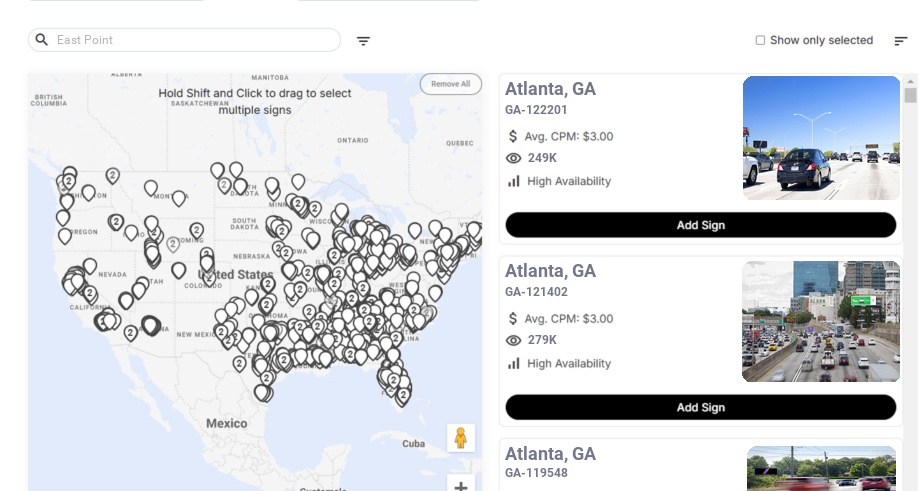



How much is a billboard in East Point?
Why Choose Blip for Billboard Advertising in East Point
Blip lets you launch East Point billboards fast, reaching I-85, I-285, and airport-bound traffic without sales calls or delays.
Set a flexible budget for East Point and pay only for the blips you get—ideal for testing Camp Creek and airport corridors.
Daypart your East Point campaign for rush hour, early airport waves, or weekend retail spikes near Camp Creek Marketplace.
No contracts means East Point brands can scale up for Falcons games, holiday shopping, or hiring pushes, then pause anytime.
Track East Point results in real time and swap creative fast to match commuter, traveler, and Southside shopper traffic.
Frequently Asked Questions About Billboard Advertising in East Point
How much does a billboard cost near East Point, Georgia with Blip?
With Blip, you can advertise on East Point billboards on any budget, because you set your own daily spend and Blip automatically keeps your campaign within that limit. Each ad plays as a short “blip” on digital billboards near East Point, Georgia, and you only pay for the individual blips you receive. Costs vary based on when and where you choose to advertise and on advertiser demand, but you stay in control by adjusting your campaign budget at any time.
Where can I advertise with Blip near East Point, Georgia?
We have 37 digital billboards serving the East Point area, positioned within roughly 10 miles in Hapeville, College Park, Forest Park, and Atlanta. These neighboring cities form a tight cluster of inventory that functions as a unified coverage zone. Because these cities sit on major regional arteries, campaigns can efficiently reach East Point area audiences as they commute, travel to the airport, or shop at destination retail hubs.
Who does billboard advertising near East Point, Georgia reach?
The East Point area sits at the crossroads of metro Atlanta’s transportation and commerce, giving advertisers access to dense commuter traffic, airport-related travel, and vibrant neighborhood activity. More than 60% of East Point workers commute to jobs outside the city, and Hartsfield-Jackson supports a constant flow of workers and travelers. This makes the area attractive for commuter-focused brands, airport-related businesses, and retail and service businesses.
When is the best time to run Blip billboards in East Point, Georgia?
Weekday rush hours, approximately 6:30–9:30 a.m. and 3:30–7:00 p.m., see the densest traffic on I-85, I-285, and I-75 near the boards serving East Point. Airport-related traffic runs nearly all day, with passenger and worker flows peaking around early-morning departures and evening arrivals. Weekend retail spikes also appear around late Saturday morning and early afternoon, especially near Camp Creek Marketplace and Greenbriar Mall.
What kinds of messages work best on East Point, Georgia billboards with Blip?
Because drivers around East Point and adjoining highways move quickly, clarity and contrast are essential. The page recommends big, simple headlines, high-contrast colors, and location cues like “Exit 72 – Camp Creek Pkwy” or “Off Virginia Ave in Hapeville.” It also suggests clear calls to action and multiple creatives for different audiences, such as morning commuters versus evening shoppers.
Do I need a contract to advertise with Blip in East Point?
No, Blip has no long-term contracts or minimum commitments. You can start, pause, or stop your campaign at any time.
How fast can I launch a billboard campaign with Blip in East Point?
You can have your campaign live in minutes. Create a free account, select your locations, set your budget, upload your design, and start running once approved.
Where can I advertise with Blip in East Point?
Blip has digital billboards in East Point. You can browse available locations on a map, choose the ones that fit your audience, and start advertising right away.
Still have questions? Launch a campaign in minutes — no contracts, no commitments.
Start Your CampaignEast Point Billboard Advertising Guide
The East Point area sits at the crossroads of metro Atlanta’s transportation and commerce, giving advertisers access to dense commuter traffic, airport-related travel, and vibrant neighborhood activity. With 37 digital billboards serving the East Point area from nearby Hapeville, College Park, Forest Park, and Atlanta, we can help you reach residents, commuters, and visitors with highly targeted, flexible campaigns. Whether you’re exploring billboard advertising near East Point for the first time or expanding an existing strategy, these locations give you consistent, high-visibility coverage.
Understanding the East Point Area Market
East Point is a key city in south Fulton County and part of the core Atlanta metropolitan region.
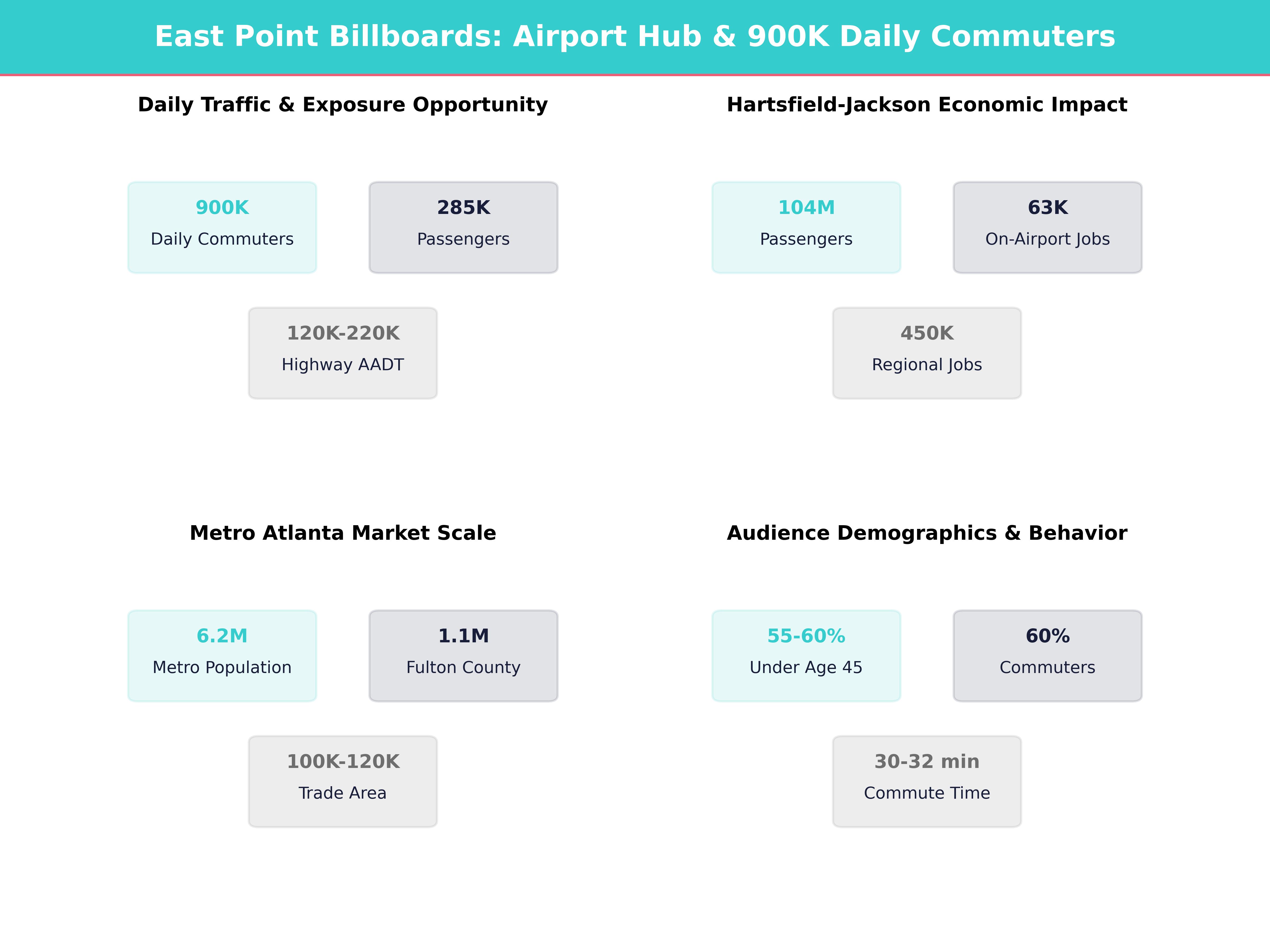
- The City of East Point 38,000 residents, and when you include nearby south Fulton communities such as unincorporated areas and the cities of College Park and Hapeville, the immediate trade area easily exceeds 100,000–120,000 people within a short drive of many billboards near East Point.
- The broader Atlanta 6.2 million residents, and Fulton County alone is home to over 1.1 million people, making it Georgia’s most populous county.
- According to the City of East Point, the city is strategically located just southwest of downtown Atlanta and adjacent to Hartsfield-Jackson Atlanta International Airport MARTA rail and bus routes.
This geography makes the East Point area attractive for:
- Commuter-focused brands – More than 60% of East Point workers commute to jobs outside the city, many into Downtown, Midtown, and northern Atlanta job centers. Typical one-way commute times in the area are around 30–32 minutes, aligning with metro averages and creating repeated impressions on East Point billboards.
- Airport-related businesses – Hartsfield-Jackson directly supports over 63,000 on-airport jobs and is estimated to support more than 450,000 jobs regionally. Hotels, parking, rideshare, logistics, and tourism businesses tap into this constant flow of workers and travelers with billboard advertising near East Point and the airport perimeter.
- Retail and service businesses – Camp Creek Marketplace and the Camp Creek corridor provide more than 800,000 square feet of retail, dining, and services, drawing shoppers from across south Fulton and nearby counties. The downtown East Point business district, plus nearby shopping in College Park and Hapeville, attracts both residents and daytime workers.
Hartsfield-Jackson Atlanta International Airport, immediately to the southeast of the East Point area, is one of the world’s busiest airports. The airport handled about 104 million passengers in 2023, according to Hartsfield-Jackson’s official site 2,400 daily arrivals and departures. Much of the ground traffic feeding that airport moves through and near East Point, College Park, and Hapeville—precisely where many of our digital billboards near East Point are located.
Where Our Billboards Are and What That Means for You
We have 37 digital billboards serving the East Point area, positioned within roughly 10 miles in:
- Hapeville (about 2.9 miles from East Point) – a compact city of around 6,800 residents, with strong daytime population from airport-adjacent hotels, offices, and restaurants. Learn more via the City of Hapeville.
- College Park (about 3.1 miles) – home to roughly 14,000 residents and large concentrations of airport hotels, convention facilities, and corporate offices. See the City of College Park.
- Forest Park (about 6.1 miles) – a Clayton County 20,000 residents, adjacent to major I‑75 traffic. Visit the City of Forest Park.
- Atlanta (about 8.7 miles) – the core city of the metro, with nearly 500,000 residents and major job centers that draw commuters from East Point and south Fulton.
For advertisers seeking convenient billboard rental near East Point, these neighboring cities form a tight cluster of inventory that functions as a unified coverage zone.
Because these neighboring cities sit on major regional arteries, campaigns can efficiently reach East Point area audiences as they:
- Commute between south Fulton neighborhoods and central Atlanta (more than 900,000 workers commute into Fulton County daily from other counties).
- Travel to and from Hartsfield-Jackson, which sees an average of 285,000 passengers and greeters per day.
- Shop at destination retail hubs like Camp Creek Marketplace and Greenbriar Mall
- Access major logistics and industrial corridors in south Fulton and Clayton counties, where employment in transportation and warehousing has grown by more than 20% over the last decade.
Key corridors and nodes to consider when selecting billboards near East Point:
- Interstate 85 & Interstate 285: These interstates carry heavy commuter and freight traffic around and through the south side of Atlanta. The Georgia Department of Transportation annual average daily traffic (AADT) on many segments near East Point, Hapeville, and College Park in the 120,000–220,000 vehicles per day range, with some I‑85 and I‑285 segments exceeding 200,000 vehicles daily.
- I‑75 through Forest Park: A primary north–south interstate, capturing both commuter and long-haul traffic approaching downtown Atlanta from the south, with typical AADT volumes in the 150,000–190,000 vehicles per day range on nearby segments reported by GDOT.
- Airport perimeter routes (e.g., around Hapeville and College Park): Virginia Avenue, Camp Creek Parkway, and airport loop roads collectively carry tens of thousands of vehicles each day tied directly to passenger, cargo, and employee movements, according to planning documents from Hartsfield-Jackson
When you select billboard locations serving the East Point area, think about:
- Southbound morning and northbound evening flows (or vice versa, depending on commute direction) along I‑85, I‑75, and I‑285, where peak-hour traffic speeds often drop below 30 mph, increasing dwell time on your creative.
- Proximity to airport exits, MARTA park-and-ride locations, and major retail centers like Camp Creek Marketplace, which reports high weekend and evening traffic.
- Routes connecting East Point neighborhoods to Downtown Atlanta, Midtown, and major employment centers highlighted by the Atlanta Regional Commission
Audience Profiles in the East Point Area
The East Point area reflects the diversity and economic structure of south metro Atlanta:
- The area has a relatively young population, with East Point’s median age in the mid‑35s, closely aligned with metro Atlanta’s overall median of around 36 years. Roughly 55–60% of residents are under age 45, creating strong demand for family-oriented and working‑age services.
-
Household incomes vary widely. Across south Fulton and neighboring Clayton County
- Many neighborhoods post median household incomes in the $45,000–$70,000 range.
- Nearby areas closer to downtown Atlanta and major employment hubs often exceed $80,000–$100,000 median incomes, bringing higher discretionary spending into the travel corridors you can reach with billboards.
- The Atlanta metro is one of the largest African American–majority metros in the U.S.; in and around East Point, Black residents represent an estimated 70–80% of the local population, with growing Latino and immigrant communities.
- Education levels are mixed: in surrounding south Fulton areas, 25–35% of adults hold a bachelor’s degree or higher, while a significant share has some college or technical training, supporting strong interest in upskilling and career-change programs.
- Key employment sectors include transportation and warehousing, accommodation and food services, retail, healthcare, and public administration. In Fulton and Clayton counties combined, more than 140,000 jobs are tied directly to logistics, warehousing, and transportation.
This mix suggests several strong billboard opportunities:
- Local retail and services: Grocery, quick-service restaurants, auto repair, salons/barber shops, medical clinics, and financial services can appeal to the large share of households watching value and convenience. Many local households spend over 30% of income on housing and transportation, making savings-oriented messaging resonate on East Point billboards and nearby corridors.
- Workforce recruiting: Airport, logistics, and warehouse employers; public services; healthcare and education can tap into a local labor pool where labor force participation rates typically run in the 60–65% range.
- Events and entertainment: Local festivals, concerts, and sports benefit from the region’s robust cultural calendar and proximity to Atlanta’s large venues covered by outlets like the Atlanta Journal-Constitution, 11Alive, and FOX 5 Atlanta.
When crafting messages for the East Point area, we recommend:
- Emphasizing value, convenience, and community for local residents, such as “Save $X Today,” “5 Minutes from Camp Creek,” or “Locally Owned Since 20XX.”
- Highlighting career stability, benefits, and location for recruitment campaigns, especially around logistics, hospitality, and airport-adjacent roles. Many frontline positions in the area advertise starting pay from $15–$22 per hour, so clear wage and benefits statements help your ads stand out.
- Using clear, bold statements and cultural cues that resonate with Atlanta’s southside communities, including nods to local neighborhoods, area high schools, and major teams like the Atlanta Falcons, Atlanta Hawks, Atlanta Braves, and Atlanta United FC.
Timing Your Campaign: When the East Point Area Moves
Traffic patterns around East Point are heavily shaped by commuting and airport operations.
Key timing insights:
- Weekday rush hours (approx. 6:30–9:30 a.m. and 3:30–7:00 p.m.) see the densest traffic on I‑85, I‑285, and I‑75 near our boards in College Park, Hapeville, Forest Park, and south Atlanta. During these windows, average speeds on key freeway segments can drop below 25–30 mph, meaning drivers have more time to absorb billboard messages.
- Airport-related traffic runs nearly all day, with Hartsfield-Jackson recording consistent operations from before 5:00 a.m. until after midnight. Passenger and worker flows peak around early-morning departures (5:00–8:00 a.m.) and evening arrivals (7:00–10:00 p.m.), which is ideal for travel and hospitality messaging.
- Weekend retail spikes appear around late Saturday morning and early afternoon, as residents shop and dine out near Camp Creek Marketplace, Greenbriar Mall, and neighborhood centers. Retailers often see 20–30% higher foot traffic on Saturdays compared to typical weekdays.
- Special events in downtown Atlanta and at major venues like State Farm Arena, Mercedes-Benz Stadium, and the Georgia World Congress Center Discover Atlanta 10–20% on event days.
With Blip’s flexible scheduling, you can align your spend with these patterns:
-
Commuter-focused campaigns
- Run heavier Monday–Friday during rush hours. Many advertisers allocate 60–70% of their weekly impressions to these windows for commuter-oriented offers.
- Perfect for service businesses, automotive, financial services, and employment ads that rely on billboard advertising near East Point’s major freeways.
-
Retail & restaurants
- Emphasize late afternoon and evening slots for dinner and entertainment offers, roughly 4:00–9:00 p.m.
- Increase impressions on Fridays and Saturdays, when restaurant and retail spending often spikes by 20% or more compared to early-week days.
-
Travel, hospitality, and airport services
- Use early morning and late evening dayparts on boards in Hapeville and College Park to reach travelers and airport workers heading to and from shifts.
- Consider 24/7 presence for parking, rideshare, and hotel booking campaigns, scaled by budget, as airport operations run nearly round-the-clock and overnight traffic still counts in the tens of thousands of vehicles.
-
Events and seasonal campaigns
- Boost frequency during major Atlanta events (festivals, sports, conventions) that drive additional traffic through the south side. Local event schedules are well-covered by outlets like 11Alive, FOX 5 Atlanta, WSB‑TV, and Discover Atlanta
- Plan heavier rotations around major retail seasons—back-to-school (late July–August), holiday shopping (November–December), and tax refund season (February–April), when consumer spending typically rises by 15–30%.
Creative Strategies That Work Near East Point
Because drivers around East Point and adjoining highways move quickly, clarity and contrast are essential. We suggest these best practices for any East Point billboards in your mix:
-
Big, simple headlines
- Aim for 6–8 words or fewer, as most drivers have only 5–7 seconds of viewing time on freeway-speed boards.
- Example: “Camp Creek Car Care – 5 Minutes Ahead” or “Now Hiring at Airport – $20/HR+.”
-
High contrast, brand-consistent colors
- Use bold backgrounds (deep blue, black, bright yellow, red) with clear white or light lettering to maintain readability at 55–70 mph.
- Avoid cluttered photo collages; one strong image plus text is usually ideal and aligns with industry findings that simple creatives can improve recall by up to 30%.
-
Location and direction cues
- The East Point area is highly directional: people think in terms of “toward the airport,” “inside the Perimeter,” or “off Camp Creek Parkway.”
- Use simple cues: “Exit 72 – Camp Creek Pkwy,” “Off Virginia Ave in Hapeville,” or “Next Right in College Park.” Distance markers like “2 Miles Ahead” or “3 Minutes from Airport” have been shown to lift visit intent.
-
Clear calls to action
- For local visits: “Turn Right at Next Light,” “2 Miles Ahead,” “Next Exit.”
- For mobile actions: short URLs, QR codes (for slower surface streets), or simple brand names that are easy to search after the drive. Many advertisers see 10–25% higher web traffic when using a short, memorable URL or promo code.
-
Cultural resonance
- The southside has a strong identity within the metro Atlanta area. Phrases or visuals that reference local pride (“Southside Strong”), sports teams, music, or community events can stand out if used authentically. Partnering with local events promoted by the City of East Point or neighborhood festivals can deepen that connection.
-
Multiple creatives for different audiences
- Use different versions for morning commuters vs. evening shoppers, or residents vs. travelers.
- With Blip, you can rotate multiple designs and test which messages perform best—many advertisers find that optimized creatives can improve engagement metrics (calls, web visits, coupon redemptions) by 20–40% over initial versions.
Using Blip’s Tools to Pinpoint the East Point Area
Blip’s platform lets you buy exposure in flexible “blips” rather than fixed, long-term contracts. That flexibility is especially powerful in a market like the East Point area, where audiences vary by corridor, time of day, and day of week. It also makes billboard rental near East Point accessible for businesses of all sizes.
Ways to leverage our tools:
-
Geographic targeting across nearby cities
- Combine boards in Hapeville, College Park, Forest Park, and south Atlanta to blanket routes that East Point area residents and workers use daily, including I‑85, I‑75, I‑285, and major surface streets like Camp Creek Parkway and Main Street corridors.
- Emphasize boards along I‑85 and I‑285 for commuters; add I‑75 and Forest Park for broader southside coverage that reaches into Clayton and Henry counties.
-
Dayparting and budgeting
- Allocate more budget to peak periods (rush hour or weekend shopping times) and maintain a lighter presence at off-peak times to stretch your spend. Many advertisers dedicate 50–70% of their budget to high-impact dayparts.
- If you have a limited budget, focus on 3–4 high-impact dayparts per week rather than spreading impressions too thin; concentrated bursts often produce clearer lifts in store traffic or inquiries.
-
Message testing
- Run two or three versions of your creative simultaneously to see which generates more website traffic, calls, or store visits. Even small tweaks—like changing a price point or headline—can impact response by 10–20%.
- Rotate creatives seasonally—back-to-school, holiday shopping, tax season, or summer travel—to keep your presence fresh and relevant to what local consumers are thinking about.
-
Short-term bursts
- For grand openings in the East Point area, limited-time sales, or hiring pushes, concentrate your budget over 7–14 days to create a sense of urgency and high frequency. Many brands see the strongest awareness gains when they reach the same driver 8–12 times over a short window.
Industry-Specific Tactics for the East Point Area
Different sectors can capitalize on the East Point area’s unique dynamics in specific ways.
Local Retail, Food, and Services
- Focus on boards that line primary approach routes to your business (Camp Creek Parkway, Main Street corridors, and connector roads from I‑85 and I‑285). These roads can see 20,000–40,000 vehicles per day depending on the segment, according to GDOT, making them ideal for prominent billboards near East Point shopping and dining.
- Use time-sensitive messaging for lunch specials, happy hours, or weekend sales—food and beverage spending in metro Atlanta typically jumps 15–25% on Fridays and Saturdays compared to Mondays.
- Include simple distance markers (e.g., “2 Miles Ahead on Camp Creek”) and recognizable landmarks like “Near Camp Creek Marketplace” or “By Greenbriar Mall.”
Airport-Related Businesses
- Target boards nearest to Hapeville and College Park, close to Hartsfield-Jackson and major hotel clusters promoted by Discover Atlanta.
-
For hotels, parking, rideshare, and transportation:
- Emphasize proximity (“3 Minutes to Airport”), pricing, and ease (“Free Shuttle, 24/7”)—airport passengers often make decisions within 24–48 hours of travel, or even same-day while en route.
- Run heavier schedules around typical flight banks—early morning and late evening—when tens of thousands of passengers pass through the terminal each wave.
-
For B2B logistics and freight:
- Highlight capacity, reliability, and location near the airport and interstates. The airport handles more than 4.5 million tons of cargo annually, and surrounding industrial parks support thousands of daily truck movements; being visibly positioned along those routes on East Point billboards and nearby inventory reinforces your operational scale.
Hiring & Workforce Campaigns
The East Point area and surrounding south Fulton/Clayton employment corridors have substantial numbers of workers in transportation, warehousing, hospitality, healthcare, and public services.
- Use bold, direct offers: “Now Hiring – Up to $22/HR + Benefits – Apply Today.” Wage transparency can boost application rates by 20% or more compared to generic “Now Hiring” messages.
- Target corridors used by local workers: boards in Forest Park, south Atlanta, and around College Park that connect to major warehouse districts, distribution centers, and airport facilities.
- Time your campaigns around shift changes—early morning (5–8 a.m.), mid-afternoon, and late evening—when many frontline employees and contractors are on the road.
- Consider rotating messages that speak to benefits, schedule flexibility, and career growth, since large shares of the local workforce balance family responsibilities and multiple jobs.
Real Estate, Education, and Healthcare
- For residential real estate, focus on lifestyle messages—proximity to Atlanta, affordability compared to other intown areas, and access to transportation. South Fulton and Clayton often offer home prices 20–30% lower than some northside suburbs, which is compelling for first-time buyers seeing your billboard advertising near East Point commute routes.
-
For schools and training programs (including technical colleges, CDL schools, and healthcare training):
- Highlight career outcomes, short commute times, and flexible schedules relevant to adults working full time.
- Many local programs advertise completion timelines of 6–24 months, which can be effectively conveyed in a concise billboard message.
-
For medical practices, clinics, and urgent care:
- Use simple, reassuring headlines: “Walk-In Clinic – 7 Days a Week” or “Urgent Care – 10 Minutes Away.”
- Add clear directional cues and a web address or easy-to-remember phone number. Healthcare usage is steady year-round, with urgent care volumes often peaking in evenings and on weekends—ideal for after-hours messaging.
Measuring and Improving Your Campaign
To ensure your billboard campaigns serving the East Point area are performing as strongly as possible, we recommend:
-
Aligning flight dates with your internal data
- Compare store traffic, online inquiries, or call volumes during your Blip campaign to previous weeks or comparable periods last year.
- Look for lift during the specific dayparts you targeted; many advertisers aim for at least a 5–15% uptick in key metrics during strong campaigns.
-
Tracking web and phone responses
- Use unique URLs or promo codes on your billboards when feasible.
- Track spikes in direct traffic and brand-name searches that align with campaign timing; out-of-home is known to increase brand search activity, and even a 10% increase can be meaningful for local businesses.
-
Iterating on creative
- If a headline or offer is underperforming, adjust it quickly—Blip makes it simple to upload new artwork without waiting for a new print cycle.
- Test one variable at a time: first the main headline, then the offer, then colors or imagery. Advertisers who systematically A/B test billboards often report 20–30% performance improvements over static, untested creative.
-
Pairing billboards with local media
- Combine your out-of-home presence with social campaigns or local news sponsorships from outlets like the Atlanta Journal-Constitution, 11Alive, FOX 5 Atlanta, or WSB‑TV to reinforce awareness among East Point area audiences.
- Cross-channel campaigns—billboard plus digital or local TV/radio—are often associated with multi‑channel reach gains of 30% or more, helping your message cut through.
By understanding how people move through and around the East Point area—and by using Blip’s flexible digital billboard platform—you can reach residents, commuters, and travelers with precisely timed, locally resonant messages. With 37 digital billboards serving the East Point area from nearby Hapeville, College Park, Forest Park, and Atlanta, we’re positioned to help you build visibility, drive action, and grow your brand across south metro Atlanta with cost-effective billboard advertising near East Point.