Billboards in East Ellijay, GA
No Minimum Spend. No Long-Term Contracts. Just Results.
Trusted by Leading Brands


Billboard advertising
in East Ellijay has never been easier



How much is a billboard in East Ellijay?
Why Choose Blip for Billboard Advertising in East Ellijay
Blip lets East Ellijay advertisers launch fast on SR 515/U.S. 76 and SR 52, reaching drivers headed to the retail core or Blue Ridge.
East Ellijay has no transit-heavy crowd—Blip hits the 80% solo-driver audience with flexible budgets you can start, pause, or scale anytime.
Use Blip dayparting in East Ellijay for weekday commuters, Thursday-Saturday visitors, and Georgia Apple Festival weekends.
No contracts with Blip make East Ellijay testing easy, so local businesses can try seasonal apple, cabin, or retail campaigns without long commitments.
Track East Ellijay performance in real time and shift spend as fall color, holiday traffic, or SR 52 corridor demand changes.
Blip's creative tools help East Ellijay ads stay local with fast swaps for orchard season, downtown errands, and mountain-road reading speed.
Frequently Asked Questions About Billboard Advertising in East Ellijay
How much does a billboard cost in East Ellijay with Blip?
With Blip, pricing starts at just $0.01 per display. Each display, called a blip, runs for about 7.5 to 10 seconds, and pricing changes based on time of day, location, and advertiser demand. You choose a daily budget, and Blip’s algorithm uses it to bid for open ad slots on rotating digital billboards, so you only pay when your ad actually appears.
Where can I advertise with Blip in East Ellijay?
The most important corridor in the market is the SR 515 and U.S. 76 spine through East Ellijay, which generally falls in the 20,000 to 25,000 AADT range. SR 52 west toward Ellijay, Talking Rock, and Jasper is another major corridor, and eastbound SR 52 reaches orchards, recreation, and Dawson County connections. Short-trip connectors between East Ellijay and downtown Ellijay can also be valuable for local-service advertisers and restaurants.
Why is East Ellijay a good billboard market for Blip?
East Ellijay is a strong billboard market because it operates as the commercial front door to Gilmer County and captures both resident errands and mountain-bound visitor traffic. The market is highly car-dependent, with roughly 80% of workers driving alone and public transit use near 0%. It also benefits from tourism patterns because East Ellijay is roughly 80 miles north of metro Atlanta and about 15 miles south of Blue Ridge.
When is the best time to run billboard ads in East Ellijay with Blip?
Fall is the signature season, with apple harvest, leaf color, scenic drives, and festival traffic creating the market’s most concentrated tourism window. The Georgia Apple Festival is held on 2 weekends in October, and many advertisers start fall campaigns 4 to 6 weeks before the festival window. Summer also performs well from Memorial Day to Labor Day, especially on Thursday, Friday, and Saturday.
What kinds of businesses work well on billboards in East Ellijay?
Restaurants, auto services, healthcare practices, home-service companies, real estate professionals, banks, insurance agencies, seasonal attractions, and event-driven retailers can all find a fit here. East Ellijay is also a strong family market and a good place for tourism-related advertisers like cabin rentals, hotels, orchards, wineries, and attractions. The economy spreads across tourism, orchards, construction, healthcare, retail, local government, education, and small business services.
Do I need a contract to advertise with Blip in East Ellijay?
No, Blip has no long-term contracts or minimum commitments. You can start, pause, or stop your campaign at any time.
How fast can I launch a billboard campaign with Blip in East Ellijay?
You can have your campaign live in minutes. Create a free account, select your locations, set your budget, upload your design, and start running once approved.
Where can I advertise with Blip in East Ellijay?
Blip has digital billboards in East Ellijay. You can browse available locations on a map, choose the ones that fit your audience, and start advertising right away.
Still have questions? Launch a campaign in minutes — no contracts, no commitments.
Start Your CampaignEast Ellijay Billboard Advertising Guide
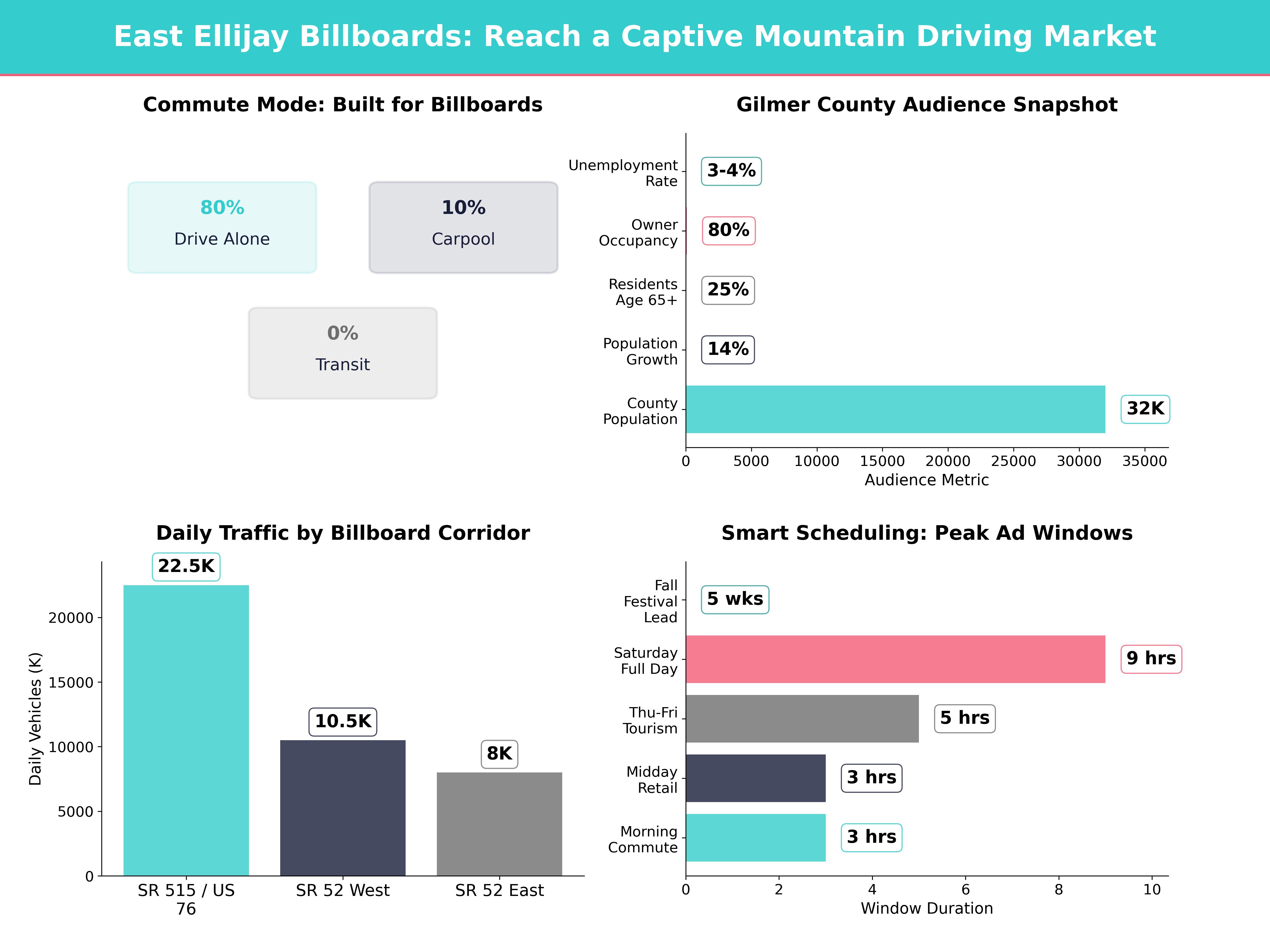
East Ellijay Gilmer County and captures both resident errands and mountain-bound visitor traffic. Recent profiles from the Georgia Department of Community Affairs and the Georgia Mountains Regional Commission place Gilmer County at a little over 32,000 residents, while East Ellijay itself remains a compact city of roughly 700 people, which means a large share of shopping and service demand concentrates along a handful of roads, especially SR 515/U.S. 76 and SR 52. The market is highly car-dependent, with roughly 80% of workers driving alone, about 10% carpooling, and public transit use near 0%. We also benefit from tourism patterns, because East Ellijay is roughly 80 miles north of metro Atlanta and about 15 miles south of Blue Ridge 2 weekends of the Georgia Apple Festival in October.
East Ellijay Market Overview
East Ellijay reaches far beyond its city limits
When we advertise in East Ellijay, we are not buying only a small municipal footprint. We are reaching a broader trade area of roughly 32,000+ county residents that includes nearby Ellijay, rural Gilmer County communities, second-home neighborhoods, and travelers moving between Jasper, Ellijay, and Blue Ridge.
That larger context matters. Gilmer County grew from about 28,000 residents in 2010 to more than 32,000 today, an increase of roughly 14%, so the local audience is larger than many advertisers assume when they first look at East Ellijay on a map. East Ellijay and Ellijay also function as one practical consumer zone for groceries, pharmacies, banking, dining, healthcare, fuel, and big-box retail, which gives billboard campaigns both frequency and intent.
East Ellijay is a windshield market
For billboard advertising, East Ellijay’s strongest trait is its driving culture. Recent commuting profiles show roughly 80% of workers driving alone, about 10% carpooling, and average one-way commutes near 30 minutes. Public transit use is effectively 0%, which means we do not have to fight for attention across buses, subways, or dense walkable alternatives.
Housing patterns support out-of-home visibility as well. Owner occupancy is around 80% in recent county profiles, and that usually translates into regular local routines for school, work, healthcare, church, home improvement, and retail errands. In practical terms, East Ellijay billboards can deliver repeated impressions to the same households over many weeks.
East Ellijay’s economy favors practical, local advertisers
East Ellijay does not depend on a single mega-employer. Instead, the economy spreads across tourism, orchards, construction, healthcare, retail, local government, education, and small business services. According to the Georgia Department of Labor, Gilmer County unemployment has generally been in the low 3% to 4% range when the broader Georgia economy is healthy, which is a positive sign for discretionary spending and local business activity.
For advertisers, that mix creates room for many categories to win. Restaurants, auto services, healthcare practices, home-service companies, real estate professionals, banks, insurance agencies, seasonal attractions, and event-driven retailers can all find a fit here. We are not limited to tourism-only messaging, even though tourism is clearly important.
Key Traffic Corridors for East Ellijay Billboards
SR 515 and U.S. 76 through East Ellijay
The most important corridor in the market is the Georgia Department of Transportation parkway spine formed by SR 515 and U.S. 76 through East Ellijay. Published GDOT count maps for the East Ellijay commercial area generally place this corridor in the 20,000 to 25,000 AADT range, making it the highest-value billboard zone in the market.
This route works because it combines several audiences at once. It carries county residents into the retail district, commuters moving between mountain communities, and leisure travelers headed north toward Blue Ridge and other North Georgia destinations.
Advertisers that usually benefit most on this corridor include the following categories.
- Restaurants, coffee shops, fuel stations, and convenience retail perform well because drivers can act immediately on the next turn or signalized intersection.
- Healthcare, legal, financial, and insurance brands perform well because repeated commuter exposure builds trust over time.
- Cabin rentals, hotels, orchards, wineries, and attractions perform well because northbound visitors are often deciding where to stop next.
SR 52 west toward Ellijay, Talking Rock, and Jasper
The second major East Ellijay corridor is SR 52 westbound through Ellijay and toward southern feeder markets. GDOT counts on key sections of this route are commonly in the 9,000 to 12,000 AADT range, depending on the exact segment.
This corridor is especially useful when we want to reach residents on recurring local trips rather than purely tourism traffic. It is a strong fit for dentists, urgent care, family restaurants, grocery-adjacent retail, contractors, banks, and community events. Because this route also connects the retail district with the historic center of Ellijay, it can help bridge upper-funnel awareness and same-day visitation.
SR 52 east toward orchards, recreation, and Dawson County connections
Eastbound SR 52 matters for a different reason. Traffic volumes are lighter than the parkway, but they still often land around 7,000 to 9,000 AADT on relevant sections, and the audience is highly intentional. This route leads toward orchards, scenic mountain drives, wedding venues, and recreation-oriented destinations, as well as Dawson County connections.
That makes the corridor especially valuable for seasonal advertisers. Businesses such as B.J. Reece Orchards, Hillcrest Orchards
Short-trip connectors between East Ellijay and downtown Ellijay
East Ellijay and Ellijay are adjacent, but drivers experience them differently. East Ellijay is the practical retail side, while downtown Ellijay is more experiential, with local shopping, dining, and event traffic. The local street network is shaped by the point where the Ellijay River and the Cartecay River meet to form the Coosawattee River, so drivers often repeat the same bridge and connector trips when moving between retail centers, schools, and downtown destinations.
We should not ignore these shorter loops. They are often where local-service advertisers, municipal events, boutiques, and restaurants can build frequency with the same households several times each week.
East Ellijay Audience Segments
Commuters and daily errand traffic in East Ellijay
The first audience is the most dependable one. Because roughly 4 in 5 workers drive alone, East Ellijay is ideal for campaigns that need repeated weekday visibility. Medical offices, auto repair shops, insurance agencies, banks, fitness providers, and home-service companies can all benefit from the same people seeing the same message over and over.
This is one reason the East Ellijay retail area is so valuable. It is not only a pass-through market. It is where people actually complete errands.
Tourists, cabin guests, and weekend visitors around East Ellijay
The second audience is the tourism wave that powers much of the North Georgia mountains. Explore Georgia Ellijay-Carters Lake Chamber of Commerce
Several local draws reinforce that opportunity.
- The Georgia Apple Festival has operated since 1971.
- The festival is held on 2 weekends in October.
- The event typically features more than 300 vendors.
- Nearby Carters Lake is known for 62 miles of shoreline and a maximum depth of 450 feet.
- Amicalola Falls State Park & Lodge is home to a 729-foot waterfall, which helps pull scenic-drive traffic through the region.
For billboard planning, that means we should think beyond county residents. Weekend travelers, day-trippers, and short-term rental guests are a real audience here.
Families, school households, and youth activities in East Ellijay
East Ellijay is also a strong family market. Gilmer County Schools run on a traditional K-12 calendar of roughly 180 instructional days from August through May, which creates dependable weekday movement in the morning and afternoon. Even though East Ellijay is not a major college town, school households still shape traffic patterns in a meaningful way.
This audience is especially important for the following categories.
- Family dining, dessert shops, and takeout brands can win during after-school and early-evening windows.
- Youth sports, tutoring, healthcare, and orthodontics can build trust with repeated exposure near school travel paths.
- Community events and seasonal attractions can use billboards to turn a general family audience into weekend attendance.
Retirees, second-home owners, and home-service buyers in East Ellijay
Gilmer County also skews older than many Georgia metros. Recent profiles indicate that adults 65 and older make up more than 1 in 4 residents, which is significant for healthcare, financial services, home improvement, hearing care, legal planning, and local retail.
Second-home and cabin ownership adds another layer. Even when part-time residents are not in town every day, they create demand for property management, HVAC, internet service, pest control, cleaning, plumbing, and remodeling. Billboards help those advertisers stay visible to owners and guests at the exact moment they are using the property.
Seasonal and Timing Opportunities in East Ellijay
Spring in East Ellijay
Spring campaigns should usually begin in March and build through May. This is when we start seeing renewed travel for hiking, cabin weekends, orchard blossoms, weddings, and spring break movement through the mountains. If we advertise attractions, patios, garden centers, or real estate, this is often the best time to re-enter the market after winter.
Spring is also a good window for healthcare, tax, home improvement, and automotive advertisers. Drivers are back on the road more often, and local households are planning warm-weather projects.
Summer in East Ellijay
From Memorial Day to Labor Day, East Ellijay benefits from vacation patterns, lake trips, and cabin stays. Carters Lake traffic, tubing activity, mountain getaways, and downtown browsing all strengthen from late spring into summer.
For many advertisers, the best summer timing is not evenly spread across the whole week. We often see the strongest opportunity on Thursday, Friday, and Saturday, when visitors are arriving, checking into cabins, or making dining and activity decisions. Restaurants, grocery stores, fuel stations, attractions, wineries, and urgent-care providers all have a reason to be visible during these days.
Fall in East Ellijay
Fall is the signature season. Apple harvest, leaf color, scenic drives, and festival traffic combine into the market’s most concentrated tourism window. The Georgia Apple Festival is the headline event, and its timing on the second and third full weekends of October makes the campaign calendar easy to plan around.
We usually recommend starting fall campaigns 4 to 6 weeks before the festival window if we want to build awareness with repeat travelers. Businesses tied to agritourism, lodging, dining, shopping, healthcare, and even home services can all benefit, because local roads are simply busier and more diverse during this period.
Winter in East Ellijay
Winter is quieter, but it is not dead. Holiday shopping, cabin stays, year-end dining, church events, and healthcare visits continue through November and December. After the holiday period, East Ellijay shifts into a more local pattern that can be very efficient for tax services, medical practices, gyms, financial planning, and indoor entertainment.
Shorter daylight hours can also help digital billboard visibility. Evening commutes become more prominent earlier in the day, so late-afternoon and early-evening scheduling can be especially effective in winter.
Billboard Design Tips for the East Ellijay Market
Make East Ellijay creative feel unmistakably local
Local specificity works well here. Drivers respond to copy that sounds like it belongs in Gilmer County, not generic creative that could run in any suburb. When appropriate, we should use place-based cues such as “East Ellijay,” “Downtown Ellijay,” “515,” “Carters Lake,” or “next light” to reduce uncertainty and make action easier.
This matters even more for visitor-facing campaigns. Tourists are often choosing between several stops they know only vaguely, so geographic confidence can be the deciding factor.
Design for mountain-road reading speed
SR 515 traffic moves quickly, and even slower routes still demand fast comprehension. In most East Ellijay campaigns, we should keep the main message to about 6 to 8 words, use 1 offer, and ask for 1 action. That structure gives us a much better chance of being read in time.
High contrast is important as well. Clean color combinations such as dark blue and white, black and yellow, or deep green and white usually perform better than low-contrast scenic backgrounds. If we use photography, we should keep it simple and avoid clutter.
Use imagery that matches why people are in East Ellijay
East Ellijay has a mountain-town emotional palette. Orchard reds, fall golds, evergreen greens, lake blues, wood textures, cabins, and locally recognizable scenery all fit the market better than sleek urban visuals that feel imported from Atlanta. That does not mean every ad needs apples or mountains. It means the overall tone should feel authentic to the place.
For example, home-service brands can still look polished while using practical local cues. Healthcare advertisers can pair clean design with reassuring, community-oriented language. Tourism advertisers can lean harder into experience and scenery.
Rotate East Ellijay creative with the calendar
Because the market shifts so much by season, we usually get better performance when we rotate creative every 2 to 4 weeks instead of leaving the same artwork untouched for months. A summer creative set can emphasize lakes, cabins, and dining. A fall version can pivot to apples, leaf season, and festivals. A winter version can move toward local convenience, health, and value.
That approach keeps the campaign feeling current to repeat local drivers, who are exactly the people we often need to influence in East Ellijay.
Regional Strategies Around East Ellijay
East Ellijay retail core strategy
The East Ellijay retail core is our best choice for immediate action. This is where we should prioritize restaurants, grocery-adjacent retail, urgent care, pharmacies, cell service, auto services, and any business that depends on same-day visits.
When we want conversions, this is usually the first zone to test. Drivers here are already in a spending mindset.
Downtown Ellijay strategy
Downtown Ellijay is better for charm-driven categories. Boutiques, event promotions, local dining, arts programming, tasting rooms, and community festivals can all benefit from messaging that feels more experiential and less transactional.
We should also remember that many visitors pass through East Ellijay before deciding whether to continue into downtown. That makes sequencing useful, with one board introducing the brand and another closer board giving the final cue.
Northbound East Ellijay strategy toward Blue Ridge
Northbound traffic from East Ellijay toward Blue Ridge is highly valuable for cabins, attractions, breweries, shops, scenic experiences, and travel-related services. People on this route are often actively exploring. Many are willing to make an unplanned stop if the message is clear and the detour feels small.
This is a strong direction for weekend campaigns, especially on Friday afternoons and Saturdays. It is also useful for businesses that want to intercept travelers before they continue to Blue Ridge.
Southbound strategy from the mountains back toward metro feeders
Southbound traffic behaves differently. Some drivers are heading back toward Jasper, Canton, and metro Atlanta after a trip. Others are local residents returning from work or errands. This direction can work well for reminders, repeat-visit messaging, and local brands that want to stay top of mind after a tourism weekend.
Healthcare systems, home-service companies, auto dealers, and financial services often fit this pattern. Their goal is not always an immediate stop. Their goal is recall later in the week.
East-of-town orchard and recreation strategy
The corridors east of East Ellijay are ideal for seasonal businesses and destination-style brands. Orchards, wedding venues, wineries, farm markets, outdoor recreation operators, and scenic lodging all benefit when we place boards where drivers are already committed to leisure travel.
This is where East Ellijay’s identity as Georgia’s apple country becomes especially useful. When the route itself feels like part of the experience, the billboard can act as both branding and wayfinding.
Using Blip Tools in East Ellijay
Use East Ellijay dayparts to match real traffic behavior
East Ellijay is one of those markets where timing matters almost as much as location. Weekday commuter traffic, school-related movement, and weekend tourism are not the same audience, so we should not treat them the same way.
A practical schedule often looks like this.
- We can run weekday commuter messaging from 6-9 a.m. for coffee, breakfast, healthcare, and routine services.
- We can emphasize retail and food from 11 a.m.-2 p.m. when lunch and errand traffic peaks.
- We can increase tourism, dining, and cabin-related messaging on Thursdays and Fridays from 2-7 p.m. when weekend arrivals rise.
- We can stay visible on Saturdays from 9 a.m.-6 p.m. for orchards, attractions, shopping, and local events.
Because Blip lets us adjust schedules without committing to one rigid traditional buy, we can shape the campaign around East Ellijay’s actual rhythm.
Test multiple East Ellijay audiences without overcommitting
This market contains at least two major buyer types, which are local residents and leisure travelers. With Blip, we can test separate creative for both groups instead of forcing one compromise message. We can run a practical weekday version for locals, then switch to a tourism-forward version on Friday and Saturday.
That flexibility matters in a small market. It lets us discover whether our best response comes from county residents, weekend visitors, or both.
Use short-form creative and fast swaps
Because each ad display is only 7.5 to 10 seconds, East Ellijay creative works best when it is simple and decisive. The platform’s artwork tools make it easier to produce seasonal variants, direction-based messaging, and quick promotional swaps without slowing down the campaign.
That is especially useful in a market with sharp seasonal swings. We can move from a summer lake message to a fall apple message, then to a winter local-services message, without rebuilding our strategy from scratch.
Let East Ellijay performance data guide the next move
Blip’s real-time analytics are valuable in East Ellijay because we can quickly learn which direction, time window, or creative angle is doing more work. If northbound boards are outperforming southbound ones, we can shift budget. If fall weekends clearly beat weekdays for an attraction, we can lean harder into those days.
The low entry point also helps. Since pay-per-play starts at $0.01 per display, we can test East Ellijay screens with relatively modest budgets before expanding.
Getting Started with Billboard Rental in East Ellijay
Start with the East Ellijay objective
Before we pick a board, we should define what success means. If we need immediate visits, we should focus on boards close to the business. If we need broader awareness across Gilmer County and mountain travelers, we should give more weight to SR 515 exposure and direction of travel.
That one decision usually narrows the field quickly.
Evaluate East Ellijay screens by travel intent, not just geography
In East Ellijay, a screen that is technically close to our business is not always the best screen. We should ask whether the driver has time to act, whether the message matches the direction of travel, and whether the route is serving residents, visitors, or both.
A good rule is to use close-in boards for immediate visits and use approach boards for awareness. If the destination is within about 1 to 5 miles of the billboard, we can be more direct with calls to action. If the destination is farther away, the board should focus more on memory and brand recognition.
Launch a short East Ellijay test first
We usually recommend starting with 2 to 3 screens and running for 2 to 4 weeks. That approach gives us enough data to compare corridors, dayparts, and creative styles without spending blindly. In East Ellijay, even a short test can reveal whether our best audience is weekday locals, Friday arrivals, Saturday tourists, or fall event traffic.
Once we see that pattern, scaling becomes much easier.
Use Blip to simplify East Ellijay billboard rental
Traditional billboard buying can be slow, rigid, and difficult to compare, especially in smaller mountain markets where inventory is spread across a few critical roads. Blip simplifies that process by letting us review digital inventory on a map, set our own schedule, upload creative, and make changes as local conditions change.
That is a real advantage in East Ellijay. Traffic and demand can shift with school calendars, leaf season, rain weekends, festival dates, and tourism bursts. A self-serve approach gives us a much better way to match the campaign to the market instead of forcing the market to fit a fixed contract.