Billboards near Lawrenceville, GA
No Minimum Spend. No Long-Term Contracts. Just Results.
Trusted by Leading Brands


Billboard advertising
near Lawrenceville has never been easier



How much is a billboard near Lawrenceville?
Why Choose Blip for Billboard Advertising near Lawrenceville
Blip lets you launch Lawrenceville ads fast and self-serve, reaching I-85 commuters and US 29 drivers without traditional billboard hassles.
Set a budget that fits Lawrenceville, then shift spend for Gas South District events, GGC semesters, or school rush hours.
No contracts means you can test Lawrenceville billboards, then pause or pivot when traffic peaks on Pleasant Hill or Sugarloaf Parkway.
Track real-time performance in Lawrenceville and optimize for commuter flows from Duluth and Lilburn as demand changes.
Use Blip's creative tools to tailor Lawrenceville billboards for diverse audiences—families, students, and multicultural neighborhoods alike.
Frequently Asked Questions About Billboard Advertising near Lawrenceville
How much does a billboard cost near Lawrenceville, Georgia with Blip?
With Blip, you control exactly what you spend on Lawrenceville billboards by setting a daily budget that works for you, whether that’s a few dollars a day or more. Each “blip” is a brief 7.5–10 second ad on digital billboards near Lawrenceville, Georgia, and you only pay for the blips you receive. Prices per blip vary based on when you choose to run your ads, where they appear in the Lawrenceville area, and real-time advertiser demand, so your total cost is simply the sum of those individual blips.
Where can I advertise with Blip near Lawrenceville, Georgia?
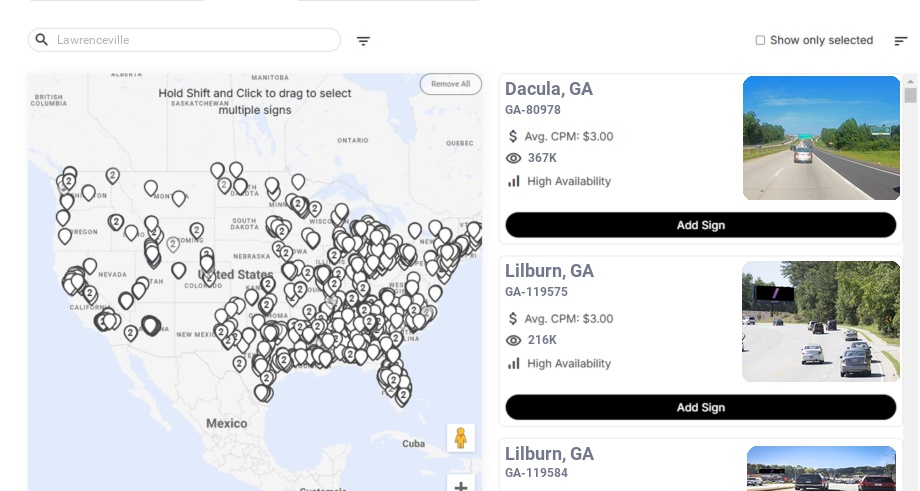
There are 9 Blip digital billboards near Lawrenceville, located in Duluth and Lilburn within roughly 10 miles. These nearby placements help you reach residents, commuters, and visitors moving through Gwinnett County. For advertisers looking for high-impact Lawrenceville billboards without paying premium in-city rates, these nearby placements provide a powerful, budget-friendly option.
Who can Lawrenceville, Georgia billboards reach?
The Lawrenceville area sits at the heart of Gwinnett County, one of the largest and fastest-growing counties in Georgia. The Lawrenceville trade area easily extends to 100,000–150,000 people when you account for nearby unincorporated suburbs and commuters using regional roads. Gwinnett County’s daytime population swells further as an estimated 400,000+ workers commute into or within the county for employment.
When is the best time to run billboards in Lawrenceville, Georgia with Blip?
The Lawrenceville area experiences distinct event and school cycles that should shape your scheduling strategy. Peak family-related decision periods include late July–August for back-to-school shopping and May–June for graduations, moving season, summer camps, travel, and sports. Target morning and afternoon commute windows of 6:30–9:00 a.m. and 3:00–7:00 p.m. for heavy local traffic.
Which roads see the most traffic for Lawrenceville, Georgia billboard ads?
I-85 near Duluth is one of metro Atlanta’s heaviest-traveled interstates, with GDOT counts commonly showing 150,000–200,000 vehicles per day in the Duluth segment. US 29, or Lawrenceville Highway, is a primary artery between Lilburn and the Lawrenceville area, with counts frequently in the 30,000–45,000 vehicles per day range on key segments. Sugarloaf Parkway and Pleasant Hill Road also carry substantial daily traffic and connect Lawrenceville to major commercial and event areas.
Do I need a contract to advertise with Blip near Lawrenceville?
No, Blip has no long-term contracts or minimum commitments. You can start, pause, or stop your campaign at any time.
How fast can I launch a billboard campaign with Blip near Lawrenceville?
You can have your campaign live in minutes. Create a free account, select your locations, set your budget, upload your design, and start running once approved.
Where can I advertise with Blip near Lawrenceville?
Blip has digital billboards near Lawrenceville. You can browse available locations on a map, choose the ones that fit your audience, and start advertising right away.
Still have questions? Launch a campaign in minutes — no contracts, no commitments.
Start Your CampaignLawrenceville Billboard Advertising Guide
The Lawrenceville, Georgia area is one of the most dynamic and diverse suburban markets in metro Atlanta, combining historic neighborhoods, a fast‑growing immigrant community, major commuter routes, and regional attractions. With 9 Blip digital billboards near Lawrenceville—located in Duluth and Lilburn within roughly 10 miles—we can help you reach residents, commuters, and visitors moving through this influential corner of Gwinnett County. For advertisers looking for high‑impact Lawrenceville billboards without paying premium in‑city rates, these nearby placements provide a powerful, budget‑friendly option.
Understanding the Lawrenceville Area Market
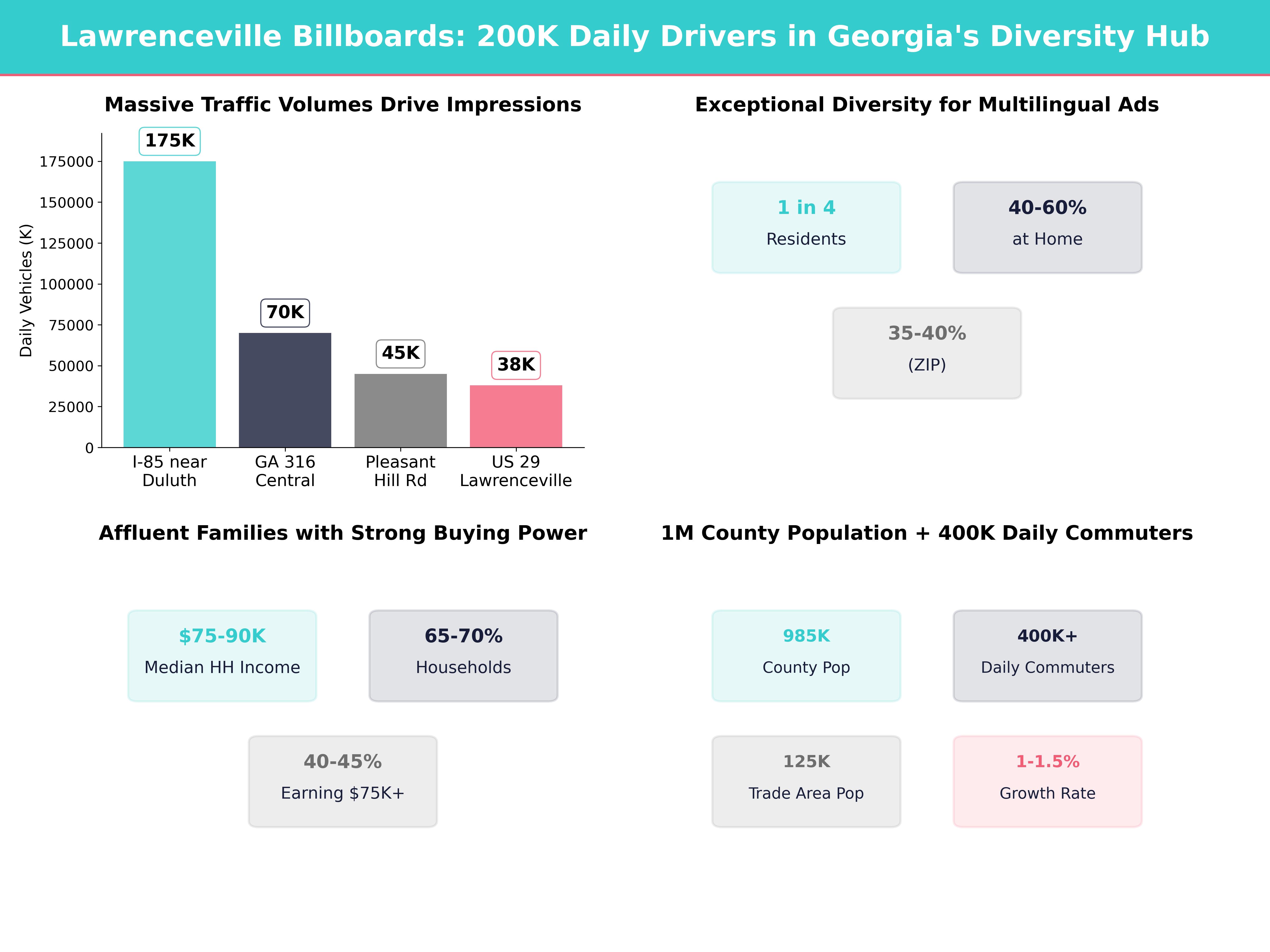
The Lawrenceville area sits at the heart of Gwinnett County, one of the largest and fastest‑growing counties in Georgia. According to 2020 data, the City of Lawrenceville itself has approximately 30,629 residents, while Gwinnett County overall has close to 1 million residents (around 980,000–990,000). Local county estimates indicate that Gwinnett has added roughly 10,000–15,000 residents in the first half of the 2020s, keeping annual growth in the 1–1.5% range. That means a billboard strategy near Lawrenceville doesn’t just reach city residents—it taps into a large regional audience that continues to expand and makes billboard advertising near Lawrenceville an efficient way to build brand awareness.
Key context points:
-
Population scale
- City of Lawrenceville: ~30,600 residents (2020), with local estimates edging toward 32,000+ by the mid‑2020s as new townhomes and apartments open around Downtown.
- Gwinnett County: 980,000+ residents, making it one of Georgia’s most populous counties and typically ranking among the top 2–3 largest in the state.
- The Lawrenceville “trade area” easily extends to 100,000–150,000 people when you account for nearby unincorporated suburbs (such as Five Forks–Trickum and Bethesda areas) and commuters using regional roads.
- Gwinnett County’s daytime population swells further as an estimated 400,000+ workers commute into or within the county for employment.
-
Diversity
- Gwinnett County is frequently cited as one of the most diverse counties in the Southeast. No single racial or ethnic group makes up a majority: local demographic snapshots show roughly 35–40% White (non‑Hispanic), 30–32% Black or African American, 20–25% Hispanic or Latino (any race), and 11–13% Asian.
- Around 1 in 4 Gwinnett residents is foreign‑born, and in some Duluth and Lilburn ZIP codes that share a trade area with Lawrenceville, foreign‑born residents can exceed 35–40%.
- Korean, Indian, Vietnamese, Chinese, and Latino communities are especially prominent along Pleasant Hill Road in Duluth and US 29 / Lawrenceville Highway near Lilburn, with dozens of plazas anchored by ethnic grocery stores and restaurants.
- This diversity has direct implications for language choices, imagery, and cultural cues in your billboard creative.
-
Income & spending power
- Median household income in the Lawrenceville area sits around the mid‑$60,000s, while Gwinnett County overall is around the low‑$80,000s. Several Lawrenceville‑area ZIP codes (like 30043 and 30044) report median household incomes in the $75,000–$90,000 range.
- Roughly 40–45% of households in many nearby neighborhoods earn $75,000 or more, and 20–25% earn $100,000+.
- This signals solid middle‑class and upper‑middle‑class purchasing power, ideal for consumer services, retail, auto, healthcare, dining, and home improvement.
-
Education levels
- Gwinnett County reports that well over 30% of adults 25+ have a bachelor’s degree or higher, with some Lawrenceville‑adjacent tracts exceeding 40%.
- Higher educational attainment supports demand for financial services, professional healthcare, college prep, and enrichment programs.
-
Employment base
- Gwinnett’s economy includes major employment in healthcare, logistics, advanced manufacturing, and technology. The county typically supports 400,000+ jobs, with an unemployment rate that has often run 1–2 percentage points below the national average in recent years.
- Large nearby job centers include the Sugarloaf business corridor, the Gwinnett Justice and Administration Center, and medical facilities such as Northside Hospital Gwinnett
-
Local anchors & destinations
- Downtown Lawrenceville has been heavily revitalized, with the Lawrenceville Arts Center and a growing restaurant scene promoted by the City of Lawrenceville. The city has invested tens of millions of dollars in streetscapes, parking, and public spaces to attract thousands of visitors to events, performances, and dining each year.
- Georgia Gwinnett College (GGC), with over 12,000 students and hundreds of faculty and staff, brings a young, tech‑savvy audience to the area (Georgia Gwinnett College). GGC reports that more than 80% of students live in the surrounding Gwinnett area, making local visibility particularly valuable.
- The nearby Gas South District (arena, theater, and convention center in Duluth) attracts hundreds of thousands of visitors annually for concerts, sports, graduations, and expos (Gas South District). Major events regularly draw 5,000–13,000+ attendees in a single night.
- Regional tourism promotions from Explore Gwinnett highlight that Gwinnett hosts 100+ annual festivals and events, many clustered within a 10–15 mile radius of Lawrenceville.
For advertisers, this means that well‑placed digital billboards near Lawrenceville allow you to speak to commuting families, students, professionals, and visitors all at once—with enough message flexibility to tailor to each group and turn simple Lawrenceville billboards into consistently performing local media.
Key Travel Corridors and How Our Billboards Fit In
Our 9 digital billboards serving the Lawrenceville area are located in Duluth (about 8.3 miles away) and Lilburn (about 8.4 miles away). Both cities sit on major commuter and retail corridors used daily by Lawrenceville‑area residents, so when you’re planning billboard advertising near Lawrenceville, these are the roads that determine who sees your message.
Important roadways and traffic patterns:
-
I‑85 near Duluth
- I‑85 is one of metro Atlanta’s heaviest‑traveled interstates. Georgia Department of Transportation (GDOT) counts commonly show volumes of 150,000–200,000 vehicles per day in the Duluth segment, depending on the exact milepost (GDOT).
- Peak‑direction rush hours can see 6,000–8,000 vehicles per hour in each direction during the busiest times.
- Many Lawrenceville residents travel this stretch for work in Atlanta, Norcross, Peachtree Corners, and beyond, making our Duluth boards ideal for commuter‑focused messaging and for capturing workers headed to and from regional employers.
-
US 29 / Lawrenceville Highway near Lilburn
- US 29 (Lawrenceville Highway) is a primary artery between Lilburn and the Lawrenceville area, with GDOT and local counts frequently in the 30,000–45,000 vehicles per day range on key segments.
- This route captures a large share of daily trips for shopping, schools, and services—especially from working‑class and immigrant neighborhoods that rely heavily on this corridor.
- The roadway’s mix of local traffic, buses, and service trips makes it ideal for everyday consumer offers, faith‑based messaging, and local services.
-
Pleasant Hill Road & Sugarloaf Parkway connectors
- Pleasant Hill Road in Duluth, a major retail corridor linking I‑85 to local shopping centers and ethnic plazas, can see 40,000–50,000 vehicles per day on busy segments.
- Sugarloaf Parkway, which connects Lawrenceville to Duluth, the Gas South District, and the I‑85 corridor, routinely carries 30,000+ vehicles per day where it intersects major commercial nodes.
- Many point‑to‑point trips between Lawrenceville homes and Duluth jobs/retail pass right by our boards serving the Lawrenceville area.
-
GA 316 (University Parkway) & regional access
- GA 316 just west of the Lawrenceville area is a limited‑access route carrying traffic between Lawrenceville, Athens, and I‑85, with daily traffic counts often in the 60,000–80,000 vehicles per day range on central segments.
- Although our billboards are focused in Duluth and Lilburn, feeder routes from GA 316 funnel travelers toward the I‑85 and US 29 corridors where our boards sit.
Strategically, this means:
- Duluth boards are your high‑reach commuter & entertainment placements, intersecting with tens of thousands of daily I‑85 drivers plus regional shoppers.
- Lilburn boards are your community‑oriented, family, and everyday errand placements, intercepting thousands of daily local trips along US 29 and nearby arterials.
- Combined, your ads can appear thousands of times a day on routes heavily used by residents of the Lawrenceville area heading to work, school, worship, or shopping, supported by reliable traffic data from GDOT.
For more context on local growth and roadway investments, advertisers can also review Gwinnett County government transportation and SPLOST project updates and city planning pages from Duluth and Lilburn. This information can help refine which Lawrenceville billboards and nearby boards are best for your goals.
Demographics & Audience Segmentation Near Lawrenceville
When planning a campaign near the Lawrenceville area, segmenting by life stage and culture yields more relevant creative and more efficient billboard advertising near Lawrenceville overall.
Key demographic groups:
-
Commuter families
- Gwinnett County consistently maintains a high share of family households; in many Lawrenceville‑area neighborhoods, 65–70% of households are family households, and a majority of those include children under 18.
- Median age in the Lawrenceville area is in the low‑to‑mid 30s, younger than the national median, which is ideal for financial services, childcare, healthcare, auto, home improvement, and family dining.
- With 180,000+ students in Gwinnett County Public Schools and thousands more in private schools and preschools, daily school‑related travel generates substantial morning and afternoon traffic.
-
Young adults & students
- Over 12,000 students at Georgia Gwinnett College plus young professionals working in tech, healthcare, logistics, and professional services hubs in Gwinnett provide a robust 18–34 segment. In some Lawrenceville‑adjacent tracts, 25–30% of residents fall into this young adult category.
- Ideal for mobile apps, fast‑casual dining, nightlife, gyms, and entry‑level professional services (insurance, banking, rentals).
- Many GGC and nearby technical college students live off‑campus and commute using I‑85, Sugarloaf Parkway, and local arterials, making roadside visibility valuable.
-
Multicultural and multilingual audiences
- Neighborhoods around Duluth and Lilburn are especially known for strong Korean, Indian, Latino, and other immigrant communities, with many family‑owned businesses. In some census tracts near these corridors, 40–60% of residents speak a language other than English at home, and 20–30% report speaking English less than “very well.”
- Korean, Spanish, Hindi, Vietnamese, and Chinese signage is common in nearby shopping centers, reflecting real demand for multilingual marketing.
- Bilingual or multilingual creative (English + Spanish, or English + Korean, for example) can strongly increase resonance on these routes.
-
Faith‑oriented communities
- The Lawrenceville area and nearby cities host hundreds of churches and religious institutions, along with mosques, temples, and other houses of worship. In Gwinnett, weekend religious participation is notably high compared to many urban cores.
- Large congregations near Duluth and Lilburn can draw 1,000–5,000+ attendees on a single weekend, creating pronounced Saturday and Sunday traffic peaks on local roads.
- Religious organizations, private schools, and community groups can use Blip to focus messages on weekend dayparts when attendance decisions are made.
By using multiple creatives, you can run:
- One version geared toward families (schools, healthcare, family activities).
- One geared toward students/young professionals (events, nightlife, services).
- One geared toward multicultural audiences (bilingual offers, culturally relevant imagery).
Local insights from Gwinnett County Public Schools, Explore Gwinnett, and city community pages (such as City of Lawrenceville) can help refine the tone and timing for each segment and make your Lawrenceville billboards feel authentically local.
Timing Your Campaign: Seasonality & Dayparting
The Lawrenceville area experiences distinct event and school cycles that should shape your scheduling strategy.
1. School calendar & family patterns
-
Gwinnett County Public Schools is one of the largest school districts in the state, educating more than 180,000 students across 140+ schools and educational centers (Gwinnett County Public Schools).
- The district employs tens of thousands of staff members, so school schedules directly influence traffic.
-
Peak family‑related decision periods:
- Late July–August: back‑to‑school shopping, tutoring, healthcare checkups, after‑school activities; local retailers often report double‑digit sales lifts during this window compared with June.
- May–June: graduations, moving season, summer camps, travel, and sports; apartments and home listings typically spike, creating demand for real estate and home services.
-
Target morning and afternoon commute windows:
- 6:30–9:00 a.m.: parents and staff headed to work and school; school zones and arterials often operate near capacity.
- 3:00–7:00 p.m.: after‑school pickup, extracurriculars, errands, youth sports, and dinner runs.
2. College & sports calendar
- Georgia Gwinnett College’s semesters (roughly August–December and January–May) bring increased weekday and evening traffic around the campus and nearby corridors. GGC enrollment growth over the past decade—climbing from just a few thousand to 12,000+ students—has steadily expanded this audience (Georgia Gwinnett College).
- The Gwinnett Stripers (Triple‑A affiliate of the Atlanta Braves) draw fans April–September at Coolray Field just north of the Lawrenceville area, boosting evening and weekend traffic (Gwinnett Stripers). Annual attendance can reach 300,000–400,000+ fans, with individual game crowds often ranging from 3,000 to 10,000+.
-
Align promotions for dining, bars, retail, and rideshare with:
- Evening drive (4:30–8:00 p.m.) on game days.
- Weekends during home series, especially Fridays and Saturdays.
3. Events and tourism
- The Gas South District in Duluth hosts concerts, trade shows, graduations, cultural festivals, and major events year‑round. Its arena capacity is around 13,000 seats, with thousands more in the theater and convention spaces (Gas South District). Many attendees come from or pass through the Lawrenceville area.
- The Explore Gwinnett tourism authority highlights year‑round festivals, food events, sports tournaments, and cultural celebrations across Gwinnett. Seasonal marquee events—such as food truck festivals, holiday markets, and international cultural festivals—can spike traffic by several thousand extra vehicles per day around host sites.
- Local municipal calendars from City of Lawrenceville, Duluth, and Lilburn regularly list free concerts, farmers markets, and parades that add to weekend and evening traffic.
-
Adjust Blip schedules to:
- Increase impressions during major event weekends (concerts, festivals, big games).
- Focus more of your budget on the specific days and times when visitors travel to and from events—typically 2–3 hours before start times and immediately afterward.
4. Weather & seasonal habits
-
The Lawrenceville area experiences hot summers, with many days reaching 90°F+, and mild winters where average highs often stay in the 50s–60s°F.
- Summer: strong demand for HVAC tune‑ups, home services, outdoor activities, pools, water parks, and cold beverages; utility usage data in metro Atlanta routinely shows summer peak loads 20–40% higher than shoulder seasons.
- Winter holidays: gift retail, financial services (year‑end planning), nonprofits, and seasonal events see a spike from November–December, when many retailers derive 20–30% or more of their annual sales.
- Spring: home buying, remodeling, landscaping, and health/fitness services often surge as families prepare for the school year end.
- With Blip, you can shift emphasis week by week: more impressions during high‑conversion seasonal windows, fewer during slow periods.
Creative Strategies That Resonate Near Lawrenceville
To stand out to drivers near Lawrenceville, Duluth, and Lilburn, billboard design must be both clear and locally attuned. Well‑executed creative can turn basic billboard rental near Lawrenceville into a long‑term brand asset.
1. Use clear, bold geography cues
Rather than generic phrases, anchor your message:
- “Serving the Lawrenceville area since 2005”
- “Just 10 minutes from Downtown Lawrenceville”
- “Your Lawrenceville‑area HVAC experts”
This helps drivers immediately connect your ad with their community and sense of place. Local pride is strong—municipal surveys frequently show that 70%+ of residents in Gwinnett cities rate quality of life as “good” or “excellent,” so explicitly mentioning local ties reinforces trust.
2. Make diversity visible
Reflect the local demographic:
-
Show families and individuals from diverse backgrounds in imagery to mirror Gwinnett’s “no‑majority” demographic reality.
- Use bilingual headlines wisely—e.g., a short English headline with a Spanish sub‑line, or vice versa, as long as the total text count stays low (ideally under 7–10 words).
- Cultural references to Korean BBQ, pan‑Asian groceries, or Latin bakeries can resonate strongly near Duluth and Lilburn, where entire centers are dedicated to K‑food, pan‑Asian markets, and Hispanic retailers.
- Consider rotating English‑only and bilingual creatives and monitoring which version drives more web traffic or calls.
3. Focus on one core action
Given typical 6–8 second viewing windows at highway speeds:
- Use 1 main headline + 1 short sub‑line + logo/URL or simple call‑to‑action (CTA).
-
Examples:
- “Need a Pediatrician Near Lawrenceville? Call 770‑XXX‑XXXX”
- “Car Trouble on I‑85? Exit at [Your Shop Name]”
- “New Homes Near Lawrenceville from the $300s”
- Aim for 6–8 words max in your primary message; clarity beats cleverness for moving audiences.
- Avoid clutter: no paragraphs, no long URL strings, and minimal fine print.
4. Use contrasting colors for daytime and nighttime
The Lawrenceville area has heavy commuter traffic in early morning and after dark, especially in winter when sunset can be before 6:00 p.m.:
- Use high contrast combinations (dark background + light text or vice versa).
- Test versions optimized for night (slightly brighter elements, but not so bright they cause glare).
- Avoid thin serif fonts; choose bold sans‑serif type for better readability at speed. Industry legibility tests often show 20–30% better recall for bold, high‑contrast designs versus low‑contrast or script fonts.
5. Rotate creatives for different audiences
With digital, you’re not locked into one message:
- Morning: “Beat Traffic from the Lawrenceville Area – Telehealth Appointments Available”
- Midday: “Lunch Near Lawrenceville? Exit Now for $8 Combos”
- Evening: “After‑Work Yoga Near Lawrenceville – Classes at 6 & 7 p.m.”
This rotation helps maximize relevance across segments without changing your media buy. Local businesses featured in outlets like the Gwinnett Daily Post and AJC Gwinnett community news
Using Blip Strategically for the Lawrenceville Area
Blip’s flexibility is particularly powerful in a commuter‑heavy, event‑driven market like the Lawrenceville area, where advertisers need billboard rental near Lawrenceville that can scale up or down quickly.
1. Micro‑target your geography
-
Choose Duluth boards for:
- Reaching Lawrenceville residents commuting toward Atlanta, Norcross, and Peachtree Corners via I‑85.
- Promoting events at Gas South District or regional retail along Pleasant Hill Road and Sugarloaf Parkway.
- Higher‑income professional audiences clustered near office parks and Class A apartments.
-
Choose Lilburn boards for:
- Reaching everyday shoppers and families making short trips along US 29 and Lawrenceville Highway.
- Promoting local services (medical, dental, legal, auto repair, education, childcare).
- Reaching multicultural neighborhoods and faith communities concentrated around Lilburn’s many churches and ethnic plazas.
You can run on all 9 boards or select just those that align best with your geography and budget. Pair this with demographic and neighborhood context from Gwinnett County government and local city planning documents to refine placement and pinpoint which Lawrenceville billboards best match your customer base.
2. Control budget by time of day and day of week
-
Focus your spend on:
- Weekday morning and evening rush for B2B and commuter‑focused offers.
- Weekends for retail, family attractions, leisure activities, and worship invitations.
-
For example:
- Allocate 70% of impressions Mon–Fri, 6–9 a.m. and 3–7 p.m., when combined commuter flows on I‑85, Sugarloaf Parkway, and US 29 are highest.
- Allocate 30% Sat–Sun, 10 a.m.–7 p.m. for leisure and shopping, when traffic around malls and town centers increases but congestion is less severe.
3. Tactical campaigns around news and events
Local news outlets such as the Gwinnett Daily Post and local sections of the Atlanta Journal‑Constitution frequently cover:
- New business openings
- Road projects and detours
- School and sports milestones
- Community safety initiatives
- Major development projects approved by Gwinnett County or the City of Lawrenceville
Use Blip to:
- Launch a short, high‑frequency burst campaign when you’re featured in local media. Businesses often see a spike of 20–50% more search and web traffic in the days immediately following local coverage; billboards can help capture and convert that attention.
- Provide detour messaging during major roadworks affecting the Lawrenceville area, especially for service businesses that rely on drive‑by traffic.
- Promote time‑sensitive community events or fundraisers with precise date windows, coordinating with city calendars from Lawrenceville, Duluth, and Lilburn.
4. A/B test your creative
Because you pay per “blip” (individual ad play), you can:
- Run two designs simultaneously on the same boards.
- Compare web traffic, call volume, coupon redemptions, or store visits during each creative’s run. Even small changes—like a new headline or color scheme—can produce 10–30% differences in response rates.
- Shift spend toward the higher‑performing design within days, not months, allowing you to quickly adapt to what resonates most with Lawrenceville‑area audiences.
Example Campaign Approaches for the Lawrenceville Area
To make all of this more concrete, here are sample strategies for common advertiser types using billboards near Lawrenceville.
Local medical practice near Lawrenceville
- Goal: Increase new patient appointments within a 10‑mile radius.
- Boards: Mix of Duluth and Lilburn to cover commute routes in and out of the Lawrenceville area.
- Audience context: Within a 10‑mile radius, you’re drawing from a pool of well over 200,000 residents, including tens of thousands of children and young adults.
-
Messaging:
- “New Family Doctor Accepting Patients Near Lawrenceville – Same‑Day Appointments”
- “Urgent Care Near Lawrenceville – Open 8 a.m.–8 p.m., 7 Days”
-
Tactics:
- Heavier weekday daytime presence (8 a.m.–6 p.m.), when healthcare and appointment decisions are most common.
- Rotate Spanish/English versions in Lilburn, English‑dominant in Duluth, reflecting local language usage patterns where 20–30% of households may primarily speak Spanish or another language at home.
- Align immunization, sports physical, and flu‑shot campaigns with school calendar milestones highlighted by Gwinnett County Public Schools.
Restaurant or entertainment venue
- Goal: Drive evening and weekend traffic from the Lawrenceville area.
- Boards: Primarily Duluth (for Gas South District events) plus key Lilburn placements for families.
- Audience context: Major event nights at Gas South District can add several thousand extra vehicles along Sugarloaf Parkway and I‑85, while family dining volumes tend to increase 20–30% on Friday and Saturday evenings.
-
Messaging:
- “Dinner Before the Show? 5 Minutes from Gas South District”
- “Lawrenceville‑Area Families Eat Free Kids’ Meals on Tuesdays”
-
Tactics:
- Daypart to run 3–10 p.m. weekdays and noon–10 p.m. weekends.
- Increase impression concentration on days with major events listed on Gas South District’s calendar and on the events pages of Explore Gwinnett.
- Feature limited‑time offers around high‑traffic holidays (Valentine’s Day, Mother’s Day, graduation week, and December holidays), when restaurant visits and catering orders typically jump.
Home services or contractors
- Goal: Own mindshare among homeowners in the Lawrenceville area.
- Boards: Both Duluth and Lilburn to blanket commuting patterns and local errand routes.
- Audience context: In many Lawrenceville‑area ZIP codes, 55–65% of housing units are owner‑occupied, providing a strong base of homeowners who make big‑ticket decisions on roofs, HVAC, and remodeling.
-
Messaging:
- “Lawrenceville‑Area Roof Leaks? Call 24/7 – 770‑XXX‑XXXX”
- “New Windows Near Lawrenceville – $0 Down Financing”
-
Tactics:
- Seasonal bursts: roof repair before storm season (late winter/early spring), HVAC before peak summer heat, insulation and window upgrades in fall. Severe thunderstorms, which are common in North Georgia spring and summer, can trigger spikes in demand immediately after major weather events.
- Use Blip’s flexible budget control to double impressions during weather alerts and high‑demand periods.
- Coordinate messaging with local building and code updates shared by Gwinnett County government.
Measuring, Iterating, and Staying Local
To get the most from your digital billboards near Lawrenceville, treat them like a test‑and‑learn channel, not a one‑time buy.
1. Tie billboard exposure to clear KPIs
- Use short, memorable URLs or QR codes (only if large and simple enough to scan safely).
-
Track:
- Landing page visits from the Lawrenceville and Gwinnett area (you can segment by ZIP code or city in most analytics platforms).
- Coupon or promo code use (e.g., “Mention ‘Lawrenceville’ and Save 10%”); even a 5–10% redemption rate on a billboard‑specific offer can indicate strong performance.
- Call tracking numbers unique to your billboard campaign and measure changes in call volume during your flight dates.
2. Optimize using local feedback
- Ask customers how they heard about you and tally “saw your billboard near Lawrenceville/Duluth/Lilburn.” Even a simple in‑store or online survey can quickly reveal what percentage of customers—often 10–30% for local service businesses—first discovered you via roadside visibility.
-
Read local coverage and community feedback from:
- City of Lawrenceville announcements.
- Gwinnett County government updates on infrastructure and community initiatives.
- Gwinnett Daily Post community stories and neighborhood coverage.
- AJC Gwinnett community news
- Adjust messaging to reflect real‑time local concerns—traffic changes, school stories, economic trends, or public safety campaigns—so your Lawrenceville billboards always feel relevant.
3. Refresh creative regularly
-
Aim to update your creative every 60–90 days at minimum, or whenever:
- A major season changes (back‑to‑school, holidays, tax season).
- You launch a new service, product, or location in the Lawrenceville area.
- You see diminishing response to existing messages (fewer calls, lower web traffic, declining redemption of billboard‑specific offers).
- Tie refreshes to local event calendars from Explore Gwinnett, City of Lawrenceville, Duluth, and Lilburn so your billboards always feel timely and connected to what’s happening on the ground.
By pairing data‑driven targeting with locally tuned creative and flexible scheduling, advertisers can use Blip’s 9 digital billboards serving the Lawrenceville area—located in nearby Duluth and Lilburn—to build consistent, measurable visibility with some of the most economically active and culturally diverse audiences in Georgia. Whether you are testing billboard advertising near Lawrenceville for the first time or expanding an existing campaign, these placements offer a scalable, high‑impact way to stay visible in this growing market.