Billboards in Burley, ID
No Minimum Spend. No Long-Term Contracts. Just Results.
Trusted by Leading Brands


Billboard advertising
in Burley has never been easier
How much is a billboard in Burley?
Why Choose Blip for Billboard Advertising in Burley
Blip lets you launch Burley billboards fast, reaching I-84 travelers and Mini-Cassia commuters without a lengthy setup.
Set flexible budgets in Burley and only pay for the blips you use—ideal for testing ads during harvest, school runs, or fair week.
Use Blip dayparting in Burley to hit 5–8 a.m. plant traffic and 3–6 p.m. family commutes on US-30 and I-84.
No contracts mean Burley advertisers can scale up for Cassia County Fair & Rodeo or the Spudman, then pause anytime.
Track real-time results in Burley and shift spend as traffic changes on the Snake River bridge routes and downtown arterials.
Blip creative tools make it easy to tailor Burley ads for truckers, farm workers, or Spanish-speaking families.
Frequently Asked Questions About Billboard Advertising in Burley
How much does a billboard cost in Burley, Idaho with Blip?
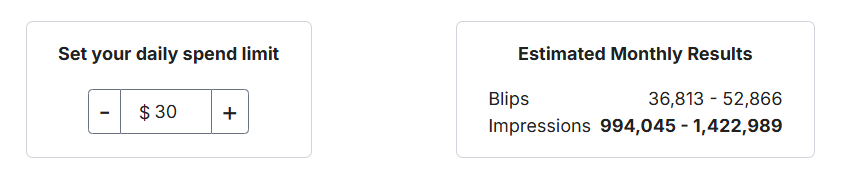
With Blip, you control exactly what you spend on Burley billboards by setting your own daily budget, and Blip automatically keeps your campaign within that amount. Each “blip” is a brief 7.5 to 10-second display, and you only pay for the blips you receive, making billboards in Burley, Idaho accessible even on a small budget. Pricing per blip changes based on when and where you choose to advertise and current advertiser demand, so you can adjust your budget or schedule anytime to match your goals.
Where can I advertise with Blip in Burley, Idaho to reach the most people?
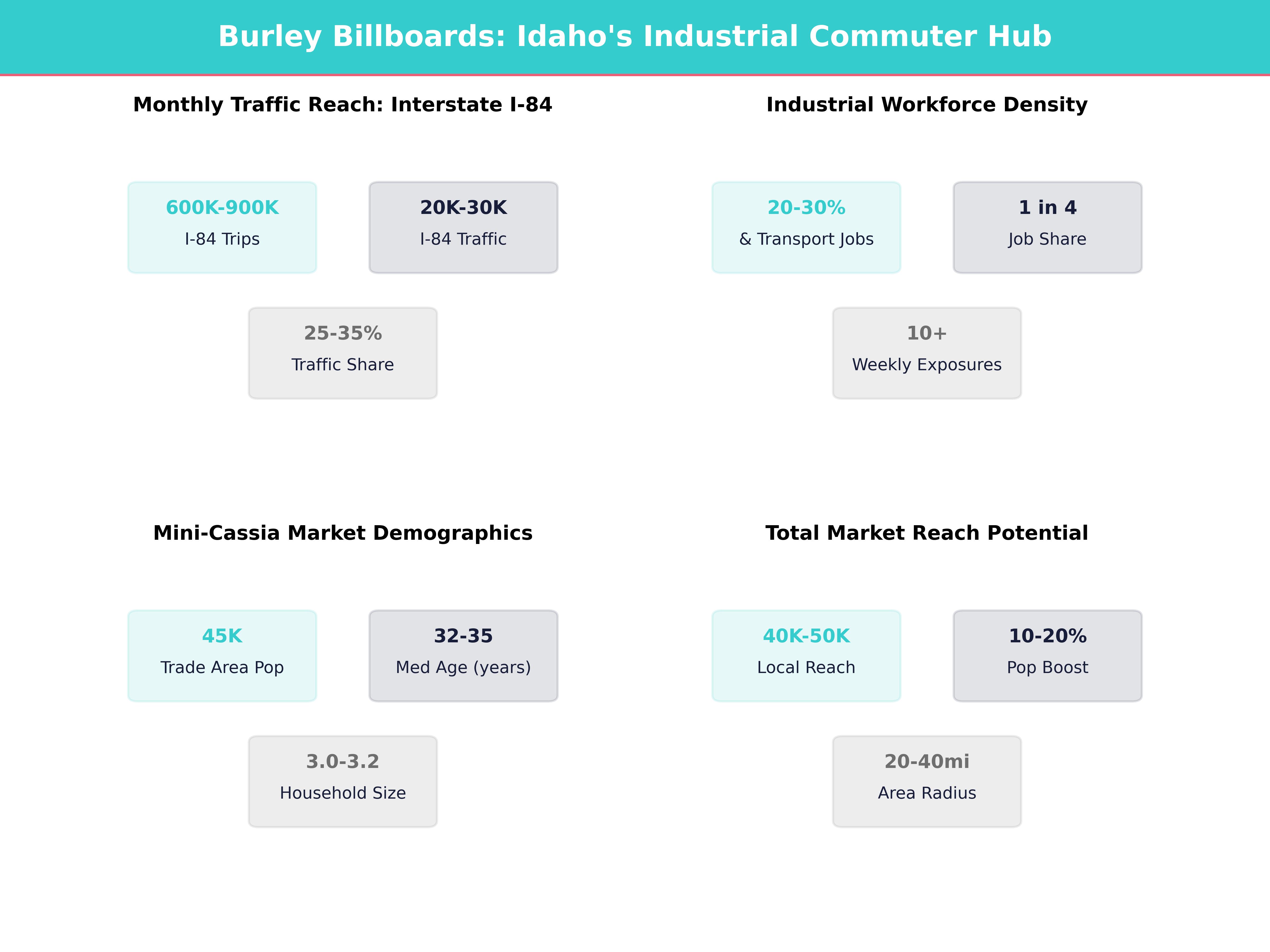
Burley sits at the center of the “Mini-Cassia” region, drawing daily traffic and commerce from Cassia County and Minidoka County. That means a realistic local reach of 40,000–50,000 people in everyday shopping, commuting, and school patterns, and a daytime population that often runs 10–20% higher than the resident count because of commuters and regional visitors. For advertisers evaluating billboard rental in Burley, that combination of local and regional traffic creates consistent, repeat exposure.
What are the best traffic corridors for Burley, Idaho billboards with Blip?
I‑84 is one of Idaho’s primary interstate routes, and in the Burley/Heyburn area it carries average daily traffic volumes in the 20,000–30,000 vehicles per day range, with truck traffic often making up 25–35% of that flow. US‑30 connects Burley with Rupert and Heyburn and carries strong commuter and school traffic across the Snake River, with daily traffic counts in key stretches often falling in the 7,000–12,000 vehicles per day range. The downtown core and main east‑west routes also serve local businesses, city offices, and events, with traffic spikes around school start/end times.
When should I run billboard ads in Burley, Idaho with Blip for the best results?
Spring planting and fall harvest ramp up activity in fields and processing plants, and during those times early-morning traffic and late afternoon traffic swell with farm and plant workers. Burley’s calendar is also defined by major local events like the Cassia County Fair & Rodeo in August, the Burley Spudman Triathlon in July, and the Idaho Regatta in late June. Blip allows us to ramp our budget up around these spikes and scale back in quieter weeks, maximizing ROI instead of committing to a rigid year-long schedule.
Who should I target with Burley, Idaho billboards if I'm using Blip?
Strong local audiences include commuting workers, families and parents, travelers and truckers on I‑84, and Spanish-speaking residents. In Cassia and Minidoka counties, transportation, warehousing, and manufacturing jobs together can account for 1 in 4 non-farm jobs, while roughly 30% of residents are under 18, creating predictable school-year travel patterns. Cassia and Minidoka counties also have sizable Hispanic and Latino populations, with many neighborhoods where 30–40% of residents identify as Hispanic/Latino and a large share of households are bilingual.
Do I need a contract to advertise with Blip in Burley?
No, Blip has no long-term contracts or minimum commitments. You can start, pause, or stop your campaign at any time.
How fast can I launch a billboard campaign with Blip in Burley?
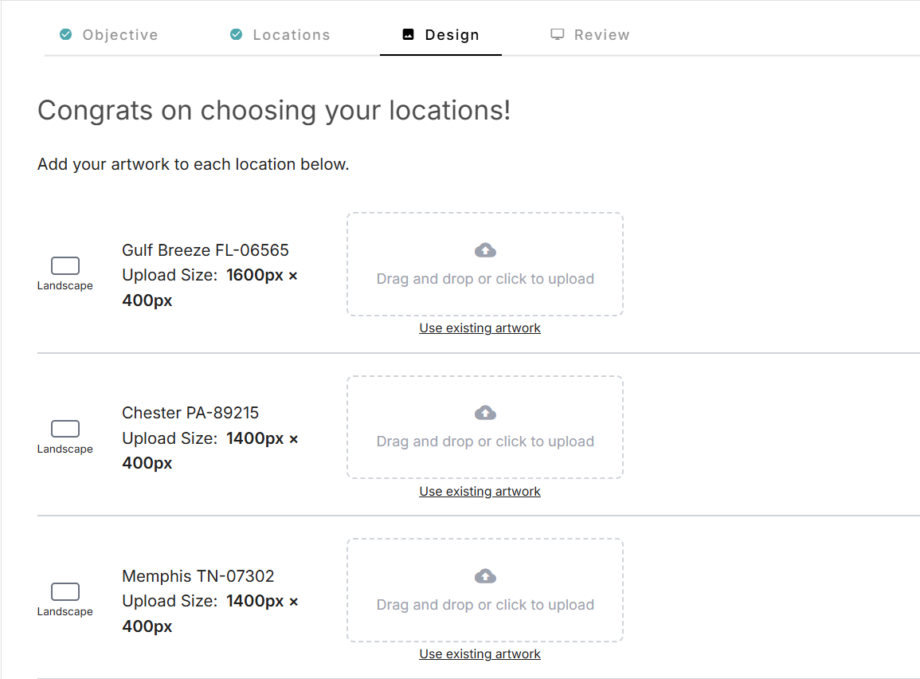
You can have your campaign live in minutes. Create a free account, select your locations, set your budget, upload your design, and start running once approved.
Where can I advertise with Blip in Burley?
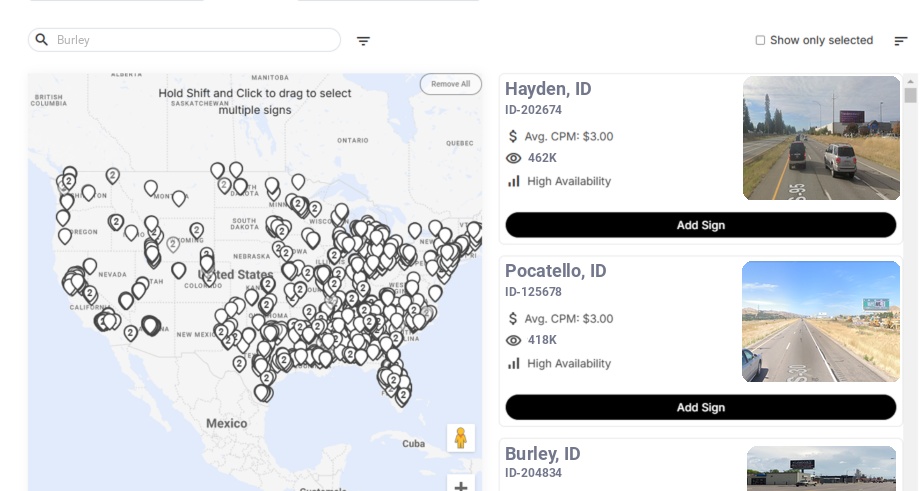
Blip has digital billboards in Burley. You can browse available locations on a map, choose the ones that fit your audience, and start advertising right away.
Still have questions? Launch a campaign in minutes — no contracts, no commitments.
Start Your CampaignBurley Billboard Advertising Guide
Nestled on the Snake River between Cassia County and Minidoka County, Burley is one of southern Idaho’s most strategic small markets for out-of-home. With a city population of roughly 11,000 and a broader Mini-Cassia trade area of more than 45,000 people, plus heavy pass-through traffic on I‑84, digital billboards in Burley let us reach both a deeply rooted local community and a constant stream of travelers and workers. Using Blip, we can time, target, and test our Burley billboard advertising campaigns to match the rhythms of this unique agricultural and industrial hub, making Burley billboards a smart extension of any southern Idaho media plan.
Understanding the Burley Market
Burley sits at the center of the “Mini‑Cassia” region, drawing daily traffic and commerce from Cassia County (about 25,000 residents) and Minidoka County (about 21,000 residents). That means a realistic local reach of 40,000–50,000 people in everyday shopping, commuting, and school patterns, and a daytime population that often runs 10–20% higher than the resident count because of commuters and regional visitors. For advertisers evaluating billboard rental in Burley, that combination of local and regional traffic creates consistent, repeat exposure.
Key local context:
-
Population profile
- City of Burley: ~11,000 residents in the latest city estimates from the City of Burley.
- Cassia County: roughly 25,000 residents; Minidoka County: roughly 21,000 residents, giving the core Mini‑Cassia region a combined base near 46,000 people.
- Median age in Cassia and Minidoka counties sits in the early‑ to mid‑30s (around 32–35 years), reflecting a strong base of working‑age adults and young families compared with Idaho’s statewide median age in the late 30s.
- Average household sizes in the Mini‑Cassia area are typically 3.0–3.2 people per household versus closer to 2.5 nationally, so family‑focused messaging (meals, activities, healthcare, financial services) tends to over‑index.
- Many neighborhoods have a high share of children and teens: in Cassia and Minidoka, roughly 30% of residents are under 18, meaning school‑linked routines and youth activities drive a lot of daily travel.
-
Economy & major sectors
- Agriculture, food processing, and transportation dominate. Cassia and Minidoka counties consistently rank among Idaho’s leading producers of potatoes, sugar beets, grains, and dairy, with farm cash receipts in the broader South Central region in the hundreds of millions of dollars per year according to regional profiles from the Idaho Department of Labor.
- The Mini‑Cassia area supports thousands of jobs in food manufacturing, trucking, and warehousing. Manufacturing and transportation together often account for 20–30% of local non‑farm employment, creating a large blue‑collar commuter base that regularly encounters billboards in Burley on the way to and from work.
- Large employers within a 10–15 minute drive include plants for companies like McCain Foods (in nearby Heyburn), dairy processors, and regional logistics operations along I‑84, many running 24‑hour shifts and generating consistent traffic even outside 9‑to‑5 hours.
- This workforce creates substantial weekday commuter traffic, especially during early mornings (5–8 a.m.) and late afternoons (3–6 p.m.), ideal windows for employment, food, and service messages.
-
Regional pull
- Burley draws shoppers from smaller communities like Declo, Paul, Heyburn, and Rupert for groceries, healthcare, auto, and big‑ticket purchases. For many of these towns, Burley is the nearest center with multiple grocery stores, auto dealers, and hospital‑level care.
- Hospital and clinic usage, banking, and big‑box retail typically pull patients and customers from 20–40 miles away, making Burley a de facto regional hub.
- According to regional coverage from the Times-News and the Mini-Cassia Chamber of Commerce, Burley functions as a service hub for a trade area that extends 20–40 miles in every direction, with the Chamber representing 300+ member businesses in the Mini‑Cassia area.
For advertisers, all of this translates to a concentrated, community-oriented audience that still sees significant highway and visitor traffic. With Blip, we can reach both the local core and the constant flow of outsiders passing through, and scale Burley billboard advertising up or down as business needs change.
Traffic Patterns and High-Impact Corridors
Burley’s geography creates a few standout corridors that are especially valuable for billboard campaigns. Selecting the right placements for Burley billboards along these routes greatly improves visibility and response.
-
I‑84 east–west corridor
- I‑84 is one of Idaho’s primary interstate routes, linking Boise to Twin Falls, Burley, and on toward Pocatello and Salt Lake City. In south‑central Idaho, I‑84 carries a large share of both statewide and interstate freight.
- Recent traffic data from the Idaho Transportation Department indicate that average daily traffic volumes on I‑84 in the Burley/Heyburn area run in the 20,000–30,000 vehicles per day range, with truck traffic often making up 25–35% of that flow.
- Over a month, this can translate into 600,000–900,000 vehicle trips, giving repeated exposure to both long‑haul and regional drivers.
-
This traffic is a mix of long-haul trucking, regional freight, and family travel between urban centers. Perfect for:
- Lodging, dining, and fuel offers.
- Auto services and truck repair.
- Tourist attractions, outdoor recreation, and events promoted by outlets like Visit Southern Idaho.
-
US‑30 & Snake River bridge approaches
- US‑30 connects Burley with Rupert and Heyburn and carries strong commuter and school traffic across the Snake River, linking business districts, industrial areas, and residential neighborhoods.
- Daily traffic counts in key stretches often fall in the 7,000–12,000 vehicles per day range, heavily skewed toward local residents and repeat drivers who see the same boards multiple times per week.
- At 7,000–12,000 vehicles a day, a single digital face can reasonably be seen 200,000–350,000 times per month, even before counting multiple occupants per vehicle.
-
Ideal for:
- Grocery, retail, and restaurants.
- Health care, dental, and local services.
- Bank branches and credit unions.
-
Downtown Burley and key arterials
- The downtown core and main east‑west routes serve local businesses, the City of Burley offices, and events at places like the fairgrounds and local parks.
- Cassia County government offices and the courthouse in Burley bring in a steady stream of residents for services, courts, and public meetings on weekdays.
- Traffic spikes around school start/end times due to Cassia Joint School District 151 campuses and youth activities. The district, which educates over 5,000 students across multiple schools according to Cassia Joint School District 151, generates highly predictable morning and afternoon flows.
- Local arterials around grocery stores, big‑box retailers, and medical offices typically see heavier Friday and Saturday volumes as regional shoppers come into town.
Using Blip’s location controls, we can focus spending on billboards in Burley that directly serve the audiences we care about—highway travelers on I‑84 for visitor‑oriented campaigns or city arterials for local service businesses.
Seasonality, Events, and When to Run
Burley’s calendar is defined by agriculture, outdoor recreation, and a few marquee events. Aligning billboard activity with these patterns can dramatically increase performance and make billboard rental in Burley more cost‑effective.
-
Agricultural seasons
- Spring planting (April–May) and fall harvest (September–October) ramp up activity in fields and processing plants. In southern Idaho, those periods correspond to some of the highest seasonal employment levels of the year in agriculture and food manufacturing.
- During these times, early-morning traffic (5–8 a.m.) and late afternoon (3–6 p.m.) swell with farm and plant workers moving along I‑84, US‑30, and local farm‑to‑market roads.
- Many seasonal workers put in 10–12 hour shifts, increasing demand for quick meals, fuel, and auto repair during non‑traditional hours.
-
Smart uses of Blip:
- Recruit seasonal labor with early‑morning ads featuring wage ranges (e.g., “Starting at $18–$20/hr”) and shift details.
- Promote workwear, auto repair, and quick-service food for workers commuting in and out of town.
- Time‑sensitive offers to coincide with common paydays (every 1–2 weeks) or bonus periods at processing plants.
-
Major local events
- Cassia County Fair & Rodeo (August): The fairgrounds in Burley host thousands of visitors over several days. According to local coverage from KMVT and the Cassia County website, fair attendance reaches into the tens of thousands across the week, with peak days easily drawing 8,000–10,000+ visitors.
- Burley Spudman Triathlon (July): The Spudman regularly attracts 700–1,000 athletes plus family and spectators along the Snake River, pushing total event‑related visitors well into the low thousands for race weekend. Registration updates and results are frequently covered by local outlets like the Times-News.
- Idaho Regatta (usually late June): High‑speed boat races on the Snake River bring in racing fans from around the region, with race‑day crowds in the thousands and a strong concentration of visitors around hotels, restaurants, and river access points.
-
Around these events:
- Run “Welcome racers/rodeo fans” messages to capture visitor spend on lodging, food, and last‑minute supplies.
- Promote hotels, RV parks, restaurants, and convenience stores, highlighting “vacancy,” “RV hookups,” or “open late” in large text.
- Increase frequency 3–5 days before the event and during peak event hours using Blip’s flexible scheduling, then scale back to regular levels after the event window.
-
Tourism and outdoor recreation
- Nearby attractions like Pomerelle Mountain Resort, the Snake River, and access to places like City of Rocks (via Albion and Almo) produce strong weekend visitor patterns, especially from the Boise, Pocatello, and northern Utah areas.
- Visit Southern Idaho and regional tourism data show that South Central Idaho draws hundreds of thousands of visitor‑days per year, with summer and winter weekends showing the highest hotel and campground occupancy.
- Summer weekends see noticeable upticks in traffic to and from Burley’s boat ramps, campgrounds, and hotels, with marinas and river access areas filling early in the day and traffic returning to town in the late afternoon and evening.
- Winter ski days at Pomerelle (often 100+ operating days per season) make Burley a staging point for gear, fuel, and dining, with many skiers and snowboarders passing through for breakfast, rentals, or dinner on their way back.
- Promoting lodging, gear rentals, dining, and local attractions on Thursdays–Sundays can align with these peaks.
-
Weather-driven behavior
- Winter conditions on I‑84—snow, ice, fog—often slow traffic and keep locals closer to town. South‑central Idaho typically sees dozens of days per winter with snow‑covered or icy roads, and wind/visibility advisories can be common in the Snake River Plain.
-
Use weather‑tuned creative such as:
- “Snow day? Warm up with…” for restaurants and coffee shops.
- “Road trouble? Call…” for towing and repair services; emphasize 24/7 or emergency availability.
- In summer, high temperatures (frequently 80–95°F in July and August, with occasional spikes above 100°F) boost demand for cold beverages, AC service, and indoor activities like movies, bowling, and family entertainment centers.
Blip allows us to ramp our budget up around these spikes and scale back in quieter weeks, maximizing ROI instead of committing to a rigid year‑long schedule for Burley billboard advertising.
Audience Segments and How to Talk to Them
We can design different creatives for distinct Burley audiences and rotate them via Blip, tailoring Burley billboards to who is actually on the road at different times.
-
Commuting workers
- Strong presence of plant workers, truck drivers, and tradespeople along I‑84 and US‑30. In Cassia and Minidoka counties, transportation, warehousing, and manufacturing jobs together can account for 1 in 4 non‑farm jobs.
- A significant share of local workers commute between towns (Burley, Rupert, Heyburn, Paul), meaning many drivers see the same signs 10+ times per week.
-
Effective messaging:
- Employment: “Hiring now – $20/hr starting – 10 min from this exit.” Include benefits such as “health, dental, 401(k)” in a sub‑line.
- Food: “Drive‑thru breakfast 5–10 a.m. – Exit ___.”
- Services aligned with shift changes: open‑late clinics, urgent care, car wash, auto maintenance, and 24‑hour truck services.
-
Families and parents
- With school‑aged children forming a big share of the population (roughly 30% under 18), school-year routines are predictable: morning drop‑off (7–9 a.m.) and afternoon pick‑up (2:30–4:30 p.m.) along key arterials and near schools.
-
Messaging ideas:
- Back‑to‑school offers in August: clothing, supplies, eye exams, sports physicals, often tied to state‑wide back‑to‑school windows.
- Afterschool activities: dance studios, tutoring, sports clubs, music lessons; highlight limited spots (e.g., “Only 20 seats left”).
- Safety and community messages (insurance, banks, hospitals) that emphasize trust, local roots, and years in business (“Serving Mini‑Cassia families for 25+ years”).
-
Travelers & truckers on I‑84
- These drivers make fast decisions based on simple, clear information; national research shows drivers often have 3–6 seconds to read a billboard at highway speeds.
-
Messaging best practices:
- One main call‑to‑action: “Exit 211 – Fuel + Showers” or “Next 2 Exits – 6 Hotels.”
- Big numbers: prices (e.g., room rates), open hours, exit numbers (“Open 24/7 – Exit 208”).
- Use icons (fork & knife, bed, gas pump, wrench) that can be understood at 70+ mph.
-
Spanish‑speaking residents
- Cassia and Minidoka counties have sizable Hispanic and Latino populations, with many neighborhoods where 30–40% of residents identify as Hispanic/Latino and a large share of households are bilingual.
-
Consider:
- Dual‑language creatives (English + Spanish) during prime local commute hours.
- Fully Spanish messages for services commonly used by Spanish‑speaking households (tax prep, immigration help, local clinics, grocery, money transfer).
- Community‑oriented messages that reference local parishes, schools, or events covered by Spanish‑language segments on stations like KMVT or in community bulletins.
With Blip’s ability to upload multiple designs, we can A/B test messages by audience, time of day, or day of week and quickly favor the best performers.
Creative Strategy for Burley Billboards
For Burley, clarity and local relevance beat cleverness. Drivers are moving quickly on I‑84 and focused on practical needs in town, so Burley billboards should be direct, legible, and timely.
Key creative guidelines:
-
Keep copy short
- Aim for 7 words or fewer of main text; outdoor advertising benchmarks show recall rates drop sharply beyond about 8–10 words.
- Use one dominant message per design: “Now Hiring,” “Open Late,” “New Patients Welcome,” etc.
-
Prioritize legible typography
- Bold sans‑serif fonts and high contrast (e.g., white on dark blue, yellow on black).
- Minimum letter heights of 12–18 inches (equivalent in digital design) are generally recommended for highway readability at 500–700 feet.
- Avoid thin scripts or tightly packed text—they’re hard to read at highway speeds and on winter days with reduced visibility.
-
Highlight directional cues
- Add simple cues like “Exit 211 – 0.5 miles” or “Downtown Burley – 3 min ahead.”
- Including distance (“2 miles ahead”) can increase response because drivers know they can act immediately.
-
For local businesses, referencing well‑known landmarks helps:
- “By the Snake River boat dock”
- “Near Cassia County Courthouse”
- “Across from the fairgrounds”
-
Use local imagery
- Snake River scenes, farm fields, mountains, or rodeo imagery resonate strongly with local pride and match visuals commonly featured by Visit Southern Idaho and the Mini-Cassia Chamber of Commerce.
- During the Cassia County Fair & Rodeo, consider rodeo‑themed visuals even if you’re not a sponsor—it situates your brand in the shared community experience.
- Highlight seasonal visuals—boats and rivers in July, snow and skiing in January—to signal that your message is current.
-
Leverage numbers and proof
-
In a practical, value‑focused community, specific numbers build trust:
- “Serving Mini‑Cassia for 25 years”
- “Save up to 40% on auto repair”
- “Over 1,000 local patients cared for in 2024”
- “Rated 4.8★ by local customers”
- Use time‑bound statements (“Sale ends Sunday,” “Enroll by Aug. 15”) to add urgency.
-
In a practical, value‑focused community, specific numbers build trust:
-
Match visuals to conditions
- Winter: high‑visibility colors (yellow, orange, white) that pop against grey skies or snow; consider simple layouts to remain legible in blowing snow or fog.
- Summer: cool blues and greens for water, A/C, or indoor entertainment messaging; emphasize “A/C,” “shade,” or “indoor fun” on days forecast above 90°F.
Because Blip allows unlimited creative swaps, we’re not locked into one design for months. We can adapt artwork for seasons, events, and promos without new long‑term contracts or reprinting costs for billboard rental in Burley.
Dayparting: Reaching People at the Right Time
Burley’s daily rhythms are consistent, which makes time‑of‑day targeting especially effective.
-
Early morning (5–9 a.m.)
- Primary audiences: shift workers, truck drivers, commuters, parents on school drop‑off. In a region where many plants run multiple shifts, a meaningful share of the workforce starts before 7 a.m.
-
Run:
- Hiring ads, especially for early shifts or seasonal work.
- Breakfast and coffee offers; highlight “drive‑thru,” “open at 5 a.m.,” or “truck parking.”
- Roadside services, diesel, and truck stops on I‑84.
-
Midday (11 a.m.–2 p.m.)
- Lunch crowd and errand runs. Many local offices, plants, and schools release people for lunch in this window, driving short, high‑intent trips.
-
Ideal for:
- Quick‑service restaurants and sit‑down dining; promote “lunch specials under $10” or “in and out in 30 minutes.”
- Retail promotions, bank offers, and same‑day services (oil changes, tire shops).
- Healthcare walk‑in services (chiro, physical therapy, urgent care) that can accommodate lunchtime appointments.
-
Afternoon school & work commute (3–6 p.m.)
- Heavy family and local traffic with parents, students, and day‑shift workers.
-
Focus on:
- After‑school programs, youth sports, and tutoring; registration pushes in August–September and January.
- Grocery deals (“Dinner tonight: ___”) and family dining.
- Healthcare (walk‑in clinics, dental, optometry) open after 5 p.m.
-
Evening (6–10 p.m.)
- Captures leisure, travel, and late‑shift workers.
-
Great for:
- Entertainment, restaurants, and events (bowling, movie nights, live music).
- Hotels, RV parks, and travel services geared to I‑84 traffic; highlight “vacancy,” “truck parking,” and “pet‑friendly.”
- Services that benefit from planning for the next day (“Schedule tomorrow’s appointment now”).
With Blip, we can allocate higher bids to the 2–3 time blocks that matter most and lower bids elsewhere instead of paying the same rate for low‑value hours.
Budgeting and Bidding in a Smaller Market
Burley’s cost of digital billboard exposure is typically lower than in Idaho’s big metros, which means our dollars often go further and more advertisers can test Burley billboard advertising without large upfront commitments.
Practical budgeting tips:
-
Start with a test budget
- Many local advertisers start seeing meaningful presence with $300–$500 per month, especially if they concentrate on the highest‑impact hours and locations rather than trying to be on 24/7.
-
For example:
- Allocate 60–70% of spend to workday morning and afternoon commutes.
- The remaining 30–40% to weekends and key event periods (triathlon, fair, regatta).
-
Vary bids by priority
-
Place higher bids on:
- I‑84 screens if you’re seeking travelers, truckers, and out‑of‑area visitors.
- City arterials near your storefront if you’re retail or service‑oriented.
- Keep a smaller “always‑on” budget at a lower bid for consistent visibility, even on slower days and in off‑peak seasons.
-
Place higher bids on:
-
Use short, intense bursts
- For promotions or events, a 7–14 day “blitz” with higher frequency can outperform a thin, low‑frequency presence over 1–2 months.
- Example: two weeks of heavy impressions before a car sale or clinic grand opening, then a scaled‑back sustaining schedule.
- For monthly retail promotions, consider 4–7 day pushes around payday periods (1st and 15th of the month) when many households have more discretionary spend.
Because Blip charges per “blip” (each display of your ad) rather than a fixed monthly contract, we can constantly refine our spending based on what’s working and make billboard rental in Burley flexible instead of fixed.
Local Business Use Cases
Different sectors can take unique advantage of Burley’s patterns and Blip’s flexibility. The examples below show how billboards in Burley can support a variety of local goals.
-
Local retail & grocery
- Promote weekly specials, fuel points, or new departments; many grocery chains in Idaho update circulars every 7 days, so billboards can mirror that rhythm.
- Rotate creatives every 7 days to match your circular.
- Emphasize “Shop Mini‑Cassia first” messaging to tap into local loyalty and keep spending within Cassia and Minidoka counties.
- Use price points and savings percentages to stand out (“Save 30% on meat this week”).
-
Healthcare and dental
- Highlight new providers, new locations, or short appointment wait times.
- Use reassuring, family‑oriented imagery and reference local institutions like Cassia Regional Hospital (part of Intermountain Cassia Regional Hospital) if relevant to your campaign.
- Cassia Regional Hospital and local clinics collectively serve tens of thousands of patient visits per year, drawing from across Mini‑Cassia.
- Daypart around work commutes and school hours, and emphasize same‑day or next‑day availability for urgent needs.
-
Hospitality & tourism
-
Hotels, motels, RV parks, and campgrounds:
- Use I‑84 boards to advertise room availability, “pets welcome,” truck parking, or free breakfast.
- Mention distance from hot spots: Snake River, boat ramps, ski areas, or events highlighted by Visit Southern Idaho and the Mini-Cassia Chamber of Commerce.
-
Outfitters and recreation brands:
- Promote rentals, guided trips, or gear sales during summer weekends and ski season.
- Use specific numbers: “10+ ski runs nearby,” “20 miles to City of Rocks access,” or “Kayak rentals from $25.”
-
Hotels, motels, RV parks, and campgrounds:
-
Automotive & trucking
- Timely for an area with substantial freight traffic—on some I‑84 segments, 1 in 3 vehicles may be a commercial truck.
-
Ads such as:
- “Truck repair – Exit __”
- “Tires & alignment – 5 min ahead in Burley”
- “24/7 towing – ‑‑____”
- Run 24/7, but consider extra weight during overnight trucking hours (10 p.m.–4 a.m.) if your business is open late or offers emergency service.
-
Education & training
- Local colleges, technical programs, and training centers can recruit from both high school graduates and adults looking to upskill from agricultural or plant work.
- Programs in trades, CDL driving, healthcare support, and welding often show job placement rates of 80–90% in Idaho’s technical education system, a powerful proof point to feature.
-
Use proof points:
- “90% job placement”
- “12‑month program – classes nights & weekends”
- “Finish your GED in as little as 6 months”
-
Community institutions
-
Cities, counties, and nonprofits can leverage billboard visibility for:
- Public health messages (vaccination clinics, mental health resources, emergency preparedness).
- Local elections and bond measures.
- Community events and festivals listed on the City of Burley or Cassia County calendars.
- Referencing those official resources in your creative—“Learn more at BurleyIdaho.org”—adds credibility and a clear next step.
-
Cities, counties, and nonprofits can leverage billboard visibility for:
Testing, Measuring, and Optimizing in a Small Market
Even without complex big‑city analytics, we can still measure and improve campaigns in Burley using straightforward methods. Thoughtful testing turns basic billboard rental in Burley into a repeatable local marketing channel.
-
Track promo codes and URLs
- Use unique URLs (e.g.,
/burleybillboardor/mini-cassia) or promo codes (“Mention BURLEY10”) in your creative. - Compare response during active weeks vs. inactive weeks; shifts of even 10–20% in redemptions can signal a successful board or message.
- Use unique URLs (e.g.,
-
Compare time‑bound offers
- Run a 10‑day campaign for “Free drink with meal” and measure redemptions.
- Next month, switch to “$5 off $25 purchase” with similar scheduling and see which drives more business.
- Over a few cycles, you’ll know which offer produces higher average ticket or more total visits.
-
Ask customers
- A simple “How did you hear about us?” on intake forms or at checkout can quickly tell you when billboards are moving the needle.
- Track the percentage mentioning “billboard” or “sign by the highway”; increases of even 5–10 percentage points after a campaign are meaningful in a small market.
-
Adjust creative frequently
- Swap out underperforming designs and test new headlines or visuals every 2–4 weeks, especially during key seasons (back‑to‑school, holidays, harvest).
- Use real numbers from your business (appointments, sales, phone inquiries, web sessions) as your success metric rather than impressions alone.
- When you see a strong week or month, note which message, location, and dayparts were active and replicate that pattern.
Because Blip lets us make these adjustments without re‑signing contracts or changing physical vinyl, we can refine campaigns quickly based on what the Burley audience actually responds to.
Leaning Into Local Identity
Burley and the larger Mini‑Cassia region are tight‑knit and proud of their agricultural heritage and outdoor lifestyle. Campaigns that feel “from here” rather than “dropped in” tend to gain more trust and engagement, and Burley billboard advertising is a natural way to express that local identity at scale.
Ways to incorporate local identity:
- Reference local landmarks: the Snake River, the fairgrounds, Pomerelle, the river docks, downtown Burley, and well‑known venues highlighted by the Mini-Cassia Chamber of Commerce.
- Tie offers to well-known events: Cassia County Fair & Rodeo, the Spudman Triathlon, the Idaho Regatta, and holiday parades or festivals posted on City of Burley or Cassia County calendars.
- Use language that respects agriculture and hard work—many households depend directly or indirectly on farms and processing plants, and local news coverage from outlets like Times-News and KMVT frequently highlights that heritage.
- Support local sports or youth programs and highlight that support in your creative: “Proud supporter of Burley High athletics,” or “Supporting Mini‑Cassia 4‑H & FFA for 10 years.”
By combining local insight with Blip’s flexible, data‑driven tools, we can craft campaigns in Burley, Idaho that are not only visible, but highly relevant and effective—meeting people where they live, work, and travel across this high‑potential corner of the Snake River Plain.