Billboards in Moscow, ID
No Minimum Spend. No Long-Term Contracts. Just Results.
Trusted by Leading Brands


Billboard advertising
in Moscow has never been easier
How much is a billboard in Moscow?
Why Choose Blip for Billboard Advertising in Moscow
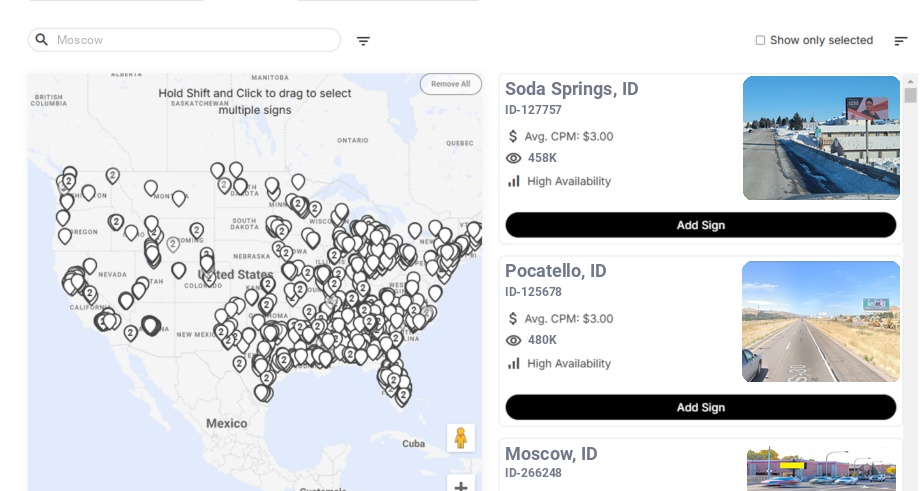
Blip lets you launch Moscow billboards on US-95 or ID-8 in minutes, reaching commuters, students, and Pullman cross-border traffic with self-serve control.
Set a flexible daily budget for Moscow and shift spend for Vandals games, Farmers Market Saturdays, or late-summer move-in—no contracts needed.
Use dayparting in Moscow to hit 7-9 a.m. commutes, class-change lunch rush, or 4-7 p.m. return traffic on Pullman Road and downtown routes.
Blip's real-time analytics show what works in Moscow, so you can adjust fast when traffic spikes for homecoming, graduation, or Palouse road trips.
Create sharper Moscow ads with Blip's creative tools—clean, bold designs that stand out to the city's design-savvy students, families, and regional visitors.
Frequently Asked Questions About Billboard Advertising in Moscow
How much does a billboard cost in Moscow, Idaho with Blip?
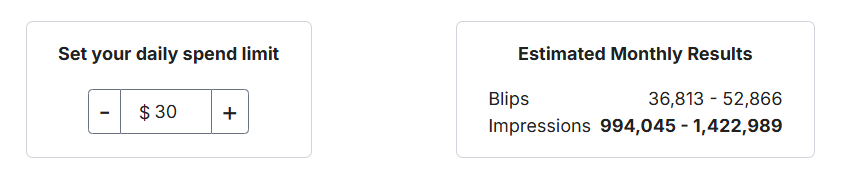
With Blip, you control exactly what you spend on Moscow billboards by setting a daily budget that can be adjusted anytime, so your campaign always stays within your comfort zone. Each short ad display, or “blip,” runs for 7.5 to 10 seconds on digital billboards in Moscow, Idaho, and you only pay for the blips you receive. The price of each blip varies based on when and where your ad appears and current advertiser demand, so you can choose times and locations that fit your goals and budget.
Where can I advertise with Blip in Moscow, Idaho?
The page highlights key travel corridors and locations for Moscow billboard advertising, especially US-95 and ID-8 / Pullman Road. US-95 captures commuters, regional travelers, and university visitors, while Pullman Road connects Moscow to Pullman and sees heavy student and staff traffic. Downtown approaches like Third Street and Main Street are also noted for local resident, tourist, and Farmers Market traffic.
When is the best time to run Blip billboards in Moscow, Idaho for students?
If you’re targeting students or campus-related traffic, the page recommends concentrating spend from late August through early December and from mid-January through early May. That lines up with the University of Idaho academic calendar, when tens of thousands of weekly trips occur between campus, downtown, and nearby housing. Late evening can also be strong for students and nightlife, especially on Thursday through Saturday.
What kind of audience does Moscow, Idaho billboard advertising reach?
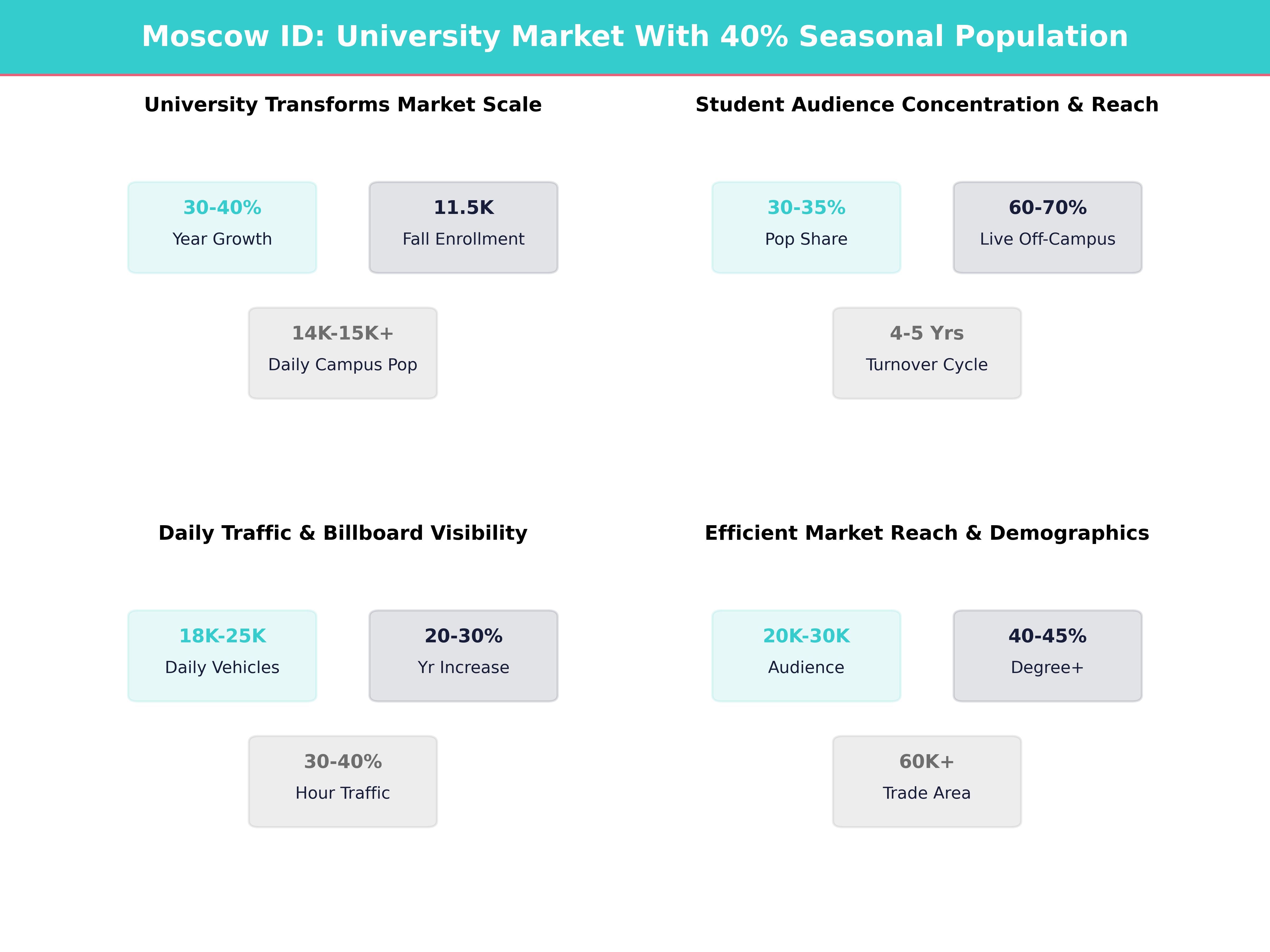
Moscow blends a vibrant college-town energy with small-city stability, and its core audience is educated and media-savvy. The University of Idaho enrolls around 11,000–12,000 students each year, and more than 40–45% of adult residents hold a bachelor’s degree or higher. Moscow also serves a regional trade area of 60,000+ people across the Palouse, so campaigns can reach both local residents and regional visitors.
How much traffic do Moscow, Idaho billboards get on major roads with Blip?
Key corridors such as US-95 and ID-8 running through Moscow typically see 18,000–25,000 vehicles per day. US-95 near Moscow is described as carrying 15,000–20,000 vehicles per day, and Pullman Road sees heavy student and staff traffic between the University of Idaho and Washington State University. These flows are what make flexible Moscow billboard advertising valuable for time-sensitive offers.
Do I need a contract to advertise with Blip in Moscow?
No, Blip has no long-term contracts or minimum commitments. You can start, pause, or stop your campaign at any time.
How fast can I launch a billboard campaign with Blip in Moscow?
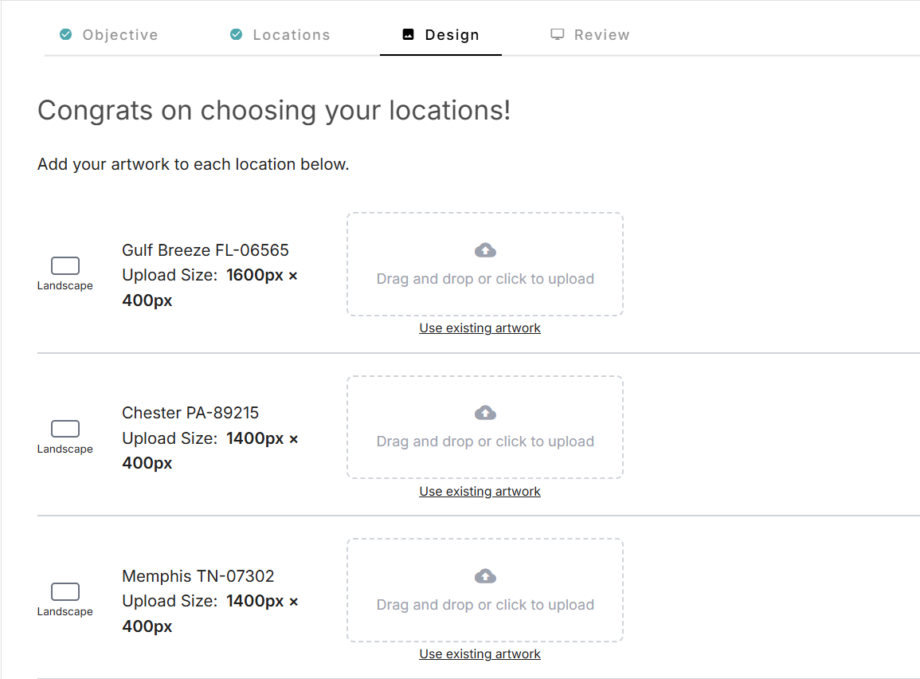
You can have your campaign live in minutes. Create a free account, select your locations, set your budget, upload your design, and start running once approved.
Where can I advertise with Blip in Moscow?
Blip has digital billboards in Moscow. You can browse available locations on a map, choose the ones that fit your audience, and start advertising right away.
Still have questions? Launch a campaign in minutes — no contracts, no commitments.
Start Your CampaignMoscow Billboard Advertising Guide
Moscow, Idaho blends a vibrant college-town energy with small-city stability, making it a powerful place to test and scale digital billboard campaigns. With a strong University of Idaho presence, busy regional highways, and a calendar full of events, we can use Blip’s flexibility to reach very specific audiences at exactly the right times, and make Moscow billboards work efficiently even on modest budgets.
Understanding the Moscow Market
Moscow is compact, but its influence stretches across the Palouse region.
- The City of Moscow 26,000–27,000 residents within city limits, with the official estimate hovering around 26,800 residents in 2023, up more than 10–12% compared with a decade ago, reflecting steady, college-driven growth.
- The University of Idaho in Moscow enrolls around 11,000–12,000 students across undergraduate and graduate programs each year, with recent fall headcounts typically in the 11,500 range, plus approximately 2,500–3,000 faculty and staff, creating a daily on-campus population of 14,000–15,000+ and a consistent flow of commuters and visitors from across Idaho and neighboring Washington.
- Moscow is also the retail and services hub for surrounding rural communities and the broader Palouse; local business organizations estimate that the city commonly serves a regional trade area of 60,000+ people, when we include nearby communities such as Pullman, Troy, Genesee, and rural Latah County (Moscow Chamber of Commerce + Visitor Center).
- Latah County as a whole has roughly 40,000–41,000 residents, with Moscow accounting for more than two-thirds of the county population, underscoring its role as the primary economic center.
The city promotes itself as a center for arts and culture on the Palouse ( City of Moscow economic base is diversified, with education, health care, retail, and agriculture-related industries all represented, and the city’s unemployment rate often trends 1–2 percentage points below national averages, indicating relatively strong local purchasing power that Moscow billboard advertising can tap into year-round.
Key implications for our billboard strategy:
- Moscow’s core audience is educated and media-savvy; more than 40–45% of adult residents hold a bachelor’s degree or higher, significantly above the national average, so they respond well to clever, concise messages and high-quality visuals.
- University activity means a significant portion of the population turns over every 4–5 years—roughly 2,500–3,000 graduates each year—which is ideal for recurring campaigns that re-engage new cohorts of students and families with fresh messaging on digital billboards in Moscow.
- Because Moscow serves a larger rural catchment area, campaigns can effectively reach both local residents and regional visitors with the same placements, with thousands of daily trips into the city for work, shopping, and medical services.
Seasonal and Weekly Traffic Patterns
Moscow’s traffic patterns shift dramatically with the academic calendar and agricultural seasons.
The Idaho Transportation Department and local planning data show that key corridors such as US-95 and ID-8 running through Moscow typically see 18,000–25,000 vehicles per day, with volume spikes during the university’s fall and spring semesters and on weekends with major events. These flows are exactly what make flexible Moscow billboard advertising so valuable for time-sensitive offers.
Academic year vs. summer
- During the University of Idaho’s fall and spring semesters (late August–early May), Moscow’s effective population increases by roughly 7,000–9,000 people, or about 30–40%, when students are on campus and living nearby.
- On a typical weekday when classes are in session, university-area traffic and transit activity can be 20–30% higher than during summer months, boosting impressions for boards along US-95, Pullman Road, and routes into downtown.
- During summer and major breaks (winter holiday, spring break), student traffic drops sharply—on-campus housing occupancy can fall by 50–70%—but tourism, construction, and regional travel pick up, especially with outdoor recreation and agricultural activity across the Palouse.
Strategic takeaways:
- If we’re targeting students or campus-related traffic (restaurants, nightlife, apartments, events), we should concentrate spend from late August through early December and from mid-January through early May, when tens of thousands of weekly trips are occurring between campus, downtown, and nearby housing. This is prime time to increase your share of voice on billboards in Moscow located on key student routes.
- For tourism, outdoor recreation, and regional services, we can shift spend upward in late spring and summer, aligning with road trips, agricultural travel, and visitors exploring the Palouse and nearby destinations promoted by Visit Idaho Moscow Chamber of Commerce + Visitor Center.
Day-of-week patterns
From local observations, university/work schedules, and traffic counts:
- Monday–Thursday: Strong commuting patterns along US-95 and ID-8, with AM and PM peak windows around 7:00–9:00 a.m. and 4:00–6:00 p.m. accounting for 30–40% of daily traffic volume on some corridors.
- Friday: More mid-day movement as students travel, shop, or leave town, and families prepare for weekend events; retail centers often report 10–20% higher sales on Fridays and Saturdays versus early-week days.
- Saturday: Heavier retail and leisure traffic, especially near shopping areas, downtown, and routes to outdoor recreation; Moscow Farmers Market days routinely see downtown foot traffic increase by several thousand people.
- Sunday: Lower commuting, but continuous travel for grocery, church, and return trips to campus; late afternoon and evening can see mini-spikes as students return from weekend trips.
With Blip, we can respond to these patterns:
- Concentrate impressions on weekday rush hours for B2B, employment, education, and routine services, when a large share of the 18,000–25,000 daily vehicles along major corridors is on the road.
- Emphasize Friday–Sunday for dining, entertainment, events, and leisure-oriented offers to match peak shopping and social days, using Moscow billboards close to retail and downtown destinations.
Audience Segments to Target in Moscow
Because Moscow is diversified but small, clear audience segmentation makes campaigns more efficient.
1. Students and campus community
- Around 11,000–12,000 students plus 2,500–3,000 staff and faculty at the University of Idaho represent a large, highly concentrated audience in a city under 30,000 residents—students alone can represent 30–35% of Moscow’s total population during the academic year.
- A significant share of students live off-campus; university housing data commonly show 60–70% of students residing in rentals, shared houses, or apartments off campus, many of them commuting daily via US-95, ID-8, and key arterials like Pullman Road and Third Street.
- The university also draws thousands of visitors annually for campus tours, athletic events, conferences, and performances, expanding the reach of campaigns during key weekends (University of Idaho).
Best categories to target:
- Apartments, property management, and student housing (especially June–September, when leasing decisions peak)
- Fast-casual restaurants, coffee shops, and bars—students and staff contribute heavily to downtown and campus-adjacent food and beverage sales
- Fitness centers, medical clinics, mental health services, and counseling—services that research shows are used by 20–30% of students over the course of a year
- Campus-adjacent retail and tech (phone repair, banking, insurance, convenience retail)
- Events, nightlife, and local entertainment, particularly those aligned with the university’s performance and athletics calendars
2. Local families and professionals
- Moscow’s permanent residents skew toward education, health care, agriculture, and public sector employment. The University of Idaho and Gritman Medical Center together provide thousands of jobs, making them two of the largest employers in Latah County.
- Local K–12 schools, the City of Moscow, Latah County, and regional agribusiness add another thousand-plus public-sector and agricultural jobs, contributing to a relatively stable year-round workforce.
- Household incomes are moderate but stable; many local households fall into mid-income brackets that are highly responsive to value-driven offers and essential services.
Effective categories:
- Healthcare, dentistry, optometry, and family services, including clinics that serve both Moscow and neighboring communities
- Financial services (credit unions, local banks, tax and legal services), particularly around tax season and major life events such as home purchases or small-business formation
- Home services (HVAC, roofing, landscaping, remodeling), which see increased demand during spring and summer building and renovation seasons
- Auto dealers, repair shops, and insurance, especially along US-95 corridors where vehicle traffic is highest
- Childcare, after-school programs, and extracurriculars, serving hundreds of families tied to the university and local schools
3. Regional and rural audience
Moscow serves surrounding towns and rural communities throughout Latah County and the broader Palouse:
- US-95 connects Moscow to Lewiston to the south and Coeur d’Alene and Spokane to the north; segments around Moscow can see 15,000–20,000 vehicles per day, a mix of commuters, freight, and long-distance travelers (Idaho Transportation Department).
- ID-8 and ID-9 connect Moscow to Troy, Deary, and other rural towns, carrying steady flows of farm-related and commuter traffic.
- Latah County’s land area is largely rural, and agriculture remains a key economic sector; farm operators, equipment dealers, and ag services rely heavily on highway visibility to reach their customer base.
Ideal categories:
- Farm and ranch supply, heavy equipment, and trucking—targeting the hundreds of farms and agricultural operations across the Palouse
- Regional healthcare providers and specialty clinics drawing patients from a 30–50 mile radius
- Regional retailers (big-box, grocery, farm stores) that capture shoppers from multiple small towns
- Political campaigns and ballot measures needing broad rural reach, particularly in election years when turnout drives heightened media consumption
- Tourism, outdoor recreation, and sporting events that attract visitors from across eastern Washington and north-central Idaho
Leveraging Local Events and Seasonality
Moscow’s cultural and sports calendar creates built-in peaks in traffic and attention that we can use as anchors for our Blip campaigns.
Examples of recurring draws include:
- University of Idaho Vandals athletics: Home football games at the Kibbie Dome and basketball games draw 5,000–15,000+ fans per football game and 1,000–4,000 fans per basketball game, depending on the opponent and event, many of them driving in from within a 100-mile radius ( Vandal Athletics
- Moscow Farmers Market: Running Saturdays from May through October, it’s one of the city’s flagship attractions, with the city reporting 3,000–6,000 visitors each week during peak season, and a season-long attendance that can top 80,000–100,000 total visits ( City of Moscow – Farmers Market
- Renaissance Fair, art walks, and music events: These draw thousands of attendees across a season and are repeatedly highlighted by the Moscow Chamber of Commerce + Visitor Center, the City of Moscow
- University events such as orientation, homecoming, and graduation bring in hundreds to thousands of visiting family members on specific weekends, increasing local lodging and restaurant demand.
How we can use these:
- Run short, high-frequency bursts (1–3 days) around major games and events to promote dining, bars, lodging, ride services, and event-specific offers—timing creative so it appears during pre-game arrival windows (3–4 hours before) and post-game departures.
- Schedule weekend-focused campaigns May–October aimed at market-goers: brunch spots, local boutiques, arts organizations, and family activities; downtown pedestrian counts on Market Saturdays can run 2–3 times higher than a typical off-season Saturday.
- Use countdown creatives (“Farmers Market opens in 3 days!”) to build anticipation for your booth or sponsored activity, and include clear directional cues from major corridors into downtown.
- Align with city-promoted festivals and cultural events via the City of Moscow events calendar
Crafting Effective Creative for Moscow
Because Moscow is small and drivers see the same routes frequently, the quality and clarity of our creative matter more than in a large, anonymous metro.
Visual style
-
Moscow residents and students encounter a lot of design-forward content through the university and local arts scene, including frequent exhibitions, performances, and student design work. We should favor:
- Clean, modern layouts
- Strong color contrast (but not overly flashy)
- Simple, bold typography that reads from a distance and in under 2 seconds of viewing at typical city speeds
-
Feature local imagery when possible:
- The rolling Palouse hills and wheat fields that define the region
- University of Idaho landmarks like the Administration Building or Kibbie Dome
- Downtown Moscow streetscapes, recognizable storefronts, or the Farmers Market
Messaging guidelines
- Keep to 7 words or fewer on the main line; studies of roadside ad recall consistently show that shorter messages (7 words or less) can have up to 50–60% higher recall than dense copy.
- Use highly specific value propositions: “$2 Tacos After 9pm on 3rd St” will resonate more than generic branding like “Great Food in Moscow.”
-
Consider hyper-local cues that connect directly to drivers’ routes:
- “Vandal Game-Day Specials 5 Minutes Ahead”
- “Palouse Grown. Moscow Owned.” for local brands
- “Farm & Fleet Deals – Next Right on US-95”
Calls to action
-
Because many residents are digitally connected—university surveys and regional data routinely show high smartphone and broadband adoption rates among students and younger households—explicit calls to action perform well:
- “Text VANDAL to 55555 for 10% Off”
- “Order Now – [BrandName].com”
- “Apply Today – Hiring in Moscow & Pullman”
- Including short URLs or QR codes can work, especially at lower-speed locations near downtown or major intersections, but should never crowd out the core message.
With Blip, we can test multiple creatives simultaneously:
- Run A/B tests with different headlines, colors, or calls to action, and monitor which gets better web traffic or store visits during the campaign window; even a 10–20% difference in response rate can materially improve ROI in a small market.
- Rotate creatives for different dayparts: promotion-focused during commute hours, brand storytelling mid-day, and nightlife-focused messaging after 8 p.m.
- Tailor creatives for event days vs. regular days—for example, a “Game Day Parking & Food Specials” version on Vandals home dates and a more general “Everyday Lunch Deals” version otherwise.
Timing Your Blip Campaigns
Using Blip’s scheduling, we can align message timing with when specific audiences are on the road.
By time of day
-
Morning (7:00–9:00 a.m.)
- Best for coffee shops, breakfast, daily commute services, and reminders about same-day events or appointments.
- Captures a significant share of the 30–40% of daily traffic that occurs during the two commute peaks.
-
Midday (11:00 a.m.–2:00 p.m.)
- Ideal for lunch promotions, quick services, retail, and student-focused offers between classes; many campus schedules produce a lunchtime lull when thousands of students are moving between buildings or into town.
-
Evening (4:00–7:00 p.m.)
- Strong for family dining, groceries, fitness, entertainment, and after-work services; this window captures commuters returning from Pullman, Lewiston, or rural areas via US-95 and ID-8.
-
Late evening (after 8:00 p.m.)
- Target students and nightlife: bars, late-night food, entertainment, rideshare promotions, and convenience retail; student-heavy corridors often remain active until 10:00–11:00 p.m. on Thursday–Saturday.
By season
- August–September: Student move-in, apartment hunting, back-to-school offers, club promotions, and recruiting campaigns; residence halls and apartments process thousands of move-ins during this period.
- October–November: Fall sports, homecoming, seasonal retail, and early holiday promotions; homecoming weekends can increase regional visitation and hotel occupancy significantly.
- December–January: Holiday shopping, service promotions for residents, and awareness-building when student traffic dips and locals have more attention for home, auto, and financial services.
- March–May: Spring sports, graduation-related promotions, housing and moving services, and “summer job” recruiting for students; graduation can bring hundreds to thousands of visiting family members into town.
- May–October: Tourism, outdoor recreation, farmers market tie-ins, and regional events across the Palouse promoted through regional tourism outlets Moscow Chamber of Commerce + Visitor Center; this is also prime season for construction, home improvement, and landscaping.
Location Strategy and Commuter Corridors
While specific billboard availability shifts over time, we can plan around Moscow’s key travel corridors and identify where billboard rental in Moscow is likely to have the greatest impact:
-
US-95: The main north–south highway through Moscow. Captures:
- Commuters to and from surrounding towns such as Genesee, Potlatch, and Lewiston
- Long-distance regional travelers heading between Boise, Lewiston, Coeur d’Alene, and Spokane
- Students and families coming from Coeur d’Alene, Lewiston, and beyond for university events or weekend visits
- Traffic volumes near Moscow commonly in the 15,000–20,000 vehicles per day range, according to the Idaho Transportation Department.
-
ID-8 / Pullman Road: Runs east-west, connecting Moscow to Pullman, Washington.
- Heavy student and staff traffic between the University of Idaho and Washington State University, with thousands of cross-border trips daily when both campuses are in session.
- Excellent for campaigns that want dual-university exposure, capturing two combined student bodies of well over 30,000 students in the Moscow–Pullman area, and ideal for billboards in Moscow that need to reach both sides of the state line.
-
Downtown approaches (Third Street, Main Street):
- Capture local resident and tourist traffic heading to retail, dining, and the Farmers Market (seasonal).
- Great for hyper-local offers (“2 Blocks Ahead on Main”) where drivers are moving at slower speeds and can process slightly more detail.
- Downtown is also a focal point for parades, festivals, and art walks, significantly boosting pedestrian and vehicle counts on select days.
Strategic tips:
- If your business is directly off a highway, include clear directional cues: “Next Exit,” “2 Miles Ahead on Right,” or “Turn at Third St.” Studies of roadside wayfinding indicate that adding a distance marker can improve follow-through by 10–20% compared with generic branding alone.
- If you serve both Moscow and Pullman, focus on east–west routes and mention both cities to increase perceived relevance (“Serving Moscow & Pullman”); cross-border commuters and students often compare options in both communities.
- Consider pairing highway boards for awareness with downtown-facing boards for conversion (e.g., promo codes or “Turn Now” CTAs) when available in the Blip inventory so your Moscow billboard advertising can guide people from first impression to final action.
Using Blip Tools Effectively in Moscow
Blip’s flexibility is especially powerful in a smaller market like Moscow where:
- Audiences are highly patterned (university calendar, rush hours, event days).
- We can see noticeable results from modest budgets because impressions are highly concentrated; a relatively small ad spend can repeatedly reach the same 20,000–30,000 area residents and commuters.
Key tactics:
-
Dayparting:
Run different creatives at different times:- Morning: “Need Coffee? Drive-Thru on Troy Rd”
- Evening: “Dinner for 2 Under $20 – Tonight Only”
Matching the message to the time of day can increase response rates by 20–30% in many local campaigns.
-
Budget control:
Start with a modest daily budget and increase spend on:- Vandals home game days, when 5,000–15,000 extra visitors may be in town
- Farmers Market Saturdays, when downtown attendance rises by several thousand people
- University move-in and graduation weeks, which concentrate high-intent visitors looking for lodging, dining, and services
-
Creative rotation:
Use 3–5 creatives targeting:- Students
- Local families
- Regional/rural customers
Then allocate more budget to the segment responding best (e.g., by monitoring website traffic, tracked phone numbers, or in-store code redemptions). Even shifting 20–30% of impressions toward better-performing creatives can yield substantial gains in leads or sales.
-
Event-based spikes:
When local media like the Moscow-Pullman Daily News Inland 360
Blip essentially turns billboard rental in Moscow into an on-demand, campaign-based tool you can dial up or down in real time, instead of a fixed long-term commitment.
Sample Campaign Blueprints
1. Local restaurant near campus
- Goal: Increase weekday evening traffic.
- Target audience: Students and faculty.
-
Strategy:
- Run 5–7 second blips Mon–Thu, 4:30–9:00 p.m. on routes connecting campus and main housing areas; this window can capture two distinct waves of student traffic—post-class and pre-nightlife.
- Creative 1: “$8 Vandal Meal – Tonight Only – Main St.”
- Creative 2: “Show This Screen for Free Drink” (use QR code and track scans or ask guests to mention the billboard).
- Increase frequency on home game days and Farmers Market Saturdays when visitor counts rise by thousands, and extend hours slightly later (to 10:00 or 11:00 p.m.) on Fridays.
2. Regional medical clinic
- Goal: Grow patient base across the Palouse.
- Target audience: Families and older adults from Moscow, Pullman, rural towns.
-
Strategy:
- Focus on US-95 and ID-8 for regional reach, where daily vehicle counts can exceed 15,000–20,000.
- Run 7:00–9:00 a.m. and 4:00–6:00 p.m. to catch commuters and school traffic.
- Creative 1: “New Patients Welcome – Same-Week Appointments – [ClinicName].com”
- Creative 2: “Primary Care in Moscow & Pullman – Call Today”
- Use longer continuous campaigns (1–3 months) to build familiarity, aiming for repeated exposure; marketing research suggests that 5–7 exposures can significantly increase recall and brand preference.
3. Student housing / apartments
- Goal: Lease-up for fall.
- Target audience: Incoming and returning University of Idaho students and their parents.
-
Strategy:
- Concentrate spend in June–September, with peaks during orientation and move-in weeks, when thousands of housing decisions are being finalized.
- Daypart for afternoons and early evenings when tours are more likely and families are out exploring (e.g., 1:00–7:00 p.m.).
- Creative 1: “Walk to Campus – Furnished Units – Now Leasing”
- Creative 2: “Apply by Aug 15 – Save $200 – [PropertyName].com”
- Track form fills and calls that mention “billboard” or include a promo code; aim for a measurable response rate (for example, 2–5% of inquiries referencing the billboard) to justify budget increases.
Measuring and Optimizing Your Moscow Campaigns
To make the most of every impression in a smaller market, we should build a simple measurement loop:
-
Define a clear metric
- Website visits from the Moscow area or from specific ZIP codes
- Coupon or promo code redemptions in-store or online
- Phone calls and walk-ins mentioning the billboard
- QR code scans if used in slower-speed locations
-
Sync timing with reporting
- Note when Blip flights are running (e.g., 7–9 a.m., Mon–Fri) and compare store or web activity by daypart and weekday.
- Look for correlations of 10–20% or more between active flight windows and uplift in traffic, calls, or sales.
-
Iterate creatives
- After 1–2 weeks, pause weaker-performing creatives and double down on those correlated with higher response.
- In a market with tens of thousands of reachable residents rather than millions, even a small absolute increase (say, 10–20 extra orders per week) can be significant relative to the campaign cost.
-
Layer local context
- Watch local calendars via the City of Moscow Moscow Chamber of Commerce + Visitor Center, and regional news to time bursts around events that naturally increase traffic.
- Adjust messaging seasonally—for example, highlighting “Back-to-School Savings” in August or “Winter Check-Up Specials” for auto and home services in late fall.
By aligning our creative, timing, and location strategy with Moscow’s academic rhythm, rural-urban mix, and strong sense of community, we can use Blip and a smart approach to Moscow billboards to turn even modest budgets into highly visible, highly relevant campaigns that residents and visitors notice—and act on.