Billboards near Chubbuck, ID
No Minimum Spend. No Long-Term Contracts. Just Results.
Trusted by Leading Brands


Billboard advertising
near Chubbuck has never been easier



How much is a billboard near Chubbuck?
Why Choose Blip for Billboard Advertising near Chubbuck
Blip lets you launch Chubbuck billboards fast and self-serve, reaching I-15 commuters and Yellowstone Avenue shoppers without the usual hassle.
Set a daily budget for Chubbuck and scale up or down anytime—ideal for student traffic near ISU and family shoppers in the Chubbuck-Pocatello trade area.
Use Blip dayparting to hit Chubbuck rush hours, school pickup, or weekend retail peaks on US-91 and I-15 when attention is highest.
No contracts means you can test Chubbuck billboards risk-free, then shift spend for ISU move-in, homecoming, or holiday shopping traffic.
Track real-time results and adjust your Chubbuck campaign as traffic shifts between commuter routes, retail corridors, and event nights in Pocatello.
Blip’s creative tools help you build bold, simple ads for Chubbuck that stand out in winter dusk and fast-moving traffic.
Frequently Asked Questions About Billboard Advertising near Chubbuck
How much does a billboard cost near Chubbuck, Idaho with Blip?
With Blip, you choose your own daily budget for Chubbuck billboards, and our system automatically keeps your digital ads within that limit, so you never spend more than you’re comfortable with. Each blip is a brief 7.5 to 10-second ad, and you only pay for the actual blips you receive, making billboards near Chubbuck, Idaho accessible even on a small budget. Costs per blip vary based on your schedule, locations serving the Chubbuck area, and advertiser demand, but you can adjust your budget at any time to scale up or down as needed.
Where can I advertise with Blip in Chubbuck and nearby Idaho?
All 8 Blip digital billboards serving the Chubbuck area are located in Pocatello, within roughly 3–10 miles of Chubbuck. Thanks to the way residents move through this compact metro, boards near Pocatello can still deliver strong, repeated exposure to Chubbuck audiences, functioning as practical Chubbuck billboards for most local campaigns. Key corridors include I-15, the US-91 / Yellowstone Avenue corridor, and downtown and university-area routes in Pocatello.
What kind of people do Chubbuck billboards with Blip reach?
Chubbuck and Pocatello form a single, highly integrated trade area in northern Bannock County, and campaigns near Chubbuck can reach 75–80% of the county’s total population with a compact set of billboard locations. The area includes a younger median age driven by Idaho State University, a strong family-oriented household base, and median household incomes generally in the $55,000–$65,000 range. A high share of residents travel between Chubbuck and Pocatello at least weekly for work, school, or shopping, so the market is ideal for repeated local exposure.
When is the best time to run billboards in Chubbuck with Blip?
Morning commute hours from 6:30–9:00 a.m. are strong for coffee shops, breakfast, convenience stores, fuel, auto services, banks, and healthcare reminders. Midday can work well for lunch specials and professional services, while 4:30–7:30 p.m. is best for dining, shopping, home improvement, entertainment, and events. Weekend and ISU semester timing also matter, since Friday–Sunday and the fall and spring semesters bring especially valuable traffic.
Why are Chubbuck billboards effective for local advertising?
Digital billboards near Chubbuck give us a powerful way to reach a tight-knit, fast-growing community at the gateway to eastern Idaho. With Blip’s 8 digital boards serving the Chubbuck area from nearby Pocatello, we can tap into daily commuter flows, regional shopping traffic, and university-driven audiences with highly targeted, flexible campaigns. This makes modern billboard advertising near Chubbuck accessible for businesses of almost any size, from solo practitioners to multi-location brands.
Do I need a contract to advertise with Blip near Chubbuck?
No, Blip has no long-term contracts or minimum commitments. You can start, pause, or stop your campaign at any time.
How fast can I launch a billboard campaign with Blip near Chubbuck?
You can have your campaign live in minutes. Create a free account, select your locations, set your budget, upload your design, and start running once approved.
Where can I advertise with Blip near Chubbuck?
Blip has digital billboards near Chubbuck. You can browse available locations on a map, choose the ones that fit your audience, and start advertising right away.
Still have questions? Launch a campaign in minutes — no contracts, no commitments.
Start Your CampaignChubbuck Billboard Advertising Guide
Digital billboards near Chubbuck, Idaho give us a powerful way to reach a tight‑knit, fast‑growing community at the gateway to eastern Idaho. With Blip’s 8 digital boards serving the Chubbuck area from nearby Pocatello, we can tap into daily commuter flows, regional shopping traffic, and university‑driven audiences with highly targeted, flexible campaigns. This makes modern billboard advertising near Chubbuck accessible for businesses of almost any size, from solo practitioners to multi‑location brands.
Understanding the Chubbuck Area Market
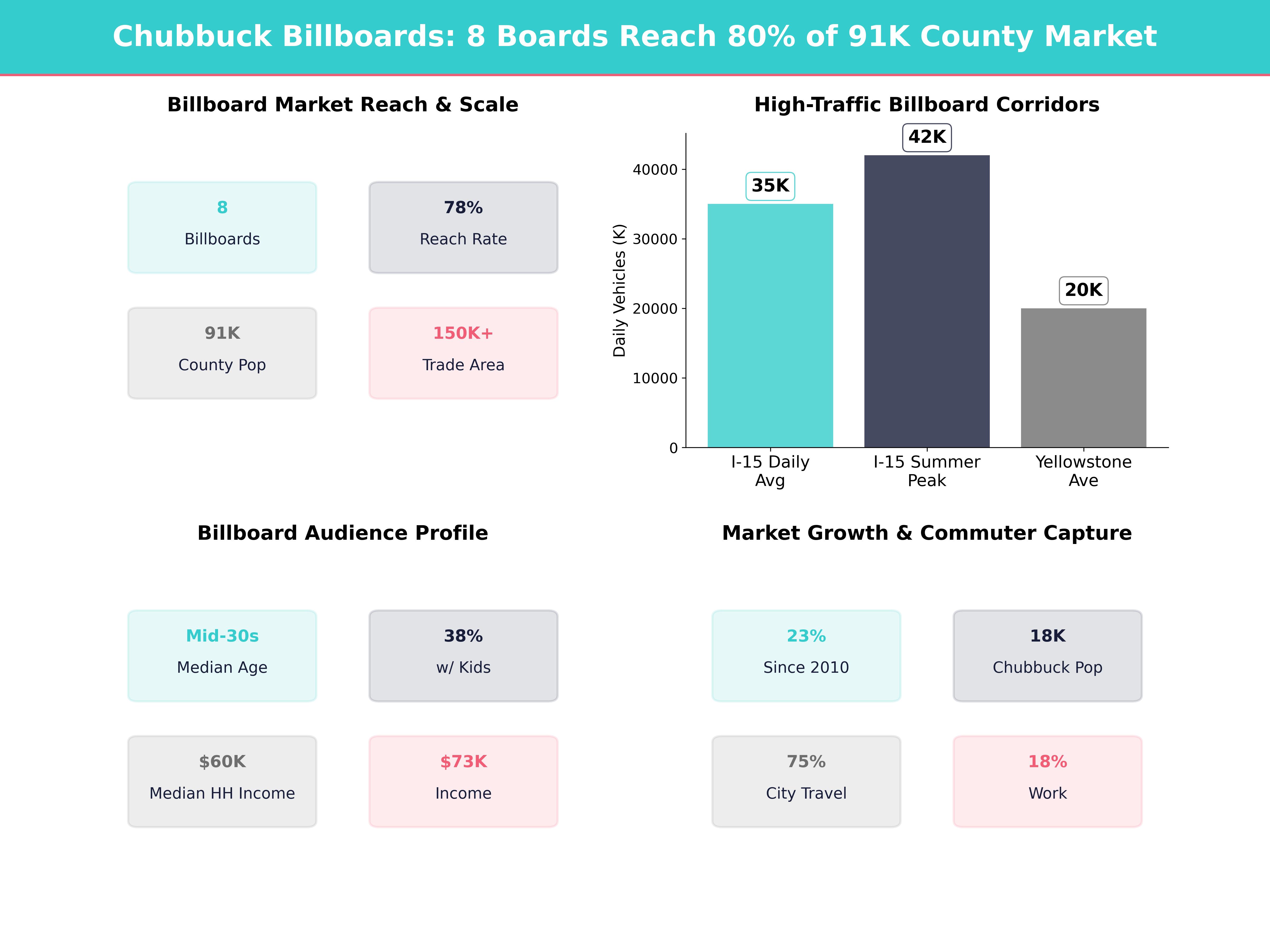
Chubbuck and Pocatello form a single, highly integrated trade area in northern Bannock County, which is why Chubbuck billboards can efficiently cover both communities with one coordinated buy.
-
Population footprint
- Recent city and county estimates place the City of Chubbuck at around 17,000–19,000 residents, up roughly 20–25% from 2010, making it one of the faster‑growing communities in eastern Idaho.
- Neighboring Pocatello adds approximately 56,000–58,000 residents, for a combined urban population of about 73,000–77,000 people in the immediate Chubbuck–Pocatello area.
- Bannock County 90,000–92,000 residents, so campaigns near Chubbuck can reach 75–80% of the county’s total population with a compact set of billboard locations.
- The Pocatello-Chubbuck Chamber of Commerce regularly reports that the broader regional trade area pulls in consumers from 150,000+ people across southeastern Idaho and western Wyoming.
-
Age and household profile
- Idaho State University (ISU) in Pocatello enrolls around 11,000–12,500 students (including part‑time and graduate students) and employs 2,000+ faculty and staff, keeping the area’s median age in the low‑ to mid‑30s—several years younger than the statewide median.
- Chubbuck itself is strongly family‑oriented, with roughly 35–40% of households including children under 18 and an estimated median age in the mid‑30s.
- About 60–65% of households in the Chubbuck–Pocatello area are owner‑occupied, which supports demand for home services, real estate, and long‑term financial products.
-
Income and spending
- Median household incomes in the Chubbuck–Pocatello area generally fall in the $55,000–$65,000 range, with dual‑earner family households often exceeding $70,000–75,000.
- Local retail studies from the City of Pocatello and City of Chubbuck indicate that residents spend hundreds of millions of dollars annually in categories like auto, home improvement, and general merchandise, with leakage analysis suggesting 10–20% of spending still flows to larger metros like Idaho Falls—an opportunity for local advertisers to recapture sales.
- Commuter and shopper surveys consistently show that a high share of residents—often 70–80%—travel between Chubbuck and Pocatello at least weekly for work, school, or shopping, so a well‑placed board near Pocatello retail or commuter routes effectively serves the Chubbuck area.
To ground your strategy in local context, we recommend watching updates from the City of Chubbuck, City of Pocatello, Bannock County, and regional planning partners like the Bannock Transportation Planning Organization, which often share growth, housing, and transportation news that signal new advertising opportunities and help you decide where billboards near Chubbuck will perform best.
Where Our Digital Billboards Reach the Chubbuck Area
All 8 Blip digital billboards serving the Chubbuck area are located in Pocatello, within roughly 3–10 miles of Chubbuck. Thanks to the way residents move through this compact metro, boards near Pocatello can still deliver strong, repeated exposure to Chubbuck audiences, functioning as practical Chubbuck billboards for most local campaigns.
According to traffic counts published by the Idaho Transportation Department and local transportation planners, key corridors in the Pocatello–Chubbuck area regularly carry tens of thousands of vehicles per day, translating to hundreds of thousands of weekly impressions for well‑placed boards. For advertisers seeking billboard advertising near Chubbuck, these corridors provide the core canvas for cost‑effective reach.
Key traffic corridors we can leverage:
-
I‑15 (north–south interstate)
- Idaho’s main north–south artery; near Pocatello it typically carries 30,000–40,000 vehicles per day (average annual daily traffic, AADT), with some segments peaking above 42,000 vehicles during summer travel months.
- Roughly 15–20% of Bannock County workers commute across municipal boundaries, and many Chubbuck residents use I‑15 daily for work and regional trips toward Idaho Falls, Blackfoot, and southern Idaho.
- Ideal for brands looking for regional reach and repeated impressions on daily commuters—an advertiser running 1,000–2,000 daily blips in high‑traffic windows can generate tens of thousands of weekly impressions on this corridor alone.
-
US‑91 / Yellowstone Avenue corridor
- Connects Pocatello and Chubbuck and serves as a primary commercial strip lined with big‑box retailers, grocery stores, and restaurants.
- In busy segments near major shopping areas, traffic counts often exceed 18,000–22,000 vehicles per day, with weekend peaks and holiday shopping periods pushing even higher.
- This corridor captures a significant share of retail, dining, auto, and service purchases in the Chubbuck area; chamber and city reports often cite it as the top‑grossing retail strip in northern Bannock County.
-
Downtown and university‑area routes in Pocatello
- Surface streets around Idaho State University and downtown Pocatello carry heavy flows of students, staff, healthcare workers, and visitors. ISU alone draws hundreds of thousands of campus visits per year when you add classes, events, and games.
- Nearby medical centers, including Portneuf Medical Center and associated clinics, add thousands of daily employee and patient trips.
- Campaigns here are strong for education, nightlife, events, and recruitment targeting Chubbuck‑area residents who study or work near ISU. Billboards in these zones can also capture out‑of‑town visitors attending ISU athletics or conferences promoted via Idaho State University and Visit Pocatello.
By selectively choosing locations near these corridors, we can ensure that campaigns reach both local neighborhood traffic and high‑frequency commuter flows that include a large portion of Chubbuck’s 7,000+ workers and Pocatello’s 25,000+ workers on a regular basis.
Key Audience Segments Near Chubbuck
When we design a billboard campaign serving the Chubbuck area, it’s helpful to think in terms of specific audience groups so that billboards near Chubbuck speak directly to the right people at the right times:
-
Commuters between Chubbuck and Pocatello
- Transportation data and employer surveys suggest that thousands of residents travel daily along I‑15, US‑91, Yellowstone Avenue, and nearby arterials, with peak‑hour volumes on some approaches increasing by 30–40% compared with mid‑day.
- Major employment anchors include Idaho State University, Portneuf Medical Center, local school districts such as Pocatello/Chubbuck School District 25, manufacturing, logistics, and government offices. Combined, these sectors employ 10,000–15,000 people in and around the Pocatello–Chubbuck urban area.
- These commuters produce consistent rush‑hour peaks ideal for time‑targeted messaging (e.g., coffee shops, quick‑service restaurants, auto repair, and local services) that can be scheduled through Blip to align with 6:30–9:00 a.m. and 4:00–6:30 p.m. flows.
-
Retail and dining shoppers
- The Chubbuck–Pocatello area functions as a regional retail hub for northern Bannock County and nearby rural communities; the Pocatello‑Chubbuck Chamber estimates that the local retail trade pulls shoppers from a radius of 40–60 miles.
- With multiple large shopping centers, national chains, and local businesses along Yellowstone Avenue and adjacent corridors, weekend and holiday foot traffic often spikes by 20–30% compared to weekday baselines.
- These audiences are primed for price‑driven, promotion‑focused creatives: sales, limited‑time offers, store openings, and restaurant specials—especially when timed to Friday–Sunday windows.
-
Students and education‑linked households
- ISU’s ~11,000–12,500 students, plus 2,000+ employees, create a sizable seasonal population, and roughly 60–70% of students live off campus in surrounding neighborhoods.
- Many students live, shop, and socialize in areas that overlap with Chubbuck’s trade area, especially along the US‑91 and Yellowstone corridors and near major apartment clusters.
- Student and young‑professional segments are heavily influenced by price, convenience, and social experiences (restaurants, entertainment, gyms, apartments, events). Advertisers targeting this group can piggyback on the ISU academic calendar and events promoted via Idaho State University and local media like KPVI News 6 and the Idaho State Journal.
-
Families and faith‑oriented communities
- The region has a strong family culture, with public school enrollment in the greater Pocatello–Chubbuck area numbering in the low tens of thousands of students across elementary, middle, and high schools.
- Multiple churches and youth programs contribute to high participation rates in youth sports, scouting, and faith‑based activities, often filling after‑school and early‑evening traffic windows.
- Messaging that highlights family value, community, safety, and long‑term relationships performs well for banks, healthcare, insurance, real estate, and education services, especially when boards are scheduled during school pick‑up and evening family travel times.
-
Outdoor and travel enthusiasts
- Chubbuck is a jump‑off point for outdoor destinations like the Portneuf Range, Lava Hot Springs, and gateways toward Yellowstone and Grand Teton. The broader region receives hundreds of thousands of leisure trips annually, according to state tourism figures shared by Visit Pocatello and Visit Idaho.
- Local surveys and recreation‑related sales indicate strong ownership rates of RVs, ATVs, boats, and outdoor gear compared with national averages, supporting categories like powersports, camping, fishing, and hunting.
- Tourism and recreation brands can effectively seed awareness for trips, passes, and gear during spring–fall, when overnight stays and day‑trip volumes rise.
Timing Your Campaign: When Impressions Are Most Valuable
Because Blip lets us schedule “blips” (individual ad plays) by time of day and day of week, we can align spend with the rhythms of life in the Chubbuck area and make Chubbuck billboards work harder during peak decision windows.
Daily patterns
-
Morning commute (6:30–9:00 a.m.)
- On workdays, local traffic counts show inbound volumes to major employment centers rising by 40–50% compared with early‑morning baselines.
- Strong for coffee shops, breakfast, convenience stores, fuel, auto services, banks, and healthcare reminders (checkups, urgent care).
- Clear, direct calls like “Open at 7 a.m.” or “On your way to work? Stop at…” help convert a portion of the thousands of daily commuters passing these boards.
-
Midday (11:00 a.m.–2:00 p.m.)
- Midday trips in commercial areas are driven by lunch breaks and errands; some corridors see 15–25% of daily traffic occurring in this band.
- Good for lunch specials, quick‑service restaurants, retail, and professional services targeting workers taking breaks.
- Also effective for B2B messaging (equipment, software, staffing) aimed at decision‑makers out on errands.
-
Afternoon school run (2:30–4:30 p.m.)
- School dismissal and after‑school activities create noticeable volume bumps near education corridors and family neighborhoods—often 10–20% higher than mid‑afternoon troughs.
- Ideal for after‑school programs, tutoring, youth sports, pediatric care, family dining, and grocery that cater to the thousands of school‑age children in the region.
-
Evening (4:30–7:30 p.m.)
- Peak traffic returning to Chubbuck‑area neighborhoods from Pocatello, with outbound volumes from employment centers reaching their daily highs.
- Best for dining, shopping, home improvement, entertainment, and events—categories that benefit from capturing consumers when they’re deciding where to stop on the way home.
Weekly and seasonal timing
-
Friday–Sunday
- Retail, restaurants, events, and entertainment campaigns should concentrate spend here; many centers report 20–30% more sales on weekends than weekdays.
- Many Chubbuck residents head into Pocatello shopping districts on weekends, so boards along those routes gain exceptional reach and can generate higher impression‑to‑visit conversion rates when tied to limited‑time offers.
-
ISU calendar
- Fall and spring semesters (roughly late August–early May) bring maximum student and staff traffic; campus occupancy can rise by 30–40% compared with summer.
- Campaigns around move‑in weeks, homecoming, and graduation can target housing, banking, furniture, electronics, and career opportunities when thousands of students and visiting family members are in town.
- Lighter summer traffic can still be valuable for locals at lower bid levels, especially for tourism, home services, and year‑round healthcare.
-
Local events and sports
- The City of Pocatello events calendar and Visit Pocatello highlight festivals, sports tournaments, fairs, and concerts that spike traffic and hotel occupancy.
- Events like the Portneuf Valley Fun Run series, county fairs, rodeos, and ISU football games can draw thousands to tens of thousands of attendees each, significantly increasing traffic around venues and primary corridors.
- Short, high‑frequency bursts around these dates can outperform generic always‑on campaigns, particularly when creatives reference the event or offer same‑day incentives.
-
Weather and season
- Winter brings earlier darkness; during December and January, evening commutes often occur entirely after sunset. Digital boards gain visual dominance, making evening impressions especially valuable.
- Snow and storm conditions reduce legibility of low‑contrast ads; high‑contrast creative can maintain visibility and brand recall.
- Summer’s long days and travel patterns favor tourism, outdoor gear, cold beverages, and family recreation messaging, especially on Thursday–Sunday when road trips and camping departures peak.
Creative Strategy: What Works on Billboards Near Chubbuck
We should design artwork that reflects local culture and viewing conditions so that billboard advertising near Chubbuck feels relevant, readable, and compelling:
1. Keep it simple and bold
-
Aim for 7 words or fewer of main text; drivers on I‑15 or Yellowstone Avenue typically have 3–6 seconds to read a board at speeds of 35–65 mph.
- Use high‑contrast colors (e.g., white or yellow text on dark background) – especially important for winter storms and dusk lighting, when regional crash data show visibility challenges increase.
- Feature a single focal image: a person, product, or logo, not crowded collages. Tests across digital out‑of‑home campaigns often show that simplified designs can lift recall by 20–30% versus cluttered layouts.
2. Match creative to Chubbuck’s identity
- Highlight family, community, and reliability for services used by local residents (banks, healthcare, insurance, education, auto). These themes align with survey findings from chambers and cities, where residents consistently rank “family‑friendly” and “community‑oriented” among the area’s top strengths.
- For student‑oriented offers, use visuals and language that resonate with college life but still feel appropriate for a conservative, family‑oriented region.
-
Lean into outdoor and regional pride:
- Mountains, rivers, local sports, agriculture, and “Eastern Idaho” themes.
- Phrases like “Proud to serve the Chubbuck–Pocatello area” or “Your neighbors near Chubbuck” reinforce local connection and can improve perceived relevance.
3. Localize offers and directions
Because boards are physically near Pocatello while serving the Chubbuck area, directional and locational clarity matters:
- Use distance‑based cues: “2 miles ahead,” “Next Pocatello exit,” “Off Yellowstone Ave.” Simple geographic cues help drivers at 55–65 mph decide quickly whether to stop.
- Name recognizable anchors that Chubbuck residents know well: major shopping centers, intersections, or landmarks regularly mentioned by the City of Chubbuck and City of Pocatello.
- If your business is in Chubbuck, make that clear:
“Just minutes from Pocatello, right in the heart of the Chubbuck area.”
4. Use dynamic and rotating creatives
Digital boards through Blip allow us to:
-
Run multiple creatives in rotation for the same campaign:
- One ad for weekday commuters.
- Another for weekend sale messaging.
- A different one for event countdowns (“Sale ends in 2 days”).
-
Test A/B variations:
- Version A: price‑driven headline.
- Version B: benefit‑driven headline.
- Compare response through web traffic, coupon codes, or store asks (“How did you hear about us?”). Even modest A/B tests can reveal 10–20% performance differences that justify shifting spend.
5. Include clear calls to action
- Use short, action‑oriented phrases: “Visit Today,” “Order Online,” “Apply Now,” “Call for a Quote.”
- Short URLs or memorable domains are better than long websites; studies in out‑of‑home effectiveness often show recall drops sharply once URLs exceed 15–20 characters.
- For local awareness, a phone number or simple URL works; for brand building, sometimes just logo + tagline is enough to lift unaided awareness over repeated exposures.
Using Blip’s Flexibility to Target the Chubbuck Area Efficiently
Blip’s pay‑per‑blip model lets us tailor campaigns specifically to how people move through the Chubbuck area, turning digital inventory into highly efficient billboard rental near Chubbuck:
1. Geographic focus
-
Concentrate impressions on the Pocatello locations that align with:
- I‑15 commuters heading to and from the Chubbuck area.
- Key shopping corridors that Chubbuck residents use (especially Yellowstone Avenue–adjacent boards).
- If you draw customers from smaller nearby towns (e.g., Inkom, Fort Hall), include boards that intercept regional traffic coming through Pocatello before entering the Chubbuck trade area. Regional planners estimate that a meaningful share of traffic—often 10–20% on certain segments—originates outside Bannock County.
2. Budget control and scaling
-
Start with a modest daily budget to measure impact:
- For small local businesses, even $10–$20 per day can create consistent exposure when carefully time‑targeted, often generating hundreds to a few thousand blips per day depending on bid levels and competition.
- Regional or multi‑location advertisers can scale upward, layering boards and time blocks to reach tens of thousands of impressions per week.
-
Use performance indicators:
- Increases in direct web traffic from the Chubbuck–Pocatello area (measured via analytics geo‑reports).
- Redeemed promo codes shown only on billboards.
- Customer surveys asking where they heard about you; even a 10–15% “billboard” response rate can validate ongoing investment.
3. Daypart and day‑of‑week optimization
- For breakfast or coffee shops, bid more aggressively on early morning near commuter routes; capturing just 1–2% of passing commuters can translate into dozens of incremental daily visits.
- For family dining or entertainment, emphasize late afternoon and evenings, especially Thursday–Sunday, when discretionary trips and out‑of‑home activities increase.
- For B2B or professional services, focus on weekday daytime impressions, when business owners and managers are most active.
4. Seasonality adjustments
-
Increase bids during:
- Back‑to‑school and ISU move‑in (August–September), when thousands of students and families arrive or return to the area.
- Holiday shopping season (November–December), when retail‑related traffic and spending can rise by 20–40% over typical months.
- Tax time (February–April) for financial services, auto dealers, and large purchases.
- Pull back or refine to brand‑building messages in quieter periods, using lower bids and fewer time blocks while maintaining a baseline presence for frequency and recall.
Industry‑Specific Tips for Advertising Near Chubbuck
Different sectors can benefit uniquely from boards serving the Chubbuck area, and understanding how to use Chubbuck billboards within your media mix can sharpen results:
Retail & Restaurants
- Use specific price points and timelines: “Weekend Sale,” “Today Only,” “Kids Eat Free on Tuesdays.” Limited‑time language can lift response rates by 15–30% compared with generic creative.
- Target Friday evening–Sunday near retail‑heavy corridors to align with peak shopping times, when foot traffic in some centers nearly doubles compared with mid‑week.
- Consider co‑branding with local events promoted via Visit Pocatello or highlighted in the Idaho State Journal and KPVI News 6 to ride the wave of event‑driven traffic.
Healthcare & Wellness
- Emphasize trust, convenience, and family care: “Same‑day appointments,” “Walk‑in urgent care,” “Serving families in the Chubbuck area.”
- Run consistent, low‑variance creatives year‑round for long‑term top‑of‑mind awareness. For categories like primary care or dental, decision cycles can span months to years, making sustained visibility more important than short bursts.
Education & Youth Programs
- Time campaigns around enrollment periods, sports seasons, and summer camps, when parents are actively researching options.
- Use parent‑oriented creatives in afternoon school‑run hours, when a large share of local households with children are on the road.
- Partner messaging with information shared by school districts and community calendars such as the City of Chubbuck and City of Pocatello event listings.
Home Services & Real Estate
- Chubbuck’s population growth—roughly 20–25% since 2010—means steady demand for builders, remodelers, landscapers, HVAC, and real estate agents.
-
Highlight:
- “Free estimates in the Chubbuck area.”
- “Specializing in Chubbuck and Pocatello homes.”
- Target evenings and weekends, when homeowners are planning projects and visiting open houses. Real estate agents can tie creative to new subdivisions or infill projects highlighted by local planning departments and the Bannock County assessor and development offices.
Tourism, Recreation & Outdoor Brands
- Position Chubbuck–Pocatello as the launchpad for adventures. Regional tourism agencies report strong interest in day trips and weekend getaways to nearby hot springs, ski areas, and trail systems.
- Use imagery of camping, fishing, skiing, or hot springs, and promote packages, gear, or lodging that appeal to both locals and pass‑through travelers on I‑15.
- Focus on spring–fall weekends and pre‑holiday travel windows, when hotel occupancy and park visitation tend to rise, as noted by Visit Pocatello and Visit Idaho.
Measuring Success and Iterating
To get the most value from boards near Chubbuck, we should plan for ongoing measurement and adjust how we use billboard rental near Chubbuck based on results:
-
Use trackable elements
- Unique URLs or landing pages (e.g.,
/chubbuck), which allow you to attribute pageviews, form fills, and sales to billboard traffic. - Promo codes (“Mention CHUBBUCK for 10% off”) to measure direct redemptions.
- Dedicated phone numbers or extensions, so you can count billboard‑driven calls. Even a few extra calls per day can represent strong ROI for high‑ticket services.
- Unique URLs or landing pages (e.g.,
-
Monitor local response
- Watch metrics around the Chubbuck–Pocatello area in your web analytics, focusing on direct and organic traffic during and after campaign flight dates.
- Ask new customers where they heard about you, and tally “billboard” responses. Over time, this can show whether boards are driving 5%, 10%, or more of new‑customer acquisition.
-
Refine creative and schedules
- If certain messages or times correlate with better performance, shift budget toward them. For example, if weekend‑only offers generate 30% more redemptions than weekday offers, concentrate impressions accordingly.
- Rotate new creatives every 6–8 weeks to avoid ad fatigue while maintaining brand recognition. Many out‑of‑home campaigns see diminishing returns after 6–10 weeks if designs remain unchanged.
- Keep an eye on development updates and economic news via the City of Chubbuck, City of Pocatello, Bannock County, and local news sources like the Idaho State Journal to adjust your messaging around new subdivisions, road projects, or business openings that may alter traffic patterns.
By combining local insight into how people live, work, and travel in the Chubbuck area with Blip’s flexible, data‑driven tools, we can build billboard campaigns that punch above their weight—delivering precise exposure to the customers who matter most, at the moments they are most ready to act.