Billboards in Parma, ID
No Minimum Spend. No Long-Term Contracts. Just Results.
Trusted by Leading Brands


Billboard advertising
in Parma has never been easier



How much is a billboard in Parma?
Why Choose Blip for Billboard Advertising in Parma
Blip lets you self-serve Parma campaigns fast, so you can hit U.S. 20/26 and U.S. 95 commuters without sales calls or delays.
In Parma, Blip-optimized campaigns auto-pick screens and timing to reach car commuters, farm traffic, and Ontario cross-border travelers.
Set flexible budgets in Parma and pay only for each blip, perfect for testing local reach across Canyon County without contracts.
Daypart your Parma ads for 6-9 a.m. or 4-8 p.m. to catch work, school, and shopping traffic when roads are busiest.
Use Blip's real-time analytics in Parma to see what works, then shift spend toward the routes and seasons driving the best results.
Frequently Asked Questions About Billboard Advertising in Parma
How much does a billboard cost in Parma, Idaho with Blip?
Blip makes billboard advertising in Parma surprisingly affordable because you only pay when your ad actually appears. Each “blip” is a 7.5-to-10-second display on a rotating digital billboard, starting at just $0.01 per display. Your total cost is simply the sum of the blips you receive, making it a flexible, low-risk way to give billboard advertising a try.
Where can I advertise with Blip in Parma, Idaho?
For Parma itself, U.S. 20/26 is one of the most important corridors in the market. U.S. 95 gives us north-south visibility through Parma and into surrounding communities such as Homedale and the broader agricultural belt. Parma campaigns also benefit from surrounding connectors, including State Highway 19 and State Highway 44.
Why is billboard advertising in Parma, Idaho effective for local businesses?
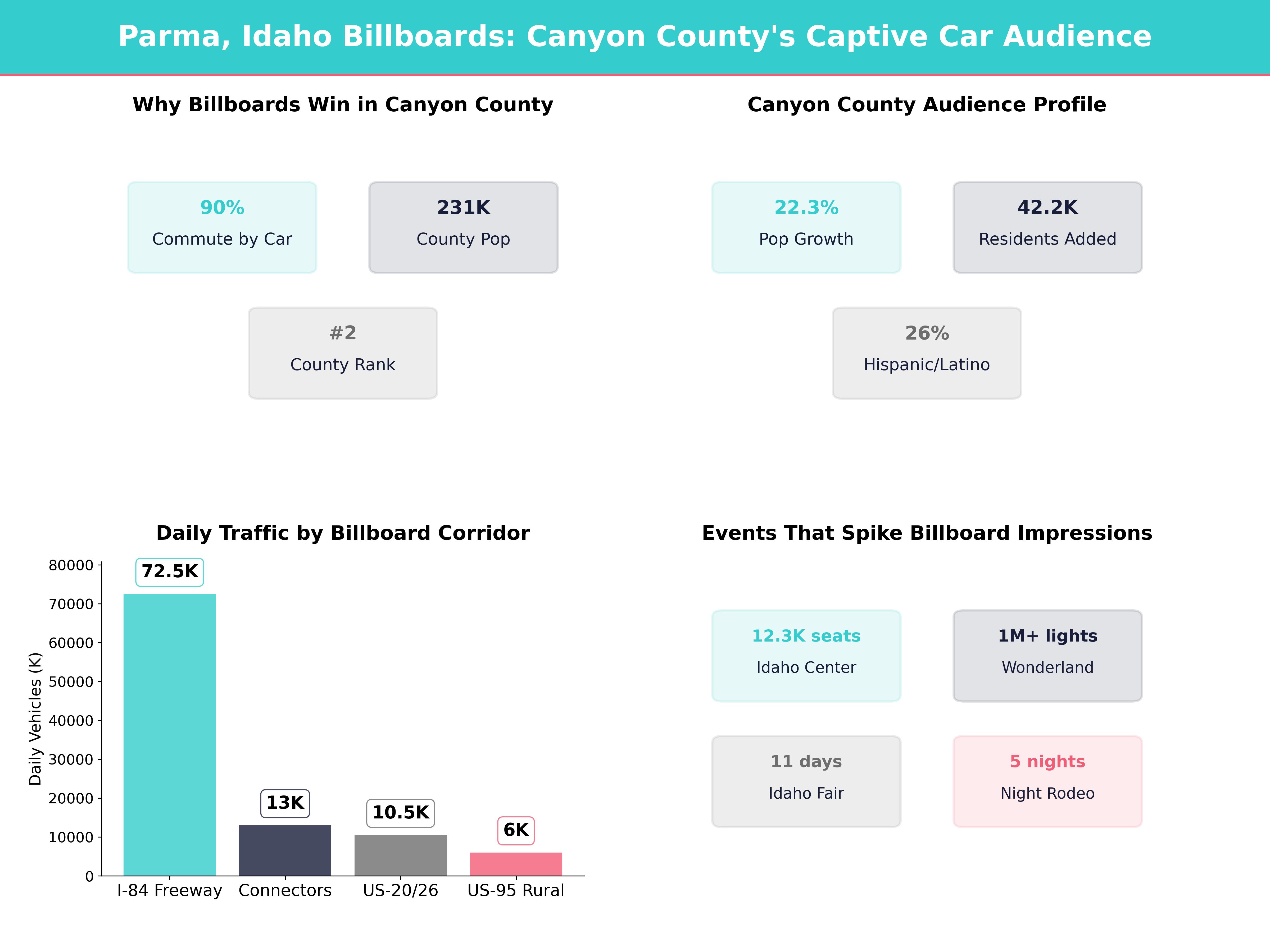
Parma sits inside Canyon County, Idaho’s second-most-populous county, and along travel routes that connect the west Treasure Valley with Ontario, Oregon. Because daily life here is strongly car-based, with roughly 9 in 10 Canyon County workers commuting by car, roadside messaging benefits from repeated exposure among commuters, shoppers, farm traffic, and cross-border travelers. Canyon County also added 42,182 residents between 2010 and 2020, which equals 22.3% growth.
What kinds of businesses should advertise in Parma, Idaho with Blip?
Parma sits in a working landscape shaped by agriculture, food production, logistics, trades, education, and regional services. That means everyday-need categories often perform especially well, including healthcare, dental, vision, and urgent care providers; farm supply, equipment, irrigation, tire, and truck services; and auto dealers, repair shops, insurance agencies, and banks. Recruiting campaigns for employers that need dependable local visibility also fit well.
When is the best time to run billboards in Parma, Idaho?
Spring campaigns in Parma should start early, because from March through June road activity expands with planting season, home projects, youth sports, and warmer-weather errands. Summer is one of the best billboard seasons for the broader Parma market, and winter can be extremely effective because shorter daylight hours increase screen visibility. In December, darkness arrives around 5 p.m., which strengthens the value of evening commuter and shopping impressions.
Do I need a contract to advertise with Blip in Parma?
No, Blip has no long-term contracts or minimum commitments. You can start, pause, or stop your campaign at any time.
How fast can I launch a billboard campaign with Blip in Parma?
You can have your campaign live in minutes. Create a free account, select your locations, set your budget, upload your design, and start running once approved.
Where can I advertise with Blip in Parma?
Blip has digital billboards in Parma. You can browse available locations on a map, choose the ones that fit your audience, and start advertising right away.
Still have questions? Launch a campaign in minutes — no contracts, no commitments.
Start Your CampaignParma Billboard Advertising Guide
Parma, Idaho gives us the kind of billboard market that looks small on a map, but performs much bigger in practice. Parma itself has about 2,100 residents, yet it sits inside Canyon County, Idaho’s second-most-populous county at 231,105 people, and along travel routes that connect the west Treasure Valley with Ontario, Oregon. Because daily life here is strongly car-based, with roughly 9 in 10 Canyon County workers commuting by car, roadside messaging benefits from repeated exposure among commuters, shoppers, farm traffic, and cross-border travelers. We also gain seasonal momentum from west Treasure Valley tourism and events tied to Indian Creek Plaza, the Ford Idaho Center, Caldwell Night Rodeo Idaho Wine Commission.
Parma, Idaho Market Overview
Parma is small, but the reachable market is much larger.
When we advertise in Parma, we are rarely targeting only the city limits. Parma sits near the junction of U.S. 20/26 and U.S. 95, roughly 20 miles from Caldwell, about 30 miles from Nampa, roughly 15 miles from Ontario, and about 45 miles from Boise. That geography gives us a practical trade area that extends across western Canyon County and into eastern Oregon.
Canyon County added 42,182 residents between 2010 and 2020, which equals 22.3% growth. That is a meaningful signal for billboard advertisers because growing counties generate more daily trips, more service demand, more school traffic, and more household spending. It also means Parma businesses can grow by reaching people who live outside Parma, but pass through its corridors regularly.
Car dependence is a real advantage for billboard campaigns.
Regional commute data from COMPASS and labor-market context from the Idaho Department of Labor point to a market where driving remains the default. In Canyon County, roughly 9 in 10 workers commute by car, either driving alone or carpooling. That matters because billboard campaigns work best where people spend predictable time on the road, and western Canyon County fits that pattern.
For advertisers, this creates three practical advantages:
- We can build frequency without needing a dense urban transit audience.
- We can target repeat local exposure among the same households several times per week.
- We can reach both destination traffic and pass-through traffic on the same regional road network.
Parma’s demographics support localized and bilingual creative.
Canyon County is younger and more family-oriented than many rural counties, and about 26% of residents are Hispanic or Latino. That makes Parma a strong market for family services, schools, healthcare, grocery, wireless, banking, restaurants, farm-and-ranch retail, and bilingual community messaging. It also means local relevance matters. Creative that feels authentic to western Canyon County usually performs better than generic “big city” creative built for Boise alone.
The local economy rewards practical, service-oriented advertisers.
Parma sits in a working landscape shaped by agriculture, food production, logistics, trades, education, and regional services. Boise Valley Economic Partnership regularly highlights the Treasure Valley’s strengths in food processing, manufacturing, and distribution, and that mix is visible in western Canyon County. For billboard advertisers, that means everyday-need categories often perform especially well, including:
- Healthcare, dental, vision, and urgent care providers.
- Farm supply, equipment, irrigation, tire, and truck services.
- Auto dealers, repair shops, insurance agencies, and banks.
- Restaurants, convenience retail, grocery, and home services.
- Recruiting campaigns for employers that need dependable local visibility.
Key Traffic Corridors for Parma, Idaho Billboards
Parma’s travel patterns are shaped by a few corridors that do very different jobs. Some routes deliver broad metro-scale awareness, while others are better for practical local conversion. When we understand that difference, we can match our billboard placements to the right audience and trip purpose.
I-84 through Nampa and Caldwell
Parma is not directly on I-84, but this interstate is still one of the best ways to build reach for Parma-area businesses. On Idaho Transportation Department count segments through Nampa and Caldwell, I-84 commonly carries roughly 55,000 to 90,000+ vehicles per day depending on the segment.
This corridor is ideal when we want to reach:
- Regional healthcare and professional services that draw patients or clients from western Canyon County into larger service hubs.
- Retail and dining brands that want visibility before drivers choose where to stop.
- Event and entertainment campaigns that need broad awareness across the west Treasure Valley.
- Recruiting campaigns that need reach beyond Parma itself.
For many Parma advertisers, I-84 works best as an awareness layer, while closer-in boards on U.S. 20/26 or U.S. 95 handle the directional and destination message.
U.S. 20/26 through Caldwell, Middleton, and Parma
For Parma itself, U.S. 20/26 is one of the most important corridors in the market. It carries local commuting, school traffic, rural errands, agricultural vehicles, and cross-border movement between western Canyon County and eastern Oregon. On ITD count segments west of Caldwell and around Parma, traffic volumes commonly fall in the 8,000 to 13,000 AADT range.
This corridor is especially useful for:
- Local retail, because shoppers make repeat trips along the same route.
- Healthcare and family services, because parents and caregivers often travel this road for appointments and errands.
- Restaurants, fuel, and convenience offers, because drivers make quick stop decisions on corridor trips.
- Agricultural and truck-oriented businesses, because the audience includes work vehicles as well as households.
If our goal is to drive people into Parma, this is usually the first corridor we should evaluate.
U.S. 95 through Parma and the western agricultural belt
U.S. 95 gives us north-south visibility through Parma and into surrounding communities such as Homedale 4,000 to 8,000 AADT range, which is lower than I-84, but still very meaningful for frequency in a rural market.
This route tends to work well for:
- Farm and ranch suppliers, because it captures practical trip traffic.
- Auto, tire, diesel, and mechanical services, because it reaches pickup and work-truck audiences.
- Banks, insurers, and healthcare providers, because local residents use the corridor repeatedly.
- Schools, churches, and community organizations, because it supports local familiarity over time.
The lower volume is not a weakness if our audience is local and high-intent. In a market like Parma, repeated exposure to the right drivers often matters more than raw volume alone.
State Highway 19, State Highway 44, and feeder routes
Parma campaigns also benefit from surrounding connectors. State Highway 19 links the rural west side back toward Caldwell, while State Highway 44 supports traffic through the Middleton area. Depending on segment and proximity to larger towns, ITD counts on these connectors can range from about 6,000 to 20,000 vehicles per day.
These feeder routes help us reach:
- Households moving between small towns and larger job centers.
- Parents on school, sports, and shopping trips.
- Service customers making destination-based trips to Caldwell, Nampa, or Parma.
- Travelers heading toward wineries, events, and weekend recreation.
For many advertisers, these routes are excellent support placements when paired with one higher-volume corridor.
Audience Segments We Can Reach in Parma, Idaho
Daily commuters and household shoppers
The most reliable audience in Parma is the repeat driver. Because roughly 9 in 10 Canyon County workers commute by car, billboard campaigns can build familiarity quickly among local households. Parma residents often travel to Caldwell, Nampa, Fruitland, and Ontario for work, shopping, medical care, and school activities, and that makes road-based advertising unusually efficient.
This audience responds well to messages tied to practical needs, including:
- Primary care, dental care, urgent care, and pharmacy.
- Grocery, restaurant, and fuel offers.
- Banking, insurance, tax, and legal services.
- Auto repair, HVAC, plumbing, and home services.
Agricultural, logistics, and trades audiences
Parma’s identity is still tied to productive land, work vehicles, and practical commerce. We see that in daily traffic patterns, shift schedules, and the prominence of agriculture and food-related business across western Canyon County and neighboring Payette County
Campaigns that often fit this segment include recruiting, equipment sales, irrigation services, trucking support, workwear, tire shops, diesel repair, ag lending, and bilingual service businesses.
Students, parents, and education-oriented households
Within roughly 20 to 60 minutes of Parma, we can reach audiences tied to Treasure Valley Community College, The College of Idaho, College of Western Idaho, Northwest Nazarene University, and Boise State University. College of Western Idaho serves 30,000+ students annually, and Boise State University enrolls 26,000+ students.
That matters even for Parma businesses because education audiences create demand for:
- Affordable food and beverage options.
- Wireless, internet, and financial services.
- Apartments, storage, and moving services.
- Healthcare, tutoring, childcare, and family retail.
Tourists, eventgoers, and leisure travelers
Parma is close enough to western Treasure Valley attractions that tourism traffic matters, especially from late spring through the holidays. The Ford Idaho Center arena seats 12,279, Caldwell Night Rodeo 5 nights each August, and Indian Creek Plaza draws major seasonal traffic with a Winter Wonderland display of more than 1 million lights. The Idaho Wine Commission also promotes the nearby Sunnyslope area, which includes 15+ wineries, including Ste. Chapelle Winery and Sawtooth Winery.
This segment is a strong fit for hospitality, dining, tasting rooms, entertainment, specialty retail, and short-term promotions.
Seasonal and Timing Opportunities in Parma, Idaho
Spring in Parma, Idaho
Spring campaigns in Parma should start early. From March through June, road activity expands with planting season, home projects, youth sports, and warmer-weather errands. This is a productive window for farm supply, home services, lawn and garden, equipment, staffing, and healthcare campaigns.
We also see strong relevance for graduation and summer-planning messages by May and June. Families begin making decisions about camps, travel, dental visits, vehicle purchases, and seasonal jobs during this stretch.
Summer tourism and event timing in Parma, Idaho
Summer is one of the best billboard seasons for the broader Parma market. Afternoon and evening traffic rises as people attend events, visit wineries, travel for recreation, and make more discretionary trips. Caldwell Night Rodeo August, and the Western Idaho Fair runs 11 days each August, adding to late-summer movement across the Treasure Valley.
Summer creative can lean into:
- Weekend dining and entertainment.
- Cold beverages, convenience, and fuel.
- Outdoor gear, auto services, and road-trip readiness.
- Winery, event, and family attraction promotions.
Because summer afternoons regularly push into the 90s°F, bold color contrast and clean readability become especially important on sunlit roads.
Fall harvest and back-to-school opportunities in Parma, Idaho
From August through October, the market shifts toward harvest, school routines, and practical spending. This is an ideal time for campaigns focused on truck service, banking, ag inputs, workwear, healthcare checkups, and family retail. Back-to-school messaging usually needs to be live by early to mid-August, especially for education, clinics, wireless, and discount retail.
Fall is also one of the best seasons for local-authenticity creative. Ads that reference harvest, community, convenience, or value often feel especially natural in the Parma market during this period.
Winter retail and holiday visibility in Parma, Idaho
Winter can be extremely effective for digital billboards in this region because shorter daylight hours increase screen visibility. In December, darkness arrives around 5 p.m., which strengthens the value of evening commuter and shopping impressions. Indian Creek Plaza and holiday programming in Caldwell help pull extra leisure traffic into the area from November through early January.
Winter campaigns are well suited for:
- Holiday retail and gift promotions.
- Restaurants and entertainment.
- Medical, tax, and financial services.
- Heating, emergency repair, and vehicle service offers.
Fog, low sun, and winter road conditions also make high-contrast creative more important than usual.
Billboard Design Tips for the Parma, Idaho Market
Use Parma-area visual language, not generic metro imagery.
Parma audiences tend to respond better when our creative looks like western Canyon County. Images of vineyards, irrigated fields, pickups, orchards, local dining, family gatherings, and practical service outcomes feel more believable here than downtown skyline imagery. That does not mean every ad needs a tractor in it, but it does mean tone and context matter.
For example, a medical clinic can feel more local by showing convenience, family care, and clear direction from Parma or Caldwell. A restaurant can feel more relevant by emphasizing hearty meals, local hospitality, or a quick stop on the way to or from an event.
Build for bilingual and family-centered communication.
With about 26% of Canyon County residents identifying as Hispanic or Latino, bilingual creative is often worth testing. We do not need to overload the design. Short, confident phrases tend to work best.
The strongest bilingual approaches in this market usually have three traits:
- They keep the message short enough to read at road speed.
- They lead with the benefit, not the translation.
- They feel natural to family and community audiences.
Healthcare, banking, schools, restaurants, grocery, retail, and public-service campaigns can all benefit from this approach.
Design for road speed, glare, and rural decision-making.
Parma is not a market where people linger in dense urban traffic for long periods. We should design for movement. On faster corridors such as I-84 and the larger U.S. routes, one idea and one destination cue usually outperform complex layouts.
Local-specific approaches that work well include:
- Clear directional language, such as “In Caldwell,” “Near Ontario,” or “Off U.S. 20/26.”
- Mile or minute framing when the destination is close.
- Large logos and strong color contrast for winter fog and summer glare.
- Practical offers, hours, or service promises instead of abstract branding alone.
Regional Strategies Around Parma, Idaho
Parma and western Canyon County
If our goal is local frequency, we should treat Parma and nearby rural traffic as a precision market. This is where we focus on repetition, trust, and familiarity. Boards serving Parma-area traffic are especially strong for healthcare, schools, churches, grocery, convenience, ag support, and employer recruiting.
In this zone, we should prioritize relevance over scale. A smaller audience can still be very valuable when it is made up of the exact households and workers we want.
Caldwell and the Parma-to-Caldwell corridor
Caldwell is one of the best supporting markets for Parma campaigns because it combines residential growth, event traffic, and westbound travel toward Parma. It also provides access to the Indian Creek Plaza audience, the Caldwell Night Rodeo
We should use Caldwell-area placements when we want:
- More scale than Parma alone can provide.
- A tourism or leisure overlay.
- Stronger family and retail reach.
- Traffic that can still convert into Parma visits.
Nampa and I-84 westbound strategy
Nampa expands the audience further. If we need broader awareness, especially for regional healthcare, major retail, higher education, or event marketing, boards near Nampa and I-84 can introduce the brand before people make westbound decisions.
This is often the right play when our offer is strong enough to justify a 30- to 45-mile drive, or when we want to build brand recognition across the wider west Treasure Valley before narrowing into Parma-serving corridors.
Ontario, Fruitland, and cross-border trade area strategy
Because Parma sits only about 15 miles from Ontario and close to Fruitland, we should think in terms of a shared trade area, not just an Idaho city boundary. Cross-border travel is normal here. That creates opportunity for medical, legal, automotive, banking, storage, recruiting, and service advertisers that draw from both sides of the state line.
This approach is especially useful when we know our buyers travel widely for price, convenience, specialty services, or trusted providers.
Using Blip Tools in Parma, Idaho
We can match dayparts to Parma’s actual travel rhythms.
Parma campaigns tend to perform best when we align timing with the purpose of the trip. Morning commuter windows such as 6 a.m. to 9 a.m. work well for coffee, fuel, healthcare, recruiting, and practical services. Midday windows such as 11 a.m. to 2 p.m. often fit restaurants, errands, and local retail. Late afternoon and evening periods such as 4 p.m. to 8 p.m. are strong for family dining, events, and return-home traffic.
Weekend timing matters too. Tourism and leisure traffic usually rise from Thursday through Sunday, especially in summer, during rodeo week, and through the holiday season in Caldwell.
We can choose manual control or broader optimization based on the goal.
When we know the exact corridors we want, such as U.S. 20/26, Caldwell approaches, or westbound I-84, a manual campaign gives us precise control. When we want reach across Parma, Caldwell, Nampa, and surrounding corridors without hand-selecting every screen, Blip’s optimized approach can be the better fit.
A simple rule works well here:
- We should choose manual selection when local route knowledge is the advantage.
- We should choose optimization when coverage and efficiency matter more than micromanaging each location.
We can test creative quickly in a market with distinct micro-audiences.
Parma is a good place to test multiple messages because the audience changes by corridor. A farm-and-truck audience on U.S. 95 is different from a family-event audience in Caldwell or a broader commuter audience on I-84. With digital inventory, we can compare those messages, review analytics, and shift budget toward the strongest-performing mix.
This is also where Blip’s artwork tools help. We can build one version for general awareness, one bilingual version for family and community reach, and one event-driven version for weekends or seasonal pushes.
Getting Started with Billboard Rental in Parma, Idaho
We should start by defining the real objective.
Before we choose locations, we should decide what job the billboard needs to do. In Parma, the most common goals are local frequency, cross-border capture, event promotion, recruiting, and awareness across the west Treasure Valley. That distinction matters because each objective points to a different map strategy.
- Local-frequency campaigns usually need Parma-area and west Canyon placements.
- Regional-awareness campaigns often need Caldwell and I-84 support.
- Cross-border campaigns usually benefit from Parma plus Ontario or Fruitland coverage.
- Event and leisure campaigns often perform best with Caldwell, Sunnyslope, and evening dayparts.
We should evaluate each board by route, direction, and action distance.
A good Parma billboard is not just a board with traffic. It is a board that reaches the right traveler at the right moment. When we compare locations, we should ask:
- Is the board on a route our audience uses weekly, or only occasionally?
- Is the direction of travel correct for the destination we want to promote?
- Is the destination close enough for an immediate response?
- Is this board reaching work traffic, school traffic, shopping traffic, or event traffic?
In the Parma market, boards that sit 1 to 5 miles before a town, turn, or service area can be especially effective because rural drivers often make decisions with fewer alternate routes than in dense urban areas.
We can simplify the rental process and refine over time.
Traditional billboard buying often means fixed packages, sales calls, and longer commitments than a local advertiser really needs. In Parma, where seasonality and route purpose matter so much, flexibility is a major advantage. We can launch with a focused test, monitor results, and adjust when harvest, school calendars, or event traffic changes.
A practical starting structure for Parma often looks like this:
- We begin with 2 to 4 strategically different billboard placements.
- We run for 1 to 2 weeks to establish baseline performance.
- We compare corridor types, time windows, and creative variations.
- We shift more budget toward the boards and dayparts that match the real audience response.
That approach keeps us from overcommitting too early, while still giving us enough data to make smarter placement decisions. In a market like Parma, Idaho, the best billboard strategy is usually not the biggest one. It is the one that respects how people actually move through western Canyon County and turns that movement into repeated, relevant visibility.