Billboards in Cascade, ID
No Minimum Spend. No Long-Term Contracts. Just Results.
Trusted by Leading Brands


Billboard advertising
in Cascade has never been easier
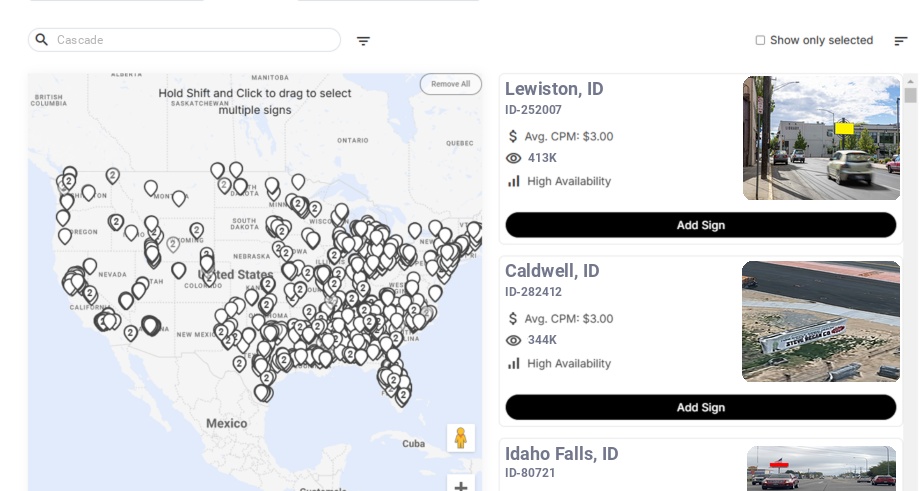



How much is a billboard in Cascade?
Why Choose Blip for Billboard Advertising in Cascade
Blip's self-serve platform lets you launch on Cascade's SH-55 corridor fast, reaching Boise-to-McCall drivers without the usual back-and-forth.
Use Blip-optimized campaigns in Cascade to auto-pick the best billboards and timing for lake weekends, ski traffic, and local commuters.
Set flexible budgets in Cascade and scale up for Lake Cascade State Park summers or winter resort surges, then pause anytime.
Daypart Blip ads in Cascade for Friday northbound arrivals and Sunday southbound returns on SH-55, so your message hits drivers at the right moment.
Track real-time results in Cascade and tweak creative on the fly for SH-55, Tamarack, and Brundage travelers as demand shifts.
Frequently Asked Questions About Billboard Advertising in Cascade
How much does a billboard cost in Cascade, Idaho with Blip?
Each “blip” is a 7.5-to-10-second display, and pricing is pay-per-play, starting at just $0.01 per display. Because cost per blip changes based on time of day, location, and advertiser demand, Blip works to stretch your budget and maximize reach without making you commit to a long-term contract. Your total cost is simply the sum of the blips your ad runs over time.
Where can I advertise with Blip in Cascade, Idaho?
State Highway 55 is the backbone of the Cascade market and connects the Treasure Valley with Cascade, Donnelly, and McCall. North of Cascade, SH-55 continues into Idaho’s best-known mountain tourism zone, while State Highway 22 toward Warm Lake reaches a lower-volume but more specialized audience. Downtown Cascade and the immediate town core are best for frequency and local awareness.
What kind of traffic does Cascade, Idaho get for billboard advertising?
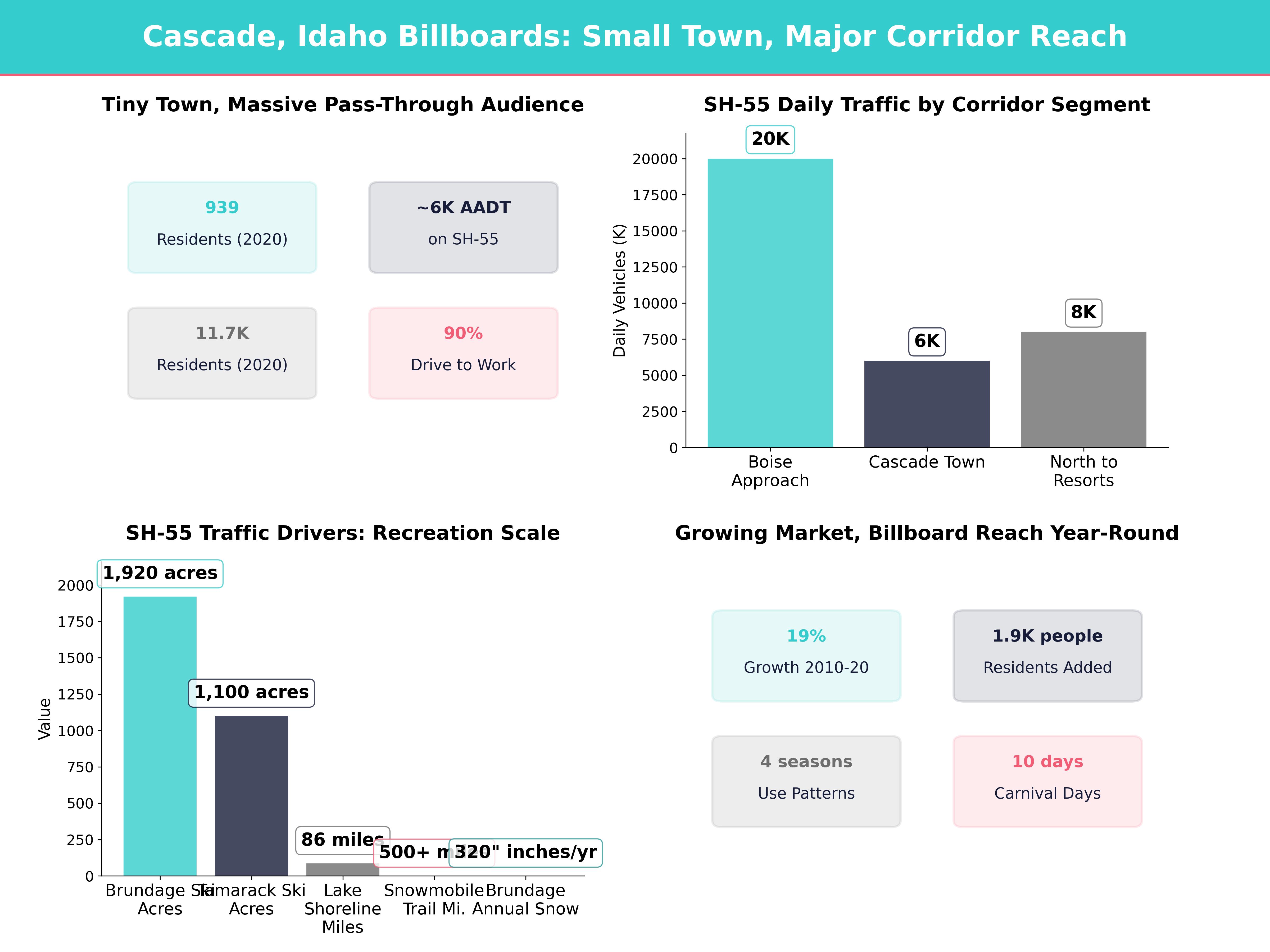
The city itself had a 2020 population of 939, while Valley County reached 11,746 residents, and nearly every shopper, worker, and visitor arrives by vehicle. SH-55 around Cascade generally operates in the mid-thousands of vehicles per day, with through-town and nearby segments often around 5,000 to 7,000 AADT. In county commuting profiles, roughly 9 in 10 workers travel by car, truck, or van.
When is the best time to run billboard ads in Cascade, Idaho with Blip?
From Memorial Day through Labor Day, Cascade becomes a strong warm-weather recreation market, and summer is the best season for advertisers in food, fuel, lodging, retail, recreation, and event promotion. In winter, the market stays active with ski travel, snowmobiling, holiday visitation, and event traffic. For many advertisers, shoulder seasons are where efficiency is highest because you can often keep frequency high without paying peak-period rates.
What kinds of businesses work best for billboard ads in Cascade, Idaho?
Advertisers that benefit most include fuel, convenience, restaurants, coffee shops, grocery stores, medical, automotive, home-service, tourism, hospitality, lodging, real estate, and outdoor-gear brands. Cascade also supports campaigns for health care providers, schools, nonprofits, family-oriented businesses, and community institutions. The market works well when creative matches the reason people are on the road.
Do I need a contract to advertise with Blip in Cascade?
No, Blip has no long-term contracts or minimum commitments. You can start, pause, or stop your campaign at any time.
How fast can I launch a billboard campaign with Blip in Cascade?
You can have your campaign live in minutes. Create a free account, select your locations, set your budget, upload your design, and start running once approved.
Where can I advertise with Blip in Cascade?
Blip has digital billboards in Cascade. You can browse available locations on a map, choose the ones that fit your audience, and start advertising right away.
Still have questions? Launch a campaign in minutes — no contracts, no commitments.
Start Your CampaignCascade Billboard Advertising Guide
Cascade, Idaho gives us an unusually efficient billboard market because a very small resident base sits on one of Idaho’s most important recreation corridors. The city itself had a 2020 population of 939, while Valley County reached 11,746 residents, and nearly every shopper, worker, and visitor arrives by vehicle. We also benefit from year-round demand drivers, including Lake Cascade State Park, the route between Boise and McCall, and winter traffic headed to Tamarack Resort Brundage Mountain Resort. For advertisers, that combination means digital billboards in and around Cascade can reach locals, pass-through travelers, and high-intent recreation visitors with the same campaign.
Cascade, Idaho Market Overview
Cascade is small, but it is not isolated in advertising terms. It functions as a service hub on State Highway 55, and it sits at roughly 4,748 feet in elevation in a county that covers more than 3,700 square miles, or about 3 people per square mile. In practical terms, that means physical distance matters, cars matter, and outdoor travel patterns matter even more than city-limit population.
Valley County grew from 9,862 residents in 2010 to 11,746 in 2020, an increase of 1,884 people and about 19% growth over the decade. That is a meaningful increase for a rural county, and it helps explain why advertisers in health care, construction, home services, real estate, and retail can all find viable audiences here. When a county grows while maintaining a dispersed settlement pattern, outdoor media tends to stay relevant because residents continue to rely on roads for work, errands, recreation, and school travel.
Recent county profiles from the Idaho Department of Labor show a labor force of roughly 5,700 people in Valley County, out of 11,746 total residents. The economy is diversified for a mountain market, with lodging, food service, construction, retail, public services, real estate, and health care all playing visible roles. Institutions such as Cascade Medical Center, Cascade School District 422
For billboard planning, the most important behavioral fact is car dependence. In county commuting profiles compiled through state labor-market tools, roughly 9 in 10 workers travel by car, truck, or van. That is exactly the kind of environment where concise, directional, repeat-exposure messaging performs well. We are not trying to interrupt subway riders or dense downtown pedestrians in Cascade. We are reaching drivers who are already making route-based decisions about fuel, food, lodging, shopping, recreation, and services.
Key Traffic Corridors Around Cascade, Idaho
Cascade’s travel patterns are concentrated, which makes corridor choice especially important. We do not need dozens of disconnected roads to build coverage here. We need the right highway positions, the right directional timing, and creative that matches why people are on the road.
State Highway 55 Through Cascade
State Highway 55 is the backbone of the Cascade market. It connects the Treasure Valley with Cascade, Donnelly McCall, and it carries both local trips and visitor traffic. Cascade is about 75 miles north of Boise, about 17 miles south of Donnelly, and about 29 miles south of McCall, so the city regularly captures travelers at a decision point between departure, arrival, and onward recreation travel.
According to traffic count patterns published by the Idaho Transportation Department, SH-55 around Cascade generally operates in the mid-thousands of vehicles per day, with through-town and nearby segments often around 5,000 to 7,000 AADT. In a city of 939 residents, those volumes tell us immediately that the audience is much larger than the local population alone.
This corridor is especially strong for the following categories.
- Fuel, convenience, and quick-service brands benefit because drivers are already watching for their next stop.
- Restaurants, coffee shops, and grocery stores benefit because Cascade naturally functions as a pause point on a longer trip.
- Medical, automotive, and home-service advertisers benefit because local residents also use the same corridor repeatedly.
- Real estate and lodging advertisers benefit because many travelers are destination shoppers, not just pass-through traffic.
The Southbound and Northbound SH-55 Feeder Corridor
The full SH-55 corridor matters, not just the city block where a board sits. South of Cascade, traffic is fed by Horseshoe Bend Smiths Ferry five digits and exceed 20,000 AADT near the Boise-area end of the corridor.
That matters because many Cascade impressions are effectively prequalified by origin. A northbound driver coming from Boise is not random traffic. That person is usually headed toward a lake, campground, cabin, trailhead, restaurant, vacation rental, or ski destination. If we are advertising in Cascade, we should think about that traveler’s full journey.
Advertisers that benefit most from this feeder logic include the following groups.
- Tourism and hospitality brands can intercept travelers before final booking or meal decisions are made.
- Retail and outdoor-gear brands can present “buy now before you hit the lake or slopes” messaging.
- Event marketers can promote same-day or next-day activities with short lead times.
- Regional service brands can build recognition with both residents and repeat visitors who make the drive multiple times per year.
The Northbound Cascade-to-Donnelly-to-McCall Corridor
North of Cascade, SH-55 continues into Idaho’s best-known mountain tourism zone. Traffic on resort-oriented segments north of town commonly moves in roughly the 7,000 to 9,000 AADT range, depending on location and season, according to Idaho Transportation Department count maps. That is significant for a rural corridor, and the audience quality is high because many of these drivers are destination-focused.
The route serves travelers headed toward Tamarack Resort Donnelly McCall, and Brundage Mountain Resort. It is ideal for advertisers that sell experiences, lodging, dining, winter recreation, and real estate.
We should also remember that northbound and southbound traffic can behave differently. Northbound drivers on Friday afternoons and Saturday mornings are often still planning. Southbound drivers on Sunday afternoons may be more responsive to fuel, food, coffee, and “one last stop” offers.
State Highway 22 Toward Warm Lake and Eastside Recreation
State Highway 22 toward the Warm Lake 1,000 vehicles per day. That lower count does not make the route unimportant. It simply means the audience is more specialized.
Drivers on SH-22 are often heading to camp, fish, boat, or recreate in a specific area. That makes this route valuable for cabin rentals, guides, marinas, outdoor retailers, and businesses with a clear geographic hook. A smaller but more intentional audience can outperform a larger general-audience corridor when our offer is tightly aligned with the destination.
Audience Segments We Can Reach in Cascade, Idaho
Cascade works best when we think in audience layers rather than a single local market. We are not only speaking to year-round residents. We are also speaking to weekenders, vacationers, skiers, second-home owners, and regional travelers who pass through several times each season.
Year-Round Residents and Daily Drivers
The base audience starts with 939 city residents in Cascade and 11,746 county residents in Valley County. In a county this large geographically, routine life requires driving. That creates recurring visibility for advertisers in the following categories.
- Health care providers such as Cascade Medical Center can stay top of mind for local households.
- Home-service companies can reach owners of primary homes, vacation homes, and rental properties.
- Local retailers and restaurants can build frequency with residents who make repeated trips on SH-55.
- Schools, nonprofits, and community organizations can reach parents and families through everyday route exposure.
Because the resident base is small, frequency matters as much as raw reach. A message repeated to the right drivers over several weeks can be more valuable in Cascade than a one-time broad burst.
Lake Cascade Recreation Visitors
Lake Cascade State Park is one of the strongest demand generators in the market. The park includes about 86 miles of shoreline, which gives us a good sense of its scale and the breadth of activity around the lake. Summer visitors come for boating, fishing, beaches, paddle sports, camping, and RV travel, and many of them are moving through Cascade for supplies and services.
That audience is especially attractive for the following advertisers.
- Restaurants and grocery stores can capture same-day spending.
- Sporting goods and marine-related businesses can reach people who need gear, bait, ice, propane, or accessories.
- Family entertainment venues can attract visitors looking for activities after time on the water.
- Lodging and vacation rentals can influence travelers who extend a stay or return later in the season.
In this segment, timing and relevance matter more than polish. A simple billboard that tells visitors where to stop, how far away the offer is, and why it fits a lake day can perform very well.
Skiers, Riders, and Snowmobile Travelers
Winter is not a dead season in Cascade. It is one of the market’s biggest opportunities. Tamarack Resort 1,100 skiable acres and roughly 2,800 vertical feet of terrain. Brundage Mountain Resort offers about 1,920 acres of lift-served terrain and averages more than 320 inches of snowfall annually. Visit McCall also highlights more than 500 miles of groomed snowmobile trails in the broader area.
Those are large numbers for a rural corridor, and they create a valuable winter audience that includes destination travelers, second-home owners, seasonal workers, and day-trippers. Winter billboard categories that fit well include the following groups.
- Hotels, lodges, and vacation rentals can target late planners and return visitors.
- Coffee, breakfast, and quick-service brands can target early departure traffic.
- Auto, tire, towing, and roadside services can speak directly to winter conditions.
- Apparel, sporting goods, and equipment-rental brands can connect with active recreation users.
Families, Students, and Community Institutions
While tourism gets most of the attention, community life still matters. Cascade School District 422 Cascade Aquatic and Recreational Center
This audience is ideal for the following campaigns.
- Back-to-school promotions perform best in late summer.
- Youth sports, lessons, and enrichment programs fit well in fall and spring.
- Health screenings, dental, and family practice messaging can run year-round.
- Holiday retail and service campaigns can build familiarity before peak shopping periods.
Second-Home Owners, Builders, and Real Estate Shoppers
A county that grew 19% in a decade, an increase of 1,884 residents, combines recreation with remote-work appeal, and sits on a highly visible tourism corridor naturally supports real estate and construction advertising. Buyers, sellers, investors, and builders often travel the same highway repeatedly while comparing towns, neighborhoods, and resort access.
For this audience, outdoor media works well because real estate decisions in mountain markets are spatial. Buyers care where the lot is, how far it is from the lake, whether it is south of Donnelly or near Cascade, and how the drive feels from Boise. Billboards can reinforce those route-based considerations in a way that online ads often do not.
Seasonal Advertising Opportunities in Cascade, Idaho
Cascade is a market where calendar strategy can dramatically improve efficiency. We should not spend the same way in February, July, and November. We should align budgets and timing with the reasons people are in the area.
Summer in Cascade and Lake Season
From Memorial Day through Labor Day, Cascade becomes a strong warm-weather recreation market. Lake Cascade State Park drives boating, camping, and family travel, and SH-55 becomes a major weekend route. Summer is the best season for advertisers in food, fuel, lodging, retail, recreation, and event promotion.
We usually see the following timing patterns work well.
- Thursday afternoon through Saturday is strong for northbound arrival traffic.
- Sunday afternoon and evening is strong for southbound return traffic.
- Midday placements work well for spontaneous meal, activity, and retail decisions.
- Weather-responsive campaigns become especially valuable during hot weekends and holiday periods.
Winter in Cascade and the Ski Corridor
Winter campaigns should focus on ski travel, snowmobiling, holiday visitation, and event traffic. Visit McCall promotes the McCall Winter Carnival, which typically runs about 10 days and creates a concentrated burst of regional travel. The surrounding mountains, plus the winter pull of Tamarack Resort Brundage Mountain Resort, keep the corridor active when many non-mountain markets slow down.
In winter, we should consider the following timing choices.
- Early-morning dayparts work for coffee, breakfast, and road-prep messaging.
- Friday afternoon and evening work for arrival traffic.
- Holiday weeks deserve their own creative and budget settings.
- Storm-period messaging can support lodging, chains, vehicle services, and urgent retail offers.
Shoulder Seasons in Cascade
Spring and fall are smaller, but they should not be ignored. These periods often deliver lower ad competition while still reaching anglers, hunters, shoulder-season travelers, contractors, and local residents. Fall is particularly useful for home services, winterization, tires, heating, medical appointments, and local retail. Spring is useful for fishing, outdoor cleanup, landscaping, equipment, and tourism warm-up.
For many advertisers, shoulder seasons are where efficiency is highest. We can often keep frequency high without paying peak-period rates.
School, Community, and Event Windows
Late August, early September, the winter holidays, and late spring each create predictable local demand. Community-oriented advertisers should sync with the Cascade Chamber of Commerce, Cascade School District 422 Valley County calendars whenever possible. A small town rewards relevance. If our creative references what residents are already doing this week, not just this season, the message feels more useful and more local.
Billboard Design Tips for the Cascade, Idaho Market
Creative that works in Cascade usually feels place-aware, practical, and immediate. We should design for mountain travel behavior, not for a generic urban audience.
Use Cascade-Specific Visual Cues
Blue water, evergreen tones, mountain silhouettes, docks, snow textures, skis, boats, and campfire imagery all fit the area naturally because they reflect what people are already doing. A Cascade board should look like it belongs between the lake and the mountains. Generic corporate visuals can still work, but they usually perform better when grounded with local references such as “On SH-55,” “Near Lake Cascade,” or “Before Donnelly.”
Design for Highway Speed and Glare
Drivers outside town are often traveling 55 to 65 mph, and mountain light can be intense in both summer and winter. We should use high contrast, bold type, and a single clear message. In winter especially, white backgrounds can wash out against snow and sky, so deeper blues, greens, charcoal, and warm accent colors often read better.
Make Distance and Direction Part of the Offer
In Cascade, direction is part of the value proposition. “2 miles north,” “In downtown Cascade,” “Before the lake,” or “Next stop on SH-55” gives people immediate context. This is far more useful than a vague slogan when drivers are actively deciding whether to keep going or stop now.
Match the Season, Not Just the Brand
A summer board with lake imagery in January feels careless, and a powder shot in July feels disconnected. Because Cascade has at least 4 distinct seasonal use patterns across summer, fall, winter, and spring, advertisers should rotate artwork with the calendar. This is especially important for restaurants, lodges, events, and outdoor retailers.
Regional Billboard Strategies Within Cascade and Valley County
Not every part of the market does the same job. We should match the board location to the customer decision we want to influence.
Downtown Cascade and the Immediate Town Core
Boards close to the core are best for frequency, local awareness, and immediate action. This area works well for community organizations, restaurants, grocery, pharmacy, clinics, and services that residents need often. It is also the best place for advertisers that want to feel local first and tourist-facing second.
South of Cascade on the Boise Approach
This strategy is ideal for capturing travelers before they finalize stop decisions. South-approach messaging works best for fuel, food, coffee, lodging, grocery, and “stock up before the lake” offers. It can also work well for local attractions that want to intercept traffic before travelers continue north toward Donnelly McCall.
North of Cascade Toward Donnelly and McCall
Boards on the north side of the market should focus on comparison decisions, including whether to stop now, eat now, book now, or come back later. This region is especially strong for real estate, resort services, dining, and recreation businesses that serve travelers headed to Tamarack Resort Brundage Mountain Resort.
Eastside Recreation Messaging
If our offer is tied to a specific outdoor destination, lower-volume eastbound recreation routes can still be highly effective. The traffic count may be smaller than SH-55, but the audience intent is often stronger. This is where cabin rentals, guides, marinas, and outdoor service providers can outperform more general advertisers.
Using Blip Tools for Cascade Campaigns
Cascade is a good market for flexible execution because demand shifts so clearly by direction, season, and day of week. We can use a Blip-optimized campaign when we want broad efficiency across the region, especially during summer lake travel or winter ski travel. We can use manual selection when we want to concentrate on a very specific stretch of the SH-55 corridor or compare town-core placements against resort-route placements.
Dayparting is especially useful here. We can weight northbound traffic on Friday afternoons, Saturday mornings, and holiday eves, then shift toward southbound return traffic on Sundays. We can also prioritize breakfast, lunch, or dinner windows depending on whether the goal is meal conversion, local awareness, or travel-stop capture.
Artwork flexibility matters in Cascade because the market changes fast. We may want one creative set for summer boating, another for fall services, and another for winter mountain travel. Blip’s creative tools make that much easier than treating each version like a separate traditional billboard buy.
Real-time campaign feedback is also valuable in a seasonal market. If one board performs better during ski weekends and another performs better during July lake traffic, we can adjust rather than waiting for a fixed contract period to end. That agility is one of the biggest advantages in a place where demand can swing dramatically by month.
Getting Started With Billboard Rental in Cascade, Idaho
Renting a billboard in Cascade works best when we start with a clear local objective. We should decide whether the campaign is meant to reach residents repeatedly, intercept pass-through travelers, support a seasonal business, or build regional awareness across the Boise-to-McCall corridor. Those goals require different locations, timing patterns, and creative choices.
Choose the Cascade Goal Before the Board
A restaurant may want immediate stop-in traffic. A medical provider may want year-round local frequency. A resort property may want to influence repeated corridor travel over several months. Once we know the job, choosing the right board becomes much simpler.
Evaluate Board Fit by Route Context
In Cascade, the most important location questions are practical.
- Which direction is the audience traveling?
- How far is the business from the board?
- Is the message for locals, tourists, or both?
- Does the board sit before the decision point or after it?
- Will the creative still make sense in snow, glare, and weekend traffic?
A board 5 to 10 miles before town can be excellent for food, fuel, and lodging. A board in town can be better for local services and repeat frequency. A resort-corridor board can be better for real estate and recreation.
Start With a Focused Test in Cascade
For many advertisers, a 2- to 4-week test is the smartest way to begin. We can run a summer test, a winter test, or both, compare timing and creative, and learn which corridor behavior matches our audience. That is usually far easier and less risky than entering a long traditional commitment without local performance insight.
Use Blip to Simplify the Rental Process
Traditional billboard buying in rural and resort markets can be slow, opaque, and tied to long negotiations. Blip makes the process more practical for businesses that want to move with the season, test creative, or adjust quickly when weather, events, or tourism patterns change. That is especially useful in Cascade, where a holiday weekend, a powder cycle, or a hot lake forecast can shift demand fast.
If we approach Cascade with local logic, route-aware creative, and seasonally timed execution, billboard advertising can punch far above the market’s population size. The reason is simple. In Cascade, the road is the marketplace, and the right message on the right corridor can reach the exact audience we want while they are already on their way.