Billboards in Buckeye Lake, OH
No Minimum Spend. No Long-Term Contracts. Just Results.
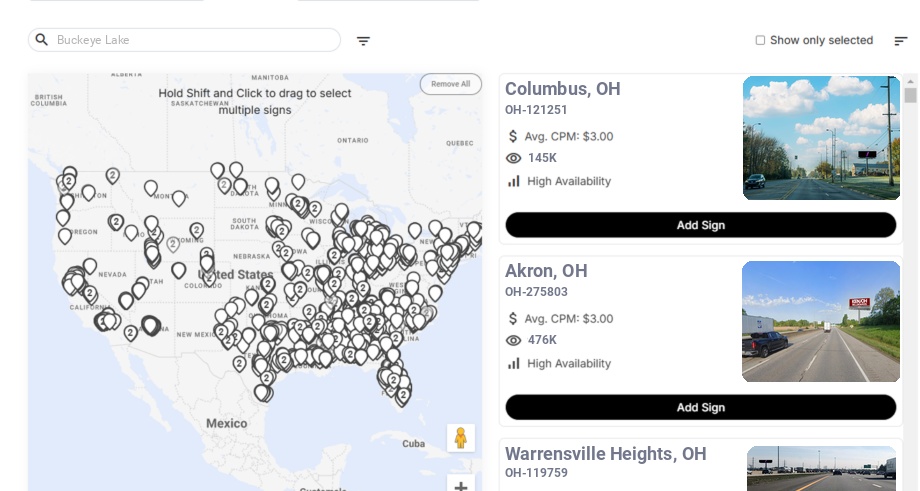
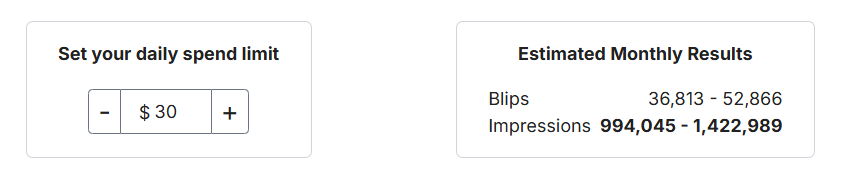
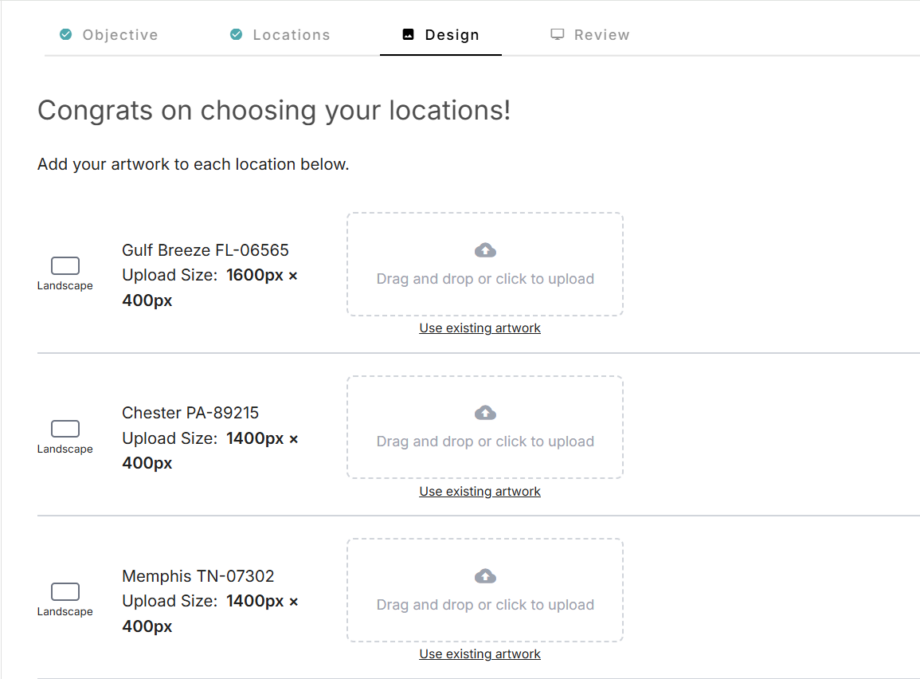
Make a splash with Buckeye Lake billboards using Blip’s easy, self-serve platform. Choose your favorite billboards in Buckeye Lake, Ohio, set any budget, and launch eye-catching digital ads with full control and real-time results.
Billboard advertising
in Buckeye Lake has
never been easier
HERE'S HOW IT WORKS
How much is a billboard in Buckeye Lake?
Billboards in other Ohio cities
Buckeye Lake Billboard Advertising Guide
Buckeye Lake is one of central Ohio’s classic getaway spots—a small village wrapped around a busy recreational lake, sitting right on the I‑70 corridor between Columbus and Zanesville
Understanding the Buckeye Lake Market
Buckeye Lake itself is a village of only about 3,000 residents, but it anchors a much larger lake region that spans Fairfield, Licking, and Perry counties. Within a 20‑ to 25‑minute drive we’re touching parts of:
- The east Columbus suburbs (Pataskala, Pickerington Reynoldsburg)
- The cities of Newark (about 50,000 residents) and Heath
- Lancaster
Key context (recent estimates):
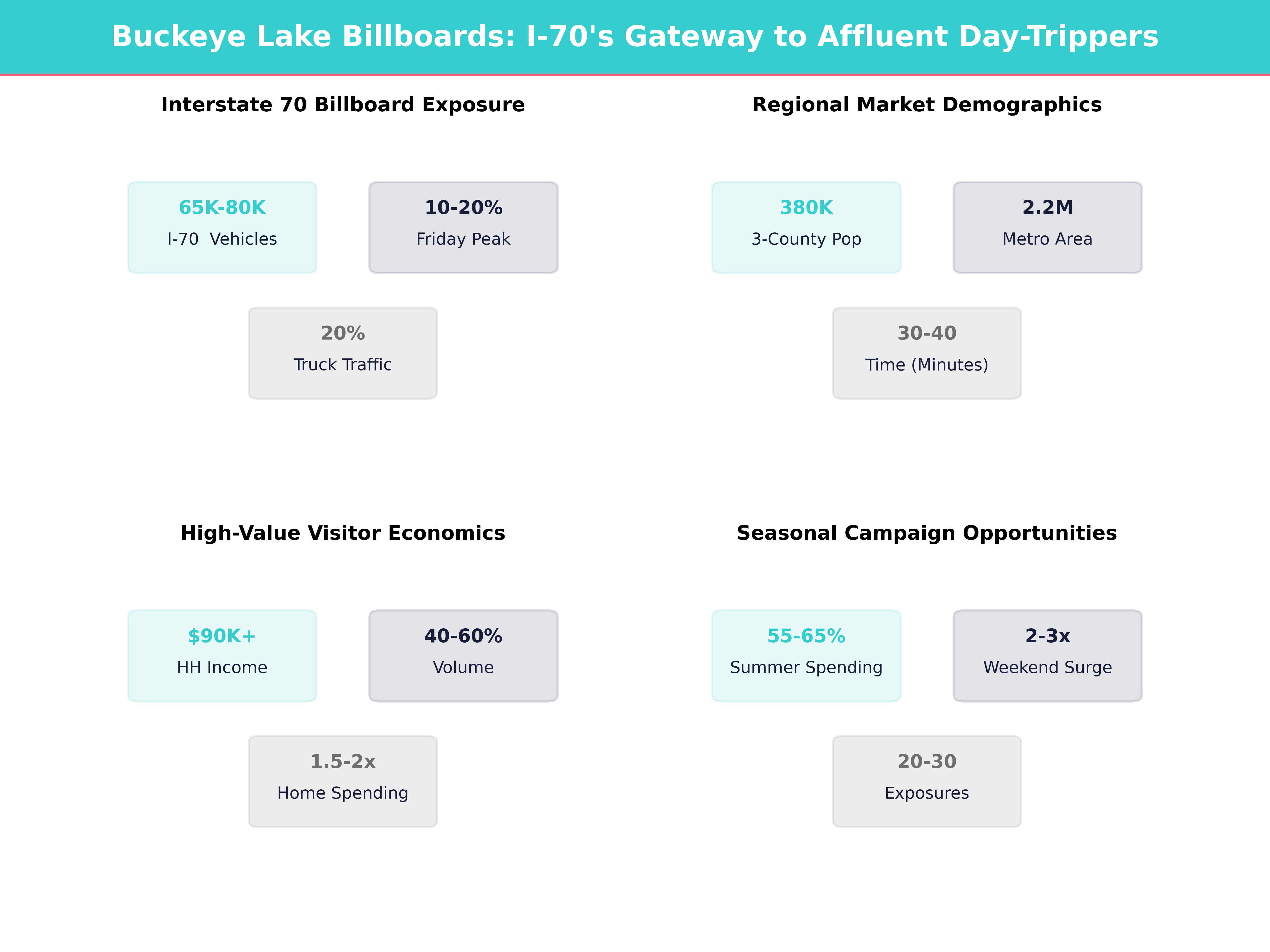
- Fairfield County has roughly 165,000 residents, Licking County about 180,000, and Perry County about 35,000, giving us around 380,000 people in the broader catchment area.
- The Columbus metropolitan area now exceeds 2.2 million people, and Columbus itself is approaching 910,000 residents, feeding a large, drive‑ready visitor base.
- Median household income in the three‑county region generally runs from the mid‑$50,000s to low‑$70,000s, with many Columbus‑area visitors coming from suburbs where household incomes often exceed $90,000—strong spending power for restaurants, entertainment, and recreation.
- The village is directly off I‑70, one of Ohio’s main east‑west arteries connecting Columbus with Zanesville, Wheeling, and points east. Across much of I‑70 in central Ohio, more than 20% of traffic is heavy trucks, which supports fuel, lodging, and quick‑service offers.
- Buckeye Lake is a heavy day‑trip destination; the lake is within about 30–40 minutes of much of the Columbus metro, making it attractive for spontaneous visits that billboard messaging can strongly influence. Day‑trippers typically spend less than 24 hours in market but can account for 40–60% of total visitor volume to similar “drive‑to” lakes.
Tourism agencies like Visit Fairfield County, Explore Licking County, and Visit Buckeye Lake consistently promote the lake as a four‑season getaway, but visitor volume is heavily skewed toward late spring through early fall. In many Ohio lake communities, 55–65% of annual visitor spending happens between Memorial Day and Labor Day, with summer weekends often running at 2–3x the average daily visitor count.
For advertisers, this means we’re not just speaking to a village of 3,000; we’re tapping into a dense drive‑market of well over 300,000 nearby residents plus seasonal visitors who collectively generate tens of millions of dollars in annual lake‑related spending—people who use Buckeye Lake as both a recreation hub and a pass‑through along I‑70. That combination makes billboards in Buckeye Lake unusually efficient for brands that want to reach both local customers and travelers on the move.
For more granular local context, you can also reference:
Traffic Patterns and Prime Billboard Corridors
To get the most from Buckeye Lake billboards, we need to think like drivers do. Understanding how traffic flows across the lake region helps you decide where Buckeye Lake billboard advertising will have the highest impact.
1. I‑70 East–West Corridor
According to the Ohio Department of Transportation
- Heavy commuter traffic each weekday as people travel between the lake region and Columbus; in central Ohio, roughly 75–80% of workers commute by car alone, and average commute times in the region run 25–30 minutes—prime billboard exposure windows.
- Strong weekend leisure traffic, especially Friday afternoons and Sunday evenings, as visitors head to and from the lake. Weekend days can see 15–25% higher passenger‑vehicle volumes compared with midweek on good‑weather summer weekends.
- A blend of local, regional, and through‑traffic, giving us both branding and direct‑response potential. In similar interstate corridors, 30–40% of vehicles are “through‑trips” not starting or ending in the immediate counties—ideal for fuel, food, and lodging offers.
Strategic uses on I‑70:
- Promote destinations “this exit” or “next 2 exits” to capture impulse stops; studies of interstate traveler behavior show that more than 60% of food and fuel decisions are made en route, not planned.
- Weekday, rush‑hour campaigns appealing to commuters (auto services, home services, healthcare, education). Morning and evening peaks often account for 40–45% of daily traffic, so concentrating impressions here increases effective frequency.
- Weekend campaigns aimed at lake visitors (restaurants, rentals, marinas, events, breweries, live music). Align with check‑in/out behavior—Friday 3–8 p.m. and Sunday 11 a.m.–6 p.m. when departure traffic is highest.
2. Local Connector Roads Around the Lake
Key local routes include Hebron Road (OH‑79), Mill Dam Road, and the local grid streets within the village of Buckeye Lake and nearby Hebron and Thornville. While traffic volumes are smaller than on I‑70, with many local segments in the 5,000–15,000 vehicles‑per‑day range, drivers here are:
- More likely to be repeat viewers (residents, workers, seasonal slip or campground renters). Residents in small communities can pass the same sign 10+ times per week during normal routines.
- Closer to decision points for dining, shopping, entertainment, and essential services. National out‑of‑home research shows that up to 50% of OOH‑influenced store visits occur within 30 minutes of viewing a sign.
We can use these local‑road placements to deliver:
- Frequent‑view “top‑of‑mind” campaigns for local essentials (grocery, hardware, auto repair, medical, dental). Consistent exposure—seeing a message 10–20 times per month—can increase brand recall by 20–30%.
- Event and live‑music promos for lakefront spots and nightlife.
- Service‑area based advertising: landscapers, roofers, HVAC, marinas, boat repair, especially targeting the roughly 40–50% of nearby households that are owner‑occupied single‑family homes and therefore more likely to purchase maintenance services.
3. Directional Strategy: Westbound vs. Eastbound
- Westbound toward Columbus:
Great for morning commuters, promotion of Columbus‑bound services (park‑and‑ride, transit, downtown events, jobs), and reminding visitors leaving the lake of businesses they just passed (“Plan your next weekend at Buckeye Lake – Book now”). With around three‑quarters of workers in the region commuting by car, targeting 6–9 a.m. and 4–7 p.m. westbound flows is especially efficient. - Eastbound away from Columbus:
Ideal for enticing metro residents to exit for Buckeye Lake, highlighting “Today at the Lake” offers (happy hour, boat rentals, patio dining, festivals, live music). In many lake destinations, 60–70% of visitor arrivals occur between late morning and early evening (10 a.m.–6 p.m.), which is when eastbound ads can do the most work.
When we build a Blip campaign, we can weight impressions toward boards that match our best direction and daypart (morning vs. evening) so our message meets the right driver at the right time. This selective approach to billboard rental in Buckeye Lake allows smaller budgets to compete effectively by focusing on only the most valuable impressions.
For road construction, travel alerts, and detailed traffic statistics, check ODOT’s regional resources via District 5 (Jacksontown) District 6 (Delaware)
Seasonality: Planning for Lake Rhythms
Buckeye Lake’s economy and traffic patterns shift dramatically through the year. A smart digital billboard strategy leans into these patterns instead of ignoring them.
Across Midwest lake communities, it’s common for:
- 50–60% of annual visitor spending to occur in summer (June–August)
- 20–30% in spring and fall shoulder seasons
- 10–20% in winter
We can assume Buckeye Lake follows a similar pattern, especially given its state‑park core and proximity to Columbus.
Spring (March–May)
- Reopening of seasonal businesses: marinas, patios, rental properties. In comparable Ohio lakes, 60–70% of seasonal operators reopen by mid‑May.
- Rising weekend traffic as temperatures climb; even a 10°F rise in weekend temperatures can lift visitation by 10–20% for outdoor destinations.
- Ideal time to launch awareness campaigns for new businesses or services before peak competition. Consumers often begin planning summer trips 30–60 days in advance.
Campaign ideas:
- “Season opener” offers and grand re‑openings.
- Pre‑booking for summer rentals, charters, and events—early‑bird discounts can shift 15–25% of bookings into pre‑season windows.
- Home services targeting lake properties (docks, landscaping, deck work, roofing), as many owners tackle projects before Memorial Day.
Summer Peak (June–August)
The lake is in full swing:
- State park beaches, boating, festivals, and concerts draw large crowds; Buckeye Lake State Park Ohio Department of Natural Resources
- Businesses see their highest weekend revenue; for many seasonal operators, 50% or more of annual sales may occur in these three months. Friday–Sunday can account for 60–70% of weekly revenue in peak season.
- Traffic surges on nice‑weather days and holiday weeks (Memorial Day, July 4th, Labor Day). Holiday weekends can push lake visitation to 150–200% of typical summer levels.
Campaign ideas:
- Frequent, short‑duration Blips on Fridays and Saturdays targeting visitors as they arrive. Increasing digital board frequency from a few plays per hour to 6–10 per hour on peak days can lift ad recall by 20–40%.
- “Tonight only” offers for live music, drink specials, or special menus. Scarcity‑driven messaging often sees higher response among visitors on short stays.
- Cross‑promotions among local attractions (restaurant + boat rental, brewery + lodging packages) to increase average party spend; joint offers can drive 10–15% higher per‑visit revenue.
Fall (September–November)
- Visitor volume softens but remains meaningful, especially on fair‑weather weekends. Shoulder‑season weekends can still run at 50–70% of peak summer visitation.
- Locals regain more control of the roads; it’s a good time to deepen relationships with resident audiences, who provide year‑round stability.
- School‑year routines return; family schedules become more predictable, and weekday traffic patterns normalize.
Campaign ideas:
- “Locals’ season” messaging: loyalty programs, weeknight specials, professional services. Loyalty offers can increase visit frequency among residents by 10–20%.
- Football‑themed promotions tied to Ohio State and local high schools (schedules often published by outlets like the Newark Advocate and Lancaster Eagle‑Gazette).
- Shoulder‑season tourism: fall foliage, wine and brewery trails, harvest festivals—fall travel has grown nationally, with some regions seeing 20–30% of annual visits in September–October.
Winter (December–February)
- Lake recreation slows, but year‑round residents and commute traffic remain; in many lake towns, permanent residents still represent 60–80% of winter spending.
- This is the cheapest, least crowded time to build brand share of voice. Digital billboard inventory is often less contested, allowing lower bids to capture a larger share of impressions.
Campaign ideas:
- Year‑round necessity services (healthcare, auto repair, insurance, heating/plumbing).
- Holiday shopping and New Year promotions; retail sales in November–December can represent 20–30% of annual revenue for many small businesses.
- Employment campaigns and recruitment for the next busy season; seasonal employers often start recruiting 60–90 days before Memorial Day.
With Blip’s flexible scheduling and budgeting, we can increase impression bids and frequency during summer weekends and dial them back or re‑target toward locals in the off‑season instead of buying the same schedule 12 months a year. That flexibility is a key advantage of digital billboard rental in Buckeye Lake compared with static placements that can’t easily shift with the seasons.
Audience Segments and How to Speak to Them
Because Buckeye Lake sits at the intersection of three counties and a major interstate, its audiences are more diverse than the village headcount suggests.
1. Local Residents
- Many residents commute toward Columbus, Newark, or Lancaster for work; in the broader region, about 60–70% of workers commute to a different city or town than where they live.
- Housing in the area has grown as people seek waterfront or near‑water lifestyles within driving distance of the city. In several central‑Ohio counties, housing unit counts have grown by 5–10% over the last decade.
- Residents see the same billboards multiple times per week; OOH studies show that commuters might pass the same sign 20–30 times per month, supporting long‑term brand building.
What works:
- Consistent branding and simple, memorable URLs or brand names. Repetition can boost unaided brand awareness by 15–30% over a few months.
- Local pride messaging (“Buckeye Lake’s Own…”, “Serving the Lake Region Since…”)
- Utility‑driven offers: healthcare, automotive, home services, education, financial services, especially those that address common household needs (about two‑thirds of regional households are family households).
2. Seasonal and Weekend Homeowners
- Own second homes or seasonal RV/camp spaces; in popular lake communities, 20–40% of housing units can be seasonal or recreational.
- Spend high amounts per visit (home maintenance, food, entertainment, watercraft, fuel); second‑home owners typically spend 1.5–2x as much per trip as day‑trippers.
- Often come from higher‑income Columbus or suburban neighborhoods where median household incomes can exceed $90,000–$100,000.
What works:
- Upscale messaging and high‑quality visuals that reflect lake lifestyle.
- Services tailored to part‑time residents (property management, security, cleaning, landscaping, premium dining).
- Calls‑to‑action that acknowledge limited time: “This Weekend Only,” “Book Before Sunday,” “Call While You’re Here.”
3. Day‑Trippers and Short‑Stay Visitors
- Come from within a 30–60 mile radius for a single day or weekend. For many Ohio attractions, 70–80% of visitors live within a two‑hour drive.
- Rely heavily on signage and mobile search to decide where to stop—nationwide, more than 40% of travelers say roadside signs influence last‑minute decisions.
What works:
- Exit‑driven campaigns: “Hungry? Exit 129 – 2 Minutes Ahead.”
- “Today” language: “Live Music Tonight,” “Brunch This Sunday,” “Rent Boats Today.”
- Clear directions: use “next exit,” distance (e.g., “1 mile ahead”), or recognizable landmarks.
4. Through‑Traffic on I‑70
- Truckers, vacationers, regional travel connecting Columbus to eastern states. As noted earlier, heavy trucks can represent 20%+ of traffic on some I‑70 segments.
- Less likely to exit unless the benefit is obvious and immediate.
What works:
- Highly value‑driven messages: fuel prices, quick food, fast EV charging, easy truck parking. Among interstate drivers, price and ease of access are top reasons for choosing a stop.
- Big, bold offers: “Exit Now – Clean Restrooms & Food,” “Drive‑Thru Open 24/7.”
- Brand awareness for regional chains and service networks.
By tailoring creative to these specific segments and then using Blip’s location and scheduling controls, we can run different messages for different audiences without paying for completely separate traditional campaigns. That’s where Buckeye Lake billboard advertising can feel personalized even though it’s reaching thousands of drivers.
Creative Best Practices for Buckeye Lake Billboards
On fast‑moving I‑70 and local highways, every second counts. We typically have 5–7 seconds of viewing time, sometimes less. Research on out‑of‑home readability suggests that keeping messages under 7–8 words significantly improves comprehension at highway speeds.
We should design campaigns accordingly.
Keep it simple and bold
- Aim for 6–8 words or fewer of main text.
- Use one dominant visual (boat, burger, beer glass, dock, logo) rather than cluttered collages.
- Contrast text and background (light on dark or dark on light). High‑contrast designs can be read at 20–30% greater distance than low‑contrast ones.
Use lake‑specific imagery
Buckeye Lake is a strong visual brand on its own. Images that resonate:
- Boats, marinas, docks, fishing, and sunsets.
- Patio dining, live music scenes, fire pits.
- Families and friend groups having fun on or near the water.
These instantly signal to drivers that the message is “for them” while they’re thinking about the lake—especially powerful when timed around arrival and departure patterns. In visual tests, contextually relevant imagery can increase ad recall by 10–20%.
Location‑anchored copy
We can give drivers just enough orientation to act:
- “At Buckeye Lake – Next Exit 129”
- “On the Water – 3 Minutes from This Exit”
- “In Downtown Buckeye Lake – Follow Signs”
Be sure the on‑ground wayfinding (street signage, Google Maps listing, etc.) aligns with what we promise on the billboard. Inconsistent directions are a common reason visitors abandon a potential stop.
Calls‑to‑Action that match mobile behavior
Most drivers will not remember a long URL; they will search or map you. To bridge that gap:
- Use short brand names or repeating phrases people can easily search (“Buckeye Lake Brewery,” “Lakefront Grill Buckeye Lake”).
- Consider tracking phone numbers or simple URLs (e.g., LakeNameDeals.com) if you want direct response. Dedicated billboard URLs or phone numbers make it easier to measure ROI.
- For immediate actions: “Search ‘[Brand] Buckeye Lake’,” “Tap ‘[Business]’ in Maps,” or “Text LAKE to [short code].” Nationally, more than 70% of adults report using smartphones in vehicles as passengers, and a significant share perform “near me” searches shortly after seeing an OOH ad.
Timing and Dayparting: When to Run Your Blips
Digital billboards let us pay for exposure when our audience is actually on the road. In Buckeye Lake, the “when” can matter as much as the “where.”
Weekday Patterns
- Morning (6–9 a.m.): Commuters heading west toward Columbus and east toward Newark/Zanesville. Effective for employment ads, coffee and breakfast, healthcare reminders, and service businesses targeting working adults. Morning peak hours can account for about 20–25% of daily weekday traffic.
- Midday (10 a.m.–3 p.m.): Errand runs, retirees, parents with young children, and tourists on flexible schedules. Good for retail, lunch promos, and professional services. Many restaurants generate 30–40% of daily traffic in this window.
- Evening (4–7 p.m.): Commuters returning home, locals going out to eat or run errands. Prime for restaurants, grocery, fitness, and family entertainment. Evening peaks often mirror morning, representing another 20–25% of daily traffic.
Weekend Patterns
- Friday afternoons/evenings: Heavy inflow of lake visitors; position offers that influence where people eat, drink, fuel, and stay. For many lake businesses, Friday can be 1.5–2x a typical weekday in revenue.
- Saturday midday: Visitors already at the lake, driving between activities; ideal for lunch, rentals, entertainment, and shopping. Saturday alone can account for 25–35% of weekly sales in peak season.
- Sunday afternoons/evenings: Departure traffic; good for last‑chance offers (“Stop on Your Way Out”), branding for future trips, and ad campaigns asking people to follow you on social or join an email list.
With Blip, we can:
- Bid higher and run more frequently during our highest‑value windows (e.g., Fridays 3–8 p.m. in June–August). Even a 20–30% increase in bid during top hours can dramatically shift the share of impressions you receive.
- Reduce spend or pause entirely during low‑yield periods (late night, off‑season, or times when your business is closed).
- Test different dayparts for a week or two and compare performance metrics (calls, web traffic, walk‑in counts). Short test windows of 7–14 days are often enough to see directional trends.
This kind of dayparting is especially useful when you’re experimenting with billboard rental in Buckeye Lake for the first time and want to prove out which hours drive the most response.
Industry‑Specific Opportunities in Buckeye Lake
Some sectors are especially well‑positioned to profit from Buckeye Lake’s unique geography.
Hospitality, Dining, and Nightlife
Lake visitors cluster around:
- Lakefront and near‑lake restaurants and bars.
- Breweries, wineries, and live‑music venues.
- Short‑term rentals, campgrounds, and hotels.
In similar lake markets, visitors often spend:
- 30–40% of their trip budgets on food and beverage
- 20–30% on lodging
- 20–25% on entertainment, attractions, and retail
Effective strategies:
- Promote daily or weekend specials just as traffic is arriving (Friday and Saturday afternoons).
- Align messages with events listed on sites like Visit Buckeye Lake or Visit Fairfield County (“Before the Concert,” “After the Fireworks”).
- Use limited‑time language: “Tonight Only,” “This Weekend,” “Happy Hour 4–6.” Limited‑time offers can increase urgency and response rates by 10–30%.
Tourism & Recreation
Boat rentals, fishing charters, marinas, kayak/PWC rentals, and guided tours can:
- Run pre‑arrival campaigns encouraging reservations (“Reserve Your Boat Before Exit 129”). Many operators find that advance reservations are worth 1.5–2x more than walk‑ups due to upsells and longer bookings.
- Focus on weather‑responsive, short bursts when warm weekends are forecast; shifting spend toward good‑weather days can improve return on ad spend significantly in outdoor‑dependent businesses.
- Partner with lodging providers for joint deals promoted on shared billboard creatives. Cross‑promotions can lift occupancy by several percentage points in shoulder seasons.
For broader recreation and state‑park information you can reference ODNR and regional partners via Ohio State Parks & Watercraft
Local Services and Trades
Even as a seasonal town, Buckeye Lake and surrounding communities have year‑round needs:
- Contractors, dock builders, roofers, landscapers, HVAC, electricians.
- Medical, dental, chiropractic, and urgent care.
- Insurance, banks, and real estate agents.
Campaign angles:
- Off‑season branding (fall/winter) when fewer tourist ads compete for attention, but 100% of residents still need core services.
- Local‑pride messages that differentiate you from Columbus‑only competitors.
- “Free estimate” or “Same‑week service” style offers targeted at residents. Across home‑services categories, “fast response” and “no‑obligation quote” rank among the top reasons consumers choose a provider.
Real Estate and Development
Buckeye Lake has seen renewed interest as a second‑home and lifestyle community:
- Advertise new developments, condos, or townhomes to I‑70 commuters. In many lake markets, 10–20% of buyers are converting from day‑trippers to owners.
- Promote open houses and model homes on weekends. Weekend open houses can attract 2–3x more traffic when supported by nearby signage and digital calls‑to‑action.
- Use lifestyle imagery showing year‑round enjoyment, not just summer. Buyers increasingly look for 4‑season destinations where they can use their properties 9–12 months a year, not only in July.
For all of these sectors, the flexibility of digital Buckeye Lake billboards makes it easier to match your creative and schedule to changing inventory, pricing, and demand.
Leveraging Local Events and Media
We can significantly boost relevance by syncing our campaigns with the local conversation.
- Monitor event calendars from Visit Buckeye Lake Explore Licking County, and Visit Fairfield County. Large events can double or triple typical weekend visitation.
- Align billboard creatives with marquee events: lake festivals, fireworks, boat parades, fishing tournaments, and major concerts.
- Use local news outlets such as the Newark Advocate, Lancaster Eagle‑Gazette, and regional broadcasters like NBC4 Columbus 10TV Columbus to identify popular annual happenings and community priorities.
Example plays:
- “Headed to the Fireworks? Stop at [Your Business] First” during event weekends.
- Seasonal tie‑ins like “Dock & Dine All Summer Long” or “Warm Up by the Lake This Fall.”
- Sponsorship messaging: “Proud Supporter of Buckeye Lake Events – [Your Brand].” Sponsorship tags can increase favorability toward a brand by 10–20% when tied to beloved local events.
For coordination with civic partners, consider keeping an eye on announcements from the Village of Buckeye Lake and county‑level calendars via Fairfield County and Licking County. Aligning creative with these community touchpoints helps make your Buckeye Lake billboard advertising feel native and supportive rather than intrusive.
Measuring Success and Optimizing Over Time
To get the most from digital billboards in Buckeye Lake, we should treat our campaigns as living, testable assets.
Trackable elements
- Use unique phone numbers or extensions on billboard campaigns. Call‑tracking can attribute dozens or hundreds of leads per month in busy seasons, depending on spend.
- Create simple, memorable URLs or landing pages just for billboard visitors. Even if only 5–10% of viewers respond directly, that can be enough to measure differences between creatives or schedules.
- Encourage easy calls‑to‑action like “Show this screen” or “Mention this billboard” for in‑store offers. Redemption rates as low as 1–3% can still be highly profitable if average transaction values are high (e.g., dining, lodging, home services).
Compare by season, daypart, and creative
We can:
- Run Version A and Version B creatives in alternating time blocks and compare calls, website traffic, and walk‑ins. Even small tests (a few hundred dollars per variant) can reveal 20–50% performance differences.
- Shift spend from underperforming dayparts (e.g., weekday midday) to stronger ones (e.g., weekend afternoons).
- Increase bids during high‑ROI months (June–August for tourism, November–January for retail/holidays) based on past results. For many businesses, reallocating 20–30% of budget toward best‑performing windows meaningfully improves overall ROI.
Listen to local feedback
- Ask customers directly, “How did you hear about us?” and track responses; many small businesses discover that 10–30% of new customers mention billboards when asked.
- Work with the Village of Buckeye Lake and local chambers or business associations to coordinate messaging around community priorities and events.
- Monitor local social media groups and pages for mentions of your billboard and brand.
Over time, this feedback loop helps you refine where you choose billboard rental in Buckeye Lake and which messages resonate most strongly with each audience segment.
Bringing It All Together
Buckeye Lake’s strength as an advertising market lies in its intersections: between three counties, city and small‑town life, tourists and locals, and leisure‑seekers and everyday commuters. By combining those insights with Blip’s on‑demand digital billboard platform, we can:
- Focus spend around the seasons, days, and hours that match our best customers, instead of treating all impressions as equal.
- Tailor creative to segment‑specific needs—locals, weekenders, and day‑trippers—rather than relying on one generic message.
- Continuously test, measure, and refine campaigns as conditions and visitor flows change, using data from traffic counts, sales patterns, and customer feedback.
When we use Buckeye Lake’s geography, traffic, and tourism cycles as the backbone of our strategy, digital Buckeye Lake billboards become more than just impressions—they become timely, targeted invitations that move people from the highway to our doors.