Billboards in Loveland, OH
No Minimum Spend. No Long-Term Contracts. Just Results.
Trusted by Leading Brands


Billboard advertising
in Loveland has never been easier
How much is a billboard in Loveland?
Why Choose Blip for Billboard Advertising in Loveland
Blip lets you launch in Loveland, Ohio fast and self-serve, reaching I-275 commuters and Loveland-Madeira Road traffic without the usual hassle.
Use flexible budgets in Loveland, Ohio to test ads on the Little Miami Trail and downtown weekends, then scale what brings results.
Daypart your Loveland, Ohio billboards to hit weekday rush hours, Friday dinner crowds, or Sunday family traffic when they're most active.
No contracts with Blip means you can run Loveland, Ohio campaigns for spring home services, then pause or pivot as seasons and demand change.
Track real-time analytics in Loveland, Ohio and adjust quickly for I-275 volumes, trail events, and commuter peaks across the city.
Blip's creative tools make it easy to tailor Loveland, Ohio billboards for families, cyclists, and affluent suburban commuters with clear, local messaging.
Frequently Asked Questions About Billboard Advertising in Loveland
How much does a billboard cost in Loveland, Ohio with Blip?
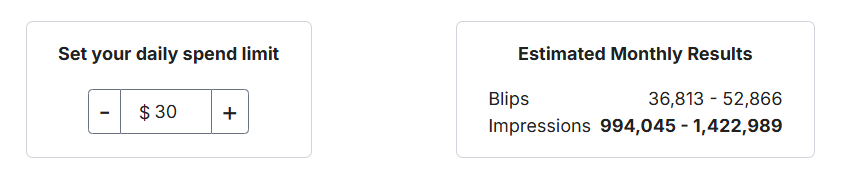
With Blip, you can advertise on Loveland billboards on any budget, because you set your own daily limit and only pay per “blip”—a 7.5 to 10-second ad display on a digital board. Blip automatically keeps your campaign within the budget you choose, and you can adjust that budget at any time, so you stay in control while your message appears on billboards in Loveland, Ohio. The price of each blip varies based on when and where you choose to run your ad and on advertiser demand, and your total cost is simply the sum of all the blips you receive.
Where can I advertise with Blip in Loveland, Ohio to reach commuters and local families?
Loveland sits at a unique crossroads of small-town charm and big-city access, with heavy regional traffic on I‑275 and the surrounding commercial corridors. Major commuter routes include I‑275, State Route 48, US‑22/3 (Montgomery Road) just west of Loveland, and Loveland‑Madeira Road feeding I‑275 and the Fields Ertel area. That mix makes Loveland a powerful location for digital billboard advertisers who want to reach both local families and commuters moving between Cincinnati’s eastern and northern suburbs.
What makes Loveland, Ohio a good market for Blip billboard advertising?
Loveland, Ohio sits at a unique crossroads of small-town charm and big-city access. Nestled along the Little Miami River downtown Cincinnati, it combines a tight-knit residential community of just over 13,000 people with heavy regional traffic on I‑275 and the surrounding commercial corridors. That mix makes Loveland a powerful location for digital billboard advertisers who want to reach both local families and commuters moving between Cincinnati’s eastern and northern suburbs.
When is the best time to run billboards in Loveland, Ohio with Blip?
Weekday morning (6–9 a.m.) and evening (4–7 p.m.) commuter peaks are best for professional services, healthcare, education, B2B, auto repair, and coffee or breakfast concepts. Midday (10 a.m.–3 p.m.) works well for lunch specials, seniors, at-home parents, and home services, while evenings and weekends are best for restaurants, entertainment, events, local retail, and churches. Using Blip’s dayparting and scheduling tools, campaigns can be aligned to these patterns and adjusted quickly as traffic changes.
What roads get the most billboard visibility in Loveland, Ohio?
I‑275 segments near Loveland carry 90,000–110,000 vehicles per day, depending on the precise location and direction, according to counts published by ODOT District 8. Key arterial roads around Loveland often see 15,000–25,000 vehicles per day, with some busy segments near retail clusters and interchanges approaching 30,000 vehicles per day. Even many local collector streets in and out of downtown Loveland carry 5,000–10,000 vehicles per day, providing consistent visibility for boards positioned near neighborhood retail and services.
Do I need a contract to advertise with Blip in Loveland?
No, Blip has no long-term contracts or minimum commitments. You can start, pause, or stop your campaign at any time.
How fast can I launch a billboard campaign with Blip in Loveland?
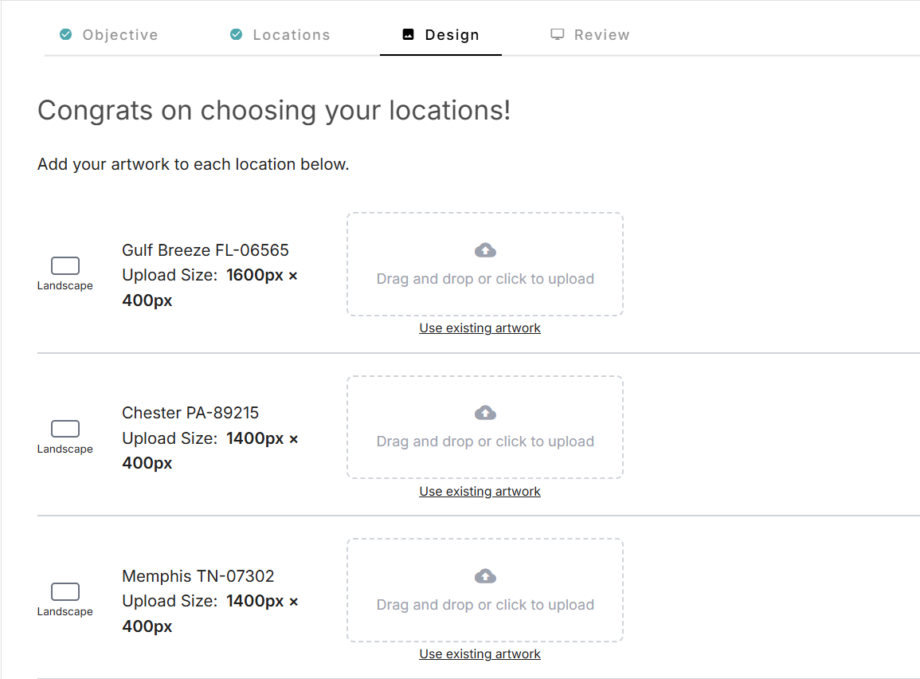
You can have your campaign live in minutes. Create a free account, select your locations, set your budget, upload your design, and start running once approved.
Where can I advertise with Blip in Loveland?
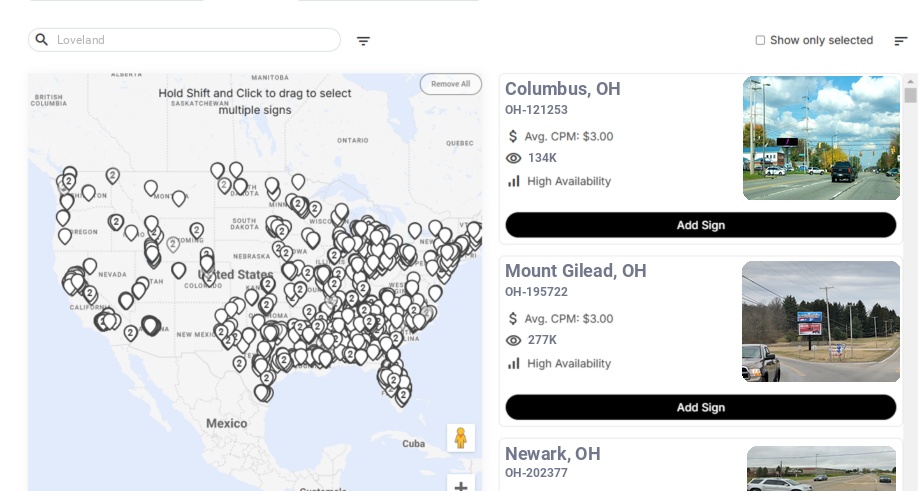
Blip has digital billboards in Loveland. You can browse available locations on a map, choose the ones that fit your audience, and start advertising right away.
Still have questions? Launch a campaign in minutes — no contracts, no commitments.
Start Your CampaignLoveland Billboard Advertising Guide
Loveland, Ohio sits at a unique crossroads of small-town charm and big-city access. Nestled along the Little Miami River downtown Cincinnati, it combines a tight-knit residential community of just over 13,000 people with heavy regional traffic on I‑275 and the surrounding commercial corridors. That mix makes Loveland a powerful location for digital billboard advertisers who want to reach both local families and commuters moving between Cincinnati’s eastern and northern suburbs. For brands exploring Loveland billboards for the first time—or looking to upgrade existing Loveland billboard advertising—these dynamics are especially important.
Below, we walk through what makes Loveland distinct—and how to use Blip’s flexible tools to build smart, data-driven billboard campaigns here, whether you’re testing a single location or scaling billboard rental in Loveland across multiple corridors.
Loveland at a Glace: Who You’re Reaching
Understanding the local audience helps us decide what to say, how to say it, and when to say it. For billboards in Loveland, these audience details influence everything from your creative to which roads you prioritize.
Population and households
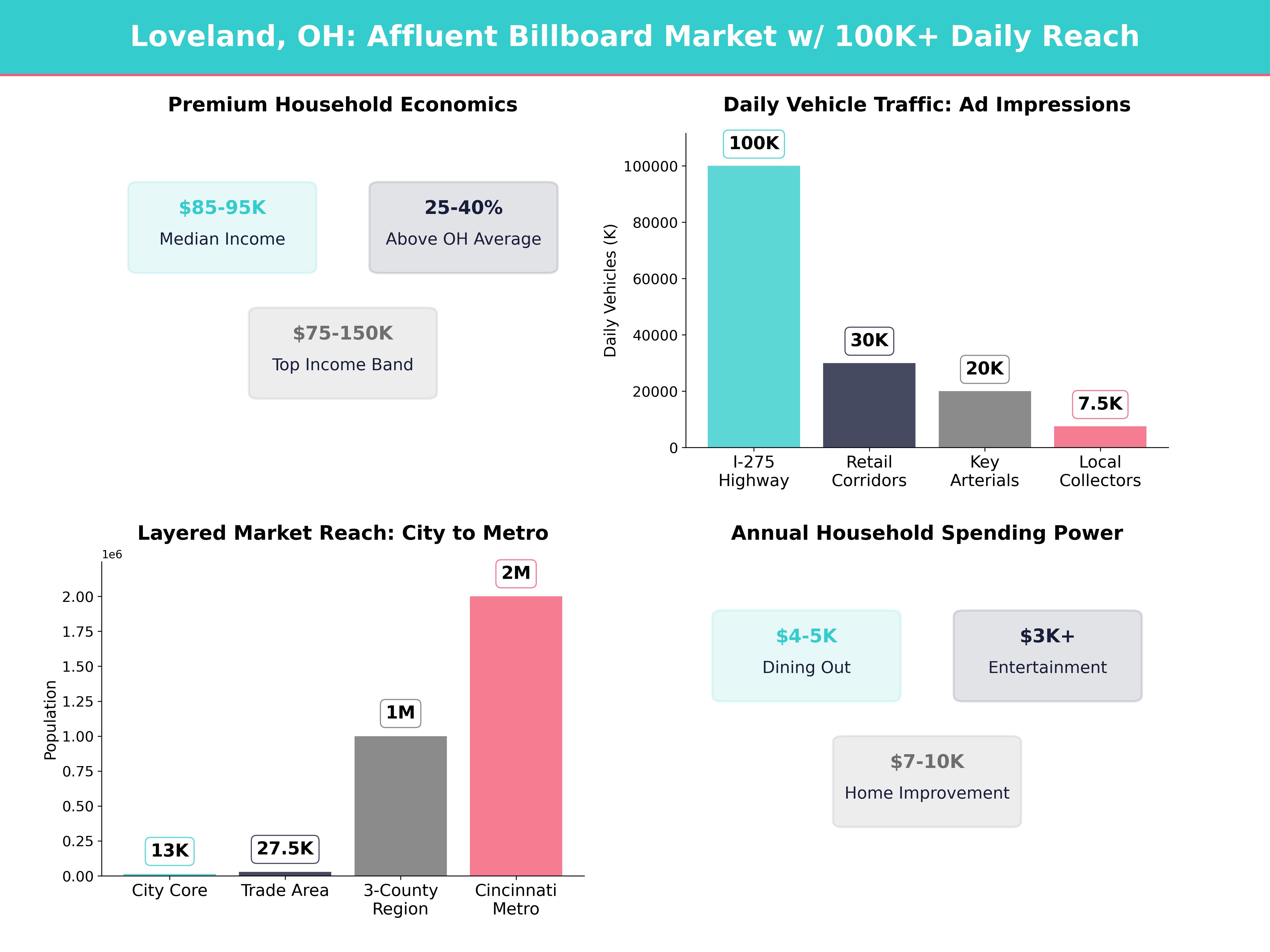
- The City of Loveland’s population is a little over 13,000 residents, according to recent estimates referenced by the City of Loveland. Nearby communities in the broader Loveland mailing area and school district add several thousand more residents, giving businesses access to a trade area of 25,000–30,000 people within a short drive.
- These residents are spread across roughly 5,000–5,500 households, giving Loveland a dense, neighborly feel compared with more spread-out suburbs. That translates to an average of about 2.4–2.6 persons per household, typical of family-oriented suburbs.
- Loveland sits in three counties—Hamilton, Clermont, and Warren—connecting us to a broader regional population of more than 1 million people across those counties combined, per Hamilton County, Clermont County Warren County sources. Greater Cincinnati as a whole has well over 2 million residents, meaning Loveland boards can serve as a gateway to a large metropolitan audience.
- Local schools such as Loveland City Schools enroll roughly 4,000–4,500 students across elementary, middle, and high school, signaling a strong base of families with children—key for education, retail, healthcare, and activity-based advertisers.
Income and spending power
Loveland is relatively affluent for the Cincinnati region:
- Recent local and regional planning sources put Loveland’s median household income around $85,000–$95,000, well above Ohio’s statewide median, which sits in the mid‑$60,000s. That means Loveland households typically have 25–40% higher income than the average Ohio household.
- A significant share of households fall into the $75,000–150,000 income band, with many dual‑income professional families commuting to major employment centers in Mason Blue Ash, and downtown Cincinnati. In some nearby ZIP codes, more than 40–50% of households fall into this higher-income bracket.
- Regional consumer expenditure data for similar-income suburbs in the Cincinnati metro show households in this range often spend $4,000–$5,000 per year on dining out, $3,000+ on entertainment and recreation, and $7,000–$10,000 annually on home improvement and furnishings.
- Homeownership is high—many nearby communities report 70–80% owner-occupied housing, which correlates with stronger demand for contractors, landscaping, real estate services, and financial planning.
What this means for your billboard messaging
- Emphasize quality and value, not just low price. “Trusted,” “locally owned,” and “family-focused” themes play well here, especially when paired with proof (e.g., “20+ years in Loveland,” “Voted #1 by local readers” referencing outlets like the Loveland Beacon). This kind of language helps Loveland billboards feel like a natural part of the community instead of generic regional ads.
- Highlight aspirational but attainable products and services—home remodeling, financial services, healthcare, education, premium casual dining, and family entertainment. In similar Cincinnati suburbs, businesses in these categories commonly see 10–20% of revenue coming from targeted local marketing such as out-of-home, digital, and sponsorships combined.
- Use clear calls-to-action that match how this audience buys: “Book your consultation,” “Visit this weekend,” or “Schedule your free quote” rather than only “Call now.” Including a simple URL or search phrase on your creative helps capture the 60–70% of consumers who research online before visiting a local business.
How People Move Through Loveland: Traffic and Commuting Patterns
Loveland’s daily rhythms are shaped by commuters and recreational visitors. Knowing where and when people are on the road should guide how we schedule Blip campaigns and which billboards in Loveland we select.
Commuter flow
Many Loveland residents work outside the city, especially in greater Cincinnati’s office and healthcare corridors:
- Downtown Cincinnati is about 20 miles away (typically 30–40 minutes depending on traffic).
- Major commuter routes include I‑275, State Route 48, US‑22/3 (Montgomery Road) just west of Loveland, and Loveland‑Madeira Road feeding I‑275 and the Fields Ertel area.
- Regional employment hubs like Mason, Blue Ash, and Sharonville host tens of thousands of jobs in corporate offices, manufacturing, and healthcare. That draws both Loveland residents outbound in the morning and non‑residents driving past Loveland on I‑275 and feeder roads.
The Ohio Department of Transportation (ODOT)
- I‑275 segments near Loveland carrying 90,000–110,000 vehicles per day, depending on the precise location and direction, according to counts published by ODOT District 8
- Key arterial roads around Loveland often see 15,000–25,000 vehicles per day, with some busy segments near retail clusters and interchanges approaching 30,000 vehicles per day.
- Even many “local” collector streets in and out of downtown Loveland carry 5,000–10,000 vehicles per day, providing consistent visibility for boards positioned near neighborhood retail and services.
Recreation and weekend traffic
Loveland is a major stop on the Little Miami Scenic Trail hundreds of thousands of users annually. Studies and park reports for comparable regional trails indicate popular segments can see 1,000–2,500 users on peak weekend days in good weather. Downtown Loveland has become a widely known cycling and riverfront destination, highlighted by the city’s own Downtown Loveland Visit Cincy.
This drives:
- Heavy weekend visitor traffic from across Greater Cincinnati, with summer Saturdays often bringing thousands of additional visitors into the downtown riverfront area.
- Strong summer and fall peaks as families and cyclists head to the riverfront, restaurants, and ice cream shops. Local businesses along the trail frequently report double or triple their typical weekday sales on sunny weekend days.
- Evening activity in the historic downtown area, with people staying for dinner, drinks, and events. Friday and Saturday evenings often fill local parking areas and trailhead lots to near capacity, as noted regularly by the City of Loveland and local media.
How to translate this into scheduling strategy with Blip
Using Blip’s dayparting and scheduling tools, we can align impressions to these patterns and make the most of Loveland billboard advertising:
-
Weekday morning (6–9 a.m.) and evening (4–7 p.m.) commuter peaks
- Best for: professional services, healthcare, education, B2B, auto repair, coffee/breakfast concepts.
- Messaging: time-sensitive (“Stop on your way home”), convenience (“On your commute via I‑275 exit…”).
- Regional traffic data show that in many suburbs, 40–50% of daily vehicle trips occur in these combined peak windows, so concentrating spending here can significantly raise the likelihood of being seen by working professionals.
-
Midday (10 a.m.–3 p.m.)
- Best for: lunch specials, seniors, at-home parents, home services.
- Messaging: “Call today,” “Same-week appointments,” “Lunch near downtown Loveland.”
- Many local retailers report 20–30% of their daily sales during the midday period, especially food and personal services, making this an efficient time for conversion-focused creatives.
-
Evenings and weekends
- Best for: restaurants, entertainment, events, local retail, churches.
- Messaging: “Tonight in Downtown Loveland,” “This weekend only,” “Saturday 10–4 in Montgomery / Mason,” etc.
- Hospitality businesses in riverfront and trail-adjacent areas often derive 50% or more of their weekly revenue from Friday–Sunday trade, meaning carefully timed weekend blips can punch far above their weight.
Because Blip lets us pay per “blip” and change schedules quickly, we can:
- Run heavier frequency during commuter peaks but pull back during slower periods, smoothing out cost-per-thousand (CPM) while focusing on high-intent audiences.
- Increase impressions during summer weekends when Downtown Loveland is packed, and reduce spend in slower winter shoulder seasons if needed. Some advertisers see 15–30% better response rates when budgets are shifted into these high-traffic windows instead of being spread evenly.
Seasonal and Weekly Timing Strategies in Loveland
Loveland’s calendar matters just as much as its clock, especially when you’re planning when to launch or ramp up billboard rental in Loveland.
Seasonal patterns
-
Spring (March–May):
- Rising trail use, spring sports, home improvement season, and pre-summer planning. Park and trail agencies across southwest Ohio typically report 30–50% increases in trail counts between February and May.
- Housing markets in the Cincinnati region often see 25–35% of yearly home listings enter the market in spring, driving demand for realtors, mortgage lenders, inspectors, and contractors.
- Great time for: landscaping, contractors, HVAC, realtors, summer camp signups, outdoor recreation, and festivals.
-
Summer (June–August):
- Peak visitor traffic to Downtown Loveland, Little Miami River June–August can account for 40–50% of annual revenue.
- Schools are out; families look for activities and day trips. Local camps and enrichment programs often fill 80–100% of their available slots by early summer, especially those that start marketing in late winter and spring.
- Ideal for: restaurants, ice cream shops, attractions, family activities, tourism, and seasonal retail.
-
Fall (September–November):
- Back-to-school, youth sports, and fall events. Nearby districts like Loveland City Schools and neighboring systems collectively serve tens of thousands of students, meaning school-year rhythms strongly influence traffic and purchasing.
- People shift attention to home projects and financial planning before year-end. Many financial institutions report 20–30% of annual IRA and retirement account contributions happening in the last quarter of the year.
- Strong window for: education, tutoring, healthcare, insurance, financial advisors, and contractors.
-
Winter (December–February):
- Holiday shopping and New Year’s resolutions. Retail data in comparable suburban markets show 25–30% of annual sales in some categories happening in November–December.
- Travel may dip slightly for downtown trail use but increase for commuting and shopping. Snow events and colder weather push more trips onto major arterials, where billboards hold steady visibility.
- Effective for: retail, fitness centers, tax prep, credit unions, and interior home services. Tax preparers and accountants often generate 60–70% of their yearly client interactions between January and April.
Weekly rhythms
Local news outlets such as the Loveland Beacon and regional coverage from the Cincinnati Enquirer often highlight:
- Friday and Saturday evenings in Downtown Loveland as peak dining and entertainment times. Restaurants commonly report 20–40% of weekly revenue on these two nights alone.
- Sunday mornings as a strong church and family activity period, with traffic around community corridors. Nearby congregations collectively draw thousands of attendees each weekend, creating consistent flows along main arterials.
With Blip, we can mirror this:
- Intensify campaigns Thursday–Saturday for hospitality and weekend events, using higher bid caps or more impressions during those days.
- Concentrate Sunday morning impressions for faith communities and brunch/lunch advertisers, when many households are already planning their day.
- Shift budget within the week rather than running the same schedule seven days straight—advertisers who reallocate spend toward known peak days often see 10–25% improvements in response metrics compared with flat schedules.
Crafting Creative That Resonates in Loveland
The best billboard strategy in Loveland pairs local context with clear, simple creative. Whether you’re running one or several Loveland billboards, these principles keep your message readable and relevant.
Local identity and values
Loveland brands itself as a “sweetheart” town, known for its historic downtown, riverfront, and community events, as reflected by the city’s materials on community life and amenities. This suggests:
- Community-oriented messages work: highlighting support for local schools, teams, and charities. Sponsoring or referencing beloved traditions (parades, 5Ks, festivals) covered by outlets like the Loveland Magazine can increase perceived local commitment.
- “Family,” “neighborhood,” and “local favorite” language feels authentic. In consumer surveys in similar Midwest suburbs, 60–70% of residents say they prefer to buy from locally owned businesses when given a clear choice.
- Visuals featuring the river, trail, bikes, or downtown streetscapes help ads feel rooted in place. Ads that feel “local” can outperform generic creative by 10–20% in recall studies for out-of-home.
Creative best practices for this market
- Use large, legible fonts: Drivers on I‑275 at 60–70 mph often have 3–6 seconds to absorb your message. Keep to 7 words or fewer of main text when aiming at highway traffic and aim for letter heights of 18–24 inches or more on standard-sized digital boards for readability.
- Bold color contrasts: Bright colors that contrast strongly (dark background / light text or vice versa) stand out, especially during early morning and at dusk when up to 30–40% of daily traffic may be driving in low-light conditions.
-
Directional cues:
- “Next exit,” “2 miles ahead,” or “5 minutes from Loveland” can dramatically improve response for brick-and-mortar locations. Directional boards in suburban corridors commonly drive 15–30% higher in-store response versus non-directional branding messages.
- Pair with a simple icon (arrow, exit sign lookalike) and your logo.
-
Localized offers:
- “Loveland families save 10%,” “Show this ad on your phone,” or “Trail riders welcome – water & restrooms” connect directly to local behavior. Redemption tracking of such offers can help you quantify billboard ROI; many local advertisers aim for 3–5x return on their media spend over a campaign.
-
Short URLs or search prompts:
- Instead of long URLs, try “Search: ‘Loveland Orthodontics’” or a short, memorable domain. Mobile search accounts for 60%+ of local-intent searches in many markets.
- QR codes can work on lower-speed routes (downtown streets, near retail), but are less effective on high-speed highways; use sparingly and only where safe.
Because Blip allows multiple creatives in a single campaign, we can:
- Run one set of creatives tailored to commuters (benefits, quick calls-to-action).
- Run another set tailored to weekend visitors and families (lifestyle images, event dates, offers).
- A/B test variations in headline, color scheme, and offer, then allocate more budget to top performers. Marketers who systematically test creative variants often see 20–40% improvements in engagement metrics over time.
Geo-Targeting and Placement Strategy Around Loveland
Loveland’s footprint touches three counties and sits near multiple business and retail hubs. Smart location choices can extend your reach far beyond the city limits and help you prioritize the most effective billboards in Loveland for your goals.
Core zones to think about
-
I‑275 Corridor (Northeast Cincinnati beltway)
- High daily volume (often 90,000–110,000 vehicles per day in segments near Loveland).
- Reaches commuters going between Loveland, Mason, Blue Ash, Milford, and downtown Cincinnati. Regional transportation agencies like the Ohio-Kentucky-Indiana Regional Council of Governments note that I‑275 is one of the metro’s busiest outer belt segments.
- Best for: regional brands, larger service areas (healthcare, universities, banks, auto dealers, home services serving multiple suburbs). For brands drawing from multiple ZIP codes, boards here can reach tens of thousands of unique drivers in a typical week.
-
Loveland‑Madeira Road and Feeder Arteries
- Strong daily local and regional traffic (15,000–25,000 vehicles per day typically).
- Connects downtown Loveland, residential subdivisions, and I‑275, as well as the Fields Ertel and Montgomery Road retail corridors.
- Best for: local retailers, restaurants, clinics, and professional services that draw from Loveland + nearby neighborhoods. A well-placed board here can repeatedly reach the same core 10,000–15,000 residents multiple times per week, building strong frequency.
-
Downtown Loveland / Trail Access Area
- Lower vehicle speeds but high visibility and visitor counts, especially spring–fall.
- Great for reaching cyclists, pedestrians, and families visiting the riverfront corridors. Trailhead and riverfront parking areas often cycle through hundreds of vehicles per day on peak weekends.
- Best for: food and beverage, entertainment, tourism, and special events. This area is also frequently highlighted by tourism and lifestyle coverage from outlets like Visit Loveland, OH Cincinnati Enquirer.
-
Adjacent Suburbs: Symmes Township, Miami Township, Mason, and Milford
- These areas contain major office parks, retail centers, and dense residential neighborhoods. Mason Kings Island, drawing millions of visits annually to the broader area. Symmes Township, Miami Township, and Milford round out the immediate trade area with additional rooftops, schools, and businesses.
- Reaching them via strategically placed digital boards helps Loveland-area businesses tap into broader demand. Boards along key corridors like Fields Ertel Road, Montgomery Road, and State Route 28 can effectively introduce Loveland destinations to residents who may not visit downtown regularly.
With Blip, we can create campaigns that:
- Focus only on Loveland-facing boards if we’re a local shop with a tight radius, prioritizing impressions within 3–5 miles of the business.
- Combine I‑275 + arterial boards if we serve a multi-suburb region, targeting audiences 10–20 miles out who are still within your service area.
- Allocate separate budgets to “local-conversion” locations (closest to your store or office) and “awareness” locations (broader regional reach). Many advertisers aim for a mix where 60–70% of spend is on conversion-focused boards and 30–40% on broader awareness.
Using Data and Testing to Optimize Your Campaign
One advantage of digital billboards is the data feedback loop. Even without 1:1 attribution, we can use specific numbers and signals to improve outcomes and refine how we approach Loveland billboard advertising over time.
Set clear, measurable goals
Tie your Blip campaign to metrics like:
- Store visits and same-store sales in the Loveland trade area. Retailers often look for at least a 5–10% lift in sales during well-timed billboard flights compared with baseline periods.
- Website sessions from IP geographies near Loveland and I‑275 corridors. Use basic analytics tools to track traffic from ZIP codes that correspond to your board locations; a 10–20% bump during your campaign is a good early sign.
- Call volume or form submissions during ad flight periods. Many service businesses track cost per lead, aiming to keep it comfortably below their typical customer acquisition cost.
- Coupon redemptions using billboard-only promo codes (“LOVELAND10,” for example). Even a small redemption rate of 1–3% of exposed audience can generate a strong return if your average transaction value is high.
Test systematically
Use Blip’s ability to upload multiple creatives and adjust schedules:
-
Run two to three headline variations at the same time on the same locations.
- After 1–2 weeks and at least a few thousand impressions, compare lift in website visits, calls, or coupon use. In many A/B tests, a winning creative can outperform the baseline by 20–50%.
-
Test different dayparts:
- For example, run one week with heavier spend 6–9 a.m., next week 4–7 p.m., and track which aligns better with inquiries or store traffic.
- Businesses often discover that one daypart delivers lower cost per action even if raw impressions are similar.
-
Compare location clusters:
- Group billboards near downtown Loveland separately from I‑275 or Fields Ertel corridors and see which cluster correlates with better results.
- Over several months, shifting budget toward your top 1–2 clusters can improve campaign efficiency by 15–30%.
Lean on local context
Use updates from:
- City of Loveland for road projects, festivals, and citywide events that can swing traffic by thousands of people over a weekend.
- Hamilton County and Clermont County
- Local media like the Loveland Beacon, Loveland Magazine, and Cincinnati Enquirer for seasonal stories, high school sports, and business news that highlight what locals are talking about.
If a major trail event, festival, or road closure is expected to bring thousands of extra visitors into Loveland, we can temporarily boost impressions and tailor creative to that moment (“Welcome trail riders,” “Festival weekend special,” etc.). Short, event-specific flights of 3–10 days can be especially effective when paired with strong offers and clear dates.
Practical Campaign Ideas for Key Local Industries
To make all of this concrete, here are ways different types of advertisers can use Loveland’s unique dynamics with Blip. These examples apply whether you’re just starting billboard rental in Loveland or expanding an existing footprint.
Local restaurants and bars
- Target zones: Downtown Loveland approaches, Loveland‑Madeira Road, nearby I‑275 exits, and corridors feeding trail access points.
- Best times: Evenings (4–9 p.m.), weekends, and sunny spring/summer days. Many restaurants see 20–30% higher check counts on warm, dry days compared with rainy or cold ones.
-
Creative ideas:
- “Dinner on the river tonight – 5 minutes ahead in Downtown Loveland.”
- Include a mouth-watering dish photo, a simple logo, and a short web address.
- Show different creatives by daypart (lunch special vs. dinner/date night). Casual dining chains often see 5–15% sales lifts in markets where they combine digital billboards with search and social advertising.
Home services (contractors, HVAC, landscaping, roofing)
- Target zones: I‑275 corridor and suburban arterials connecting Loveland, Mason, and Milford.
- Best times: Morning and early evening commute, heavier in spring and fall when weather drives home maintenance needs. Many HVAC and roofing businesses generate 40–60% of annual revenue in these shoulder seasons.
-
Creative ideas:
- “Loveland’s trusted roofer – free inspection this week – Call ###‑####.”
- Emphasize “locally owned” and “serving Loveland, Mason, Milford.”
- Rotate seasonally: A/C tune-ups before summer, furnace checks before winter, roof/gutter/siding before storm seasons. Include urgency where appropriate (“Book in 48 hours,” “Limited appointments this week”) to push action.
Healthcare and dental/orthodontic practices
- Target zones: Boards near schools, residential corridors, and commuter routes used by parents.
- Best times: Weekday mornings and afternoons, plus early evening for after‑work appointments. In many family practices, 30–40% of visits occur between 3–7 p.m.
-
Creative ideas:
- “New patients welcome – Loveland family dentistry – 3 miles ahead.”
- Use warm imagery (families, kids) and emphasize convenience (“Evening appointments,” “Same-week visits”).
- For orthodontists, focus on teen and adult braces or aligners; many practices report that 60–70% of new patient inquiries start online, so pair billboard messaging with a strong landing page.
Education, camps, and extracurriculars
- Target zones: Neighborhood arteries, roads leading to schools, I‑275 for regional draw, and corridors near community recreation centers.
-
Best times:
- Camps: Late winter to spring for summer registration; camps that advertise by March often fill 70–90% of spots before school lets out.
- Tutoring/learning centers: Late summer (back-to-school) and January (mid-year boost). Enrollment spikes of 20–30% are common around these times.
-
Creative ideas:
- “Loveland summer camp – limited spots – enroll now.”
- Short URL and strong visual (kids outdoors, STEM activities, sports).
- Emphasize outcomes: “Boost reading skills,” “Get ahead in math,” or “College prep starts here.”
Financial services and real estate
- Target zones: I‑275 and high-income residential corridors, plus routes into downtown Loveland and nearby business districts.
- Best times: Weekday commutes, tax season (Feb–Apr), and year-end (Nov–Dec), when many households review finances. Advisors often set 30–50% of new client meetings during these windows.
-
Creative ideas:
- “Buying in Loveland? Talk to a local expert – [Brand Name].”
- “Loveland families: Plan for college and retirement – Free consultation.”
- For mortgage and real estate, reference market stats when appropriate (“Homes in Loveland often go under contract in days, not weeks”) to emphasize urgency and local expertise.
Events, festivals, and attractions
- Target zones: Downtown Loveland approaches, key exits and feeder roads from across Greater Cincinnati, and corridors highlighted by regional tourism outlets such as Visit Cincy.
-
Best times:
- Build-up: 2–4 weeks before event, with a gradual ramp in impressions. Many organizers aim to reach the same local household 5–7 times before the event date to drive attendance.
- Heavy push: The week and weekend of the event.
-
Creative ideas:
- “Loveland Riverfest – July 20 – Live music & family fun – Downtown Loveland.”
- Countdown creatives (“3 days away”) rotated as the date approaches.
- Include time, date, and a simple URL or “Search: [Event Name]” to make it easy for drivers to find more information later.
Because Blip allows you to buy short bursts of impressions at flexible budgets, even smaller events or nonprofit organizations can afford visibility during their most critical days. A modest campaign of a few thousand targeted impressions over 7–10 days can still generate meaningful awareness when focused on the right locations and times.
By combining Loveland’s specific traffic patterns, seasonal rhythms, and community identity with Blip’s location control, dayparting, and creative flexibility, we can build campaigns that punch far above their budget. The key is to think locally: speak to Loveland residents and visitors in the context of how they actually live, commute, and spend time—then let data guide continuous refinement for your Loveland billboard advertising over the long term.