Billboards near South Euclid, OH
No Minimum Spend. No Long-Term Contracts. Just Results.
Trusted by Leading Brands


Billboard advertising
near South Euclid has never been easier
How much is a billboard near South Euclid?
Why Choose Blip for Billboard Advertising near South Euclid
Blip lets South Euclid brands launch fast on nearby corridors like I-271, I-480, and I-90—reaching commuters without traditional billboard hurdles.
Set a daily budget for South Euclid billboards and Blip keeps you on track, ideal for testing ads around Notre Dame College and Cedar Center traffic.
Use dayparting in South Euclid to hit rush hours, school runs, or weekend shoppers near Warrensville Heights and Wickliffe when they’re most likely to act.
No contracts means South Euclid advertisers can run short bursts for back-to-school, Browns season, or winter service promos, then pivot as demand changes.
Track South Euclid campaign results in real time and adjust creative or spend quickly based on commuter response across Cleveland’s east-side corridors.
Blip’s creative tools make it easy to build bold, clear South Euclid ads that stand out in 6-8 second drives on busy highways and local arterials.
Frequently Asked Questions About Billboard Advertising near South Euclid
How much does a billboard cost near South Euclid, Ohio with Blip?
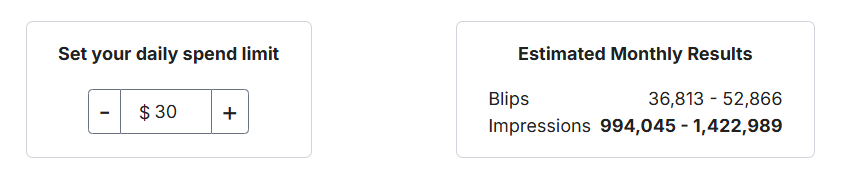
With Blip, you control exactly what you spend on South Euclid billboards by setting a daily budget that can be as modest or ambitious as you like, and Blip automatically keeps your digital billboard campaign within that limit. Each “blip” is a brief 7.5–10 second ad display on billboards near South Euclid, Ohio, and you only pay for the individual blips you receive, based on when and where your ads appear and current advertiser demand. Because Blip uses flexible, pay-per-blip pricing and lets you adjust your budget at any time, it’s easy to experiment, reach people in the South Euclid area, and scale up once you see what works.
Where can I advertise with Blip in South Euclid, Ohio?
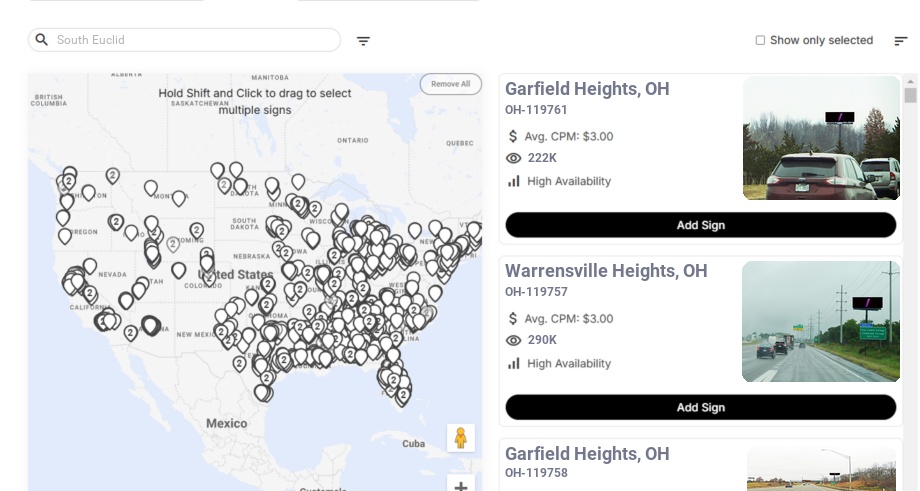
There are six nearby digital billboards in Warrensville Heights, Wickliffe, and Garfield Heights serving the South Euclid area. These locations are strategically placed within about 10 miles, giving coverage over the key east- and south-side commuter flows. If you’re looking for billboards near South Euclid without paying Beachwood or downtown premiums, these locations offer strong visibility and value.
Who can South Euclid billboards reach in the local market?
South Euclid sits at the crossroads of suburban neighborhoods, college life, and major commuter corridors on Cleveland’s east side. With six nearby digital billboards serving the South Euclid area, we can help you reach daily commuters, local families, students, and shoppers with precisely timed, data-informed campaigns. The South Euclid area is a compact but influential slice of eastern Cuyahoga County, with roughly 22,000 residents and a diverse mix of households.
What are the best times to run South Euclid, Ohio billboard ads with Blip?
Dayparting is especially powerful in the South Euclid area because most adults commute out of their home municipality for work. Morning inbound and outbound, midday, evening rush, and late-night/weekends each capture different audiences, from commuters and students to caregivers and shoppers. With Blip’s tools, you can concentrate your budget in the hours that matter most for your specific audience while monitoring impression delivery in near real time.
What nearby roads get the most traffic for South Euclid billboard advertising?
Our six digital billboards serving the South Euclid area are strategically located to reach the major commuter flows around I‑271, I‑480, I‑90, and nearby arterials. Warrensville Heights sits at the critical junction of I‑271, I‑480, and major arterials like Harvard Road and Warrensville Center Road, while Wickliffe and Garfield Heights also reach heavy east–west and north–south traffic. Because the boards are distributed around the South Euclid area rather than clustered in one spot, they can follow real commuting patterns and expand your reach beyond the city limits.
Do I need a contract to advertise with Blip near South Euclid?
No, Blip has no long-term contracts or minimum commitments. You can start, pause, or stop your campaign at any time.
How fast can I launch a billboard campaign with Blip near South Euclid?
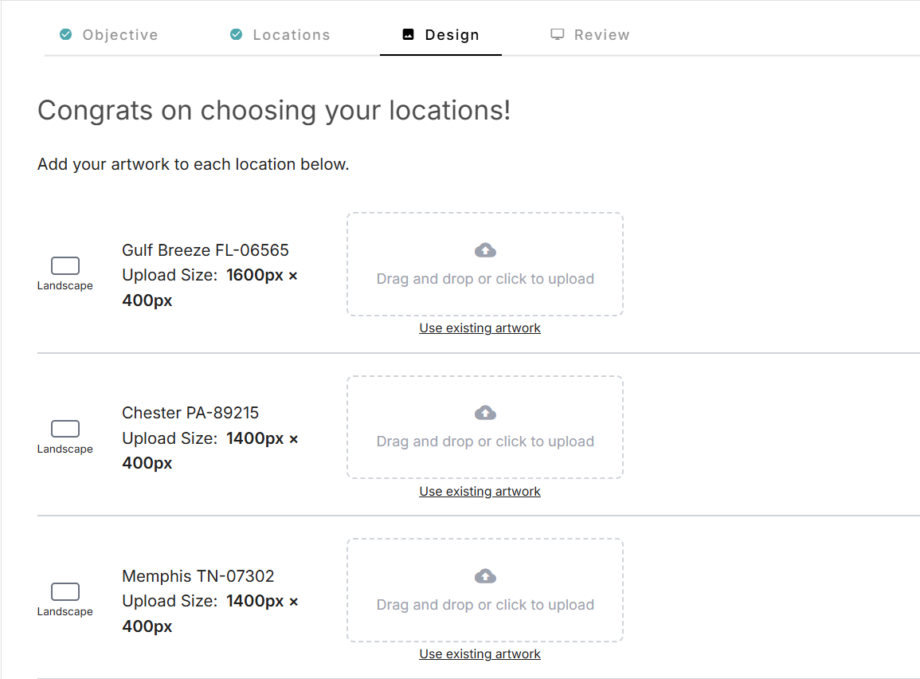
You can have your campaign live in minutes. Create a free account, select your locations, set your budget, upload your design, and start running once approved.
Where can I advertise with Blip near South Euclid?
Blip has digital billboards near South Euclid. You can browse available locations on a map, choose the ones that fit your audience, and start advertising right away.
Still have questions? Launch a campaign in minutes — no contracts, no commitments.
Start Your CampaignSouth Euclid Billboard Advertising Guide
South Euclid sits at the crossroads of suburban neighborhoods, college life, and major commuter corridors on Cleveland’s east side. With six nearby digital billboards in Warrensville Heights, Wickliffe, and Garfield Heights serving the South Euclid area, we can help you reach daily commuters, local families, students, and shoppers with precisely timed, data-informed campaigns. If you’re looking for billboards near South Euclid without paying Beachwood or downtown premiums, these locations offer strong visibility and value.
The South Euclid Area Market at a Glance
The South Euclid area is a compact but influential slice of eastern Cuyahoga County:
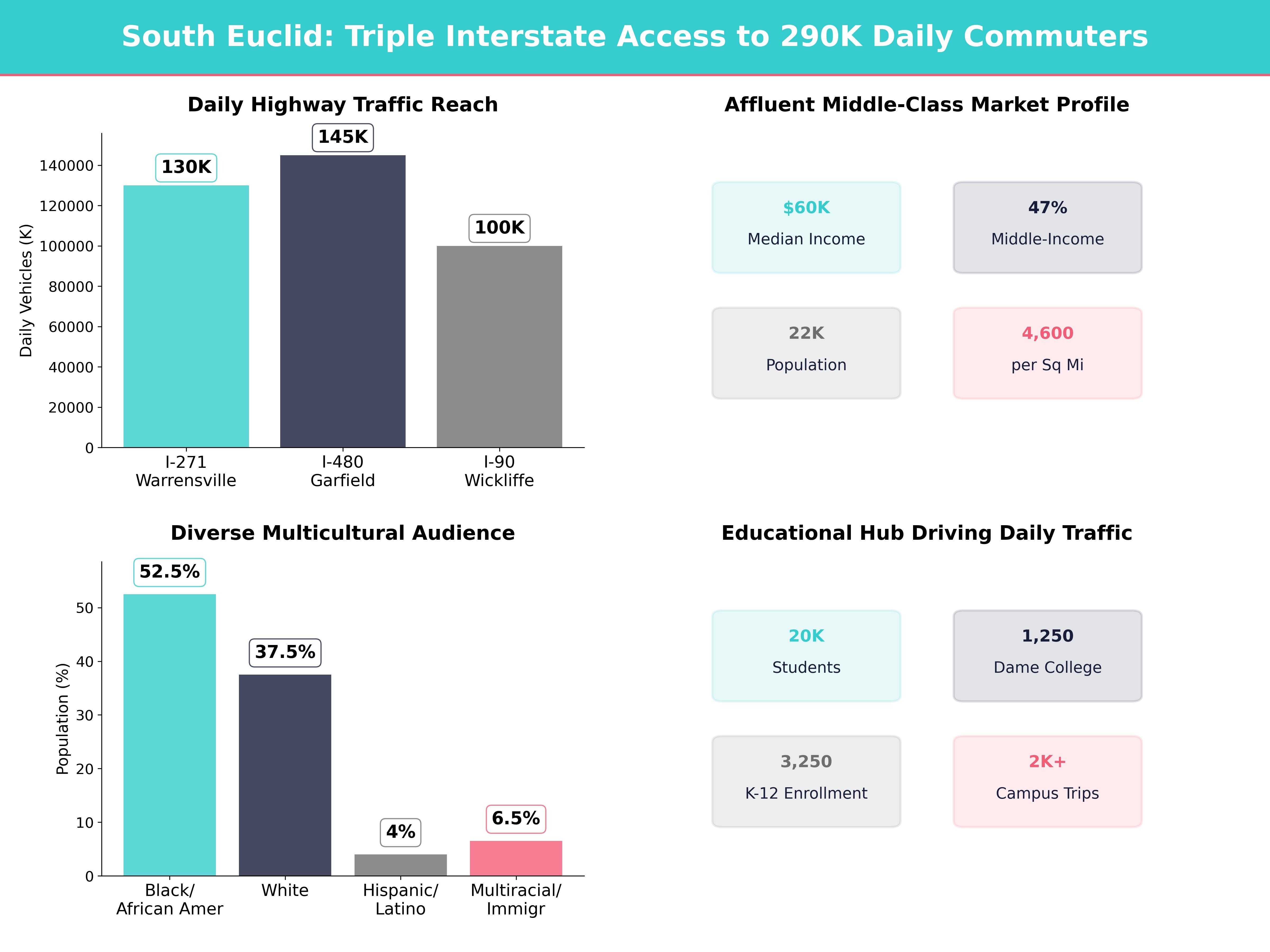
- The City of South Euclid reports a population of roughly 22,000 residents in its 4.7 square miles, with a density of over 4,600 people per square mile, making it one of the more densely populated east-side suburbs compared with many Cuyahoga County suburbs that average 2,500–3,500 residents per square mile.
- The community is notably diverse: estimates put the population at roughly 50–55% Black or African American, 35–40% White, 3–5% Hispanic or Latino, and a growing share (roughly 5–8%) of multiracial and immigrant households, including Eastern European, Middle Eastern, and African communities.
- Median household income in the broader east-side inner-ring suburbs sits around $55,000–$65,000, with roughly 45–50% of households in the core middle-income band of $35,000–$100,000—a strong consumer base for retail, health care, education, home services, and dining.
- About 30–35% of households in the surrounding area have children under 18, and average household size is around 2.4–2.6 people, supporting consistent demand for family-oriented services, youth activities, and everyday shopping.
- The median age in many nearby east-side communities is in the 38–42 range, giving you a balanced mix of young adults, working-age professionals, and older residents.
- The South Euclid area feeds into larger employment hubs in downtown Cleveland, University Circle, and the I‑271 corridor. Cuyahoga County as a whole has more than 1.2 million residents, and the Cleveland-Elyria metro area exceeds 2 million, giving campaigns broad spillover potential and the ability to influence consumers well beyond city limits.
Local institutions create reliable patterns of traffic and demand:
- Notre Dame College, located in the South Euclid area, serves about 1,000–1,500 students plus 150–200 faculty and staff, amplifying demand for food, housing, tutoring, fitness, and entertainment. During peak semesters, that can mean 2,000+ daily trips to and from campus. Visit the college at Notre Dame College
- Nearby universities like John Carroll University in University Heights and Case Western Reserve University in University Circle collectively serve more than 20,000 students and 5,000+ faculty and staff, many of whom live, work, or commute through the South Euclid area. Learn more at John Carroll University and Case Western Reserve University.
- Major health systems—including the Cleveland Clinic, University Hospitals, and MetroHealth—employ more than 80,000 people regionally, drawing thousands of daily commuters through I‑271, I‑480, and local arterials. You can explore these employers at Cleveland Clinic, University Hospitals, and The MetroHealth System.
- The City of South Euclid’s own development efforts, detailed at cityofsoutheuclid.com, highlight ongoing residential reinvestment, small business growth, and corridor improvements—especially along Mayfield Road and Cedar Center.
- Public schools in the surrounding area, including South Euclid-Lyndhurst City Schools, serve 3,000–3,500 students, generating predictable school-day traffic patterns and regular flows of parents and caregivers.
When we build campaigns for the South Euclid area, we can tap into this mix: students and young professionals, established families, faith communities, and commuters moving between Cleveland’s urban core and its eastern suburbs. For context, regional surveys show that more than 70% of adults 18–49 in Greater Cleveland see roadside advertising at least once per week, and about 40–50% say it has prompted them to visit a website, store, or search for more information—evidence that South Euclid billboards can reliably support both brand awareness and direct response.
Where Our Billboards Reach Drivers Near South Euclid
Our six digital billboards serving the South Euclid area are strategically located within about 10 miles, giving coverage over the key east- and south-side commuter flows. Traffic counts from the Ohio Department of Transportation (ODOT) NOACA
-
Warrensville Heights (about 5.9 miles from South Euclid)
- Sits at the critical junction of I‑271, I‑480, and major arterials like Harvard Road and Warrensville Center Road.
- ODOT counts along I‑271 in this area commonly range from 120,000 to 140,000 vehicles per day, translating to 3.6–4.2 million vehicle trips per month and 40–50 million per year along key segments.
- Warrensville Heights has more than 13,000 residents, but its daytime population swells higher because of nearby employment centers and retail like Pinecrest and Harvard Park, drawing shoppers and workers from across the east side.
- Draws shoppers to areas such as Cleveland’s east-side retail hubs and office parks, making it ideal for regional brands and services that want to reach both residents and employees.
-
Wickliffe (about 7.2 miles from South Euclid)
- Sits along I‑90 and SR‑2, key east–west routes linking Lake County suburbs (Willoughby, Mentor) to Cleveland.
- ODOT traffic counts on I‑90 in the Wickliffe area often top 90,000–110,000 vehicles per day, or roughly 2.7–3.3 million per month. Peak summer weekends can push volumes even higher as drivers head for lakefront parks and marinas.
- Lake County has a population of around 230,000, with about 60–65% of workers commuting out of their home municipality—many along I‑90—making Wickliffe ideal for reaching Lake County residents who shop, dine, or attend school and church in the South Euclid area.
- Local amenities like City of Wickliffe recreation facilities and nearby retail centers help keep weekend and evening traffic strong.
-
Garfield Heights (about 7.9 miles from South Euclid)
- Located around the intersection of I‑480, I‑77, and local routes like Transportation Boulevard, near regional retail destinations such as the City View Center area and other shopping corridors in the City of Garfield Heights.
- Sections of I‑480 in Garfield Heights see over 140,000–150,000 vehicles per day, producing an estimated 4.2–4.5 million monthly vehicle trips and more than 50 million annually.
- This placement is perfect for brands that serve the entire Greater Cleveland region but want strong penetration into the South Euclid area audience, especially commuters heading to and from the south and west sides.
Because our boards are distributed around the South Euclid area rather than clustered in one spot, we can build campaigns that follow real commuting patterns: east–west on I‑90, north–south on I‑271, and circumferential traffic on I‑480. Regional data shows that about 82–85% of workers in Cuyahoga and surrounding counties commute by car, truck, or van, and average one-way commute times in the east-side suburbs are about 23–26 minutes—long enough for repeated billboard exposures across a typical week.
Commuter Patterns and Dayparting Strategy
Most adults in the South Euclid area commute out of their home municipality for work—Cuyahoga County data shows that over 80% of workers commute to jobs outside their immediate suburb, and roughly 55–60% cross at least one municipal boundary each day. That makes dayparting especially powerful:
-
Morning inbound and outbound (6–9 a.m.)
- Warrensville Heights and Garfield Heights screens capture commuters heading to downtown Cleveland, University Circle (Cleveland Clinic, University Hospitals, Case Western), and the I‑271 office corridor.
- In many locations, 35–40% of daily traffic passes during the combined morning and evening rush periods, with 6–9 a.m. often accounting for 15–20% of daily volume.
- Use this window for essential services: banking, health care, education, and quick-service restaurants promoting breakfast or coffee. Brands that advertise in morning commute windows often see 10–20% higher recall among full-time workers compared with all-day averages.
-
Midday (10 a.m.–3 p.m.)
- Traffic remains strong but less congested; this is when caregivers, retirees, shift workers, and students are on the roads. In many corridors, midday still represents 30–35% of daily traffic.
- Ideal for promotions around grocery shopping, local events, home services, and medical appointments.
- Advertisers can use lower midday rates to stretch budgets and build frequency, often achieving 20–40% more impressions per dollar than during peak rush-hour pricing.
-
Evening rush (3–7 p.m.)
- Workers and students return to the South Euclid area via I‑271, I‑480, and I‑90.
- Drive-time traffic often spikes again, with ODOT peak hour volumes reaching 8–10% of daily traffic per hour, especially from 4–6 p.m.
- Perfect for restaurants, gyms, retail, and entertainment encouraging same-night visits or online orders. Many food-service and fitness advertisers report that 30–50% of same-day response clusters within a few hours of their evening billboard exposures.
-
Late-night and weekends
- Notre Dame College students, service workers, and second-shift employees generate steady traffic later in the evenings. Regional travel surveys show that 15–20% of all weekly trips occur on weekends, and late-night driving is significant for hospitality and shift-work sectors.
- Weekend traffic on I‑90 and I‑271 remains high thanks to shopping, youth sports, and visits to entertainment areas promoted by Destination Cleveland.
- Advertise nightlife, streaming services, weekend events, and time-flexible home services during these periods, often at more efficient cost per impression—CPMs can run 20–30% lower than during weekday peaks in some rotations.
With Blip’s tools, we can concentrate your budget in the hours that matter most for your specific audience—rush-hour for B2B and commuters, mid-afternoon for seniors and stay-at-home parents, evenings and weekends for leisure spending—while monitoring impression delivery in near real time.
Tailoring Your Message to South Euclid Area Demographics
The South Euclid area’s demographic mix should directly inform your creative:
-
Families and homeowners
- Inner-ring suburbs like the South Euclid area have a strong share of owner-occupied housing, often 60–65% in many nearby east-side communities, with median home values in the $150,000–220,000 range.
- About 25–30% of households are single-family homes with children, creating steady demand for pediatric care, activities, and home services.
- Focus messages on stability and value: “Protect your home,” “Upgrade this season,” “Save on your family’s care.”
- Home services, health care, insurance, and education see strong response from this group; national OOH studies show that up to 40% of homeowners exposed to local outdoor ads report visiting a business they saw advertised.
-
Students and young adults
- With Notre Dame College and nearby John Carroll University, there are thousands of students and early-career professionals moving through the South Euclid area. University data indicates that 60–70% of students in these institutions either commute or live off campus, generating frequent trips past nearby corridors.
- Use bold, high-contrast design with simple, benefit-driven messages: “Student discounts,” “Move-in specials,” “Night classes that fit your schedule.”
- Include short URLs or recognizable app icons instead of phone numbers; surveys show that over 90% of college students own smartphones and 70–80% will search a brand immediately if the URL is short and memorable.
-
Diverse, multicultural audience
- The South Euclid area’s racial and cultural diversity means inclusive imagery and language are critical. Roughly 45–50% of residents in many east-side inner-ring communities identify as non-White, and more than 10% speak a language other than English at home.
- Use visuals representing different ages and ethnic backgrounds and avoid assumptions about family structure or lifestyle.
- If your business serves specific cultural or faith communities, consider creative variants that highlight those offerings, rotated via Blip’s multiple-creative support—this can boost relevance and recall by 10–30% according to typical A/B tests.
-
Commute-focused professionals
- Many residents work at large employers such as the Cleveland Clinic, University Hospitals, and major office parks along I‑271 and in downtown Cleveland. The health-care sector alone accounts for 18–20% of regional employment.
- Emphasize convenience and time-saving: “Book in 60 seconds,” “Same-day appointments,” “On your way home, pick up dinner.”
- Professional segments often respond strongly to time-bound offers; campaigns with explicit time cues (“Today Only,” “This Week”) can see 15–25% higher engagement versus generic branding.
The more precisely you match creative and scheduling to these segments, the more efficiently your impressions convert into leads and sales.
Creative Best Practices for High-Traffic Corridors
Drivers near the South Euclid area typically have 6–8 seconds to absorb a billboard message at highway speeds of 55–65 mph. Design accordingly:
-
Limit text to 7–10 words
- Each additional word can reduce legibility and recall, and OOH research shows that concise headlines can improve message retention by 20–30%.
-
Use a single, dominant message:
- “New Urgent Care 8 Minutes from South Euclid Area”
- “Cedar Center Dining: Dinner in 10 Minutes”
- “Notre Dame Area Apartments – Now Leasing”
-
Use large, legible fonts
- Main copy should be at least 18–24 inches in real-world height (your designer or our templates can convert to pixels), with key words sometimes pushed to 30 inches on freeway boards.
- Avoid script fonts and thin weights; bold sans-serif fonts read best at 65+ mph and can improve legibility distance by 100–200 feet versus decorative fonts.
-
High contrast colors
- Light text on a dark background—or vice versa—improves legibility, especially at night and during rain or snow.
- Cleveland’s frequent overcast days (the region typically sees 160–180 cloudy/partly cloudy days per year and 60+ inches of combined rain and snow) mean bright colors like yellow, cyan, and white pop well.
- High-contrast color combinations have been shown to increase message recall by up to 38% compared with low-contrast palettes.
-
Strong call to action
- Use one clear action: “Exit at …,” “Text [KEYWORD],” “Visit Cedar & Green,” “Download [APP].”
- For campaigns focused on awareness, a short tagline plus logo is enough; brand-awareness campaigns that run for 8–12 weeks typically achieve recognition lifts of 20–40% in post-campaign surveys.
-
Local cues
- References like “Minutes from Cedar Center,” “Serving the South Euclid area since 19XX,” or “Near Mayfield & Green” help drivers connect the message with a specific place and can raise perceived relevance by 10–15%.
- For seasonal campaigns, lean into local traditions covered by outlets like Cleveland.com and WKYC—e.g., back-to-school, Browns and Cavaliers seasons, or holiday shopping.
By A/B testing multiple creatives and rotating them via Blip, we can quickly see which visuals and messages perform best—often within 1–2 weeks—and then allocate more budget to top performers.
Seasonal Timing: How the Local Calendar Affects Campaigns
The South Euclid area’s rhythms follow both suburban and collegiate calendars, and timing your flights around them can materially improve results:
-
Winter (December–February)
- Snowy conditions and early sunsets mean more people rely on nearby services and see billboards in the dark. Northeast Ohio often experiences 50–60 inches of snow annually, with sunset before 5:30 p.m. for much of December and January.
- Use high-contrast, bright designs, and promote services like auto repair, home heating, urgent care, and grocery delivery.
- Holiday season campaigns in December can target shoppers heading to east-side retail centers like Legacy Village Beachwood Place; January is ideal for fitness, financial planning, and education ads, as gyms and financial advisors often see 20–30% spikes in inquiries.
-
Spring (March–May)
- Home improvement and landscaping interest spikes with warming weather; home-related retail spending typically increases 15–25% from winter levels in this period.
- Tax season (through mid-April) is prime for financial services, CPAs, and legal firms—roughly 70–75% of individual returns are filed by mid-April, driving demand for deadline-focused messaging.
- College open houses and graduations at Notre Dame College and other institutions create demand for housing, restaurants, and gift retailers; nearby hospitality businesses often see 10–20% higher weekend traffic around graduation dates promoted by local calendars on City of South Euclid and Destination Cleveland.
-
Summer (June–August)
- Families travel more, and traffic to lakefront communities via I‑90 increases, improving impressions on Wickliffe-area boards. Lakefront attractions highlighted by Lake County Visitors Bureau and Destination Cleveland help keep weekend volumes high.
- Daylight lasts well into the evening, with sunset often after 8:45 p.m. in June and July, boosting visibility for bright creatives and extending effective viewing hours for family and entertainment messaging.
- Great window for summer camps, outdoor events, tourism offers, and back-to-school teasers starting late July, as retailers gear up for a back-to-school market worth billions statewide.
-
Fall (September–November)
- Back-to-school and college return bring a surge of younger drivers and parents through the South Euclid area corridors. In many districts, 90–95% of K–12 students resume in-person classes, driving consistent weekday traffic around start and dismissal times.
- Football and other sports seasons—covered extensively by outlets like WEWS News 5 and FOX 8 10–30% higher sales on major game days.
- Home services, roofing, and insulation campaigns can urge pre-winter preparation, with many homeowners scheduling projects before the first hard freeze, which typically occurs in late October or November.
With Blip’s flexible scheduling, we can run short, intense bursts around these seasonal peaks—sometimes just a few days or weeks—without requiring long-term contracts, and then measure how those bursts affect web traffic and in-store visits.
Using Geography to Your Advantage
The South Euclid area sits between major east-side retail, education, and medical hubs. Our billboard locations let you “geographically bracket” your audience:
-
East-side bracket (Warrensville Heights + Wickliffe)
- Target drivers entering and leaving the South Euclid area from both the I‑271 corridor and the Lake County / I‑90 direction.
- A retailer or clinic near Mayfield Road, for example, can run creatives that say “On Your Way Home from I‑271” on Warrensville Heights boards and “Just South of I‑90” on Wickliffe boards, each tailored to that approach path.
- By hitting both corridors, you can influence a combined daily traffic pool of 210,000–250,000 vehicles, significantly expanding your reach beyond South Euclid’s 22,000 residents.
-
Regional bracket (Garfield Heights + Warrensville Heights)
- Capture both south-side and southeast commuters who pass through I‑480 and I‑271, linking suburbs such as Maple Heights, Bedford, and Independence with east-side destinations.
- Together, these corridors can account for 260,000–290,000 vehicles per day, making them ideal for businesses serving all of Greater Cleveland (e.g., regional hospitals, higher education, auto dealers) but wanting particular strength in the South Euclid area.
-
Hyperlocal reinforcement
-
For businesses headquartered in the South Euclid area—restaurants, law offices, local non-profits—billboards can serve as “reassurance messaging” for people already inclined to visit:
- “You Pass Us Every Day—Next Right at Cedar Center”
- “Serving South Euclid Area Families for 25 Years – Call Today”
- Pair this with mentions in hyperlocal news from outlets like Cleveland Jewish News or neighborhood coverage on Cleveland.com to reinforce credibility.
- Consistent local reinforcement over 3–6 months can help lift unaided brand awareness by 15–30%, especially when combined with search and social advertising.
-
For businesses headquartered in the South Euclid area—restaurants, law offices, local non-profits—billboards can serve as “reassurance messaging” for people already inclined to visit:
By carefully selecting which boards to use and at what times, we can shape a directional narrative that literally guides drivers toward your location and supports the way they naturally move through the region.
Integrating Billboards With Your Other Marketing Channels
Digital billboards serving the South Euclid area work best when integrated with your broader marketing plan:
-
Search and social synergy
- Industry data shows that out-of-home exposure can increase brand-related search queries by 20–50% during active flight periods. When people see your brand name during a commute, many will later search it on their phone or desktop.
- Match your billboard headline with your paid search ad headlines for stronger brand recall: e.g., “South Euclid Area Orthodontist – Free Consult” in both.
- Coordinate with your social campaigns on platforms where 70–80% of adults in the 25–54 age bracket are active at least weekly.
-
Local news and sponsorship tie-ins
-
If your brand is sponsoring local coverage on Cleveland.com or appearing in segments on WKYC, use billboards to reinforce that visibility:
- “As Seen on Channel 3 – Book Today”
- “Featured on Cleveland.com – Learn Why”
- News audiences in Greater Cleveland number in the hundreds of thousands across TV and digital; combining a news presence with billboards can create a “surround sound” effect that boosts recognition and trust.
-
If your brand is sponsoring local coverage on Cleveland.com or appearing in segments on WKYC, use billboards to reinforce that visibility:
-
Community and event marketing
- Promote parish festivals, school fundraisers, or city events listed on the City of South Euclid or Cuyahoga County calendars, as well as neighborhood events highlighted by Cleveland Scene.
- Short, event-specific campaigns—sometimes just a week long—can dramatically boost attendance and sponsor visibility. Event organizers often report 10–25% higher turnout when combining billboards with social media and email promotions.
-
Measurement and tracking
- Use short, memorable URLs with UTM parameters, SMS keywords, or unique promo codes for billboard traffic.
- Compare web traffic, calls, and store visits from zip codes surrounding the South Euclid area before and during campaigns to quantify lift. Many advertisers see 10–30% increases in target-area web sessions during strong flights.
- For brick-and-mortar locations, pair billboards with “show this code in-store” offers to estimate direct response; codes redeemed from billboards often represent 5–15% of total campaign-attributed conversions, with the rest coming from untracked walk-ins and online actions.
Because Blip allows you to adjust budgets and creatives in near real time, you can respond to what the data tells you quickly—ramping up successful messages and pausing underperformers.
Practical Budgeting for South Euclid Area Campaigns
Digital billboards serving the South Euclid area can accommodate a wide range of budgets, whether you need ongoing billboard rental near South Euclid or a short-term push for a specific event:
-
Entry-level local campaigns
- For small businesses, we can start with modest daily budgets focused on a single board and tight dayparts (for example, morning and evening commutes only).
- Even budgets of $10–20 per day can generate 5,000–20,000 impressions per week, depending on the board and competition for slots.
- Spreading $300–600 per month over several weeks lets you test creative variations and identify which messages drive the strongest web or call-volume lift.
-
Growth campaigns across multiple boards
- Regional advertisers can divide budgets across Warrensville Heights, Wickliffe, and Garfield Heights to blanket east- and south-side traffic. A combined monthly budget in the $1,500–$5,000 range can produce hundreds of thousands of impressions, reaching commuters from Cuyahoga, Lake, and Summit Counties.
- By rotating creatives, we can run brand, offer, and directional messages simultaneously, maximizing the value of each dollar. Campaigns with 3–5 creative variants often see 10–20% better overall performance than single-message flights.
-
Event and deadline-driven bursts
- For time-sensitive promotions—like enrollment deadlines for schools, seasonal sales, or grand openings—we can concentrate spend over 7–21 days to quickly build awareness.
- Because you pay per “blip” (each 7.5–10 second display), we can fine-tune frequency by time of day and location, often achieving 5–15 exposures per commuter per week in your primary corridors during intense bursts.
- Short, high-frequency bursts are particularly effective for events listed on local calendars run by Destination Cleveland and local media partners.
The flexibility to start small, test, and scale is especially valuable in the South Euclid area, where businesses range from single-location local shops to regional healthcare systems and universities.
Putting It All Together
For advertisers who want to influence a diverse, commuter-heavy, and education-rich audience on Cleveland’s east side, the South Euclid area is a strategic target. By combining:
- High-traffic placements in Warrensville Heights, Wickliffe, and Garfield Heights,
- Data-driven dayparting aligned to local commute and school schedules,
- Creatives tailored to the South Euclid area’s demographic diversity and neighborhood identity, and
- Integrated measurement with your digital and community marketing,
we can build billboard campaigns that do more than generate impressions—they drive real, measurable outcomes for your business.
When you are ready, we can help you choose the right boards, set your schedule, and craft creative that resonates with people who live, work, study, and shop in the South Euclid area—and make it easy to access billboards near South Euclid in a way that fits your goals and budget.