Billboards near Perrysburg, OH
No Minimum Spend. No Long-Term Contracts. Just Results.
Trusted by Leading Brands


Billboard advertising
near Perrysburg has never been easier
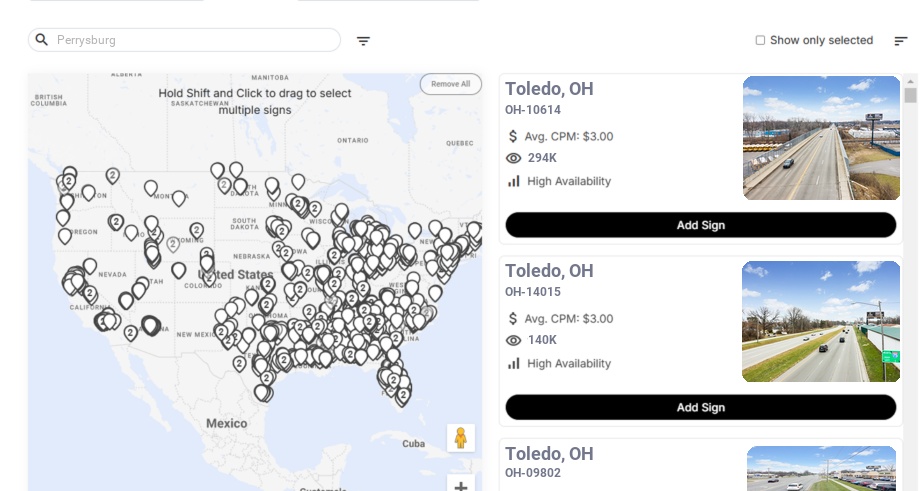



How much is a billboard near Perrysburg?
Why Choose Blip for Billboard Advertising near Perrysburg
Blip lets you launch Perrysburg billboards fast on I-75 and I-475 commuter routes—perfect for reaching Toledo-bound drivers in minutes.
Set a flexible daily budget for Perrysburg and target high-income shoppers near Levis Commons without long-term commitments.
Use Blip dayparting in Perrysburg to hit 7-9 AM and 4-7 PM rushes, plus weekend retail traffic on US-20 and SR 25.
Track Perrysburg campaign performance in real time and shift spend as construction slowdowns or holiday shopping boost impressions.
Blip creative tools make Perrysburg ads easy to rotate for winter nights, back-to-school, and family-focused messages that stand out on dark roads.
Frequently Asked Questions About Billboard Advertising near Perrysburg
How much does a billboard cost near Perrysburg, Ohio with Blip?
With Blip, you control exactly what you spend on Perrysburg billboards by setting a daily budget that can be adjusted anytime, making digital billboard advertising accessible on virtually any budget. Each ad “blip” is a brief 7.5–10 second display on billboards near Perrysburg, Ohio, and you only pay for the blips you receive. Pricing for these digital displays serving the Perrysburg area depends on when and where your ads run, along with local advertiser demand.
Where can I advertise with Blip near Perrysburg, Ohio?
We serve the Perrysburg area with 13 digital billboards near Perrysburg in nearby Holland and Toledo, within about 10 miles of the city. These Perrysburg billboards sit along some of the busiest commuter and shopping routes in northwest Ohio, many of which see tens of thousands of vehicles per day. Holland-based boards can be used to catch westbound and beltway traffic, while Toledo-based boards can reach northbound I-75 and I-475 drivers.
Who do Perrysburg, Ohio billboards reach?
The Perrysburg area audience is distinct within the Toledo region, with a large share of adults in the 30–54 age range and many households that include children under 18. Perrysburg is one of the most affluent and fast-growing communities in the Toledo region, and median household income is roughly 60–80% higher than many neighboring communities. The area also includes professionals, families, commuters, and regional travelers passing near Perrysburg along major highways.
When should I run a Blip billboard campaign in Perrysburg, Ohio?
For campaigns, morning and evening rush hours on the Holland and Toledo billboards are prime times to message Perrysburg area workers and residents. In many corridors, traffic volumes during these peaks spike 30–50% above midday levels. Midday impressions catch errand-running parents, retirees, and shift workers, which is valuable for healthcare, quick-service restaurants, auto service, and retail.
What highways are best for billboard advertising near Perrysburg, Ohio?
Perrysburg is strategically located along several major arteries, including I-75, I-475 / US-23, the Ohio Turnpike, and US-20 / US-20A / SR 25. In the Perrysburg–Toledo area, many segments of I-75 carry 60,000–80,000 vehicles per day, with certain stretches north of I-475 approaching 90,000 vehicles per day. Segments near Maumee and Holland on I-475 / US-23 often see 55,000–70,000 vehicles per day.
Do I need a contract to advertise with Blip near Perrysburg?
No, Blip has no long-term contracts or minimum commitments. You can start, pause, or stop your campaign at any time.
How fast can I launch a billboard campaign with Blip near Perrysburg?
You can have your campaign live in minutes. Create a free account, select your locations, set your budget, upload your design, and start running once approved.
Where can I advertise with Blip near Perrysburg?
Blip has digital billboards near Perrysburg. You can browse available locations on a map, choose the ones that fit your audience, and start advertising right away.
Still have questions? Launch a campaign in minutes — no contracts, no commitments.
Start Your CampaignPerrysburg Billboard Advertising Guide
Perrysburg sits at the crossroads of northwest Ohio commerce, commuter traffic, and regional tourism. With 13 digital billboards near Perrysburg serving the area from nearby Holland Toledo, we can help advertisers tap into a high-income suburban audience, heavy interstate traffic, and a steady flow of visitors drawn to local shopping, dining, and recreation.
Understanding the Perrysburg Area Market
Perrysburg is one of the most affluent and fast-growing communities in the Toledo region.
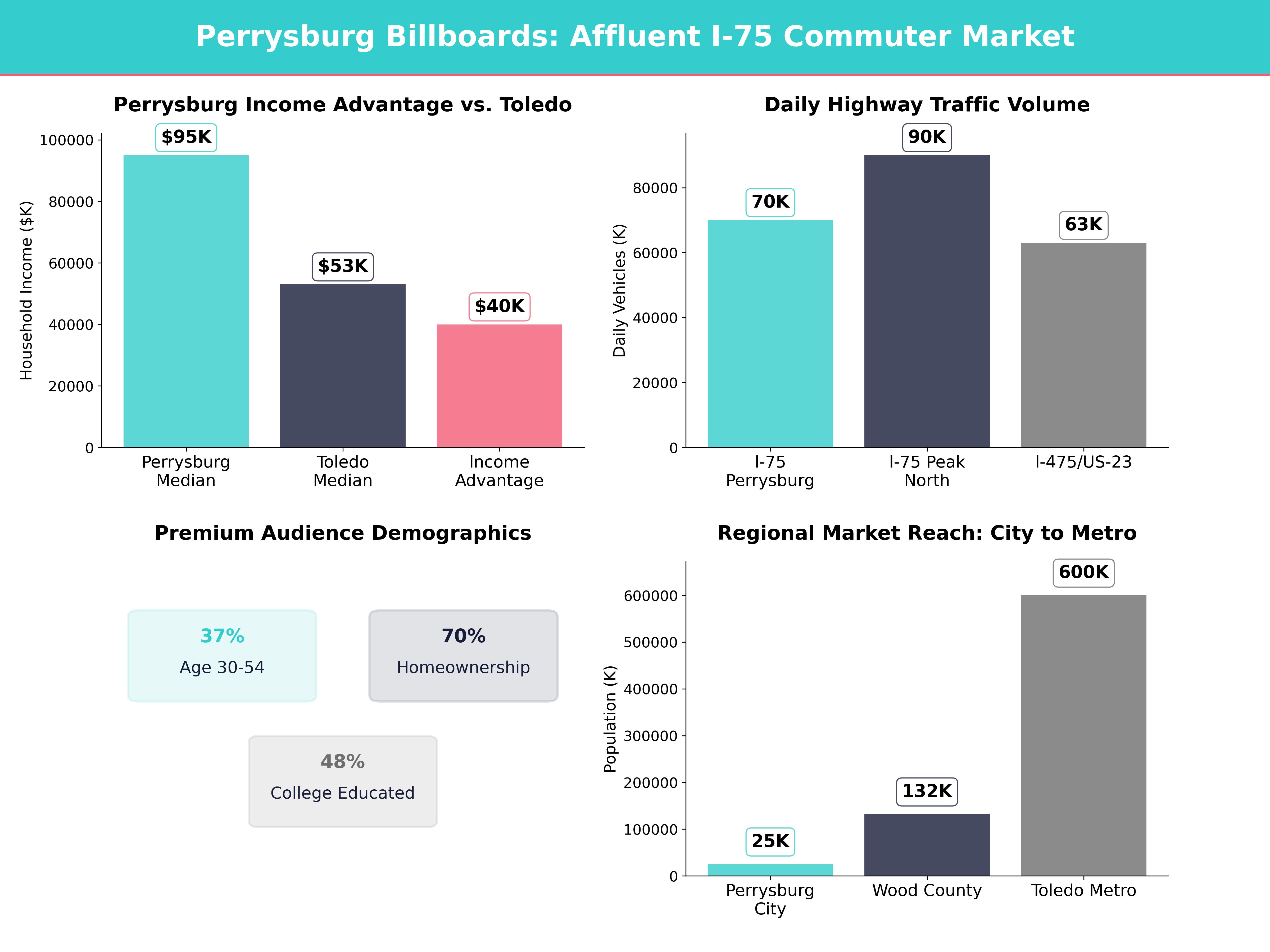
- The City of Perrysburg reported a population of about 25,000 residents as of the 2020 Census, up from roughly 20,600 in 2010—roughly 21% growth in a decade. By comparison, many northwest Ohio communities grew more slowly or even declined in the same period. You can review local stats and planning documents on the City of Perrysburg website and through regional partners like TMACOG.
- Perrysburg sits in Wood County, which has around 132,000 residents, while the broader Toledo metropolitan area (including Lucas, Wood, Fulton, and surrounding counties) includes over 600,000 residents. Wood County’s population has been relatively stable to slightly growing over the last decade, while many nearby counties have seen flat or declining numbers.
- Median household incomes are significantly higher than many nearby communities, with Perrysburg commonly cited around $90,000–$100,000, versus closer to the $50,000–$55,000 range in the City of Toledo according to regional economic summaries from Lucas County and Wood County. In practical terms, this means households in Perrysburg often have $35,000–$45,000 more disposable income per year than households in some neighboring zip codes.
Additional local context:
- Perrysburg’s housing market is strong, with many years seeing hundreds of new housing permits issued, far outpacing most other Wood County communities according to planning reports from the Wood County Planning Commission
- Owner-occupancy rates in Perrysburg neighborhoods commonly exceed 70%, contributing to a stable base of long-term residents who respond well to campaigns about home services, education, and community-based brands.
For advertisers, this means:
- Strong purchasing power and a large “aspirational suburb” audience who can support premium price points.
- A mix of professionals, families, and commuters who move daily between Perrysburg, Maumee, and nearby industrial/employment hubs like Rossford and Northwood.
- The chance to reach both local residents and regional travelers passing near Perrysburg along major highways through well-placed billboards near Perrysburg.
We serve the Perrysburg area with 13 digital billboards near Perrysburg in nearby Holland and Toledo, within about 10 miles of the city. These Perrysburg billboards sit along some of the busiest commuter and shopping routes in northwest Ohio, many of which see tens of thousands of vehicles per day according to the Ohio Department of Transportation District 2
Key Highways, Traffic Flows, and Where Billboards Fit
Perrysburg is strategically located along several major arteries:
- I-75 (north–south): The dominant corridor linking Cincinnati, Dayton, and Lima to Toledo and Detroit. In the Perrysburg–Toledo area, many segments carry 60,000–80,000 vehicles per day, with certain stretches north of I-475 approaching 90,000 vehicles per day based on ODOT traffic counts.
- I-475 / US-23: The Toledo beltway that loops traffic around the city, heavily used by commuters between Perrysburg, Holland, and other suburbs. Segments near Maumee and Holland often see 55,000–70,000 vehicles per day.
- Ohio Turnpike (I-80/I-90): A major east–west toll road moving freight and long-distance travelers across northern Ohio. The Ohio Turnpike and Infrastructure Commission has reported tens of millions of annual vehicle trips systemwide, with truck traffic making up roughly 35–40% of total volume—strong for B2B, logistics, and travel-focused campaigns.
- US-20 / US-20A / SR 25: Important east–west and north–south surface routes feeding Perrysburg’s retail and residential zones. Typical average daily traffic on key segments around Perrysburg and Maumee often runs in the 15,000–30,000 vehicles per day range, depending on exact location and land use.
Our digital billboards in Holland and Toledo are ideally positioned to intercept:
- Suburban commuters driving between Perrysburg and employment centers in Toledo, Maumee, and Holland. Regional commuting data from TMACOG shows that over half of working residents in many Wood County suburbs commute to jobs in Lucas County.
- Shoppers and diners traveling to and from major retail hubs, including the Town Center at Levis Commons in the Perrysburg area, The Shops at Fallen Timbers
- Through-travelers and truck traffic using I-75 and the Ohio Turnpike, who regularly exit for fuel, food, and lodging near the Perrysburg area. ODOT estimates show that commercial trucks often account for 15–25% of vehicles on key interstate segments in northwest Ohio.
When planning campaigns, it’s helpful to think in terms of corridors rather than just city names. For example:
- Holland-based boards can be used to catch westbound and beltway traffic that is likely heading toward the Perrysburg area after work or shopping.
- Toledo-based boards can reach northbound I-75 and I-475 drivers just before they enter or after they leave the Perrysburg area.
- Pairing multiple boards along I-75 and I-475 can create 3–5 exposures per single commute, dramatically increasing recall versus a single isolated sign for your billboard advertising near Perrysburg.
Who You Reach in the Perrysburg Area
The Perrysburg area audience is distinct within the Toledo region. Based on local government reports, economic development data, and regional housing trends, we can broadly characterize the market:
Age and Family Structure
- Perrysburg skews family-oriented, with a large share of adults in the 30–54 age range. In many recent demographic summaries, roughly one-third to two-fifths of residents fall into this working-age, family-building group.
- A significant percentage of households are families with children; in similar-sized northwest Ohio suburbs, 35–45% of households include children under 18, and local school district enrollment has risen accordingly. Perrysburg Schools have reported steady year-over-year enrollment growth, with total students in the 5,000+ range according to Perrysburg Schools district data.
- The city’s planning information from City of Perrysburg Planning & Zoning
Implications for advertisers:
- Family services (healthcare, education, childcare, recreation), kid-focused attractions, and family dining are strong fits.
- Financial services (college savings, mortgages, insurance) can use family-oriented imagery and messaging tied to milestones like home purchase, college, and retirement.
Income and Occupation
- Median household income in Perrysburg is roughly 60–80% higher than many neighboring communities. In practice, this places Perrysburg among the top income brackets in northwest Ohio, comparable to other affluent suburbs in Lucas and Wood counties.
- A large share of residents work in professional, managerial, healthcare, education, and skilled technical roles, often commuting to Toledo-based employers such as major hospital systems, the University of Toledo, Bowling Green State University, and large manufacturers and logistics firms in the I-75 corridor.
- Educational attainment in suburbs like Perrysburg is high, with many local summaries indicating that over 45–50% of adults hold an associate’s degree or higher, and a substantial share with bachelor’s and graduate degrees.
Implications:
- Higher willingness to pay for premium products (vehicles, home improvement, specialty retail, elective medical, travel).
- Messages stressing quality, reliability, and lifestyle benefits will typically outperform pure price appeals.
- Professional and B2B services (IT, legal, financial, consulting) can tap into an audience accustomed to and responsible for corporate decision-making.
Commuting Patterns
Regional transportation and planning documents, plus local employer distributions, suggest:
- A large portion of Perrysburg residents commute 15–30 minutes, often via I-75 or I-475/US-23, which aligns with typical commute times published for many Toledo-area suburbs by regional planning agencies.
- Roughly 70–80% of workers in the Toledo metro commute by driving alone, with another 8–10% carpooling, meaning roadside media reaches the vast majority of employed adults.
- There is significant reverse commuting as well—workers from Toledo and other suburbs travel to Perrysburg-area job centers (warehousing, logistics, retail, and offices along I-75 and at Levis Commons). Large logistics parks and distribution centers along the I-75 and US-20 corridors draw employees from across Wood and Lucas counties.
For campaigns, this means:
- Morning and evening rush hours on the Holland and Toledo billboards are prime times to message Perrysburg area workers and residents. On many corridors, traffic volumes during these peaks spike 30–50% above midday levels.
- Midday impressions catch errand-running parents, retirees, and shift workers, which is valuable for healthcare, quick-service restaurants, auto service, and retail.
Seasonality: When to Turn Up Your Billboard Spend
While digital billboards deliver value year-round, seasonal patterns in the Perrysburg area can guide budget allocation and creative rotations.
Winter (Dec–Feb)
- Weather is often snowy and overcast, with average highs in the 30s°F and lows in the teens to 20s°F across northwest Ohio, according to long-term climate normals from the National Weather Service Cleveland. Road conditions can be challenging, increasing drive times and the length of exposure to roadside media.
- Holiday shopping peaks from late November through December at retailers throughout the region, including the Perrysburg area’s Levis Commons and other centers. Major centers often report holiday sales volumes 20–30% higher than typical months.
- Residents spend more time driving in darkness—sunset is as early as 5:00 PM in December, and there can be 9 hours or less of daylight at the winter solstice.
Campaign ideas:
- Emphasize visibility and high-contrast creatives for dark, snowy conditions.
- Focus on holiday retail, auto service, HVAC, medical/urgent care, and winter recreation (indoor play centers, fitness, and entertainment).
- Use Blip’s dayparting to increase presence in evening drive times, when it’s dark and digital boards stand out most, and when traffic volumes remain high.
Spring (Mar–May)
- Construction season restarts; ODOT notes heavier work on I-75 and I-475, sometimes causing detours and slowdowns. Major reconstruction projects can last several months and impact tens of thousands of vehicles daily.
- Home buying, remodeling, and landscaping activity ramp up alongside tax refunds. Historically, many real estate markets see 25–35% of annual home sales occur in the spring months.
- Local events such as Easter activities, community cleanups, and early festivals increase weekend travel to destinations promoted by Visit Perrysburg and Destination Toledo
Campaign ideas:
- Rotate in home services, landscaping, real estate, and spring events.
- Lean on commuter slowdowns during construction to deliver more impressions to stuck drivers—extra minutes in congestion translate to higher message frequency.
- Promote outdoor attractions and festivals, coordinating with event calendars from local tourism sites.
Summer (Jun–Aug)
- Tourist season for northwest Ohio, with visitors heading to Lake Erie, Cedar Point, and local parks like nearby Maumee Bay State Park millions of visitor trips each year, many of which use I-75, I-475, and the Turnpike.
- More road trips on I-75 and the Ohio Turnpike, plus youth sports and family outings. Long-distance vehicle miles traveled often peak in June–August, with statewide traffic counts rising 5–10% versus winter months.
- Long daylight hours (sunset as late as 9:10 PM in late June), but still strong digital visibility at dawn and dusk when sky contrast is high.
Campaign ideas:
- Target travelers with messaging for hotels, restaurants, fuel, and attractions convenient to the Perrysburg area.
- Emphasize quick exits and easy access from the main corridors (“Next exit for…”) and “Kids Eat Free” or “Family Packages” to match summer travel behavior.
- Consider heavier weekend and Friday afternoon coverage when road trips spike and tourist traffic builds toward the Lake Erie shore and Cedar Point.
Fall (Sep–Nov)
- Back-to-school for Perrysburg Schools and nearby higher-ed institutions such as Bowling Green State University and the University of Toledo. Combined, these universities enroll over 35,000 students, many of whom travel along I-75 and I-475.
- Local events and high school sports draw regular crowds, with Friday night football and weekend tournaments boosting evening and weekend traffic to campuses and stadiums.
- Early holiday shopping begins in October–November; national data typically show 20–25% of holiday spending occurring before Thanksgiving.
Campaign ideas:
- Highlight education services, after-school programs, fitness centers, and fall events.
- Use countdown messaging (“Only 2 weeks left for…”) leading into major holidays or deadlines.
- Shift budget toward commute peaks and event days, using Blip scheduling to match specific local games or festivals listed by local news outlets like the Toledo Blade and TV stations such as 13abc and WTOL 11.
Crafting Effective Creative for the Perrysburg Area
Digital billboards near Perrysburg have only a few seconds to make an impact. Creative must be tailored to both the audience and the traffic environment.
Design Principles
- Readability at a glance: Stick to 7 words or fewer for the main message. Highway readability studies suggest that at 60–70 mph, drivers have just 3–6 seconds to process a message.
- High contrast: Dark backgrounds with light text—or vice versa—perform best in overcast winters and at night, which is especially important in a region that can see over 160 cloudy or partly cloudy days per year.
- Simple calls to action: URLs should be short and memorable (e.g., “SmithDentist.com”). For local brick-and-mortar, directions like “Next Exit,” “At Levis Commons,” or “5 Miles Ahead” work better than detailed addresses.
Tailoring to Perrysburg Area Demographics
- Appeal to family and community: Imagery of families, school spirit colors, or local landmarks near Perrysburg can build emotional resonance—Perrysburg Yellow Jackets imagery, for instance, is instantly recognizable to thousands of local residents.
- Speak to quality and trust: Words like “trusted,” “award-winning,” and “since [year]” align with higher-income, quality-conscious households and mirror language local residents are used to from established area brands.
- Use location anchors that make sense regionally: “Serving the Perrysburg area,” “Minutes from I-75,” “billboards near Perrysburg,” or “Near Levis Commons” tells viewers you are local and convenient.
Examples of On-Point Creative
- Healthcare: “Trusted Orthopedics Near the Perrysburg Area – Exit 193”
- Auto Dealer: “Upgrade Your SUV – 0% APR – 10 Min from the Perrysburg Area”
- Restaurant: “Wood-Fired Pizza at Levis Commons – Tonight”
Because our signs are digital, we can rotate multiple creatives:
- One version focused on commuters (“Beat Traffic. Try Telehealth Today.”).
- Another focused on weekend shoppers (“Brunch Near the Perrysburg Area – Sat/Sun 10–2”).
- A third aimed at travelers during peak seasons (“Hotel Near the Perrysburg Area – Next 2 Exits”).
Using Blip’s Flexibility: Budget, Targeting, and Testing
Blip allows advertisers to purchase individual “blips” (rotations) on digital billboards, giving fine-grained control over when and where ads run, and making billboard rental near Perrysburg and its commuter corridors highly flexible and accessible.
Smart Budgeting for the Perrysburg Area
- Start with a daily budget that ensures repeated exposure in key dayparts. Advertising research commonly recommends aiming for 10–20 impressions per person per month to build awareness; Blip’s flexibility lets you approximate that frequency along busy routes.
- For commuter-focused campaigns, prioritize 7–9 AM and 4–7 PM on Holland and Toledo boards feeding the Perrysburg area, when hourly traffic counts are often at 125–150% of mid-afternoon levels.
- Scale up during peak local seasons (e.g., August back-to-school, November–December holidays) and scale down slightly in off-peak windows, while maintaining always-on presence.
Location Targeting Strategy
- Use Holland-area billboards to engage west-side commuters and shoppers likely moving between the Perrysburg area, Holland, and Maumee. These corridors serve large retail clusters and employment hubs, capturing tens of thousands of daily trips.
- Use Toledo-area boards on I-75/I-475 to capture traffic entering and exiting the Perrysburg area from the north and northeast, including drivers from City of Toledo neighborhoods and suburbs like Sylvania and Oregon.
- Combine several boards to create a corridor dominance effect—drivers see your message multiple times along a single trip, which studies show can increase ad recall by 2–3x compared to a single exposure.
A/B Testing Creative
Because you can upload multiple designs and control run times:
-
Test two messages for two weeks each:
- Version A: “Premium Home Remodeling Near the Perrysburg Area”
- Version B: “Remodel Now – 0% Financing – Serving the Perrysburg Area”
- Monitor web traffic, call volume, or promo code usage during each version. For example, use distinct URLs or phone numbers (e.g.,
/Avs./Blanding pages). - Shift more budget to the stronger performer, then iterate with a new variation.
This approach turns your billboard campaign into a measurable channel, similar to digital ads online, and can help drive double-digit improvements in response rates over time.
Industry-Specific Opportunities in the Perrysburg Area
Different sectors can leverage the Perrysburg area’s demographics and traffic patterns in unique ways. Whether you are testing billboard advertising near Perrysburg for the first time or scaling a mature campaign, tailoring your approach by industry can boost performance.
Retail & Dining
- The Perrysburg area’s Levis Commons and nearby corridors make this one of the region’s top shopping and dining destinations, drawing not only local residents but also visitors from throughout Wood and Lucas counties. Weekend foot traffic at major centers can be 50–75% higher than weekday averages.
- Pair billboard exposure with promotions in local media such as the Toledo Blade or stations like 13abc and WTOL 11, and in community outlets like the Sentinel-Tribune for Wood County.
- Use distance-based copy: “2 Miles Past Perrysburg Exit,” “Next Exit for Dining Near the Perrysburg Area.”
- Time lunch and dinner promotions around 11 AM–1 PM and 4 PM–8 PM, aligning with peaks in restaurant visits typically observed in suburban markets.
Automotive Dealers & Service
- I-75 and I-475 carry heavy commuter and long-distance traffic—ideal for vehicle, tire, and service offers. Auto-related advertisers benefit from the fact that over 90% of households in many suburbs own at least one vehicle, and many own two or more.
- Use strong visual cues: images of SUVs or trucks, clear branding, and specific offers (“Oil Change $39.99 – Perrysburg Area Location”).
- Rotate creative seasonally (winter tire checks, spring tune-ups, back-to-school safety checks) and tie into key car-buying months, when national auto sales data show spikes in March–May and August–October.
Healthcare & Wellness
- High-income, family-oriented markets are receptive to specialists (orthodontics, orthopedics, dermatology, eye care) and wellness services (chiropractic, fitness, weight loss, mental health).
- Local hospital systems and clinics along the I-75 corridor attract patients from multiple counties; positioning your practice as close and convenient (“Same-Day Appointments – Serving the Perrysburg Area”) aligns with demand for timely care.
- Tie messaging to health awareness months and seasonal needs (flu season, sports physicals, allergy care). For example, flu activity often peaks December–February, while sports physicals cluster in July–August.
Education, Camps, and Youth Programs
- Leverage the strong presence of families and school-age children, evidenced by growing enrollment in Perrysburg Schools and regional youth leagues.
- Time campaigns around January–March (summer camp sign-ups), July–August (back-to-school), and late fall (enrollment for the next academic year). Many camps fill 50–70% of spots several months before start dates.
- Use clear CTAs like “Enroll by March 31 – Serving the Perrysburg Area” and highlight limited capacity (“Only 20 Spots Left”) to drive early action.
Tourism, Entertainment, and Events
- Promote concerts, festivals, sports, and performances across the Toledo region, especially if they draw from Perrysburg area residents and I-75 travelers.
- Coordinate flight dates with event publicity calendars from Visit Perrysburg, Destination Toledo Huntington Center in downtown Toledo.
- Use countdown formats: “3 Days to the Food Truck Festival – Downtown Toledo” to build excitement and urgency.
- Pair billboard exposure with social media and email campaigns; multi-channel campaigns have been shown to increase event attendance by 20–30% compared to single-channel promotion.
Integrating Billboards with Local Media and Community Presence
Billboards serving the Perrysburg area become even more powerful when integrated with other channels.
Cross-Promotions
- Align your billboard messages with promotions in local news outlets like the Toledo Blade, TV stations, and community publications in Wood and Lucas counties. Consistent creative across at least 3–4 touchpoints can significantly increase brand recall.
- Use the same tagline, color palette, and visuals across billboards, social media, and local print to create a cohesive brand story.
- Consider short “burst” campaigns tied to major features or news segments on outlets like 13abc, WTOL 11, or WNWO NBC 24, so viewers see your billboard before or after encountering you on screen.
Community Alignment
- Perrysburg has a strong sense of community, reflected in events, school pride, and civic engagement promoted on the City of Perrysburg and Wood County websites.
- Local events such as the Perrysburg Farmers Market, city festivals, and parades draw thousands of attendees per season, providing ideal tie-ins for hyper-local messaging.
-
Consider tying campaigns to:
- Local festivals and parades.
- School or youth sports sponsorships.
- Fundraisers or charitable events.
Mention your involvement on the boards: “Proud Supporter of Perrysburg Schools” or “Supporting Local Youth Sports in the Perrysburg Area.” Brands that highlight local sponsorships often see improvements in favorability and trust metrics of 10–20 percentage points in community surveys.
Measuring Impact and Optimizing Over Time
While billboards do not provide click-through data, there are practical ways to measure impact:
- Trackable URLs and phone numbers: Use custom URLs (e.g., “BrandName.com/Perrysburg”) or dedicated phone numbers for calls-to-action on your boards. Businesses that implement tracking often find that 10–30% of new inquiries reference seeing a billboard when asked directly.
- Promo codes: “Show this code: PERRY10” in-store or online and monitor redemptions. Even a 2–5% redemption rate on a billboard-specific offer can represent strong performance depending on your margins.
- Google Analytics & traffic patterns: Watch for spikes in direct traffic and branded searches in the Perrysburg area corresponding to campaign dates. Look for changes of 10% or more in direct traffic, call volume, or appointment requests during your flight.
- Customer surveys: Ask, “How did you hear about us?” and specifically include “Billboard near the Perrysburg area” as an option. Over a few months, you can build a clear picture of what percentage of new customers were influenced by your out-of-home efforts.
Once you see which creative, boards, and time frames deliver results:
- Shift more budget to the best-performing locations (e.g., certain Holland or Toledo boards), especially boards that correlate with higher tracked response for your billboard advertising near Perrysburg.
- Emphasize high-impact dayparts (e.g., weekday rush hours, weekend afternoons) where you see the strongest lift in web or in-store activity.
- Continue testing new creative angles—different imagery, offers, or calls-to-action. Incremental improvements of 5–10% in response per test can compound into much stronger ROI over the course of a year.
By combining strong local knowledge of the Perrysburg area with Blip’s flexible, data-friendly digital billboards in nearby Holland and Toledo, we can help you create campaigns that do more than just get noticed. These strategically placed Perrysburg billboards reach the right drivers, at the right times, with messages tuned to how Perrysburg area residents live, work, shop, and travel—turning regional traffic patterns and community growth into measurable business results from your billboard rental near Perrysburg.