Billboards in New Richmond, OH
No Minimum Spend. No Long-Term Contracts. Just Results.
Trusted by Leading Brands


Billboard advertising
in New Richmond has never been easier



How much is a billboard in New Richmond?
Why Choose Blip for Billboard Advertising in New Richmond
Blip lets you launch on New Richmond's U.S. 52 in minutes—ideal for the daily drivers and river corridor traffic that pass the same spots שוב and again.
Use New Richmond's SR 132 and school-year commute patterns to daypart ads for parents, commuters, and errand runs—no contracts needed.
Set a flexible budget in New Richmond and Blip will stretch it across repeat views from Clermont County drivers, weekend visitors, and river-town shoppers.
Track New Richmond campaign results in real time, then shift spend toward U.S. 52 or inland routes as seasonal park and tourism traffic changes.
Blip's creative tools make it easy to build clear, local ads for New Richmond—perfect for fast reads from commuters, families, and East Fork visitors.
Frequently Asked Questions About Billboard Advertising in New Richmond
How much does a billboard cost in New Richmond with Blip?
With Blip, billboard advertising in New Richmond can fit a wide range of budgets because you only pay when your ad actually displays. Pricing starts at $0.01 per display, and your daily budget guides Blip’s algorithm as it bids for open ad slots. Costs can change based on time of day, location, and advertiser demand, so your spend is always working to maximize reach.
Where can I advertise with Blip in New Richmond, Ohio?
U.S. 52 is the defining corridor for New Richmond, and it carries both daily traffic and scenic travelers along the Ohio River corridor. State Route 132 is New Richmond’s key north-south connector and helps funnel traffic toward State Route 32. For broader reach, State Route 32 and Interstate 275 can serve as regional amplifiers beyond the village itself.
Why is New Richmond, Ohio a good market for billboard advertising with Blip?
New Richmond gives us an unusually efficient billboard market because it combines small-town loyalty with regional mobility. The village has about 2,500 residents, but it sits inside Clermont County, which reached 208,601 people in the 2020 Census and remains one of Greater Cincinnati’s important growth corridors. More than 80% of county workers drive alone, and transit use is below 1%.
What kinds of businesses work best for billboards in New Richmond, Ohio with Blip?
Several categories line up especially well with this market, including healthcare, home services, auto, insurance, banking, education, dining, and community events. Restaurants, coffee shops, destination retail, and tourism-related businesses also perform well along U.S. 52 because the corridor captures both planned trips and spontaneous stop decisions. Small businesses can benefit from the trust factor in a place like New Richmond, because local consumers tend to respond well to names they see consistently.
When is the best time to run billboards in New Richmond, Ohio?
Spring is strong for home services, insurance, tax preparation, landscaping, and outdoor retail, with demand building in March and April. Summer is especially important because New Richmond sits near river recreation and county tourism assets, and the prime leisure window usually runs from Memorial Day through Labor Day. Back-to-school season begins in mid-August and gives advertisers one of the most dependable targeting windows of the year.
Do I need a contract to advertise with Blip in New Richmond?
No, Blip has no long-term contracts or minimum commitments. You can start, pause, or stop your campaign at any time.
How fast can I launch a billboard campaign with Blip in New Richmond?
You can have your campaign live in minutes. Create a free account, select your locations, set your budget, upload your design, and start running once approved.
Where can I advertise with Blip in New Richmond?
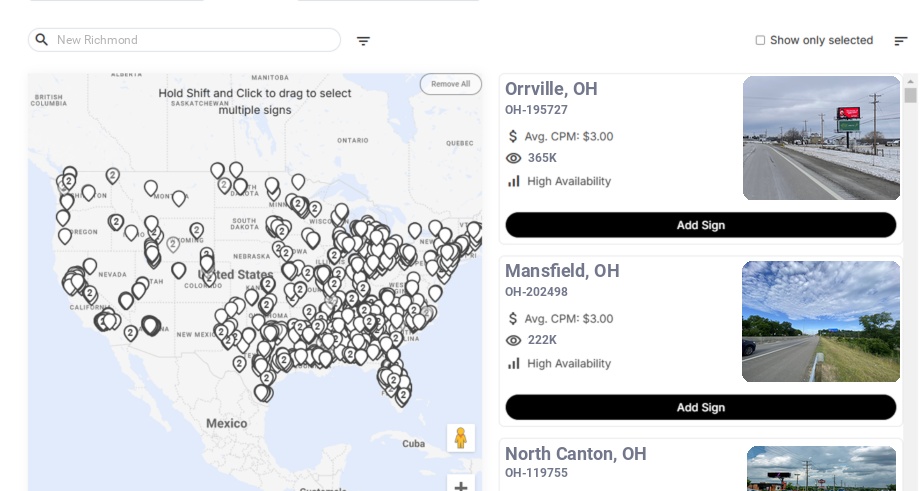
Blip has digital billboards in New Richmond. You can browse available locations on a map, choose the ones that fit your audience, and start advertising right away.
Still have questions? Launch a campaign in minutes — no contracts, no commitments.
Start Your CampaignNew Richmond Billboard Advertising Guide
New Richmond about 2,500 residents, but it sits inside Clermont County, which reached 208,601 people in the 2020 Census and remains one of Greater Cincinnati’s important growth corridors. We also benefit from New Richmond’s location on U.S. 52, roughly 25 miles east of downtown Cincinnati, because most daily errands, commutes, and weekend trips here still happen by car, with more than 80% of county workers driving alone and transit use below 1%. Add in riverfront recreation, seasonal tourism, and nearby park traffic, and we get a market where repeated roadside exposure can work very hard for local and regional advertisers.
New Richmond Market Overview
New Richmond sits at the meeting point of village commerce, river-town tourism, and Cincinnati-area commuting. We are not buying media in an isolated hamlet. We are buying into a travel shed that includes the Ohio River corridor, eastern Clermont County, and the broader Cincinnati metro, which has roughly 2.3 million residents.
From a growth perspective, the county matters. Clermont County grew from 197,363 residents in 2010 to 208,601 in 2020, which was an increase of 11,238 people, or 5.7%. That kind of steady household growth supports the categories that tend to win on billboards, including healthcare, home services, auto, insurance, banking, education, dining, and community events.
Demographics and mobility in New Richmond
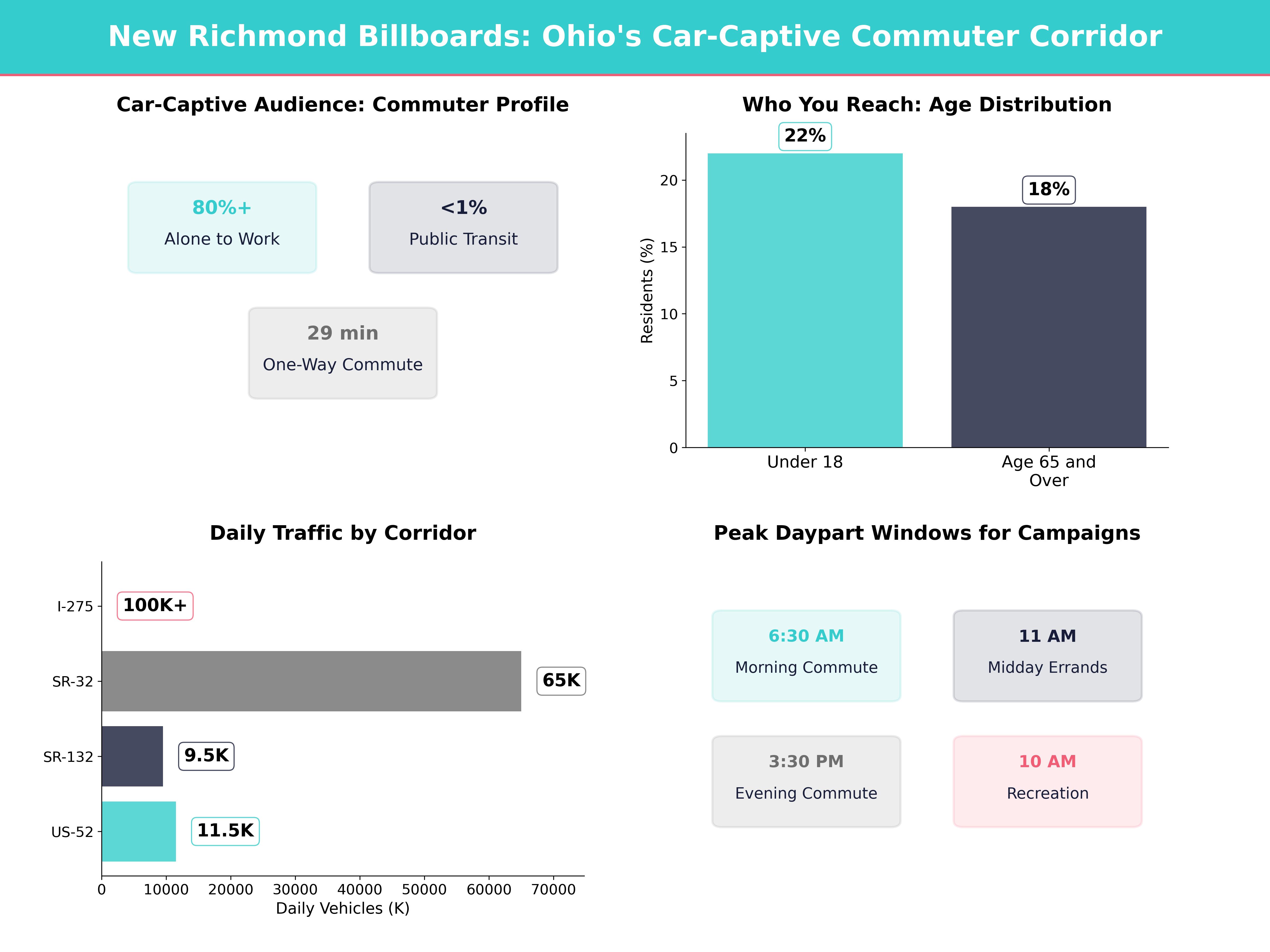
The local audience skews practical, family-oriented, and road-based. In Clermont County, more than 80% of workers commute by driving alone, average commute times land at about 29 minutes, and public-transit use is below 1%. That matters because billboard value rises when a market spends large amounts of time behind the wheel and has limited transit substitution.
The age mix is also useful for advertisers who need stable, recurring demand. About 22% of county residents are under 18, and about 18% are 65 or older. We therefore get strong reach into family decision-makers, parents, grandparents, healthcare consumers, and homeowners, rather than only into a narrow young-professional audience.
For advertisers, the takeaway is simple. New Richmond is a frequency market. We usually win here by showing up repeatedly on routes people drive every day, not by relying on one-time spectacle.
Economy and consumer behavior around New Richmond
New Richmond’s economy is local, but its spending patterns are regional. Residents often live in or near the village, work elsewhere in Clermont County or the Cincinnati area, and shop across several nodes, including Batavia, Milford, and the Eastgate area. That means our billboard strategy should not be limited to the village core if the goal is countywide awareness.
Several categories line up especially well with this market. Mercy Health - Clermont Hospital UC Health, local dental groups, banks, contractors, and schools all serve audiences that make repeated car trips and often choose providers based on familiarity and convenience. Small businesses also benefit from the trust factor in a place like New Richmond, because local consumers tend to respond well to names they see consistently.
Tourism adds another layer. Discover Clermont promotes the county’s river towns, events, parks, and outdoor recreation, and that visitor traffic complements the daily commuter base rather than replacing it. We therefore get a useful combination of dependable weekday impressions and seasonal weekend surges.
Key Traffic Corridors for Digital Billboards in New Richmond
New Richmond’s travel patterns are shaped by a small number of roads that carry a very high share of local attention. When we understand which corridor serves which purpose, we can match billboard placements to real buying behavior instead of chasing map pins.
U.S. 52 through New Richmond
U.S. 52 452 miles across southern Ohio.
Based on Ohio Department of Transportation 8,000 to 15,000 AADT range, depending on the exact location. That is not interstate volume, but it is very meaningful in a market this size because the same drivers often pass the same points again and again.
This corridor works especially well for several advertiser types.
- Restaurants, coffee shops, and destination retail perform well because U.S. 52 captures both planned trips and spontaneous stop decisions along the river.
- Healthcare providers and personal services perform well because local residents use this road for recurring errands and appointment travel.
- Tourism, events, and entertainment perform well because scenic-route travelers are already in a discovery mindset when they move through New Richmond.
Westbound creative should usually emphasize next-step action, because that audience is often moving toward job centers and denser retail. Eastbound creative can do more destination branding, especially on afternoons, evenings, and weekends.
State Route 132 northbound from New Richmond
State Route 132 Batavia area, and it helps funnel traffic toward State Route 32 7,000 to 12,000 AADT range.
This route is valuable because it captures intent-rich local movement. Drivers on 132 are often running errands, commuting to schools or work, or linking up with higher-speed regional corridors. We can use that behavior to our advantage.
- Home services benefit on this route because homeowners tend to be in task-oriented mode when they travel inland for work and errands.
- Auto services, insurance, and banking benefit because the road reaches everyday local decision-makers rather than only pass-through leisure traffic.
- Schools, training programs, and community institutions benefit because 132 supports practical trips tied to enrollment, activities, and appointments.
Because many trips on 132 are local and habitual, repetition matters more than novelty. Simple, place-based messaging usually beats clever but abstract branding.
State Route 32 and Interstate 275 as New Richmond’s regional amplifiers
If we want to scale beyond the immediate village, we should think about State Route 32 Interstate 275
In Clermont County, busier State Route 32 50,000 to 80,000-plus AADT range near higher-density retail and commuter zones. Interstate 275 83 miles long. In western Clermont County, heavily traveled I-275 segments are commonly above 100,000 vehicles per day.
These roads are not “New Richmond only” placements, but they are often smart additions when our service area extends beyond the village.
- Hospitals, colleges, and regional service brands benefit because these corridors reach households across the full county and metro edge.
- Event venues, attractions, and entertainment brands benefit because high-volume roads create broad awareness before weekend decision windows.
- Legal, financial, and business-to-consumer brands benefit because commuters on these routes deliver large-scale frequency very quickly.
A good New Richmond campaign often layers one or two hyperlocal placements with one regional feeder placement. That combination gives us both relevance and reach.
Audience Segments We Can Reach in New Richmond
The best New Richmond campaigns start with the audience, not the board. This market gives us several distinct groups, and each one responds to a slightly different message structure.
New Richmond commuters and everyday drivers
Commuters are the backbone of roadside media here. With more than 80% of workers driving alone and average commute times near 29 minutes, daily drivers provide reliable impression volume and strong repeat exposure. They are ideal for healthcare reminders, auto repair, insurance, quick-service dining, home services, and regional retail.
We should also remember that many local trips are not long-distance commutes. In a community like New Richmond, short drives to school, groceries, appointments, and errands still create high billboard value because the same households travel familiar routes multiple times per week.
New Richmond families and homeowners
Family households are a major part of the local opportunity. When about 22% of residents are under 18, the market naturally supports family spending categories such as pediatric care, orthodontics, tutoring, sports programs, restaurants, seasonal entertainment, and back-to-school retail. At the same time, the roughly 18% of residents who are 65 or older create strong demand for healthcare, vision, hearing, pharmacy, and financial planning.
This mix is especially good for businesses that need trust. In smaller communities, we often see better response when the ad feels familiar, useful, and locally grounded. That makes New Richmond a strong fit for contractors, churches, banks, real estate agents, and service providers who want to build recognition over time.
Riverfront visitors and outdoor recreation audiences
Tourism is not the whole story in New Richmond, but it meaningfully expands the audience. East Fork State Park Ohio Department of Natural Resources 4,870 acres and includes 2,160-acre William H. Harsha Lake. That park brings boaters, campers, anglers, hikers, and day visitors into Clermont County from spring through fall.
New Richmond also benefits from Ohio River travel, scenic-drive traffic, and countywide events promoted by Discover Clermont. This audience is valuable for restaurants, breweries, antique stores, event promoters, lodging, marinas, outdoor retailers, and attractions that can convert a trip already in progress.
For these visitors, we should speak in destination language. They respond well to messages about what to do today, where to stop next, and how far away the experience is.
Students, parents, and institutional audiences in New Richmond
Education adds another dependable layer to the audience mix. New Richmond Exempted Village School District keeps local parent traffic highly active from roughly August through May, while University of Cincinnati Clermont College Grant Career Center, and the Clermont County Public Library contribute ongoing activity across the county.
This audience segment is strong for: Childcare, tutoring, and youth activities, because parents make repeated school-year driving trips; Healthcare and family dining, because school schedules create predictable appointment and meal windows; and Adult education and workforce training, because regional campuses and career programs attract both traditional students and working adults.
In practice, the school-year calendar helps us create dependable annual rhythms rather than guessing at demand.
Seasonal and Timing Opportunities in New Richmond
New Richmond rewards advertisers who respect the calendar. This is a four-season Ohio market with clear shifts in recreation, school traffic, and local buying behavior.
Spring and summer opportunities in New Richmond
Spring is strong for home services, insurance, tax preparation, landscaping, and outdoor retail. We often see demand build in March and April, then widen in May as boating, fishing, camping, and event travel accelerate.
Summer is especially important because New Richmond sits near river recreation and county tourism assets. The prime leisure window usually runs from Memorial Day through Labor Day, a roughly 14-week stretch, with especially strong creative opportunities from May through October for outdoor businesses. Annual village activities such as RiverDays, plus destination traffic promoted by Discover Clermont, can make short campaign bursts very efficient.
The Clermont County Fair late July is another useful timing anchor. Fair traffic lifts awareness for food, entertainment, auto dealers, political campaigns, family attractions, and local merchants across the county.
Back-to-school and fall opportunities in New Richmond
Back-to-school season usually begins in mid-August, and it gives us one of the most dependable targeting windows of the year. Parents suddenly return to weekday routine, activity schedules resume, and family spending shifts toward healthcare, school services, apparel, after-school programs, and quick meals.
Fall stays active through September, October, and November. Football, community events, cooler weather outings, and holiday planning all support billboard activity. This is an excellent period for HVAC, roofing, legal services, colleges, urgent care, and local retailers, because households are back in routine but not yet in full winter hibernation.
If we want to own the local mood, fall creative can be particularly effective in New Richmond because river-town imagery, foliage, and community identity all become more visible.
Holiday and winter opportunities in New Richmond
Winter is quieter for tourism, but it is still productive for the right categories. In November and December, we can push restaurants, gift-oriented retail, healthcare open enrollment, holiday events, and financial services. In January and February, tax preparation, fitness, urgent care, auto service, and home improvement planning often become stronger.
Winter weather also changes road behavior. Drivers slow down, daylight ends earlier, and people become more attentive to clear, practical messages. That can improve performance for advertisers with direct offers, trusted local brands, and immediate service needs.
Billboard Design Tips for the New Richmond Market
New Richmond does not respond best to generic “big city” creative. We usually get better results when our design feels rooted in the river corridor, practical for drivers, and respectful of local trust cues.
Use New Richmond’s river-town identity in the creative
New Richmond is a historic Ohio River community, and that context matters visually. Colors such as navy, deep blue, forest green, white, and warm red often fit the market well because they echo water, parks, Americana, and small-town main-street energy. Photography that shows riverfront dining, boating, family recreation, historic storefront character, or outdoor leisure can also feel more authentic than sterile stock imagery.
If the advertiser is not a tourism brand, we do not need to overdo the scenery. We simply want the creative to feel like it belongs in Clermont County, not like it was copied from a generic national campaign.
Build New Richmond messages around route, distance, and action
Because so much of this market moves by car, directional utility is powerful. Phrases such as “On U.S. 52,” “Next Right on 132,” “5 Minutes Ahead,” or “Book Today in New Richmond” usually outperform vague brand slogans. Drivers here are often making real route decisions while on the road.
We should also design for the physical environment. Tree cover, changing light, and river glare all make contrast important. Dark backgrounds with bright type, or bright backgrounds with bold dark type, usually hold up better than subtle palettes. In most cases, one headline, one brand mark, and one action will do more work than crowded layouts.
Match the design to the New Richmond audience segment
Different audiences need different visual signals.
- Commuters usually respond best to speed, clarity, and practical value.
- Families usually respond best to trust, convenience, and familiar local references.
- Tourists and weekend visitors usually respond best to imagery, distance cues, and “what to do now” language.
For New Richmond specifically, community credibility often matters more than flashy polish. If a local business has been around for 10, 20, or 50 years, that fact can be worth featuring. If a service area includes New Richmond, Batavia, and Milford, we should say so plainly.
Regional Strategies Around New Richmond
A strong New Richmond billboard plan should usually segment the market instead of treating every road the same. The village core, the river corridor, and the regional commuter network each support different campaign goals.
New Richmond village core and riverfront strategy
In the immediate village area, our campaigns should focus on familiarity and repeated local exposure. This is where restaurants, coffee shops, community events, churches, insurance agencies, real estate agents, and service businesses can build mental availability over time.
Ads here should feel highly local. Naming New Richmond directly, referencing U.S. 52, or using timely community messaging can outperform broader county language.
Westbound New Richmond strategy toward Anderson Township and Cincinnati
The westbound audience moving toward Anderson Township
Morning campaigns should emphasize convenience and appointment-setting. Afternoon campaigns can shift toward dinner, errands, and after-work decisions. If we can select directional placements, that nuance matters.
Northbound New Richmond strategy toward Batavia and State Route 32
The northbound path toward Batavia, Pierce Township, and the State Route 32
This is also a useful zone for educational institutions, especially during enrollment periods and the school year.
Countywide New Richmond strategy with metro extension
When our business serves more than the village, we should pair New Richmond-specific placements with countywide reach. That often means adding boards on State Route 32 Interstate 275 Milford, the Eastgate trade area, and the broader Cincinnati orbit promoted by Visit Cincy and the Cincinnati USA Regional Chamber
This blended strategy works well for medical groups, colleges, entertainment brands, and multi-location retailers. We keep local relevance in New Richmond, but we also create scale where the county’s biggest traffic volumes live.
Using Blip Tools in New Richmond
Blip’s self-serve tools fit New Richmond especially well because this market rewards timing, route selection, and iterative testing more than fixed long-term buys.
Daypart around New Richmond traffic patterns
We can use dayparting to match message and movement. For example, 6:30 to 9:00 a.m. is a logical window for westbound commuter messaging on U.S. 52. 11:00 a.m. to 1:00 p.m. can work for lunch, errands, and appointment reminders. 3:30 to 6:30 p.m. is ideal for return-commute offers, dinner, healthcare, and family services. On weekends, 10:00 a.m. to 6:00 p.m. often lines up well with recreation and destination traffic.
That flexibility matters in a place where weekday and weekend audiences are meaningfully different.
Test creative by corridor, season, and audience
New Richmond is a great market for creative rotation. We can run one version for U.S. 52 leisure traffic, another for northbound county traffic, and another for regional SR 32 or I-275 reach. We can also swap seasonal messages quickly for school calendars, fair week, summer recreation, or winter service needs.
Because each blip is only 7.5 to 10 seconds, local relevance and simple language matter. Blip makes it easier to test that without rebuilding an entire traditional media schedule.
Use analytics and flexible budgets to learn the market
We do not need to guess which corridor is doing the work. We can watch performance, compare locations, and shift spending as we learn. That is especially useful in a market like New Richmond, where one business may need hyperlocal village exposure while another needs countywide commuter reach.
Blip’s pay-per-play model also helps smaller advertisers participate. With pricing that can start at $0.01 per display, we can test New Richmond without committing to the kind of large fixed package that traditional billboard buying often requires.
Getting Started With Billboard Rental in New Richmond
Renting a billboard in New Richmond works best when we start with the real business goal, then choose locations that mirror how people actually travel.
Define the New Richmond objective first
Before selecting boards, we should decide whether the campaign is meant to drive immediate visits, build local name recognition, support an event, recruit employees, or expand countywide awareness. A restaurant serving mostly local diners should think differently from a healthcare group serving all of Clermont County.
In practical terms, we should ask whether our customer radius is roughly 5 miles, 15 miles, or countywide. That single question usually clarifies whether we need only New Richmond placements, a New Richmond-plus-132 strategy, or a blended New Richmond-plus-SR 32/I-275 plan.
Evaluate New Richmond billboard locations like a local driver
When we evaluate boards, we should look beyond raw traffic count. A great New Richmond board usually has several of these traits:
- It reaches drivers moving in the direction we actually need.
- It sits near a decision point, such as a turn, retail cluster, or destination zone.
- It has enough read time for a simple message to register.
- It aligns with the audience’s purpose, whether that purpose is commuting, errands, or leisure travel.
In New Richmond, a board with lower volume but better local intent can easily outperform a busier board with weaker relevance. That is why map-based selection matters so much here.
Launch simply, then expand what works
For many advertisers, the smartest start is a focused test. We can begin with 2 to 3 strategically chosen boards, run for 2 to 4 weeks, and review performance before scaling. If one corridor clearly outperforms the others, we can add budget there or rotate fresh creative into the winning area.
This is where Blip simplifies the process compared with many traditional billboard companies. We can get into the market faster, adjust without long delays, and keep refining the plan as we learn what New Richmond drivers respond to. In a place with strong repeat traffic, distinct seasonal rhythms, and clear corridor differences, that flexibility is a real competitive advantage.
If we approach New Richmond with local context, clean creative, and corridor-specific timing, billboard advertising can be remarkably efficient here. We are not just buying a sign. We are placing our message into the daily rhythm of a growing Clermont County community that still spends a lot of life on the road.