Billboards in Mount Gilead, OH
No Minimum Spend. No Long-Term Contracts. Just Results.
Trusted by Leading Brands


Billboard advertising
in Mount Gilead has never been easier
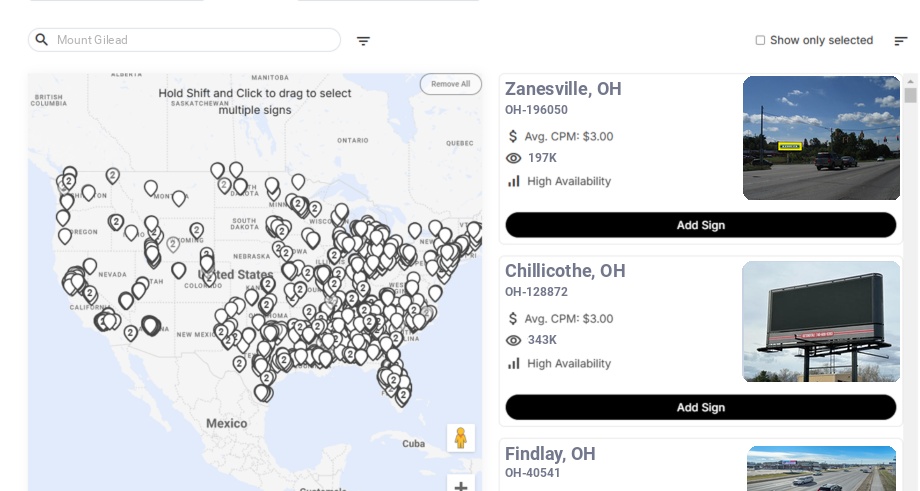



How much is a billboard in Mount Gilead?
Why Choose Blip for Billboard Advertising in Mount Gilead
Blip lets you launch in Mount Gilead fast, reaching I-71 Exit 140/151 drivers and county-seat traffic without contracts or delays.
Set flexible budgets in Mount Gilead and pay only when ads play, perfect for testing SR 61, SR 95, and U.S. 42 routes.
Use dayparting in Mount Gilead to catch 31-minute commuters at 6-9am and 3-7pm, plus fair and weekend traffic.
Track real-time results in Mount Gilead, then shift spend as I-71, Marion-bound, or Mansfield-bound traffic patterns change.
Blip's creative tools make it easy to tailor Mount Gilead ads for the Morrow County Fair, Mount Gilead State Park, or local healthcare.
Frequently Asked Questions About Billboard Advertising in Mount Gilead
How much does a billboard cost in Mount Gilead with Blip?
With Blip, pricing starts at just $0.01 per display. The cost per blip can change based on time of day, location, and advertiser demand, but Blip works to maximize your reach for whatever you’re comfortable spending. Your total cost is simply the sum of the blips you run, making billboard advertising in Mount Gilead accessible for businesses that want to start small and scale as they see results.
Where can I advertise with Blip in Mount Gilead?
Mount Gilead’s best billboard strategy usually comes from matching the corridor to the travel intent. Interstate 71 is the region’s biggest roadside asset, while U.S. Route 42, State Route 61, and State Route 95 all support strong local and regional visibility. These routes give you access to commuters, county-seat traffic, and through-traffic tied to Columbus, Marion, and Mansfield.
Why is billboard advertising in Mount Gilead effective with Blip?
Mount Gilead sits at the intersection of local necessity and regional travel, which creates a strong billboard market. The village had 3,503 residents in the 2020 count, and the wider Morrow County market has about 35,000 residents spread across a very drivable rural landscape. Most households rely heavily on personal vehicles, and average commute times are about 31 minutes, which gives outdoor advertising repeated daily exposure.
What traffic corridors in Mount Gilead should I target for Blip ads?
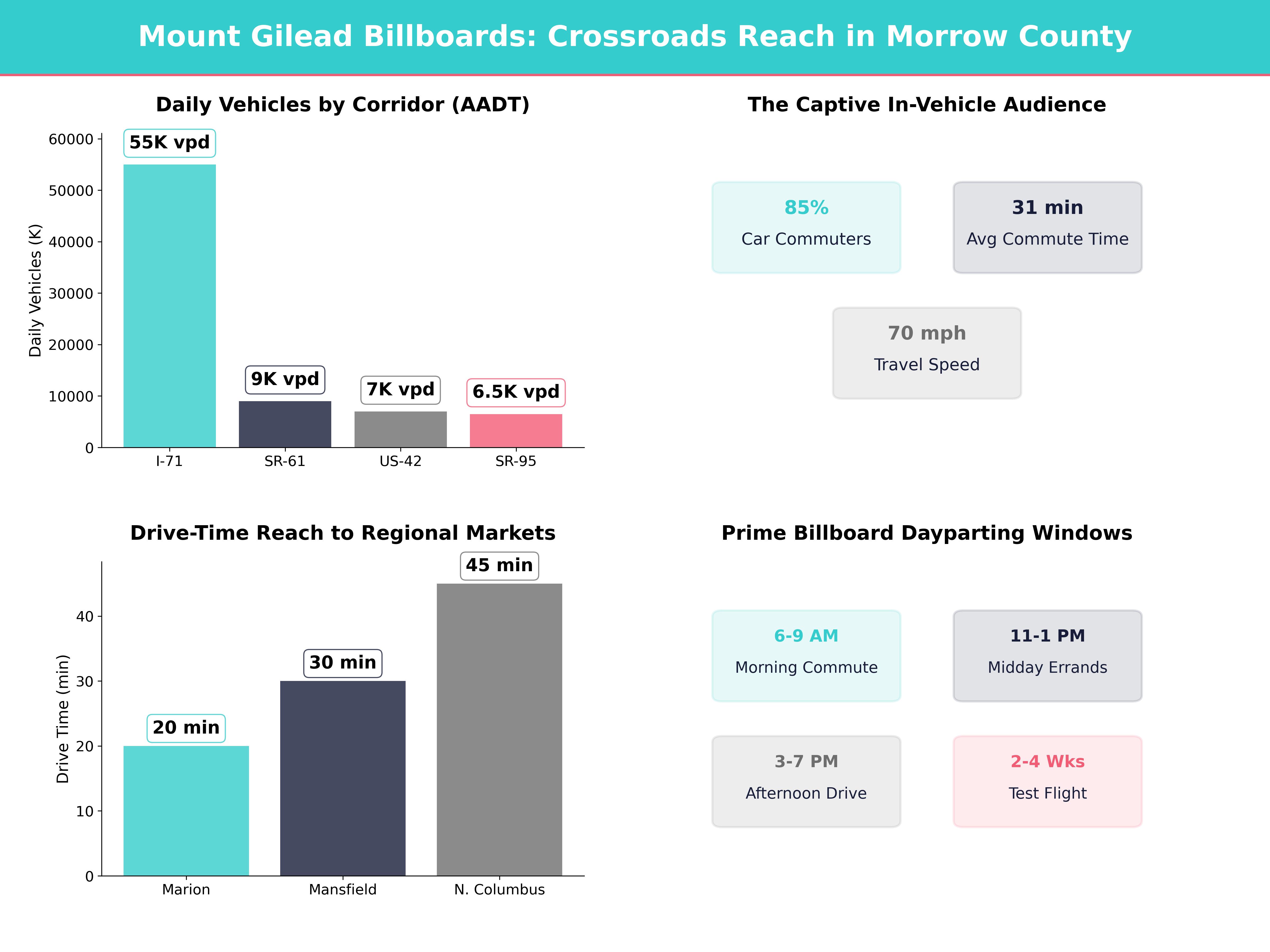
Interstate 71 commonly carries roughly 45,000 to 65,000 vehicles per day in Morrow County, with the busiest stretches closer to the Delaware County side exceeding 60,000 AADT. U.S. Route 42 is generally around 5,000 to 9,000 AADT, State Route 61 often falls around 7,000 to 11,000 AADT, and State Route 95 usually lands in the 5,000 to 8,000 AADT range. Those corridors work differently, but all of them can support effective billboard campaigns in Mount Gilead.
When is the best time to run billboard ads in Mount Gilead?
Dayparting matters here because traffic purpose changes throughout the day. The page recommends 6 a.m. to 9 a.m. for the morning commute, 11 a.m. to 1 p.m. for lunch and errands, and 3 p.m. to 7 p.m. for after-school and after-work decisions. Friday afternoon through Sunday can be especially useful for recreation, dining, and event traffic.
Do I need a contract to advertise with Blip in Mount Gilead?
No, Blip has no long-term contracts or minimum commitments. You can start, pause, or stop your campaign at any time.
How fast can I launch a billboard campaign with Blip in Mount Gilead?
You can have your campaign live in minutes. Create a free account, select your locations, set your budget, upload your design, and start running once approved.
Where can I advertise with Blip in Mount Gilead?
Blip has digital billboards in Mount Gilead. You can browse available locations on a map, choose the ones that fit your audience, and start advertising right away.
Still have questions? Launch a campaign in minutes — no contracts, no commitments.
Start Your CampaignMount Gilead Billboard Advertising Guide
Mount Gilead may be a small village, but we get a strong billboard market here because it sits at the intersection of local necessity and regional travel. The village had 3,503 residents in the 2020 count, and the wider Morrow County 35,000 residents (34,950 in 2020) spread across a very drivable rural landscape. Most households rely heavily on personal vehicles, and average commute times are about 31 minutes, which gives outdoor advertising repeated daily exposure. We also benefit from through-traffic on Interstate 71 Columbus Region Marion, and Mansfield.
Mount Gilead Market Overview
Population, geography, and local economic role
Mount Gilead is the county seat of Morrow County 406 square miles, so residents routinely drive between towns for work, school, shopping, healthcare, and government services. That geography matters for billboard planning because road visibility often beats hyperlocal neighborhood targeting in a spread-out county like this one.
The county’s population growth has been modest rather than explosive, adding only a few hundred residents from 2010 to 2020 (123 residents, to be exact). For advertisers, that is not a weakness. It means we are usually speaking to a stable audience with repeat travel habits, familiar routes, and high recognition of local businesses, schools, and civic institutions.
Mount Gilead also benefits from its position inside the broader Columbus Region 11-county metro footprint. That gives us a hybrid market. We can target truly local consumers in town, and we can also target commuters and pass-through traffic tied to Delaware County, north Columbus, Marion, and Richland County.
Commuting behavior and why roadside media matters
In Morrow County, driving is the default mode of transportation. American Community Survey estimates place solo driving at about 85% of workers, and the average commute is about 31 minutes. In a market where most residents are behind the wheel, outdoor advertising fits the way people already move.
That travel pattern gives us two advantages. First, local brands can build frequency with the same residents over and over on recurring routes. Second, regional brands can intercept decision-making while people are already in transit, which is especially useful for healthcare, auto service, restaurants, retail, home improvement, education, and event marketing.
Economic themes that influence ad performance in Mount Gilead
The local economy is shaped by agriculture, small manufacturing, logistics, healthcare, government services, and commuting households tied to larger nearby job centers. Resources from JobsOhio, the Ohio Department of Development One Columbus
Mount Gilead’s county-seat role also concentrates important trip generators in one place. OhioHealth Morrow County Hospital is a 25-bed hospital, and county offices, schools, and service businesses all pull residents into town on a regular basis. We should think of Mount Gilead not just as a village, but as the service hub for a much larger rural trade area.
Key Traffic Corridors Around Mount Gilead
Mount Gilead’s ad value is tied directly to how traffic flows through Morrow County. The best billboard strategy usually comes from matching the corridor to the travel intent, rather than treating every road as equal. ODOT ODOT TIMS traffic map
Interstate 71
Interstate 71 45,000 to 65,000 vehicles per day range, with the busiest stretches closer to the Delaware County side exceeding 60,000 AADT. That is substantial volume for a county of this size, and it creates reach well beyond Mount Gilead residents alone.
Mount Gilead’s practical interstate access is shaped by Exit 140 at State Route 61 and Exit 151 at State Route 95. Those exits matter because they create clear “next move” opportunities for drivers who are deciding where to stop, eat, fuel up, seek care, shop, or detour.
This corridor works especially well for:
- Restaurants, convenience stores, and travel services that can convert same-trip decisions.
- Auto dealers, repair shops, and tire stores that benefit from drivers already thinking about vehicle needs.
- Healthcare providers that want regional awareness across multiple counties.
- Colleges, training programs, and employers recruiting from a wider labor shed.
- Tourism, lodging, and event venues drawing from Columbus, Delaware County, Marion, and Mansfield.
Because rural Ohio interstate traffic often moves at 70 mph, creative on I-71 needs to be extremely direct. We should treat these boards as fast-decision media, not information-dense media.
U.S. Route 42
U.S. Route 42 is the town-and-region connector that gives Mount Gilead its everyday commercial rhythm. ODOT counts around Mount Gilead generally place U.S. 42 in about the 5,000 to 9,000 AADT range, depending on the exact segment. That is a strong local-service corridor because drivers here are often closer to their destination and more open to acting quickly.
U.S. 42 is especially useful for:
- Local retail and grocery-adjacent businesses.
- Banks, insurance agencies, and legal services.
- Medical, dental, and urgent-care messaging.
- Restaurants and coffee stops.
- Political, nonprofit, and community event campaigns.
Unlike I-71, this route supports slightly more detailed creative because speeds are lower as traffic approaches and moves through Mount Gilead.
State Route 61
State Route 61 links Mount Gilead to Marengo, the I-71 interchange, and Marion-bound travel patterns. ODOT counts on key approaches commonly fall around 7,000 to 11,000 AADT, especially near the interchange area and village approaches. That makes SR 61 one of the best routes for businesses that depend on habitual commuters rather than one-time passersby.
We like SR 61 for:
- Home services such as HVAC, roofing, plumbing, and remodeling.
- Healthcare systems and specialty clinics.
- Education and workforce recruiting.
- Farm, truck, and equipment-related advertisers.
- Local restaurants and everyday retail.
If our goal is to reach people who live in Morrow County but work elsewhere, SR 61 often deserves serious attention.
State Route 95
State Route 95 is Mount Gilead’s east-west spine. Traffic levels around the village and interchange influence zone usually land in the 5,000 to 8,000 AADT range. While that is below I-71, it is exactly the kind of volume that supports strong local conversion when the message is relevant.
SR 95 is a good fit for:
- Hardware, farm supply, and building materials.
- Local healthcare and pharmacy messaging.
- Insurance, banking, and financial services.
- Schools, churches, and civic events.
- Seasonal retail, especially around fair season, holidays, and tax season.
Audience Segments We Can Reach in Mount Gilead
Commuters and regional workers
The biggest audience in this market is the daily driver. With about 85% of workers commuting alone by car and average trips at roughly 31 minutes, we get repeated exposure opportunities on roads where people are making practical decisions. These are ideal conditions for brands that win on convenience, trust, price, or location.
For this segment, the best categories include auto service, healthcare, restaurants, insurance, fuel, banking, legal services, employers, and trade schools. Messages like “Exit 151,” “10 minutes from I-71,” or “On your way home” often resonate because they match the actual behavior of the audience.
Families and county-seat households
Mount Gilead’s in-town audience is shaped by family routines. Residents come into town for healthcare, public services, school functions, sports, errands, and shopping. Because the county population is spread across 406 square miles, even routine household tasks often involve a meaningful drive.
That makes Mount Gilead a good billboard market for:
- Pediatric, dental, vision, and primary care providers.
- Grocery-adjacent retail and restaurants.
- Banks, credit unions, and insurance agencies.
- Home improvement and repair services.
- Local events, churches, and community programs.
The presence of OhioHealth Morrow County Hospital adds a consistent healthcare trip generator, and the county-seat role adds government and service traffic throughout the week.
Students, parents, and career-builders
Mount Gilead is also positioned near several commuter-oriented education centers. The Ohio State University at Marion and Marion Technical College are roughly 20 minutes north, and North Central State College is about 30 minutes north toward Mansfield. That gives education marketers, apartment communities, retailers, and employers a solid audience of students, parents, faculty, and career-switchers who are already used to driving for school.
This segment works especially well for:
- Colleges and certificate programs.
- Healthcare and skilled-trade recruiting.
- Quick-service restaurants and coffee.
- Telecom, internet, and financial services.
- Affordable retail with clear location cues.
Outdoor visitors and weekend traffic
Mount Gilead is not a pure tourism market, but it absolutely benefits from recreation and event traffic. Mount Gilead State Park 181 acres, which helps generate spring, summer, and fall leisure travel. The Morrow County Fair
To the north, Mid-Ohio Sports Car Course brings race-weekend visitors to a 2.4-mile, 13-turn road course, and Snow Trails draws winter recreation traffic with a 300-foot vertical drop. For advertisers, that means we can build targeted bursts for:
- Hotels and short-term lodging.
- Restaurants, bars, and family attractions.
- Fuel, convenience, and travel services.
- Sporting goods and outdoor brands.
- Event promotions and ticketed attractions.
Seasonal Opportunities in Mount Gilead
Spring and early summer in Mount Gilead
Spring is a strong season for home services, healthcare, outdoor retail, and agricultural support businesses. As weather improves, local residents spend more time on the road for recreation, sports, and home projects. Campaigns tied to lawn care, roofing, HVAC tune-ups, clinics, nurseries, and local restaurants often align well with real seasonal behavior.
This is also when Mount Gilead State Park
Late summer and fall in Mount Gilead
Late summer and fall are especially valuable because several audience streams overlap. We have back-to-school trips, county fair traffic, football schedules, harvest-related movement, and continued commuting volume. The Morrow County Fair
This is also a strong time for local pride messaging. Creative that references Mount Gilead, Morrow County, or nearby communities often feels more relevant during the fair and school season than generic metro-style copy.
Winter timing for Mount Gilead campaigns
Winter shifts the messaging mix. Road safety, vehicle maintenance, heating, urgent care, pharmacies, and comfort-oriented food offers often gain relevance. We also pick up some regional recreation traffic headed north toward Snow Trails and winter destinations promoted by Destination Mansfield.
For dayparting, we usually like these windows in this market:
- 6 a.m. to 9 a.m. for the morning commute.
- 11 a.m. to 1 p.m. for lunch, errands, and medical scheduling.
- 3 p.m. to 7 p.m. for after-school, after-work, and dinner decisions.
- Friday afternoon through Sunday for recreation, dining, and event traffic.
Mount Gilead Billboard Design Tips
Design for speed, distance, and exit decisions
In Mount Gilead, creative should match the road environment. On I-71, where traffic is often moving at 70 mph, we should focus on one offer, one location cue, and one simple action. “Exit 151,” “Next right from SR 61,” or “10 minutes west” tends to outperform cluttered copy because the driver is processing the message quickly.
On U.S. 42, SR 61, and SR 95, we can add a little more specificity because speeds are lower and trip intent is more local. That is where address cues, local landmarks, or event dates can become useful.
Use imagery that feels local, not imported
Mount Gilead responds well to practical, grounded creative. Clean family imagery, healthcare credibility, local food, farm-adjacent visuals, trucks, tools, outdoor recreation, school-season relevance, and value messaging all fit the market better than flashy luxury creative with no local context.
We should also remember that this is a county-seat audience. Trust matters here. Brands that look dependable, service-oriented, and easy to reach often feel more relevant than brands that only emphasize aspiration.
Make the message sound close
Location language is especially powerful in this geography. We can improve performance by naming the route, the exit, or the nearby town. Phrases such as “off I-71,” “in Mount Gilead,” “near Marion,” or “worth the drive from Delaware County” make the billboard feel immediately usable.
For regional advertisers, distance framing can be effective. “North of Columbus pricing,” “20 minutes from Marion,” or “easy stop at Exit 140” gives drivers a reason to convert the ad into an action.
Regional Strategies Around Mount Gilead
Mount Gilead village core and service hub strategy
When we target Mount Gilead itself, we are usually after local conversion. The audience is already in errand mode, and the best advertisers are the ones that can fulfill a near-term need. Healthcare, dentistry, pharmacy, restaurants, banks, insurance, local retail, and household services tend to fit best.
In this part of the market, we should prioritize relevance over raw volume. A lower-speed local board can outperform a higher-speed corridor if our goal is appointments, store visits, or event attendance in town.
I-71 interchange strategy near Mount Gilead
The I-71 approach is different. Around Exit 140 and Exit 151, we are targeting decision points. These boards are ideal when we need to pull drivers off the interstate, introduce a regional brand, or keep a business top of mind for the next trip.
This strategy is especially effective for travel-related categories, but it also works for hospitals, colleges, event venues, and employers that draw from multiple counties. If we can connect the message to time or distance, we usually improve response.
Southbound strategy toward Delaware County and Columbus
Southbound traffic matters because Morrow County is connected to the broader Delaware County 45 minutes away, depending on the destination, and that shapes how many residents think about work, shopping, and entertainment.
For this flow, the best messages often emphasize:
- Convenience on the way home.
- Price advantages versus bigger-city options.
- Appointments and services with easier parking and faster access.
- Weekend dining or recreation without downtown hassle.
Northbound strategy toward Marion and Mansfield
Northbound, Mount Gilead connects efficiently to Marion in about 20 minutes and to Mansfield in about 30 minutes. That makes the market relevant for advertisers tied to education, healthcare, events, and regional entertainment. The proximity of The Ohio State University at Marion, Marion Technical College, North Central State College, Snow Trails, and Mid-Ohio Sports Car Course creates more northbound opportunity than many small villages can claim.
Using Blip Tools in the Mount Gilead Market
Build a layered map strategy
In Mount Gilead, we usually get the best results when we combine at least 1 higher-speed regional board with 1 more localized board. The regional unit builds scale and intercepts through-traffic, while the local unit supports conversion closer to the destination. Using Blip’s map-based planning makes it easier to see those layers together rather than buying each location in isolation.
Match timing to real local behavior
Dayparting matters here because traffic purpose changes throughout the day. We can place more weight on morning and evening commuter windows, add lunch visibility for healthcare and restaurants, and increase weekend emphasis during fair season, race weekends, or park-heavy months. If a business depends on appointments, we can bias toward weekdays.
If it depends on recreation or dining, we can lean harder into Friday through Sunday.
Swap creative by corridor
Mount Gilead is a good place to rotate creative by route. We might run an interstate version that says “Exit 151” and a village-core version that says “In Mount Gilead today.” We can also test resident-focused messages against traveler-focused messages without rebuilding the whole campaign from scratch.
Use analytics to tighten the plan
Because this is a smaller market, optimization can happen quickly. If one road delivers stronger volume or better timing, we can move budget there instead of waiting for a long fixed contract cycle. That flexibility is useful in Mount Gilead, where seasonality, events, and route choice can shift the best-performing boards from month to month.
Getting Started with Billboard Rental in Mount Gilead
Start with the goal, not the board
The best way to rent a billboard in Mount Gilead is to decide first what outcome we want. If our goal is regional awareness, we should lean toward I-71. If our goal is store visits, appointments, or local event turnout, we should pay closer attention to U.S. 42, SR 61, and SR 95.
A simple starting framework looks like this:
- Awareness across counties: prioritize I-71.
- Local business traffic: prioritize town-serving routes.
- Event bursts: prioritize fair, school, and recreation timing.
- Recruiting: prioritize commute corridors and regional connectors.
Evaluate each location the way a driver experiences it
When comparing available billboard locations, we should ask a few practical questions. Is the board on a route people use every day, or only occasionally. Is traffic moving at 70 mph, or at a slower in-town speed. Is the board before the decision point, or after it. Is the audience local, regional, or mixed.
Those questions usually matter more than a simplistic “higher traffic is always better” approach. In a market like Mount Gilead, intent can beat raw volume.
Expect testing to improve performance
We generally recommend a test flight of 2 to 4 weeks with at least 2 versions of the creative if the budget allows. One version can emphasize location and convenience, and the other can emphasize the offer or benefit. In a practical, road-driven market like this one, small changes in wording can make a real difference.
Why Blip simplifies the Mount Gilead buying process
Traditional billboard buying in smaller Ohio markets can feel slow, inflexible, and built around long commitments. Blip makes the process easier because we can choose locations, control timing, update artwork, and refine budget levels as we learn. That matters in Mount Gilead, where one advertiser may need county-fair intensity in August, while another only wants weekday commuter visibility all year.
If we stay focused on route logic, local relevance, and a clear call to action, Mount Gilead can be a very efficient outdoor market. It is not a giant metro, and we do not need it to be. We just need to align the message with the roads people actually drive, the seasons they actually live through, and the destinations they actually choose.