Billboards in Marion, OH
No Minimum Spend. No Long-Term Contracts. Just Results.
Trusted by Leading Brands


Billboard advertising
in Marion has never been easier



How much is a billboard in Marion?
Why Choose Blip for Billboard Advertising in Marion
Blip lets you launch Marion, Ohio billboards self-serve on U.S. 23 and SR 95 without long contracts.
Use Marion, Ohio dayparting to hit 7–9 a.m. commuters and 3–6 p.m. return traffic near SR 309 and downtown.
Set any budget with Blip in Marion, Ohio and reach students, families, and plant workers without overspending.
Track Marion, Ohio performance in real time, then shift spend as Popcorn Festival and holiday traffic surge.
Blip's creative tools help Marion, Ohio ads stand out with quick offer swaps for healthcare, retail, or hiring messages.
Frequently Asked Questions About Billboard Advertising in Marion
How much does a billboard cost in Marion, Ohio with Blip?
With Blip, you control exactly what you spend on Marion billboards by setting a daily budget that can be as small or as flexible as you want. Your ad shows as short “blips” of 7.5 to 10 seconds on digital billboards in Marion, Ohio, and you only pay for each blip you receive. Prices per blip vary based on the time of day, location, and advertiser demand, so your campaign can be tailored to busy drive times or quieter hours, depending on your goals.
Where can I advertise with Blip in Marion, Ohio?
Marion lies along key routes that make it a strong regional shopping and services center, with U.S. Route 23, State Route 95, State Route 309, State Route 4, and State Route 423 all serving important traffic flows. Blip allows us to choose boards near retail clusters, industrial parks and logistics facilities, and the approaches between U.S. 23 and downtown Marion. Aligning your placements with these high-traffic corridors ensures your Marion billboards consistently intersect everyday commute patterns and weekend trips.
Who does billboard advertising in Marion, Ohio reach?
Marion offers a rare combination of small-city intimacy and regional reach, drawing daily traffic from residents, commuters, and through-travelers heading between Northwest Ohio and Central Ohio. We are usually speaking to a mixed audience: long-term residents, blue-collar workers, families, students, and visitors from surrounding communities. The Marion Campus of The Ohio State University and Marion Technical College bring in more than 3,000 combined students plus faculty and staff during the academic year, adding a distinct young-adult audience to the market.
When is the best time to run Blip billboards in Marion, Ohio?
In Marion, tailoring by daypart can significantly improve relevance and stretch smaller budgets. Weekday morning commuter traffic is strong, mid-day is ideal for errand-running and retiree traffic, and the evening commute is one of the most valuable windows. Weekends bring more discretionary travel for family visits, shopping, recreation, and church.
How does the Marion, Ohio market affect billboard messaging with Blip?
Marion County households are about 25–30% below the statewide median income, so price- and value-focused messages are powerful. Family-oriented messaging and visuals work well, and healthcare, trades, automotive, and local retail can all use billboards in Marion to speak to a very practical, needs-driven audience. Messaging that emphasizes value, trust, and local roots plays well in this market.
Do I need a contract to advertise with Blip in Marion?
No, Blip has no long-term contracts or minimum commitments. You can start, pause, or stop your campaign at any time.
How fast can I launch a billboard campaign with Blip in Marion?
You can have your campaign live in minutes. Create a free account, select your locations, set your budget, upload your design, and start running once approved.
Where can I advertise with Blip in Marion?
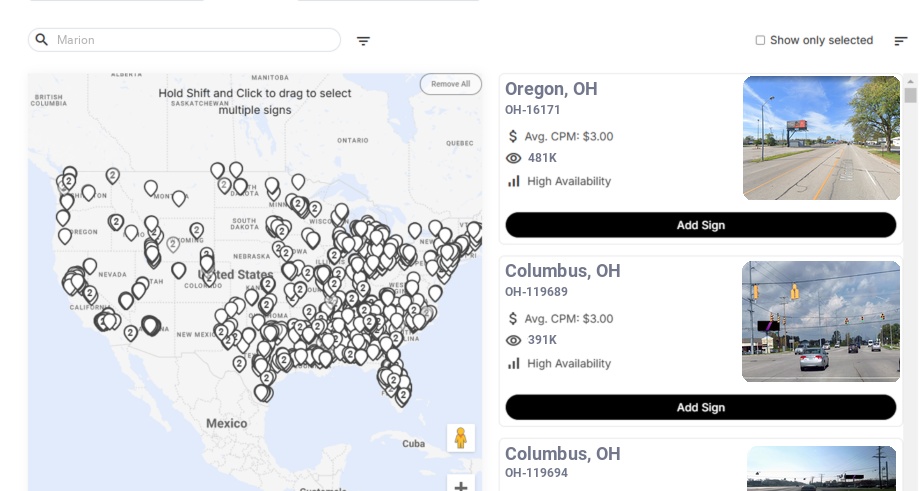
Blip has digital billboards in Marion. You can browse available locations on a map, choose the ones that fit your audience, and start advertising right away.
Still have questions? Launch a campaign in minutes — no contracts, no commitments.
Start Your CampaignMarion Billboard Advertising Guide
Marion, Ohio offers a rare combination of small-city intimacy and regional reach. Located about 50 miles north of Columbus along U.S. Route 23, it draws daily traffic from residents, commuters, and through-travelers heading between Northwest Ohio and Central Ohio. When we use digital Marion billboards strategically, we can efficiently reach both local households and a larger trade area that shops, works, and plays in the city. Thoughtful Marion billboard advertising can connect regional visitors with local businesses at precisely the moments they are deciding where to stop, shop, and dine.
Understanding the Marion Market
Marion is the seat of Marion County and serves as the county’s commercial and service hub.
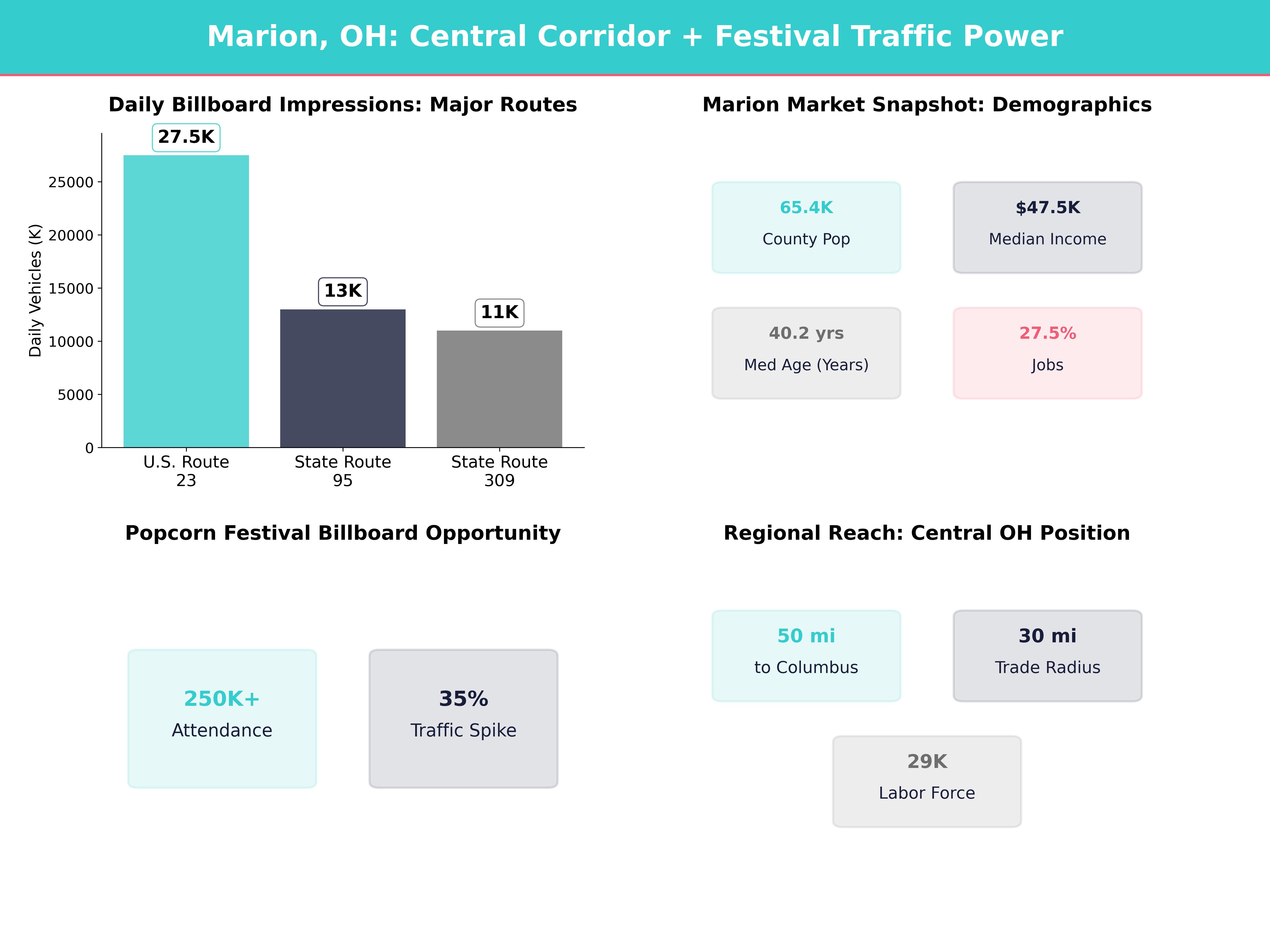
- The City of Marion's population is roughly 36,000 (about 35,999 in 2020), while Marion County as a whole sits near 65,000 residents (about 65,359 in 2020).
- Marion lies within an easy drive of larger markets: Columbus (~50 miles), Delaware (~30 miles), and Mansfield (~40 miles), making it a natural regional shopping and services center with a practical trade radius of 20–40 miles.
- According to the City of Marion and Marion County government, the community has significant employment in manufacturing, healthcare, logistics, and education. Local anchors include OhioHealth Marion General Hospital, major manufacturers in the Marion Industrial Center Marion City Schools.
- The Marion Campus of The Ohio State University and Marion Technical College bring in more than 3,000 combined students plus faculty and staff during the academic year, adding a distinct young-adult audience to the market.
- The Marion Area Chamber of Commerce represents over 500 businesses, underscoring a dense base of local enterprises that depend on regional visibility.
What this implies for billboard advertisers:
- We are usually speaking to a mixed audience: long-term residents, blue-collar workers, families, students, and visitors from surrounding communities.
- Marion County’s labor force sits around 28,000–30,000 people, with unemployment rates that often track close to or slightly above the state average; messages about job stability and benefits are highly salient.
- Messaging that emphasizes value, trust, and local roots plays well; chamber and city surveys routinely show that residents rank “supporting local businesses” and “community involvement” as top reasons for choosing a provider.
- Because Marion also serves as a regional service hub—with the Visit Marion Ohio
Key Demographics and Audience Segments
Using recent state and local summaries, we can sketch a useful profile of the Marion trade area:
- Median age in Marion County is roughly 40 years (about 40.2), with around 24–26% of residents under 20 and about 18–20% age 65+. This creates strong youth, family, and senior-care segments.
- Household incomes are lower than the statewide median. Marion city median household income sits around $39,000–$40,000, while Marion County is closer to $47,000–$48,000. Ohio overall is roughly $63,000–$65,000, so Marion County households are about 25–30% below the statewide median.
- Roughly 65–70% of Marion County housing units are owner-occupied, indicating a high share of stable, long-term residents and strong potential for home-improvement, insurance, and financial-services messaging.
- Educational attainment shows that roughly 85–88% of adults 25+ have at least a high school diploma, and about 15–18% hold a bachelor’s degree or higher—typical of a blue-collar–leaning labor market with pockets of college-educated professionals.
-
The largest employment sectors include:
- Manufacturing and warehousing/logistics: together accounting for around 25–30% of local jobs.
- Health care and social assistance: about 15–20% of employment, led by OhioHealth Marion General Hospital and regional clinics.
- Retail trade, education services, and accommodation/food services: together another 25–30% of jobs.
For campaign planning, this suggests:
- Price- and value-focused messages are powerful; in markets where median incomes are 20–30% below the state, promotions like “Payments from $199/Month” or “$39.99 Oil Change” consistently outperform brand-only creative.
- Family-oriented messaging and visuals work well: children, multigenerational families, and home-related themes (improvement, comfort, safety) match a county where roughly 30% of households include children and nearly 20% of residents are seniors.
- Healthcare, trades, automotive, and local retail can all use billboards in Marion to speak to a very practical, needs-driven audience that prioritizes savings, reliability, and nearby service.
Traffic Patterns and High-Impact Corridors
To get the most from Blip’s location tools, we should anchor our strategy around Marion’s main corridors and commuter routes.
Key routes in and around Marion include:
- U.S. Route 23 – The major north–south highway just east of Marion, connecting to Columbus to the south and Upper Sandusky/Findlay to the north. According to Ohio Department of Transportation
- State Route 95 (Mount Vernon Ave/Bellefontaine Ave) – East–west through the city, connecting residential neighborhoods, downtown, and commercial clusters. Segments inside the city often carry 10,000–16,000 vehicles per day, making SR 95 excellent for local retail and service promotions.
- State Route 309 – Another east–west route carrying local and regional traffic, with many sections in the 8,000–14,000 vehicles-per-day range, including drivers headed toward the U.S. 23 corridor.
- State Route 4 and State Route 423 – North–south routes into and through Marion, serving residential areas, industrial zones, and commuters with AADT values often between 7,000 and 12,000 in and near the city.
The Ohio Department of Transportation
- Heavier daily traffic along U.S. 23 and the main approach roads into Marion, with weekday peaks pushing above 30,000 vehicles on the busiest stretches.
- Moderate but steady flows along SR 95/309 across the city, ideal for frequency-based campaigns that rely on repeat local impressions.
- Noticeable peaks during weekday commuting windows (7–9 a.m. and 4–6 p.m.), when traffic volumes on key urban segments can be 20–30% higher than mid-day.
Blip allows us to choose boards near:
- Retail clusters (especially along SR 95/309 corridors and near shopping areas highlighted by Visit Marion Ohio
- Industrial parks and logistics facilities (for workforce recruiting or B2B branding), including routes serving the Marion Industrial Center
- The approaches between U.S. 23 and downtown Marion, capturing both locals and regional visitors traveling to events, dining, and entertainment such as the Marion Palace Theatre.
Aligning your placements with these high-traffic corridors ensures your Marion billboards consistently intersect everyday commute patterns and weekend trips.
Seasonality and Local Events in Marion
Marion’s calendar can be one of our strongest planning tools. Smart use of Blip’s flexible scheduling lets us lean into local rhythms.
Key seasonal patterns:
-
Late Spring–Summer (May–August)
- Increased leisure travel, road trips, and visits to local attractions like the Harding Presidential Sites and Marion Tallgrass Trail
- Construction and home improvement spending typically rises in late spring and summer; regional retailers often report double-digit percentage increases in building material and garden center sales versus winter months.
- Great window for tourism, recreation, outdoor activities, and quick-service food campaigns aimed at families and day-trippers.
-
Fall (September–November)
- College students and K–12 students are back; weekday traffic stabilizes and school-related trips add to morning and afternoon peaks.
- High school and college sports, festivals, and community events draw local crowds; fall Friday night football at Marion-area schools can attract thousands of spectators weekly.
- Strong period for education, after-school programs, fitness, healthcare checkups, and seasonal retail (back-to-school and early holiday).
-
Winter (December–February)
- Holiday shopping in November–December: people travel into Marion from surrounding towns for gifts and services, with many retailers seeing 20–30% of annual revenue in the November–December window.
- January–February shift to financial services (tax prep, loan products), health (New Year’s resolutions), and home services that help with weather and safety such as HVAC and insulation.
Anchor event:
-
Marion Popcorn Festival – One of Ohio’s best-known small-city festivals, held annually in downtown Marion, drawing tens of thousands of visitors over a multi-day stretch. The festival’s official site
-
Use Blip to:
- Ramp up campaigns 2–3 weeks before the festival to promote downtown businesses, parking, and special offers.
- Switch creative to “Welcome Festival Visitors” messages during the event itself to connect with out-of-town guests.
- Target boards on key entry routes and near downtown access to catch both day visitors and repeat attendees.
-
Use Blip to:
Other community focal points:
- Local sports (high school football and basketball), events at the historic Marion Palace Theatre, and seasonal fairs and concerts. The Palace Theatre alone hosts dozens of shows, movies, and community events annually, drawing thousands of attendees.
- Tracking the events calendar via the Marion Area CVB / Visit Marion Ohio City of Marion calendar helps us time message bursts with Blip around events likely to increase traffic by 10–20% on certain corridors.
These seasonal shifts are prime opportunities to adjust billboard rental in Marion—ramping up spend during key festivals and shopping seasons, then scaling back when traffic and demand naturally soften.
Timing Strategy: Dayparting Marion with Blip
Blip allows us to choose specific hours and days for our ads. In Marion, tailoring by daypart can significantly improve relevance and stretch smaller budgets.
Consider these patterns:
-
Weekday Morning (6–9 a.m.)
- Commuters heading to plants, warehouses, medical facilities, schools, and Columbus-bound traffic via U.S. 23. In many small Ohio metros, 60–70% of the workforce drives alone to work, and peak-hour volumes on main corridors can be 25–35% higher than mid-day.
-
Best for:
- Recruitment ads (“Now Hiring – Starting at $20/hour – 5 min ahead on the right”).
- Coffee/breakfast spots.
- Day-service reminders (clinics, auto shops, trades).
-
Midday (10 a.m.–3 p.m.)
- Errand-running, retirees, stay-at-home parents, and shift workers. In communities with older populations, mid-day trips can account for a large share of retail and medical traffic.
-
Ideal for:
- Retail, grocery, and restaurant lunch specials.
- Health and personal services (dental, optometry, salons, physical therapy).
- Government services and community messaging from entities like the Marion Public Health Marion Public Library.
-
Evening Commute (3–7 p.m.)
- One of the most valuable windows: workers returning home, students leaving campus, and people heading to shopping and dining.
-
Ideal for:
- Restaurants and fast casual concepts (“Kids Eat Free Tonight – Exit SR 95”).
- Auto dealers, home improvement, and large-ticket retail.
- Entertainment and events (theatre, local sports, nightlife at downtown Marion venues).
-
Weekends
- More discretionary travel: visits to family, shopping, recreation, and church. Regional tourism data frequently shows weekend hotel and attraction usage 20–40% higher than weekdays.
-
Use weekend-heavy schedules for:
- Big promotions or sales events.
- Tourism and attractions.
- Real estate open houses.
With Blip, we can:
- Run heavier frequency during weekday rush hours only, cutting out low-value times and stretching budget by concentrating impressions when traffic is highest.
- Activate short “bursts” around key weekends (e.g., Popcorn Festival, back-to-school, Black Friday, tax refund season).
- Test two different daypart mixes for the same budget to see which yields more engagement (measured by website visits, calls, or store traffic).
This dayparting approach lets you treat Marion billboard advertising more like a digital campaign—highly targeted, flexible, and responsive to daily demand patterns.
Creative Strategy for Marion’s Billboards
The style of our creative should reflect how quickly drivers process information at 45–60 mph and what resonates in Marion culturally.
Essential creative principles:
-
Keep it minimal: 6–8 words max, plus logo and one call-to-action (CTA).
- Example: “New Patients $49 Exam – Marion Dental – Exit 95.”
- Use high-contrast colors: White or yellow text on dark backgrounds (or vice versa) is ideal for visibility in Ohio’s often overcast conditions and during winter months when daylight is limited to roughly 9–10 hours.
-
Feature real people and local cues:
- Workers in uniforms, families in front of recognizable Marion landmarks like the Harding Presidential Sites or Marion Palace Theatre, or references to local high schools can increase emotional connection and recall.
-
Emphasize value and simplicity:
- “Oil Change $29 – No Appointment – 2 Miles Ahead.”
- “Kitchen Remodels Starting at $149/Month – Call Today.”
Because Blip supports multiple artwork files within a single campaign:
-
Rotate 2–4 creatives:
- Image A: Brand-focused with strong logo and tagline.
- Image B: Price/offer-focused.
- Image C: Seasonal or event-themed (festival, back-to-school, holidays).
- Image D: Recruiting message, if applicable.
-
Use A/B tests:
- Run two versions of offer wording: “$49 Exam” vs. “Free X-Ray” and track which version correlates with more calls or online appointment forms; even a 10–15% lift in response justifies rotating in the better-performing message.
For Marion specifically, some high-performing themes we often see in similar communities:
- “Locally Owned Since [Year]” or “Proudly Serving Marion County” builds trust in a county where two-thirds of residents have lived there 10+ years.
- “Just 10 Minutes from Downtown Marion” helps orient regional visitors entering from U.S. 23 or neighboring towns and clarifies why choosing billboards in Marion over nearby towns keeps your brand top-of-mind for more of the drive.
- Time-limited urgency works well: “This Week Only,” “Through Sunday,” “Ends 6/30” can drive short-term spikes in store traffic of 10–20% when paired with a compelling offer.
Geo-Targeting and Campaign Structure in Marion
Even though Marion is smaller than major metros, structuring our campaign thoughtfully across boards ensures we cover the right audiences without overspending.
Useful basic structures:
-
Local Coverage Campaign
- Objective: Reach city residents frequently.
-
Approach:
- Choose boards along SR 95, SR 309, and within major commercial corridors in town highlighted on the City of Marion and Visit Marion Ohio
- Daypart around weekday commutes and weekend shopping.
- Allocate ~60–80% of your budget to these local boards to build reach and frequency in a core population of about 36,000, using Marion billboards as an everyday reminder of your brand.
-
Regional Pull Campaign
- Objective: Bring in shoppers or clients from surrounding towns (Prospect, Caledonia, Waldo, Upper Sandusky, Bucyrus, etc.), which together add tens of thousands more potential customers.
-
Approach:
- Prioritize boards near U.S. 23 and main approach roads to Marion (SR 4, SR 309, SR 95).
- Messaging: “Worth the Drive to Marion – Save 30%,” “Regional Specialty Clinic – Marion, OH.”
- Keep creative clear about the location and simple directions (e.g., “Marion – Exit SR 95 East – 2 Miles”).
-
Event-Driven Burst Campaign
- Objective: Capitalize on a specific event (Popcorn Festival, sales weekend, grand opening, a major show at the Marion Palace Theatre).
-
Approach:
- Run higher intensity during the 7–10 days before the event and during the event itself; short bursts can double or triple your usual daily impression share without long contracts.
- Use highly time-specific creative (“This Weekend Only,” specific dates, or “Tonight” messages).
- Focus on boards that sit on routes leading directly to downtown or your venue, where event traffic can spike 20–50% over typical volumes.
Blip’s flexibility means we can:
- Pause or reduce spend between events or slower seasons.
- Shift budget toward boards or corridors that seem to drive more revenue (based on your own analytics from POS systems, web traffic, or call tracking).
- Treat billboard rental in Marion as a dynamic line item that can grow or shrink week to week, instead of a fixed, year-long commitment.
Industry-Specific Tips for Marion Advertisers
Different sectors can tailor their use of digital billboards in Marion in distinct ways.
Retail & Restaurants
- In value-conscious markets like Marion, percentage-off and dollar-amount offers can drive quick action. National retail benchmarks show promotions can boost short-term sales 10–30%, and local feedback from Marion Area Chamber of Commerce members mirrors that pattern.
-
Focus on:
- Boards closest to your physical location and along routes into major shopping areas and plazas.
- Weekend-heavy scheduling, when shopping and dining trips typically peak.
- Creatives that show product or food clearly and boldly—simple, close-up images work best at highway speeds.
Healthcare and Dental
- Marion serves a wider catchment area for healthcare, with OhioHealth Marion General Hospital and specialty clinics drawing patients from multiple counties.
-
Emphasize:
- Short wait times (“Same-Day Appointments Available”).
- New patient specials (“New Patients $99 – Exam & X-Rays”).
- Specialty services not available in smaller neighboring towns (orthopedics, cardiology, advanced imaging).
- Consider dayparting toward daytime hours when appointment scheduling is top-of-mind and pairing campaigns with online booking via your website.
Auto Dealers and Repair Shops
- Auto ownership in small Ohio counties often exceeds 1.8 vehicles per household; that means heavy demand for both sales and service.
-
Use U.S. 23 and entry corridors to promote:
- “$0 Down” and “Payments From $299/Month.”
- Service specials (“Brake Jobs from $199,” “Free Inspection with Any Oil Change”).
- Rotate branding creative with limited-time offers to keep exposure fresh and capture both in-market buyers and upcoming shoppers.
Home Services and Contractors
- Many homes in Marion County are older—large shares were built before 1980—supporting ongoing demand for roofing, HVAC, windows, and remodeling.
-
Highlight:
- “Free Estimates.”
- Financing options (“As Low As $99/Month”).
- Warranties (“Lifetime Shingle Warranty”).
-
Use seasonal messaging:
- Spring–Summer: roofing, siding, exterior, concrete, landscaping, deck building.
- Fall–Winter: heating, insulation, windows, snow and ice management, emergency services.
Recruiting and Workforce
-
With a solid base of manufacturing, logistics, healthcare, and service jobs, many employers compete for a labor pool of under 30,000 workers.
- Use commuter corridors and early morning/late afternoon dayparts to reach shift workers.
- Show starting pay (“Up to $22/hr”), benefits (“$1,000 Sign-On Bonus”), and shift type (“No Sundays,” “Day Shift Only”).
- Update wages and bonuses quickly in your creative files as conditions change—one of the key advantages of digital with Blip versus printed signage.
Industry-specific tweaks like these ensure each dollar of Marion billboard advertising spend is tuned to the expectations and habits of your best prospects.
Measuring Success and Iterating
To maximize return on your Marion billboard investment, we should connect our Blip campaigns to concrete metrics.
Set trackable goals such as:
- Website traffic lifts during campaign dates (e.g., 15–25% increases in sessions versus baseline).
- Coupon redemptions or promo codes mentioned only on billboards (“Show this ‘23MARION’ code for 10% off”).
- “How did you hear about us?” responses mentioning “billboard” or “sign” on intake forms, aiming to grow that share over time.
- Walk-in volume or appointment requests correlated with campaign periods; even a 5–10% bump in a four-week period can justify continued investment.
Implementation tips:
- Use a unique URL (e.g., yoursite.com/marion) or QR code on the billboard if it will be legible at the typical viewing distance; short URLs with 10–15 characters are easier to recall.
- Assign a dedicated phone number or extension for billboard campaigns so you can count exactly how many calls come from those ads.
- Watch local news and community sources, such as the Marion Star, Visit Marion Ohio City of Marion, to time new creative around community developments, events, and economic shifts such as major employer expansions or road-construction projects.
Because Blip lets us adjust budgets and creatives in near real time, we can:
- Start with a modest daily budget, observe results for 2–4 weeks, then increase investment on the best-performing dayparts and locations.
- Swap underperforming creatives quickly, instead of waiting months for a traditional static contract to end.
- Layer in special bursts during high-opportunity windows (festivals, holiday shopping, tax refund season, school start dates published by Marion City Schools).
Over time, this test-and-learn approach turns simple billboard rental in Marion into a continuously improving channel that supports both short-term promotions and long-term brand growth.
By aligning our creative, timing, and location strategy with Marion’s unique traffic flows, demographics, and community calendar, we can use Blip’s digital billboards to punch above our weight in this market. A data-informed, local-first approach ensures that every blip contributes meaningfully to awareness, foot traffic, and long-term brand trust across Marion and the surrounding region, making billboards in Marion a core part of a well-rounded local marketing plan.