Billboards near Green, OH
No Minimum Spend. No Long-Term Contracts. Just Results.
Trusted by Leading Brands


Billboard advertising
near Green has never been easier



How much is a billboard near Green?
Why Choose Blip for Billboard Advertising near Green
Blip lets you launch fast in Green, Ohio and hit I-77 commuters between Akron and Canton without the traditional buy-in.
In Green, Ohio, daypart your ads for rush hour and weekend shopping peaks to reach families, business travelers, and airport traffic.
No contracts in Green, Ohio means you can test a short flight, then shift spend as Akron–Canton traffic and demand change.
Use Blip’s real-time analytics to track Green, Ohio performance and adjust around I-77, Massillon Road, and Arlington Road traffic.
Blip’s creative tools make it easy to build bold, simple ads for Green, Ohio drivers racing past at 60+ mph.
Frequently Asked Questions About Billboard Advertising near Green
How much does a billboard cost near Green, Ohio with Blip?
With Blip, you choose your own daily budget for Green billboards, and our system automatically delivers your digital ad in short 7.5–10 second “blips” while keeping you within that limit. Each blip is individually priced based on when and where it runs and on current advertiser demand, so you only pay for the advertising you receive. That means the total cost of your campaign is simply the sum of all your blips over time, and you can raise or lower your budget whenever you like.
Where can I advertise with Blip near Green, Ohio?
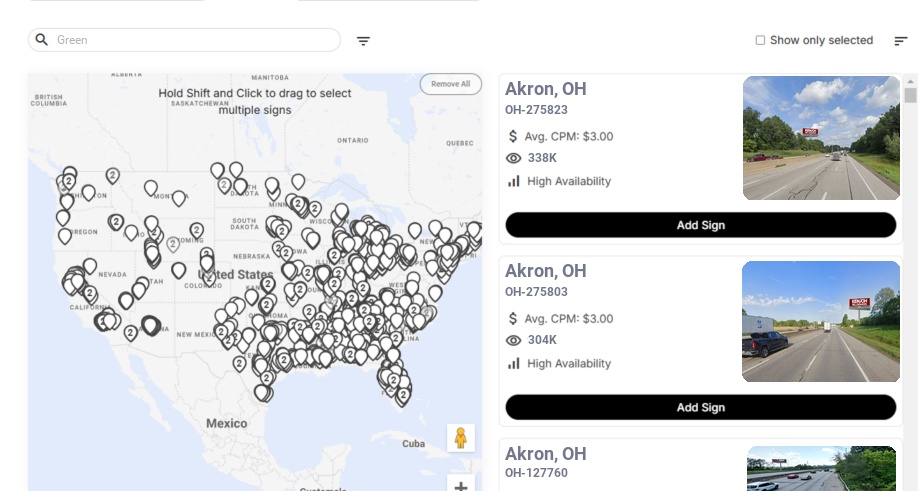
There are 9 Blip digital billboards serving the Green area from nearby North Canton and Akron. The boards are strategically positioned near I‑77 interchanges serving the Green area and the airport, major retail areas frequented by Green-area residents, and corridors connecting Green to downtown Akron, Fairlawn, and Canton. Because our 9 boards are all within about 10 miles of Green, we can customize which ones run your creative to best match your customer draw radius.
What kind of audience will Blip billboards near Green, Ohio reach?
The Green area and surrounding communities form a strong middle-income, family-oriented audience with pockets of higher-income households and a significant business traveler segment tied to Akron-Canton Airport. Green and nearby suburbs skew slightly older than central Akron, with a large 35–64 age band, and roughly 25–30% of residents are under 18. The area is also car-reliant, with 75–85% of workers commuting by driving alone.
When is the best time to run Blip billboards near Green, Ohio?
Traffic volumes on I‑77 and key arterials typically rise 30–50% during peak commuting periods compared with overnight lows, and weekend mid-day periods often match or exceed weekday mid-day traffic around shopping destinations. Morning commute, evening commute, midday, and the evening retail window are all highlighted as strong dayparts. Weekends also see heavy traffic to regional destinations, making Saturday late morning to early afternoon and Sunday midday especially useful.
How can businesses use billboard advertising near Green, Ohio during busy seasons?
The Green area’s annual calendar and regional events create multiple opportunities to time campaigns, including winter holiday shopping, spring home buying and renovation, summer travel, and fall back-to-school activity. Blip’s flexible scheduling lets us adjust your impressions month-by-month to match these peaks rather than spreading your budget thinly across lower-impact periods. This flexibility is especially valuable for advertisers timing billboard rental near Green to coincide with busy local seasons.
Do I need a contract to advertise with Blip near Green?
No, Blip has no long-term contracts or minimum commitments. You can start, pause, or stop your campaign at any time.
How fast can I launch a billboard campaign with Blip near Green?
You can have your campaign live in minutes. Create a free account, select your locations, set your budget, upload your design, and start running once approved.
Where can I advertise with Blip near Green?
Blip has digital billboards near Green. You can browse available locations on a map, choose the ones that fit your audience, and start advertising right away.
Still have questions? Launch a campaign in minutes — no contracts, no commitments.
Start Your CampaignGreen Billboard Advertising Guide
The Green, Ohio area sits at the heart of the Akron–Canton corridor, making it an ideal place to reach commuters, families, and business travelers with digital billboards. With 9 Blip digital billboards serving the Green area from nearby North Canton (about 5.5 miles away) and Akron (about 8.3 miles away), advertisers can tap into heavy traffic on I‑77 and surrounding routes while staying tightly focused on local consumers. Across similar suburban freeway corridors, digital billboards typically deliver tens of thousands of daily impressions per face, with industry studies showing unaided ad recall rates of 40–50% for well-designed digital boards. For businesses exploring billboard advertising near Green, this combination of repeat exposure and strong recall makes the corridor especially attractive.
Understanding the Green Area Market
The City of Green is a growing community in southern Summit County between Akron and Canton. According to the City of Green, the city’s population is approximately 27,000 residents spread across roughly 33 square miles, for a low-to-moderate density of about 800 people per square mile. City planning documents note that more than 1,000 new housing units have been added over the last decade, along with hundreds of thousands of square feet of new commercial and industrial space. Green is also home to the Akron-Canton Airport (CAK), a key regional travel hub that handled roughly 800,000–900,000 passengers annually in recent years.
To understand the broader advertising opportunity, it helps to look at the surrounding metro:
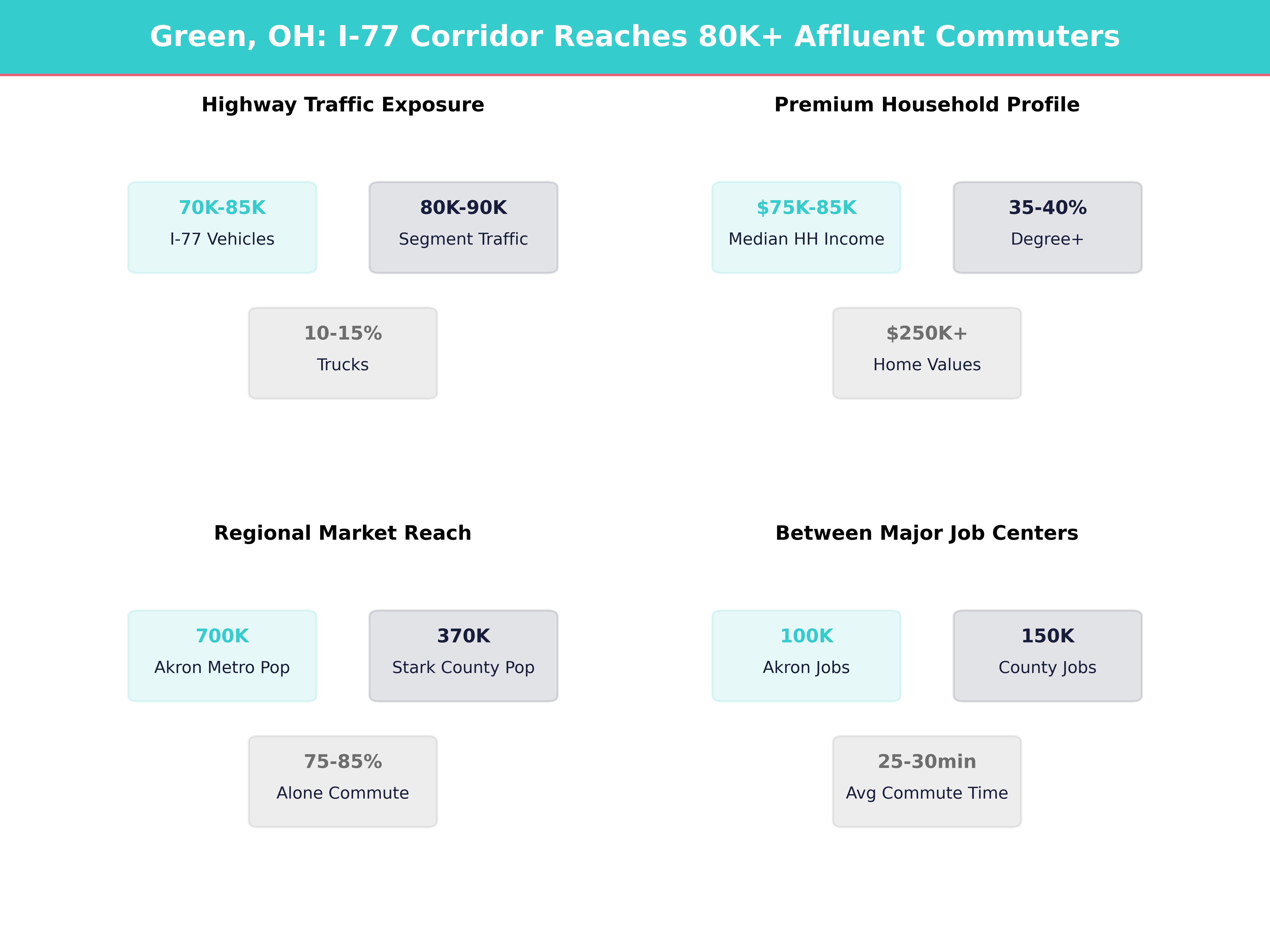
- The City of Akron has a population of about 189,000 residents, with more than 700,000 people in the surrounding Akron metro area, per regional planning and city data cited by Summit County. Akron serves as a major employment center, with more than 100,000 jobs in sectors such as healthcare, manufacturing, and education.
- North Canton, in northern Stark County, has roughly 17,000 residents, and Stark County overall has around 370,000 residents, according to county figures shared by Stark County. Stark County employment data point to 150,000+ jobs, concentrated in manufacturing, logistics, and services.
- The Akron–Canton region benefits from cross-commuting: regional transportation and planning sources such as the Akron Metropolitan Area Transportation Study (AMATS) estimate that tens of thousands of residents travel daily between southern suburbs like Green and employment centers in Akron, Canton, and North Canton. In many suburban Ohio corridors, 75–85% of workers commute alone by car, a pattern that also holds in the Akron–Canton area.
The result is a dense, mobile audience moving past our 9 digital billboards near Green multiple times per week, especially along I‑77, which is the primary north–south spine connecting Akron and Canton. In similar interstate corridors, average workers drive 25–30 minutes each way, giving your message repeated exposure during daily routines and making Green billboards a cost-effective way to stay in front of local drivers.
Traffic Patterns and Where Your Message Shows Up
Effective billboard campaigns near the Green area start with understanding how and when people travel.
According to analyses and traffic count data published by the Ohio Department of Transportation (ODOT) Summit County Engineer’s Office
- I‑77 between Akron and Canton carries roughly 70,000–85,000 vehicles per day near the Green area.
- On peak commuter stretches closer to Akron, some segments of I‑77 see 80,000–90,000 vehicles daily, with truck percentages frequently in the 10–15% range, which is important for B2B and industrial advertisers.
- Arterial roads feeding I‑77 and the Akron-Canton Airport, such as Massillon Road (SR‑241) and Arlington Road, can carry 15,000–25,000 vehicles per day, depending on the segment.
- Nearby routes such as SR‑619, Mayfair Road, and South Main Street commonly see 10,000–18,000 vehicles daily, helping feed traffic between Green neighborhoods, shopping areas, and the interstate.
Our digital billboards in North Canton and Akron are strategically positioned near:
- I‑77 interchanges serving the Green area and the airport, where ODOT counts often exceed 70,000 daily vehicles
- Major retail areas frequented by Green-area residents, where trade-area studies typically show 60–70% of customers arriving by vehicle from within a 10–15 mile radius
- Corridors connecting Green to downtown Akron, Fairlawn, and Canton, which together host hundreds of thousands of square feet of office, retail, and medical space
This means that when we schedule your Blips during peak commuting or shopping hours, you’re putting your message in front of a large share of the Green-area audience, even though the boards themselves are located in neighboring cities. Industry research on out-of-home advertising shows that over 70% of drivers frequently notice roadside billboards during commutes, and about 1 in 3 report visiting a business they saw advertised on a billboard. For businesses seeking billboard advertising near Green, tapping into these traffic flows can significantly amplify your brand’s visibility along drivers’ everyday routes.
Who You’re Reaching Near Green
Demographically, the Green area and surrounding communities form a strong middle-income, family-oriented audience with pockets of higher-income households and a significant business traveler segment tied to Akron-Canton Airport.
Drawing from city, county, and regional tourism data via the City of Green, Visit Canton, Destination Akron–Summit, and local partners such as the Green Area Chamber of Commerce:
-
Age profile
- Green and nearby suburbs skew slightly older than central Akron, with a large 35–64 age band that often represents 40–45% of the local population.
- Roughly 25–30% of residents are under 18, indicating strong family presence and demand for youth activities, education, and healthcare.
-
Income
- Median household income in Green is in the $75,000–$85,000 range, noticeably higher than many urban neighborhoods to the north and above statewide medians.
- Surrounding suburbs of Summit and Stark Counties include affluent clusters with median incomes above $90,000, and local housing data show a substantial share of owner-occupied homes valued at $250,000+.
-
Education & occupations
- In many Green-area neighborhoods, 35–40% of adults hold a bachelor’s degree or higher.
- Major occupations include healthcare, professional and technical services, manufacturing, education, logistics, and aviation-related work tied to Akron-Canton Airport, which supports thousands of direct and indirect jobs in the region.
- Proximity to institutions like the University of Akron and nearby colleges adds a student and young-professional component to the traveling audience along I‑77.
-
Travel behavior
- Akron-Canton Airport has historically handled close to 1 million passengers in strong years, with peak summer and holiday travel days generating several thousand vehicle trips per day on roads adjacent to Green.
- Regional commuting data for Summit and Stark Counties show that 75–85% of workers commute by driving alone, with many residents routinely driving 10–20 miles for work, shopping, and entertainment.
- Average one-way commute times in the broader Akron–Canton area commonly fall in the 22–26 minute range, meaning most commuters pass the same locations 10 times per workweek.
For advertisers, this translates into an audience that is car-reliant, value-conscious but with discretionary income, and responsive to messages about family services, home improvement, healthcare, auto, dining, and regional attractions. National out-of-home studies consistently find that over 60% of drivers have looked up a website or visited a store after seeing a billboard, which pairs well with call-to-action messaging aimed at this mobile, digitally connected audience and reinforces the value of well-placed Green billboards as part of a broader media mix.
When to Run Your Blips Near Green
One of the biggest advantages of digital billboards with Blip is the ability to schedule your ads in short increments when your ideal audience is most likely to be on the road.
Based on commuter and retail patterns in the Green area and broader Akron–Canton corridor, traffic volumes on I‑77 and key arterials typically rise 30–50% during peak commuting periods compared with overnight lows, and weekend mid-day periods often match or exceed weekday mid-day traffic around shopping destinations.
Weekday drive times
-
Morning commute (6:30–9:00 a.m.)
- Targets professionals commuting from the Green area toward Akron, North Canton, and Canton; in many corridors, 35–40% of daily traffic occurs in the combined morning and evening peaks.
- Ideal for B2B services, healthcare, higher education, auto repair, and quick-service restaurants promoting breakfast.
-
Evening commute (3:30–6:30 p.m.)
- Captures both workers returning to Green-area neighborhoods and people heading out for shopping or dining. Retail studies frequently show 50%+ of weekday store visits occurring after 4:00 p.m.
- Strong for retail, grocery, dining, entertainment, gyms, and after-school activities.
Midday and retail peaks
-
Midday (11:00 a.m.–2:00 p.m.)
- Reaches remote workers, retirees, stay-at-home parents, and business travelers around Akron-Canton Airport.
- Great for lunch specials, medical practices, financial services, and local attractions, especially as restaurants can see 30–40% of daily revenue during the lunch window.
-
Evening retail window (5:00–8:00 p.m.)
- Popular shopping period around major retail corridors near Akron and North Canton that draw Green-area residents. Regional mall and power center data often show 60–70% of weekday sales taking place after 5:00 p.m.
- Use for urgent offers, same-day promotions, and events happening that night.
Weekends
- Saturdays and Sundays see heavy traffic to regional destinations promoted by Destination Akron–Summit and Visit Canton: malls, parks, museums, sports events, and seasonal festivals. Visitor bureaus report hundreds of thousands of annual visitors to area attractions like Portage Lakes State Park Downtown Akron Partnership Hall of Fame Village.
- In many retail centers, 25–35% of weekly sales occur on Saturdays alone, with additional gains on Sundays.
-
Consider increasing Blip frequency:
- Saturday late morning to early afternoon (10:00 a.m.–2:00 p.m.)
- Sunday midday (11:00 a.m.–3:00 p.m.)
- Weekend emphasis tends to work well for home improvement, furniture, outdoor recreation, tourism, and automotive, as auto dealers often report 40–50% of weekly foot traffic between Friday and Sunday.
We can also flex your budget, putting more spend during high-value windows (for example, only during weekday rush hour plus Saturday afternoons) and pausing or reducing at less critical times, helping you generate more impressions per dollar during the hours when traffic is heaviest.
Seasonal Opportunities Specific to the Green Area
The Green area’s annual calendar and regional events create multiple opportunities to time campaigns:
-
Winter (Dec–Feb)
- Holiday shopping traffic to regional malls and shopping centers in and around Akron and North Canton, where retailers can see 20–30% of annual sales in November–December.
- Weather-related services (auto repair, HVAC, roofing, snow removal) see heightened demand as northern Ohio averages 40–60 inches of snowfall per season.
- Leverage highway visibility for “last exit before…” gift promotions and travel-related messaging for Akron-Canton Airport, which typically sees sharp passenger spikes around Thanksgiving, Christmas, and New Year’s.
-
Spring (Mar–May)
- Tax season, home buying, and home renovation pick up. Real estate markets in Summit and Stark Counties often see 25–35% of annual home sales between March and June.
- Focus on realtors, mortgage lenders, landscapers, contractors, and medical providers (allergy clinics, primary care), as allergy-related visits regularly increase in spring.
-
Summer (Jun–Aug)
- Family travel increases, with more trips via Akron-Canton Airport and outings to area attractions. Regional tourism organizations report that 40% or more of annual visitor spending can occur in the summer months.
- Target day trips and events promoted by Akron’s local media and the Canton Repository, along with local television and radio outlets.
- Great season for amusement venues, youth sports programs, outdoor dining, and tourism; park and trail usage in the Akron–Canton area can double compared with winter.
-
Fall (Sep–Nov)
- Back-to-school, university activities, and high school sports increase local travel and visibility. School districts around Green and Akron, including Green Local Schools and Akron Public Schools, collectively serve tens of thousands of students, boosting evening and weekend traffic to campuses and stadiums.
- Back-to-school retail, tutoring, healthcare, and fitness centers can use strong, time-bound messages; school- and sports-related purchases often account for 15–20% of annual family retail spending during this period.
- Pre-winter home and auto services can build urgency, especially as homeowners prepare for colder weather and potential snowfall.
Blip’s flexible scheduling lets us adjust your impressions month-by-month to match these peaks rather than spreading your budget thinly across lower-impact periods, which can increase your effective reach and frequency during the highest-response times of year. This flexibility is especially valuable for advertisers timing billboard rental near Green to coincide with busy local seasons.
Crafting Creative That Works for Drivers Near Green
Drivers in the Green area and on surrounding interstates typically have 3–6 seconds to absorb your billboard. Creative choices must reflect this reality. Eye-tracking and legibility studies for roadside advertising show that keeping copy short and high-contrast can increase message retention by 20–30% compared with cluttered designs.
Messaging
- Keep to 7 words or fewer for your main message; research on outdoor readability indicates that messages with 7 words or fewer are retained significantly better than longer headlines.
- Use one clear call to action: “Exit 5 for Green,” “Call Today,” “Book at CAK,” or “Visit [YourBrand].com”.
- Use large, high-contrast fonts; think bold sans-serif type that can be read quickly at 60–70 mph, which often means character heights of 18–24 inches or more on a standard 14’ x 48’ face.
-
Tailor language to local context:
- Reference major routes: “Off I‑77 near the Green area,” “Minutes from Akron-Canton Airport.”
- Mention known hubs: “Near Portage Lakes,” “Short drive from downtown Akron.”
Visuals
- Choose one focal image—a product shot, a local landmark, or a strong brand graphic. Industry best practices suggest limiting designs to no more than 3 key elements (logo, headline, main image) for maximum clarity.
- Avoid clutter; every extra element reduces legibility and can drop comprehension scores by 10–20 percentage points.
- High contrast is crucial: light text on a dark background or vice versa. Contrast ratios of at least 4:1 help maintain readability in sun, rain, and dusk.
- If timing around events (for example, big games or festivals), incorporate relevant imagery sparingly, but keep your core branding strong so it is still recognizable in half-second glances as vehicles pass.
Local cues
Including subtle local touches can improve recall:
- Referencing the Akron-Canton Airport (“Fly CAK,” “Just 5 minutes from the airport”) can anchor your business location in the minds of travelers; airport-area businesses often report that a significant share of customers mention seeing roadside signage.
- Calling out “Akron–Canton,” “Summit & Stark Counties,” or “Green area” can reassure viewers you serve their community and can raise relevance perceptions by 10–15% in consumer surveys.
- When targeting commuters, emphasize time savings (“10 minutes from the Green area,” “Same-day service”) or convenience on their route, as commute-time optimization is a top concern for many of the 70%+ of local workers who drive to work daily.
Targeting by Industry: How Businesses Can Use Billboards Near Green
Below are practical ways different sectors can leverage our 9 digital billboards serving the Green area. Industry benchmarks show that well-planned out-of-home campaigns can lift search activity for a brand by 20–50% and in-store visits by 10–20%, making them a strong complement to digital marketing and a smart approach to billboard advertising near Green.
Local retail & restaurants
- Target evening commuter and weekend dayparts near Akron and North Canton retail clusters where Green-area residents shop; trade-area studies typically show that 60–75% of shoppers at these centers come from within a 15–20 minute drive.
- Use short, offer-driven messages: “Tonight Only – Kids Eat Free,” “New Location Near Green Area.”
- Highlight proximity: “Next Exit Off I‑77” or “7 Minutes from Akron-Canton Airport.” Restaurants and retailers often see immediate traffic bumps when proximity-based billboards go live.
Home services & contractors
- Focus on homeowners commuting through the corridor; local homeownership rates in surrounding suburbs often exceed 70%, creating a large homeowner audience.
- Run heavier schedules during spring and fall when home improvement is top-of-mind. Nationally, home improvement spending can be 30–40% higher in these seasons versus winter.
- Use problem-solution creative: “Roof Leak? Call [Brand], Serving the Green Area.” Service businesses commonly report that 20–30% of new callers mention “seeing your sign” when billboard campaigns are active.
Healthcare & wellness
- Promote urgent care, primary care, dental, and specialty clinics near the Green area, especially given the strong family base and older adult population segments.
- Schedule during commute windows when people are thinking about errands they need to schedule; healthcare providers often see appointment call spikes aligned with early-morning and late-afternoon ad exposure.
- Use trust-building language: “Same-Day Appointments,” “Serving Families in the Green Area.” Surveys show that 60–70% of consumers perceive businesses with outdoor signage as more established and trustworthy.
Automotive sales & service
- Target I‑77 segments near North Canton and Akron that Green-area drivers use daily. In many regions, auto ownership rates exceed 1.8 vehicles per household, which is consistent with car-reliant suburban communities.
- Pair messaging with time sensitivity: “Oil Change Today – No Appointment,” “Year-End Sales Event.” Year-end auto promotions can account for 15–20% of annual dealer sales.
- Consider heavier weekend schedules to catch shoppers visiting auto malls; dealerships often register peak lot traffic on Saturdays, with strong secondary peaks on weekday evenings.
Education & training
- Universities, community colleges, vocational schools, and training centers can reach both young adults and career changers commuting across the region. The Akron–Canton corridor is home to tens of thousands of college and technical students.
- Run bursts around application deadlines or enrollment events; short, intense campaigns of 2–4 weeks can generate noticeable increases in web inquiries and campus visits.
- Use simple, aspirational lines: “Advance Your Career – Classes Near the Green Area.”
Tourism, entertainment, and events
- Use billboards to drive attendance to regional attractions highlighted by Destination Akron–Summit and Visit Canton, as well as venues like Canal Park Pro Football Hall of Fame
- Intensify schedules in the 2–3 weeks leading up to major events; event marketers frequently see double-digit percentage increases in ticket sales when combining outdoor with digital campaigns.
- Include a strong date or countdown: “This Weekend Only,” “Festival Starts Friday.” Time-specific messages help convert awareness into immediate action.
Using Blip’s Flexibility to Your Advantage Near Green
With Blip, you buy airtime one “blip” at a time, allowing us to align your budget with the most relevant boards, times, and days for the Green area. Digital out-of-home platforms commonly allow for hundreds to thousands of ad plays per board per day, depending on your budget and share of voice. This makes it easy to experiment with different Green billboards and refine your mix based on performance.
Here are ways to structure your campaign:
-
Concentrated bursts
- Run higher-frequency Blips over shorter windows (for example, 2–4 weeks) around a sale, grand opening, or event.
- Focus on morning and evening rush hours on weekdays and midday on Saturdays; concentrating impressions can raise effective frequency to 5–7+ views per person in your target area during the flight.
-
Always-on presence
- Maintain a low, steady baseline of impressions throughout the year for brand awareness—many local brands aim for a modest daily spend to sustain visibility.
- Add temporary boosts during key seasonal periods (back-to-school, holidays, tax season) when consumer spending spikes by 15–30% in key categories.
-
Daypart-only strategies
- For restaurants, concentrate budget 10:30 a.m.–1:30 p.m. and 4:30–7:30 p.m., aligned with the two major daily meal peaks.
- For B2B and professional services, focus on 7:00–9:00 a.m. and 4:00–6:00 p.m. weekdays, when decision-makers are commuting and more receptive to work-related messaging.
-
Location-optimized mixes
- Emphasize boards closest to the Green area commuter routes and airport access when your goal is reaching residents and travelers near Green.
- Extend to additional Akron and North Canton boards if you want to reach a broader Akron–Canton audience that includes workers and shoppers from neighboring communities.
Because our 9 boards are all within about 10 miles of Green, we can customize which ones run your creative to best match your customer draw radius. Businesses whose customers typically travel 10–15 minutes are especially well-suited to this cluster of locations, and can treat Blip as a flexible, on-demand form of billboard rental near Green rather than committing to a single long-term, fixed-location board.
Measuring Impact and Improving Over Time
While billboard advertising near the Green area is primarily an upper-funnel and mid-funnel medium, we can still help you measure impact and refine performance. Studies of integrated campaigns show that adding out-of-home can increase the effectiveness of digital and search efforts by 20–40%, thanks to higher brand familiarity.
To make analysis easier:
- Use a simple, trackable URL or landing page specifically for your billboard campaign (for example, yourbrand.com/green). Monitor visits, bounce rates, and conversions during your flight.
- Feature billboard-only offers or promo codes, especially for retailers, restaurants, and service businesses; even a 5–10% redemption rate on a unique code can indicate strong billboard-driven response.
-
Watch for changes in:
- Direct and branded search volume for your business within the Akron–Canton region.
- Web traffic from IPs geolocated to Summit and Stark Counties during your flight.
- Call volume or form fills during the days and times your Blips are scheduled; call tracking services can quantify uplift.
We also recommend monitoring local news and events through outlets like the Akron Beacon Journal, the Canton Repository, and regional broadcasters that cover the Akron–Canton market. When major regional developments, road projects, or events shift traffic or consumer attention—for example, construction updates announced by the City of Green or lane closures published by ODOT—we can quickly adjust your Blip schedule and creative to keep your message relevant and maintain reach.
By understanding how Green-area residents move through the Akron–Canton corridor, who they are, and when they’re on the road, we can use our 9 digital billboards in nearby North Canton and Akron to deliver tightly targeted, high-impact campaigns. With flexible budgeting and scheduling, we can tailor your presence near the Green area to match your goals—whether that’s building brand awareness, driving foot traffic, or pushing time-sensitive offers to commuters and travelers—while grounding decisions in local traffic, demographic, and seasonal data and maximizing the value of billboards near Green for your business.