Billboards in Sandusky, OH
No Minimum Spend. No Long-Term Contracts. Just Results.
Trusted by Leading Brands


Billboard advertising
in Sandusky has never been easier
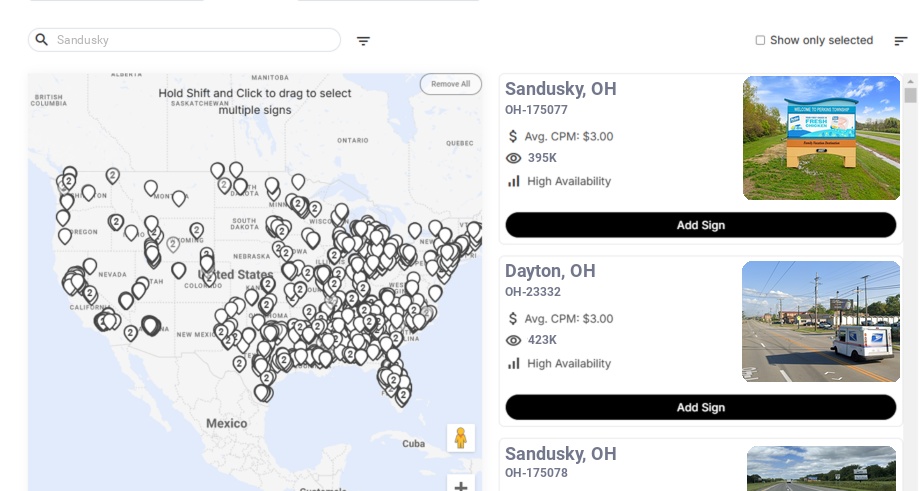



How much is a billboard in Sandusky?
Why Choose Blip for Billboard Advertising in Sandusky
Blip lets you launch Sandusky billboards fast and target OH-2 and US-250 traffic in minutes—perfect for Cedar Point visitors and year-round commuters.
Set a flexible budget for Sandusky, then scale up for May-September and holiday weekends when Lake Erie Shores & Islands tourism surges.
Use dayparting in Sandusky to hit Friday arrivals, Saturday park traffic, and Sunday departures on US-250, US-6, and the Turnpike.
No contracts means you can test Sandusky ads for ferries, downtown nightlife, or healthcare recruitment and shift when results change.
Track Sandusky performance in real time and adjust for peak traffic on OH-2 or downtown event nights near Jackson Street Pier.
Blip's creative tools make it easy to build clear, visitor-friendly Sandusky messages like 'Next Exit' or '3 min from Cedar Point.'
Frequently Asked Questions About Billboard Advertising in Sandusky
How much does a billboard cost in Sandusky, Ohio with Blip?
With Blip, you can advertise on Sandusky billboards on any budget by setting a daily amount that fits your goals, and Blip automatically keeps your campaign within that limit. Each “blip” is a 7.5 to 10-second ad on rotating digital billboards in Sandusky, Ohio, and you only pay for the blips you receive. Pricing for each blip varies based on when and where you choose to advertise and on advertiser demand, giving you flexibility to reach locals and visitors during prime times or slower hours.
Where can I advertise with Blip in Sandusky, Ohio?
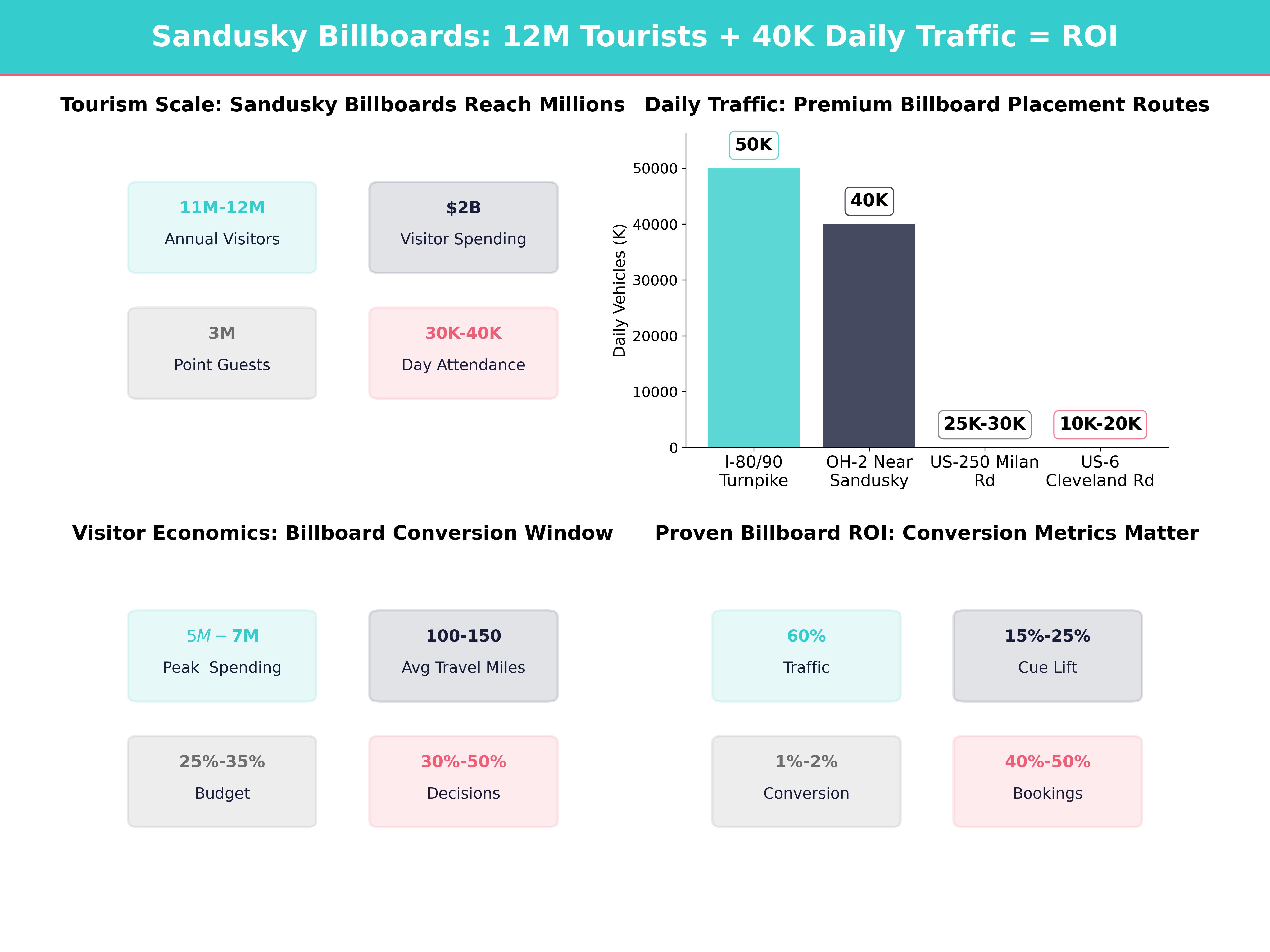
Sandusky’s layout concentrates traffic along a few corridors, which makes board selection important for a billboard rental in Sandusky strategy. OH-2 near Sandusky carries 40,000+ vehicles per day in some segments, US-250 is the primary commercial strip with stretches exceeding 25,000–30,000 vehicles per day, and US-6 connects downtown Sandusky to outlying communities and Cedar Point. Nearby interstates such as I-80/I-90 also funnel regional visitors toward Sandusky and the lake.
When is the best time to run Sandusky billboards with Blip during Cedar Point season?
Sandusky is highly seasonal, and peak season runs from May through September. Cedar Point typically operates from early May through late October, with June through August as the busiest months, and traffic on OH-2 and US-250 increases significantly in late spring and summer. Blip campaigns can concentrate budget on weekends, holiday periods, and summer Fridays when visitors are arriving and making same-day decisions.
What kind of audience do Sandusky, Ohio billboards reach?
Sandusky billboards can reach year-round residents, high-spending tourists in peak months, and day trippers and weekend visitors passing through on highways and major arterials. The City of Sandusky has roughly 25,000 residents, while Erie County totals around 73,000–75,000 people, and the broader Lake Erie Shores & Islands region welcomes an estimated 11–12 million visitors annually. Cedar Point alone draws around 3 million visitors in a typical season.
What should my Sandusky, Ohio Blip billboard ad say to reach visitors?
Good creative in Sandusky balances clarity for visitors with relevance to locals and makes the most of the unique exposure billboards in Sandusky can provide. Many billboard viewers are out-of-towners relying on GPS but still searching for reassurance, so include distance cues like “0.5 mile ahead” or “Next Exit,” and use simple wayfinding. For many visitors, same-day decisions account for 30–50% of their trip spending, so timely, situation-specific hooks can capture real-time demand.
Do I need a contract to advertise with Blip in Sandusky?
No, Blip has no long-term contracts or minimum commitments. You can start, pause, or stop your campaign at any time.
How fast can I launch a billboard campaign with Blip in Sandusky?
You can have your campaign live in minutes. Create a free account, select your locations, set your budget, upload your design, and start running once approved.
Where can I advertise with Blip in Sandusky?
Blip has digital billboards in Sandusky. You can browse available locations on a map, choose the ones that fit your audience, and start advertising right away.
Still have questions? Launch a campaign in minutes — no contracts, no commitments.
Start Your CampaignSandusky Billboard Advertising Guide
Sandusky, Ohio gives us an unusually powerful combination of resident reach, seasonal tourism spikes, and highway visibility. With digital Sandusky billboards through Blip, we can tap into this market at exactly the right times, on the right roads, with messages tailored to who is in town that week or even that hour.
Why Sandusky Is a High-Impact Billboard Market
Sandusky is much more than a small Lake Erie city. It functions as a regional tourism hub that multiplies its population several times over in peak season, making Sandusky billboard advertising especially efficient.
- The City of Sandusky has roughly 25,000 residents, while Erie County totals around 73,000–75,000 people, giving advertisers a stable, year-round base audience.
- Erie County’s median household income is in the $58,000–$62,000 range, with consumer spending on food services, entertainment, and retail accounting for well over 30% of local household expenditures.
- The broader Lake Erie Shores & Islands region welcomes an estimated 11–12 million visitors annually, generating over $2 billion in visitor spending according to regional tourism reports from Lake Erie Shores & Islands.
- Tourism supports more than 14,000 jobs across the Shores & Islands region, and visitor spending generates tens of millions of dollars in local and state tax revenue annually.
- Cedar Point alone draws around 3 million visitors in a typical season, with guests coming from Ohio, Michigan, Indiana, Pennsylvania, Ontario, and beyond. On peak Saturdays in summer, daily attendance can top 30,000–40,000 guests.
- Passenger ferry services from Sandusky and nearby ports routinely carry hundreds of thousands of riders per season to Kelleys Island and Put-in-Bay, concentrating visitor vehicle traffic on a tight network of local roads.
This means a digital billboard campaign here is never just “local.” We can reach:
- Year-round residents making repeated trips on the same roads.
- High-spending tourists in peak months (hotels, dining, entertainment, attractions).
- Day trippers and weekend visitors passing through on highways and major arterials.
Blip’s flexibility—choosing specific boards, timeframes, and budgets—lets us ramp up during those massive tourism surges and scale back to a steady, efficient baseline during the off-season. For many advertisers, that makes billboard rental in Sandusky a controllable, testable channel rather than a fixed, long-term commitment.
Understanding Sandusky’s Audience
To choose the right messages and schedules, it helps to understand who we’re talking to.
Residents and workers
- Median age in Sandusky is around 38 years, similar to the U.S. average, giving us a broad middle-aged core audience with both family households and younger adults.
- Roughly 1 in 5 residents is under age 18, and about 17–18% are 65 or older—two groups that drive spending on family entertainment, healthcare, and services.
- Around 55–60% of Sandusky households live in owner-occupied housing, while 40–45% rent, which supports steady demand for home services, furnishings, and apartment-oriented offers.
- Health care, manufacturing, tourism/hospitality, and education are key employers, with major institutions such as Firelands Health Sandusky City Schools, and hospitality operations supporting Cedar Point and the lake economy. Firelands Health alone employs 2,000+ staff, drawing workers from multiple counties.
- Unemployment in Erie County typically tracks close to state averages, often in the 3.5–5% range, indicating a relatively active labor market—helpful for recruitment campaigns.
- Many workers commute into the city from across Erie, Huron, and Ottawa counties, driving daily on US-250, US-6, and OH-2. These corridors see tens of thousands of trips per day, creating reliable weekday impression opportunities for billboards in Sandusky.
You can find additional demographic and community information via the City of Sandusky and Erie County, Ohio websites.
Tourists
Tourism is the main multiplier for the market:
- The Lake Erie Shores & Islands region reports 11–12 million visitors each year, with the majority arriving between May and September and notable spikes on holiday weekends.
- Tourism generates more than $2 billion in visitor spending annually across lodging, food and beverage, transportation, retail, and recreation. In some peak summer weeks, daily visitor spending in the region easily surpasses $5–7 million per day.
-
Families and young adults dominate Cedar Point traffic. Park guests skew toward:
- Families with children (seeking lodging, food, shopping, and kid-friendly activities). Families with children under 18 represent roughly one-third of Erie County households.
- Teens and young adults (food, nightlife, quick-serve restaurants, activities).
- Multi-generational groups (seeking convenient, recognizable brands and experiences).
- The average Cedar Point guest travels 100–150 miles to visit the park, making billboards on approach routes particularly valuable for last-minute decision-making around food, lodging, and activities.
- Lake enthusiasts heading to the islands (Kelleys Island, Put-in-Bay) use ferries departing nearby, again concentrating out-of-area visitors on a few key roadways and downtown waterfront areas.
What this means for creatives
- Family-focused and value-oriented messages play well (bundle deals, “kids eat free,” “family fun tonight”). Families on leisure trips typically spend 25–40% more per day than solo travelers.
- Simple wayfinding (“2 miles ahead,” “Next right on US-250”) is crucial for visitors unfamiliar with the area—more than 60% of leisure visitors are first-time or infrequent visitors.
- Give visitors confidence: emphasize “open late,” “easy parking,” or “on the way to Cedar Point / ferries.” For many visitors, same-day decisions (where to eat, shop, or stay) account for 30–50% of their trip spending.
Seasonal Strategy: Riding the Tourism Waves
Sandusky is highly seasonal, and our Blip campaigns for Sandusky billboards should mirror that pattern.
Peak season: May–September
- Cedar Point typically operates from early May through late October, with June–August as the busiest months. Attendance in July alone can account for 20–25% of the park’s annual visitors.
- Regional lodging demand reflects this: summer hotel occupancy in the Shores & Islands area often runs 70–80% on weekends, with many properties selling out on peak Saturdays.
- Hotel average daily rates (ADR) in peak season can be 30–50% higher than in winter months, so converting even a small percentage of highway traffic into bookings has outsized revenue impact.
- Traffic volumes on OH-2 and US-250 increase significantly in late spring and summer, with some weekend days showing 10–20% more vehicles than off-season averages.
- Weather plays a major role: warm, sunny weekends can dramatically spike last-minute trips, with Cedar Point and lake traffic surging on short notice.
Blip advantage: we can concentrate more of our budget into:
- Memorial Day, July 4th, and Labor Day weekends, which often produce some of the highest visitor counts and lodging rates of the year.
- Summer Fridays (afternoon and evening) as visitors arrive—Friday check-ins can represent 30–40% of weekend lodging arrivals.
- Weekend mornings (check-in, park arrival) and evenings (dining, entertainment, shopping), when visitors are actively searching for where to spend money next.
Shoulder seasons: March–April, October
- Spring break periods and fall weekends (including HalloWeekends at Cedar Point) bring additional bursts of traffic. HalloWeekends has become a significant draw, helping extend the season into late October.
- Visitor numbers in shoulder seasons are typically lower than midsummer, but per-visitor spending can remain strong, especially on attractions and dining.
- Families still seek restaurants and entertainment, but may be more budget-conscious and time-limited, often taking 2–3 night trips instead of full-week vacations.
Strategy ideas:
- Promote “off-peak” specials, fall events, or weeknight discounts. Even a 10–15% discount can meaningfully improve conversion among price-sensitive travelers.
- Target Fridays and Saturdays heavily during HalloWeekends, especially evening hours, when traffic to and from the park is heaviest and visitors are looking for post-event dining or late-night activities.
Off-season: November–February
- Tourism slows, but daily local life continues. Hotel occupancy can drop into the 30–40% range on some winter weekdays, and park attendance is paused.
- Commuter and resident-focused campaigns perform best—healthcare, education, home services, automotive, and financial services.
- Retailers and service providers can benefit from holiday-season and New Year’s resolutions: November–January still accounts for a disproportionate share of annual retail and fitness/health-related sign-ups.
During these months we can:
- Reduce daily budgets but maintain always-on presence during commuter windows, supporting long-term brand awareness.
- Shift messaging to local needs: heating and cooling services, tax prep, holiday shopping, winter events promoted by the City of Sandusky and Erie County.
Geographic Hotspots and Commuter Patterns
Sandusky’s layout concentrates traffic along a few corridors, which we should prioritize when choosing boards in Blip’s platform for our billboard rental in Sandusky strategy.
Highway and arterial corridors
According to traffic counts referenced by the Ohio Department of Transportation
- OH-2 near Sandusky carries 40,000+ vehicles per day (AADT) in some segments, acting as the main east–west expressway along Lake Erie and serving both long-distance and regional traffic.
- US-250 (Milan Road) is the primary commercial strip, feeding Cedar Point, hotels, restaurants, and shopping areas, with stretches exceeding 25,000–30,000 vehicles per day.
- US-6 (Cleveland Road) parallels the lake and connects downtown Sandusky to outlying communities and Cedar Point, with daily traffic in the 10,000–20,000 vehicles range on many segments.
- Nearby interstates such as I-80/I-90 (Ohio Turnpike) funnel regional visitors toward Sandusky and the lake, with some Turnpike segments carrying 50,000+ vehicles per day, a significant portion of which are leisure travelers in summer.
Implications for board selection:
- Boards visible from OH-2 are ideal for reaching long-distance travelers and day trippers arriving from Cleveland, Toledo, and beyond—regions that collectively contribute millions of annual visits to the Shores & Islands area.
- US-250-facing boards capture visitors in “decision mode” as they pass hotels, restaurants, gas stations, and retail. Even a 1–2% conversion rate from this traffic can translate into hundreds of incremental customers during peak weekends.
- Boards along US-6 and near downtown can focus on local nightlife, waterfront attractions, live events, and services, especially for repeat visitors and residents who use these routes frequently.
Downtown and waterfront
The revitalized downtown and waterfront host:
- The Jackson Street Pier
- Events and festivals promoted by the City of Sandusky and local partners, including concerts, food and wine events, holiday celebrations, and waterfront activities.
- Restaurants, bars, and boutique shops benefiting from evening pedestrian and vehicle traffic. On busy summer nights, downtown streets and parking often operate at or near capacity.
Consider:
- Messaging keyed to events (“Tonight: Live Music on the Bay,” “After the Festival, Join Us on Market St.”).
- Clear directional cues if your business is more than a few turns off the main route; even a 10-second reduction in wayfinding confusion can make the difference between a stop and a pass-by.
For transit-focused campaigns, you can also reference routes and schedules from Erie County’s transit services
Crafting Creative That Resonates Locally
Good creative in Sandusky balances clarity for visitors with relevance to locals and makes the most of the unique exposure billboards in Sandusky can provide.
Prioritize ultra-clear wayfinding
Many billboard viewers are out-of-towners relying on GPS but still searching for reassurance. Include:
- Distance: “0.5 mile ahead,” “Next Exit,” “3 min from Cedar Point.”
- Landmarks: “across from Cedar Point Causeway,” “near the Sandusky Mall
- Simple maps or arrows, when legible.
Studies in roadside advertising show that including clear distance cues (e.g., “1 Mile Ahead”) can increase stop-ins by 15–25% compared with generic brand awareness messages for the same location.
Use seasonal and tourism-specific hooks
Examples tailored to Sandusky:
- “Beat the Cedar Point Rush – Breakfast Here, 1 Mile Before the Park”
- “Rainy Day at the Park? Indoor Fun 2 Miles Ahead”
- “After the Rides, Relax on the Bay – Dinner on the Water Tonight”
- “Park, Eat, Explore Downtown Sandusky – Exit Now”
Leisure travelers typically make over half of their dining and shopping decisions the same day, so timely, situation-specific hooks (rainy day, after the park, before the fireworks) can capture real-time demand.
Design for fast-moving highway traffic
On OH-2 and US-250, drivers have only seconds to absorb your message. We recommend:
- 7 words or fewer in your main headline; readability studies show recall drops sharply beyond about 7–9 words at highway speeds.
- Large, contrasting fonts and simplified color palettes; high-contrast designs can improve legibility distance by 20–40%.
- Single, bold offer or idea (e.g., “Kids Eat Free,” “Rooms from $89,” “Open 24 Hours”).
Leverage local pride and media themes
Sandusky has strong local identity, amplified by outlets like the Sandusky Register. Build trust by:
- Referencing local milestones, teams, or waterfront imagery.
- Aligning your creatives with big local stories (e.g., Cedar Point anniversaries, lakefront improvements, festivals).
- Using “Locally Owned Since [Year]” or “Proud to Serve Sandusky” language, which can be especially persuasive to residents and repeat visitors who follow local news from the Sandusky Register and city updates from City Hall.
Timing Your Blips for Maximum Visibility
Blip’s ability to choose specific hours and days is especially valuable here, because Sandusky traffic is highly time-dependent.
Tourist arrival and departure windows
- Many Cedar Point visitors arrive Friday afternoon/evening and Saturday morning. Weekend check-ins and same-day ticket purchases often cluster between 3–9 p.m. Friday and 8–11 a.m. Saturday.
- Departures often spike Sunday afternoon and Monday morning as guests head home, with heavy use of OH-2, US-250, and the Turnpike.
Recommended scheduling:
-
Increase bids and share of budget:
- Fridays: 3–10 p.m.
- Saturdays: 8 a.m.–1 p.m. and 5–10 p.m.
- Sundays: 11 a.m.–7 p.m. (capture last-minute spending and dinner traffic).
Even modest uplifts—such as converting an extra 0.5–1% of those outbound visitors into one more meal, retail stop, or activity—can add up to significant weekly revenue.
Daily patterns for residents and workers
- Morning commute: roughly 6:30–9:00 a.m.
- Lunch hours: 11:30 a.m.–1:30 p.m.
- Evening commute: 3:30–6:30 p.m.
For locals-focused businesses (healthcare, trades, financial, education):
- Concentrate impressions around morning and evening commuting windows, when more than 60% of weekday vehicle trips occur on key arterials.
- Add a lighter presence during lunch if dining or quick-service food is a focus; lunchtime conversions can be especially strong for locations within 5–10 minutes of major employment centers like hospitals, schools, and offices.
Nightlife and waterfront activity
Downtown and the waterfront see evening peaks in good weather, especially on weekends and during events promoted by the city or regional tourism.
Consider:
- Higher bids Thursday–Saturday from 6–11 p.m. when restaurants, bars, and waterfront venues are busiest.
- Event-responsive creatives (“Tonight Only,” “Post-Fireworks Specials,” “Live Music After the Game”). Event nights can increase downtown foot traffic by 20–50% versus typical evenings.
You can stay ahead of these surges using the City of Sandusky events and news page and the Lake Erie Shores & Islands events calendar.
Strategies by Business Type
Different industries can use Sandusky’s dynamics in specific ways and get more from Sandusky billboard advertising overall.
Hotels, vacation rentals, and campgrounds
- Focus on US-250 and OH-2 boards that catch travelers before they choose lodging. National travel surveys show 40–50% of road-trip stays are booked same-day, especially in drive-to destinations like Sandusky.
- Use real-value offers: “Last-Minute Rooms from $99,” “Free Breakfast & Wi‑Fi,” “Waterfront Views – Exit 118.” Even a $10–20 perceived savings can shift booking decisions.
- Intensify campaigns June–August and over holiday weekends; scale but do not fully stop in shoulder seasons, when occupancy may drop but competition for each traveler remains high.
- For campgrounds and RV parks, highlight amenities important to the roughly 11 million annual regional visitors: hookups, proximity to the lake, and drive time to Cedar Point.
Restaurants and bars
-
Time heavy delivery of blips around meals:
- Breakfast: 6–10 a.m. (on approach roads to Cedar Point and from hotels).
- Lunch: 11 a.m.–2 p.m.
- Dinner and nightlife: 5–11 p.m., especially Thursday–Sunday.
-
Different creatives for locals vs. tourists:
- Tourists: “Family-Friendly Dining Near Cedar Point,” “Kids’ Menu & Patio Seating,” “On the Way to the Ferries.”
- Locals: “Locals’ Night Specials,” “Happy Hour Downtown,” “$X Lunch Combos.”
- Restaurant spending accounts for a substantial share of visitor budgets—often 25–35% of daily trip spending—so even a minor lift from billboard exposure can translate to strong ROI.
Attractions and entertainment
- Indoor attractions (escape rooms, bowling, cinemas, indoor waterparks, museums) can capitalize on rainy or cooler days when park time decreases. Bad-weather days can shift hundreds or thousands of potential park hours into off-park activities.
- Use creative like: “Too Windy for the Lake? Indoor Fun 1 Mile Ahead.”
- Run heavier schedules during afternoons and early evenings when families look for secondary activities (typically 2–6 p.m.).
- Align campaigns with specific events listed on the Lake Erie Shores & Islands calendar or covered in the Sandusky Register to ride existing awareness.
Retail and services
- Target commuters and residents year-round.
- Ads for auto repair, home services, banks, and healthcare providers should prioritize clear branding, contact info, and quick benefits (“Same-Day Appointments,” “Walk-In Clinic Open Late”).
- Local research often shows that 60–70% of residents prefer doing routine business (banking, healthcare, auto repair) within 15–20 minutes of home or work—making directional and “near you” language particularly effective.
- For multi-location brands, include “Multiple Locations in Erie County” or similar cues to reassure both residents and repeat visitors.
Education and recruitment
-
Local colleges, trade programs, and employers can use billboards for recruitment:
- Feature starting wages, benefits, and short URLs or QR codes. Including a clear wage figure (e.g., “Starting at $20/hour”) can increase response by 20% or more over generic “Now Hiring” messages.
- Time campaigns around graduation seasons (April–June) and back-to-school months (August–September), when students and job-seekers are actively evaluating options.
- Major employers and institutions can link their billboard messaging with information on the City of Sandusky and Erie County workforce and education resources.
Measuring, Testing, and Optimizing With Blip
To get the most from Sandusky’s variable traffic patterns, we should treat campaigns as ongoing experiments and continuously refine how we use Sandusky billboards.
A/B test seasonal and audience-specific creatives
Run two or more creatives simultaneously:
- “Tourist” message vs. “Local” message on the same board.
- “Price-focused” vs. “Experience-focused” creative for the same offer.
- “Event-tied” vs. “Evergreen” versions during festival or park weekends.
Monitor:
- Website traffic spikes during your scheduled windows (via your analytics). Many advertisers see 10–30% higher direct and branded search volume when billboard campaigns go live.
- Redemptions of billboard-specific promo codes or mention of billboard offers at point of sale.
- In-person feedback (“How did you hear about us?”) and social media comments referencing your signs.
Shift more of your Blip budget toward the best-performing messages.
Optimize locations and time blocks
After several weeks:
- Identify which boards generate more visible lifts in traffic, call volume, or online searches of your brand name. Even 5–10% differences in response between boards can meaningfully improve ROI when you reallocate spend.
-
Concentrate on:
- OH-2 and US-250 boards during tourist peaks.
- Downtown-adjacent boards for nightlife, waterfront businesses, and local services.
- Off-peak, lower-cost times for always-on brand awareness—especially valuable for categories with longer decision cycles like healthcare, education, and home services.
Align with the local calendar
Use information from:
- The City of Sandusky events and news.
- The Lake Erie Shores & Islands events calendar.
- Coverage in the Sandusky Register.
Then:
- Launch or intensify campaigns one to two weeks before major festivals, holiday weekends, park openings/closings, and waterfront events. Pre-event anticipation can drive 20–40% of total event-related spending.
- Update creatives to reference those events (“Before the Fireworks,” “Welcome HalloWeekends Visitors,” etc.).
- Dial budgets up for key weekends and slightly down in the gaps, keeping a consistent but efficient presence.
By pairing Sandusky’s unique tourism-driven traffic patterns with Blip’s granular control over timing, location, and budget, we can build campaigns that feel “everywhere” during the busiest days and laser-focused during quieter periods. With the right seasonal strategy, local insights, and ongoing testing, digital Sandusky billboard advertising becomes a dependable driver of both visitor and resident business all year long.