Billboards near North Olmsted, OH
No Minimum Spend. No Long-Term Contracts. Just Results.
Trusted by Leading Brands


Billboard advertising
near North Olmsted has never been easier



How much is a billboard near North Olmsted?
Why Choose Blip for Billboard Advertising near North Olmsted
Blip lets North Olmsted advertisers launch fast, self-serve campaigns for I-480 and I-90 commuters without traditional billboard hassles.
Set flexible budgets in North Olmsted and reach Great Northern Mall shoppers, suburban families, and west-side workers on any spend.
Use dayparting on Blip to hit North Olmsted's 6:30-9 a.m. and 3:30-6:30 p.m. commute peaks with the right message at the right time.
No contracts mean North Olmsted businesses can test seasonal plays for winter heating, spring home repair, or back-to-school traffic, then pivot quickly.
Track results in real time on Blip and adjust North Olmsted campaigns as traffic shifts along Lorain Road, Brookpark Road, and the retail core.
Blip's creative tools make it easy to tailor legible North Olmsted ads for older adults, families, and mall shoppers in a few clicks.
Frequently Asked Questions About Billboard Advertising near North Olmsted
How much does a billboard cost near North Olmsted, Ohio with Blip?
With Blip, you control exactly what you spend on North Olmsted billboards by setting a daily budget that can be adjusted anytime, so your campaign always stays within your comfort zone. Each blip is a brief 7.5–10 second ad on rotating digital billboard screens, and you only pay for the blips you receive, making it easy to reach drivers in the North Olmsted area on any budget. The price of billboards near North Olmsted, Ohio changes based on time of day, location, and advertiser demand, but every blip simply adds to your total over time.
Where can I advertise with Blip near North Olmsted, Ohio?
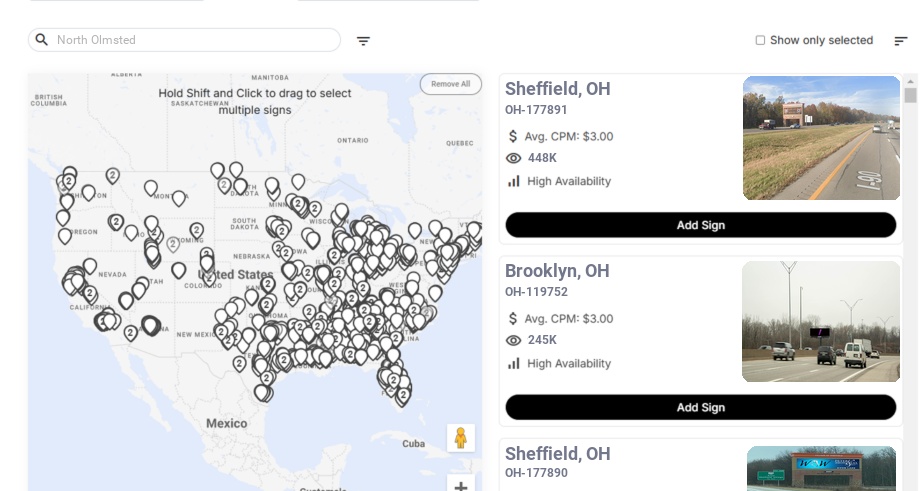
There are nine nearby digital billboards in Brooklyn, Sheffield, and Cleveland serving the North Olmsted area. These locations allow us to intercept drivers who live, shop, or work near North Olmsted while they travel major arteries, creating a highly efficient footprint for billboard advertising near North Olmsted without needing a sign on every local street. The boards are especially useful for reaching traffic on the I‑480 and I‑90 corridors.
Who do North Olmsted billboards reach in the North Olmsted, Ohio area?
The North Olmsted area is a mature, stable suburb with a strong retail and family presence, making it ideal for businesses that benefit from repeat impressions and local loyalty. Roughly 70–75% of occupied housing units in and around North Olmsted are owner‑occupied, and about 60–65% of households have two or more vehicles, indicating strong car reliance and consistent exposure to roadside media. The median age is in the mid‑40s, with about 20–22% of residents age 65+, while around 27–30% of households include children under 18.
When is the best time to run Blip ads near North Olmsted, Ohio?
The North Olmsted area follows predictable weekly and seasonal patterns that we can target carefully with Blip’s scheduling tools. Morning commute runs from 6:30–9:00 a.m., afternoon school and work traffic from 3:00–6:30 p.m., and evenings from 6:30–10:00 p.m. Weekends shift traffic toward shopping, dining, church, sports, and leisure.
Do I need a contract to advertise with Blip near North Olmsted?
No, Blip has no long-term contracts or minimum commitments. You can start, pause, or stop your campaign at any time.
How fast can I launch a billboard campaign with Blip near North Olmsted?
You can have your campaign live in minutes. Create a free account, select your locations, set your budget, upload your design, and start running once approved.
Where can I advertise with Blip near North Olmsted?
Blip has digital billboards near North Olmsted. You can browse available locations on a map, choose the ones that fit your audience, and start advertising right away.
Still have questions? Launch a campaign in minutes — no contracts, no commitments.
Start Your CampaignNorth Olmsted Billboard Advertising Guide
The North Olmsted area sits at a powerful crossroads of western Cleveland suburbs, regional shopping destinations, and daily commuter routes. With nine nearby digital billboards in Brooklyn, Sheffield, and Cleveland serving the North Olmsted area, we can help brands tap into steady suburban traffic, mall visitors, and workers traveling to and from downtown Cleveland and the I‑480/I‑90 corridors with highly visible billboards near North Olmsted.
Understanding the North Olmsted Area Market
The North Olmsted area is a mature, stable suburb with a strong retail and family presence, making it ideal for businesses that benefit from repeat impressions and local loyalty. This is a market where well‑placed North Olmsted billboards can reinforce your brand with the same drivers day after day.
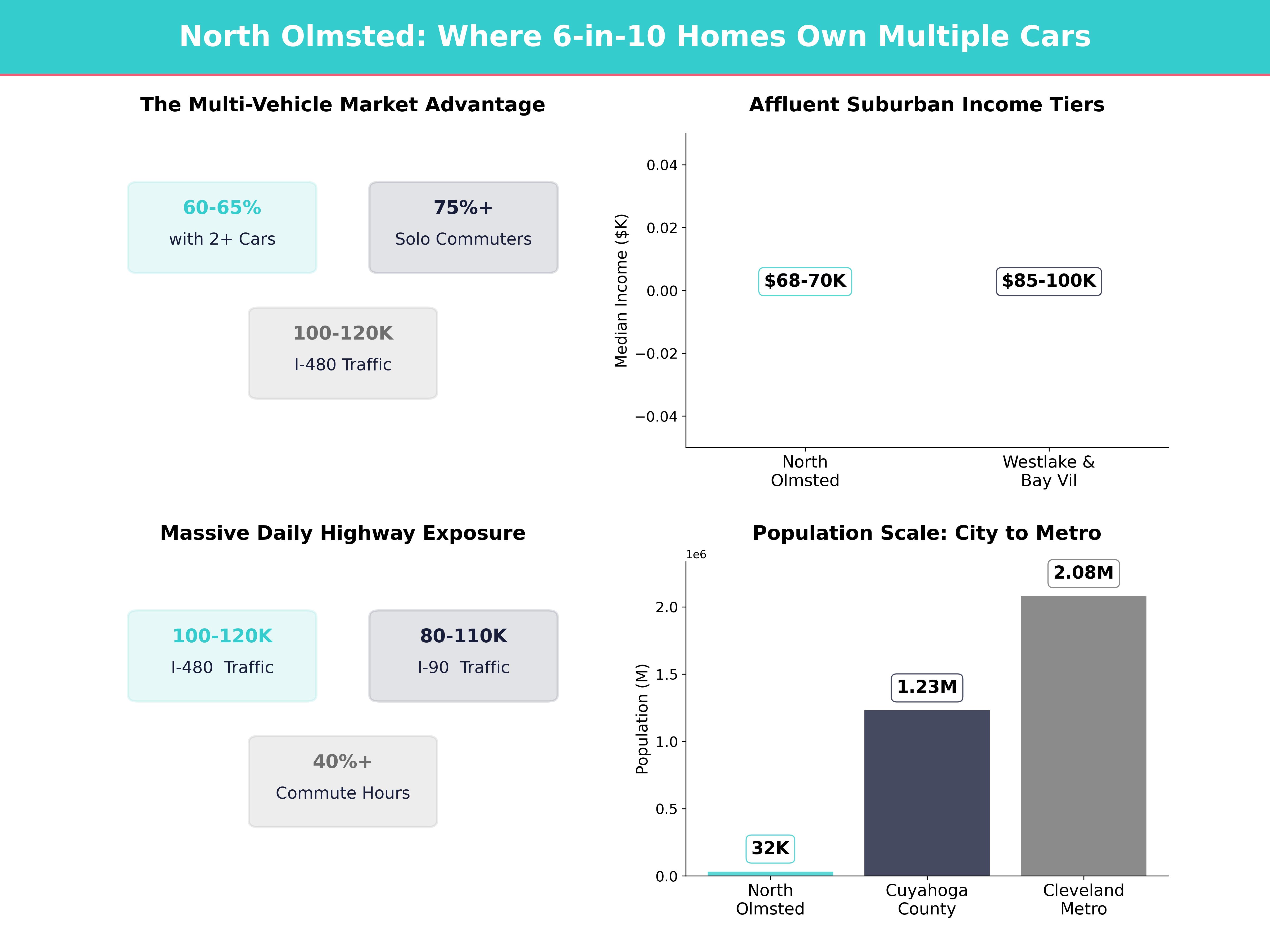
- The City of North Olmsted reports a population of about 32,000 residents, with a mix of established homeowners and younger families.
- North Olmsted is part of Cuyahoga County, which has roughly 1.23 million residents and anchors the broader Cleveland–Elyria metro area of over 2.08 million people.
- The median age in the North Olmsted area is in the mid‑40s (around 44 years), with about 20–22% of residents age 65+, compared with roughly 17% nationally. At the same time, around 27–30% of households include children under 18, creating a dual focus on seniors and families.
- Roughly 70–75% of occupied housing units in and around North Olmsted are owner‑occupied, and about 60–65% of households have two or more vehicles, indicating strong car reliance and consistent exposure to roadside media.
- The median household income in the area is around $68,000–$70,000, with nearby suburbs such as Westlake and Bay Village pushing into the $85,000–$100,000+ range.
- North Olmsted is a major retail hub on the west side, anchored by Great Northern Mall 1 million+ square feet of retail space and more than 120 stores and restaurants, plus the dense retail strip along Lorain Road and Brookpark Road.
What this means for billboard advertisers near North Olmsted:
- Messages can confidently focus on middle‑income and upper‑middle‑income households, family spending, and home‑oriented services. With household incomes near or slightly above state averages and high homeownership rates, offers for home improvement, financial products, and healthcare tend to perform well on North Olmsted billboards and surrounding locations.
- Because the population skews slightly older than the national average, clear, legible designs and straightforward value propositions perform especially well. A market where 1 in 5 residents is 65+ rewards easy‑to‑read copy and strong contrast.
- The mall and retail concentration means we can align campaigns with shopping trips, seasonal sales, and weekend traffic. Regional centers like Great Northern typically draw from a 10–15 mile trade area, capturing shoppers from multiple west‑side suburbs.
For deeper local context, we recommend browsing:
- City of North Olmsted
- Cuyahoga County
- Regional tourism: Destination Cleveland
- Local news and business coverage:
Key Traffic Corridors Serving the North Olmsted Area
Our nine digital billboards serving the North Olmsted area are located in:
- Brooklyn, Ohio (about 8.4 miles away)
-
Sheffield, Ohio (about 8.6 miles away)
- Sheffield Village
- Cleveland, Ohio (about 9.0 miles away)
These locations allow us to intercept drivers who live, shop, or work near North Olmsted while they travel major arteries, creating a highly efficient footprint for billboard advertising near North Olmsted without needing a sign on every local street:
-
I‑480 corridor (west side)
- I‑480 is one of Northeast Ohio’s most heavily traveled commuter routes, linking North Olmsted, Fairview Park, and Brook Park to downtown Cleveland and the I‑271/I‑77 corridors.
- According to the Ohio Department of Transportation (ODOT) 100,000–120,000 vehicles per day (average annual daily traffic, AADT).
-
I‑90 corridor (Cleveland to Lorain County)
- I‑90 connects Cleveland to Lakewood, Rocky River, Westlake, Avon, and Sheffield.
- West‑side segments between downtown Cleveland and Lorain County routinely see 80,000–110,000 vehicles per day, capturing both daily commuters and regional shoppers.
- Communities like Westlake and Avon along I‑90 have been among the faster‑growing west‑side suburbs, adding thousands of residents over the past decade and increasing traffic demand that your North Olmsted billboards can tap into.
-
Lorain Road & Brookpark Road influence
- While the core billboards are along interstate and main highways near North Olmsted, much of the local traffic funnels through Lorain Road, Brookpark Road, and the Great Northern retail area before or after hitting I‑480 or I‑90. These arterials commonly carry tens of thousands of vehicles per day, especially near major shopping nodes and interchanges.
Implications for your campaign:
- Use our locations in Brooklyn and Cleveland to reach eastbound and westbound commuters who travel daily between the North Olmsted area and downtown or the airport. In Cuyahoga County, a majority of workers—often 75%+—drive alone to work, underscoring the value of highway‑visible media and digital billboards near North Olmsted.
- Use Sheffield boards to capture Lorain County commuters (from Avon, Avon Lake, Sheffield, Elyria 310,000+ residents to the reachable audience, many of whom cross county lines for work and shopping.
- Focus on am/pm commute dayparts, where typical I‑480 and I‑90 traffic spikes between roughly 6:30–9:00 a.m. and 3:30–6:30 p.m. In many commuter studies, these windows account for 40% or more of weekday traffic volume on major freeways.
Who You’ll Reach Near North Olmsted
Combining local demographics and commuter flows, we can segment the audiences you’re likely to reach with billboards serving the North Olmsted area:
-
Suburban families and household decision‑makers
- High share of owner‑occupied homes and two‑car households: in many west‑side suburbs, 7 in 10 homes are owner‑occupied and 6 in 10 households have 2+ vehicles.
- Strong demand for home services (HVAC, roofing, landscaping), family dining, healthcare, and education. Household expenditure data for similar income bands show 30–35% of spending going to housing and utilities, and 12–15% to food at home and restaurants—key categories for billboard advertisers.
- Many families are budget‑conscious but open to quality and convenience, especially for services that save time during busy school and activity schedules.
-
Retail and mall shoppers
- Great Northern Mall and surrounding big‑box stores draw visitors from a 10–15 mile radius, including Westlake, Fairview Park, Brook Park North Ridgeville. Within a 15‑minute drive time of the mall, you can reach well over 150,000 residents.
- Weekends, holidays, and back‑to‑school periods see significant spikes in shopping traffic; national mall benchmarks often show 20–30% higher weekend foot traffic versus weekdays, with major holidays and sales events pushing that even higher.
- The concentration of anchors—big‑box retailers, chain restaurants, and specialty shops—creates repeated, high‑frequency exposure to billboard messaging that points consumers to specific offers or store locations.
-
Commuters to downtown Cleveland and the airport
- Cleveland Hopkins International Airport, just southeast of the North Olmsted area, handles around 10 million passengers annually and supports more than 7,000 on‑ and off‑airport jobs, including airlines, concessions, maintenance, and logistics.
- The City of Cleveland has roughly 372,000 residents, but the daytime population swells as commuters come in from the suburbs for work, entertainment, and healthcare. Many of these workers travel via I‑480 and I‑71 through the North Olmsted catchment.
- Regional commuting data for the Cleveland metro area show that 80%+ of workers drive to work and a large share—often 50% or more—travel 20 minutes or longer each way, creating consistent exposure to highway billboards.
-
Older residents and retirees
- The North Olmsted area includes a meaningful population of retirees, assisted‑living residents, and seniors living in single‑family homes or condos, with 1 in 5 residents age 65 or older.
- This group responds well to messages about healthcare, financial services, senior living, travel, and local community events, and they are often among the most loyal repeat customers once trust is established.
- Healthcare utilization and financial‑planning needs are higher in this age band, making billboard visibility near key corridors a cost‑effective way to reach decision‑makers and their adult children.
Crafting Effective Creative for the North Olmsted Audience
Because billboards serving the North Olmsted area reach a mix of families, commuters, and older adults, your creative should be:
-
Extremely legible at a glance
- Aim for 7 words or fewer in your main headline; outdoor advertising research consistently shows shorter copy (7–10 words) significantly improves recall at highway speeds.
- Use large, high‑contrast fonts (e.g., white on dark blue, yellow on black).
- Avoid clutter; limit to 1 main image, 1 logo, 1 call‑to‑action to keep cognitive load low for drivers traveling at 55–65 mph.
-
Hyper‑local in references
-
Calling out familiar landmarks builds trust:
- “Minutes from Great Northern”
- “Serving the North Olmsted area since 1998”
- “Off I‑480, exit for Lorain Rd”
- Mention nearby suburbs residents identify with: Rocky River, Fairview Park, Westlake, North Ridgeville, or Brook Park. Naming 2–3 recognizable communities can increase relevance without overloading the design.
- This kind of localized messaging helps your billboard advertising near North Olmsted feel directly relevant to daily routines.
-
Calling out familiar landmarks builds trust:
-
Value‑oriented and practical
-
In a middle‑income, family‑heavy market, specific value drives response:
- “$89 Furnace Tune‑Up”
- “Kids Eat Free Tuesdays”
- “$0 Down Invisalign Consult”
- Price‑anchored offers tend to boost response in markets where 60%+ of households fall into middle‑income brackets.
-
In a middle‑income, family‑heavy market, specific value drives response:
-
Clear about next steps
-
Use simple CTAs that align with driving behavior:
- “Exit at Lorain Rd”
- “Search: ‘Smith Roofing North Olmsted’”
- “Book Today at ABCDental.com”
- Short URLs and direct search phrases are especially effective on digital billboards, where dwell time is often 6–8 seconds.
-
Use simple CTAs that align with driving behavior:
Blip makes it easy to upload multiple creatives; we recommend:
- 2–4 variations that rotate based on time of day or promotion. Many advertisers see measurable improvements when testing at least two distinct messages rather than relying on a single design.
- Creative A/B testing (e.g., price vs. no price, “minutes away” vs. exit number) to see which message gets stronger recall or direct response. Over a 4–8 week test period, it’s common to find one variant outperforming others by 20–30% in direct inquiries or promo code redemptions.
Timing Your Blip Campaign Around Local Behavior
The North Olmsted area follows predictable weekly and seasonal patterns that we can target carefully with Blip’s scheduling tools.
Daily and weekly rhythms
-
Morning commute (6:30–9:00 a.m.)
- Reach commuters driving from suburbs like North Ridgeville, Elyria, or Avon toward jobs in downtown Cleveland, Brooklyn, or airport‑area employers. In many west‑side corridors, a third or more of weekday traffic moves during the combined morning and evening peaks.
- Best for: coffee, quick‑service restaurants, traffic‑driven retail, banking, fitness, and podcasts/streaming apps.
-
Afternoon school and work traffic (3:00–6:30 p.m.)
- Teachers, parents, and students tied to North Olmsted City Schools
- Great for: after‑school programs, tutoring, restaurants, family activities, and youth sports.
-
Evenings (6:30–10:00 p.m.)
- Capture restaurant, entertainment, and gym traffic, plus residents running errands after work. Evening trips often focus on discretionary spending, making this window valuable for dining, entertainment, and retail messages.
-
Weekends
- Saturdays and Sundays shift traffic toward shopping, dining, church, sports, and leisure. For many retail corridors, weekend days can account for 30–40% of weekly traffic volume, even though they are only two days of the week.
- Our boards in Sheffield and Cleveland become particularly powerful for capturing shoppers traveling to or from Great Northern and other west‑side destinations.
Seasonal opportunities
-
Winter (Dec–Feb)
- Heating services, indoor recreation, healthcare, car maintenance, and holiday retail.
- Snow and cold weather in Cuyahoga County—where average annual snowfall can exceed 60 inches and temperatures frequently dip below freezing—make messaging about safety, warmth, and convenience resonate.
- This is also peak season for flu and respiratory illnesses, driving demand for urgent care and primary care services.
-
Spring (Mar–May)
- Home improvement, landscaping, roofing, and exterior maintenance, as homeowners prepare for warmer months.
- Tax season offers an opportunity for financial advisors, tax preparers, and credit unions. Historically, a large share of refunds are issued by late spring, opening a window to advertise savings products, debt payoff services, and big‑ticket purchases.
-
Summer (Jun–Aug)
- Family activities, summer camps, local attractions, and travel services. School is out for roughly 10–11 weeks, shifting daytime traffic to shopping, parks, and recreation.
- Use Destination Cleveland’s event calendars to sync messaging with festivals and downtown events: This Is Cleveland Events
- Tourism and regional events bring additional visitors from outside Cuyahoga County, expanding the potential audience beyond local residents.
-
Fall (Sep–Nov)
- Back‑to‑school campaigns, flu shots, auto service, and pre‑winter home prep.
- Local sports (the Cleveland Browns, high school football) provide creative hooks like “Gear Up Before the Game” or “Game‑Day Pizza Specials.” Friday‑night football and weekend game days often spike restaurant and grocery traffic by double‑digit percentages compared with non‑game days.
Using Blip, we can schedule your ads to run only during the times and days most relevant to your audience, ensuring your budget is focused when impressions are most valuable.
Matching Billboard Locations to Your Business Type
With boards across Brooklyn, Sheffield, and Cleveland serving the North Olmsted area, we can align placements based on your business model and the specific type of billboard advertising near North Olmsted you need:
-
Local retailers and restaurants near North Olmsted
- Prioritize boards that intercept I‑480 and I‑90 drivers who are a few minutes away from exits leading to Great Northern or Lorain Road. In many studies, proximity‑based messages within 5–10 minutes of the destination significantly increase visit likelihood.
- Use directional language: “Next 2 Exits,” “5 Minutes from Great Northern.”
-
Regional destination businesses (furniture, auto dealers, medical centers)
- Run across all nine boards to blanket the western suburban commuter belt, reaching a combined potential audience of hundreds of thousands of unique drivers over the course of a typical month.
- Emphasize regional draw: “Worth the Drive from the North Olmsted Area.”
-
Service‑area businesses (plumbers, roofers, HVAC, pest control)
- Focus on frequency rather than perfect proximity. Repeated exposure—10+ impressions per month per commuter in your core area—helps keep your brand top‑of‑mind when urgent needs arise.
- Highlight coverage: “Serving Homes Across the North Olmsted, Westlake & Fairview Area.”
-
Professional services (attorneys, credit unions, healthcare)
- Use boards closest to major employment centers and commuting patterns. Professional and business services account for a substantial share of jobs in both downtown Cleveland and the airport‑area corridors.
- If your office is in or near downtown Cleveland, pair messaging like “West‑Siders, We’ve Got You Covered Downtown” with boards on west‑side inbound routes.
Leveraging Blip’s Flexibility for the North Olmsted Area
Blip allows us to buy individual ad plays (“blips”) on digital billboards and control:
- Budget – Start with a modest daily budget and scale up or down based on results. Many advertisers begin with $10–$20 per day and then increase investment once they see positive response.
- Schedule – Choose specific times of day and days of the week (e.g., weekday a.m. drive only). Concentrating spend into high‑value windows can improve effective reach without increasing overall budget.
- Locations – Select particular boards in Brooklyn, Sheffield, and Cleveland that best serve your North Olmsted‑area audience. Over time, performance data can guide you toward the top‑performing 3–5 boards for your goals.
- Creative – Upload multiple files and rotate them, or schedule different creatives for different time blocks.
For many businesses, this model effectively turns Blip into an on‑demand billboard rental near North Olmsted, where you pay only for the impressions and time slots that matter most.
How we recommend structuring campaigns near North Olmsted:
-
Start with a 4‑week “learning phase”
- Run across most or all available boards serving the North Olmsted area to build initial reach—often hundreds of thousands of impressions in a month, depending on budget and selected boards.
- Test both commute and weekend dayparts.
- Use at least 2 creatives (e.g., one price‑focused and one brand‑focused) to gather comparative data.
-
Monitor your own metrics
- Track website traffic from the Cleveland/North Olmsted sub‑regions in Google Analytics and other analytics tools. Watch changes in sessions, new users, and pages per session while your campaign runs.
- Watch for spikes in direct traffic and branded search queries while your Blip campaign is active; many billboard campaigns see a 5–20% lift in branded search volume during active flight periods.
- For brick‑and‑mortar, train staff to ask: “How did you hear about us?” and tally “billboard” mentions. Even a modest increase—say 10–20 additional mentions per month—can signal strong ROI, especially for high‑value services.
-
Refine based on performance
- Shift budget toward the boards and time windows that align with your strongest response. For example, if evening impressions drive more web visits, move 20–30% more budget into that window.
- Retire underperforming creative and extend high‑performing variations. It’s common to find one message delivering significantly higher engagement than others in the same market.
- Layer in promotional or seasonal messages once a strong brand base is established, using short 2–4 week bursts around key retail or service periods.
Sample Campaign Strategies for Common Advertisers
To make the North Olmsted area feel concrete as a marketing environment, here are some sample approaches by vertical:
1. Local restaurant near Great Northern
- Target: Families and workers in the North Olmsted area and nearby suburbs.
-
Strategy:
- Focus on boards along I‑480 during 4:00–7:00 p.m. weekdays and 11:00 a.m.–7:00 p.m. weekends, matching the times when restaurant and QSR traffic usually peaks.
- Creative 1: “Family Dinner Tonight? Kids Eat Free – Exit Lorain Rd Near Great Northern.”
- Creative 2: “15‑Minute Lunch from the North Olmsted Area Offices – Order Ahead at [URL].”
- Track: Nightly covers, average check, and online orders. A 5–10% lift in early‑evening traffic during the campaign is a strong success indicator.
2. Home services company (roofing/HVAC) covering west‑side suburbs
- Target: Homeowners in the North Olmsted, Westlake, North Ridgeville, and Fairview Park areas.
-
Strategy:
- Run across all nine boards to build broad suburban awareness, targeting a combined homeowner audience of tens of thousands of households within routine driving distance.
- Heavy weight in spring and fall, when homeowners think about maintenance and weather changes.
- Messaging: “Roofs Repaired in 24 Hours – Serving the North Olmsted Area & West‑Side Suburbs – Call [Phone].”
- Track: Call volume, estimate requests, and form fills; many service businesses see noticeable spikes in inbound calls during heavy billboard flights tied to storms or weather extremes.
3. Credit union with branches in western Cuyahoga County
- Target: Commuters and families within a 10–15 mile radius.
-
Strategy:
- Concentrate impressions on weekday commute hours, when financially focused messaging can catch people thinking about car loans, mortgages, and daily banking.
- Creative A: “Auto Loans Starting at X.XX% APR – Join XYZ Credit Union Near North Olmsted.”
- Creative B: “Tired of Big Bank Fees? Switch on Your Way Home – Branches Across the West Side.”
- Track: New account openings, online applications, and loan inquiries, especially from ZIP codes clustered around the west‑side branches.
4. Healthcare provider or clinic
- Target: Seniors, families, and professionals in the North Olmsted area.
-
Strategy:
- Emphasize trust and convenience, with short, clear messages and recognizable healthcare symbols.
- Messaging: “New Patients Welcome – Primary Care for the North Olmsted Area – 10 Minutes Off I‑480.”
- Track: New‑patient appointment requests and call volume; healthcare providers often see a gradual but steady rise in brand awareness after 8–12 weeks of consistent billboard presence.
Tying It All Together
Billboards serving the North Olmsted area give us a way to meet people where they actually live and drive: between the western suburbs, the airport, and downtown Cleveland. By combining:
- Data‑driven placement along I‑480 and I‑90,
- Localized, legible creative tailored to families and commuters, and
- Blip’s flexible control over budget, timing, and artwork,
we can build campaigns that not only look good but also align with how the North Olmsted area actually moves, shops, and makes decisions.
When we match your message to the right boards near North Olmsted at the right times of day, digital billboards become a powerful, measurable driver of awareness, foot traffic, and sales for your business, whether you need always‑on billboard advertising near North Olmsted or short‑term billboard rental near North Olmsted for key promotions.