Billboards near Bedford, OH
No Minimum Spend. No Long-Term Contracts. Just Results.
Trusted by Leading Brands


Billboard advertising
near Bedford has never been easier



How much is a billboard near Bedford?
Why Choose Blip for Billboard Advertising near Bedford
Blip lets you launch Bedford campaigns fast and self-serve, reaching commuters on I-480, I-271, and Rockside Road without traditional buying hassles.
Use Blip’s flexible budgets in Bedford to focus spend on 6–9 a.m. and 3–7 p.m. commute windows, when southeast Cuyahoga traffic is heaviest.
No contracts make it easy to test Bedford billboards near Garfield Heights and Warrensville Heights, then scale what works for local shoppers and workers.
Track real-time results on Bedford campaigns and shift blips as ODOT construction, snow, or Metroparks weekends change traffic on Northfield and Miles roads.
Blip’s creative tools help Bedford advertisers swap family, hiring, or service promos for winter HVAC, school nights, or Rockside Road retail traffic.
Frequently Asked Questions About Billboard Advertising near Bedford
How much does a billboard cost near Bedford, Ohio with Blip?
With Blip, you can advertise on Bedford billboards on any budget because you only pay per “blip,” a 7.5–10 second ad display on a rotating digital billboard. You simply set a daily budget for your campaign, and Blip automatically keeps your spending within that limit while showing your message on billboards near Bedford, Ohio during the times you choose. The total cost is just the sum of the individual blips you receive, so it stays flexible and affordable.
Where can I advertise with Blip near Bedford, Ohio?
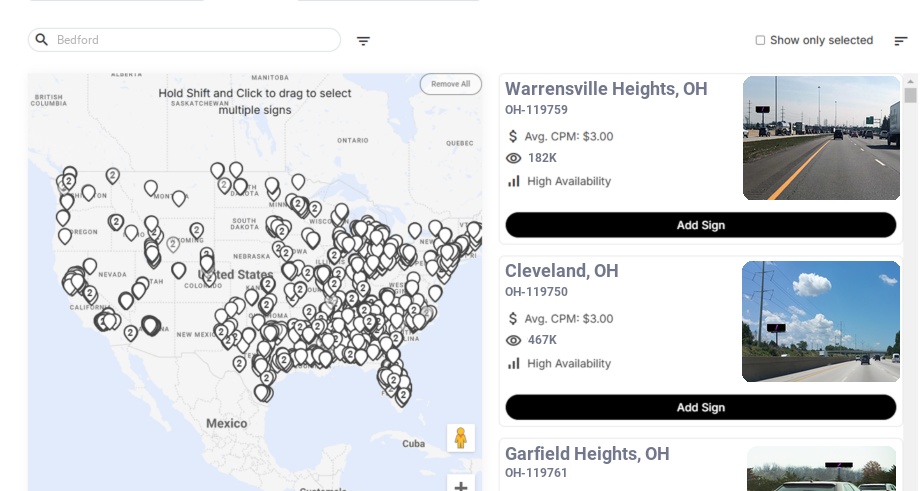
Five Blip digital billboards serve the Bedford area from nearby Garfield Heights and Warrensville Heights, both less than 5 miles from the heart of the Bedford area. These boards sit along major commuter and shopping routes used daily by Bedford area residents. The placement helps advertisers reach local residents, commuters, and shoppers moving through southeast Cuyahoga County.
What kind of traffic do Bedford, Ohio billboards reach?
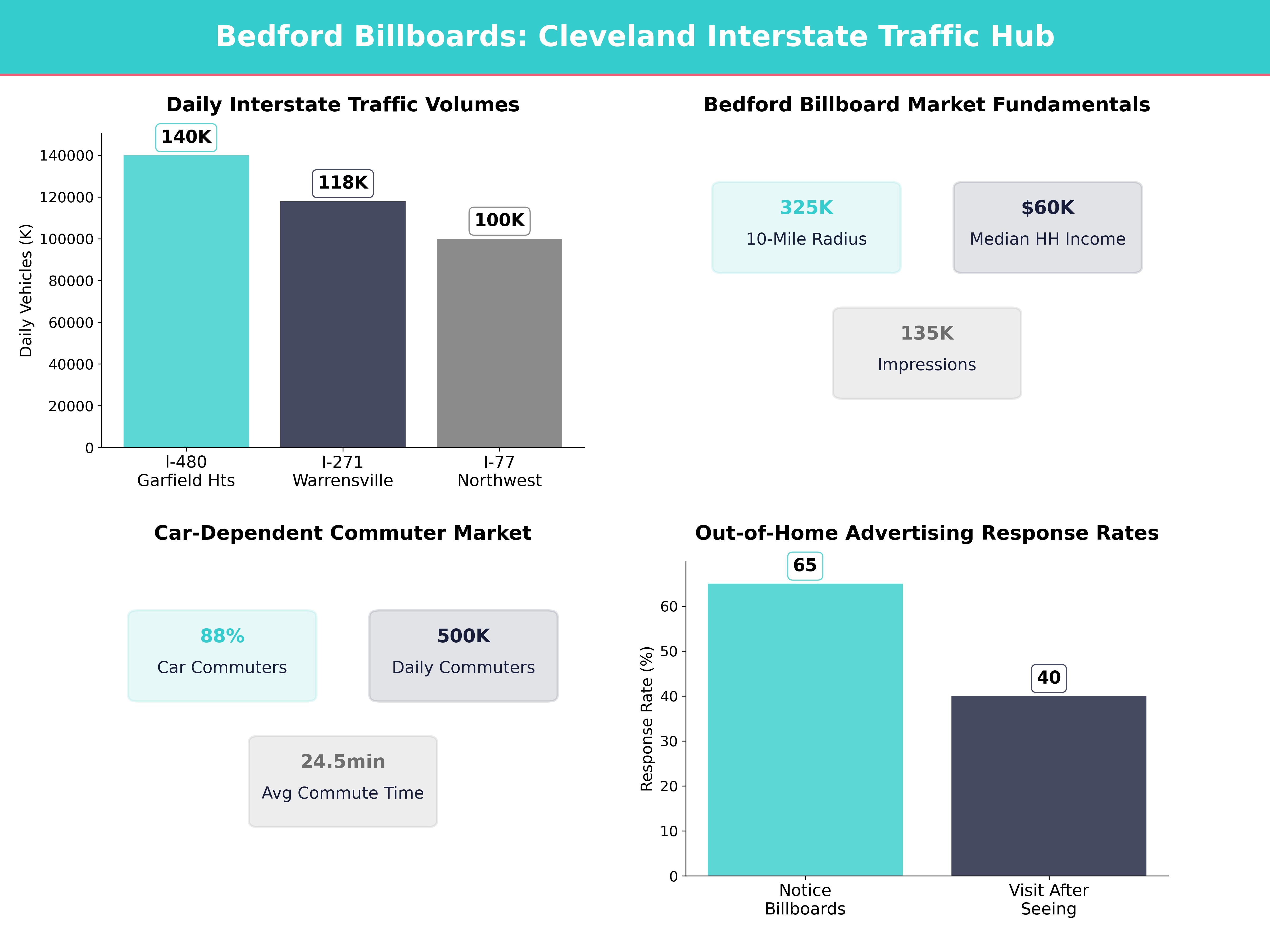
The Bedford area sits at a powerful crossroads in southeast Cuyahoga County, where commuters, shoppers, and logistics traffic from across Greater Cleveland move through each day. I-480 carries roughly 130,000–150,000 vehicles per day across various segments, and I-271 near Warrensville Heights sees about 110,000–125,000 vehicles per day. Major arterials such as Northfield Road, Rockside Road, and Miles Road also carry 15,000–30,000 vehicles per day depending on the segment.
When is the best time to run billboards in Bedford, Ohio with Blip?
For commuter-heavy campaigns, the page recommends targeting weekday morning 6–9 a.m. and evening 3–7 p.m., when traffic counts on I-480 and I-271 routinely peak. Weekend daytime, especially 10 a.m.–4 p.m., is also suggested for retail, dining, events, and local services near the Bedford area. Blip’s flexible scheduling lets advertisers spend more when the roads are busiest and pull back when travel dips.
What makes Bedford, Ohio a good market for billboard advertising?
The City of Bedford has roughly 12,000 residents, and surrounding communities expand the immediate trade area to more than 50,000 people within a 10-minute drive of key corridors. The Bedford area is also part of the larger Cuyahoga County market of around 1.2–1.3 million people, with steady non-resident traffic coming through year-round. This mix means billboard advertising near Bedford can reach both local residents and a constant influx of visitors.
Do I need a contract to advertise with Blip near Bedford?
No, Blip has no long-term contracts or minimum commitments. You can start, pause, or stop your campaign at any time.
How fast can I launch a billboard campaign with Blip near Bedford?
You can have your campaign live in minutes. Create a free account, select your locations, set your budget, upload your design, and start running once approved.
Where can I advertise with Blip near Bedford?
Blip has digital billboards near Bedford. You can browse available locations on a map, choose the ones that fit your audience, and start advertising right away.
Still have questions? Launch a campaign in minutes — no contracts, no commitments.
Start Your CampaignBedford Billboard Advertising Guide
The Bedford, Ohio area sits at a powerful crossroads in southeast Cuyahoga County, where commuters, shoppers, and logistics traffic from across Greater Cleveland move through each day. With five Blip digital billboards serving the Bedford area from nearby Garfield Heights and Warrensville Heights, advertisers can tap into tens of thousands of daily impressions while targeting budgets and schedules to match local behavior. In the Cleveland DMA, audited out-of-home data typically show 70,000–200,000 weekly impressions per digital face on heavily trafficked interstates and arterials, so a focused Bedford-area plan using billboards near Bedford can realistically generate hundreds of thousands of views each month even at modest budgets.
Understanding the Bedford Area Market
The City of Bedford itself has roughly 12,000 residents (recent estimates place it just above 12,000, with a median age of about 42 years) and a mix of long-time homeowners and renters. Surrounding communities like Garfield Heights (about 29,000 residents) and Warrensville Heights (about 13,000 residents) expand the immediate trade area to more than 50,000 people within a 10-minute drive of key corridors like Northfield Road and Rockside Road, all of whom can be reached efficiently with Bedford billboards positioned on these commuter routes.
Zooming out, the Bedford area is part of the larger Cuyahoga County market of around 1.2–1.3 million people, anchored by nearby Cleveland. Recent regional visitor reports from Destination Cleveland indicate that the Greater Cleveland area attracts more than 15 million leisure and business visits annually, helping sustain a steady flow of non-resident traffic through southeast suburbs year-round. The result is a local audience that feels “small town” but behaves like a suburban-urban hybrid: people commute out for work, shop along arterial corridors, and regularly travel to regional attractions such as downtown Cleveland, Cuyahoga Valley National Park, and nearby Cleveland Metroparks reservations like the Bedford Reservation. For advertisers, this mix means billboard advertising near Bedford can reach both local residents and a constant influx of visitors.
Local resources such as the City of Bedford, Garfield Heights, Warrensville Heights, Cuyahoga County, Destination Cleveland, the Bedford City School District Cleveland Metroparks Bedford Reservation are useful for staying on top of local events, school calendars, festivals, and road projects that can influence when and how we run campaigns near the Bedford area. For example, high school sports nights, Metroparks events, and construction updates often correlate with 10–20% shifts in evening or weekend traffic volumes on nearby roads, which can inform when to increase or decrease spend on billboards near Bedford.
Traffic Patterns and Why Our Billboard Locations Work
Our five digital billboards serving the Bedford area are placed in Garfield Heights and Warrensville Heights, both less than 5 miles from the heart of the Bedford area. These suburbs sit along major commuter and shopping routes used daily by Bedford area residents. In Cuyahoga County, more than 85–90% of workers commute by car, with an average one‑way commute of about 24–25 minutes, which keeps freeway and arterial traffic consistently high during drive times and makes Bedford billboards a strong option for reaching these daily drivers.
Key roadway dynamics:
- Interstate 480 (I‑480), running through Garfield Heights, carries roughly 130,000–150,000 vehicles per day across various segments according to Ohio Department of Transportation (ODOT) traffic counts
- Interstate 271 (I‑271) near Warrensville Heights sees about 110,000–125,000 vehicles per day, capturing traffic moving between the southeast suburbs, I‑480, and I‑90.
- Interstate 77 (I‑77) corridors northwest of Bedford typically handle 100,000+ vehicles daily, feeding commuters toward downtown Cleveland and into the Rockside Road business corridor in nearby Independence.
- Major arterials such as Northfield Road (SR‑8), Rockside Road, and Miles Road connect Bedford area neighborhoods to these freeways, with many segments carrying 15,000–30,000 vehicles per day depending on the exact segment and time of year.
Because our boards sit along and near these commuter routes, we can reliably reach:
- Bedford area residents commuting to jobs in downtown Cleveland, Independence, and the Rockside Road business district.
- Shoppers traveling to regional retail centers like Cleveland’s east-side shopping areas, Rockside Road, and the Harvard Park / Miles Road corridors.
- Workers, truck traffic, and service vehicles serving the hospital, industrial, and distribution clusters around Garfield Heights and Warrensville Heights.
National out-of-home research (for similar midwestern metro areas) finds that 60–70% of drivers notice roadside digital billboards each week, and about 35–45% report visiting a business after seeing an OOH message. When planning with Blip, we recommend:
- Targeting weekday morning (6–9 a.m.) and evening (3–7 p.m.) for commuter-heavy campaigns, when traffic counts on I‑480 and I‑271 routinely peak.
- Layering in weekend daytime (10 a.m.–4 p.m.) for retail, dining, events, and local services near the Bedford area, as shopping and recreation trips increase Saturday traffic volumes by 10–15% on some corridors.
- Using multiple nearby boards simultaneously (e.g., one in Garfield Heights and one in Warrensville Heights) to build a “halo” of visibility around the Bedford area, effectively multiplying impressions as the same driver encounters several boards in a single trip and strengthening the impact of billboard advertising near Bedford.
Demographics and What They Mean for Your Messaging
The Bedford area reflects many of the broader trends of southeast Cuyahoga County: a mix of middle-income households, aging housing stock, and a diverse population. Many Bedford‑area neighborhoods were built between the 1940s and 1970s, so homes crossing the 50–80‑year mark often require ongoing investment in roofs, HVAC, plumbing, and electrical systems.
Approximate demographic benchmarks (combining Bedford and neighboring suburbs, based on recent census-derived estimates):
- Population base within a 10-mile radius: 300,000–350,000 residents, capturing much of southeast Cuyahoga County.
- Median household income in the immediate Bedford area: around $45,000–$55,000, compared with roughly $55,000–65,000 for Cuyahoga County as a whole.
-
Age distribution:
- About 22–25% under age 20 (families with kids, school-related spending).
- Roughly 55–60% in the 20–64 working-age range (commuters, career professionals, tradespeople).
- 15–20% age 65+ (a growing senior segment with healthcare and home-service needs).
- In many southeast suburbs, 30–40% of households are single-person and 10–15% are single-parent families, which can influence demand for convenience services, childcare, and value-oriented retail.
- Homeownership rates in surrounding communities often fall in the 55–65% range, while 35–45% of households rent, creating opportunities for both homeowner-focused and renter-focused offers.
Implications for creatives and offers:
- Value messaging matters. Given moderate incomes and rising costs of living, ads highlighting savings, flexible payment plans, financing, or “$‑off” offers can outperform generic branding. Studies in similar markets show 10–30% higher response to clearly priced, value-driven OOH ads.
- Family and community themes resonate. With roughly one in four residents under age 20 in many nearby ZIP codes, visuals featuring families, youth sports, or local landmarks (like the Bedford Bearcats or Cleveland Metroparks scenery) can lift recall.
- Service-based businesses are strong candidates. Home services, auto repair, healthcare, legal and financial services, and senior care speak to ongoing needs in an older housing and aging population base.
- Cultural diversity in surrounding communities means inclusive imagery and clear, simple language work better than niche or heavily slang-focused messaging. In many southeast Cuyahoga communities, no single racial or ethnic group comprises more than 60–65% of the population, so broad, inclusive appeal is key.
We can cross-check our assumptions with local data sources like:
- Bedford area information from the City of Bedford.
- The Cuyahoga County Planning Commission.
- The Cuyahoga County Board of Elections for turnout and population distribution by precinct.
These insights help ensure that creative running on billboards near Bedford speaks directly to real local needs and lifestyles.
Major Employers and Daily Movement Around the Bedford Area
People do not stay put; they move between home, work, school, and entertainment, and our boards sit along many of those paths. In Cuyahoga County, more than 500,000 workers commute daily, and southeast corridors like I‑480, I‑271, and I‑77 channel a significant share of that flow.
Key employment and activity hubs affecting Bedford area travel patterns:
- Rockside Road / Independence business corridor, a major office and hospitality center to the west, pulling tens of thousands of daily commuters from the Bedford area via I‑480 and local roads. The City of Independence notes millions of square feet of office, hotel, and conference space clustered near Rockside Road and I‑77, sustaining heavy peak-hour traffic.
-
Healthcare clusters:
- Hospitals and clinics throughout Garfield Heights, Warrensville Heights, and the southeast suburbs, drawing patients and staff from the Bedford area. Notable facilities include Marymount Hospital in Garfield Heights and South Pointe Hospital hundreds of medical professionals and serving tens of thousands of patient visits per year.
- Light industrial and logistics along corridors like Northfield Road, Miles Road, and Broadway Avenue, generating freight and service vehicle traffic. Many industrial parks in these corridors host dozens of small and mid-sized employers, with typical shift changes around 6–8 a.m., 2–4 p.m., and 10 p.m.–midnight, which line up well with strategic billboard scheduling.
- Retail destinations, including shopping plazas and big-box retailers across Garfield Heights and Warrensville Heights. Regional data for similar centers show that large strip centers can attract 10,000–20,000 vehicle trips per day on peak weekends.
According to Cuyahoga County labor and commuting data, a large share of workers in southeast suburbs commute 15–30 minutes each way, often using freeways and major arterials rather than solely local streets. Our nearby billboards intersect these drive patterns, making them ideal for:
- Recruiting campaigns (healthcare, logistics, trades, warehouse), where OOH has been shown to generate 2–4x more applications when paired with easy‑to‑remember URLs or QR codes.
- B2B services targeting small manufacturers, contractors, and local businesses that populate these industrial and office corridors.
- Consumer brands that want repeated impressions for Bedford area residents while they move through the region; national OOH studies show that frequency of 8–12 impressions per month is often enough to affect brand consideration.
For organizations planning billboard advertising near Bedford to support hiring, retail traffic, or B2B awareness, mapping these daily movement patterns is a crucial first step.
Seasonality and Timing: When to Turn Up Your Blips
The Bedford area has a true four-season climate, which significantly changes driving behavior and out-of-home exposure. In northeast Ohio, annual snowfall commonly exceeds 50 inches, and average daily high temperatures range from the 30s (°F) in January to the 80s (°F) in July, driving different patterns of road use.
Winter (Dec–Feb)
- Snow and early sunsets reduce evening visibility and non-essential trips, but core commuting remains steady. Traffic count data in similar Cleveland‑area corridors often show only a 5–10% drop in weekday volumes during winter compared with fall.
- Morning and evening commutes remain highly consistent; midday driving can dip during storms.
-
This is an ideal time for:
- Auto repair, tires, and towing (tire and roadside assistance calls often spike 20–40% in heavy snow weeks).
- Heating, plumbing, and emergency home services.
- Healthcare (flu season, urgent care, primary care reminders).
We recommend focusing Blips around 7–9 a.m. and 3–6 p.m., when drivers are most captive and daylight still supports strong digital visibility.
Spring (Mar–May)
- Road construction season begins; traffic can reroute and slow down, increasing viewing time. ODOT notes that major work zones can reduce speeds by 10–20 mph, extending the amount of time drivers see nearby billboards.
- Home improvement, landscaping, tax services, and youth sports all ramp up, with retailers often reporting 15–30% sales lifts versus winter months.
-
Use Blip’s flexible scheduling to:
- Increase spend during clear-weather weekends, when Metroparks visits and home‑center traffic climb.
- Temporarily shift impressions if ODOT or local construction causes unusual congestion near one of our boards.
You can monitor current traffic and construction updates through ODOT
Summer (Jun–Aug)
- Longer daylight hours extend peak visibility well into the evening; sunset in late June is close to 9:00 p.m. in northeast Ohio.
- Families take vacations, but local day trips and shopping remain strong. Regional tourism data show that summer can account for 35–40% of annual leisure visits to Greater Cleveland.
- Community events, youth programs, and recreation around the Bedford area see increased participation through groups like Bedford Parks & Recreation
-
Excellent seasonal windows for:
- Festivals, fairs, and local attractions.
- Summer sales, back-to-school campaigns (late July–August), when many retailers see double-digit percentage increases in traffic.
- Restaurants, ice cream shops, and outdoor entertainment.
Fall (Sep–Nov)
- Back-to-school drives consistent weekday traffic. School calendars from Bedford City Schools
- Local high school sports and community activities increase evening trips, especially Thursdays through Saturdays.
- Consumers begin early holiday prep and home maintenance; home-related categories often see 10–20% higher demand for services like roofing, gutters, and HVAC tune-ups before winter.
-
Effective categories:
- Education, tutoring, and youth activities.
- Home services (roofing, gutters, HVAC tune-ups).
- Retail and early holiday promotions.
Blip allows us to align budget and scheduling with these patterns, spending more when the Bedford area’s roads are busiest and pulling back when travel dips, which can improve cost‑per‑impression efficiency by 20–30% versus a flat, always‑on schedule. This seasonal flexibility is especially useful for advertisers using billboard rental near Bedford to support time-sensitive promotions.
Creative Best Practices for the Bedford Area
For any campaign serving the Bedford area, clarity beats cleverness. Drivers on I‑480, I‑271, and major arterials typically have 6–8 seconds to process a message, and OOH studies consistently find that ads with fewer than 10 words produce higher recall and response.
We suggest:
-
One Core Message, One Call-to-Action
- Aim for 7 words or fewer in your main line.
- Example: “Bedford Area Plumbing – 24/7 Emergency Help.”
- Use a single, strong CTA: “Call Now,” “Exit at Rockside,” “Schedule Today.” Campaigns with a clear CTA can generate 20–50% more website visits or calls than purely awareness messages.
-
Bold, High-Contrast Design
- Use dark backgrounds with bright, high-contrast text (or vice versa).
- Sans-serif fonts, large sizes (easily legible from 500–700 feet).
- Avoid long URLs; use short domains or emphasize search terms (“Search ‘Bedford Roof Repair’”).
- Keep logo heights to at least 10–15% of screen height so brands remain legible even at highway speeds.
-
Local Anchors
-
Reference recognizable landmarks and roads:
- “Minutes from Rockside Road.”
- “Serving Bedford Area Families Since 1995.”
- “Near Bedford Reservation – Exit at [Exit].”
- Mention Bedford area neighborhoods or nearby suburbs when it helps orientation. Directional OOH has been shown to increase navigation‑related searches by up to 20%.
-
Reference recognizable landmarks and roads:
-
Weather and Season-Based Messaging
- Swap creatives seasonally: snow imagery and “24/7 Service” in winter; bright, outdoor visuals in summer.
- Because Blip lets us upload multiple creatives and rotate them, we can run different messages by time of day or month—e.g., commute‑focused offers in the morning, family or dining messages in the evening.
-
Use Multiple Creatives for Storytelling
- Creative A: Brand awareness (“Bedford Area’s Trusted Dentist”).
- Creative B: Offer (“$99 New Patient Special”).
- Creative C: Directional or urgency (“On Rockside – Call Today”).
Rotating these during the same flight builds familiarity and response. Campaigns that run 2–3 coordinated creatives often see better recall than single‑creative campaigns, without requiring higher budgets.
How to Use Blip’s Tools Strategically Near the Bedford Area
Blip’s flexible platform is especially powerful for a market like the Bedford area, where we want to focus precisely on who is driving nearby without overextending spend. For context, even a modest local campaign can deliver tens of thousands of impressions per week, and shifting spend by time or board can meaningfully change which audiences you reach.
Key tactics:
-
Geographic selection
- Choose boards in Garfield Heights and Warrensville Heights that align with where your customers live or travel.
-
For example:
- Target more Garfield Heights inventory for Bedford area commuters heading west toward downtown or Rockside Road.
- Target more Warrensville Heights inventory for east-side shoppers and workers in the I‑271 corridor and destinations like Beachwood Place or Pinecrest.
- This targeted board selection gives advertisers access to billboards near Bedford that match their customer draw area rather than paying for media far outside their core trade zone.
-
Dayparting
- Service businesses: prioritize weekday commuting windows and Saturday mornings, when call volumes often run 15–25% higher for categories like home services and auto repair.
- Retail and restaurants: emphasize lunchtime (11 a.m.–2 p.m.) and early evening (4–8 p.m.) plus weekend daytime, when dining and shopping traffic peaks.
- B2B: focus on weekday business hours (7 a.m.–6 p.m.), when decision-makers and field staff are on the road visiting job sites or clients.
-
Budget control
- Start with a modest daily budget to “test the waters” and raise it during proven high-response windows. Many local advertisers start around $10–$30 per day on a few boards and scale up as they see results.
- Use Blip’s bidding flexibility to compete more aggressively during peak times (e.g., Friday afternoon, pre-payday, or evenings before local events). Competitive bidding during high‑demand windows can lift share of voice by 20–40%, improving how often your creative appears.
-
Creative testing
- Run two or three versions of a creative simultaneously and track which offers or headlines coincide with higher engagement (calls, web traffic, store visits).
- Swap out underperforming designs quickly; we are not locked into long print cycles. Many advertisers see meaningful performance differences—sometimes 30–50% swings in response—between strongest and weakest creatives.
Together, these tools make billboard rental near Bedford highly flexible: you can scale up quickly, pull back just as fast, and always keep your message aligned with who is actually on the road.
Industry-Specific Ideas for the Bedford Area
Different verticals can take advantage of distinct local dynamics. A few examples:
Home Services (HVAC, roofing, plumbing, electrical, lawn care)
- Many homes in the Bedford area and nearby suburbs were built 50–80 years ago, increasing demand for repairs and upgrades. In comparable Cleveland suburbs, service contractors report that homes of this age can require 30–50% more maintenance spend than newer builds.
-
Emphasize:
- “Emergency Service in the Bedford Area.”
- Seasonal hooks: “Furnace Tune-Up Before Winter,” “Roof Inspections After Storms.”
- Run heavier in extreme weather weeks when call volume typically spikes 20–40% for emergency HVAC and plumbing services, leveraging Bedford billboards to remind homeowners help is nearby.
Healthcare and Dental
- The region’s older population slice and significant commuting to healthcare jobs make billboards efficient for both patient acquisition and recruitment. In Cuyahoga County, adults aged 55+ account for roughly one‑third of the population, driving ongoing demand for primary care, specialists, and dental services.
-
Ideas:
- “New Bedford Area Patients Welcome – Same-Day Appointments.”
- “Now Hiring RNs – Competitive Pay, Short Commute.”
- Focus on commute windows and routes connecting residential areas to hospital clusters such as Marymount Hospital and South Pointe Hospital. Recruitment campaigns that add billboards to digital job ads often see 15–25% more qualified applications.
Retail and Restaurants
-
Use directional and distance-based messaging:
- “2 Miles Ahead – Exit at Rockside.”
- “Near [major intersection] in Garfield Heights.”
-
Increase Blip frequency around:
- Weekends and paydays (1st and 15th of each month), when many stores see 20–30% higher sales.
- Local events and holidays covered by outlets like Cleveland.com or Destination Cleveland.
- Consider pairing billboard‑only offers (“Show this message on your phone for 10% off”) to measure impact; even a 1–3% redemption rate from billboard-driven customers can be highly profitable for restaurants and specialty retailers using billboard advertising near Bedford to draw in new guests.
Education, Training, and Youth Programs
- Families and working adults in the Bedford area increasingly look for skills training, childcare, and enrichment. Local districts and community colleges report steady interest in career‑tech and certificate programs, particularly in healthcare, trades, and IT.
-
Highlight:
- “After-School Programs Near the Bedford Area.”
- Enrollment deadlines and limited spots (e.g., “Only 25 Seats – Enroll by Aug 15”).
- Push heavier during back-to-school (Aug–Sep) and early January “fresh start” periods, when education and fitness‑related inquiries can rise 20–40%.
Automotive (dealers, repair, tires)
- High vehicle dependence and winter driving conditions provide ongoing demand. In Cuyahoga County, roughly 90% of households have access to at least one vehicle, and winter weather leads to increased wear and tear.
-
Campaign ideas:
- “Need Brakes Before Winter? We’re 5 Minutes from Bedford.”
- “Tire Sale – Exit at [nearest exit].”
- Reinforce message after major weather events or during ODOT-announced construction, when drivers are more aware of vehicle condition. Auto service businesses often see 15–25% revenue bumps after sustained, well‑targeted OOH campaigns on billboards near Bedford.
Measuring and Refining Success
To make the most of digital billboards near the Bedford area, we should set measurable goals and track performance closely. Advertisers who actively track OOH often report 10–30% lower cost per acquisition versus using digital or print alone.
Recommended approach:
-
Define a clear objective
- Phone calls, web form fills, coupon redemptions, walk-ins, or hiring applications.
- For example, “Increase inbound calls by 20% over 6 weeks” or “Generate 50 new patient inquiries this month.”
-
Use trackable elements
- Unique phone numbers (via call tracking services), which can tie call volume and call duration back to billboard flights.
- Short, billboard-only URLs or QR codes (ideal when boards face slower traffic or intersections). Even if only 1–3% of viewers scan a QR code, that can translate into dozens or hundreds of leads at scale.
- Simple offer codes like “Mention ‘BEDFORD20’ for 20% off.”
-
Align analytics with flight dates
- Watch for traffic spikes in Google Analytics and POS systems during and just after periods when your Blips are scheduled.
- Compare performance between boards serving different parts of the Bedford area (e.g., Garfield Heights vs. Warrensville Heights) and allocate more budget to the best performers.
- Look for patterns: for instance, a restaurant might see 30–40% of billboard-driven visits within 2–3 days of a new creative going live.
-
Iterate continuously
- Test new creatives by season, offer, and audience segment.
- Adjust dayparts as you learn when your audience responds best; shifting spend into the most productive windows can raise response rates by 15–30%.
- Layer billboard flights with other channels (local news, digital, social) to create multi-touch campaigns. Studies show that combining OOH with mobile or social can increase overall campaign reach by up to 30% and improve ad recall.
By combining localized insights about the Bedford area with Blip’s flexible scheduling, precise board selection, and rapid creative swapping, we can build campaigns that are both cost-efficient and highly visible. With five digital billboards strategically serving the Bedford area from nearby Garfield Heights and Warrensville Heights, advertisers gain a powerful platform to reach local residents, commuters, and shoppers—often delivering tens or even hundreds of thousands of impressions per week—at the exact moments they are most likely to pay attention. Whether you are exploring billboard advertising near Bedford for the first time or optimizing existing billboard rental near Bedford, these strategies help ensure your message stands out to the right audiences on the roads they use every day.