Billboards near Dent, OH
No Minimum Spend. No Long-Term Contracts. Just Results.
Trusted by Leading Brands


Billboard advertising
near Dent has never been easier



How much is a billboard near Dent?
Why Choose Blip for Billboard Advertising near Dent
Blip lets you launch Dent, Ohio billboards fast on I-74 and I-275 commuter corridors, reaching west-side drivers in minutes.
In Dent, Ohio, set flexible budgets and buy only the blips you need—great for testing families, shoppers, and commuters from Bridgetown to Delhi Township.
Use dayparting in Dent, Ohio to hit 6:30-9 a.m. and 4-7 p.m. rushes on Harrison Ave and Glenway Ave when traffic is strongest.
No contracts in Dent, Ohio means you can scale up for Reds, Bengals, or downtown event traffic and pause when demand dips.
Track real-time results with Blip in Dent, Ohio and shift spend toward the west-side boards that drive the most response from suburban homeowners.
Blip's creative tools help Dent, Ohio ads stay bold and readable for highway speeds, perfect for Oak Hills families and Cincinnati commuters.
Frequently Asked Questions About Billboard Advertising near Dent
How much does a billboard cost near Dent, Ohio with Blip?
With Blip, you control exactly what you spend on Dent billboards by setting a daily budget that can be adjusted anytime, so you’re always in charge of your costs. Each ad is a short “blip” on digital billboards near Dent, Ohio, and you pay only for the individual blips you receive, much like pay-per-click ads online. Prices per blip change based on when and where you choose to run your ads and on advertiser demand, so your total costs are simply the sum of those brief, targeted displays.
Where can I advertise with Blip in Dent, Ohio?
We have 11 digital billboards serving the Dent area, all located within about 10 miles, concentrated in Cincinnati. Because Dent is only about 9 miles from downtown Cincinnati, much of the area’s traffic flows naturally toward these boards, making billboards near Dent effective for both local and regional exposure. Strategic routes include I-74, I-275, Harrison Avenue, Glenway Avenue, and US-50.
What kind of audience do Dent, Ohio billboards reach with Blip?
The Dent area combines the feel of a close-knit suburb with fast access to the urban energy of Cincinnati, which makes it a powerful way to reach families, commuters, and shoppers who travel back and forth along the west side of the metro every day. Dent’s core census-designated place has roughly 12,000–13,000 residents, while the immediate west-side trade area easily exceeds 100,000 residents within a 10–15 minute drive. Adults aged 35–64 make up a strong share of the local population, and median household incomes in Green Township are in the $75,000–$85,000 range.
When is the best time to run Blip billboards in Dent, Ohio?
Weekday commuter windows are especially strong, with mornings around 6:30–9:00 a.m. and evenings around 4:00–7:00 p.m. On many Hamilton County roadways, 40–50% of daily traffic occurs within these peak windows, making them prime slots for reach and frequency. Saturdays often see heavy traffic toward shopping areas and downtown events, and Sunday traffic patterns are more spread out across the day.
Who should advertise on billboards near Dent, Ohio with Blip?
The Dent area’s profile makes it fertile ground for home-focused local businesses, family and lifestyle brands, automotive and transportation advertisers, and education and workforce campaigns. With homeownership above 70% and a median household income near $80,000, even modest lift can often pay for a west-side billboard schedule. Because many Dent-area residents are stable, long-term households, billboard campaigns can be especially effective for building top-of-mind familiarity instead of just one-off promotions.
Do I need a contract to advertise with Blip near Dent?
No, Blip has no long-term contracts or minimum commitments. You can start, pause, or stop your campaign at any time.
How fast can I launch a billboard campaign with Blip near Dent?
You can have your campaign live in minutes. Create a free account, select your locations, set your budget, upload your design, and start running once approved.
Where can I advertise with Blip near Dent?
Blip has digital billboards near Dent. You can browse available locations on a map, choose the ones that fit your audience, and start advertising right away.
Still have questions? Launch a campaign in minutes — no contracts, no commitments.
Start Your CampaignDent Billboard Advertising Guide
The Dent, Ohio area combines the feel of a close‑knit suburb with fast access to the urban energy of Cincinnati. That mix makes digital billboards near Dent a powerful way to reach families, commuters, and shoppers who travel back and forth along the west side of the metro every day. With 11 Blip digital billboards serving the Dent area from nearby Cincinnati (all within about 10 miles), we can help you build a flexible, data‑driven campaign that fits almost any budget and makes the most of billboard advertising near Dent.
Understanding the Dent Area Market
Dent is an unincorporated community and census‑designated place in Green Township, part of western Hamilton County. While Dent itself is relatively compact, it is surrounded by dense suburban neighborhoods such as Bridgetown, Covedale, and Delhi Township, all feeding trips toward Cincinnati and passing Dent billboards along the way.
Recent population and housing estimates from regional and local planning sources such as the OKI Regional Council of Governments, Hamilton County, and Green Township help paint a clear picture of the market and why billboards near Dent consistently deliver strong local reach.
Key market characteristics:
-
Population profile
- Dent’s core census‑designated place has roughly 12,000–13,000 residents, while Green Township as a whole is home to about 58,000–60,000 people, making it one of Hamilton County’s largest townships.
- When you include adjacent west‑side neighborhoods such as Bridgetown, Covedale, Delhi Township, and parts of Westwood, the immediate west‑side trade area easily exceeds 100,000 residents within a 10–15 minute drive of Dent.
- The broader Hamilton County population is just over 830,000, while the Cincinnati metropolitan area totals around 2.25 million residents. That regional scale gives Dent‑area advertisers access to a deep pool of potential customers moving along west‑side corridors and seeing Dent billboards during daily routines.
- Age distribution in Green Township is slightly older than the City of Cincinnati: the median age in many west‑side neighborhoods is around 40–42 years, while the city median is closer to the mid‑30s. Adults aged 35–64 make up a strong share of the local population, aligning well with decision‑makers for home services, healthcare, and finance.
- Household size is typically 2.5–2.7 people per household, with a strong presence of families with school‑aged children attending districts such as Oak Hills Local School District.
-
Income and spending power
- Recent local data show median household incomes in Green Township in the $75,000–$85,000 range, compared with many Cincinnati city neighborhoods where median incomes often fall in the $40,000–$55,000 range. That gap translates directly into higher discretionary spending capacity.
- A large share of households earn well above the national median: roughly 30–35% of Green Township households report incomes of $100,000+, supporting demand for higher‑ticket services such as remodeling, autos, and specialty healthcare.
-
Homeownership rates in nearby Green Township exceed 70%, compared with closer to 40–45% within the Cincinnati city limits. High ownership rates correlate with strong demand for:
- Home services (HVAC, roofing, plumbing, landscaping)
- Financial services (mortgages, refinancing, insurance)
- Long‑term healthcare relationships (primary care, pediatric, dental)
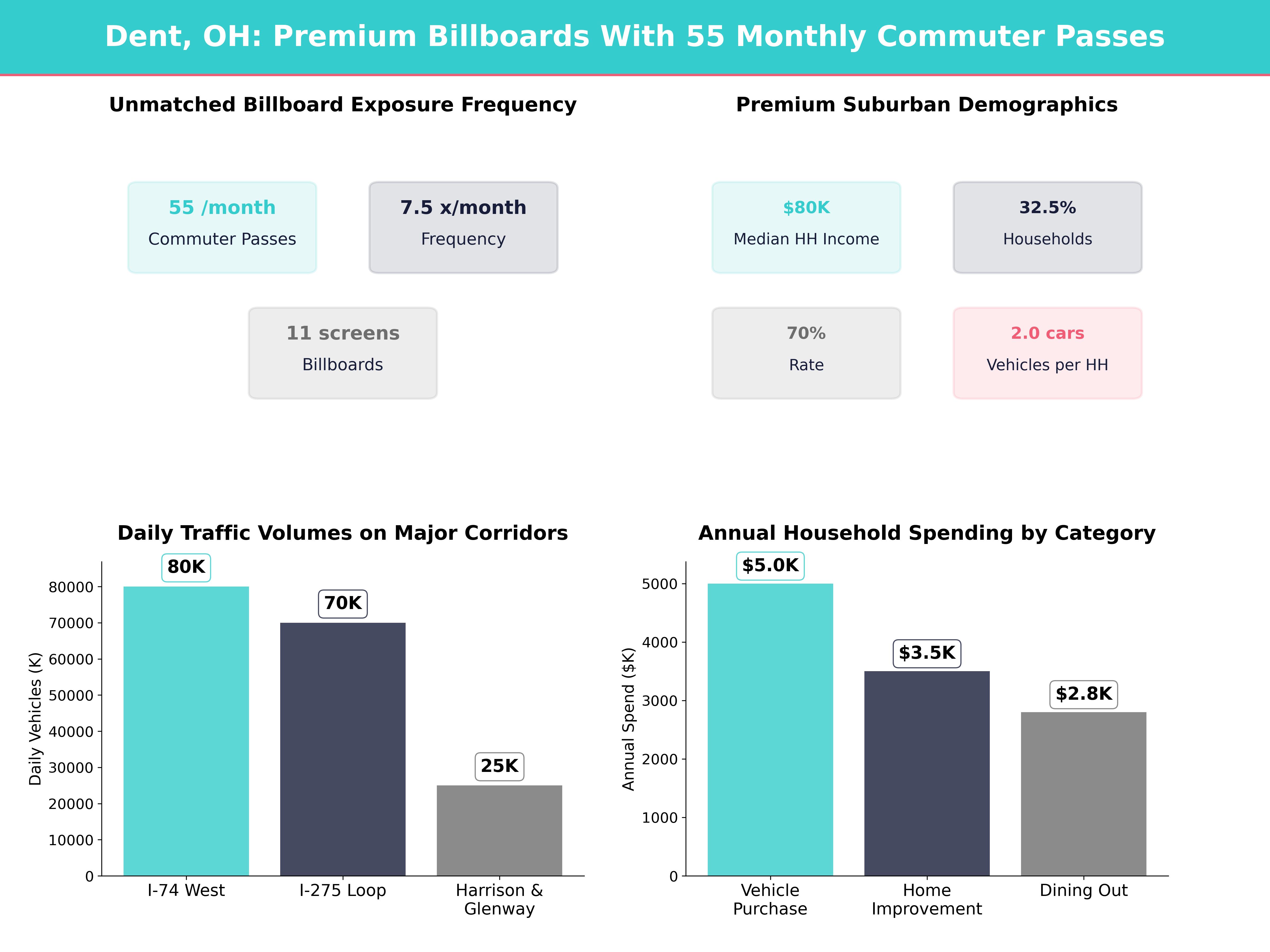
- Consumer spending studies conducted for Hamilton County indicate that west‑side households spend thousands of dollars annually per household on categories like home improvement ($3,000–4,000), vehicle purchases and maintenance ($5,000+), and dining out ($2,500–$3,000), all of which are well‑suited for billboard advertising near Dent.
-
Commuting patterns
- According to regional travel modeling from OKI, a significant share of west‑side residents commute into job centers in downtown Cincinnati, Uptown (hospital/university district), and northern suburbs via I‑74, I‑275, and US‑50/River Road.
- Average one‑way commute times for Hamilton County residents are around 23–25 minutes, which aligns with Dent‑to‑downtown trips via I‑74 and I‑75. That puts thousands of drivers from the Dent/Green Township area on the road during traditional rush periods every weekday.
-
The Ohio Department of Transportation (ODOT) reports annual average daily traffic (AADT) volumes on key corridors near the Dent catchment such as:
- I‑74 west of downtown Cincinnati: often 70,000–90,000 vehicles per day
- I‑275 on the west/northwest loop: frequently 60,000–80,000 vehicles per day
- Major surface routes like Harrison Avenue and Glenway Avenue: typically 20,000–30,000 vehicles per day on busier segments
These volumes provide a strong base of repeat impressions for digital billboards placed along these roads.
For advertisers, this blend means the Dent area is ideal when you want to reach:
- Suburban families and homeowners with stable, above‑average incomes
- Daily commuters heading into Cincinnati’s job centers and medical/university districts
- Local shoppers using regional corridors to reach malls, big‑box centers, and downtown destinations promoted by groups like Visit Cincy and City of Cincinnati
Where Our Billboards Reach the Dent Area
We have 11 digital billboards serving the Dent area, all located within about 10 miles, concentrated in Cincinnati. Because Dent is only about 9 miles (roughly a 15–20 minute drive in typical traffic) from downtown Cincinnati, much of the area’s traffic flows naturally toward these boards, making billboards near Dent effective for both local and regional exposure.
Strategic implications:
-
Dual audience exposure
Your message doesn’t just reach Dent‑area residents; it also reaches Cincinnati workers, visitors, and through‑traffic passing close to Dent’s catchment area. For example, downtown and riverfront attractions promoted by Visit Cincy and event coverage from local outlets like Cincinnati.com / The Enquirer, WCPO 9 News, and WLWT 5 regularly draw tens of thousands of additional vehicles through west‑side corridors for Reds, Bengals, and festival days. Well‑timed billboard advertising near Dent can capture these extra impressions. -
Key travel patterns
Drivers from the Dent area frequently use:- I‑74 and I‑275 to reach northern and central Cincinnati job centers
- Surface routes like Harrison Avenue, Glenway Avenue, and US‑50 to reach shopping, entertainment, and downtown
Based on ODOT counts, a commuter using I‑74 five days a week can rack up 50–60 billboard passes per month on a given sign, even at conservative frequency, if your campaign is scheduled during rush hours.
Well‑placed boards near these routes can hit the same residents multiple times per week, helping you achieve an effective frequency of 5–10+ exposures per person per month when campaigns run consistently.
-
Layering with local destinations
Residents often travel toward:- Downtown Cincinnati for work and events
- Retail nodes such as Western Hills/Westwood, Northgate, and central city shopping districts
- Attractions promoted by Visit Cincy such as the Cincinnati Zoo, riverfront parks, museums, and seasonal festivals
Traffic counts around major events can spike 20–40% above normal weekend volumes near the city core. Positioning your Blip schedule when traffic peaks around these destinations can materially improve total impressions at no extra creative cost.
Because Blip lets us buy exposure by the “blip” instead of a fixed 4‑week contract, we can weight your delivery toward the boards and dayparts that best match Dent‑area travel—prioritizing stretches where tens of thousands of local vehicles pass daily. This flexible approach to billboard rental near Dent helps you focus spend where it matters most.
Who Should Advertise on Billboards Near Dent?
The Dent area’s profile makes it fertile ground for:
-
Home‑focused local businesses
- Contractors (roofing, HVAC, remodeling, plumbing, electrical)
- Lawn care and landscaping
- Real estate agents and mortgage brokers
- Storage facilities and moving companies
With homeownership above 70% and a median household income near $80,000, even modest lift—say capturing 1–2 extra projects per month—can often pay for a west‑side billboard schedule.
-
Family and lifestyle brands
- Pediatricians, dentists, and urgent care clinics
- Gyms, martial arts studios, and youth sports programs
- Restaurants, fast‑casual chains, and local breweries
- Faith communities and nonprofit organizations
Local school districts like Oak Hills Local School District and nearby parochial schools collectively serve thousands of students; targeting parents on their daily school and activity routes can yield repeated billboard exposure twice per day (drop‑off and pickup).
-
Automotive and transportation
- Dealerships on Cincinnati’s west side and beyond
- Auto repair, tire shops, and car washes
- Insurance agencies and financial services
Hamilton County vehicle registration data indicate car ownership rates near 2 vehicles per household in many west‑side neighborhoods, supporting continual demand for maintenance, repairs, and upgrades.
-
Education and workforce
- Trade schools, community colleges, and universities recruiting from the west side
- Employers trying to reach commuters driving toward major job hubs in Cincinnati, Uptown, and northern suburbs
With regional unemployment typically hovering around 3–5%, employers use billboards to stand out in a tight labor market—especially for roles where a single quality hire is worth thousands of dollars.
Because many Dent‑area residents are stable, long‑term households (local property tax and housing data show high tenure rates of 10+ years in many neighborhoods), billboard campaigns can be especially effective for building top‑of‑mind familiarity instead of just one‑off promotions. For these relationship‑driven businesses, Dent billboards act as an ongoing reminder that reinforces trust and local presence.
Timing Your Campaign Around Local Life
The Dent area follows a suburban rhythm—strong weekday commuter peaks, busy weekend retail traffic, and seasonal swings around school and holidays. Traffic and transit planning from OKI and Metro (the regional transit agency) reinforce how pronounced these peaks are on west‑side corridors.
With Blip, we can dial your schedule in to match that rhythm so that billboard advertising near Dent reaches the right people at the right time.
Key timing insights:
-
Weekday commuter windows
- Morning: roughly 6:30–9:00 a.m. as Dent‑area residents drive toward Cincinnati job centers.
- Evening: roughly 4:00–7:00 p.m. when commuters return along I‑74, I‑275, and major surface streets.
- On many Hamilton County roadways, 40–50% of daily traffic occurs within these peak windows, making them prime slots for reach and frequency.
-
Use these slots for:
- Service businesses (auto, home repair, healthcare)
- Employer recruitment
- Financial and insurance messaging
-
Midday and early afternoon
- Midday volumes are typically 60–70% of peak rush‑hour levels but feature a different audience mix: seniors, at‑home parents, and service workers.
-
Strong for:
- Seniors and at‑home parents
- Service‑call businesses (“Call today, we can be there this afternoon”)
- Restaurants pushing lunch or early dinner specials
-
Weekends
- Saturdays often see heavy traffic toward shopping areas and downtown events promoted by outlets such as Cincinnati.com / The Enquirer and local stations like WCPO 9 News and WLWT 5. Big event days can push downtown‑adjacent traffic volumes 20–30% higher than typical weekdays.
- Sunday traffic patterns are more spread out across the day, ideal for faith communities, family dining, and leisure.
-
Focus weekend creatives on:
- Dining and entertainment
- Retail sales and limited‑time offers
- Family attractions, churches, and community events
Because Blip allows day‑part and day‑of‑week targeting, we can:
- Run commuter‑focused creatives Monday–Friday
- Shift to family/entertainment messaging Friday evening through Sunday
- Pause or intensify delivery around specific date ranges (sales, events, launches, school calendars published by Oak Hills Local School District or community events promoted by Green Township)
Seasonal Strategy for the Dent Area
Suburban markets like the Dent area show strong seasonal patterns you can leverage. Local weather data and retail studies for greater Cincinnati consistently show that spending spikes around spring home‑improvement season and late‑year holidays, while service categories like HVAC and plumbing peak around extreme temperatures.
-
Winter (January–March)
- Home services (HVAC, insulation, roofing checks) as temperatures frequently dip below freezing on 60+ days per year in the Cincinnati area.
- Tax prep and financial planning as residents respond to W‑2s and local income tax requirements from City of Cincinnati and surrounding municipalities.
- Fitness clubs and health providers (New Year resolutions): national health club data often show 10–15% of annual sign‑ups concentrated in January alone.
- Creative angle: “Start the year right,” “Winterize your home,” “Don’t wait for tax season stress.”
-
Spring (April–June)
-
Peak time for:
- Landscaping and lawn care as growing season begins; many households schedule their first yard service of the year in April.
- Exterior home projects (roofing, siding, painting), particularly after winter freeze‑thaw cycles create damage.
- Real estate listings and mortgage offers, as listing activity often jumps 30–40% above winter levels in the Cincinnati housing market.
- Many households prepare for graduations and summer travel promoted by Visit Cincy, making it ideal for events, attractions, and hospitality.
-
Peak time for:
-
Summer (July–August)
-
Strong for:
- Family entertainment and local attractions (zoos, pools, festivals). Regional tourism agencies report that a large share of annual attraction visits cluster in June–August.
- Back‑to‑school promotions (retail, tutoring, healthcare checkups); local districts including Oak Hills publish calendars that drive predictable spikes in school‑related purchases.
- Restaurants and ice‑cream/coffee shops capturing evening traffic after youth sports and outdoor activities.
- Consider playful, high‑color creatives to stand out in bright daylight, as summer sunshine hours are highest from June through August.
-
Strong for:
-
Fall (September–December)
- Back‑to‑school and fall sports, with high participation in youth and high‑school athletics across west‑side schools.
- Pre‑holiday retail and e‑commerce: national and local sales data consistently show November–December accounting for 20–25% of annual retail revenue for many businesses.
- End‑of‑year healthcare, dentistry, and insurance messaging as people use remaining benefits and flexible spending dollars.
- Holiday traffic toward shopping districts generates extra impressions for boards along major corridors into Cincinnati, with December weekend traffic often rising 10–20% over non‑holiday months.
With Blip’s budgeting controls, we can front‑load spending during your highest‑value seasons (for example, a roofing company in spring or a retailer in November–December) without committing to expensive year‑round contracts. You can increase bids temporarily during peak weeks and then scale back to a maintenance‑level presence, keeping your Dent billboards active when they will have the most impact.
Creative Best Practices for Reaching the Dent Area
Dent‑area drivers are often moving at suburban or highway speeds, which means your message must be instantly clear. On a digital billboard, you typically have 6–8 seconds of viewing time—or less at freeway speeds. Eye‑tracking studies on roadside ads show that most viewers only fully process one main idea per exposure.
Use these creative guidelines:
-
One core message
- Aim for 7 words or fewer of primary text.
- Example: “Need a New Roof? Call Dent Roofing.”
- Keeping copy short can increase recall rates by 20–30% compared with crowded layouts, according to industry creative testing.
-
Readable typography
- Use bold, sans‑serif fonts at large sizes.
- Avoid script or thin fonts that disappear at a distance.
- High contrast combinations (white/yellow on dark backgrounds, or dark on light).
- Maintain generous spacing between letters and lines to keep legibility at 300–500 feet.
-
Local anchoring
-
Reference the Dent area or west side identity:
- “Serving the Dent Area Since 1998”
- “West Side’s Trusted Pediatric Dentist”
- Add a location hook: “On Harrison Ave near [Landmark]” or “10 Minutes from Dent.”
Including a clear local reference has been shown in multiple out‑of‑home case studies to lift response, because it signals convenience and relevance. This helps transform generic creative into Dent‑specific billboard advertising that feels tailored to local drivers.
-
Reference the Dent area or west side identity:
-
Simple calls to action
-
Use short, memorable CTAs:
- “Call Today”
- “Exit 2B, Then Left”
- “Book at WestSideVet.com”
- Prefer website URLs or short phone numbers over QR codes (hard for drivers to scan). Studies of roadside QR usage show completion rates typically under 1–2% of exposures due to speed and safety concerns.
-
Use short, memorable CTAs:
-
Brand consistency
Because our network is digital, you can upload multiple creatives and rotate them:
- One for weekday commuters (“Call before work, we’ll come after.”)
- One for weekends (“Family dinner tonight? Kids eat free.”)
- One for promotions (“$500 off new HVAC unit – This Month Only.”)
We can A/B test by running two designs at similar budgets and watching which one aligns with better web traffic, calls, or store visits on your end. Even small changes—like a bigger phone number or simplified headline—can produce 10–30% swings in response.
Targeting Dent‑Area Residents with Blip’s Flexibility
Blip’s buying model lets you purchase individual “blips” (ad plays) rather than fixed campaigns. For the Dent area, that means we can:
- Focus on specific boards near key routes used by Dent‑area drivers toward and from Cincinnati, such as I‑74, I‑275, and Harrison Avenue.
- Bid more during peak times (e.g., weekday rush hours) and lower your bids or pause in low‑value windows. Concentrating spend into the top 30–40% of highest‑traffic hours can significantly improve your impressions per dollar.
- Set a precise daily budget, even as low as a few dollars, and scale up when you see results. Many small advertisers start with $10–$30 per day in a tight cluster and then expand once they see measurable impact.
Practical tactics:
- Start with a tight geographic cluster of boards serving the west‑side approach to Cincinnati to maximize repeated exposure among Dent/Green Township commuters.
- Run for at least 2–4 weeks to build frequency; many Dent‑area commuters will see your message 5–10+ times in that period if targeted correctly, which aligns with common frequency benchmarks for driving action in out‑of‑home advertising.
- Monitor business metrics (calls, web traffic, offer redemptions) during and after the campaign to calculate your return. Even a 5–10% lift in inquiries can be significant for high‑value services.
Because we’re not locked into static posters or rigid contracts, we can:
- Quickly switch out underperforming creatives—often within 24 hours.
- Launch new messages for flash sales or events in hours, timed to coverage from local media like Cincinnati.com, WCPO, WLWT, or FOX19 NOW.
- Coordinate billboard pushes with public information from Hamilton County and Green Township (e.g., road work, festivals, or community days) to align your messages with known traffic and event spikes.
This level of control makes Blip an efficient option for billboard rental near Dent, especially for small and mid‑sized businesses that need to manage cash flow carefully.
Integrating Billboards with Your Other Marketing
Billboards near the Dent area are most powerful when they reinforce what audiences already see online, by mail, or at your location. Multi‑channel campaigns routinely outperform single‑channel efforts, with some studies showing 20–40% higher response when out‑of‑home is added to digital and direct mail.
Ways to integrate:
-
Match your message
- Use the same headline and imagery across billboards, paid social, and search ads.
- Example: if your Google Ads say “Dent Area Emergency Plumbing 24/7,” mirror that on your board.
- Consistent branding helps west‑side commuters connect your online presence with the sign they pass twice a day.
-
Use a trackable offer
- “Mention ‘DENT10’ for 10% off” lets you directly attribute sales or calls to your billboard campaign.
- Use unique URLs or phone numbers (e.g., westside‑roofing.com/dent) and watch analytics. If 10–20% of your new customers mention the code, you have clear evidence of billboard impact.
-
Leverage geofencing and retargeting
- Run mobile or social ads geofenced to west‑side neighborhoods while boards run on nearby highways.
- People see your brand out of home and then again on their phone, increasing recall. Industry analyses show that using out‑of‑home plus mobile retargeting can boost ad recall and engagement by up to 50% compared with mobile alone.
-
Support events and sponsorships
-
If you sponsor local schools, sports teams, or community events publicized via Green Township, Hamilton County, or local news, use billboards to highlight that:
- “Proud Sponsor of West Side Youth Sports”
- “See Us at the Community Festival This Weekend”
- Visibility on billboards plus on‑site presence can dramatically increase perceived community involvement, which is especially important in tight‑knit areas like Dent and surrounding townships.
-
If you sponsor local schools, sports teams, or community events publicized via Green Township, Hamilton County, or local news, use billboards to highlight that:
When you take this integrated approach, Dent billboards become the high‑visibility anchor that ties your other marketing channels together for local audiences.
Measuring Success in the Dent Area
While digital billboards don’t provide click‑through rates, we can build a strong picture of effectiveness using data you already have plus Blip’s reporting.
-
Before‑and‑after comparisons
-
Track:
- Website sessions and direct traffic
- Brand‑name search volume (e.g., “Dent roofing company,” your business name)
- Phone calls and walk‑ins
- Compare the 2–4 weeks before your campaign to the weeks during and after. Many local businesses see 10–30% increases in branded searches or direct visits during strong billboard flights.
-
Track:
-
Offer‑based tracking
- Use coupon codes or specific offer language unique to the billboard.
- Create dedicated landing pages that only appear on billboard creatives; a modest goal is 3–5% of viewers who notice the board and remember the URL visiting later, which can be meaningful in high‑traffic corridors.
-
Correlation with inquiry volume
- Many local businesses near the Dent area see noticeable spikes in “How did you hear about us? I saw your sign on the highway” during campaigns—train your front‑line staff to ask and log this.
- If even 1 in 5 new customers cites your billboard, that’s a strong indicator for continued investment.
By using Blip’s reporting tools (impressions, spend, delivery by board and time of day) alongside your own internal data, we can refine:
- Which boards best reach the Dent area (for example, boards that account for 60–70% of impressions from west‑side traffic)
- Which times and days are most productive (morning vs. evening, weekday vs. weekend)
- Which creative messages drive the strongest response (e.g., offers vs. branding, service‑specific vs. general awareness)
By understanding how Dent‑area residents live, commute, and spend—and by taking advantage of Blip’s flexible, data‑driven approach to digital billboards near Dent—we can build campaigns that are both cost‑effective and highly visible. Whether you are a small local shop or a regional brand, the Dent area offers a concentrated, high‑value suburban audience that can be reached and re‑reached every week through our network of digital billboards serving the area, with billboard advertising near Dent tailored to your goals and budget.