Billboards near Fairview Park, OH
No Minimum Spend. No Long-Term Contracts. Just Results.
Trusted by Leading Brands


Billboard advertising
near Fairview Park has never been easier



How much is a billboard near Fairview Park?
Why Choose Blip for Billboard Advertising near Fairview Park
Blip lets you launch on Fairview Park, Ohio billboards fast, reaching I-480 and I-90 commuters without the old-school sales process.
Set a flexible daily budget for Fairview Park, Ohio and stay in control while Blip reaches west-side drivers heading to Cleveland Hopkins and Westgate.
Daypart your Fairview Park, Ohio campaign for rush hour, school runs, or weekend shopping on Lorain and Brookpark Road.
No contracts mean you can test Fairview Park, Ohio billboards around Browns games, airport traffic, or holiday shopping, then pivot anytime.
Track Fairview Park, Ohio performance in real time and adjust bids as commuter traffic shifts between downtown Cleveland, the airport, and the west side.
Use Blip’s creative tools to tailor Fairview Park, Ohio ads for homeowners, families, and airport travelers with simple, high-contrast messaging.
Frequently Asked Questions About Billboard Advertising near Fairview Park
How much does a billboard cost near Fairview Park, Ohio with Blip?
With Blip, you can run your message on digital Fairview Park billboards on any budget, because you choose a daily spend that works for you and Blip automatically keeps your campaign within that amount. Each blip is a brief 7.5 to 10-second ad display, and you only pay for the blips you receive, based on when and where your ads appear and current advertiser demand on billboards near Fairview Park, Ohio. It can be surprisingly affordable, since you control how much you spend each day, can adjust your budget at any time, and let Blip’s pay-per-blip model stretch every dollar while reaching drivers in the Fairview Park area.
Where can I advertise with Blip near Fairview Park, Ohio?
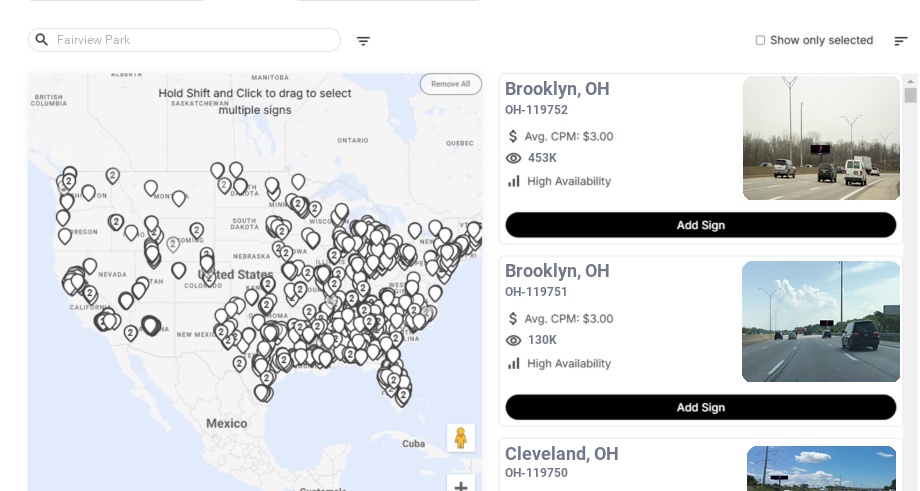
Blip’s seven digital billboards serving the Fairview Park area are strategically located in nearby Brooklyn and Cleveland, both less than 6 miles away. These nearby boards tap into some of the highest-volume corridors on Cleveland’s west side—catching not only Fairview Park residents but also drivers from Lakewood, Rocky River, North Olmsted, and Cleveland’s west-side neighborhoods. For advertisers, this cluster effectively functions as a network of Fairview Park billboards without the premium pricing that can come with smaller, hard-to-find local inventory.
What kind of audience do Fairview Park, Ohio billboards reach?
Fairview Park is a compact, highly traveled west-side suburb with a strong local identity and deep ties to the greater Cleveland region. It has about 17,300 residents within just 4.7 square miles, a density of roughly 3,700 people per square mile, and median household income around $72,000–75,000. About 65–70% of occupied housing units are owner-occupied, and the age profile includes families, working adults, and seniors, making multiple high-value segments reachable with billboard advertising.
When is the best time to run Blip billboards near Fairview Park, Ohio?
The west-side corridor that serves the Fairview Park area has distinct daily and weekly rhythms, and Blip’s dayparting and budgeting tools let you time your blips to these patterns. Morning commute, midday errands, and evening return traffic all create strong visibility, with weekends also bringing elevated traffic tied to Westgate, Great Northern, and area big-box stores. Downtown Cleveland events, holiday shopping weekends, and back-to-school periods can also create surges along I-90 and I-480.
Do I need a contract to advertise with Blip near Fairview Park?
No, Blip has no long-term contracts or minimum commitments. You can start, pause, or stop your campaign at any time.
How fast can I launch a billboard campaign with Blip near Fairview Park?
You can have your campaign live in minutes. Create a free account, select your locations, set your budget, upload your design, and start running once approved.
Where can I advertise with Blip near Fairview Park?
Blip has digital billboards near Fairview Park. You can browse available locations on a map, choose the ones that fit your audience, and start advertising right away.
Still have questions? Launch a campaign in minutes — no contracts, no commitments.
Start Your CampaignFairview Park Billboard Advertising Guide
Sitting just 10 miles west of downtown Cleveland with fast access to I‑480, I‑90, and Cleveland Hopkins International Airport, the Fairview Park area offers out‑of‑home advertisers a dense, commuter‑heavy audience with strong household incomes and frequent local shopping trips. With seven digital billboards serving the Fairview Park area from nearby Brooklyn and Cleveland, we can help you put your message in front of both everyday residents and high‑value regional visitors whenever you’re looking for billboards near Fairview Park.
Understanding the Fairview Park Area Audience
Fairview Park is a compact, highly traveled west‑side suburb with a strong local identity and deep ties to the greater Cleveland region. It sits within the broader west‑suburban band that includes Lakewood, Rocky River, North Olmsted, and Cleveland’s West Park neighborhood, creating a tightly interlinked consumer market that benefits any advertiser using Fairview Park billboards to reach the west side.
Key demographic and economic indicators
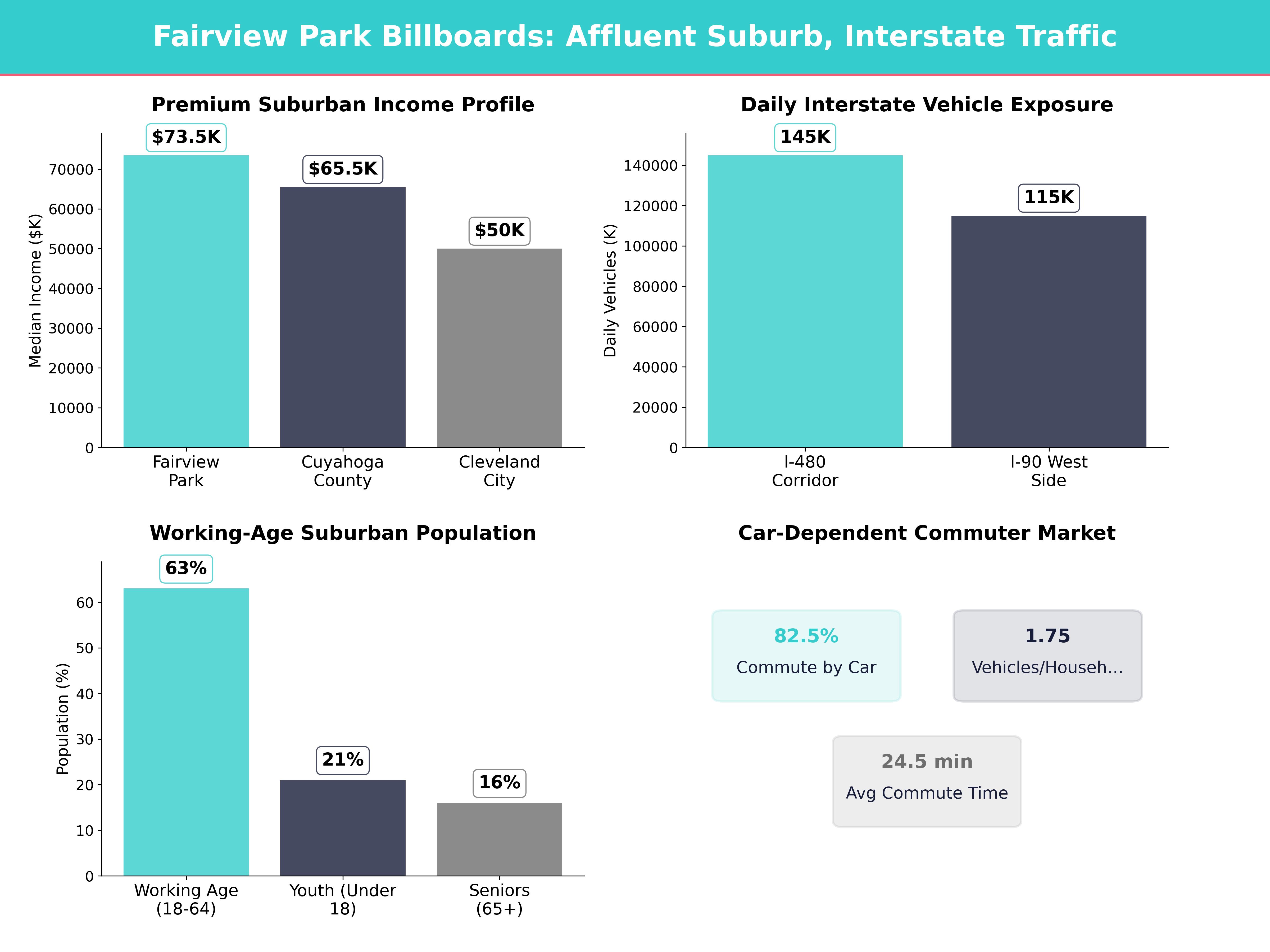
- Population: about 17,300 residents (2020 Census) within just 4.7 square miles – a density of roughly 3,700 people per square mile, higher than many neighboring suburbs and more than double the statewide average density of around 290 people per square mile.
- Households: roughly 7,900–8,000 households, with average household size near 2.2 persons, meaning a strong mix of singles, couples, and small families that are reachable with lifestyle‑oriented campaigns.
-
Age profile: A balanced mix of families and older residents creates multiple high‑value segments:
- Roughly 20–22% under 18
- Around 15–17% age 65 and older
- The remaining 61–65% in prime working ages (18–64)
This makes family‑oriented, working‑professional, and senior‑friendly messaging all viable.
-
Income: Median household income in Fairview Park is around $72,000–75,000, which is:
- Roughly 40–45% higher than the City of Cleveland’s median (in the $50,000 range)
- Slightly above or near the Cuyahoga County median (around $63,000–68,000)
That suggests strong purchasing power for retail, healthcare, financial services, and home improvement.
- Housing: About 65–70% of occupied housing units are owner‑occupied, and single‑family homes make up well over 60% of the housing stock—ideal for campaigns focused on home services, remodeling, and big‑ticket durable goods.
- Education: Roughly 32–36% of adults hold a bachelor’s degree or higher, and over 90% have at least a high school diploma or equivalent, supporting campaigns for professional services, continuing education, and higher‑end consumer products.
- Local schools: Fairview Park City Schools educate around 1,500–1,700 students across the district, contributing to a steady flow of parent, student, and staff trips on key corridors every weekday.
You can explore more about the community on the City of Fairview Park official site, the City of Cleveland portal, and Cuyahoga County pages, which all highlight the west side’s stable residential base and access to regional jobs—key context for planning billboard advertising near Fairview Park.
Mobility and commuting patterns
Fairview Park is an archetypal commuter suburb, with driving as the dominant travel mode:
- Around 80–85% of workers in the area commute by car, truck, or van, and 75–80% do so alone rather than carpooling.
- Typical one‑way commute times run 22–27 minutes, and a sizable share—about 30–35%—report commutes of 30 minutes or longer, meaning drivers frequently travel multiple exits along I‑480, I‑90, and surface routes like Lorain Road and Brookpark Road.
- Fairview Park’s location between major employment centers—downtown Cleveland, the airport/IX Center area, Strongsville/Berea to the south, and Westlake/Avon to the west—funnels daily traffic through a compact set of high‑visibility corridors.
- Cleveland Hopkins International Airport, less than 4 miles from Fairview Park’s southern edge, served about 7.2 million passengers in 2023 and handled more than 85,000 aircraft operations, according to Cleveland Hopkins International Airport. This activity sustains a large ecosystem of hospitality, rental car, cargo, and support jobs in the immediate area.
Because so much local life in the Fairview Park area revolves around driving to work, shopping, school, and the airport, digital billboards near Brooklyn and Cleveland are perfectly positioned to intercept this traffic multiple times per week for the same households, delivering the kind of repeated exposure that makes billboard advertising near Fairview Park especially effective.
For broader regional context on employment, housing, and transportation, you can also reference west‑side‑focused coverage on Cleveland.com and planning updates from the Northeast Ohio Areawide Coordinating Agency (NOACA), the regional transportation and planning body.
Where Our Digital Billboards Reach the Fairview Park Area
Blip’s seven digital billboards serving the Fairview Park area are strategically located in nearby Brooklyn and Cleveland, both less than 6 miles away. These nearby boards tap into some of the highest‑volume corridors on Cleveland’s west side—catching not only Fairview Park residents but also drivers from Lakewood, Rocky River, North Olmsted, and Cleveland’s west‑side neighborhoods. For advertisers, this cluster effectively functions as a network of Fairview Park billboards without the premium pricing that can come with smaller, hard‑to‑find local inventory.
While exact counts vary by location, Ohio Department of Transportation (ODOT) data show typical volumes on key roads that carry Fairview Park–area traffic:
- I‑480 near the western suburbs: often 130,000–160,000 vehicles per day on busy stretches between I‑71 and I‑90.
- I‑90 on the west side: commonly 100,000–130,000 vehicles per day, including traffic heading to and from downtown Cleveland and the lakefront.
- Major surface roads such as Brookpark Road (SR‑17) and Lorain Avenue (US‑20) routinely see 20,000–35,000 vehicles per day in segments between Fairview Park, Brooklyn, and adjacent cities.
- Closer to neighborhood retail, corridors like Center Ridge Road and Detroit Road in adjacent Rocky River and Lakewood often carry 15,000–25,000 vehicles per day, feeding shoppers toward Fairview Park’s Westgate area.
You can review local roadway and traffic planning details via ODOT District 12, Cuyahoga County Public Works, and regional transportation plans published by NOACA.
How this translates to advertising reach
Because Fairview Park residents regularly drive through neighboring Brooklyn and Cleveland to reach:
- Downtown Cleveland and the Flats
- Shopping hubs like Westgate Town Center (in Fairview Park) and Great Northern Mall (North Olmsted)
- Major employers near the airport, I‑480, and I‑71
- Sports and entertainment venues like Cleveland Browns Stadium, Rocket Mortgage FieldHouse, and Progressive Field
your message on nearby billboards is repeatedly exposed to the same high‑value households multiple times per week:
- A commuter using I‑480 or I‑90 five days a week easily passes the same board 10 times per week (to and from work).
- At 130,000–160,000 vehicles per day, even a conservative 5–10% share of rotation time on a digital unit can translate into 6,500–16,000 vehicle impressions per day for your creative on that board.
- Over a 4‑week campaign, that can mean 180,000–450,000+ potential impressions from a single key location, before adding weekend and event‑day surges.
With Blip, we can flexibly schedule those impressions to coincide with when your audience is actually on the road and optimize around the highest‑value time windows, making billboard rental near Fairview Park both measurable and adaptable to your goals.
For additional context on west‑side retail and development trends that influence traffic, local outlets like News 5 Cleveland and Ideastream Public Media regularly cover major corridor projects and openings.
Timing Your Campaign Around Local Traffic Patterns
The west‑side corridor that serves the Fairview Park area has distinct daily and weekly rhythms. Using Blip’s dayparting and budgeting tools, you can time your blips to these patterns rather than spreading your budget thin at low‑yield hours.
Weekday patterns
-
Morning commute (6:30–9:00 a.m.)
East‑ and southbound traffic spikes as residents head toward downtown Cleveland, the airport, and office/industrial zones. On some west‑side freeway segments, peak‑hour volumes can reach 7,000–9,000 vehicles per lane per hour, according to regional planning data.-
Best for:
- B2B services and professional firms
- Healthcare appointments and clinics
- Education and training programs
- Public service announcements with “start your day” framing
- Messaging style: concise, action‑oriented (“Schedule before work,” “Open at 7 a.m.”).
-
Best for:
-
Midday (11:00 a.m.–2:00 p.m.)
Retail workers, service providers, retirees, and remote workers moving for errands and lunch produce a reliable second traffic wave. In suburban corridors, mid‑day volumes typically reach 60–70% of peak‑commute levels, offering strong visibility at often lower bid levels.-
Best for:
- Restaurants and quick‑serve chains
- Local boutiques and auto service
- Medical, dental, and vision offices in or near Fairview Park
- Messaging style: promotions (“$8 lunch combo today”), convenience (“Walk‑ins welcome”).
-
Best for:
-
Evening commute (3:30–6:30 p.m.)
Return traffic toward Fairview Park, North Olmsted, Rocky River, and Lakewood. Evening rush on west‑side freeways frequently matches or exceeds morning peaks, particularly on days with downtown events.-
Best for:
- Grocery, home improvement, and family entertainment
- Youth activities and sports, gyms, and fitness studios
- Streaming services and local media
- Messaging style: “Tonight” and “On your way home” offers.
-
Best for:
Public transit, though less dominant than driving, also contributes to movement patterns. The Greater Cleveland Regional Transit Authority (RTA) carries tens of thousands of riders per weekday across bus and rail lines, with several routes passing through or near the Fairview Park area, further concentrating activity on major corridors.
Weekend and event‑driven opportunities
- Weekends (Saturday late morning–early evening) bring elevated traffic tied to Westgate, Great Northern, and area big‑box stores, plus family outings to regional attractions. Retail‑oriented corridors can see 10–20% higher volumes on Saturdays compared with non‑peak weekdays.
-
Downtown Cleveland events—Browns, Guardians, Cavs games, concerts, and festivals promoted by Destination Cleveland—create surges along I‑90 and I‑480 as suburban residents travel in and out of the city:
- Cleveland Browns home games at Cleveland Browns Stadium can draw 60,000–67,000 fans per game.
- Cleveland Guardians games at Progressive Field typically attract 15,000–30,000 fans, with marquee games and weekends climbing higher.
- Cleveland Cavaliers games at Rocket Mortgage FieldHouse often bring 17,000–19,000 attendees.
- Major summer concerts and festivals can add 10,000–20,000+ attendees on individual nights.
We can schedule higher bid amounts or increased blip frequency around:
- NFL home games and big college matchups
- Summer festivals on the lakefront and in the Flats
- Peak holiday shopping weekends (late November through December), when national data and local mall reports show double‑digit percentage increases in foot traffic and extended store hours
- Back‑to‑school periods (late July–August) for campaigns targeting parents and students, aligned with calendars from Fairview Park City Schools and neighboring districts such as North Olmsted City Schools and Lakewood City Schools
Crafting Creative That Resonates Near Fairview Park
A successful billboard near the Fairview Park area must be both visually striking and locally relevant. The area’s residents are used to seeing both national and regional brands on their routes; localized details help your message stand out and make your billboard advertising near Fairview Park feel tailored to daily life.
Design principles for this market
-
Prioritize legibility at highway speeds
- Use large fonts (at least 18–24 inches tall in production terms, often translating to 120–180 pixels or more on digital files, depending on board specs) and high‑contrast colors.
- Limit copy to 7 words or fewer whenever possible; studies of out‑of‑home recall consistently show significant drop‑offs when copy exceeds 10–12 words.
- Use one clear call to action (CTA), such as “Call Now,” “Exit at Clague,” or a short URL.
-
Embrace west‑side identity
Fairview Park and its neighbors share a strong sense of local pride distinct from both downtown and the eastern suburbs. Work in localized references such as:- “On Lorain near Westgate” (if applicable)
- “Minutes from Fairview Park”
- “Serving West Park, Fairview, and North Olmsted”
Mentions of landmarks like Westgate Town Center or Kamm’s Corners in nearby Cleveland can also boost relevance.
-
Reflect local lifestyles
In a suburb where roughly two‑thirds of homes are owner‑occupied and car ownership rates typically exceed 1.5–2 vehicles per household, themes that perform especially well include:- Home improvement, HVAC, roofing, landscaping
- Healthcare (family practices, urgent care, senior care)
- Financial planning and credit unions
- Youth sports, music lessons, tutoring
- Pet care, given the high rate of pet ownership in suburban markets
Weather and seasonal adaptation
Northeast Ohio’s dramatic seasons give you natural hooks for timely creative and affect how your boards are seen:
-
Winter (Dec–Feb)
- Cleveland typically records 40–60 inches of snow per year, with some seasons exceeding 70 inches; snow events and early sunsets (as early as 4:57 p.m. in December) make simple, high‑contrast designs critical.
- Cold snaps into the single digits (°F) are common, driving demand for auto repair, heating, and indoor recreation.
- Promote: auto repair, new/used vehicles, heating services, tax prep, indoor recreation, and winter clearance sales.
-
Spring (Mar–May)
- Temperatures rise from the 40s into the 60s°F, and homeowners begin exterior projects. Home‑improvement retailers and landscaping services often see double‑digit percentage increases in inquiries between March and May.
- Healthcare providers can capitalize on preventive‑care messaging as residents schedule physicals and elective procedures.
- Consider “spring cleaning,” “gutter & roof check,” and “before summer” framing.
-
Summer (Jun–Aug)
- With average highs in the 70s and 80s°F, summer brings increased trips to Lake Erie, downtown events, and regional attractions like the Cleveland Metroparks and Cedar Point.
- Family‑oriented spending spikes on travel, dining, and entertainment; regional tourism boards report that a large share of annual visitation occurs in these months.
- Promote: attractions, tourism, summer camps, ice cream & quick‑serve restaurants, back‑to‑school preparatory offers as August approaches.
-
Fall (Sep–Nov)
- Football season and school routines create predictable traffic patterns on weekday mornings and late afternoons; school‑related trips can account for 10–15% of local vehicle movements in some suburban areas.
- Temperatures slide from the 70s into the 40s°F, triggering demand for furnace tune‑ups, gutter cleaning, and interior remodeling.
- Promote: education, tutoring, home maintenance, healthcare checkups, holiday shopping, and Halloween/Thanksgiving promotions.
With Blip, you can upload multiple creatives and set rules so that different designs run in different months or even days of the week without any printing cost—similar to rotating digital ad sets online but applied to large‑format, high‑impact billboards.
Using Blip’s Flexibility to Target the Fairview Park Area Smartly
Digital billboards serving the Fairview Park area let you behave much more like a digital marketer than a traditional out‑of‑home buyer, especially when you combine audience knowledge with precise scheduling.
Budget control
- You can start with a modest daily budget—often as low as the cost of a few coffees per day—and increase only when you see results, instead of signing a fixed multi‑month contract that can run into the thousands of dollars per month on traditional static boards.
- Because Fairview Park‑area residents often repeat the same commute, even short bursts of higher‑frequency impressions on key days (for example, 3–5 days around a weekend event or sale) can cement your brand without requiring continuous, high‑spend coverage.
- Rotating multiple lower‑budget campaigns across different dayparts can reach several distinct segments (commuters, retirees, parents) while keeping your total spend under tight control.
Location combinations
-
Combine Brooklyn and Cleveland‑area boards to follow the commute:
- Eastbound into downtown and employment centers in the morning
- Westbound toward home in the evening
-
Test different board groupings:
- One set focused on airport‑bound traffic along I‑71, SR‑237, and Snow/Brookpark corridors
- Another focused on I‑90 and Detroit/Lorain corridors toward Lakewood, Rocky River, and Fairview Park
-
Consider tailoring creative per direction:
- Eastbound: “Stop in after work downtown” or “Park once, shop & dine”
- Westbound: “On your way home to Fairview Park” or “Exit now for dinner near Westgate”
Dayparting and calendar targeting
-
Increase bids during:
- Morning drive on Mondays (when people plan the week and book appointments)
- Thursday and Friday evenings for weekend‑oriented businesses; retailers often see 20–30% higher sales on weekends compared with mid‑week days
- Paycheck cycles (around the 1st and 15th of each month) for big purchases like furniture, electronics, and auto services
-
Decrease or pause during:
- Very late‑night hours when commuter traffic is minimal and freeway volumes can drop by 60–70% from daytime peaks
- Periods when your target audience is less likely to be traveling (e.g., mid‑day during school/work for youth‑focused offerings)
- Major winter storms when residents are encouraged to stay off the roads, then ramp up again as conditions improve
Campaign Ideas by Industry for the Fairview Park Area
Below are practical approaches tailored to how people live, work, and shop near Fairview Park. Each idea leverages the local numbers and patterns described above.
Retail and shopping
-
Highlight proximity to Westgate Town Center or major corridors:
- “2 miles east of Westgate on Lorain” or “Next to [recognizable chain] near Fairview Park”
- Link to or reference known retail hubs like Westgate Town Center and Great Northern Mall, which collectively attract millions of visits per year from west‑side residents.
- Run short‑term flash‑sale creatives tied to weekends or holidays—local malls often report 15–30% traffic spikes on key shopping days such as Black Friday and the last Saturday before Christmas.
- For smaller shops, focus on one signature product or offer with a clear price point (“$19 Oil Change,” “BOGO Lunch Special”) to maximize recall in the 5–8 seconds drivers typically have to view a billboard.
Healthcare and wellness
- Promote practices along Lorain Road, Center Ridge, or near the airport corridor with “Same‑day appointments” or “Walk‑ins welcome.” Fairview Park’s older adult share (around 16% seniors) supports senior‑care and specialty practices, while the substantial under‑18 population supports pediatric and family clinics.
- Aim for morning and late‑afternoon slots to catch commuters who are planning or finishing their day, and mid‑day slots for senior‑focused services when older residents are likely running errands.
- Use clear, simple CTAs such as “Call 24/7,” “Open evenings & Saturdays,” or “Most insurance accepted,” which align with local preferences for convenience and flexibility.
Home services
- The owner‑occupied housing share in the area (65–70%) makes residents strong prospects for roofing, windows, HVAC, and landscaping.
-
Use seasonal urgency:
- Spring: “Book now before summer heat”—as regional temperatures climb into the 80s°F, AC service calls typically spike sharply.
- Fall: “Furnace tune‑up before the first freeze”—early‑season service can prevent failures when overnight lows drop into the 20s°F.
- Incorporate a local credibility cue: “Trusted by west side homeowners since 2005” or “Serving Fairview Park, Rocky River & North Olmsted.”
- Consider using neighborhood names from City of Fairview Park maps or nearby communities to reinforce hyper‑local familiarity and strengthen the relevance of billboards near Fairview Park for homeowners.
Restaurants and entertainment
- Target lunch and dinner windows on weekdays and longer coverage on weekends. Many quick‑serve and casual‑dining brands see 40–50% of weekly sales concentrated between Friday evening and Sunday.
- Tie into major event nights in downtown Cleveland (games, concerts) so you catch people heading in or back out along I‑90 and I‑480. Position pre‑game offers (“Park once, eat & walk to the game”) or post‑game late‑night bites.
- Include a simple CTA such as “Exit at [street],” “Next to Westgate,” or “5 minutes from Fairview Park.” Distance‑based cues (“3 minutes off I‑480”) are especially effective for visitors using navigation apps.
- Consider cross‑promoting with local entertainment news and guides from outlets like Cleveland Scene or event calendars on Destination Cleveland.
Education and youth activities
-
With approximately 20–22% of residents under 18, Fairview Park and nearby suburbs have robust demand for:
- Tutoring, test prep, after‑school programs
- Music, dance, and sports training
- STEM camps and summer enrichment programs
- Run heavily just before and after school hours (7–9 a.m. and 2:30–5:30 p.m.) and during August/September back‑to‑school season, when local districts like Fairview Park City Schools, North Olmsted City Schools, and Rocky River City Schools return to session.
- Highlight outcomes (“Raise grades by one letter,” “College‑prep ACT/SAT support”) and convenience (“Near Fairview High School,” “On the way home from practice”).
Measuring and Optimizing Your Fairview Park–Area Campaign
While out‑of‑home is inherently a top‑of‑funnel medium, we can still track effectiveness and improve over time using a mix of traffic data and your own performance metrics.
Traffic and audience benchmarks
-
Use ODOT and local planning documents to estimate daily impressions based on:
- Average Daily Traffic (ADT) for each roadway
- Your share of digital rotation time on each board (for example, 8–10 seconds out of a 64–80 second loop)
- As a simplified example, if a board on I‑480 has 150,000 vehicles per day and your creative appears 10% of the time, your potential daily exposure is roughly 15,000 vehicle impressions. Over 30 days, that’s 450,000 potential impressions from that board alone.
- Combine these estimates with your own store traffic, web analytics, or call volume to infer lift. A spike of 10–20% in walk‑ins or web sessions during a tightly timed campaign window can be a strong indicator of billboard impact.
For more information on regional traffic and development, refer to ODOT District 12, NOACA data and maps, and local planning updates from nearby cities such as Brooklyn, Ohio and Lakewood, Ohio.
Attribution tactics
- Add unique URLs, QR codes, or promo codes that appear only on your billboard creative. Even a 1–3% usage rate on a billboard‑specific promo code can validate effectiveness.
- Use short, memorable URLs or vanity domains that redirect to your main site to capture type‑ins from drivers who remember your message later.
- Compare performance during “on” weeks vs. “off” weeks or in areas closer to the primary commuting corridors vs. farther suburbs. If locations within 3–5 miles of your boards see faster growth than outlying areas, that’s a strong supporting signal.
- Track phone call volumes during targeted dayparts; if you increase evening impressions and see a matching 10–15% rise in calls after 4 p.m., you can attribute a portion of that lift to your campaign.
Local media like Cleveland.com, WKYC Channel 3, and FOX 8 News can also provide context around economic trends, new developments, and shifting consumer behavior that may affect how people travel near Fairview Park, helping you time and position future campaigns and make smarter decisions about billboard rental near Fairview Park.
Putting It All Together
To reach the Fairview Park area effectively with Blip:
- Anchor your campaign around commuter flows between Fairview Park, Brooklyn, Cleveland, and the airport, using our seven nearby digital billboards positioned on I‑480, I‑90, and major surface routes for highly targeted billboard advertising near Fairview Park.
- Align your dayparts and calendar with when your ideal customers are actually on the road—weekday commutes, weekend shopping, and event nights that can bring tens of thousands of additional drivers through the corridor.
- Design clear, local, seasonally relevant creative that resonates with west‑side residents, emphasizes proximity and convenience, and stays legible in the 5–8 second viewing window typical of highway speeds.
- Leverage Blip’s flexibility to test multiple creatives, adjust bids in real time, and invest more heavily during your proven peak times, while pausing or reducing spend when traffic and response are lower.
- Monitor and refine based on traffic data, promotions, and your own business metrics—store visits, calls, web sessions, and redemption rates—to continuously increase your return on ad spend.
By combining deep local knowledge of the Fairview Park area with Blip’s on‑demand digital billboard platform, we can build campaigns that not only get seen, but also move people—to your website, your storefront, and your brand—whenever you need flexible, high‑impact billboards near Fairview Park.