Billboards near Reading, OH
No Minimum Spend. No Long-Term Contracts. Just Results.
Trusted by Leading Brands


Billboard advertising
near Reading has never been easier
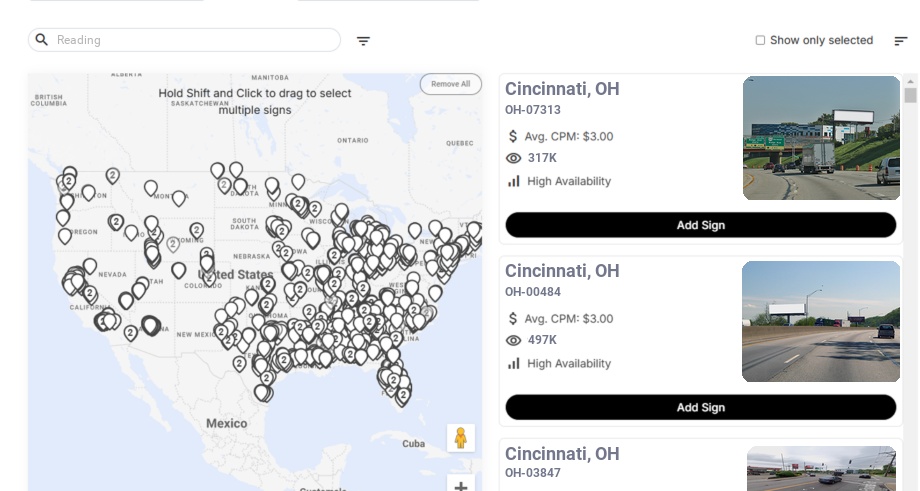



How much is a billboard near Reading?
Why Choose Blip for Billboard Advertising near Reading
Blip makes Reading, Ohio billboards self-serve, so you can launch fast along I-75, I-71, and Reading Road without traditional buying hurdles.
Set any budget in Reading, Ohio and let Blip manage spend as commuters and Bridal District shoppers flow through the Cincinnati corridor.
Use dayparting in Reading, Ohio to reach 5–9 a.m. and 3–7 p.m. commuters, then shift to weekend wedding and event traffic.
No contracts in Reading, Ohio means you can test boards near the Bridal District, Kenwood, and Sharonville, then pause or scale anytime.
Track Reading, Ohio performance in real time and tune creative for I-75 rush, downtown event traffic, or peak bridal season demand.
Blip's creative tools help you build bold Reading, Ohio ads that pop on digital boards serving car commuters and high-intent regional shoppers.
Frequently Asked Questions About Billboard Advertising near Reading
How much does a billboard cost near Reading, Ohio with Blip?
With Blip, you can run Reading billboards on any budget because you only pay per “blip,” a 7.5–10 second ad display on digital billboards near Reading, Ohio. You choose your daily budget during campaign setup, and Blip automatically keeps your ads serving the Reading area within that amount, so there are no surprises. You can also adjust your budget at any time to match your goals or seasonality.
Where can I advertise with Blip near Reading, Ohio?
We have 14 digital billboards serving the Reading area, all within about 10 miles, primarily in nearby Cincinnati (about 5.7 miles) from Reading. These Reading billboards allow us to intercept north–south commuters moving between Reading, Blue Ash, Sharonville, and downtown Cincinnati via I-75 and I-71, as well as along key surface routes such as Reading Road (US-42), Galbraith Road, and Ronald Reagan Cross County Highway (OH-126).
What kind of people does Blip reach with Reading, Ohio billboards?
Reading is a compact, business-friendly community in central Hamilton County, while the broader Cincinnati metro includes about 2.25–2.3 million people. More than 85–90% of Reading-area workers commute by car, with average one-way commute times around 22–25 minutes. The area includes a large share of adults 25–54, a prime demographic for home services, healthcare, financial planning, and family-oriented brands.
When is the best time to run Reading, Ohio billboards with Blip?
Weekday commuter focus works well during 5–9 a.m. and 3–7 p.m., since more than 70% of workers in Hamilton County commute on a traditional Monday–Friday, daytime schedule. Midday from 10 a.m.–3 p.m. is also strong for retail promotions, medical appointments, senior services, and local government or community messaging. Weekends are ideal for restaurants, entertainment, tourism, and storewide promotion campaigns that reach both locals and visitors driving near the Reading area.
Why is Reading, Ohio a strong market for billboard advertising?
The Reading, Ohio area sits in the heart of the Cincinnati metro and punches far above its size when it comes to commerce, commuting, and regional draw, especially thanks to its famous Bridal District and central location along major north-south routes. Reading’s Bridal District is frequently cited as one of the largest bridal districts in the Midwest, with more than 25–30 bridal, formalwear, and related specialty shops concentrated in just a few blocks. Local tourism and business sources report that the district attracts tens of thousands of visitors each year.
Do I need a contract to advertise with Blip near Reading?
No, Blip has no long-term contracts or minimum commitments. You can start, pause, or stop your campaign at any time.
How fast can I launch a billboard campaign with Blip near Reading?
You can have your campaign live in minutes. Create a free account, select your locations, set your budget, upload your design, and start running once approved.
Where can I advertise with Blip near Reading?
Blip has digital billboards near Reading. You can browse available locations on a map, choose the ones that fit your audience, and start advertising right away.
Still have questions? Launch a campaign in minutes — no contracts, no commitments.
Start Your CampaignReading Billboard Advertising Guide
The Reading, Ohio area sits in the heart of the Cincinnati metro and punches far above its size when it comes to commerce, commuting, and regional draw—especially thanks to its famous Bridal District and central location along major north–south routes. With 14 nearby digital billboards near Reading serving the area, we can help advertisers put messages in front of both local residents and high‑intent shoppers moving through the broader Cincinnati corridor.
Understanding the Reading Area Audience
Reading is a compact, business‑friendly community in central Hamilton County. Recent population estimates place Reading at roughly 10,500–11,000 residents, while the broader Cincinnati metro (Cincinnati–Northern Kentucky–Southeast Indiana) includes about 2.25–2.3 million people. The City of Cincinnati itself has just over 310,000 residents, giving Reading‑focused campaigns the ability to speak to a small‑town audience while still tapping into a large regional market.
Key audience characteristics to keep in mind:
-
Commuter community:
- More than 85–90% of Reading‑area workers commute by car, with average one‑way commute times around 22–25 minutes.
- Hamilton County sees approximately 57% of workers commuting alone by car, 10–11% carpooling, and a smaller share using transit, biking, or walking.
- Many Reading residents work in nearby employment hubs such as Cincinnati, Evendale Blue Ash, and Sharonville, often using I‑75, I‑71, and Reading Road (US‑42).
- According to regional analyses by the OKI Regional Council of Governments, I‑75 north of downtown carries well over 150,000 vehicles per day, underscoring the value of freeway‑visible boards for weekday reach and the impact of billboards near Reading on daily commuters.
-
Middle‑income households:
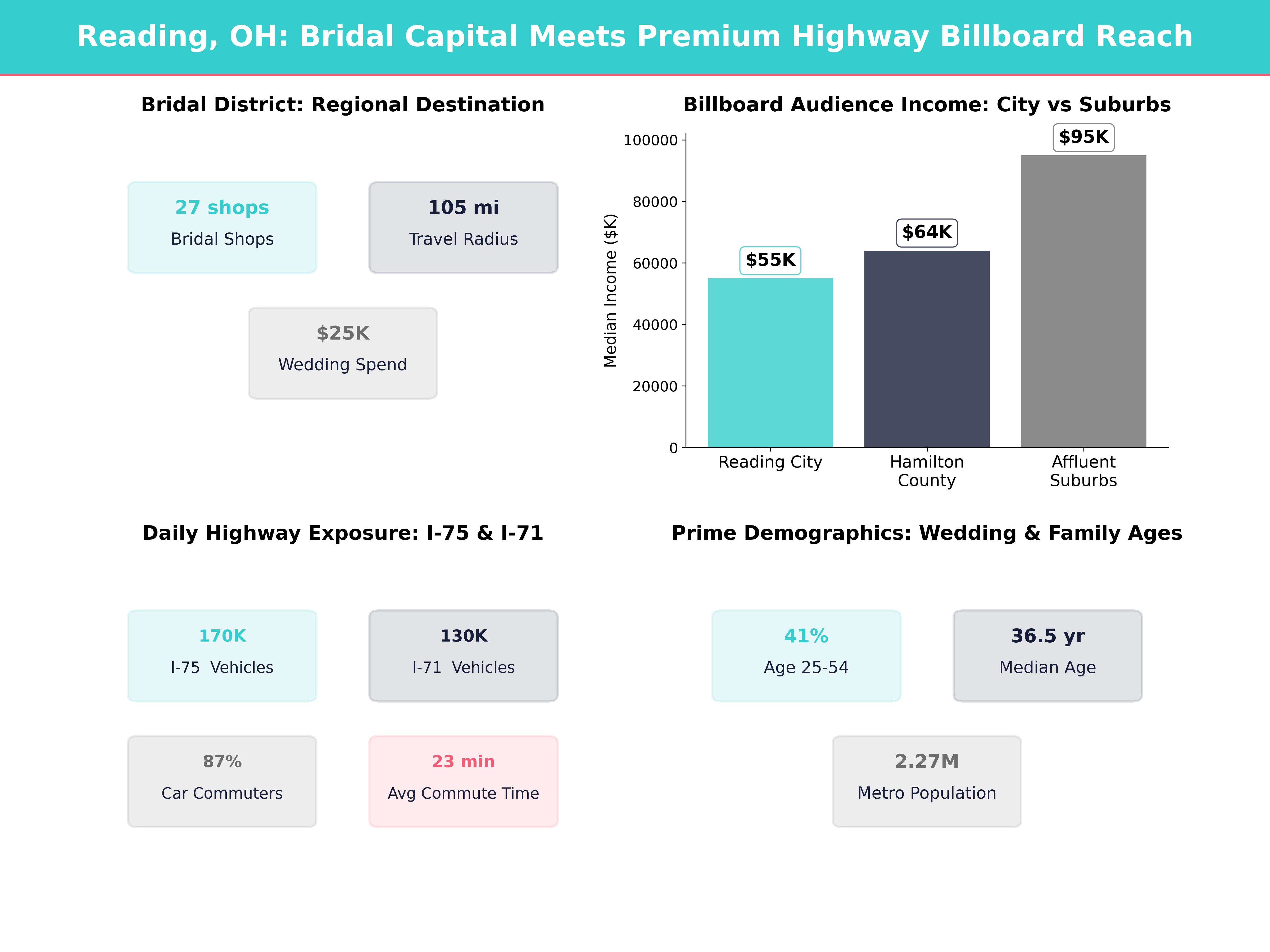
- Median household income in Reading is in the mid‑$50,000s to low‑$60,000s, roughly in line with or slightly below the Hamilton County median (around $63,000–$65,000).
- Within a 10‑mile radius of Reading, many suburban neighborhoods—Blue Ash, Montgomery, and parts of Sharonville—have median household incomes in the $80,000–$110,000 range.
- This blend of middle‑income households and higher‑income nearby suburbs supports a robust market for value‑oriented retail, automotive, healthcare, and financial services as well as premium bridal and event offerings.
-
Regional shopping draw:
- Reading’s Bridal District is frequently cited as one of the largest bridal districts in the Midwest, with more than 25–30 bridal, formalwear, and related specialty shops concentrated in just a few blocks.
- Local tourism and business sources report that the district attracts tens of thousands of visitors each year, with many brides traveling 60–150 miles from across Ohio, Indiana, and Kentucky.
- Typical wedding spending in the Cincinnati region can easily reach $20,000–$30,000+ per event when factoring in venues, catering, photography, travel, and related services, making this a high‑value audience for advertisers.
- For background on the district and local business climate, advertisers can reference the City of Reading official website Reading Bridal District.
-
Age mix:
- The Reading area includes a large share of adults 25–54, a prime demographic for home services, healthcare, financial planning, and family‑oriented brands. In many nearby ZIP codes, this age group represents 38–45% of the population.
- Hamilton County as a whole has a median age around 36–37, with about 15–17% of residents age 65+, supporting consistent demand for primary care, pharmacies, and senior services.
- This profile supports campaigns that speak both to young families and long‑time residents who value local relationships.
To get a sense of city priorities and development trends that shape daily life, advertisers can reference the City of Reading official website Hamilton County, Ohio and the regional planning data provided by OKI Regional Council of Governments.
Where Our Billboards Reach the Reading Area
We have 14 digital billboards serving the Reading area, all within about 10 miles, primarily in nearby Cincinnati (about 5.7 miles from Reading). These Reading billboards allow us to intercept:
- North–south commuters moving between Reading, Blue Ash, Sharonville, and downtown Cincinnati via I‑75 and I‑71, as well as along key surface routes such as Reading Road (US‑42), Galbraith Road, and Ronald Reagan Cross County Highway (OH‑126).
- Shoppers and errand‑runners traveling along major commercial corridors around Cincinnati, including areas near Kenwood, Norwood, and Sharonville, where regional retail centers draw thousands of vehicles per hour at peak times.
- Event and game traffic headed to downtown Cincinnati venues—such as Great American Ball Park, Paycor Stadium, and TQL Stadium
Traffic data from the Ohio Department of Transportation District 8 OKI show:
- I‑75 near downtown Cincinnati: often 160,000–180,000 vehicles per day (AADT)
- I‑71 north of downtown: typically 120,000–140,000 vehicles per day
- Major arterials in north‑central Hamilton County (e.g., Reading Road, Galbraith Road): 20,000–40,000 vehicles per day
That volume, combined with precise scheduling and budget controls, makes our Reading‑area billboards ideal for both brand‑building (broad reach, high frequency) and direct‑response campaigns (time‑sensitive offers, trackable URLs), especially for advertisers seeking billboard advertising near Reading that can scale up or down quickly.
Local transportation and traffic planning information is frequently published by Ohio Department of Transportation District 8 OKI Regional Council of Governments. For insight into regional tourism flows that affect traffic patterns, advertisers can consult Visit Cincy, which reports that the Cincinnati region welcomes over 26 million annual visitors generating $5+ billion in visitor spending.
What Reading‑Area Consumers Care About
When we build creatives for the Reading area, we want to align messaging with how people actually live and spend:
-
Weddings and life milestones
- Reading’s Bridal District features dozens of bridal and formalwear shops in a relatively small area—far more than a typical city of just 10–11,000 residents would support on its own. Many shops report serving hundreds of brides per year, with peak demand during spring and early fall.
- Regional wedding‑industry benchmarks show that couples in the Cincinnati area typically book services 9–18 months before the wedding date and may evaluate 5–10 vendors per category (venues, photographers, florists).
- Businesses offering adjacent services—venues, florists, photographers, jewelers, salons, financial advisors, honeymoon travel, and event insurance—can use boards serving the Reading area to reach couples before and after they visit the Bridal District, reinforcing decisions over a months‑long planning cycle.
- For local inspiration on events and hospitality, review listings from Visit Cincy and community calendars in outlets like The Enquirer.
-
Blue‑ and white‑collar employment mix
- The area sits near significant employment centers including the Sharonville and Evendale industrial corridors, General Electric’s sites in Evendale Blue Ash and Sharonville.
- Downtown Cincinnati adds another 100,000+ daytime workers in finance, law, healthcare, and corporate headquarters, including employers highlighted by the Cincinnati USA Regional Chamber
- This mix supports campaigns for workforce recruitment, trade schools, technical programs, and professional services aiming to reach both skilled trades and office professionals who regularly travel the same major routes that our billboards cover.
-
Local loyalty with metro‑wide options
- Surveys and local reporting consistently show strong loyalty to independent restaurants, tradespeople, and service providers, especially in inner‑ring suburbs like Reading, Norwood, and Deer Park.
- At the same time, drivers in the Cincinnati region are accustomed to traveling 10–20 miles—roughly a 15–25 minute drive—for major purchases, large retail centers, and specialty healthcare providers.
- Messaging that balances local trust (“Serving the Reading area since 1998”) with metro‑level credibility (multiple locations, major partnerships, or large product selection) tends to perform well because it mirrors how residents actually shop and seek services.
Local news outlets like The Enquirer, WCPO 9 News, and WLWT 5 provide ongoing coverage of economic, business, and neighborhood trends that can spark timely, resonant campaign ideas.
Timing Your Campaign Around Local Patterns
Digital billboards near the Reading area allow us to adjust timing with remarkable precision. Based on regional travel and lifestyle patterns, here are timing strategies that typically work well:
-
Weekday commuter focus (5–9 a.m., 3–7 p.m.)
- Across Hamilton County, more than 70% of workers commute on a traditional Monday–Friday, daytime schedule, with rush‑hour volumes peaking during these windows.
- Public transit usage is relatively modest—Cincinnati’s Metro bus system carries roughly 10–12 million rides per year, compared to hundreds of millions of annual car trips—so billboards along highways and arterials remain a primary way to reach commuters.
- Aim morning slots at coffee, quick‑service restaurants, healthcare reminders, and car‑related services (maintenance, tire shops, body shops).
- Target evening commute hours for grocery, family dining, fitness, childcare, and after‑work services, when household decision‑makers are planning the rest of their day.
-
Midday shoppers and errand runners (10 a.m.–3 p.m.)
- In many suburban areas, 20–25% of adults are not in the full‑time labor force (including retirees, stay‑at‑home parents, and part‑time workers), and a substantial share run errands during midday.
- Retail foot‑traffic data and local shopping‑center counts show strong midday activity Tuesday–Thursday, especially around grocery‑anchored centers in Blue Ash, Reading, and Sharonville.
- Use this window for retail promotions, medical appointments, senior services, and local government or community messaging that benefits from a calmer, decision‑friendly part of the day.
-
Weekend destination traffic (Friday–Sunday)
- Visit Cincy notes that the region attracts millions of leisure visitors annually, with peak tourism around baseball and football seasons, major concerts, riverfront festivals, and holiday events.
- A sold‑out Cincinnati Bengals game at Paycor Stadium can draw 65,000+ attendees, while a Cincinnati Reds home game brings around 20,000–30,000 fans on average, many of whom travel along I‑75 and I‑71 through Reading‑adjacent corridors.
- Weekends are ideal for restaurants, entertainment, tourism, and storewide promotion campaigns that reach both locals and visitors driving near the Reading area, especially Friday evenings and mid‑day Saturday.
Using Blip, advertisers can shift impressions toward these high‑value time windows—without committing to a fixed schedule—by simply bidding more aggressively during peak periods and scaling back when traffic or buying intent is lower. This flexibility is especially useful for brands testing billboard advertising near Reading for the first time and wanting close control over timing and spend.
Crafting Creative That Resonates Near Reading
The most effective Reading‑area billboard campaigns are simple, locally tuned, and visually bold. We recommend:
-
Leverage Reading and nearby landmarks in copy
- Use phrasing like “Serving the Reading area,” “Minutes from Reading,” or “Just off I‑75 near Reading” to tap into local identity without implying a physical location inside city limits if that isn’t accurate.
- Reference recognizable nearby destinations—“Near the Reading Bridal District,” “North of downtown Cincinnati,” “By the Kenwood Mall exits”—to ground your message in places drivers know well.
-
Speak directly to bridal and event planners
For brands related to weddings, events, or hospitality:- Remember that couples often visit the Bridal District multiple times over 6–12 months, so repetition matters.
-
Use strong, emotionally resonant headlines such as:
- “Planning Your Reading Bridal District Trip? Book Your Venue Today.”
- “Say ‘Yes’ to the Dress — and to 0% Financing on Your Ring.”
- Include a clear next step that can be remembered in seconds: a short URL, memorable phone number, or simple search phrase (“Search: ‘YourBrand Reading Bridal’”).
-
Design for quick comprehension
- Aim for 7 words or fewer in your primary headline; studies of roadside advertising consistently show that recall drops sharply when drivers must read more than a brief phrase in 2–3 seconds.
- Use one dominant image (product, smiling face, or clear service cue) to avoid visual clutter.
- Ensure high contrast text and background; bold colors like deep blue, black, or bright red with white text perform well on LED displays and remain legible in bright daylight or at night.
-
Show local proof and urgency
- Short social‑proof lines like “Trusted by 2,000+ Reading‑area families,” or “Voted Cincinnati’s Best Dentist 3 Years Running” help convert drivers who are choosing between multiple regional options.
- Time‑limited offers—“This Week Only,” “Weekend Sale,” or “Book By Sunday”—encourage action and work especially well when paired with flexible Blip scheduling that increases frequency right before and during the promotion.
-
Adapt creative by time of day
With digital billboards, we can rotate multiple creatives that match the driver’s mindset:- Morning: “Free Coffee With Breakfast Combo – Exit 8”
- Midday: “Lunch Under $10 Near Reading – 5 Minutes Away”
- Evening: “Skip Cooking. Order Online in 10 Seconds.”
- Late evening / overnight (for shift workers on I‑75/I‑71): “Open Late for Reading‑Area Night Shifts.”
Using Blip’s Flexibility to Test and Optimize
Digital boards serving the Reading area are ideal for test‑and‑learn campaigns. With Blip, advertisers can:
-
Run multiple creatives simultaneously
- Launch 3–5 variations of your design, each with a different headline, image, or call to action.
- After 2–4 weeks, compare performance based on website traffic, coupon redemptions, QR‑code scans, or direct inquiries tied to each version’s unique URL or code.
- Even modest tests—for example, comparing two offers (“$500 Off” vs. “0% for 12 Months”)—can reveal lifts of 15–30% in response rates.
-
Daypart and day‑of‑week targeting
- Allocate a higher percentage of your budget to weekday rush hours for commuter‑focused offers (auto, coffee, home services).
- Shift budgets to weekends for entertainment, dining, and events when Reading‑area residents are more likely to explore the metro, attend games, or visit destinations featured by Visit Cincy.
- Monitor how shifts of even 10–20% of impressions into specific time blocks affect calls, visits, or online sessions.
-
Layer campaigns with zip‑code‑level promotion
- Mirror your billboard messages with digital ads targeted to Reading‑area ZIP codes (such as 45215 and adjacent ZIPs), plus nearby suburbs like Blue Ash, Sharonville, and Norwood.
- Campaigns that pair out‑of‑home with digital often see lift in brand search volume and website visits of 20% or more compared with digital‑only efforts.
-
Seasonality adjustments
- Q1 (Jan–Mar): Tax prep, financial planning, fitness, and healthcare screenings; local healthcare systems like TriHealth and UC Health often promote checkups and preventative care early in the year.
- Spring–Summer: Home improvement, landscaping, outdoor activities, and wedding‑related services, with bridal demand typically peaking around April–June.
- Fall: Back‑to‑school, auto maintenance, and healthcare (flu shots, checkups) as families prepare for colder weather and busier schedules.
- Holiday season (Nov–Dec): Retail, dining, nonprofit fundraising, and end‑of‑year promotions, coinciding with increased traffic to regional shopping areas like the Kenwood and Tri‑County corridors.
By adjusting bids and schedules, we can ramp campaigns during key seasonal windows—such as wedding season, back‑to‑school, or the holidays—without paying for less‑relevant impressions. This makes it easy to treat Reading billboards as an always‑on channel that can flex with your calendar and cash flow.
Industry Examples That Fit the Reading Area
While every brand is unique, certain categories tend to see especially strong alignment with Reading‑area dynamics:
-
Bridal, event, and hospitality businesses
- Venues within a 30–40 minute drive of Reading, which roughly corresponds to much of the Cincinnati–Northern Kentucky metro.
- DJs, photographers, videographers, and event planners who want to intercept couples heading to or from the Bridal District.
- Jewelry stores and finance providers offering 0% or low‑APR financing, particularly those clustered along I‑75/I‑71 exits.
- Travel agencies and honeymoon packages, especially those connecting to flights from Cincinnati/Northern Kentucky International Airport (CVG), which serves 8+ million passengers annually.
-
Healthcare and wellness
- Family medicine, dental, and vision practices serving Reading and neighboring communities; many local practices draw from 5–10 mile catchment areas.
- Urgent care and specialists located along the I‑75/I‑71 corridors, including those affiliated with TriHealth, UC Health, and Mercy Health
- Fitness centers, physical therapy, and wellness clinics that benefit from commuter visibility and can track responses via intro offers or free‑trial codes.
-
Home services and trades
- HVAC, roofing, plumbing, and electrical services that need to reach homeowners concentrated in inner‑ring suburbs with housing stock built 1950–1980, where replacement cycles for roofs, furnaces, and major systems are in full swing.
- Landscaping, fencing, and exterior cleaning for single‑family neighborhoods that line the corridors between Reading, Blue Ash, and Sharonville.
- Realtors and mortgage brokers focused on the northern Cincinnati suburbs, where median home prices have shown steady year‑over‑year appreciation and inventory often moves within 30–45 days in many segments.
-
Automotive and transportation
- Dealerships, tire and repair shops, car washes, and detailing services located along I‑75, I‑71, and major arterials like Reading Road, where daily traffic counts can top 20,000–40,000 vehicles.
- Rideshare or shuttle services tied to Cincinnati events or CVG Airport, capitalizing on the region’s millions of annual visitors and regular event calendar.
-
Education and workforce development
- Trade schools, community colleges, and certification programs—such as those promoted by regional institutions like Cincinnati State Technical and Community College and University of Cincinnati.
- Employers recruiting for manufacturing, logistics, and professional roles across the region, especially companies highlighted by the Cincinnati USA Regional Chamber
- Workforce development initiatives and apprenticeships that want to reach both high school graduates and career‑changers commuting through Reading‑adjacent corridors.
Local economic coverage in outlets like Cincinnati Business Courier
Measuring Success in the Reading Area
To ensure your Reading‑area billboard investment delivers, we recommend:
-
Use a unique, billboard‑only URL or code
- Example:
YourBrand.com/Readingor “Mention CODE: READING10.” - Compare traffic and conversions from this URL against your site baseline. Even a 5–10% increase in leads from the Reading area can validate and refine your strategy.
- Example:
-
Track time‑based patterns
- Note when calls, form fills, and in‑store visits spike relative to your chosen dayparts.
- If you see a 20–30% lift in inquiries during or just after your scheduled slots, consider increasing your bids for those times and possibly expanding the number of creatives tailored to those windows.
-
Ask customers how they heard about you
- Adding a single question at checkout or intake (“Did you see our Reading‑area billboard?”) can provide a surprisingly clear signal—especially for local service businesses.
- Even if only 10–20% of customers answer, consistent responses pointing to your billboard can help attribute a meaningful share of new business to your campaign.
-
Monitor local economic and event calendars
- Events, festivals, or construction can temporarily shift traffic patterns—such as lane closures on I‑75 or major downtown events—and affect which boards perform best.
- Check resources like Visit Cincy, City of Cincinnati, and Hamilton County or OKI calendars to adjust your schedule during major happenings that could boost or reroute traffic.
For advertisers comparing options for billboard rental near Reading, these simple tracking steps also make it easier to benchmark performance against other media channels and justify renewals or expansions.
Bringing It All Together
The Reading, Ohio area offers a powerful mix of stable neighborhoods, commuter density, and specialized retail draw—especially around weddings and milestone events. By combining locally tuned messaging with the flexibility of our 14 nearby digital billboards, we can:
- Reach Reading‑area residents where they actually drive every day, along corridors that see tens of thousands to over 150,000 vehicles daily
- Align campaigns with commuter flows, shopping routines, and event traffic that shape when and how people make decisions
- Test multiple creatives and schedules to find what resonates best, then scale winning messages quickly
- Adjust in real time as seasons, offers, traffic patterns, and business needs change
When we treat Reading not as an isolated suburb but as a high‑value node within the Cincinnati metro network, digital billboard campaigns become a nimble, data‑informed tool to build awareness, drive response, and grow market share across the entire area.