Billboards near Norwood, OH
No Minimum Spend. No Long-Term Contracts. Just Results.
Trusted by Leading Brands


Billboard advertising
near Norwood has never been easier
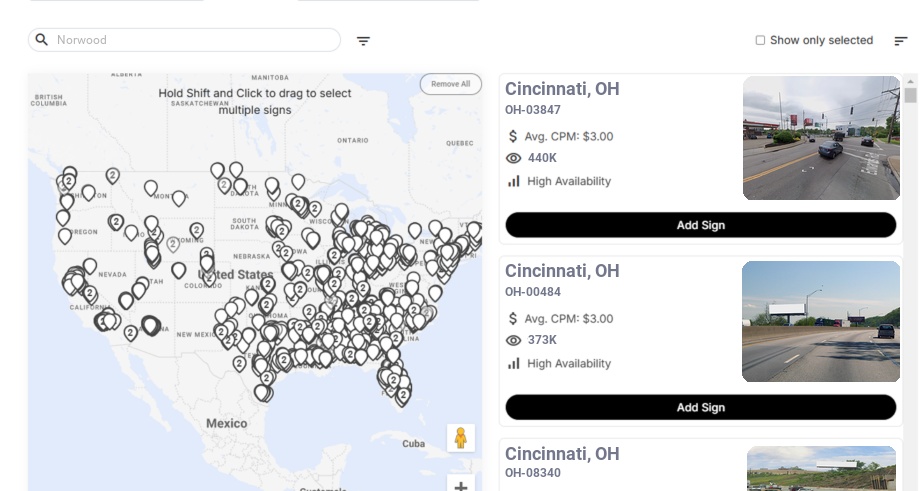



How much is a billboard near Norwood?
Why Choose Blip for Billboard Advertising near Norwood
Blip lets you launch Norwood billboards fast on I-71, I-75, and the Norwood Lateral—right where Cincinnati commuters pass daily.
Set a flexible budget in Norwood and only pay for the blips you run, ideal for testing Rookwood, Oakley, and Hyde Park traffic.
Use dayparting on Blip to hit Norwood commuters at 6–9 a.m., lunch, or 4–7 p.m. when traffic peaks on Montgomery and Smith Roads.
No contracts means you can boost Norwood ads for Bengals, Reds, or holiday shopping traffic, then pause when demand slows.
Track your Norwood campaign in real time and shift spend toward the boards and times driving the most action near downtown Cincinnati.
Blip's creative tools make it easy to tailor Norwood ads for renters, young families, and Rookwood shoppers with clear, local calls to action.
Frequently Asked Questions About Billboard Advertising near Norwood
How much does a billboard cost near Norwood, Ohio with Blip?
With Blip, you control exactly what you spend on Norwood billboards by setting a daily budget that fits your business and adjusting it anytime. Each “blip” is a brief 7.5 to 10-second ad on digital billboards near Norwood, Ohio, and you only pay for the blips you receive, similar to pay-per-click advertising online. The cost per blip changes based on when you choose to run your ads, where the boards are serving the Norwood area, and overall advertiser demand, so you can stretch a small budget or scale up when you’re ready.
Where can I advertise with Blip near Norwood, Ohio?
There are 14 digital billboards near the Norwood area—primarily in nearby Cincinnati just 2.6 miles away. This concentration of billboards near Norwood gives brands an efficient way to extend their Cincinnati reach while staying locally relevant to Norwood residents. We can precision-target local shoppers, workers, and families as they move through some of southwest Ohio’s busiest corridors.
What makes Norwood, Ohio a good market for billboards?
Norwood, Ohio sits at the geographic heart of the Cincinnati region, making it a high-value target for advertisers who want to reach both city commuters and close-knit neighborhood audiences. Norwood is a compact, densely populated inner-ring suburb surrounded on nearly all sides by Cincinnati. The city’s population is just over 19,000 residents packed into about 3 square miles, which translates to roughly 6,500 residents per square mile.
What traffic corridors should I target for Norwood, Ohio billboards with Blip?
The Norwood area is ringed by high-traffic roadways. I-71 carries an estimated 150,000–165,000 vehicles per day near the Norwood area, State Route 562 typically ranges from about 70,000 to 90,000 vehicles, and I-75 near Cincinnati often exceeds 170,000 vehicles per day. Major surface streets that feed Norwood, like Montgomery Road, Smith Road, and Edwards Road, each carry tens of thousands of vehicles daily.
When is the best time to run Blip ads near Norwood, Ohio?
By using Blip’s dayparting, we can concentrate impressions on morning drive from 6–9 a.m. to reach Norwood-area commuters heading into Cincinnati. Lunchtime from 11 a.m.–1 p.m. can influence local workers and shoppers near retail corridors, and evening drive from 4–7 p.m. is a strong time when residents return to the Norwood area. On game days and festival weekends, we can dial up your Blip schedules on game routes to intercept Norwood-area fans traveling downtown.
Do I need a contract to advertise with Blip near Norwood?
No, Blip has no long-term contracts or minimum commitments. You can start, pause, or stop your campaign at any time.
How fast can I launch a billboard campaign with Blip near Norwood?
You can have your campaign live in minutes. Create a free account, select your locations, set your budget, upload your design, and start running once approved.
Where can I advertise with Blip near Norwood?
Blip has digital billboards near Norwood. You can browse available locations on a map, choose the ones that fit your audience, and start advertising right away.
Still have questions? Launch a campaign in minutes — no contracts, no commitments.
Start Your CampaignNorwood Billboard Advertising Guide
Norwood, Ohio sits at the geographic heart of the Cincinnati region, making it a high-value target for advertisers who want to reach both city commuters and close-knit neighborhood audiences. With 14 digital billboards near the Norwood area—primarily in nearby Cincinnati just 2.6 miles away—we can precision-target local shoppers, workers, and families as they move through some of southwest Ohio’s busiest corridors. This concentration of billboards near Norwood gives brands an efficient way to extend their Cincinnati reach while staying locally relevant to Norwood residents.
Understanding the Norwood Market
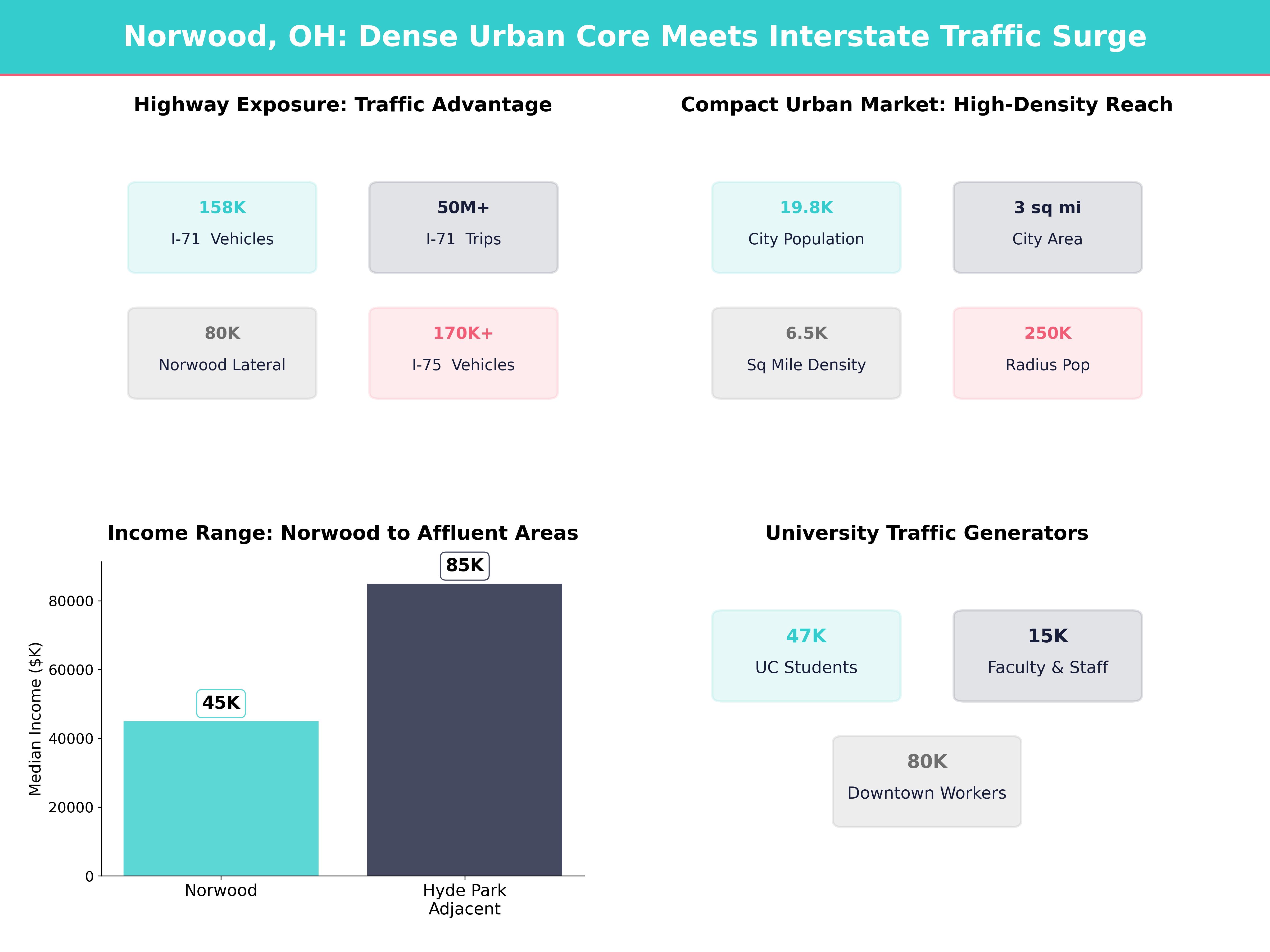
Norwood is a compact, densely populated inner-ring suburb surrounded on nearly all sides by Cincinnati. The city’s population is just over 19,000 residents (around 19,800 in recent city population estimates) packed into about 3 square miles, which translates to roughly 6,500 residents per square mile—more than double the overall density of the Cincinnati metro. Median age is in the low 30s (about 33–34 years), meaning a strong mix of young professionals, young families, and long-term residents.
Housing in Norwood skews younger and more mobile than many suburbs: local housing and planning summaries report that around 55–60% of occupied units are renter-occupied, and roughly 65–70% of units are in multi-family or small multi-unit structures. This creates a consistently renewing audience for apartments, telecom, retail, and service offers that can be reached efficiently with Norwood billboards and other nearby media.
The Norwood area is also an employment hub. Major employers like the Rookwood Commons & Pavilion retail district, medical offices, and light industrial operations draw in workers from all over Hamilton County each weekday. Hamilton County as a whole supports more than 540,000 jobs according to recent county economic snapshots, and a significant share of those jobs are clustered within a 10–15 minute drive of Norwood. Being less than 7 miles from downtown Cincinnati, the Norwood area sits in the flow between suburban neighborhoods to the north and the downtown core to the south, which makes billboard advertising near Norwood especially effective for brands that want to intercept both commuters and destination shoppers.
Key regional context for advertisers:
- The Cincinnati metro area has roughly 2.2–2.3 million people; recent regional planning estimates put the 15-county Cincinnati-Middletown-Wilmington region at around 2.28 million residents. The City of Cincinnati itself has about 310,000 residents.
- The Norwood city footprint is small—about 3 square miles—but dense residential blocks combined with high-intensity commercial corridors mean that this compact area generates disproportionate daily vehicle and foot traffic.
- The Norwood area is bisected or bordered by multiple interstates and state routes that rank among Hamilton County’s heaviest-traveled corridors.
Transportation and planning resources from Hamilton County, Ohio, the City of Norwood, the City of Cincinnati, and the OKI Regional Council of Governments all reinforce Norwood’s role as a central connector between downtown, university districts, and northern suburbs.
All of this makes digital out-of-home a strong channel for building awareness and driving action near Norwood, especially when combined with Blip’s flexibility in timing and budgeting. Industry studies from the Out of Home Advertising Association of America (OAAA) indicate that digital out-of-home can increase mobile search activity by 38–50% when consumers are exposed to nearby digital boards, and around 66% of drivers report taking some action (search, website visit, in-store visit) after seeing an OOH ad—useful benchmarks when you’re evaluating the performance of billboard advertising near Norwood.
Key Corridors and Traffic Patterns Near Norwood
To build an effective campaign, we want to align our message with where and when people are actually driving.
The Norwood area is ringed by high-traffic roadways:
- I-71 (just south and east of Norwood) carries an estimated 150,000–165,000 vehicles per day near the Norwood area, connecting downtown Cincinnati to suburban communities like Kenwood and Mason. Over the course of a year, that’s well over 50 million vehicle trips passing near Norwood.
- State Route 562 (the Norwood Lateral) runs east–west across the northern edge of Norwood, linking I-71 and I-75. Average daily traffic on the Norwood Lateral typically ranges from about 70,000 to 90,000 vehicles, equating to roughly 25–30 million annual vehicle trips.
- I-75, just west of Norwood, is one of Ohio’s heaviest-traveled interstates, with segments near Cincinnati often exceeding 170,000 vehicles per day. This means more than 60 million annual vehicles on a corridor that many Norwood-area residents and commuters use.
- Major surface streets that feed Norwood, like Montgomery Road, Smith Road, and Edwards Road, each carry tens of thousands of vehicles daily, especially near retail hubs like Rookwood and nearby Oakley and Hyde Park business districts.
The Ohio Department of Transportation’s traffic counts for Hamilton County corridors (available via ODOT’s traffic data resources Metro/SORTA also note that tens of thousands of daily transit riders and car commuters move through or adjacent to the Norwood area along these same corridors.
Because our 14 digital boards serving the Norwood area are located in nearby Cincinnati, we can position your message on approaches that Norwood-area drivers routinely use:
- Commuters heading from Norwood-area neighborhoods toward downtown Cincinnati in the morning on I-71 and local arterials. Downtown Cincinnati’s job base includes more than 80,000 workers on a typical weekday, many of whom reside in Norwood or adjacent neighborhoods.
- Shoppers and diners heading toward Rookwood Commons & Pavilion, Hyde Park, Oakley, and nearby retail clusters on evenings and weekends. Rookwood alone hosts more than 70 stores and restaurants and attracts thousands of visitors on peak days.
- Workers traveling to and from job centers in downtown Cincinnati, the University of Cincinnati area (which enrolls more than 47,000 students and employs over 15,000 faculty and staff), and the medical corridor anchored by major health systems and clinics.
By using Blip’s dayparting, we can concentrate impressions on:
- Morning drive (6–9 a.m.) to reach Norwood-area commuters heading into Cincinnati; regional counts often show 35–40% of daily traffic on key interstates occurring during morning and evening peaks.
- Lunchtime (11 a.m.–1 p.m.) to influence local workers and shoppers near retail corridors, when restaurant and QSR locations capture a large share of their daily transactions.
- Evening drive (4–7 p.m.) when residents return to the Norwood area and may be more receptive to retail, dining, and service offers; for some advertisers, 40–60% of daily in-store sales are concentrated after 4 p.m.
Demographics and Buyer Profiles in the Norwood Area
The Norwood area combines urban accessibility with neighborhood stability, creating a varied but targetable audience.
Key demographic signals (from recent local and regional summaries):
- Population: Just over 19,000 residents in the Norwood city limits, with more than 75,000 additional residents in adjacent Cincinnati neighborhoods like Hyde Park, Oakley, Evanston, and Pleasant Ridge. Within a 5-mile radius of Norwood, the total population exceeds 250,000.
- Age: Median age in Norwood is around 33–34. Roughly 30–35% of residents fall into the 25–44 working-age range, a prime target for consumer brands, apartments, and services. Another 20–25% are under age 20, supporting family-oriented messaging.
- Households: Norwood contains roughly 9,000–10,000 households, with an average household size just under 2.3 people. About 55–60% of occupied housing units are renter-occupied, and multi-unit buildings make up a majority of the housing stock in several census tracts near Rookwood and the Norwood Lateral.
- Income: Household incomes in the Norwood area and nearby Cincinnati neighborhoods are diverse. Local economic profiles show median household income in Norwood in the mid-$40,000s to low-$50,000s, while nearby areas like Hyde Park and parts of Oakley often report median household incomes above $80,000–$90,000. This supports both value-focused messaging and premium-positioned brands within a short drive.
- Education & employment: With the University of Cincinnati and Xavier University (about 5,000 undergraduate and 2,000+ graduate students) just a few miles away, there is a strong presence of college-educated professionals and students traveling through or near the Norwood area daily. Regional data show that more than 35–40% of adults in nearby neighborhoods hold a bachelor’s degree or higher. Employment is spread across healthcare, retail, education, manufacturing, logistics, and professional services.
Local government and community data from the City of Norwood (norwoodohio.gov) and the City of Cincinnati (cincinnati-oh.gov) underscore the area’s importance as a central hub in the region’s transportation and housing network. Economic development materials from the Cincinnati USA Regional Chamber
From a billboard strategy perspective, this mix implies:
- Strong potential for QSR, grocery, and retail campaigns targeting busy younger households and renters who tend to eat out more frequently and respond to convenience offers.
- High responsiveness to apartment communities, home services, and automotive offers, since many residents rent, own older homes, and commute by car. In Hamilton County, more than 85% of workers commute by personal vehicle, making roadside placements especially impactful.
- Solid opportunity for education, healthcare, and financial services given the concentration of working professionals and nearby campuses, along with thousands of daily trips between Norwood and university/medical districts.
Norwood Area Events, Seasons, and Timing Your Campaign
The Norwood area sees noticeable seasonal and event-driven traffic that we can leverage.
Seasonal patterns
- Fall (August–November): Back-to-school and college semester starts for nearby institutions like the University of Cincinnati and Xavier University (combined enrollment of roughly 55,000–60,000 students). Student, faculty, and staff traffic increases significantly along I-71, Montgomery Road, and the Norwood Lateral. Ideal for housing, transit, telecom, and fast-casual dining.
- Holiday season (November–December): Rookwood Commons & Pavilion and nearby shopping destinations become regional magnets. Visit Cincy and local retail associations report that the Cincinnati region welcomes tens of thousands of additional shoppers per day on peak December weekends, with total annual visitor spending in the region topping $5–6 billion. Retailers, restaurants, and entertainment venues can see double-digit percentage uplifts in sales compared to non-holiday months when paired with strong promotions.
- Spring and early summer (April–June): Home services, landscaping, remodeling, and automotive campaigns align with tax refunds and moving season. Many leases in the Norwood/Cincinnati area turn over in May–August, and home-improvement retailers typically see 15–25% sales bumps in spring compared to winter baselines.
- Summer (June–August): Events, attractions, and tourism across the Cincinnati region see increased traffic, as highlighted on the regional tourism site Visit Cincy. Recent tourism reports cite more than 26 million annual visits to the Cincinnati region, with summer months among the most active for downtown events, riverfront festivals, and ballgames.
Local and regional events
High-profile events in the Cincinnati area draw residents from the Norwood area onto regional highways:
- Cincinnati Reds games at Great American Ball Park. In recent seasons, the Reds have attracted around 1.5–2.0 million fans per year, averaging roughly 20,000–25,000 attendees per home game.
- Cincinnati Bengals games at Paycor Stadium. NFL games often draw 65,000–67,000 fans per home date, creating heavy pre- and post-game traffic on I-71, I-75, and central arterials.
- Cultural festivals and arts events covered by local media such as the Cincinnati Enquirer and WCPO 9 News (wcpo.com), as well as other local outlets like WLWT 5, FOX19 NOW, and Local 12/WKRC.
On game days and festival weekends, we can dial up your Blip schedules on game routes (I-71, I-75, and central arterials) to intercept Norwood-area fans traveling downtown. Traffic counts around major riverfront events can spike 15–30% above typical weekend volumes, so carefully timed billboard advertising near Norwood and downtown can capture a surge of regional demand.
With Blip, you can:
- Increase bids and impression frequency on specific dates (e.g., during major shopping weekends, Reds/Bengals home games, or local festivals).
- Temporarily pause or reduce spend on lower-traffic holidays not relevant to your offer (for example, some midweek federal holidays when office commuter volume drops).
- Run short, intense “burst” campaigns—such as a 3-day push for a festival or a 7-day countdown to a store opening near the Norwood area—to mirror the 7–14 day awareness window when residents are most likely to make plans.
Creative Best Practices for Reaching the Norwood Area
Traffic speeds on interstates around the Norwood area can be 55–65 mph, so simplicity and clarity are critical. National OOH research shows that drivers typically have 5–8 seconds of view time on a standard billboard at highway speeds, and recall drops sharply when ads exceed about 10 words.
Design for fast comprehension
- Word count: Aim for 6–9 words total. Keep it readable in 2 seconds.
- Font size: Use large, bold type. Avoid thin fonts and wordy taglines; legibility testing indicates that thick sans-serif fonts can improve readability by 20–30% at a distance.
- Contrast: High contrast (e.g., white or yellow on dark background) works best against varying light conditions, especially on digital boards that rotate every 6–10 seconds.
- One clear call-to-action: “Exit at Rookwood,” “Call Today,” or “Visit NorwoodLocation.com” works better than multiple options. Single-focus CTAs consistently outperform multi-CTA designs in recall and response studies.
Make it locally relevant
The Norwood area has a strong sense of local identity and neighborhood pride. You can increase relevance by:
- Mentioning nearby landmarks: “Minutes from Rookwood Commons,” “Just off the Norwood Lateral,” or “Across from Xavier University.”
- Highlighting local benefits: “Serving Norwood families since 1995,” “Trusted by Norwood-area homeowners,” or “Proud Partner of Cincinnati Schools.”
- Featuring familiar visuals: Skyline views, Cincinnati landmarks, or subtle nods to local sports teams (within trademark rules) can make an ad feel more “for us” instead of generic. Localized creative can improve message relevance and action intent by 15–20% in many OOH studies.
Match the message to the commute
- Morning commute: Emphasize solutions and planning—coffee shops, breakfast deals, financial services, job openings, and appointment bookings. Many commuters decide where to stop for breakfast or coffee within 1–2 miles of their route.
- Midday: Focus on lunch, errands, retail, and healthcare (e.g., “Walk-in clinic open today”). Lunchtime decision windows are short—often under 30 minutes—so proximity messaging (“5 minutes away”) is powerful.
- Evening: Highlight dinner, entertainment, grocery, gyms, and home services—anything people might choose on their way home to the Norwood area. For many local businesses, 40–60% of weekday revenue is captured between 4 p.m. and 8 p.m.
With Blip, you can upload multiple creatives and rotate them based on time of day. For example:
- 6 a.m.–10 a.m.: “Norwood-area commuters: Coffee on your way downtown – Exit at [Your Location].”
- 11 a.m.–2 p.m.: “Lunch near Rookwood? 10% off with code LUNCH.”
- 4 p.m.–8 p.m.: “Norwood families: Dinner done in 10 minutes – Order ahead.”
Using Blip’s Flexibility to Target the Norwood Area
Our 14 digital billboards serving the Norwood area give you a wide range of placements around Cincinnati. With Blip, you buy “blips” (individual ad plays) instead of fixed-time slots, allowing full control over where, when, and how often your message appears. This structure functions like on-demand billboard rental near Norwood: you decide how much to spend, which boards to use, and when your ads run.
On a typical digital board, an individual blip may appear for 6–10 seconds within a loop that repeats every 60–90 seconds. This means that even a modest buy of a few hundred blips per day can translate into thousands of impressions when traffic volumes are high.
Key tactics for this market:
1. Geo-focused board selection
- Prioritize boards along I-71, I-75, and key arterials that are commonly used by Norwood-area drivers commuting between neighborhoods, downtown Cincinnati, and shopping centers. These routes can collectively account for more than 400,000 vehicle trips per weekday across multiple segments.
- Add boards that sit near large destinations like downtown Cincinnati, university districts, or major retail corridors, since many Norwood-area residents travel there several times per week. Visitor data from downtown Cincinnati show millions of annual visits to attractions, office towers, and riverfront venues.
Because the Norwood area is just 2.6 miles from many of our Cincinnati boards, you can effectively surround your core audience without needing placements directly inside Norwood’s small footprint. This proximity makes digital billboard rental near Norwood especially efficient compared to campaigns in more sprawling suburbs.
2. Dayparting and day-of-week control
- Use weekday-focused schedules to reach workers and commuters. Monday–Friday tends to account for 65–70% of weekly traffic on major work corridors.
- Add weekend-heavy schedules for restaurants, retail, and entertainment when Norwood-area households are more flexible and likely to shop. Many malls and destination retail centers see 40–50% of weekly foot traffic on Saturday and Sunday.
- Split-test weekday vs. weekend performance by running one creative only on weekdays and a variation on weekends, then comparing response in your sales or website analytics. A 10–20% variance in performance by daypart is common and can guide reallocation.
3. Budget pacing and optimization
- Start with a modest daily budget to establish baseline performance—e.g., $10–$30 per day concentrated on high-priority commuting periods. For many advertisers, this can generate thousands of daily impressions across the 14-board network.
- Increase spend during key seasons (back-to-school, holidays, tax refund season) or events relevant to your category. For example, regional retail sales during November–December can run 20–30% higher than the annual monthly average.
- If you see high performance from specific time windows (for example, online orders or store visits spike after 4 p.m.), shift more of your blips into that window. Even moving 20–30% of impressions into your best-performing times can yield noticeable ROI gains.
Strategy Ideas by Business Type in the Norwood Area
To make this practical, here are sample approaches for common advertiser types whose customers live or work in the Norwood area.
Retail and Shopping Centers
Norwood sits near major retail anchors at Rookwood and in nearby Cincinnati neighborhoods.
Strategy:
- Use boards on I-71 and local arterials approaching your location, especially where daily traffic exceeds 40,000–60,000 vehicles.
- Promote limited-time offers (“This Weekend Only – 20% Off at Rookwood”) with a clear directional cue. Limited-time promotions can increase short-term sales by 10–25% when combined with high-visibility media.
- Concentrate impressions Thursday–Sunday and during midday and evening, when retail foot traffic is highest. Many centers record up to 60% of weekly visits from Thursday evening through Sunday.
- Leverage prominent Norwood billboards and nearby placements in Cincinnati to reinforce store openings, relocations, or seasonal sales across your full local trade area.
Restaurants and QSR
The Norwood area’s large working and commuting population is ideal for dining campaigns.
Strategy:
- Target morning drive with breakfast and coffee offers; midday for lunch; early evening for dinner carry-out and delivery. Industry benchmarks show that 40–50% of QSR transactions occur at lunch and 30–40% at dinner.
- Use short, simple creatives: “Exit Now – Pizza in 10 Minutes” or “Lunch $9.99 – 5 Minutes from Norwood.”
- Run higher frequency during sports seasons and local events when social outings increase. On Bengals or Reds home game days, nearby bars and restaurants can see 20–40% revenue lifts compared to non-game days.
Home Services and Contractors
Older housing stock in and around the Norwood area means ongoing demand for repairs and improvements. Many area homes were built before 1970, and older structures are more likely to need roofing, HVAC, plumbing, and electrical upgrades.
Strategy:
- Advertise consistently across weekdays and weekends to stay top-of-mind when issues arise (roofing, HVAC, plumbing). Homeowners typically contact the first 2–3 providers they recall when an emergency occurs.
- Feature simple trust signals: “Serving the Norwood area for 25 years,” “4.9-star rated, 24/7 emergency.” Including trust cues can improve response rates by 10–15% in service categories.
- Include a memorable phone number or short URL. Short domains and phone numbers with patterns (e.g., repeating digits) have higher recall in OOH environments.
- Use billboard advertising near Norwood to highlight fast response times and local presence so that nearby homeowners associate your brand with quick, convenient service.
Healthcare and Clinics
Proximity to major hospitals and clinics in Cincinnati makes the Norwood area a strong healthcare catchment.
Strategy:
- Promote walk-in hours, urgent care, dental, and specialists with time-sensitive messaging (“Open Today Until 8 p.m.”). Many urgent care centers see 50–60% of daily visits after 3 p.m., aligning with commute-driven demand.
- Focus on boards along routes between Norwood-area neighborhoods and your facility, especially near I-71, the Norwood Lateral, and Montgomery Road.
- Use calm, clear visuals and emphasize convenience and insurance acceptance. “Most Insurance Accepted” and “Same-Day Appointments” are high-performing phrases in healthcare OOH.
Local Events, Schools, and Nonprofits
Community organizations serving the Norwood area can use digital billboards for awareness and attendance.
Strategy:
- Run short bursts 7–14 days before an event. Event marketers often see the majority of ticket sales in the final two weeks, so concentrated exposure can be powerful.
- Use countdown language (“3 Days Until Norwood-area Community Festival”) and a simple URL.
- Target evenings and weekends to align with leisure planning. For school-related campaigns (open houses, enrollment), emphasize early evenings on weekdays when families are home.
Integrating Billboards with Your Other Marketing
Digital billboards near the Norwood area work even better when integrated with your other channels.
- Search & social: Use the same key phrases on your billboard and in your Google/Facebook campaigns. If your board says “Norwood-area Roof Repair,” make sure you bid on that term and similar local queries. Multi-channel consistency can lift ad recall by 20–30%.
- Landing pages: Create simple, memorable URLs tied to your billboard (“BrandName.com/Norwood”) and track traffic and conversions. Monitor sessions from key ZIP codes surrounding Norwood (such as 45212 and nearby Cincinnati ZIPs) to gauge local reach.
- Promo codes: Use simple, billboard-specific codes (e.g., “NORWOOD10”) to see how many redemptions your campaign drives. Even a 3–5% redemption rate on a billboard-specific offer can signal strong performance.
- Local PR and sponsorships: Reinforce your presence by appearing in community coverage from outlets like the Cincinnati Enquirer and WCPO, and by leveraging local listing and event calendars through the City of Norwood and regional resources like Visit Cincy. Sponsoring local school events, youth sports, or neighborhood festivals and echoing that sponsorship on your billboard (“Proud Sponsor of Norwood Youth Sports”) can strengthen local brand perception and complement your billboard rental near Norwood.
Measuring and Refining Your Norwood-Area Campaign
To get the most from your spend:
-
Set clear goals
Decide if you’re aiming for brand awareness (impressions) or measurable actions (calls, visits, online orders). As a benchmark, a well-targeted digital OOH campaign can deliver tens of thousands of impressions per day in a market like Norwood/Cincinnati, depending on budget and board selection. -
Track locally relevant metrics
- Website traffic from ZIP codes near the Norwood area.
- Store traffic and sales lifts on days/times when your blips run; look for 5–15% uplifts compared to similar periods without billboards.
- Phone calls or form fills tied to billboard-specific numbers or URLs. Even a modest conversion rate (e.g., 1–3% of exposed audience taking action) can yield strong ROI for high-value services.
-
Adjust by time and message
- If evening ads outperform mornings by, say, 20–30% in call volume or online orders, shift more blips later in the day.
- Test two creatives: one that emphasizes price and another that emphasizes quality or convenience; keep whichever drives better business results. Continuous A/B testing can improve campaign efficiency by 10–20% over time.
-
Plan around known peaks
- Align heavy campaigns with tax refund season, back-to-school, and holiday shopping, when consumer spending naturally rises.
- Use short, intensive “takeover” periods during major regional events that pull heavy traffic past your chosen boards—such as Bengals home games, Reds opening week, or large festivals promoted on Visit Cincy and local news outlets.
By combining the Norwood area’s dense residential base, strong commuting patterns, and central location in the Cincinnati region with Blip’s flexible digital inventory nearby, we can build highly targeted, cost-effective campaigns that reach people at precisely the moments they are most likely to act. Thoughtful use of billboards near Norwood—backed by smart scheduling, creative, and measurement—can turn everyday traffic flows into a steady stream of new customers for your business.