Billboards in Orrville, OH
No Minimum Spend. No Long-Term Contracts. Just Results.
Trusted by Leading Brands


Billboard advertising
in Orrville has never been easier



How much is a billboard in Orrville?
Why Choose Blip for Billboard Advertising in Orrville
Launch fast in Orrville with Blip’s self-serve platform and reach U.S. 30 commuters in minutes.
Use flexible budgets in Orrville to test SR 57 daily repeat traffic without long-term commitment.
Daypart Orrville campaigns for 6-9 a.m. and 3-7 p.m. commutes, then shift spend as traffic changes.
No contracts with Blip means Orrville businesses can scale up for Wayne County school, hospital, and hiring seasons.
Track Orrville results in real time and optimize for Wooster-bound shoppers, Canton traffic, or weekend Amish Country visitors.
Create sharper Orrville billboards with Blip’s creative tools, built for gray-weather contrast and quick reads on U.S. 30.
Frequently Asked Questions About Billboard Advertising in Orrville
How much does a billboard cost in Orrville with Blip?
With Blip, billboard advertising in Orrville is built to fit your budget. You choose a daily spend, and Blip only charges you when your ad actually appears as a 7.5-to-10-second “blip” on a rotating digital billboard, starting at just $0.01 per display. Because pricing is dynamic, the cost per blip can change based on time of day, location, and advertiser demand, while Blip’s algorithm works to get you the best reach for your budget.
Where can I advertise with Blip in Orrville, Ohio?
The U.S. 30 corridor around Orrville and nearby Dalton generally runs in the 20,000 to 30,000 AADT range on key segments, making it the highest-impact east-west corridor for most regional campaigns. State Route 57 is Orrville’s local spine and one of the most useful roads for repetition, with traffic commonly around 7,000 to 12,000 AADT on town-adjacent segments. Many Orrville residents also travel west into Wooster, where busier commercial stretches of U.S. 250 and State Route 3 often rise above 15,000 AADT.
What makes Orrville a good billboard market for Blip?
Orrville gives us a strong billboard market because it combines a stable hometown customer base with regional traffic that extends well beyond the city limits. Orrville had 8,475 residents in 2020, but the practical ad market is much larger because Wayne County has more than 116,000 residents and daily movement is overwhelmingly car-based. Stable communities usually reward frequency, familiarity, and trust, which are exactly the strengths of digital out-of-home.
When is the best time to run billboard ads in Orrville, Ohio with Blip?
Commuters are the core billboard audience in Orrville, and the most consistent viewing windows are 6 to 9 a.m. and 3 to 7 p.m. Spring, roughly March through May, is one of the best times for home services, lawn and garden, tax preparation, healthcare checkups, and graduation-related offers. Fall is powerful in Orrville because it layers routine and event traffic together, and from late August through November school is back in session and Friday-night sports return.
Who can Blip help reach with billboard advertising in Orrville?
Orrville supports more than one category, so we can market healthcare, financial services, colleges, restaurants, churches, community events, home services, automotive businesses, and hiring campaigns without relying on a single tourism spike. Commuters, families, students, and tourists all move through the area, and that gives digital billboards more chances to generate memory and response. The area also includes education and healthcare anchors such as The University of Akron Wayne College and Aultman Orrville Hospital.
Do I need a contract to advertise with Blip in Orrville?
No, Blip has no long-term contracts or minimum commitments. You can start, pause, or stop your campaign at any time.
How fast can I launch a billboard campaign with Blip in Orrville?
You can have your campaign live in minutes. Create a free account, select your locations, set your budget, upload your design, and start running once approved.
Where can I advertise with Blip in Orrville?
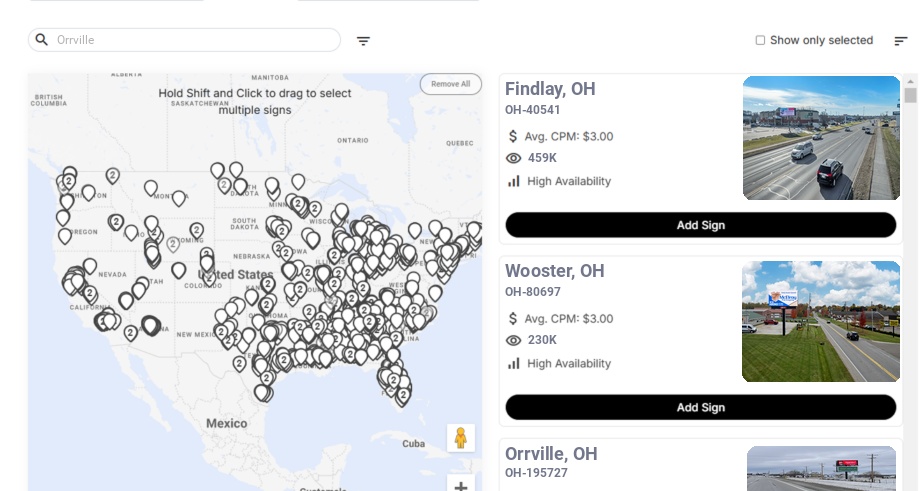
Blip has digital billboards in Orrville. You can browse available locations on a map, choose the ones that fit your audience, and start advertising right away.
Still have questions? Launch a campaign in minutes — no contracts, no commitments.
Start Your CampaignOrrville Billboard Advertising Guide
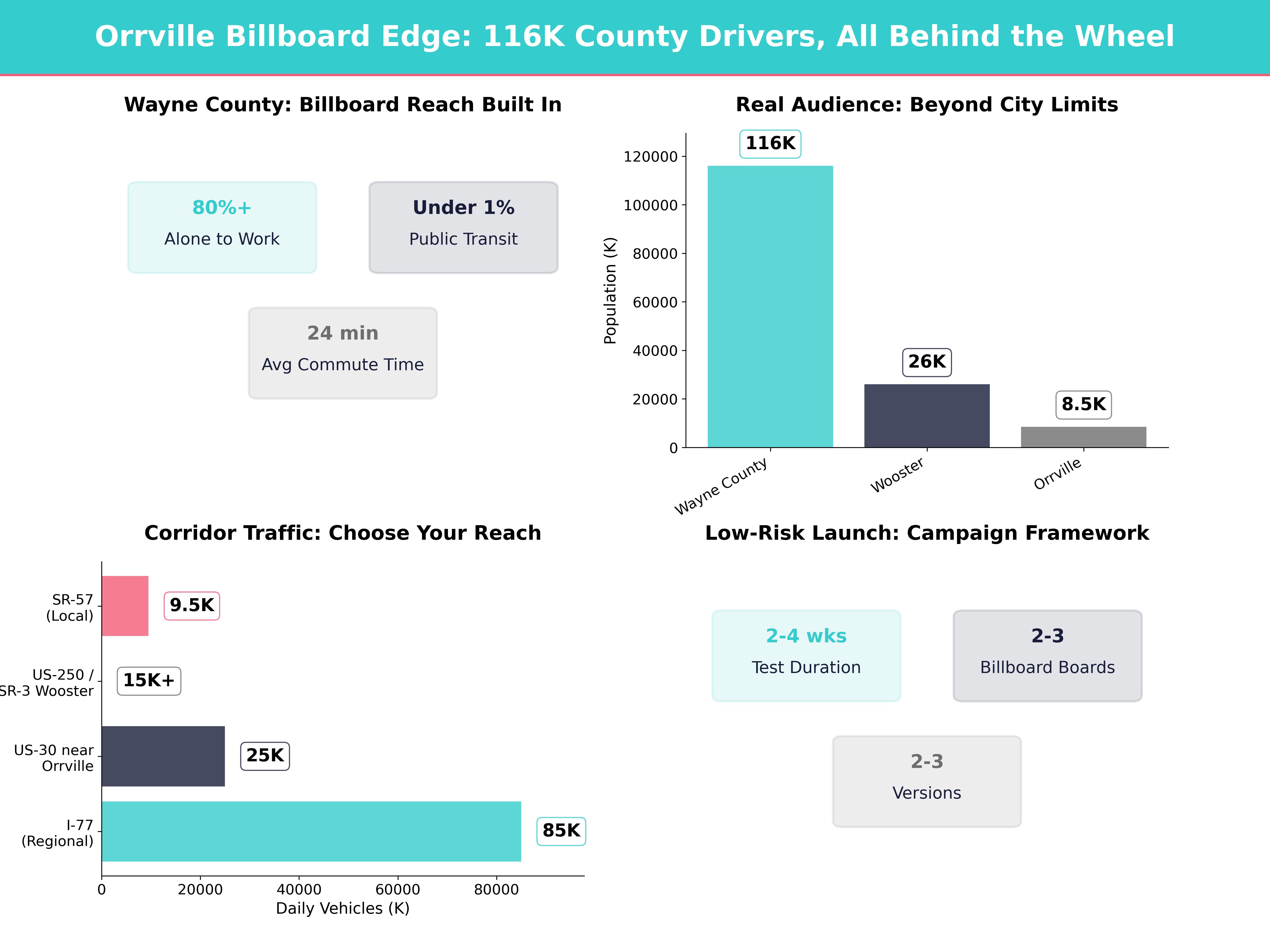
Orrville Orrville 8,475 residents in 2020, but the practical ad market is much larger because Wayne County 116,000 residents and daily movement is overwhelmingly car-based, with more than 80% of workers driving alone and average commute times around 24 minutes.
Orrville Market Overview
Orrville's size, trade area, and regional pull
When we advertise in Orrville, we are not buying only a city of 8,475 people. We are buying into a regional trade area that includes more than 116,000 residents in Wayne County 26,000 residents in nearby Wooster, and steady east-west movement toward Massillon Canton Akron-Canton corridor, including U.S. 30 traffic that commonly runs in the 20,000 to 30,000 AADT range near Orrville. Orrville is roughly 25 miles west of Canton, which means local campaigns can also function as regional reminder advertising for brands that serve a wider radius.
Orrville is not a boomtown, and that is often a benefit for billboard advertisers. Stable communities usually reward frequency, familiarity, and trust, which are exactly the strengths of digital out-of-home. We can build recall among the same households, the same commuters, and the same shoppers week after week instead of chasing a constantly changing audience.
Demographics, commuting, and what they mean for billboard reach
Wayne County is highly auto-dependent. Household and commute estimates consistently show that more than 80% of workers drive alone, several more percentage points carpool, and public transit use sits well below 1%. Average travel time to work is around 24 minutes, which is long enough for repeated route-based exposure and short enough that directional messages such as “Next Exit,” “10 Minutes Ahead,” or “In Wooster Today” still feel immediately actionable.
That commute pattern matters in Orrville because people routinely move between communities for work, school, healthcare, and shopping. A local resident may live in Orrville, work near Wooster Community Hospital, attend classes at The University of Akron Wayne College
Orrville's economic base and advertiser fit
Orrville's economy is anchored by practical, year-round industries rather than one narrow seasonal engine. The J. M. Smucker Company has been headquartered in Orrville since 1897, and the surrounding area also includes manufacturers such as The Will-Burt Company Seaman Corporation, healthcare providers such as Aultman Orrville Hospital, and education centers including The University of Akron Wayne College The College of Wooster enrolling roughly 2,000 students, Ohio State ATI with about 550 students, and Ohio State Wooster.
For advertisers, that means Orrville supports more than one category. We can market healthcare, financial services, colleges, restaurants, churches, community events, home services, automotive businesses, and hiring campaigns without relying on a single tourism spike. We also benefit from a local culture that values practicality, reliability, and clear offers.
Key Traffic Corridors for Orrville Billboard Campaigns
Orrville’s travel patterns are shaped by a small set of roads that matter far more than the city’s population alone might suggest. When we understand those corridors, we can match billboard placements to actual travel behavior instead of guessing.
U.S. 30 in the Orrville market
According to traffic maps from the Ohio Department of Transportation U.S. 30 corridor around Orrville and nearby Dalton 20,000 to 30,000 AADT range on key segments. That makes it the highest-impact east-west corridor for most regional campaigns.
This route is especially effective for advertisers that benefit from broad reach and directional intent. Restaurants, convenience stores, auto dealers, healthcare systems, retailers, banks, and colleges all benefit here because travelers are already moving between communities and often making planned stops. If we want to pull customers from Orrville toward Wooster or from western Wayne County toward Canton, U.S. 30 is usually the first corridor we evaluate.
State Route 57 through Orrville and toward Wooster
State Route 57 is Orrville’s local spine and one of the most useful roads for repetition. ODOT counts on this corridor commonly land around 7,000 to 12,000 AADT on town-adjacent segments, which is lower than U.S. 30 but often better for high-frequency local impressions.
This corridor works well for advertisers that want to stay close to everyday decision-making. Grocery stores, urgent care clinics, dental offices, insurance agencies, gyms, quick-service restaurants, churches, and local service businesses often perform best when they appear on the road people use multiple times per week. If our goal is hometown familiarity rather than broad regional reach, SR 57 deserves serious attention.
Wooster retail connectors, including U.S. 250 and State Route 3
Many Orrville residents travel west into Wooster for shopping, healthcare, events, and education. On busier commercial stretches of U.S. 250 and State Route 3 in Wooster, traffic volumes often rise above 15,000 AADT, especially near major retail and medical areas.
That matters because the Orrville market is not isolated. A business based in Orrville may still need awareness in Wooster, and a Wooster business may want to pull customers from Orrville. Billboards on these western connectors are especially strong for hospitals, colleges, apparel retailers, grocery chains, specialty food, entertainment, and household services.
I-77 and the Canton-Akron approach
If we need reach beyond Wayne County, the eastbound path toward Canton and Akron becomes important. On many segments of I-77 through the Canton 70,000 AADT and can climb above 100,000 AADT in denser stretches.
We do not need I-77 for every Orrville campaign, but it becomes valuable when we want to support regional entertainment, airport-related offers, destination retail, or large event messaging. Brands tied to the Pro Football Hall of Fame, Akron-Canton Airport, or Canton-area shopping can use these boards to expand beyond the immediate Wayne County footprint.
Audience Segments We Can Reach in Orrville
Orrville commuters and shift workers
Commuters are the core billboard audience in Orrville. With solo driving above 80% and average commute times around 24 minutes, the area naturally creates repeated roadside exposure. We can reach first-shift manufacturing workers, hospital employees, educators, office commuters, and service technicians during the most consistent viewing windows of 6 to 9 a.m. and 3 to 7 p.m.
This is one reason hiring campaigns often work well in the Orrville area. Employers can speak directly to workers already traveling between Orrville Wooster, Rittman, Dalton Canton
Orrville families, parents, and household decision-makers
Orrville is a family-oriented market. Parents move around the community for school drop-offs, sports, shopping, medical appointments, and church activity tied to Orrville City School District, Wooster City Schools, and the Wayne County Schools Career Center. The school-year rhythm from August through May creates steady weekday traffic, while sports and extracurriculars keep evenings active.
For this audience, billboards perform best when they answer practical questions. We usually see stronger resonance from messages about value, convenience, safety, family fun, seasonal services, and trusted local providers. “Open late,” “Same-day appointments,” “Near U.S. 30,” and “Locally trusted” are more aligned with the market than flashy urban-brand language.
Students and education audiences around Orrville
Orrville has more educational influence than many towns its size because The University of Akron Wayne College The College of Wooster, Ohio State ATI, and Ohio State Wooster are nearby. That gives us student, faculty, staff, and visiting-family traffic throughout the academic year.
The best timing for education-related billboard campaigns usually falls between October and April for enrollment messaging, and between May and August for orientation, housing, back-to-school retail, and part-time hiring. Restaurants, apartments, banks, wireless providers, and healthcare clinics can all benefit from targeting this audience.
Tourists, shoppers, and regional leisure traffic near Orrville
Orrville also sits close to several leisure draws, within roughly 10 to 30 miles. Weekend travelers explore Ohio's Amish Country, visit destinations such as Lehman's The Ohio Light Opera Pro Football Hall of Fame and Visit Canton attractions. Summer travel is strongest from June through August, and fair-season and harvest traffic add another lift in September.
This audience behaves differently from weekday commuters. Leisure traffic is often heavier from Thursday through Sunday, and it responds well to dining, shopping, lodging, local attractions, farm markets, and event-driven creative.
Seasonal and Timing Opportunities in Orrville
Spring in Orrville
Spring, roughly March through May, is one of the best times for home services, lawn and garden, tax preparation, healthcare checkups, and graduation-related offers. The weather turns, families start planning projects, and school calendars create a natural countdown to prom, commencement, and summer activities.
We should also remember that spring road conditions in northeast Ohio can still be gray and wet. High-contrast creative remains important even after winter ends.
Summer in Orrville
Summer, from June through August, is when Orrville’s regional leisure value really expands. Ohio's Amish Country, Lehman's The Ohio Light Opera
We also like summer for awareness campaigns because days are longer and traffic includes both commuters and discretionary travelers. If we have a weekend-heavy offer, this is a strong season to shift spend toward Thursday, Friday, Saturday, and Sunday.
Fall in Orrville
Fall is powerful in Orrville because it layers routine and event traffic together. From late August through November, school is back in session, Friday-night sports return, and harvest-season travel increases. The Wayne County Fair September creates an especially useful window for food, retail, healthcare, political, and community-event advertisers.
For many advertisers, fall is the best season for frequency. Families settle into repeat patterns, and commuters are back on predictable schedules. If we want billboard exposure to reinforce a multi-week promotion, fall often delivers the cleanest rhythm.
Winter in Orrville
Winter campaigns in Orrville should focus on clarity and urgency. From November through February, we often see strong fit for holiday retail, heating and plumbing services, healthcare, urgent care, financial services, gyms, and post-holiday lead generation. In late December, darkness arrives shortly after 5 p.m., which makes bright, simple digital creative even more important for the evening commute.
Winter also rewards trust-based messaging. In a market like Orrville, advertisers who sound dependable and local often outperform brands that try to be overly clever.
Billboard Design Tips for the Orrville Market
Messaging that feels right in Orrville
Orrville is a practical market with strong community identity, and our creative should respect that. Messages built around trust, value, family use, convenience, quality, and local relevance usually feel more natural here than edgy or ironic copy. The presence of J. M. Smucker, long-running local employers, and community institutions gives the area a culture that responds well to straightforward promises and clear benefits.
We should use local geography when it helps the driver orient quickly. References such as “In Orrville,” “Minutes from Wooster,” “Off U.S. 30,” or “On SR 57” can improve relevance because drivers already think in terms of routes and nearby towns.
Visual choices for Orrville roads and weather
Road speed should shape the design. On faster U.S. 30 placements, we should keep the main message to about 6 to 8 words and emphasize one offer, one brand, and one destination. On slower local roads such as SR 57, we may be able to support 8 to 10 words if the hierarchy is very clear.
Northeast Ohio weather also matters. Orrville experiences many gray days, wet pavement, and early winter darkness, so creative with 2 or 3 dominant colors, strong contrast, and large type tends to hold up better than muted palettes. Deep red, navy, green, black, and white often work well here, especially when paired with simple imagery tied to food, home, family, healthcare, or local service.
Creative approaches that match the audience
For commuters, we should lead with convenience and action. “Now hiring,” “Open today,” “Next exit,” and “Book online tonight” are strong fits. For families, we should emphasize trust, affordability, and ease. For tourists, we should make the destination obvious and the offer immediate.
We should also avoid overcomplicating the billboard. A fast-moving rural and suburban driver will remember a place name, a simple benefit, and a short call to action far more easily than a dense list of features. In Orrville, clarity usually wins.
Regional Strategies Around Orrville
Downtown Orrville and local-frequency strategies
In-town Orrville placements are best when we want repetition with residents who already know the area. These boards work well for community events, healthcare, schools, churches, local restaurants, financial services, and service businesses that draw mostly from the immediate trade area.
This strategy is especially effective when the goal is familiarity rather than long-distance destination pull. If a business serves customers within roughly 5 to 10 miles, local frequency often matters more than chasing the biggest regional traffic count.
U.S. 30 strategies for regional reach from Orrville
When we want scale, we should think in terms of the U.S. 30 corridor first. It gives us east-west movement across Wayne County and into Stark County, which is ideal for hospitals, colleges, event venues, auto dealers, furniture stores, chain restaurants, and destination retail.
For many advertisers, the best Orrville-area plan is a blend of one or two local-frequency boards and one regional-reach board. That combination lets us stay top of mind in town while also capturing travelers who may not pass through central Orrville every day.
Wooster-focused strategies west of Orrville
The westbound pull toward Wooster is especially important for healthcare, higher education, retail, and entertainment. Many households naturally travel that direction for appointments, shopping trips, campus visits, and cultural events. Businesses based in Orrville but serving the broader county should not ignore Wooster-facing inventory.
This is also where we can align with institutions such as The College of Wooster, Ohio State ATI, Ohio State Wooster, and Wooster Community Hospital. If our product or service fits students, parents, faculty, or county-wide healthcare consumers, westbound and Wooster-adjacent boards can be very effective.
Eastbound strategies toward Dalton, Massillon, and Canton
The eastbound strategy is more regional and more destination-driven. As we move toward Dalton Massillon Canton
If we serve both Wayne and Stark counties, eastbound messaging should be highly directional. Drivers on these routes respond well to “Ahead,” “This exit,” and “Worth the short drive” framing because they are already in motion between markets.
Northbound family-service strategies toward Rittman and beyond
The northbound path through Rittman and toward Medina County
For advertisers that serve several small communities instead of one large city, northbound boards can extend reach without losing local relevance. That is often a strong match for regional medical groups, home contractors, insurance providers, and community colleges.
Using Blip Tools for Orrville Campaigns
Applying dayparting to Orrville travel habits
Orrville is a market where timing matters because daily patterns are so route-driven. We can use Blip’s dayparting tools to prioritize weekday commute windows of 6 to 9 a.m. and 3 to 7 p.m. for hiring, healthcare, banking, and local retail. We can also shift emphasis to 11 a.m. to 2 p.m. for lunch traffic, quick-service restaurants, and same-day service offers.
Weekend-heavy advertisers should not spend the same way as weekday employers. In summer and early fall, we can lean harder into Thursday through Sunday delivery for tourism, dining, and entertainment.
Using creative rotation for local relevance
Orrville rewards tailored messaging, so we should rotate creative instead of forcing one static message to do everything. We may want 2 or 3 versions of an ad, with one focused on Orrville locals, one focused on Wooster-bound drivers, and one focused on regional travelers using U.S. 30.
This is also a strong market for seasonal swaps. We can run hiring creative during school-year commuting months, a tourism-focused design during June through August, and a holiday retail message from November through December without rebuilding the entire campaign from scratch.
Using analytics to compare corridors and optimize spend
Because the Orrville market has both local and regional travel behavior, performance data becomes especially helpful. We can compare whether a local SR 57 placement drives better repeat exposure than a higher-traffic U.S. 30 board, and we can shift budget accordingly. We can also test whether weekday commuter windows outperform weekend leisure windows for the same business.
Blip’s flexibility is useful here because it lets us optimize based on what the market actually does. In a place like Orrville, small adjustments in corridor choice, timing, and message can make a meaningful difference.
Getting Started With Billboard Rental in Orrville
What we should define before renting a billboard in Orrville
Before we choose a billboard, we should decide whether our goal is local awareness, regional reach, store visits, appointment booking, hiring, or event promotion. Orrville can support all of those goals, but the best locations are different for each one. A hometown restaurant, a county-wide healthcare provider, and a Canton event venue should not all buy the same board.
We should also define the service radius clearly. If most customers come from within 10 miles, we should lean into local-frequency placements. If customers regularly drive 20 to 30 miles, U.S. 30 and other regional connectors become more valuable.
How to evaluate billboard locations in the Orrville area
When we evaluate an Orrville billboard, we should ask four practical questions. We should ask whether the road reaches the right audience, whether the direction of travel matches the customer journey, whether the message can be acted on quickly, and whether the board supports frequency or reach better than the alternatives.
In Orrville, good locations often share three traits. They sit on a route people already use repeatedly, they connect to a known destination such as Wooster or Canton, and they make the next step obvious. The closer the billboard is to the decision point, the better the message usually performs.
Why Blip simplifies billboard rental in Orrville
Traditional billboard buying can be slow and rigid, which is not ideal in a market where we may want to test local versus regional roads, weekday versus weekend timing, or seasonal creative changes. Blip makes Orrville easier because we can review digital inventory on a map, launch quickly, and adjust without getting locked into a long static plan.
A practical way to begin is to start with 2 to 4 weeks of testing across 2 or 3 complementary boards. We can pair a high-frequency local placement with a broader U.S. 30 board, watch the delivery and performance trends, and then shift spend toward the stronger fit. That process usually tells us more about the real Orrville market than a one-size-fits-all billboard package ever could.
If we approach Orrville with a clear route strategy, locally relevant creative, and smart timing, digital billboard rental can be remarkably efficient here. The market is small enough for repetition to matter, but connected enough for regional reach to pay off, which is exactly the kind of environment where disciplined billboard planning works well.