Billboards near White Oak, OH
No Minimum Spend. No Long-Term Contracts. Just Results.
Trusted by Leading Brands


Billboard advertising
near White Oak has never been easier
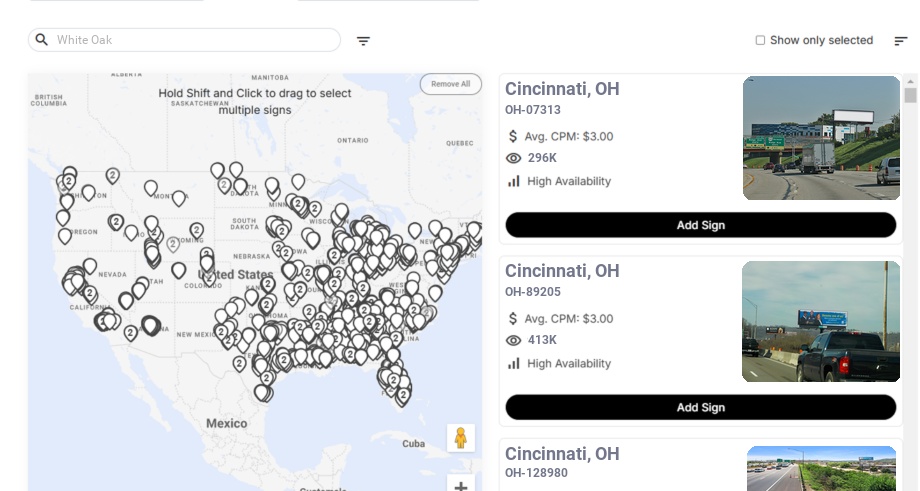



How much is a billboard near White Oak?
Why Choose Blip for Billboard Advertising near White Oak
Blip lets you launch White Oak billboards self-serve in minutes, perfect for commuters on Colerain Ave and I-74.
Set a flexible budget on Blip and reach White Oak families near Northgate and busy western Hamilton County routes.
No contracts means you can test White Oak campaigns for back-to-school, holiday, or weekend retail traffic.
Use dayparting to hit White Oak rush hours—6:30-9 a.m. and 3:30-7 p.m.—when commuters are on the road.
Track White Oak performance in real time and shift spend toward Colerain Ave or I-74 when results improve.
Blip's creative tools make it easy to tailor White Oak ads for homeowners, schools, and family-focused offers.
Frequently Asked Questions About Billboard Advertising near White Oak
How much does a billboard cost near White Oak, Ohio with Blip?
With Blip, you can advertise on digital White Oak billboards on any budget by simply setting a daily amount that works for you, and Blip automatically keeps your campaign within that limit. Each “blip” is a 7.5–10 second ad display on rotating digital billboards near White Oak, Ohio, and you only pay for the blips you receive. Pricing for each blip changes based on when and where you choose to advertise, as well as advertiser demand in the White Oak area, so your total cost over time is just the sum of those individual blips.
Where can I advertise with Blip in White Oak, Ohio?
With 14 digital billboards serving the White Oak area from nearby Cincinnati—most within roughly 10 miles—we can precisely target the daily patterns of White Oak residents while taking advantage of some of the highest-traffic roads in Hamilton County. Major corridors that support billboards serving the White Oak area include Colerain Avenue (US-27), the Interstate 74 / Interstate 275 interchange area, and the Interstate 75 corridor within about 10 miles. Because these billboards are concentrated near core travel routes, advertisers can reach residents multiple times per week during their normal routines.
What kind of people live in White Oak, Ohio for billboard advertising with Blip?
White Oak is a compact, commuter-heavy community that punches above its weight in buying power. The area’s population is just under 20,000 residents, with a broader trade area of 60,000–80,000 people within a 10–15 minute drive and 250,000+ residents within 20 minutes. The mix of working adults, families, and homeowners makes it a strong target for family dining, home services, healthcare, financial services, and retail.
When is the best time to run White Oak, Ohio billboard ads with Blip?
In the Cincinnati metro, nearly 70% of workers travel to work between 6:00–9:00 a.m., and return trips concentrate between 3:00–7:00 p.m. Morning peaks are strong for coffee, breakfast, and before-work services, while afternoon and evening peaks are best for grocery stores, retail promotions, entertainment, and healthcare. Weekend mid-day through early evening also drives strong retail and leisure traffic, making it a good time for special events, limited-time sales, and family activities.
What should billboard creative focus on in White Oak, Ohio?
To resonate near White Oak, billboard creative should reflect the community’s identity and daily life and respect real-world viewing conditions, where drivers typically have 3–6 seconds to read and process a message. Strong creative should emphasize family and everyday life, lean into value and convenience, and keep copy extremely tight. The page recommends 6–8 words or fewer per frame, one clear call to action, and large high-contrast fonts with minimal secondary text.
Do I need a contract to advertise with Blip near White Oak?
No, Blip has no long-term contracts or minimum commitments. You can start, pause, or stop your campaign at any time.
How fast can I launch a billboard campaign with Blip near White Oak?
You can have your campaign live in minutes. Create a free account, select your locations, set your budget, upload your design, and start running once approved.
Where can I advertise with Blip near White Oak?
Blip has digital billboards near White Oak. You can browse available locations on a map, choose the ones that fit your audience, and start advertising right away.
Still have questions? Launch a campaign in minutes — no contracts, no commitments.
Start Your CampaignWhite Oak Billboard Advertising Guide
White Oak, Ohio sits just northwest of downtown Cincinnati and combines dense residential neighborhoods, busy commuter corridors, and strong local retail. With 14 digital billboards serving the White Oak area from nearby Cincinnati—most within roughly 10 miles—we can precisely target the daily patterns of White Oak residents while taking advantage of some of the highest-traffic roads in Hamilton County. Together, these billboards near White Oak give advertisers a flexible, data-driven way to stay visible along the routes locals use most. Below, we outline how to build powerful campaigns near White Oak using real local data, clear creative strategies, and smart timing.

Understanding the White Oak Area Market
White Oak is a compact, commuter-heavy community that punches above its weight in buying power.
- Population: White Oak’s population is just under 20,000 residents (2020 estimates place it around 19,000–19,500), forming a dense pocket inside Green Township 62,000 residents, giving advertisers a solid base of nearby households beyond the White Oak core.
- Greater trade area: Because White Oak is tightly connected to surrounding neighborhoods (Monfort Heights, Groesbeck, Colerain Township, and the broader Cincinnati metro), advertisers can realistically consider a primary trade area of 60,000–80,000 people within a 10–15 minute drive. Within a 20-minute drive, you can easily access 250,000+ residents across western and central Hamilton County.
-
Age profile:
- The broader area around White Oak typically shows about 55–60% of residents aged 25–64, aligning with prime working and spending years.
- Children under 18 often make up 20–23% of the population, supporting a strong base of families with school-age kids tied to nearby schools in the Northwest Local School District.
- This mix supports consistent demand for family dining, youth sports, healthcare, and education services.
- Household income: Median household income in the White Oak area is roughly $65,000–$70,000, running 5–10% higher than the City of Cincinnati overall. Nearby Green Township and Colerain Township neighborhoods frequently show median incomes in the $65,000–75,000 range, indicating stable, middle-income households with discretionary spending power for retail, automotive, home improvement, healthcare, and financial services.
-
Homeownership:
- Owner-occupancy in this part of western Hamilton County is often in the 60–70% range. Some pockets of Green Township exceed 70% owner-occupied, compared with many city neighborhoods where renting can exceed 55–60% of households.
- The average household size often runs close to 2.5–2.7 persons, reflecting a significant share of multi-person and family households.
-
These patterns make the area a prime target for:
- Home services (roofing, HVAC, landscaping, remodeling)
- Financial services (mortgages, HELOCs, credit unions)
- Local medical and dental practices that serve entire families
For advertisers, this means billboard messaging near White Oak should lean toward family-oriented, value-conscious, and convenience-focused offers rather than tourism or nightlife themes. For brands investing in billboard advertising near White Oak, that translates into creative that speaks directly to everyday needs and routines. With a large share of two-income households and school-age children, clear promises around time savings, easy parking, and predictable pricing tend to perform especially well.
Key Roadways and Traffic Patterns Serving White Oak
The White Oak area is highly car-dependent, and roadways near the community carry strong daily traffic:
- Commuting mode: In western Hamilton County communities similar to White Oak, around 78–82% of workers drive alone to work and another 8–10% carpool. Transit use typically stays under 5%, according to regional planning estimates from organizations like the Ohio-Kentucky-Indiana Regional Council of Governments. This heavy reliance on vehicles makes roadside media especially effective.
- Average commute: Typical commute times in the broader Cincinnati region are around 23–24 minutes, with many workers in western suburbs like White Oak spending 20–30 minutes per trip. That means thousands of residents pass the same billboards 10 times per week (twice a day, five workdays), allowing repeated exposure and message reinforcement.
Major corridors that support billboards serving the White Oak area include:
-
Colerain Avenue (US-27)
- Runs north–south just east of the White Oak core, connecting to Northside and downtown Cincinnati.
- Segments near Northgate and south toward the city often see 35,000–45,000 vehicles per day according to Ohio Department of Transportation
- Over a typical 4‑week campaign, a single board on a 40,000‑vehicle-per-day segment can generate 1.1–1.3 million gross vehicle impressions, before adjusting for occupancy.
-
Ideal for:
- Big-box retail, restaurants, and fast food
- Auto dealers and repair shops
- Local healthcare and urgent care centers
- Financial institutions and credit unions with nearby branches
-
Interstate 74 / Interstate 275 Interchange Area
- I-74 runs east–west south of White Oak, linking to I-75 and downtown Cincinnati and providing a primary radial route into the city.
- ODOT traffic counts near the I-74/I-75 area typically exceed 100,000 vehicles per day, and stretches west of I-75 regularly carry 60,000–75,000 vehicles daily.
- Over a month, that can mean 1.8–2.2 million+ vehicle passes on key segments, positioning digital boards here as high-reach tools for metro-wide messaging that still over-index among western-suburb commuters.
-
Digital billboards along these routes reach:
- White Oak commuters heading downtown in the morning
- Shoppers and families traveling to and from western suburbs and regional retail nodes
- Event-driven traffic for games, concerts, and festivals in central Cincinnati
-
Interstate 75 Corridor (within ~10 miles)
- One of the busiest highways in Ohio, I-75 through central Cincinnati often carries 140,000–160,000 vehicles per day, with some stretches peaking above 170,000 on typical weekdays.
- While slightly farther from White Oak itself, boards here can reinforce your brand to White Oak residents who work or shop near central or northern Cincinnati, while also adding reach into adjacent markets such as West Chester and the northern suburbs.
Because our 14 digital billboards serving the White Oak area are concentrated near these core travel routes, we can help you reach residents multiple times per week—often multiple times per day—during their normal routines. Research from industry groups such as the Out of Home Advertising Association of America indicates that well-placed digital OOH can achieve 60–80% ad recall among exposed drivers, underscoring the value of being consistently present along these high-volume corridors with targeted billboard advertising near White Oak.
When White Oak Residents Are on the Road
White Oak-area travel follows classic commuter and errand patterns, but local nuances matter. In the Cincinnati metro, nearly 70% of workers travel to work between 6:00–9:00 a.m., and return trips concentrate between 3:00–7:00 p.m. This shapes how we time your impressions:
-
Morning peak:
- 6:30–9:00 a.m. is prime time for southbound and eastbound traffic toward downtown Cincinnati, hospitals, universities, and office hubs like the Uptown area
- Many school start times in Northwest Local School District fall between 7:30–9:00 a.m., adding school-related traffic to daily commutes.
-
Strong time to promote:
- Coffee shops / breakfast spots
- Quick-service restaurants open for breakfast
- Traffic, weather, and urgent service messages (healthcare, auto repair, etc.)
- “Before-work” services such as urgent care visits or oil changes that open by 7:00–8:00 a.m.
-
Afternoon and evening peak:
- 3:30–7:00 p.m. sees heavy flows as commuters return through the western suburbs, pick up kids, and run errands. In many suburban corridors, traffic volumes during the PM peak often reach 90–110% of morning peak levels, depending on direction.
- After-school and after-work activities, youth sports, and shopping trips all add to this flow.
-
Best for:
- Grocery stores and meal solutions (“Dinner solved in 15 minutes”)
- Retail promotions (home improvement, big-box, clothing)
- Entertainment (bowling alleys, family attractions, gyms)
- Healthcare providers promoting evening or walk-in hours
-
Weekend patterns:
- Saturday mid-day through early evening often drives strong retail and leisure traffic; in some retail corridors, Saturday vehicle counts can exceed weekday averages by 5–15%.
- Many White Oak residents travel toward major shopping areas (Northgate, Colerain Avenue retail, or downtown events promoted by Visit Cincy). Downtown Cincinnati alone welcomes millions of visitors annually to events, festivals, and sporting events, bringing periodic surges in weekend freeway traffic.
-
Ideal for:
- Special events and festivals
- Limited-time sales
- Attractions, museums, and sports
- Family activities and entertainment options targeting groups of 3–5
With digital scheduling, we can allocate more of your budget to specific dayparts (commute vs. weekend) that align with your audience, rather than running a flat schedule 24/7. For example, shifting 50–60% of impressions into weekday peaks and 20–30% into weekend days often maximizes exposure for retail and restaurant advertisers serving the White Oak area.
Crafting Billboard Creative for the White Oak Audience
To resonate near White Oak, billboard creative should reflect the community’s identity and daily life and respect real-world viewing conditions, where drivers typically have 3–6 seconds to read and process a message. Strong creative is what turns basic White Oak billboards into highly efficient drivers of awareness and action.
1. Emphasize family and everyday life
White Oak’s strong base of families and working adults responds well to:
- Imagery: Families, kids in sports gear, everyday home scenes, local school colors (e.g., Northwest Knights or Colerain Cardinals when appropriate)
-
Messages:
- “10 minutes from White Oak on Colerain Ave”
- “Serving White Oak families since 1995”
- “After-school snacks on your way home”
- In similar suburban markets, family-focused imagery has been shown to improve ad likability and recall metrics by 10–20% compared with purely product-focused visuals.
2. Lean into value and convenience
Median household incomes and commuting patterns suggest messaging that balances quality with value:
- Simple price points: “Oil change $39.99 – Exit at Colerain”
- Time-saving hooks: “Same-day appointment,” “In and out in under 30 minutes”
- Location cues: “Just past Northgate,” “Next to [local landmark or intersection]”
- In shopper surveys, over 60% of suburban consumers say they are more likely to stop at a new business if they see a clear, limited-time deal on their driving route.
3. Keep copy extremely tight
Drivers on I-74 and Colerain Ave have only a few seconds to absorb information. We recommend:
- 6–8 words or fewer per frame; studies of OOH readability show that legibility and recall drop sharply beyond 7–8 words at highway speeds.
- 1 clear call to action (visit, call, text, or exit)
- Large, high-contrast fonts; minimal secondary text
- Limiting to 1–2 key visual elements to avoid clutter
4. Use local references carefully
Local touches build trust when they’re clear and accurate:
- Mention nearby neighborhoods: “Proud to serve White Oak, Monfort Heights, and Groesbeck”
- Highlight proximity: “5 minutes from White Oak via North Bend Rd”
- Reference recognizable local institutions when appropriate (e.g., “Just past Northgate on Colerain”)
- Avoid overloading with hyper-local jargon that newcomers or pass-through commuters might not understand.
Seasonal and Event-Based Opportunities Near White Oak
The Cincinnati region has a robust calendar of events that White Oak residents follow closely through outlets like the Cincinnati Enquirer, WCPO 9 News, WLWT, and FOX19. Major seasonal retail and travel spikes can lift consumer spending by 20–40% compared to off-peak months in categories like retail, home services, and dining. Digital billboards allow us to align with these spikes and get more from billboard advertising near White Oak:
Spring (March–May)
- Home improvement season: roofing, landscaping, HVAC tune-ups typically see job volume rise 25–35% from winter lows.
- Tax prep and financial services ahead of April deadlines, when more than 70% of filers complete returns by mid-April.
- Sports sign-ups and youth activities as local leagues and school sports ramp up.
Tailor creatives: “Spring upgrade? Book your free roof estimate today.” or “Tax refund? Turn it into a new car—exit at Colerain.”
Summer (June–August)
- Family travel and local attractions promoted by Visit Cincy benefit from school breaks, when families often increase leisure spending by 15–25%.
- Day camps, swim clubs, and family entertainment, especially as temperatures routinely hit 80–90°F with high humidity.
- Auto repair for road trips (tire, brake, and A/C services surge as vehicle miles traveled peak).
Use imagery: bright colors, outdoor scenes, kids out of school, and pool or park visuals referencing popular regional amenities such as Cincinnati Parks
Back-to-School (August–September)
- White Oak-area families shop for clothes, supplies, electronics, and home organization products; national back-to-school spending typically ranks as the second-largest shopping season, often exceeding $800 per family in some surveys.
-
Promote:
- Tutoring and learning centers
- Pediatric and dental checkups
- Sports retailers and leagues
Copy ideas: “Back-to-school checkups – 8 minutes from White Oak.” or “Gear up for fall sports – Colerain Ave next to Northgate.”
Fall and Holiday (October–December)
- Retail peaks for big-box, local shops, and e-commerce, with November–December often generating 20–25% of annual retail sales for many categories.
- Service businesses push end-of-year offers as customers use remaining benefits or budgets (e.g., FSA dollars, insurance benefits).
- Nonprofits run fundraising campaigns, with some organizations receiving 30–40% of annual donations in the last quarter.
Use countdown-style creative: “3 days left – White Oak holiday sale.” or “Use your 2025 benefits before Dec. 31.”
Because we can update digital billboard artwork quickly—often within 24–48 hours—you can rotate creative through these seasons, A/B test offers, and highlight specific event weeks rather than run a single, static message all year. This agility is a key advantage of digital White Oak billboards compared with traditional static placements.
Industry-Specific Strategies for the White Oak Area
Different categories can tap into White Oak’s patterns in distinct ways. OOH industry studies show that pairing location-targeted creative with simple offers can increase response rates by 15–30% compared with generic creative.
Local Retail and Restaurants
- Focus boards along Colerain Ave and routes feeding shopping centers like Northgate and nearby plazas.
- Use directional cues: “Next right on Colerain after North Bend,” “Across from Northgate Mall.” Directional language such as “Next exit” or “Right at light” has been shown to significantly boost store-visit intent.
- Add time-bound offers: “Tonight only,” “Weekend sale,” aligned with heavy Saturday traffic, when many stores see 20–30% higher sales than midweek days.
- Highlight convenience for dual-income families: curbside pickup, online ordering, drive-thru, and extended hours.
Healthcare, Dental, and Vision
- Appeal to families and older residents in stable neighborhoods—areas with high homeownership often have above-average utilization rates for preventive care and elective procedures.
-
Promote:
- New patient specials
- Same-day or walk-in availability
- Proximity (“8 minutes from White Oak Circle”)
-
Run heavier schedules during:
- Back-to-school physical season (August–September)
- Flu season (typically October–March), when vaccination campaigns can increase clinic traffic by 10–20%
- Open enrollment periods (October–December) when consumers are actively considering plan changes and providers
- Consider integrating QR codes, which can now be scanned safely at lower speeds on surface streets, to connect billboards with online appointment booking.
Home Services (Roofing, HVAC, Plumbing, Landscaping)
- White Oak’s high homeownership rate creates strong lifetime value per customer, and many homes in western Hamilton County are 30–60+ years old, driving recurring needs for repairs and upgrades.
-
Emphasize:
- “Serving White Oak homeowners”
- 24/7 emergency service
- Trust signals (“Rated #1 in western Cincinnati,” “4.8★ average rating”)
-
Seasonal rotations:
- Spring: landscaping, roofing, gutters (often peak season for exterior work)
- Summer: AC service and replacements, when HVAC calls can spike by 30–50% on extreme heat days
- Fall: furnace tune-ups, insulation, and weatherization
- Include simple phone numbers or URLs; home-service campaigns often see noticeable lifts in branded search and call volume within 1–2 weeks of launch.
Financial Services and Insurance
- Many commuting professionals travel through higher-traffic corridors each day; consistent exposure on their daily route can build trust for higher-consideration products such as mortgages and investments.
-
Promote:
- Credit unions and banks near White Oak
- Mortgage refinancing and HELOCs (especially when home equity rises or rates shift)
- Auto and home insurance bundles, which can reduce premiums by 10–20% for many households
-
Consider campaigns around:
- Tax refund season (February–April)
- Back-to-school and holiday budgeting
- Major rate-change periods, when financial institutions often report boosts in inquiry volume of 20–30% following targeted OOH campaigns
Using Digital Flexibility to Target the White Oak Area
Digital billboards give us tools uniquely suited to a suburban commuter market like White Oak. Across the industry, digital OOH now accounts for roughly 30–40% of total OOH spend, driven by its flexibility and ability to support multiple messages on a single face. For advertisers exploring billboard rental near White Oak, digital units often provide the best balance of cost, control, and impact.
1. Daypart targeting
Allocate your impressions when your audience is actually passing through:
- Morning-heavy campaigns for coffee shops and breakfast-oriented QSR, when many concepts see 25–35% of daily sales before 11 a.m.
- Evening and weekend emphasis for retail and entertainment, mirroring peak shopping and dining hours.
- Midday emphasis for medical practices, senior services, and B2B services that cater to flexible schedules or remote workers.
By shifting even 20–30% of impressions out of low-traffic overnight hours and into peak commute times, you can substantially increase effective reach without increasing budget.
2. Commuter-direction targeting
If screens allow directional splits, we can emphasize:
- Inbound to Cincinnati (AM): employment ads, training programs, and destination attractions downtown, such as museums, sports venues, and events highlighted by Visit Cincy.
- Outbound to White Oak/western suburbs (PM): grocery, retail, gyms, family restaurants, and home services that residents can use on their way home.
Directional targeting can improve relevance and response, with some advertisers reporting 10–20% higher engagement when messages match trip purpose (e.g., “Stop in on your way home”).
3. Weather and condition-based messaging
The Cincinnati area experiences wide seasonal swings:
- Hot, humid summers: average July highs around 86°F with frequent high-humidity days. Promote HVAC checks, car A/C service, water parks, and frozen treats.
- Cold, icy winters: average January lows in the 20s°F, with several snow and ice events per year. Push auto repair, snow removal, tire shops, and urgent care.
- Heavy rain events: rainfall spikes can trigger spikes in emergency roofing, plumbing, and auto accident-related services.
With dynamic creative, ads can change with temperature or precipitation, such as “Too hot? AC tune-up special today” on days above 85°F, or “Snow coming? New tires today” before forecasted storms.
4. Creative rotation and testing
Run multiple versions of your ad:
- Test different offers (“$0 down” vs. “Save $500”)
- Alternate image-led vs. text-led frames
- Rotate seasonal imagery (e.g., back-to-school vs. holiday)
- Track downstream metrics like web traffic, coupon redemptions, or call volume to infer which creative performs best.
Even simple A/B tests can uncover 10–25% performance differences between creative concepts, allowing you to optimize over time without increasing spend.
Aligning with Local Media and Online Channels
Billboards near White Oak are especially powerful as part of an integrated strategy. Cross-channel campaigns regularly show higher effectiveness; industry research often finds that adding OOH to a digital mix can increase reach by 10–20% and improve brand recall.
- Reinforce TV and streaming: Many households watch local news from WCPO 9, WLWT, FOX19, or read the Cincinnati Enquirer. Matching your billboard visuals to your TV or online video creative builds strong recall, as consumers are 2–3 times more likely to remember a message they encounter across multiple channels.
- Support digital campaigns: Use the same headline or visual motif across social media, search ads, and billboards. When drivers later search for your brand, they’ll recognize you instantly. Brands that synchronize OOH with mobile and search often see lifts of 20–30% in mobile ad engagement near OOH locations.
-
Drive direct response:
- Simple URLs, short phone numbers, and unique promo codes on billboards make it easier to connect impressions with conversions.
- For surface streets like Colerain Ave, you can consider shorter QR codes that are visible at red lights or low speeds.
- Tracking unique URLs or codes by campaign flight allows you to attribute increases in leads or sales to specific billboard strategies.
Measuring and Optimizing Campaigns Serving the White Oak Area
While we cannot survey every driver near White Oak, we can use data and proxies to optimize:
- Traffic volume: ODOT’s publicly available traffic counts provide baselines for exposure (e.g., 35,000–45,000 cars per day on key Colerain Ave segments; 60,000–75,000+ on I-74 near the city; 100,000–150,000+ on I‑75 closer to downtown). These figures translate to millions of monthly impressions per board when combined with average vehicle occupancy (often 1.3–1.5 people per vehicle).
- Impression-based planning: Use those counts to approximate weekly and monthly reach, then choose budgets and schedules that match your goals. For example, a board on a 40,000‑vehicle-per-day road will typically deliver around 280,000 vehicle passes per week, or over 1.1 million per month.
-
Response metrics:
- Track lifts in website traffic from ZIP codes around White Oak, Green Township, Colerain Township, and western Cincinnati.
- Monitor branded search volume during your flight dates; increases of 10–30% during campaigns are common in well-designed OOH programs.
- Use unique URLs, QR codes, call tracking numbers, or text codes on your creative.
Over time, we can adjust:
- Which boards you use (more near I-74 vs. more near retail corridors like Colerain Ave)
- What times of day you emphasize (AM, PM, weekend)
- Which creative versions you prioritize based on measured response
This iterative approach can steadily improve cost per lead or cost per visit, often reducing acquisition costs by 10–20% across multiple campaign cycles for billboard advertising near White Oak.
Putting It All Together for White Oak
To reach the White Oak area effectively, we recommend:
- Target commuter and retail corridors: Focus on boards near I-74 and major connectors into the western suburbs and Colerain Ave retail. These corridors collectively reach tens of thousands of vehicles per day and deliver millions of monthly impressions.
- Tailor messaging to families and homeowners: Emphasize convenience, trust, value, and proximity, speaking directly to the 60–70% of households who own their homes and the many families balancing work, school, and activities.
- Leverage digital flexibility: Use dayparting, seasonal creative swaps, direction-based messaging, and A/B testing to get the most from each impression, reallocating impressions to the highest-value hours and days.
- Align with local rhythms: Plan heavier rotations around school calendars, holiday shopping, and major Cincinnati events promoted by local outlets and Visit Cincy. Sync your messages with how and when White Oak residents really move, shop, and plan.
Whether you are launching your first billboard rental near White Oak or expanding an existing regional campaign, understanding how people in the White Oak area live, commute, shop, and consume local media allows you to design digital billboard campaigns that are not only seen, but remembered—and that translate into measurable results for your business.