Billboards near Fairborn, OH
No Minimum Spend. No Long-Term Contracts. Just Results.
Trusted by Leading Brands


Billboard advertising
near Fairborn has never been easier



How much is a billboard near Fairborn?
Why Choose Blip for Billboard Advertising near Fairborn
Blip lets you launch Fairborn billboards fast and self-serve, reaching I-675 commuters, Wright State students, and WPAFB families without a media-buying hassle.
Set flexible daily budgets in Fairborn and scale up for Air Force Marathon or Wright State move-in week, then dial back anytime.
Use dayparting on Blip to hit Fairborn traffic at 6-9 a.m. and 3-7 p.m., when I-675 and US-35 commuter flow is strongest.
No contracts means you can test Fairborn billboard ads near WPAFB and the National Museum, then shift based on what performs.
Blip's real-time analytics help Fairborn advertisers track response by daypart, so you can optimize for students, military shifts, and weekend shoppers.
Design and update creatives in Blip for Fairborn's mix of blue-collar, healthcare, and university audiences—fast, clear, and local.
Frequently Asked Questions About Billboard Advertising near Fairborn
How much does a billboard cost near Fairborn, Ohio with Blip?
With Blip, you control the cost of advertising on Fairborn billboards by setting a daily budget that can be as small or as large as you’d like, and Blip automatically keeps your campaign within that amount. Each blip is a 7.5–10 second ad on digital billboards near Fairborn, Ohio, and you only pay for the blips you receive. Pricing for each blip is based on when and where you choose to advertise in the Fairborn area and on real-time advertiser demand, so your total cost is simply the sum of all your blips.
Where can I advertise with Blip in Fairborn, Ohio?
Blip’s digital billboards in Dayton serve the Fairborn area, giving you access to residents who travel daily for work, shopping, healthcare, and entertainment. Key corridors near Fairborn include I-675, I-70, and US-35/OH-4, which carry heavy commuter and freight traffic. The boards are positioned along high-flow routes where Fairborn-area drivers naturally pass through on their regular trips.
Who can Blip reach in Fairborn, Ohio?
Fairborn sits at the crossroads of education, defense, technology, and blue-collar industry for the Dayton region, making it a uniquely diverse market. The area includes military personnel and families from Wright-Patterson Air Force Base, students and staff from Wright State University, long-time local residents, and an industrial workforce tied to the Dayton–Fairborn corridor. That mix gives advertisers access to students, commuters, and households with very different needs and spending patterns.
When is the best time to run billboard ads in Fairborn, Ohio with Blip?
When you schedule campaigns during morning (6–9 a.m.) and evening (3–7 p.m.) drive times, you’re targeting the highest concentration of Fairborn-area commuters passing through Dayton. Midday (11 a.m.–2 p.m.) is also powerful for reaching students, active-duty personnel on base breaks, and shoppers. For many advertisers, this pattern makes digital billboard advertising near Fairborn’s main corridors an efficient way to stay in front of these daily flows.
What kinds of seasonal events affect billboard advertising in Fairborn, Ohio?
The Fairborn area hosts several signature events that spike traffic and visitor volume, including the Air Force Marathon, the CenterPoint Energy Dayton Air Show, and the Greene County Fair. Wright State academic calendar events like move-in weekends, homecoming, and graduation also bring surges of parents and alumni into the area. Aligning your digital billboard strategy with these dates can dramatically increase impact.
Do I need a contract to advertise with Blip near Fairborn?
No, Blip has no long-term contracts or minimum commitments. You can start, pause, or stop your campaign at any time.
How fast can I launch a billboard campaign with Blip near Fairborn?
You can have your campaign live in minutes. Create a free account, select your locations, set your budget, upload your design, and start running once approved.
Where can I advertise with Blip near Fairborn?
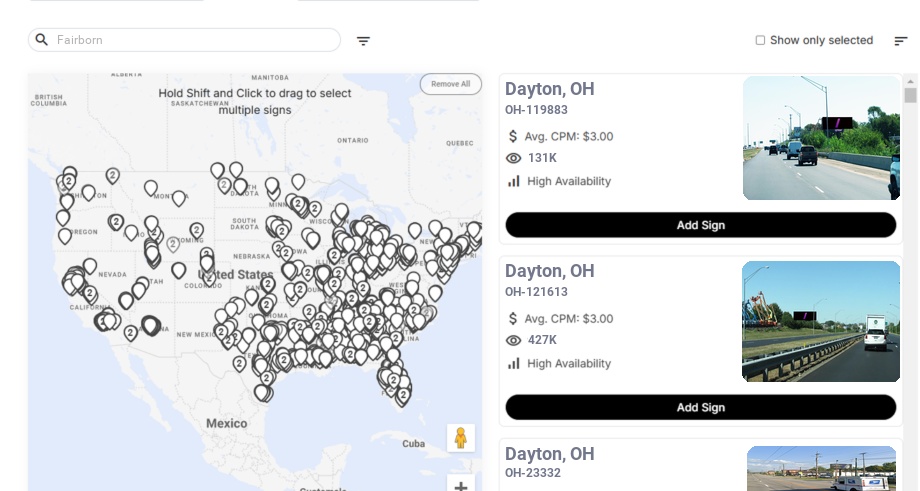
Blip has digital billboards near Fairborn. You can browse available locations on a map, choose the ones that fit your audience, and start advertising right away.
Still have questions? Launch a campaign in minutes — no contracts, no commitments.
Start Your CampaignFairborn Billboard Advertising Guide
Fairborn sits at the crossroads of education, defense, technology, and blue‑collar industry for the Dayton region, making the Fairborn area a uniquely diverse and high‑value market for digital billboard campaigns. With our digital billboards in Dayton serving the Fairborn area, we can help you reach students, military families, commuters, and long‑time local residents with precision timing and messaging, similar to what you’d expect from dedicated billboards near Fairborn itself.
Understanding the Fairborn Area Market
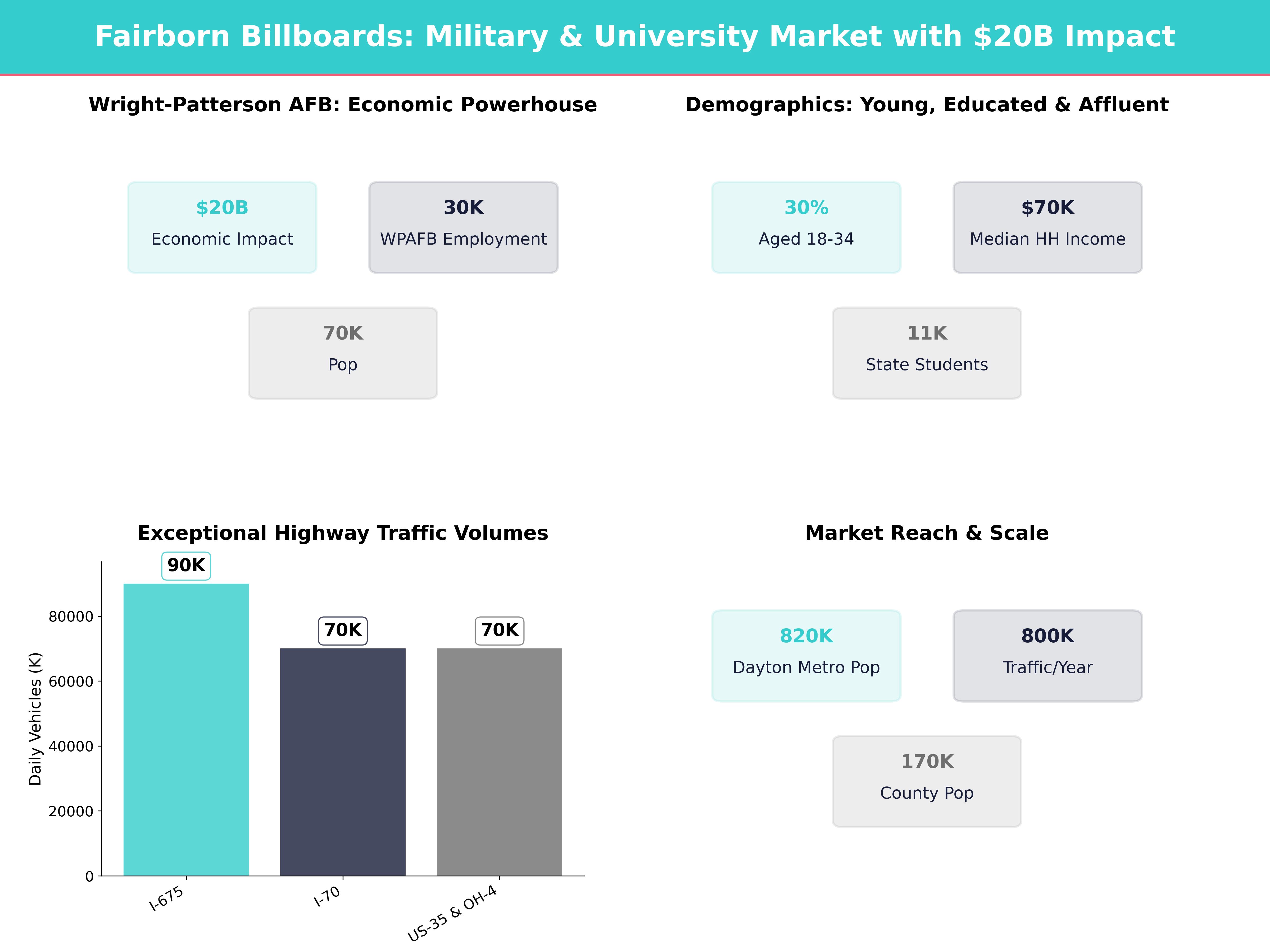
Fairborn is home to roughly 35,000 residents (around 34,000–35,000 in recent city estimates) and is part of the broader Dayton–Kettering metro area of about 800,000–820,000 people. According to recent regional planning data from Miami Valley Regional Planning Commission
The city anchors a dense cluster of employers and institutions that dramatically expand the local daytime and visitor population:
- Wright-Patterson Air Force Base (WPAFB), immediately adjacent to the Fairborn area, employs more than 30,000 military, civilian, and contractor personnel according to WPAFB public affairs over 80,000 total jobs and contributes $15–$20 billion annually to the local economy.
- Wright State University, whose main campus borders the Fairborn area, enrolls approximately 10,000–11,000 students each year, plus thousands of staff and faculty, per Wright State’s institutional research. Recent figures show that roughly 75–80% of Wright State students are from the broader Dayton region, meaning many commute past key billboard corridors daily, making Fairborn billboards and nearby placements especially visible to this group.
- Nearby healthcare providers, including Greene County facilities that are part of networks anchored by Kettering Health and Premier Health, employ thousands of physicians, nurses, and allied health professionals and serve a county population of about 170,000 residents, according to Greene County, Ohio.
The result is a compact zone where:
- Young adults (18–34) make up a notably higher share of the population than the Ohio average, driven by Wright State and WPAFB. In many Fairborn and Beavercreek‑area tracts, more than 30% of residents are 18–34, compared with roughly 23–24% statewide.
- Household incomes vary widely. Greene County median household income sits in the $70,000+ range, but Fairborn neighborhoods range from mid‑$40,000s in student and older housing areas to $90,000+ in nearby suburban subdivisions, according to county and regional planning summaries. This supports both value‑oriented retail and higher‑end services for officers, engineers, and healthcare professionals.
- A large share of households are renters and short‑term residents. In parts of Fairborn and the Wright State campus area, 50–70% of occupied housing units are renter‑occupied, significantly above Ohio’s overall renter share of around one‑third. Military tours averaging 3–4 years and student turnover every 1–4 years keep a constant churn of new residents needing local information and services.
The Fairborn area also sits within a major visitor draw: the National Museum of the U.S. Air Force, located next to WPAFB, reports 700,000–800,000 visitors per year, many of whom use I‑675, I‑70, and Dayton surface streets. These visitors, plus day‑trippers to downtown Dayton and attractions promoted by the Dayton Convention & Visitors Bureau, expand the effective audience far beyond the resident base.
Our digital billboards in Dayton sit on key commuter and shopping routes that naturally draw residents of the Fairborn area, giving you access to this diverse mix of audiences without paying big‑city billboard rates and providing a strong alternative to traditional billboard rental near Fairborn.
Key Corridors and Traffic Patterns Near Fairborn
Traffic data from the Ohio Department of Transportation (ODOT)
- I‑675, which links the Fairborn area to Dayton’s south and east suburbs, carries roughly 80,000–90,000 vehicles per day on key segments near Fairborn and Beavercreek, with peak‑direction traffic heaviest between 6–9 a.m. and 3–7 p.m.
- I‑70, north of Dayton and used by many WPAFB commuters and logistics traffic, sees 70,000+ vehicles per day on nearby stretches in western Greene and eastern Montgomery counties, including a high share of truck and freight traffic.
- US‑35 and OH‑4 connect the Fairborn area to central Dayton, with segments near our Dayton billboards typically recording 40,000–70,000 vehicles per day, based on recent ODOT average annual daily traffic counts.
- Regional reports from Greater Dayton RTA indicate that tens of thousands of transit boardings each weekday occur along corridors feeding into downtown Dayton and key employment nodes, further boosting eyeballs on surface‑street boards.
Our digital boards in Dayton are positioned along high‑flow commuter and shopping routes where residents of the Fairborn area travel daily for:
- Work at WPAFB, Wright State, downtown Dayton, and industrial parks throughout the I‑70/I‑75 logistics corridor
- Shopping trips to The Greene in Beavercreek (a lifestyle center with 100+ retail, dining, and entertainment tenants), The Mall at Fairfield Commons (more than 130 stores and eateries), big‑box corridors along North Fairfield Road and Pentagon Boulevard, and downtown Dayton
- Healthcare visits to regional hospitals and clinics in the Kettering Health and Premier Health systems
- Entertainment and dining throughout the Dayton urban core, including venues promoted by Downtown Dayton Partnership
When you schedule campaigns during morning (6–9 a.m.) and evening (3–7 p.m.) drive times, you’re targeting the highest concentration of Fairborn‑area commuters passing through Dayton. Midday (11 a.m.–2 p.m.) is also powerful for reaching students, active‑duty personnel on base breaks, and shoppers—especially on Fridays and Saturdays, when some retail corridors see 10–20% higher midday volumes compared with weekdays. For many advertisers, this pattern makes digital billboard advertising near Fairborn’s main corridors an efficient way to stay in front of these daily flows.
Audience Segments You Can Reach Near Fairborn
Because Fairborn borders major institutions, your campaign can target several distinct, high‑value segments:
-
Military Personnel & Families
- WPAFB supports over 30,000 active-duty, reserve, civilian, and contractor personnel plus tens of thousands of dependents, making the total base‑connected population often estimated at 60,000–70,000 people.
- Defense and military households in the region typically report higher‑than‑average income stability, with many dual‑income families combining federal employment and private‑sector work at tech, engineering, or healthcare firms.
- Frequent relocations—typical military tours of 3–4 years, and some contractor roles shifting with new projects—create a constant stream of new residents needing local services: housing, auto dealers, medical, childcare, banking, insurance, fitness, and more.
- WPAFB operates on predictable shift schedules, which aligns well with tightly timed billboard rotations aimed at commute windows and lunch breaks and makes nearby Fairborn billboards especially valuable for on‑base and off‑base messaging.
-
College Students & Young Professionals
- Wright State University hosts roughly 10,000+ students on its main and Lake campuses, plus several thousand faculty and staff. Additional students come from nearby institutions such as Clark State College at Greene Center Sinclair Community College, and local private colleges.
- Wright State’s enrollment data show that a large share of students—often 60–70%—are undergraduates in the 18–24 age range, a prime demographic for quick‑response advertising on food, entertainment, and services.
- Many students commute from suburbs like Beavercreek, Huber Heights, and Kettering, passing our Dayton billboards daily on I‑675, US‑35, and surface streets, much like they would pass any billboards near Fairborn placed on their regular routes.
- This group is highly responsive to food, entertainment, nightlife, affordable housing, and gig‑economy job advertising, and digital campaigns can time messaging around class hours and evening social peaks.
-
Long‑Time Local Residents & Suburban Families
- The Fairborn area includes established neighborhoods with multi‑generation households, retirees, and families who shop and work between Fairborn, Beavercreek, Xenia, and Dayton. In several nearby census tracts, more than 25–30% of residents are age 55+, supporting strong demand for healthcare and financial services.
- Homeownership is higher in suburban Greene County communities, where 65–75% of occupied units are owner‑occupied, and typical household sizes run around 2.4–2.7 people.
- These residents respond strongly to local pride, community events, healthcare, education, and home‑services ads, especially campaigns that tie into updates from the City of Fairborn, local schools, or county‑level initiatives from Greene County, Ohio. For these audiences, consistent, community‑oriented billboard advertising near Fairborn can reinforce your presence as a trusted local option.
-
Industrial & Blue‑Collar Workforce
- The Dayton–Fairborn corridor hosts logistics hubs, manufacturing, and auto‑related industries linked to the I‑70/I‑75 “Crossroads of America.” Regional economic reports from organizations such as the Dayton Development Coalition estimate that logistics and manufacturing together account for tens of thousands of jobs in the metro.
- Many of these workers travel in early‑morning and late‑evening shifts, leading to above‑average traffic between 5–7 a.m. and 4–6 p.m. on certain industrial corridors.
- This makes off‑peak dayparts ideal for recruiting, training programs, CDL schools, and skilled‑trade advertising, where a succinct wage and benefit message can stand out on well‑placed Fairborn billboards or nearby Dayton units.
By tailoring creatives and schedules to these segments, we can turn the Fairborn area’s demographic variety into a strategic advantage for your brand.
Seasonal and Event‑Based Opportunities
The Fairborn area hosts several signature events that spike traffic and visitor volume. Aligning your digital billboard strategy with these dates can dramatically increase impact.
Major Regional Events:
- Air Force Marathon (September) – Hosted nearby at WPAFB and the National Museum of the U.S. Air Force, this event regularly draws 10,000–12,000 registered runners and an estimated 30,000–40,000 spectators and volunteers over the weekend. Hotels in the Dayton region often report near‑sellout occupancy on race weekend, according to tourism updates from the Dayton Convention & Visitors Bureau. Promoting hospitality, transportation, and local attractions on our Dayton boards in the 4–6 weeks leading up to race day captures both residents and visiting runners.
- CenterPoint Energy Dayton Air Show (summer) – One of the region’s largest events, held at Dayton International Airport 60,000–70,000 attendees over a weekend and can spike area traffic by 20–30% on key approach routes. Visitors stay, dine, and shop throughout the metro, many traveling through corridors served by our billboards.
- Greene County Fair (summer) in nearby Xenia attracts tens of thousands of visitors across its multi‑day schedule each year, according to the Greene County government. Families from across the county use US‑35, US‑68, and local connectors, increasing impressions for family‑oriented advertisers.
- Wright State academic calendar – Move‑in weekends, homecoming, and graduation ceremonies bring surges of parents and alumni to the Fairborn area. A single move‑in weekend can bring thousands of vehicles onto campus and surrounding roads, while commencement events fill hotels and restaurants along I‑675 and near The Mall at Fairfield Commons.
Seasonal Patterns:
- August–October: Peak for back‑to‑school, student housing, furniture, electronics, and Q4 hiring campaigns. Retail data from regional shopping centers show that late August and early September can account for 15–20% of annual back‑to‑school sales.
- November–December: Strong months for holiday retail, nonprofit giving, and travel. Many retailers see 25–30% of annual revenue during this window, and Dayton International Airport double‑digit percentage increases in passenger counts compared with fall averages.
- January–March: Ideal for fitness, healthcare, tax services, and New‑Year‑New‑You offers. Local gyms, clinics, and tax preparers typically see sharp spikes in inquiries in the first 8–10 weeks of the year.
- Spring and early summer: Best period for home improvement, landscaping, and real estate tied to moving and renovation cycles. In many Dayton‑area neighborhoods, 30–40% of annual home listings hit the market between April and June.
With Blip, you can scale your spend up around these high‑traffic periods and taper down during slower weeks, rather than committing to a static multi‑month billboard rental near Fairborn that locks you into the same spend regardless of demand.
Crafting Effective Creative for the Fairborn Area
The Fairborn area’s mix of military, students, and families should directly influence your visual strategy and messaging.
1. Speak to Local Identity and Landmarks
Use recognizable references that residents and commuters will instantly connect with:
- Phrases like “Minutes from Wright‑Patt,” “Near Wright State,” or “Just off I‑675 at [Exit]”
- Visual nods to aviation, engineering, or the National Museum of the U.S. Air Force
- References to local coverage from outlets like the Dayton Daily News or Fairborn city updates
You can also lean on local pride themes tied to events promoted by Visit Greene County or community calendars from the Fairborn Area Chamber of Commerce
This boosts relevance and trust, especially for service businesses that want to feel rooted in the community and are considering billboard advertising near Fairborn as a long‑term branding channel.
2. Design for High‑Speed Corridors
Traffic near Fairborn and Dayton is fast‑moving, often 55–70 mph on interstates and major arterials. Effective designs follow a few key rules:
- 6–8 words max of primary text, which testing across national OOH campaigns shows can increase message recall by up to 20–30% compared with crowded copy
- High‑contrast colors (dark background, light text, or vice‑versa) to preserve legibility at 500–700 feet
- Large, sans‑serif fonts and minimal fine detail
- One dominant image or icon—no clutter
- Clear call‑to‑action: a short URL, very simple offer, or easy‑to‑remember phrase
For example:
- “Military Move‑In Special – 1 Month Free Storage – Exit 17 on I‑675”
- “Wright State Students: $5 Tacos After 9 – Downtown Dayton”
3. Tailor Messaging by Time of Day
Because Blip lets us schedule your ads by specific hours, we recommend:
- Morning commute (6–9 a.m.) – Promote coffee, breakfast, news, traffic apps, job openings, and service reminders (“Schedule your oil change today”). Morning traffic volumes on I‑675 and US‑35 often reach their daily peak in this window.
- Midday (11 a.m.–2 p.m.) – Focus on lunch specials, errands, retail, healthcare, and appointment‑driven services. Many restaurants report 30–40% of weekday transactions during lunch hours.
- Afternoon school hours (2–4 p.m.) – Highlight family activities, tutoring, after‑school programs, and youth sports as parents plan evening logistics.
- Evening (4–7 p.m.) – Target groceries, restaurants, entertainment, gyms, and big‑ticket retail. Some local grocery and big‑box stores see 40% or more of weekday foot traffic after 4 p.m.
- Late evening (after 8 p.m.) – Reach students and younger crowds with nightlife, delivery, streaming, and late‑night food.
Military and industrial shifts may start earlier or end later than typical office hours, so recruitment and workforce‑oriented creatives can perform well in pre‑dawn (4–6 a.m.) and late‑night (9–11 p.m.) dayparts too, especially on boards positioned as billboards near Fairborn’s main access points.
Budgeting and Bidding Strategy for the Fairborn Area
Because our boards serving the Fairborn area are located in Dayton—not in a dense tier‑one metro like Chicago or New York—you can often secure high impression volumes with modest budgets while still tapping into a metro of 800,000+ residents and hundreds of thousands more visitors each year.
When planning:
-
Set a Monthly Baseline
- Local service businesses (dentists, HVAC firms, independent restaurants, small retailers) can start seeing meaningful results with $300–$500 per month, especially if focused on off‑peak hours and a 1–2 board footprint. This can translate into tens of thousands to low hundreds of thousands of impressions monthly, depending on targeting.
- Regional brands, hospitals, universities, and auto dealers often allocate $1,000–$3,000+ per month to dominate multiple dayparts and boards, frequently generating hundreds of thousands to over a million impressions across the month.
-
Use Dayparting to Outperform Bigger Budgets
- Instead of spreading thin 24/7, concentrate your bids in high‑value windows for your audience.
- Example: A restaurant might run heavily from 11 a.m.–2 p.m. and 4–8 p.m., ignoring late nights and mid‑mornings. A recruitment campaign for a manufacturer might prioritize 5–7 a.m. and 3–6 p.m. when shift workers are commuting.
-
Adjust Bids by Demand
- Demand tends to spike around major holidays, big events, and weekends, especially during summer air show season and winter shopping peaks. CPMs (cost per thousand impressions) can climb during these periods as more advertisers compete for the same slots.
- You can bid slightly higher during these periods and lower your bids during off‑peak weeks, maintaining consistent visibility without overspending. This flexible approach reflects how many Dayton‑area businesses adjust media spend around key events featured by the Dayton Convention & Visitors Bureau.
-
Leverage Geographic Flexibility
- Consider running creatives both on boards closest to key Fairborn‑area commuter routes and on other Dayton boards that catch weekend and leisure traffic into downtown, the Oregon District, and regional attractions.
- For example, a Fairborn‑area business can advertise on a board near downtown Dayton or the riverfront to capture people who live in Fairborn but work or play downtown; local commuter surveys often show 20–30% of Greene County residents regularly travel into Montgomery County for work or entertainment. In practice, this means you can combine Fairborn billboards and nearby Dayton units into one cohesive regional footprint without overspending on any single location.
Using Data and Analytics to Refine Campaigns
Blip’s reporting tools give you performance data you can combine with local metrics to continually improve your campaign.
We recommend:
- Comparing performance across dayparts – If lunch‑time impressions underperform compared to evening (for instance, if you see 25–30% fewer impressions or actions mid‑day), shift more of your budget to late afternoon and early evening commutes.
- Testing creative variations – Run two or three versions targeting different audiences (e.g., one student‑focused, one family‑focused, one military‑focused) and monitor which times and boards yield the best responses. Even a 10–15% improvement in response rate can significantly lower your overall cost per lead or sale.
- Aligning with your own KPIs – Track store traffic, web visits, or calls by day and correlate with your billboard schedule, adjusting spend accordingly. Many local advertisers see noticeable lifts—5–20% increases in web sessions or branded search—during well‑timed digital billboard bursts.
To understand broader trends, follow updates from:
- The City of Fairborn for development projects, infrastructure changes, and community initiatives that may affect traffic patterns or create new customer demand
- Greene County, Ohio for population, tourism, and economic development news, including major employer announcements and construction updates
- Local news outlets like the Dayton Daily News and WHIO for coverage of new employers, road construction, and regional events that shift traffic temporarily or permanently
These sources help reveal new corridors and neighborhoods growing in importance for your target audience and guide where billboard advertising near Fairborn will have the greatest impact.
Campaign Ideas by Industry for the Fairborn Area
Here are practical ways advertisers near Fairborn can take advantage of our Dayton boards:
Retail & Shopping Centers
- Run countdown creatives leading up to weekend sales (“2 Days Left – 20% Off All Appliances Near WPAFB”). Retail studies show that clear, time‑limited offers can lift in‑store traffic by 10–30% during the promotion window.
- Highlight military discounts or student specials with a simple badge: “10% OFF – Military & Students.” With thousands of eligible shoppers from WPAFB and Wright State, a small percentage response can generate meaningful volume.
- Emphasize proximity to I‑675 or major exits so commuters can quickly connect the ad to their route, e.g., “Next Right off Exit 17 – Fairborn.” When used consistently across Fairborn billboards and nearby Dayton inventory, this positioning can strengthen recall.
Restaurants, Cafés, and Nightlife
- Promote daily specials by time of day—breakfast in the morning, lunch combos midday, happy hour during the commute. Many restaurants in college and military markets report that well‑timed promotions can boost off‑peak traffic by 15–25%.
- Use bright imagery of your top‑selling dish and a short hook: “Exit 17 – Wings & Beer in 5 Minutes.”
- Target weekend evenings for nightlife and live‑music promotions aimed at students and young professionals heading to areas highlighted by the Downtown Dayton Partnership. Pairing these messages with billboards near Fairborn helps keep your brand top of mind during both the trip out and the drive home.
Education & Training
- Universities, trade schools, and certification programs can advertise around semester starts, FAFSA deadlines, and open‑house dates, when inquiries often spike 30–50%.
- Highlight quick, easy benefits: “Become an HVAC Tech in 9 Months – Classes Near Fairborn Area.”
- Use boards on commuter routes that reach both recent high‑school grads and working adults from the industrial workforce looking to upskill, leveraging cost‑efficient billboard rental near Fairborn instead of relying only on digital channels.
Healthcare & Wellness
- Promote local clinics and hospitals with trust‑building language: “24/7 Emergency Care Minutes from WPAFB Families.” Emergency and urgent care searches typically rise 10–20% during flu season and winter months.
- Time primary care and dental ads to mornings when families are planning the day, and early evening when people finally have time to schedule appointments.
- For fitness clubs and wellness centers, focus heavier spend in January–February and late summer, when enrollment interest tends to be highest. Billboards near Fairborn are well‑positioned to reach both residents and commuters who may be deciding where to join.
Real Estate, Apartments, and Storage
- The high churn among military and student populations makes move‑in, short‑term leases, and furnished rentals particularly compelling. Some apartment communities near Wright State report lease renewal or turnover rates exceeding 40–50% annually, ensuring a steady flow of prospects.
- Use simple creatives: “Now Leasing – Walking Distance to Wright State” or “Secure Storage for PCS Moves – Military Discount.”
- Align heavier spends with Wright State move‑in and graduation periods, as well as known PCS (Permanent Change of Station) cycles for WPAFB personnel. During these windows, targeted billboard advertising near Fairborn can consistently catch families scouting housing, storage, and local services.
Recruitment & Workforce
- Target shift changes with job ads for logistics, manufacturing, and healthcare. In a region where unemployment often tracks a few tenths of a point below or near national averages, clear messaging on pay and benefits can make your opening stand out.
- Emphasize starting pay and benefits clearly, e.g., “Now Hiring – $21/hr + Benefits – Apply at [short URL].” Recruiters often see higher application volumes from simple, wage‑forward creatives than from generic branding alone.
- Consider daypart splits—industrial roles in early morning slots, healthcare roles in daytime slots, and professional roles around the standard office commute—using both Fairborn billboards and Dayton units to blanket the full commuting shed.
Bringing It All Together for the Fairborn Area
The Fairborn area offers an unusually rich mix of military, student, and family audiences moving daily along corridors that our Dayton billboards effectively serve. Within a metro of 800,000+ residents, 30,000+ base workers, 10,000+ university students, and hundreds of thousands of annual visitors, even a modest, well‑planned digital billboard presence can deliver substantial reach, especially when you treat these placements as a flexible form of billboard advertising near Fairborn rather than a rigid, long‑term contract.
By combining:
- Smart targeting around commuter flows and institutional schedules
- Locally resonant creative tailored to Fairborn‑area lifestyles
- Flexible budgeting, dayparting, and ongoing testing
we can help you build a digital billboard campaign that reaches the right people at the right time, all within a manageable budget.
When you’re ready, we can work with you to:
- Identify the boards and time windows most likely to capture residents of the Fairborn area
- Translate your goals into simple, high‑impact billboard creative
- Set a test budget, measure results, and optimize over time
The Fairborn area is growing and evolving—especially around WPAFB and Wright State. With digital billboards serving this market and strategy tailored as if you were placing billboards near Fairborn itself, you can stay visible as the community changes, ensuring your brand is one of the constants people see every day on their way through the Dayton–Fairborn corridor.