Billboards near Rocky River, OH
No Minimum Spend. No Long-Term Contracts. Just Results.
Trusted by Leading Brands


Billboard advertising
near Rocky River has never been easier



How much is a billboard near Rocky River?
Why Choose Blip for Billboard Advertising near Rocky River
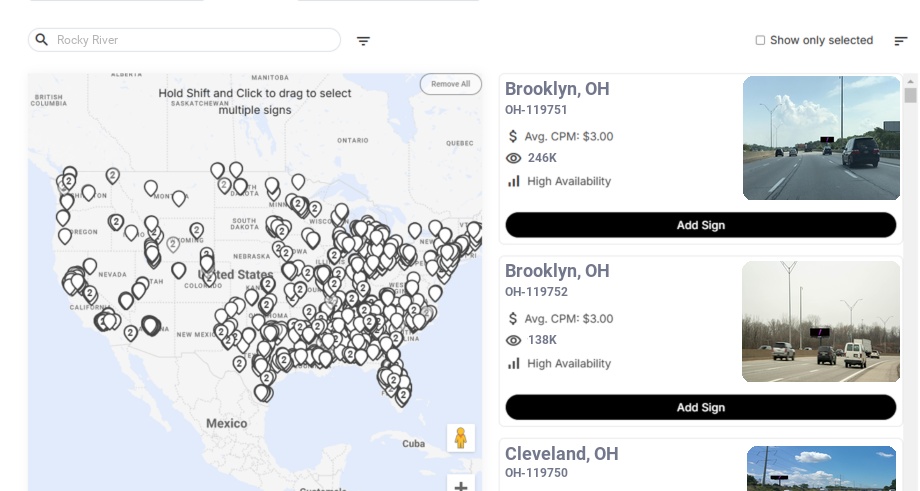
Blip lets you launch Rocky River billboards fast, reaching I-90 and I-480 commuters in Brooklyn and Cleveland without a traditional lease.
Set a budget that fits Rocky River, then let Blip pace your ads around west-side traffic and downtown Cleveland drives—no overspend.
Daypart on Blip to hit Rocky River rush hours, lunch runs, and evening lakefront traffic near Rocky River Reservation and Edgewater Park.
Track Rocky River campaigns in real time and shift spend as I-90, I-71, and game-day traffic patterns change.
Use Blip's creative tools to build bold Rocky River ads for affluent households, families, and downtown commuters in seconds.
No contracts means you can test Rocky River seasonal moments—spring home services, summer parks, and Browns weekends—then pause anytime.
Frequently Asked Questions About Billboard Advertising near Rocky River
How much does a billboard cost near Rocky River, Ohio with Blip?
With Blip, you control your budget from the start by setting a daily amount you’re comfortable with, and Blip automatically keeps your Rocky River billboards campaign within that limit. Because you pay per blip—a 7.5 to 10-second ad display—the cost of billboards near Rocky River, Ohio depends on exactly when and where you choose to advertise in the Rocky River area, plus current advertiser demand. That means you only pay for the impressions you actually receive, and you can adjust your budget at any time to ramp up or scale back.
Where can I advertise with Blip near Rocky River, Ohio?
With 7 digital billboards serving the Rocky River area from nearby Brooklyn and Cleveland, advertisers can use precise targeting, flexible scheduling, and smart creative to stay in front of commuters, families, and high-income professionals all day long. While the boards themselves are located in nearby Brooklyn and Cleveland, they are positioned on some of the most important routes serving the Rocky River area. These locations offer a highly efficient solution for advertisers searching for billboards near Rocky River that still capture strong highway volumes.
What kind of people live in the Rocky River area of Ohio?
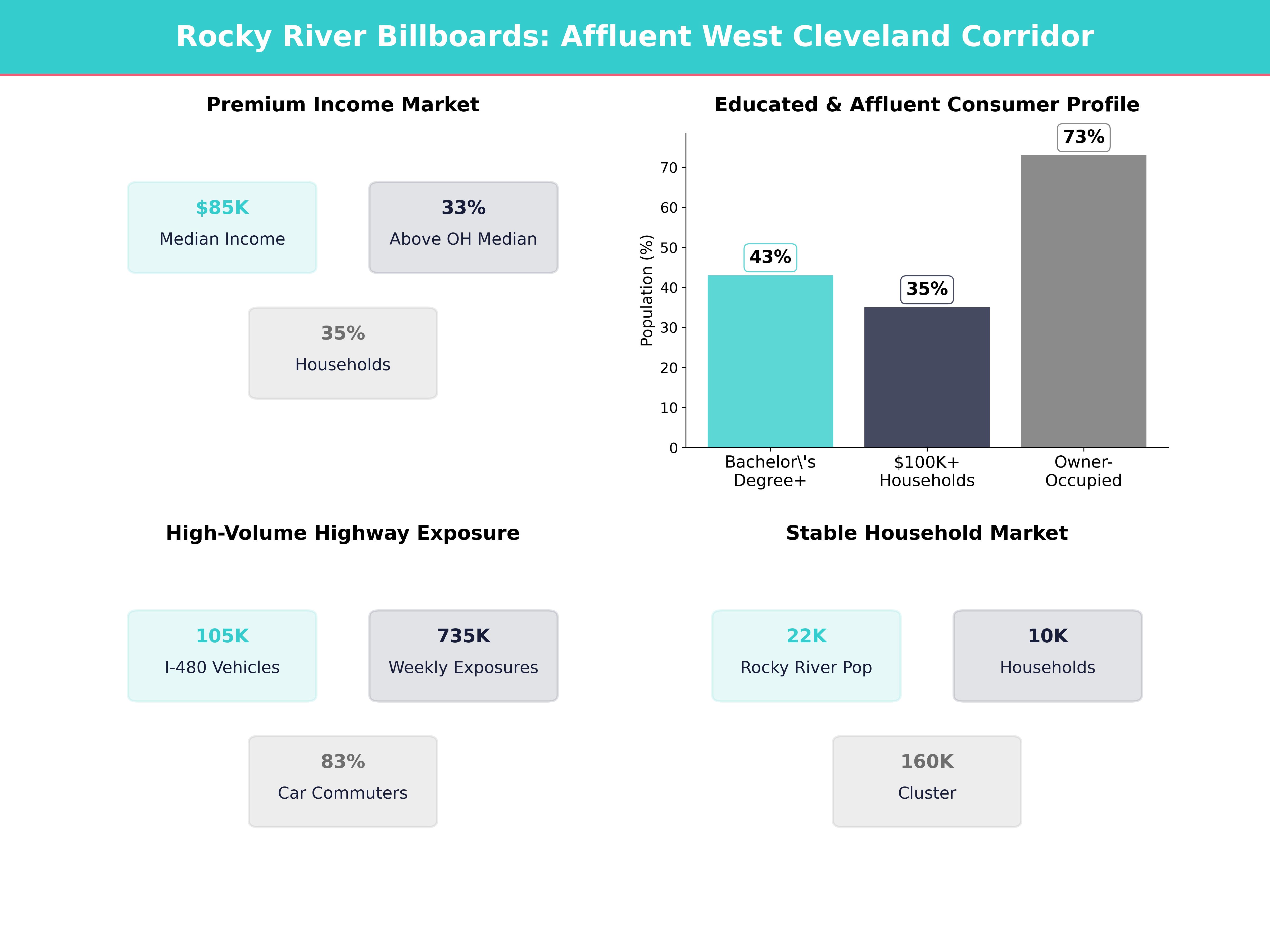
The Rocky River area itself has roughly 22,000 residents, with about 10,000 households and an average household size of around 2.1–2.3 people. Median household income in the Rocky River area is around $80,000–$90,000, roughly 25–40% higher than Ohio’s statewide median, and more than 40–45% of adults hold a bachelor’s degree or higher. Owner-occupied housing typically accounts for around 70–75% of occupied units, indicating a stable base of long-term homeowners.
When is the best time to run Rocky River, Ohio billboards with Blip for commuters?
Morning rush is typically 6:30–9:00 a.m., often peaking around 7:30–8:30 a.m., while evening rush runs from 3:30–6:30 p.m. and often peaks from 4:30–5:30 p.m. Across these periods, the same commuter may pass a board 10 or more times per week, allowing frequency to build quickly even with modest budgets. Using Blip’s dayparting and budgeting tools, you can set higher bids during morning and evening rush hours to reach commuters and lower bids in off-peak hours to maintain cost-efficient presence.
Why are Rocky River, Ohio billboards a good fit for local businesses?
The Rocky River area combines lakefront living, affluent neighborhoods, and easy access to downtown Cleveland, making it a powerful market for digital billboard advertisers. The area has a strong consumer profile and steady commuter flows, which makes it especially attractive for Rocky River billboards aimed at higher-income households. Residents tend to be brand-conscious and community-oriented, supporting local businesses while frequently traveling to nearby Westlake, Lakewood, downtown Cleveland, and Crocker Park.
Do I need a contract to advertise with Blip near Rocky River?
No, Blip has no long-term contracts or minimum commitments. You can start, pause, or stop your campaign at any time.
How fast can I launch a billboard campaign with Blip near Rocky River?
You can have your campaign live in minutes. Create a free account, select your locations, set your budget, upload your design, and start running once approved.
Where can I advertise with Blip near Rocky River?
Blip has digital billboards near Rocky River. You can browse available locations on a map, choose the ones that fit your audience, and start advertising right away.
Still have questions? Launch a campaign in minutes — no contracts, no commitments.
Start Your CampaignRocky River Billboard Advertising Guide
The Rocky River area combines lakefront living, affluent neighborhoods, and easy access to downtown Cleveland, making it a powerful market for digital billboard advertisers and anyone investing in billboard advertising near Rocky River. With 7 digital billboards serving the Rocky River area from nearby Brooklyn and Cleveland, we can use precise targeting, flexible scheduling, and smart creative to stay in front of commuters, families, and high‑income professionals all day long. These boards effectively function as the primary billboards near Rocky River for brands that want consistent visibility on the west side.
Understanding the Rocky River Area Market
Rocky River is a west-side suburb of Cleveland with a strong consumer profile and steady commuter flows, making it especially attractive for Rocky River billboards aimed at higher‑income households.
-
Population & households
- The Rocky River area itself has roughly 22,000 residents, with population holding steady or growing modestly (generally within 1–3% over the last decade based on recent community profiles).
- There are about 10,000 households, with an average household size of around 2.1–2.3 people, reflecting a mix of young professionals, empty‑nesters, and smaller families.
- Owner‑occupied housing typically accounts for around 70–75% of occupied units, indicating a stable base of long‑term homeowners who are attractive to home services, financial, and healthcare advertisers.
-
Income & spending power
- Median household income in the Rocky River area is around $80,000–$90,000, roughly 25–40% higher than Ohio’s statewide median, giving residents above‑average disposable income.
- A significant share of households earn $100,000+ annually; in many west‑side communities near Rocky River, that group often represents 30–40% of households.
- More than 40–45% of adults hold a bachelor’s degree or higher, supporting demand for higher‑end retail, financial services, healthcare, travel, and professional services.
- In similar west‑side Cleveland suburbs, annual consumer spending on categories like dining out, entertainment, and retail commonly exceeds $30,000 per household, with $4,000–6,000 per year on dining and $3,000–5,000 on entertainment and recreation.
-
Age & lifestyle
- The age spread is fairly balanced: a strong base of 35–64‑year‑old professionals (often comprising 35–40% of the population), a sizable population of school‑age children and teens (roughly 18–22%), and an above‑average share of seniors 65+ (often 20% or more in many west‑side lakefront suburbs).
- The Rocky River area feeds into highly rated local schools, drawing families who are willing to invest in tutoring, youth sports, private lessons, and enrichment programs.
- Residents tend to be brand‑conscious and community‑oriented, supporting local businesses while frequently traveling to nearby Westlake, Lakewood, downtown Cleveland, and Crocker Park.
- The broader west‑side Cleveland cluster (Rocky River, Lakewood, Fairview Park, Westlake, Bay Village) represents a combined population of roughly 150,000–170,000 residents within a 15–20 minute drive.
Combined with the broader Cleveland–Elyria metro area’s population of around 2 million, campaigns serving the Rocky River area can reach both local residents and a large regional audience who work, shop, or recreate nearby. The metro also functions as a regional employment hub with well over 900,000 jobs, including tens of thousands in downtown Cleveland alone, which expands the effective reach of billboard advertising near Rocky River beyond the immediate suburb.
For more local context, advertisers can reference:
- City of Rocky River: rrcity.com
- City of Cleveland: clevelandohio.gov
- City of Brooklyn: brooklynohio.gov
- Rocky River Chamber of Commerce
- Destination Cleveland (regional tourism)
- Cuyahoga County government (regional data and services)
- Regional news and trends: cleveland.com, wkyc.com, fox8.com news5cleveland.com
Where Our Billboards Reach the Rocky River Area
While the boards themselves are located in nearby Brooklyn and Cleveland, they are positioned on some of the most important routes serving the Rocky River area. For advertisers searching for billboards near Rocky River that still capture strong highway volumes, these locations offer a highly efficient solution.
-
Brooklyn, Ohio (about 5.4 miles from Rocky River)
- Brooklyn sits just south of the Rocky River area along I‑480 and key commercial corridors like Ridge Road and Brookpark Road.
- I‑480 in western Cuyahoga County typically carries 90,000–120,000 vehicles per day, providing 630,000–840,000 weekly vehicle exposures.
- Ridge Road and Brookpark Road are established retail corridors, with many segments handling 20,000–30,000 vehicles per day, ideal for reaching price‑sensitive shoppers and service‑oriented traffic.
-
These Brooklyn‑area boards are ideal for:
- Reaching Rocky River residents driving to/from the airport, Parma, Middleburg Heights, and Independence.
- Targeting workers who live elsewhere but shop or dine in the Rocky River area.
- Capturing airport‑related traffic to Cleveland Hopkins International Airport (which handles 7–10 million passengers per year).
-
Cleveland, Ohio (about 6.4 miles from Rocky River)
- Cleveland‑area boards near I‑90, I‑71, and downtown feeder roads catch both west‑side commuters and destination travelers.
- I‑90 west of downtown Cleveland often handles 100,000–130,000 vehicles per day, including a large share of west‑side residents from the Rocky River, Lakewood, and Fairview Park areas, making these prime placements for Rocky River billboards targeting regular commuters.
- I‑71 near downtown and the airport can carry 120,000+ vehicles per day, connecting the west side to central business districts and regional attractions.
- Downtown surface streets and feeder roads routinely see 15,000–30,000 vehicles per day, plus significant pedestrian volumes on event nights.
-
These locations are ideal for:
- Branding to Rocky River area residents who work downtown.
- Promoting events, sports, and entertainment that draw people from the west side.
- Capturing out‑of‑town visitors heading to or from the airport and downtown hotels.
- For regional transportation and traffic planning context, advertisers can reference the Ohio Department of Transportation District 12 and the Northeast Ohio Areawide Coordinating Agency (NOACA).
By using Blip, we can selectively run on these 7 boards, ensuring continuous visibility near the Rocky River area’s primary travel arteries without paying for wasteful coverage outside your target. For brands that want flexible billboard rental near Rocky River rather than a long‑term traditional lease, this network offers an especially cost‑effective option.
Commuter Patterns and Daily Rhythms to Target
Rocky River area residents are heavily car‑dependent and commute across the west side and into downtown, which is why well‑placed Rocky River billboards on major corridors are so effective.
-
Commute characteristics
- In much of west‑side Cuyahoga County, over 80–85% of workers commute by car, either alone or in carpools, with public transit usually representing under 10% of commute trips.
- Typical one‑way commute times cluster around 22–28 minutes, with roughly 35–40% of workers commuting 15–29 minutes and another 20–25% commuting 30–44 minutes.
- Thousands of Rocky River and neighboring residents travel daily to jobs in downtown Cleveland, University Circle
-
Key routes include:
- I‑90 east–west between Rocky River and downtown Cleveland.
- Detroit Road and Lake Road for localized travel between Rocky River, Lakewood, and Bay Village.
- I‑480 and Clifton Boulevard for cross‑town movements.
- The Greater Cleveland Regional Transit Authority (RTA) also serves the corridor with bus and rail routes, useful for advertisers targeting park‑and‑ride or transit‑adjacent audiences.
-
Key drive‑time windows
- Morning rush: 6:30–9:00 a.m. (often peaking around 7:30–8:30 a.m.)
- Midday shopping & errands: 11:00 a.m.–2:00 p.m.
- Evening rush: 3:30–6:30 p.m. (peak often 4:30–5:30 p.m.)
- Evening leisure: 6:30–9:30 p.m. (restaurants, gyms, youth sports, events)
- Across these periods, the same commuter may pass a board 10 or more times per week, allowing frequency to build quickly even with modest budgets.
-
Weekday vs. weekend
- Weekdays: skew toward office workers commuting between the Rocky River area and downtown Cleveland, University Circle, Independence, and west‑side industrial corridors. In many corridors, weekday traffic volumes can be 10–20% higher than weekend volumes.
-
Weekends: heavier leisure traffic to:
- Lake Erie shoreline parks, the Cleveland Metroparks Rocky River Reservation, and Edgewater Park.
- Shopping and dining hubs such as Crocker Park (Westlake), downtown Cleveland entertainment districts, and local Rocky River/Lakewood main streets.
- Crocker Park alone attracts millions of visits annually.
Using Blip’s dayparting and budgeting tools, we can set higher bids during morning and evening rush hours to reach commuters and lower bids in off‑peak hours to maintain cost‑efficient presence, optimizing every dollar you spend on billboard advertising near Rocky River.
Seasonal Trends and Local Events
The Rocky River area has four distinct seasons that change how people move and what they buy. Aligning billboard campaigns with these patterns significantly improves response.
-
Winter (December–February)
- Northeast Ohio often records 40–60 inches of snowfall annually, which increases demand for auto care, home services, healthcare, and indoor activities.
- Shorter daylight hours (as low as 9 hours per day in December) increase the relative visibility of illuminated digital billboards.
-
Strong categories:
- Auto repair, tires, insurance
- Indoor recreation and fitness
- Healthcare (urgent care, flu shots, specialists)
- Financial services (tax prep, banking, investment planning)
- Strategy: Use bright, high‑contrast artwork that reads well in snow and low light. Emphasize convenience, safety, and “on your way home” messaging.
-
Spring (March–May)
- Home improvement, landscaping, and outdoor activity spike as temperatures climb from winter averages in the 20s–30s°F to 50s–60s°F.
- Regional home selling activity often rises 25–40% from winter levels, making this a prime window for real estate and home services advertisers.
-
Strong categories:
- Contractors, landscapers, home services
- Real estate (listings, new developments, mortgage brokers)
- Youth sports and camps
- Strategy: Increase frequency near paydays and weekends. Use aspirational visuals: lush lawns, renovated homes, and family‑centric imagery.
-
Summer (June–August)
- Schools out, heavy use of parks, Lake Erie, and festivals.
- Average high temperatures in the 70s–80s°F drive increased outdoor dining, travel, and recreation spending.
- Popular regional attractions and events can draw 10,000–30,000 people on peak days, boosting highway and arterial traffic.
-
Strong categories:
- Restaurants, ice cream, and beer gardens
- Tourism, attractions, museums, and events
- Back‑to‑school promotions kicking off late July/early August
- Strategy: Highlight proximity (“Minutes from the Rocky River area”), post clear exit/turn cues, and use fast‑recognition creative for highway boards given higher speeds and potential construction detours.
-
Fall (September–November)
- Back to school, Browns season, and pre‑holiday planning.
- Back‑to‑school retail and services often see double‑digit percentage sales increases versus summer baselines.
- Pro football and other sports events can bring 60,000+ visitors to downtown on game days, amplifying exposure for downtown‑oriented messaging.
-
Strong categories:
- Education, tutoring, and extracurriculars
- Retail (early gift shopping, apparel)
- Healthcare (annual checkups, elective procedures before year‑end benefits reset)
- Strategy: Align bursts with the start of school and the run‑up to major shopping weekends like Black Friday and Small Business Saturday.
Local events and organizations worth considering in your calendar:
- Cleveland Metroparks Rocky River Reservation: attracts hundreds of thousands of visits annually; see clevelandmetroparks.com for seasonal events.
- Downtown Cleveland sports & entertainment (Guardians, Cavaliers, Browns, concerts) drawing tens of thousands per event; see Destination Cleveland and team sites for schedules, including clevelandbrowns.com, clevelandguardians.com, and cavs.com.
- City events through Rocky River’s local government and community calendar: rrcity.com.
- Additional downtown and neighborhood event listings: downtowncleveland.com and lakewoodoh.gov.
With Blip, we can increase impressions during specific weeks (e.g., festival weekends, playoff runs, or back‑to‑school) without committing to a long, fixed contract, giving you seasonal flexibility with your billboard rental near Rocky River.
Creative Best Practices for the Rocky River Area
Design choices should reflect both driving conditions and the Rocky River area’s demographics.
1. Design for fast‑moving traffic
- Limit to 7–10 words of main text plus your logo/URL.
- Use large fonts (at least 18–24 inches on final board scale) and bold, sans‑serif type.
- High‑contrast color pairings: dark text on light background or vice versa; avoid subtle color gradients that wash out.
- One dominant image or icon; no cluttered photo collages.
- Remember that at highway speeds (55–65 mph), drivers typically have 3–6 seconds to absorb your message.
2. Match the area’s visual identity
Rocky River area residents are used to:
- Lake and park imagery (Lake Erie, Rocky River Reservation).
- Well‑kept homes and tree‑lined streets.
- Contemporary, clean branding from national chains mixed with classic neighborhood storefronts.
Leverage:
- Lake and nature themes for lifestyle brands, real estate, and healthcare.
- Family‑friendly visuals for schools, youth programs, and local attractions.
- A more polished, professional look for financial, legal, and medical services, reflecting the area’s higher education and income levels.
- For education‑related campaigns, referencing strong local districts like Rocky River City Schools can build trust.
3. Localize your message
Because the boards themselves are near Rocky River rather than inside it, copy should clearly reference the area to create relevance:
- “Serving the Rocky River area since 1995”
- “Just 8 minutes from the Rocky River area on Detroit Rd”
- “Trusted by families near Rocky River, Lakewood, and Westlake”
Avoid generic claims; specificity builds trust:
- Add distance and direction (“2 miles north of I‑90”), especially if traffic is moving at 55–65 mph.
- Use exit numbers or landmark references: “Next to the Rocky River Reservation entrance” or “Near Great Northern Mall”.
4. Use multiple creatives for different audiences
Blip’s flexibility lets us rotate different messages based on time of day:
- Morning creative: “Beat the traffic from the Rocky River area – enroll in online classes now.”
- Midday creative: “Lunch special near the Rocky River area – exit now.”
- Evening creative: “Your Rocky River area urgent care – open late tonight.”
Even two or three variations can dramatically increase relevance without increasing design costs significantly, especially when you’re testing what type of billboard advertising near Rocky River performs best.
Smart Scheduling and Budgeting With Blip
Because Blip sells digital billboard space one “blip” at a time (a single play, usually 7.5–10 seconds), we can tailor campaigns exactly to your goals and budget.
1. Concentrate budget where it matters most
For Rocky River area targeting, we typically recommend:
- Heavier investment on boards along I‑90 and I‑480 corridors in Cleveland and Brooklyn that capture west‑side commuters. Given daily volumes of 90,000–130,000 vehicles, even a small share of plays can translate into tens of thousands of weekly impressions.
- Moderate presence on secondary routes for reinforcement.
We can use:
-
Higher bids during:
- 7:00–9:00 a.m. & 4:00–6:30 p.m. Monday–Friday for commuter‑oriented offers.
- Pre‑game hours during major sports events for restaurant and entertainment promotions (for example, 3–7 p.m. on Cleveland Browns home game days).
- Lower bids overnight or midday for long‑term brand awareness at lower cost per impression.
2. Match impression goals to market size
For a local business focused primarily on the Rocky River area:
- A typical starting point is to aim for 20,000–50,000 impressions per week, spread across our 7 boards, for steady visibility. At that level, a frequent commuter might see your message 5–10 times per week.
- Regional or multi‑location brands may target 100,000+ impressions per week to reach both Rocky River area residents and the greater Cleveland west‑side audience.
- Over a 3‑month campaign at 50,000 impressions per week, you can generate roughly 600,000 total impressions, enough to build strong awareness in a market of 20,000–30,000 core residents plus regular visitors.
We can scale up or down at any time—ideal for testing before a larger spend and dialing in the right level of billboard rental near Rocky River for your goals.
3. Use short, focused flights
Instead of a single long campaign, break your budget into specific flights:
- 2‑week push around a grand opening or new product.
- 3–4 week bursts aligned with seasonal peaks (spring home improvement, back‑to‑school).
- Ongoing “always‑on” baseline coverage plus high‑intensity weeks tied to promotions.
Blip makes it easy to pause, adjust bids, change creatives, or shift which boards you use without renegotiating contracts, giving you unmatched control over billboard advertising near Rocky River.
Industry‑Specific Opportunities in the Rocky River Area
Different sectors can capitalize on the Rocky River area’s demographics and traffic in distinct ways.
1. Local retail & restaurants
- Audience: Affluent residents and office workers commuting to/from downtown.
- The typical Rocky River‑area household may spend $3,000–$5,000 per year on dining out and $2,000–4,000 on local retail beyond groceries, creating strong potential for ROI from geographically targeted awareness.
-
Strategy:
- Emphasize proximity (“3 minutes from the Rocky River area off Detroit Rd”).
- Promote time‑sensitive offers at lunch and dinner.
- Use strong calls to action: “Tonight,” “Exit now,” “Happy hour until 6.”
- Coordinate with local dining spotlights and neighborhood events listed on Destination Cleveland and cleveland.com.
2. Home services & real estate
- Audience: Homeowners in established neighborhoods plus move‑up buyers from across the metro.
- In many west‑side suburbs, 70–75% of households are owner‑occupied, and a significant share of homes are valued above regional medians, supporting higher‑value renovation and real estate services.
-
Strategy:
- Align flights with spring and fall when listing and renovation activity is highest.
- Show real photos of Rocky River area‑style homes and streets.
- Reference local familiarity: “Trusted in the Rocky River area and Westlake for 20+ years.”
- Consider timing with local housing‑market cycles reported by outlets like cleveland.com and county property data from cuyahogacounty.gov.
3. Healthcare, dental, and senior services
- Audience: Families and older adults; Rocky River area skews slightly older than many suburbs, with seniors often representing 20% or more of residents in nearby communities.
- Healthcare spending per household in similar suburbs commonly exceeds $5,000–7,000 annually, creating strong demand for primary care, specialists, and senior services.
-
Strategy:
- Highlight accessibility (easy parking, evening/weekend hours) and insurance acceptance.
- Use reassuring, human‑centric imagery—doctors, families, seniors.
- Target commute times for appointment booking messages.
- Consider aligning campaigns with preventive‑care pushes and seasonal health messaging promoted by local health systems highlighted in regional news sources like ideastream.org.
4. Financial, legal, and professional services
- Audience: High‑earning professionals commuting to downtown and regional business centers.
- In higher‑income west‑side suburbs, a substantial share of households—often 30–40%—earn $100,000+, making them strong candidates for wealth management, legal, and professional services.
-
Strategy:
- Focus on credibility indicators (years in business, local awards, “Top‑rated in the Rocky River area”).
- Use simple, authoritative designs—minimal text, clear logo, direct CTA (“Schedule your consultation”).
- Run heavier frequency Monday–Thursday for B2B and financial planning messages.
- Tie campaign bursts to key financial moments: tax season (January–April), year‑end planning (October–December), and local business events or chamber programming via the Rocky River Chamber of Commerce.
5. Education and youth programs
- Audience: Parents of K‑12 and college‑age students.
- In comparable suburbs, children under 18 often comprise 20–25% of the population, and households with school‑age kids regularly invest thousands of dollars per year in tutoring, sports, arts, and camps.
-
Strategy:
- Align campaigns with enrollment windows (spring and late summer).
- Highlight location relative to the Rocky River area, safety, and outcomes (“95% college acceptance”).
- Use warm, aspirational images of students and families.
- Coordinate messaging with school calendars and community events posted by Rocky River and nearby districts such as rrcs.org and Lakewood City Schools.
Measuring and Optimizing Your Campaign
While billboards are a top‑of‑funnel medium, we can still measure and improve campaign performance in the Rocky River area.
1. Use clear, trackable calls to action
- Include unique URLs or QR codes specifically for the billboard campaign.
- Use billboard‑only promo codes (“Mention RIVER20”) for retailers and restaurants.
- Direct drivers to simple actions: “Text RIVER to 55555”, “Visit RiverAuto.com”.
- Track conversion rates: for example, if 2–5% of website visits from your target ZIP codes use the billboard code, you have a strong indicator of ROI.
2. Correlate with web and foot traffic
Monitor:
- Website analytics by geography (look for traffic from the Rocky River area, west‑side suburbs, and downtown Cleveland).
- Changes in call volume or form fills during flight periods.
- POS data and foot traffic for locations near highways and major roads.
- Compare performance week‑over‑week and year‑over‑year; a sustained 5–15% lift in key metrics during flight periods is a common target for successful awareness campaigns.
3. Test and refine creative
Run A/B tests by:
- Rotating multiple creatives at the same time and tracking which code or URL performs best.
- Changing one element at a time: headline, background color, or offer.
- Adjusting copy for clarity: sometimes reducing words from 12 to 7 dramatically improves recall.
- Reviewing results every 2–4 weeks and reallocating budget to the best‑performing creatives and time slots.
Over 4–8 weeks, we can use these data points to refine your messaging and flight structure for maximum impact, making sure your investment in billboards near Rocky River continues to improve over time.
By combining the Rocky River area’s strong demographics, heavy commuter traffic into Cleveland, and a flexible network of 7 digital billboards in nearby Brooklyn and Cleveland, we can build campaigns that deliver both broad awareness and targeted results. With smart scheduling, localized creative, and continuous optimization, digital billboards through Blip become a powerful, budget‑friendly way to connect with the Rocky River area every day of the year, whether you’re testing billboard advertising near Rocky River for the first time or scaling an established presence.