Billboards in Youngstown, OH
No Minimum Spend. No Long-Term Contracts. Just Results.
Trusted by Leading Brands


Billboard advertising
in Youngstown has never been easier



How much is a billboard in Youngstown?
Why Choose Blip for Billboard Advertising in Youngstown
Blip lets you launch on Youngstown's I-680 commuter flow in minutes—perfect for reaching daily drivers heading downtown, YSU, and hospital campuses.
Set any budget in Youngstown and pay only when ads play, so you can test US-224 Boardman shoppers or Warren-Niles traffic without contracts.
Use Blip's dayparting to catch Youngstown fairgoers, Covelli Centre nights, and Eastwood Mall rushes when local traffic is hottest.
Track Youngstown results in real time and shift spend fast if I-80 turnpike traffic outperforms downtown or Boardman routes.
Blip's creative tools make it easy to tailor Youngstown ads for Canfield Fair, YSU students, and Mahoning Valley commuters with local messaging.
Frequently Asked Questions About Billboard Advertising in Youngstown
How much does a billboard cost in Youngstown with Blip?
With Blip, billboard advertising in Youngstown can fit a wide range of budgets because you only pay when your ad actually displays. Each “blip” is a 7.5-to-10-second spot on a rotating digital billboard, starting at just $0.01 per display. Your daily budget guides Blip’s algorithm as it bids for open ad slots, and the cost per blip changes based on time of day, location, and advertiser demand.
Where can I advertise with Blip in Youngstown for commuter traffic?
I-680 is the valley’s most important urban expressway, with central segments commonly in the 60,000 to 80,000 AADT range. This route ties together downtown Youngstown, Youngstown State University, hospital campuses, and connections to the Covelli Centre and government offices. It is especially strong for healthcare providers, universities, employers, restaurants, entertainment venues, and legal, insurance, and financial services.
What parts of Youngstown have the best billboard audience for shoppers and families?
US-224 is the Mahoning Valley’s retail spine, with major Boardman segments frequently in the 30,000 to 40,000-plus AADT range near Market Street and the commercial zone around Southern Park Mall. The Warren-Niles side of the market also gives us both residential reach and destination retail, with the Eastwood Mall Complex capturing shoppers from across Trumbull County and beyond. These corridors are especially useful for retail, restaurants, home services, automotive, and healthcare and wellness campaigns.
Why is Youngstown a good market for Blip billboard ads?
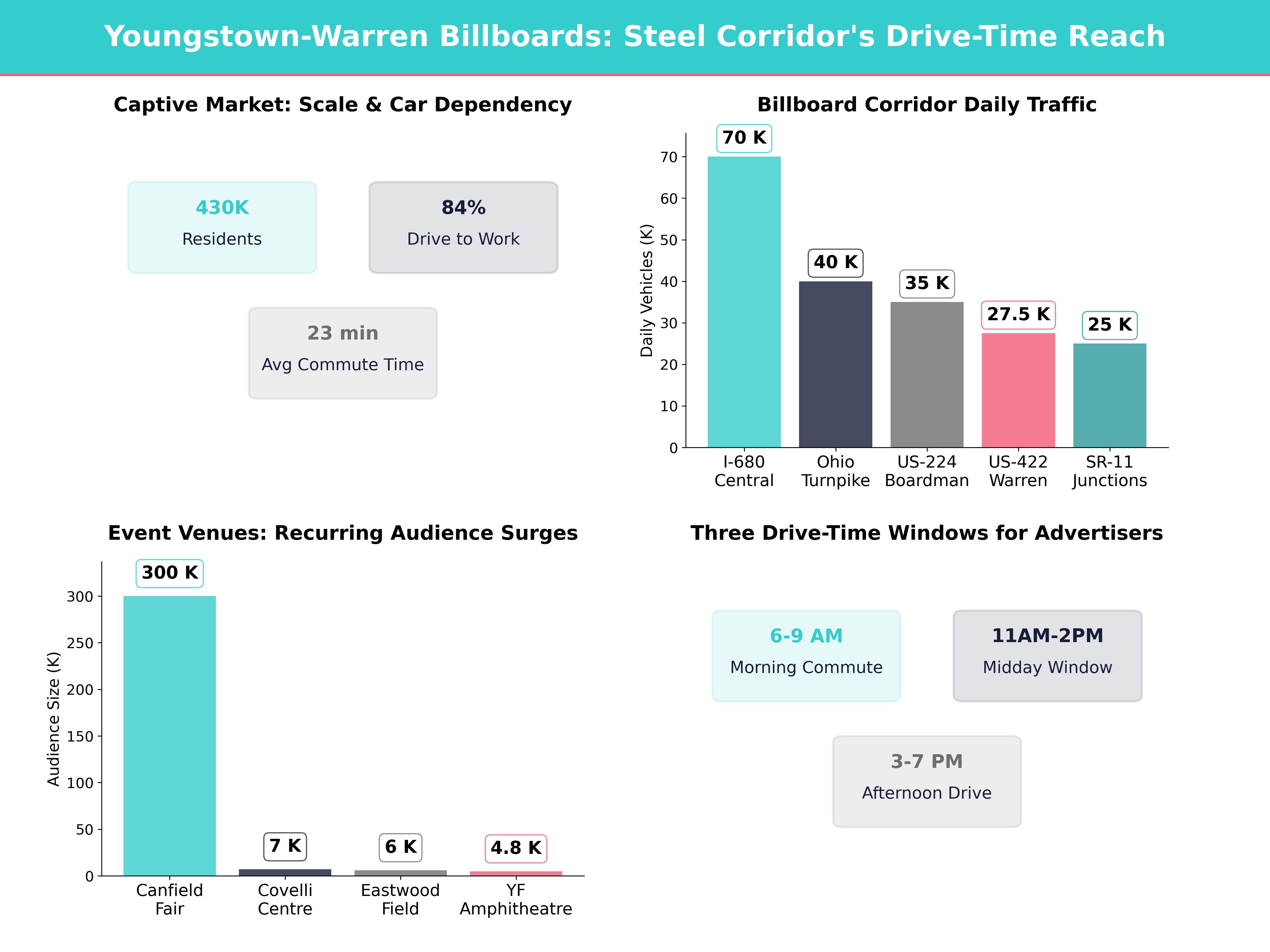
Youngstown is a compelling billboard market because it gives us a dense daily-drive audience without the pricing pressure of a mega-metro. Mahoning County and Trumbull County together hold 430,591 residents, and roughly 84% of work trips are made by car, so roadside visibility remains central. The market also has major draws like the Canfield Fair, the Covelli Centre, the Youngstown Foundation Amphitheatre, and the Eastwood Mall Complex.
Do I need a contract to advertise with Blip in Youngstown?
No, Blip has no long-term contracts or minimum commitments. You can start, pause, or stop your campaign at any time.
How fast can I launch a billboard campaign with Blip in Youngstown?
You can have your campaign live in minutes. Create a free account, select your locations, set your budget, upload your design, and start running once approved.
Where can I advertise with Blip in Youngstown?
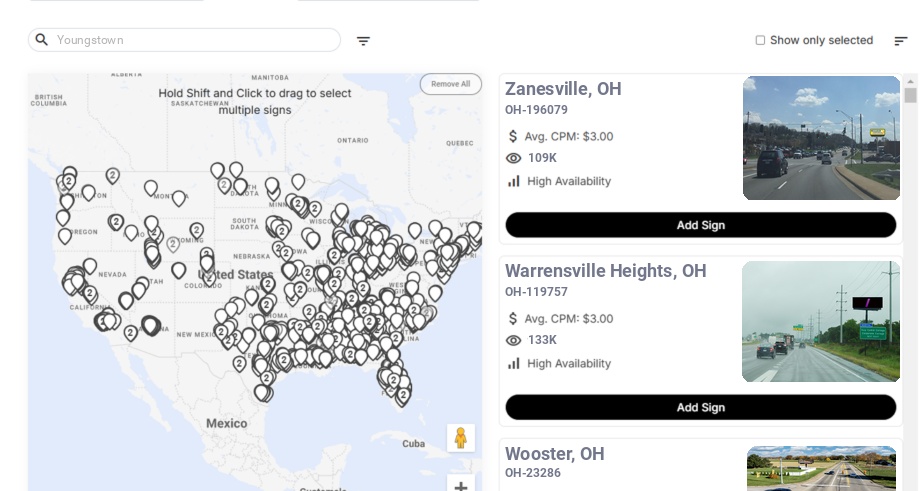
Blip has digital billboards in Youngstown. You can browse available locations on a map, choose the ones that fit your audience, and start advertising right away.
Still have questions? Launch a campaign in minutes — no contracts, no commitments.
Start Your CampaignYoungstown Billboard Advertising Guide
Youngstown is a compelling billboard market because it gives us a dense daily-drive audience without the pricing pressure of a mega-metro. Mahoning County Trumbull County 430,591 residents, with 60,068 in Youngstown and 39,201 in Warren, plus large suburban consumer bases in places such as Boardman Township and Austintown Eastgate Regional Council of Governments 84% of work trips made by car, so roadside visibility remains central to how people move through the Mahoning Valley. We also benefit from major local draws, including the 300,000-plus annual attendance of the Canfield Fair, the 5,700-seat Covelli Centre, the 4,800-capacity Youngstown Foundation Amphitheatre Eastwood Mall Complex.
Youngstown Market Overview for Billboard Advertisers
Youngstown works best when we think of it as a two-county advertising market, not just a single city. Mahoning County 228,614 residents, Trumbull County 201,977, and the corridor from Youngstown to Warren to Niles Boardman creates multiple daily movement patterns that digital billboards can capture.
Youngstown’s population trend favors frequency over novelty
This is not a fast-growth Sun Belt market, and that is useful to know upfront. Across Mahoning and Trumbull Counties combined, population moved from 446,277 in 2010 to 430,591 in 2020, which is a decline of about 3.5%. Youngstown itself declined from 66,982 to 60,068 over that decade, and Warren moved from 41,557 to 39,201. For advertisers, that means our best results usually come from repeated exposure on established routes rather than from chasing brand-new housing growth on the fringe.
Youngstown’s suburban centers matter as much as the urban core
The Mahoning Valley’s consumer spending is spread across several hubs. The Boardman area remains near 40,000 residents, Austintown 29,677, and Canfield 7,300 residents and strong household spending power and event traffic. We should treat these submarkets differently because the errands, income profiles, and trip purposes are not the same.
Youngstown’s economy is broad enough for both B2C and B2B campaigns
The local economy still reflects the valley’s industrial roots, but it is no longer a one-industry market. Youngstown State University enrolls roughly 11,000 students, while healthcare systems such as Mercy Health Akron Children’s Hospital, and Southwoods Health Lordstown Ultium Cells $2.3 billion, 2.8 million-square-foot battery plant. On the consumer side, the Eastwood Mall Complex spans more than 3.2 million square feet and more than 200 stores, restaurants, and entertainment venues, while Hollywood Gaming at Mahoning Valley Race Course 1,000 video lottery terminals.
What Youngstown’s commuting patterns mean for billboard strategy
Regional planning data from Eastgate Regional Council of Governments 84% of workers to arrive by personal vehicle, while transit, walking, and biking remain low-share commute modes in most suburban areas. Average commute times are generally in the 20-to-24-minute range, or about 23 minutes, which is long enough for repetition to matter, but short enough that location relevance matters even more. That combination makes Youngstown especially well suited to billboard campaigns focused on convenience, awareness, and route-based recall.
Key Traffic Corridors for Youngstown Billboards
Youngstown’s travel patterns are concentrated on a manageable set of highways and arterial routes. According to traffic maps and count resources from the Ohio Department of Transportation Eastgate Regional Council of Governments
I-680 through Youngstown
I-680 is the valley’s most important urban expressway. ODOT count stations commonly place central I-680 segments in the 60,000 to 80,000 AADT range, especially near downtown approaches and major interchanges. This route ties together downtown Youngstown, Youngstown State University, hospital campuses, and connections to WRTA, the Covelli Centre, and government offices.
This corridor is especially strong for the following advertisers: Healthcare providers perform well here because drivers are heading toward hospitals, specialty clinics, and urgent care sites, Universities, training programs, and employers benefit from repeated weekday exposure near campus and job centers, Restaurants, entertainment venues, and events gain from pre-event and post-work traffic moving into downtown, and Legal, insurance, and financial services benefit from high-frequency local exposure in a route people use repeatedly.
US-224 and Market Street in Boardman
US-224 is the Mahoning Valley’s retail spine. ODOT counts frequently show major Boardman segments in the 30,000 to 40,000-plus AADT range, particularly near Market Street and the commercial zone around Southern Park Mall
This corridor usually works best for the following categories: Retail, restaurants, and grocery-adjacent brands because the trip purpose is already purchase-oriented, Home services because homeowners in Boardman, Poland Automotive dealers and repair shops because the route carries people comparing options and running practical errands, and Healthcare and wellness services because Boardman is a major destination for outpatient, specialty, and elective care.
I-80, the Ohio Turnpike, and I-76 around Youngstown
Youngstown sits in a valuable regional position between Cleveland, Akron, and Pittsburgh, roughly 70 miles from both Cleveland and Pittsburgh. That geography makes I-80, the Ohio Turnpike and Infrastructure Commission corridor, and I-76 especially important for regional reach. Turnpike segments through the valley commonly carry 40,000-plus vehicles per day, with a heavy truck component.
These placements are especially useful for the following advertisers: Casinos, hotels, travel centers, and quick-service restaurants because travelers are making stop-or-continue decisions in real time, Industrial employers and staffing firms because freight routes align with warehousing, distribution, and plant commutes, B2B suppliers because decision-makers, contractors, and truck traffic move through this corridor consistently, and Regional healthcare systems and colleges because these boards can reach people crossing county lines for services.
SR-11, US-422, and the Warren-Niles retail belt
SR-11 is a north-south connector that links the Mahoning Valley to surrounding counties, while US-422 and nearby SR-82 carry significant east-west movement through Warren, Niles, and the Eastwood Mall Complex. Near major junctions, SR-11 commonly runs around 20,000 to 30,000 AADT, and US-422 in the Warren-Niles zone often falls in the 20,000 to 35,000 AADT range.
We usually like this belt for the following campaigns: Family retail and entertainment because Eastwood pulls shoppers from both Mahoning and Trumbull Counties, Recruiting campaigns because the route touches manufacturing, warehousing, and service employment zones, Healthcare and senior services because Trumbull County’s age profile supports strong demand for those categories, and Community institutions and events because this corridor reaches neighborhoods that are loyal to local brands and destinations.
Youngstown Audience Segments We Can Reach
One of Youngstown’s biggest advantages is that the audience is not one-dimensional. We can reach daily commuters, suburban families, students, regional shoppers, industrial workers, and event-driven visitors without needing a giant geography.
Youngstown commuters and daily errand traffic
The base audience is local and habitual. With more than 430,000 residents across Mahoning and Trumbull Counties, and a drive-alone share of roughly 84% in regional planning data, daily repetition is the engine of billboard performance here. The compact scale of the market means one commuter may pass the same corridor several times per week, which helps local brands build recall quickly.
Youngstown students, sports fans, and downtown event audiences
Youngstown State University brings roughly 11,000 students into the urban core, along with faculty, staff, alumni, and event traffic. The Covelli Centre seats about 5,700 for hockey and up to 7,000 for concerts, while the Youngstown Foundation Amphitheatre 4,800 capacity for warm-weather shows. For advertisers selling food, nightlife, apparel, mobile services, education, or healthcare, those event pulses are highly actionable.
Youngstown families and regional shoppers
Boardman, Niles Eastwood Mall Complex has more than 200 stores across 3.2 million square feet, and Southern Park Mall Mill Creek MetroParks 4,000 acres, which reinforces the area’s family and outdoor culture, while Hollywood Gaming at Mahoning Valley Race Course 1,000-plus gaming positions. That mix creates demand for dining, healthcare, finance, home improvement, and entertainment messages.
Youngstown industrial, logistics, and shift-based workers
The Mahoning Valley remains deeply connected to production, transport, and trades. Ultium Cells $2.3 billion investment and a 2.8 million-square-foot industrial footprint, and the broader Lordstown
Youngstown visitors and event-driven tourists
Tourism in Youngstown is not only about overnight leisure travelers. It is also about regional visitors who come in for events, concerts, fairs, gaming, sports, and family outings. The Canfield Fair typically attracts more than 300,000 visits over 6 days, Eastwood Field seats about 6,000 for Mahoning Valley Scrappers games, and attractions promoted by Visit Youngstown
Seasonal and Timing Opportunities in Youngstown
Youngstown’s calendar gives us several clear windows when specific billboard strategies can outperform a generic always-on approach. The best campaigns usually respect both the local event schedule and the region’s weather patterns.
Spring in Youngstown favors services, graduations, and home improvement
From March through May, consumers shift from winter needs to tax-season spending, spring cleanup, home projects, and graduation planning. This is a smart time for roofing, HVAC, landscaping, patio, remodeling, auto care, and education campaigns. Youngstown State University spring events and commencement activity also create a useful pulse for restaurants, hotels, and gift-oriented retailers.
Summer in Youngstown brings concerts, parks, baseball, and leisure traffic
Summer is when the valley feels most event-driven. The 4,800-capacity Youngstown Foundation Amphitheatre 5,700-seat Covelli Centre event calendar, the 6,000-seat Eastwood Field, Mill Creek MetroParks Lake Milton State Park
Late summer and fall are peak billboard season in Youngstown
If we had to choose one standout seasonal window, it would be late August through November. The Canfield Fair alone brings 300,000-plus attendees in 6 days, Youngstown State University returns for the fall term, high school football dominates Friday nights, and shopping activity rises steadily into the holiday season. This is the strongest stretch for political campaigns, colleges, entertainment venues, sports bars, auto dealers, urgent care, and hiring pushes.
Winter in Youngstown rewards practical offers and strong contrast
Winter campaigns in Youngstown should acknowledge how people actually feel and drive in the region. Snow, salt, early darkness, and cold temperatures make practical categories more relevant, including tires, auto repair, heating, healthcare, pharmacies, tax preparation, and indoor entertainment. Holiday retail in Boardman and Niles also creates a sharp spike in November and December, so we should use short promotional flights and clear price-led creative during that period.
Billboard Design Tips for the Youngstown Market
Youngstown responds best when we respect the valley’s practical, local, and community-oriented mindset. The right creative here usually feels specific and credible, not flashy for the sake of flash.
In Youngstown, clear value often beats abstract branding
Many local audiences are highly price-aware and service-aware. We usually get better results when we lead with a concrete promise, such as convenience, speed, experience, financing, local trust, or a limited-time offer, rather than relying on vague brand language. In a market shaped by healthcare workers, tradespeople, plant shifts, and family errands, clarity matters.
Youngstown creative should use place names people actually identify with
People in this market often identify strongly with their immediate community. Messaging that references Boardman, Austintown, Canfield Niles Poland Youngstown can feel more relevant than a county-level message. A line that tells drivers the service is “in Boardman” or “near Eastwood” usually lands faster than a broader geographic claim.
Youngstown design can borrow from local visual cues without becoming generic
The Mahoning Valley’s identity includes steel, resilience, sports loyalty, parks, and long-standing local businesses. Creative that uses confident reds, blacks, whites, charcoal, steel blue, or rich greens can fit the local context well, especially when paired with simple photography or bold typography. We should also use seasonal imagery carefully, because snow, fairs, football, concerts, and outdoor recreation are real local triggers.
Youngstown billboard copy should match the route
A downtown I-680 board should not say the same thing as a Turnpike-facing board. On urban commuter routes, short messages about appointments, dining, events, or professional services work well. On I-80, I-76, and the Ohio Turnpike and Infrastructure Commission corridor, next-exit language, recruiting language, and travel-oriented calls to action tend to make more sense. On US-224 in Boardman, retail, healthcare, and family-service messaging usually deserves the spotlight.
Regional Billboard Strategies Across Youngstown and the Mahoning Valley
Youngstown campaigns improve when we stop treating the market as one blob. Different parts of the valley have different trip patterns, purchase behavior, and response windows.
Downtown Youngstown and the I-680 core
Downtown Youngstown is where we concentrate education, healthcare, government, events, and cultural traffic. With Youngstown State University, the Covelli Centre, the Youngstown Foundation Amphitheatre The Butler Institute of American Art, this area is ideal for legal services, healthcare, restaurants, entertainment, apartments, and university-related campaigns. We usually prefer weekday commuting blocks and event-night support here.
Boardman and the southern suburbs
Boardman is the valley’s most reliable retail-and-services submarket. US-224 traffic in the 30,000 to 40,000-plus AADT range, strong household density, and the pull of Southern Park Mall
Austintown, I-80, and the travel capture zone
Austintown’s value comes from mobility. The area benefits from I-80, I-76, and nearby turnpike traffic, which makes it useful for hospitality, truck-oriented services, gaming, workforce recruiting, and regional healthcare awareness. This is also a practical zone for B2B campaigns because we can reach both local operators and pass-through commercial traffic.
Warren, Niles, and the eastern retail belt
The Warren-Niles side of the market gives us both residential reach and destination retail. Warren has 39,201 residents, and the broader corridor around Eastwood Mall Complex captures shoppers from across Trumbull County and beyond. We typically like this area for family retail, events, healthcare, finance, and seasonal promotions, especially when we want access to both suburban households and regional visitors.
Canfield, western Mahoning, and event-driven premium households
Canfield Canfield Fair. Campaigns for home services, financial advising, healthcare, premium retail, and local institutions often perform well here. We should also plan around the fair calendar aggressively, because few local events produce a stronger concentration of attention.
Blip Tools and Capabilities for Youngstown Campaigns
Youngstown is the kind of market where Blip’s flexibility can turn local knowledge into a very efficient campaign. We do not need to buy the entire valley at once to learn what works.
We can budget by corridor instead of overbuying the whole market
If our goal is commuter reach, we can concentrate spending on I-680 and key urban boards. If our goal is household retail response, we can push more budget toward Boardman and the Warren-Niles belt. If our goal is recruiting or travel capture, we can prioritize I-80, I-76, and turnpike-adjacent placements. That kind of geographic precision matters in a market with several distinct centers.
We can daypart around real Youngstown routines
Youngstown has very usable dayparts. We can lean into 6 a.m. to 9 a.m. inbound commuting for hiring or healthcare, 11 a.m. to 2 p.m. for dining and retail reminders, and 3 p.m. to 7 p.m. for outbound commuting, errands, and family decision-making. We can also add evening weight around Covelli Centre, Youngstown Foundation Amphitheatre
We can localize artwork for different Youngstown submarkets
Because Boardman, downtown Youngstown, Warren, and Canfield each have their own identity, localized creative is often worth the effort. With Blip’s artwork tools, we can create multiple versions that swap in route-specific headlines, neighborhood names, seasonal visuals, or event tie-ins without rebuilding a campaign from scratch. That is especially helpful during fair season, holiday retail, and recruiting pushes.
We can use real-time analytics to improve Youngstown campaigns quickly
Youngstown is compact enough that performance lessons show up fast. If one board near Boardman produces stronger response than a downtown board, we can shift budget. If event-night impressions look stronger than midday impressions, we can rebalance schedules. If a hiring message works better on I-80 than on US-224, we can act on that insight instead of waiting through a rigid contract cycle.
Getting Started with Billboard Rental in Youngstown
Renting a billboard in Youngstown should start with a simple question: what exact action do we want the audience to take? The answer changes which part of the valley we choose, when we run, and what the creative should say.
Start with the goal, not the map
If we want broad awareness, we should start with high-frequency commuter corridors such as I-680, US-224, or the Warren-Niles belt. If we want store traffic, we should stay close to the shopping corridor that actually serves the customer. If we want applicants, we should choose boards aligned with shift traffic, industrial routes, or large service-employment zones.
Evaluate Youngstown boards by trip purpose
The best location is not always the board with the biggest traffic number. We should ask the following practical questions before renting:
- Is the audience commuting, shopping, traveling, or heading to an event?
- Is the board inbound or outbound relative to our location?
- Is the message relevant at that speed and decision point?
- Is the board near an interchange, a retail node, or a major destination?
- Will we benefit more from local repetition or broader regional reach?
Those questions are especially important in Youngstown because one corridor may be dominated by shoppers, while another is dominated by freight, shift work, or downtown destination traffic.
Expect Youngstown billboard performance to improve with testing
Most advertisers do not need to get Youngstown perfect on day one. We usually recommend starting with 2 to 4 well-matched digital billboards, running long enough to compare dayparts and creative versions, and then refining. In a market like this, even small changes, such as shifting from general valley messaging to “Boardman” or “Warren” messaging, can improve relevance.
Blip simplifies Youngstown billboard rental compared with traditional buying
Traditional billboard buying often means fixed terms, slower revisions, and more negotiation than local advertisers really need. Blip lets us choose locations on a map, set a budget that fits the campaign, launch without a long-term commitment, and adjust as we learn. That is especially helpful in Youngstown, where campaign success often depends on matching the right corridor to the right audience at the right time.
A practical Youngstown launch plan
For many local advertisers, a strong first test looks like this:
- Use one downtown or I-680 board for broad weekday commuter awareness.
- Add one US-224 or Boardman-area board for household and retail reach.
- Add one Warren, Niles, or I-80 board if we need Trumbull County or regional-travel coverage.
- Rotate seasonal creative around the Canfield Fair, summer concerts, holiday retail, or winter service needs.
That approach gives us coverage across the valley’s most meaningful movement patterns without forcing us into an oversized commitment. In a market built on repeat routes, strong local identity, and clear seasonal triggers, that kind of disciplined start often leads to the best long-term billboard results.