Billboards in Trotwood, OH
No Minimum Spend. No Long-Term Contracts. Just Results.
Trusted by Leading Brands


Billboard advertising
in Trotwood has never been easier



How much is a billboard in Trotwood?
Frequently Asked Questions About Billboard Advertising in Trotwood
Do I need a contract to advertise with Blip in Trotwood?
No, Blip has no long-term contracts or minimum commitments. You can start, pause, or stop your campaign at any time.
How fast can I launch a billboard campaign with Blip in Trotwood?
You can have your campaign live in minutes. Create a free account, select your locations, set your budget, upload your design, and start running once approved.
Where can I advertise with Blip in Trotwood?
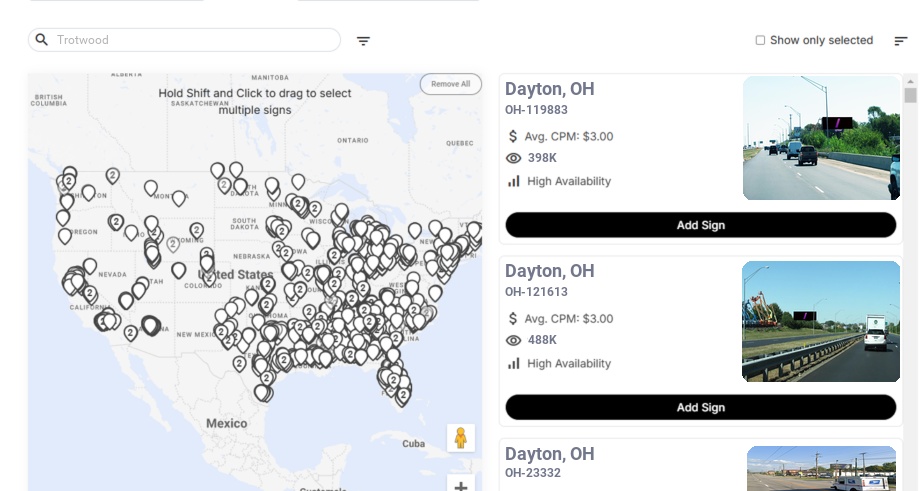
Blip has digital billboards in Trotwood. You can browse available locations on a map, choose the ones that fit your audience, and start advertising right away.
Still have questions? Launch a campaign in minutes — no contracts, no commitments.
Start Your CampaignTrotwood Billboard Advertising Guide
Billboard advertising near Trotwood, Ohio gives us a powerful way to reach a tight‑knit, commuter-heavy community that moves daily between Trotwood, Dayton, and the rest of Montgomery County. With Blip’s digital board near Trotwood in Dayton, we can tap into local traffic flows, showcase hyper-local messaging, and adjust campaigns in real time to match the rhythms of life in the Trotwood area. For advertisers searching for billboards near Trotwood that can still capture both local residents and regional commuters, this placement offers an efficient, high-visibility option.
Understanding the Trotwood Area Market
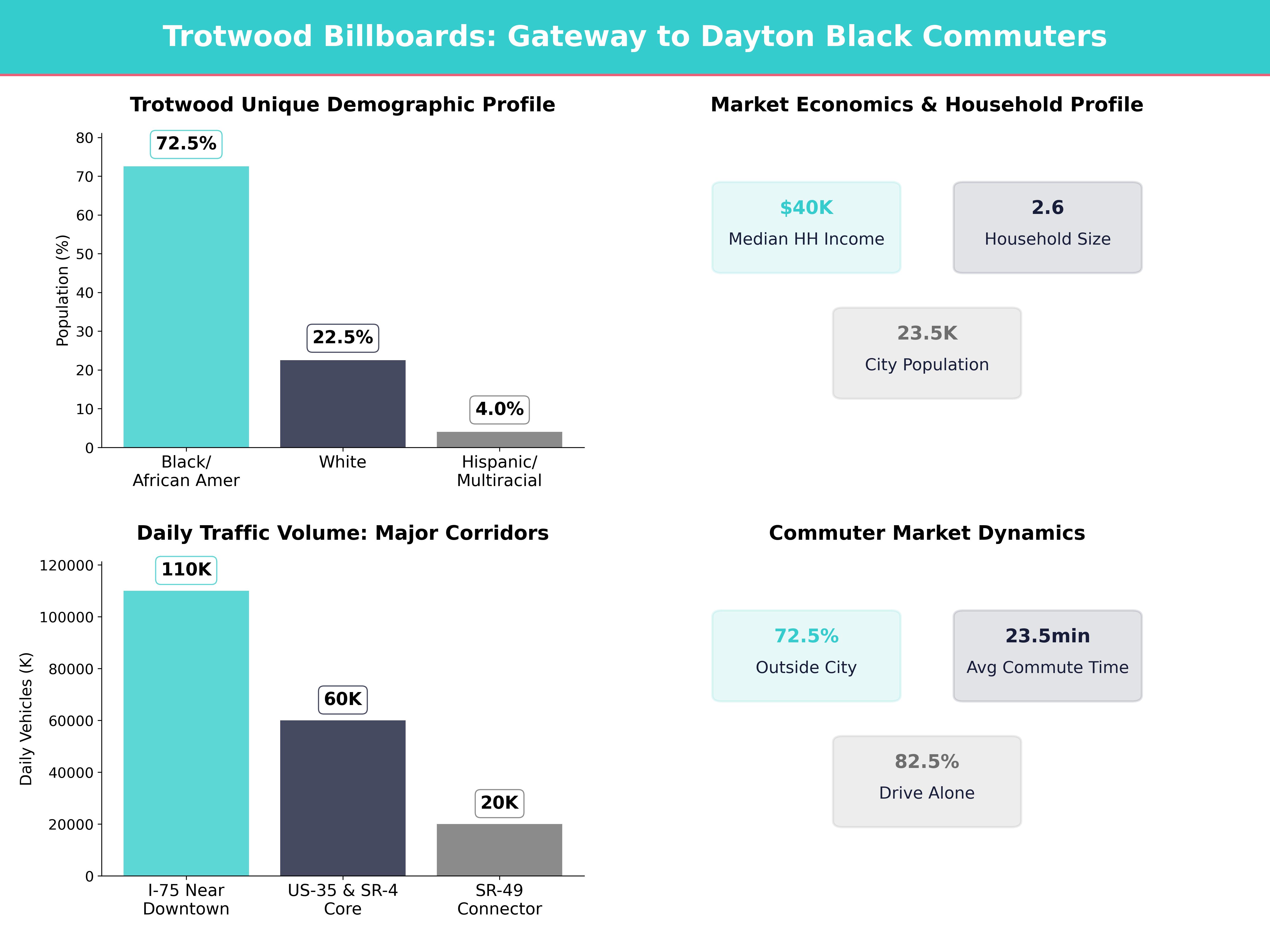
Trotwood sits just northwest of Dayton in Montgomery County and is part of the larger Dayton–Kettering metro economy, which includes communities like Kettering. According to recent local planning and regional estimates, Trotwood has roughly 23,000–24,000 residents, while Montgomery County as a whole has about 530,000–540,000 people. The city is served by major corridors like State Route 49, I‑70 to the north, and I‑75 to the east, all feeding directly into Dayton and the broader Miami Valley. This mix of dense neighborhoods and strong commuter routes is what makes Trotwood billboards and nearby digital displays especially effective for regional reach.
Key market characteristics:
-
Population density:
Trotwood’s density is around 1,000–1,100 residents per square mile, significantly higher than many surrounding townships, which often fall in the 200–600 residents per square mile range. That higher concentration translates into more potential impressions per mile of roadway, especially along key commercial stretches such as Salem Avenue and Main Street. -
Racial & ethnic makeup:
Trotwood is a majority Black community; roughly 70–75% of residents identify as Black or African American. White residents account for around 20–25%, with a smaller but important Hispanic and multiracial population in the 3–5% range. In neighboring Dayton, Black residents make up roughly 35–40% of the population, which means our board in Dayton speaks to a similarly diverse audience. Ads that reflect this diversity and use inclusive imagery tend to perform better and build trust over time. -
Age profile:
Median age in Trotwood is around 40 years, slightly higher than the national median. About 25–30% of residents are under age 25, while roughly 15–18% are 65 or older. This mix of working-age adults, school-age children, and seniors supports messaging around:- Family services and youth programs
- Healthcare and senior services
- Employment, training, and upskilling for adults in their 30s–50s
-
Households & families:
The area has a strong family orientation. Around 60–65% of households are family households, and multi-generational living is common. Average household size is around 2.5–2.7 people, which means one impression on a billboard often represents multiple potential customers in a single vehicle. -
Income & affordability:
Median household income in Trotwood is in the low‑$40,000s, compared with the mid‑$50,000s for Montgomery County overall and higher incomes in some nearby suburbs such as Clayton and Englewood. About 15–20% of residents live below the poverty line, and housing costs remain relatively affordable, with many single-family homes commonly valued in the $90,000–$150,000 range. Value propositions, clear pricing, and offers (e.g., “Under $50,” “First month free”) are especially important in this context. -
Transportation & commuting:
The Trotwood–Dayton corridor is highly car-dependent. In the broader Montgomery County region:- Around 80–85% of workers commute by driving alone.
- Another 8–10% carpool.
- Public transit use, via the Greater Dayton RTA, generally stays in the 2–4% range. Typical commute times for Trotwood residents average about 22–25 minutes, aligning closely with the Trotwood–Dayton drive. This means the same people pass the same billboard twice a day during the workweek, creating steady, repeat exposure.
We also want to consider the gravity of Dayton’s economy. The Dayton metro has a GDP of roughly $40–45 billion, anchored by sectors such as healthcare, defense/aerospace, logistics, and advanced manufacturing. Major institutions like Wright‑Patterson Air Force Base Premier Health, Kettering Health, and regional manufacturers draw workers from across Montgomery County. Many Trotwood residents commute to jobs around Dayton, Englewood, and Huber Heights, so our digital billboard near Trotwood in Dayton allows us to reach both local residents and regional commuters on their daily routes. When businesses think about billboard advertising near Trotwood, they should factor in this broader commuter ecosystem, not just the city limits themselves.
For further local context and planning, we recommend regularly checking:
- City of Trotwood
- Montgomery County
- Regional tourism & events via the Dayton Convention & Visitors Bureau
- Local news outlets such as the Dayton Daily News, WHIO, and WDTN
- Regional planning data and transportation studies from the Miami Valley Regional Planning Commission
- Road and traffic updates from the Ohio Department of Transportation – District 7
Where Our Digital Billboard Fits in the Trotwood Area
Blip currently has 1 digital billboard serving the Trotwood area, located in Dayton roughly 9 miles from Trotwood’s core. While that might sound limited, a single, well-placed digital display on a busy corridor can deliver tens of thousands of daily impressions. Many advertisers looking into billboard rental near Trotwood find that this single, strategically located structure can outperform multiple smaller placements because of the traffic volumes it reaches.
In the Dayton region, according to regional transportation counts and ODOT data:
- Segments of I‑75 near downtown carry upwards of 100,000–120,000 vehicles per day (AADT).
- Major feeders like US‑35 and State Route 4 often see 50,000–70,000 vehicles per day in their core sections.
- State Route 49, which directly links Trotwood to Dayton, carries on the order of 15,000–25,000 vehicles per day through many segments, functioning as a primary commuter and shopping route for Trotwood and northwest Dayton.
Even conservative assumptions—such as 1.3–1.5 people per vehicle—mean that a digital billboard on a corridor moving 50,000 vehicles per day can easily generate 65,000–75,000 daily impressions. Over a 30‑day campaign, that’s roughly 2–2.2 million potential impressions, with the flexibility to concentrate those impressions in your highest-value hours.
Our digital billboard near Trotwood in Dayton taps into this network of daily travel. It’s especially effective for:
- Businesses located in or near Trotwood that depend on customers who commute through Dayton (auto dealers, healthcare clinics, restaurants, retail, churches).
- Regional brands looking to reach a broad cross-section of Dayton‑area commuters, including residents from Trotwood, Clayton, Englewood, and West Dayton.
- Event organizers trying to draw attendees from across western Montgomery County to venues in Dayton, Huber Heights, or along the I‑75 and I‑70 corridors.
Because Blip rotates multiple advertisers on the same digital structure, we can choose exactly when our ad appears (by the “blip” rather than by the month), making it easy to align with drive times from Trotwood to Dayton and back. Shorter, more frequent blips in peak periods often outperform a constant presence at low-traffic times in terms of cost per thousand impressions (CPM), making this form of billboard advertising near Trotwood both measurable and flexible.
Traffic Patterns and Ideal Dayparts Near Trotwood
To maximize reach near Trotwood, we want to align our Blip schedule with how residents actually move across the region. Regional congestion data and local commuting surveys show predictable weekday peaks and strong weekend shopping and church traffic.
Morning & Evening Commute (6–9 a.m., 3:30–7 p.m.)
- A majority of Trotwood workers—typically 70–75%—commute to jobs outside the city limits, with many traveling southeast toward Dayton for work, school, or healthcare appointments.
- Morning traffic leans toward professionals, healthcare workers, service employees, and students heading toward employment centers in downtown Dayton, the hospital hubs, and industrial parks.
- Evening traffic includes people going home, shopping, or heading to second jobs, classes, or church activities.
Best for:
- Employment ads (“Now hiring,” training programs)
- Quick-service restaurants and coffee shops
- Auto service and gas stations
- Healthcare, clinics, and urgent care
- Financial services and credit unions
Midday (10 a.m.–3 p.m.)
- More stay-at-home parents, retirees, self-employed workers, and shift workers are on the road.
- Local shopping centers in Trotwood and northwest Dayton see steady midday traffic, with some retailers reporting 20–30% of their daily sales in this window.
- Good for targeting daytime shopping, healthcare, and government services.
Best for:
- Local retail and grocery
- Medical practices and dental offices
- City services, libraries, and educational programs
- Restaurants advertising lunch specials
Evenings & Weekends
- Weekends typically bring lighter rush-hour congestion but higher discretionary trip volumes, as families travel to shopping centers, parks, entertainment venues, and churches.
- Sports leagues, church events, and community gatherings often peak Thursday–Sunday, and churches across Montgomery County report their highest attendance on Sunday mornings and early afternoons.
- Major events promoted through outlets like the Dayton Convention & Visitors Bureau events calendar can draw thousands of attendees from across the county, increasing traffic on key corridors.
Best for:
- Entertainment, events, and nightlife
- Churches and faith-based events
- Auto dealerships and furniture stores
- Home improvement and landscaping services
With Blip, we can concentrate our budget on these high-value windows—buying more blips during commutes and weekends, and fewer during low-impact overnight hours, which typically account for less than 10% of daily traffic in most corridors. This approach helps turn a single digital structure into one of the most efficient billboards near Trotwood for consistent commuter reach.
Seasonal Opportunities in the Trotwood Area
Trotwood and the Dayton region follow a four-season pattern that strongly affects driving volumes and consumer behavior. Retail and service businesses often see double‑digit swings in sales across seasons, making flexible digital billboard campaigns especially useful.
Winter (December–February)
- Colder weather and early sunsets (with December sunsets often before 5:20 p.m.) shift more activity indoors.
- Driving volumes can dip during severe weather events, but everyday commuting remains strong as schools, hospitals, and major employers continue operating.
- Retailers often report 20–30% of their annual revenue in November–December due to holiday shopping.
Campaign ideas:
- Promote tax prep, heating services, auto repair, and winter sales.
- Emphasize safety, reliability, and convenience (e.g., “Same-day service,” “Open late”).
- Highlight “before and after work” hours to catch commuters in darker, colder conditions.
Spring (March–May)
- Regional traffic counts and tourism data show a noticeable uptick in driving as weather improves, with park visits and outdoor recreation increasing.
- Home improvement, landscaping, youth sports, and graduation-related spending increase sharply; home and garden businesses often see 15–25% higher sales in spring than in winter.
- Local events pick up around the region; stay tuned to area calendars via the Dayton CVB and community listings in the Dayton Daily News.
Campaign ideas:
- Lawn care, roofing, remodeling, and garden centers.
- Colleges, training programs, and graduation services.
- Churches promoting Easter services and spring revivals.
Summer (June–August)
- School is out for roughly 10–12 weeks, and families are on the road more for day trips, camps, and vacations.
- Regional attractions promoted by the Dayton CVB draw visitors from across Montgomery County and neighboring counties, boosting weekend traffic.
- Outdoor events, festivals, and sports leagues can draw hundreds to tens of thousands of visitors per event, depending on size and location.
Campaign ideas:
- Family attractions, summer camps, water parks, and festivals.
- Auto service, tire shops, and road-trip checks.
- Food trucks, ice cream shops, and outdoor dining.
Fall (September–November)
- Back-to-school season brings spikes in retail and traffic around schools, with families adjusting to new routines.
- Football season and fall festivals help drive weekend travel, and early holiday shopping often begins in October.
- Many Trotwood-area residents refocus on school, church activities, and local sports, making community-focused messaging especially timely.
Campaign ideas:
- Back-to-school retail, tutoring, and extracurriculars.
- Healthcare (flu shots, checkups), insurance, and financial planning.
- Early holiday promotions and “shop local” campaigns, potentially aligned with local initiatives promoted by Montgomery County or area chambers of commerce such as the Trotwood Chamber of Commerce.
With Blip, we can quickly update creatives as seasons change—promoting a spring offer in March, a back-to-school special in August, and Black Friday deals in November without long-term print commitments or production delays. This flexibility is a major advantage for any brand comparing traditional Trotwood billboards with more agile digital options nearby.
Demographic & Lifestyle Insights to Shape Creative
To connect with audiences from the Trotwood area on our Dayton digital board, we should reflect the community’s realities and aspirations, based on the local demographic and economic profile.
Family & Community Focus
- Many Trotwood households are multi-generational, with a strong emphasis on church, youth activities, and community groups. Local churches often report hundreds of attendees per weekend, and youth sports leagues regularly field dozens of teams each season.
- Educational attainment and access to opportunity are major local themes. A meaningful share of adults have “some college” or an associate degree, and demand for skills training, CDL programs, and healthcare certifications remains strong.
Creative tips:
- Use images of families, groups, and neighbors rather than only individuals.
- Highlight community benefits: “Serving Trotwood families since 1995,” “Proud to support Trotwood schools/youth sports.”
- Mention local landmarks or phrases: “Minutes from Trotwood,” “On the way from Trotwood to downtown Dayton.”
Value-Driven Messaging
With median incomes below national and state averages, the Trotwood area responds strongly to clear value and affordability.
Creative tips:
- Display specific prices (“$29 oil change,” “Plans from $25/mo”) to help cost-conscious households evaluate quickly.
- Use strong value propositions: “Low down payment,” “No credit? We can help,” “Free estimate.”
- Feature limited-time offers that create urgency without feeling pushy, such as “This week only” or “Ends Sunday.”
Cultural Relevance
In a majority-Black community, authentic representation matters for both brand perception and response rates.
Creative tips:
- Use diverse, realistic imagery—not stereotypes—representing a range of ages, family structures, and professions.
- If your business is actively involved in community events, local churches, or youth sports, mention that involvement briefly (“Proud sponsor of local youth football”).
- Consider tying campaigns to major cultural moments (Juneteenth, Black History Month, local HBCU or college events in the greater Dayton area) when appropriate and genuine, and consider aligning timing with coverage from outlets like WHIO or WDTN
Creative Best Practices for Digital Billboards Near Trotwood
Digital billboards offer only a few seconds—often 3–7 seconds of viewing time—to communicate. In a commuter corridor serving the Trotwood area, we recommend:
- 6–8 words max of large, legible text, ideally using fonts sized for readability at highway speed.
- High-contrast colors (dark text on light background or vice versa) to maintain visibility in bright sun, rain, and at night.
- One clear call-to-action: “Exit at…,” “Call,” “Visit today,” or a simple URL.
- Big, simple visuals (one main image or icon), avoiding clutter that can reduce recall.
Examples tailored to the Trotwood area:
- Auto service:
“Trotwood Drivers: $29 OIL CHANGE – Exit [X] in Dayton” - Healthcare:
“NEAR TROTWOOD: SAME-DAY CLINIC – Walk-ins Welcome” - Church:
“TROTWOOD AREA FAMILIES WELCOME – Sundays 10 a.m. – [ChurchName].org”
Because Blip is digital, we can rotate multiple creatives:
- One ad for morning commuters (“On your way to work from Trotwood?”)
- Another for evenings (“On your way home? Dinner is ready.”)
- A weekend-specific creative (“Sunday service near Trotwood – 10 a.m.”)
Advertisers who test 2–3 creative variations and refine based on results often see noticeable improvements in response—sometimes 10–30% higher engagement compared with running a single static message. This testing mindset is especially valuable when you’re treating nearby digital inventory as your Trotwood billboards solution.
Using Blip’s Tools to Target the Trotwood Area
Blip lets us buy billboard time one “blip” at a time instead of committing to a single, fixed monthly buy. For the Trotwood area, we can strategically:
1. Geo-Target the Most Relevant Board
- Focus budget on the digital billboard in Dayton that best serves traffic to and from Trotwood, ideally on or near routes like State Route 49 or major Dayton arterials.
- For businesses with multiple locations, prioritize creatives based on distance and direction (e.g., “5 minutes from this sign,” “Next exit toward Trotwood”).
This approach gives local businesses many of the same benefits as traditional billboard rental near Trotwood, but with more precise geographic control and no long-term contracts.
2. Daypart for Maximum Impact
- Heavy up on 6–9 a.m. and 3:30–7 p.m. drive times to capture Trotwood commuters, which is when many corridors reach their top 20–25% of daily traffic volumes.
- Add extra coverage Thursday–Sunday for churches, events, and retail, which often see weekend revenue lifts of 20% or more compared with weekdays.
- Reduce or skip late-night hours unless you’re a 24‑hour or nightlife business, since overnight volumes can drop to less than one-third of daytime levels.
3. Align Spend With Business Cycles
- Increase bids during your busiest or most profitable seasons (e.g., tax season for preparers, back-to-school for retailers, holidays for gift and apparel stores).
- Run short “burst” campaigns (3–10 days) around specific events: openings, sales, concerts, or church conferences. Many advertisers find that high-frequency bursts can deliver better short-term results than low-frequency, always-on campaigns.
4. Test, Learn, and Optimize
- Run 2–3 variations of creatives that change one element—headline, promo, or image—so you can clearly see what drives the difference.
- Watch correlations with web traffic, calls, or in-store visits from the Trotwood area, as well as Google Business Profile actions (calls, direction requests, website clicks).
- Pause underperforming creatives quickly and redirect impressions to stronger ads, using performance indicators such as week-over-week changes in leads or store traffic.
Industry-Specific Strategies for the Trotwood Area
Different sectors can leverage the Trotwood–Dayton commuter pattern in distinct ways, aligning with local demographics and travel patterns.
Local Retail & Restaurants
- The average household in the region may make 2–3 shopping trips per week, and many of these trips cross city boundaries (e.g., Trotwood–Dayton, Trotwood–Englewood).
- Promote proximity and ease: “On your route between Trotwood and Dayton.”
- Highlight quick stops and drive-thru convenience for time-pressed commuters.
- Use limited-time offers synced with paydays (1st & 15th of the month) and major benefit payment dates, when many households have more spending power.
Auto Sales & Service
- The Dayton region is highly car-dependent, and many Trotwood-area residents rely on older vehicles, increasing demand for maintenance and repair.
- Promote financing help, warranties, and “buy here, pay here” options clearly—especially for households with tight budgets or limited credit history.
-
Align with seasonal needs:
- Tires and brakes in fall and early winter
- A/C service and coolant checks in late spring and early summer
- Battery checks and wiper replacement before heavy winter weather
Healthcare & Social Services
- Many residents look for accessible, nearby care and support services and may not want to drive long distances.
- Emphasize location (“Just minutes from Trotwood”), hours, walk-ins, and insurance/Medicaid acceptance in clear, simple language.
- Consider promoting specific service lines that matter locally—urgent care, primary care, dental, behavioral health, and family services—with straightforward wording and easy-to-remember URLs or phone numbers.
Education & Training
- Community colleges, trade programs, CDL schools, and training centers can tap into adult learners and recent grads who are looking for practical credentials tied to local jobs.
- Promote job outcomes (“94% job placement”), flexible schedules (evenings, weekends, online), and financial aid availability.
- Align campaign timing with enrollment periods and information sessions, and coordinate with local coverage and education features in outlets like Dayton Daily News.
Faith-Based Organizations
- Churches and faith-based groups are central to many Trotwood area residents’ lives, and Sunday morning traffic to places of worship is significant.
- Use inviting messages: “Come as you are,” “Trotwood area families welcome.”
- Promote special events: revivals, youth nights, holiday services, and community outreach, especially around Easter, Christmas, and back-to-school seasons, when attendance and community interest often peak.
Measuring Success in a Trotwood-Area Campaign
While billboard impressions are directional rather than precise, we can still measure and refine performance using simple, trackable tactics.
Recommended tactics:
- Unique URLs or promo codes:
Use dedicated landing pages (e.g.,YourBusiness.com/Trotwood) or promo codes (“Mention ‘TROTWOOD’ for 10% off”) to tie responses directly to the billboard. Businesses that use unique codes often see 5–20% of redemptions clearly traceable to their out-of-home campaigns. - Location-based calls-to-action:
“Show this message at checkout” or “Scan QR code” (only if it’s very large and simple). Even a small number of scans, combined with high impression counts, can make the campaign’s impact visible. - Ask “How did you hear about us?”
Add this question at point of sale, on intake forms, or in online appointment systems. Track “billboard” responses separately from “internet search” or “friend/family.” - Track web and Google Business Profile activity
Monitor website sessions, calls, and direction requests from users located near Trotwood and Dayton during campaign windows. Look for week-over-week or month-over-month increases that align with your flight dates.
Combine this data with knowledge of traffic flows, seasonal sales patterns, and feedback from staff or customers to adjust schedules, bids, and creatives over time. Over several campaigns, this kind of optimization can help you identify which Trotwood billboards strategy—timing, messaging, or targeting—delivers the strongest returns.
By understanding who lives and drives in the Trotwood area, how they move between Trotwood and Dayton, and what motivates their purchases, we can use Blip’s digital billboard near Trotwood in Dayton to build highly focused, flexible campaigns. With thoughtful creative, smart dayparting, and ongoing optimization based on measurable data, even a single well-placed digital board can become a dependable driver of awareness, foot traffic, and sales for businesses serving the Trotwood area and anyone exploring billboard advertising near Trotwood.