Billboards near Whitehall, OH
No Minimum Spend. No Long-Term Contracts. Just Results.
Trusted by Leading Brands


Billboard advertising
near Whitehall has never been easier
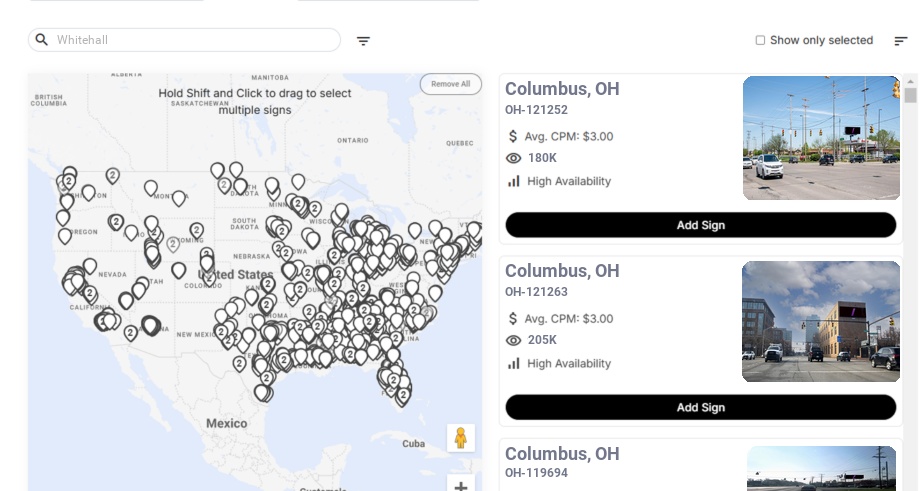



How much is a billboard near Whitehall?
Why Choose Blip for Billboard Advertising near Whitehall
Blip lets you launch Whitehall ads fast and self-serve, reaching commuters on I-70, I-270, and US-33 in minutes.
Set a daily budget for Whitehall billboards and scale as needed—ideal for value-focused shoppers and renters near East Broad and Hamilton Rd.
No contracts means you can test Whitehall campaigns around airport, Obetz, and Rickenbacker shift changes without long commitments.
Use Blip's real-time analytics to adjust Whitehall timing for 6:30-9 a.m. and 3:30-6:30 p.m. commuter peaks.
Build simple, high-contrast creative in Blip for Whitehall drivers who have only seconds to spot your message on fast-moving corridors.
Frequently Asked Questions About Billboard Advertising near Whitehall
How much does a billboard cost near Whitehall, Ohio with Blip?
With Blip, you control exactly what you spend on Whitehall billboards by setting a daily budget that can be adjusted at any time, so you only pay for the blips—those 7.5 to 10-second ad displays—you actually receive. Each blip is priced in real time based on when and where it runs and current advertiser demand, giving you flexible, pay-per-blip advertising in the Whitehall area without long-term commitments or large upfront costs. Your total cost is simply the sum of all your individual blips, so it can work with virtually any budget.
Where can I advertise with Blip near Whitehall, Ohio?
We serve the Whitehall area with 14 digital billboards within roughly 10 miles, concentrated along major east-side commuter and shopping routes. This includes billboards in Canal Winchester, Obetz, and Columbus, giving advertisers reliable access to billboards near Whitehall without having to secure placements individually in each suburb. These locations reach commuters, shoppers, and airport travelers throughout the day.
Who does Whitehall, Ohio billboard advertising reach?
Whitehall is an inner-ring suburb on the east side of Columbus, and the broader Columbus metropolitan area exceeds 2.1 million people. The area has a young, working-age population, a diverse community, and a large base of daily commuters reachable on the road. Many residents commute west into Columbus or to logistics, retail, and light-industrial jobs around I-70, I-270, Alum Creek Drive, and the Rickenbacker/Obetz corridor.
When are Whitehall-area commuters most likely to see Blip billboards?
In the Columbus metro, roughly 75–80% of workers commute by driving alone, which concentrates exposure on the road network. East-side residents heading into Columbus or to airport/industrial jobs near Obetz typically travel between 6:30–9:00 a.m. and 3:30–6:30 p.m., with the heaviest congestion between 4:30–5:30 p.m. These windows are prime for service businesses, recruiting, financial services, education, and training programs.
What kinds of ads work best on Whitehall, Ohio billboards?
Given median incomes in the Whitehall area, price and practicality matter, so concrete numbers and clear savings messages typically perform well. The area is also diverse and family-oriented, so inclusive imagery, family-friendly offers, and bilingual or dual-language phrases can resonate. For commuters, the page recommends keeping designs ultra-simple with 6–8 words, one focal point, and high-contrast colors.
Do I need a contract to advertise with Blip near Whitehall?
No, Blip has no long-term contracts or minimum commitments. You can start, pause, or stop your campaign at any time.
How fast can I launch a billboard campaign with Blip near Whitehall?
You can have your campaign live in minutes. Create a free account, select your locations, set your budget, upload your design, and start running once approved.
Where can I advertise with Blip near Whitehall?
Blip has digital billboards near Whitehall. You can browse available locations on a map, choose the ones that fit your audience, and start advertising right away.
Still have questions? Launch a campaign in minutes — no contracts, no commitments.
Start Your CampaignWhitehall Billboard Advertising Guide
The Whitehall area sits at the heart of one of Ohio’s fastest‑growing urban regions, tightly connected to Columbus, John Glenn Columbus International Airport
Understanding the Whitehall Area Market
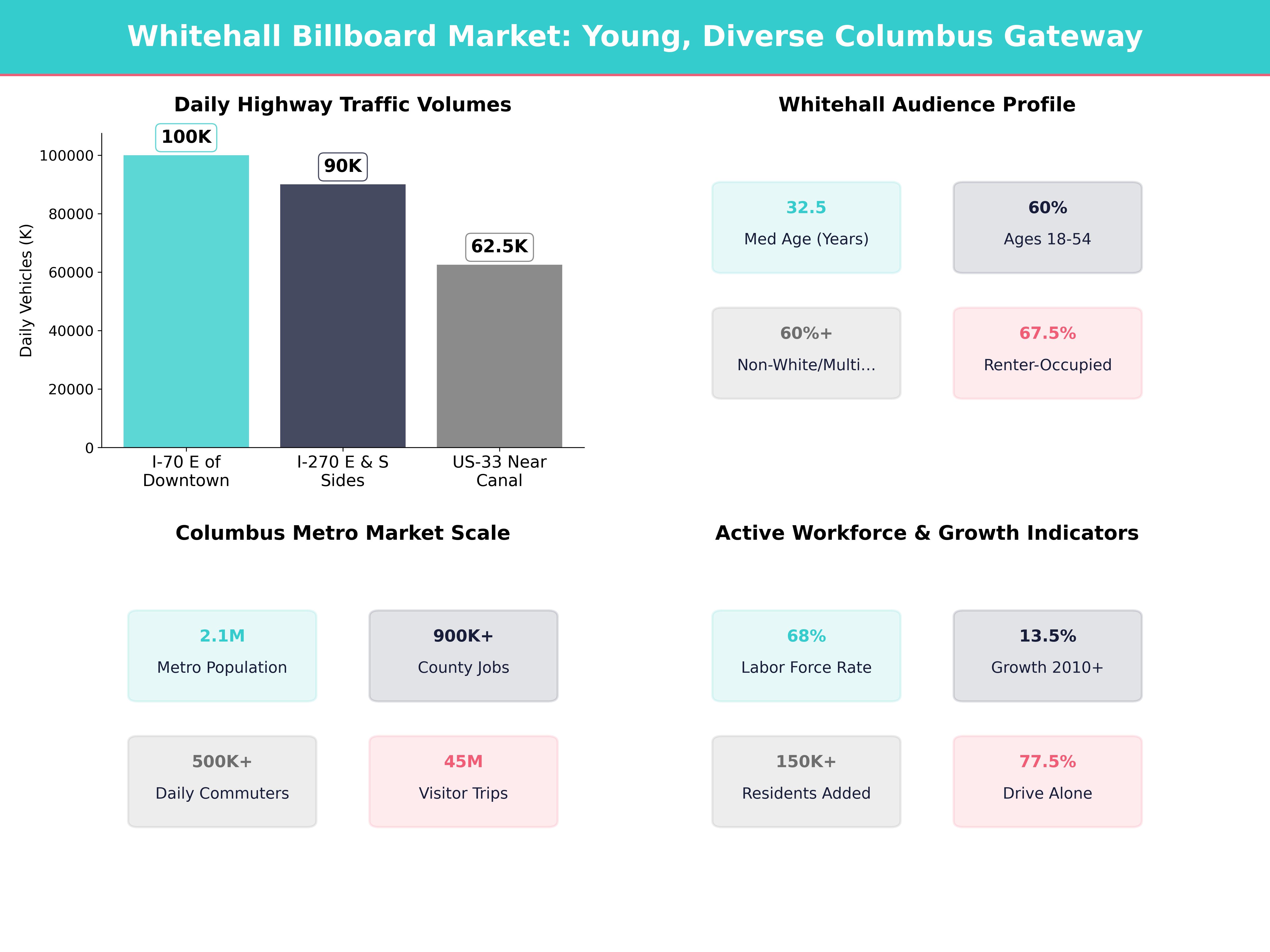
Whitehall is an inner‑ring suburb on the east side of Columbus, in Franklin County. According to the 2020 Census and recent local estimates, the City of Whitehall has roughly 20,000–21,000 residents (about 5.3 square miles), while the broader Columbus metropolitan area exceeds 2.1 million people, making it the largest metro in Ohio and one of the top 35 largest metros in the U.S. by population. Franklin County itself has grown more than 12–15% since 2010, adding well over 150,000 residents in just over a decade, which supports sustained demand for billboard advertising near Whitehall across retail, services, and workforce recruitment.
Key local context that matters for billboard advertisers:
-
Young, working‑age population
- Median age in the Whitehall area is around 32–33 years, versus about 39 years nationally and 39–40 years for Ohio overall. Nearly 60% of residents are between 18 and 54, a prime working and spending age band.
- Roughly 65–70% of occupied housing units in Whitehall are renter‑occupied, reflecting a mobile, price‑sensitive audience that responds well to convenience offers, move‑in specials, food, retail, and education messaging.
- Labor force participation in Franklin County is around 67–69%, higher than the statewide rate (about 62–63%), pointing to a large base of daily commuters reachable on the road and making Whitehall billboards especially effective for job, training, and service campaigns.
-
Diverse community
- City of Whitehall updates and community information are available via the official site: City of Whitehall.
- Whitehall is among the more diverse communities in central Ohio. Local figures show that more than 60% of residents identify as non‑White or multiracial, and over 10–15% of residents speak a language other than English at home.
- Local schools and neighborhoods reflect a mix of long‑time residents and newer arrivals from across central Ohio and abroad. Multicultural or inclusive visuals can resonate well, especially for food, healthcare, banking, and education, when featured on billboards near Whitehall that people see during daily commutes.
-
Income and value orientation
- Median household income in the Whitehall area is in the high‑$40,000s to low‑$50,000s, compared with roughly $65,000–$70,000 for Franklin County and around $62,000–63,000 statewide. About 20–25% of residents fall below the federal poverty line, higher than the Ohio average.
- This creates a large “value‑seeking” middle and working‑class market. Price‑forward creative (e.g., “$9.99,” “under $20,” “0% APR”) and clear savings messages typically perform well with this demographic profile, as do promotions tied to pay periods or tax‑refund season. Advertisers using billboard rental near Whitehall often see the best response when offers are clear, time‑sensitive, and easy to act on.
-
Regional employment pull
- Whitehall is adjacent to the John Glenn Columbus International Airport, which is managed by the Columbus Regional Airport Authority and supports an estimated 30,000+ direct and indirect jobs across airlines, hospitality, logistics, and related services.
- Whitehall is less than 15 minutes from downtown Columbus in normal traffic, and Franklin County hosts more than 900,000 jobs, with professional services, healthcare, education, retail, and logistics as major sectors.
- Many residents commute west into Columbus or to logistics, retail, and light‑industrial jobs around I‑70, I‑270, Alum Creek Drive, and the Rickenbacker/Obetz corridor. Average one‑way commute times in the region sit around 22–25 minutes, placing a large share of workers on major arterials every weekday.
Because our billboards near Canal Winchester, Obetz, and Columbus sit along these commuting and shopping paths, we can consistently reach Whitehall‑area residents during their daily routines with repeated exposures. For brands comparing different options for billboard advertising near Whitehall, this proximity to real‑world traffic flows is a key advantage.
Where Our Billboards Reach Drivers Near Whitehall
We serve the Whitehall area with 14 digital billboards within roughly 10 miles, concentrated along major east‑side commuter and shopping routes, giving advertisers reliable access to billboards near Whitehall without having to secure placements individually in each suburb:
-
Canal Winchester (about 6.2 miles from Whitehall)
- Positioned along corridors feeding U.S. 33 and nearby access to I‑270, capturing commuters traveling between the Whitehall area, southeast suburbs, and job centers.
- The Village of Canal Winchester reports strong population growth over the last decade, with residents now numbering around 9,000–10,000 and growing more than 30% since 2010. Retail, dining, and residential projects have expanded along U.S. 33 and Gender Rd., making this an ideal area for campaigns targeting both Whitehall and southeast‑Columbus shoppers.
-
Obetz (about 7.4 miles from Whitehall)
- Located near I‑270, I‑70, and the Rickenbacker logistics hub, Obetz sits in one of central Ohio’s most important freight and distribution zones. The region around Obetz and Rickenbacker employs tens of thousands of workers in warehousing, e‑commerce fulfillment, and transportation.
- The Village of Obetz highlights ongoing business development, warehouses, and industrial parks that fuel daily worker inflow from across eastern Franklin County, including the Whitehall area. Some logistics parks see thousands of shift changes per day, generating reliable peak traffic for recruiting, quick‑serve dining, and convenience offers.
-
Columbus (about 8.7 miles from Whitehall)
- Billboards near east and southeast Columbus corridors tap into major routes like I‑70, I‑270, and east‑side arterials used daily by Whitehall‑area residents.
- The City of Columbus notes that more than 900,000 people live within city limits, and the city has added over 100,000 residents since 2010.
- On a typical weekday, more than 500,000 workers travel into or across Columbus from surrounding suburbs such as Whitehall, Reynoldsburg, Gahanna, and Canal Winchester, creating strong commuter reach for area boards.
According to Ohio Department of Transportation (ODOT) traffic count data, key routes that Whitehall‑area drivers commonly use record substantial daily volumes:
- I‑70 east of downtown Columbus: often 90,000–110,000 vehicles per day on typical segments approaching and passing the east side.
- I‑270 on the east and south sides: many segments report 80,000–100,000+ vehicles per day, including the loop portions that carry Whitehall‑area drivers toward jobs, shopping, and the airport.
- US‑33 near Canal Winchester: frequently 55,000–70,000 vehicles per day, combining commuter flows and retail traffic.
By placing messages on our 14 digital faces near these corridors, we can repeatedly reach Whitehall‑area commuters, shoppers, and airport travelers throughout the day, often delivering multiple daily impressions per driver over the course of a typical campaign flight. This makes our inventory a practical solution for businesses that want broad, regional coverage from Whitehall billboards without overspending on underused placements.
When Whitehall‑Area Audiences Are on the Road
Commuting and shopping patterns in the Whitehall area strongly influence when to run billboard campaigns.
Weekday rush hours
- In the Columbus metro, roughly 75–80% of workers commute by driving alone, with another 8–10% carpooling. Fewer than 5–7% use public transit, biking, or walking, which concentrates exposure on the road network.
-
East‑side residents heading into Columbus or to airport/industrial jobs near Obetz typically travel between:
- Morning: 6:30–9:00 a.m. (with volumes often peaking around 7:30–8:30 a.m.).
- Evening: 3:30–6:30 p.m. (with the heaviest congestion between 4:30–5:30 p.m.).
These windows are prime for:
- Service businesses (auto, medical, home services)
- B2B and workforce recruitment
- Financial services, education, and training programs
With Blip, we can bid higher during these peak periods to ensure more impressions from Whitehall‑area commuters, then lower bids or pause during mid‑day lulls if your budget is tight. This time‑based control is particularly valuable for advertisers testing billboard advertising near Whitehall for the first time and wanting to prove results quickly.
Mid‑day and evening shopping traffic
The Whitehall area sits near several retail centers and big‑box corridors along E. Broad Street, Main Street, and Hamilton Road, along with regional destinations on E. Main St. and U.S. 33. Regionally, the Columbus metro logs particularly strong retail and visitor performance:
- According to Experience Columbus, the region welcomes more than 40–50 million visitor trips annually, supporting over 75,000 tourism‑related jobs and generating billions of dollars in visitor spending each year across lodging, food, entertainment, and shopping.
- Visitor economic impact in recent years has exceeded $7–9 billion annually metro‑wide, helping drive steady traffic near hotels, attractions, and retail corridors used by Whitehall‑area residents.
- Whitehall‑area residents often travel to Canal Winchester, east Columbus, and southeast Columbus for big‑box retailers, restaurants, and family venues, especially on Hamilton Rd., Brice Rd., and U.S. 33.
Mid‑day and early evening (11:00 a.m.–2:00 p.m. and 5:00–8:00 p.m.) are ideal for:
- Restaurants and quick‑serve food
- Retail sales, grocery, and discount stores
- Entertainment, family attractions, and local events
Weekend patterns
- Saturday traffic on major retail corridors in Franklin County often matches or exceeds weekday peaks; in many shopping districts, Saturday mid‑day volumes are 10–20% higher than an average weekday hour.
- Sports, festivals, and shopping trips drive additional visits via major highways and arterials serving the Whitehall area. Regional events can bring tens of thousands of extra visitors into the Columbus core and east‑side routes on select weekends.
We can schedule heavier weekend rotations for:
- Event promotions (festivals, concerts, local sports)
- Deal‑driven retail (furniture, mattresses, appliances)
- Automotive sales and test‑drive campaigns
Matching Creative to Whitehall‑Area Demographics and Culture
To connect with audiences near Whitehall, we recommend tailoring billboard creative to reflect local values, visual cues, and everyday life.
1. Emphasize value and convenience
Given median incomes in the Whitehall area, price and practicality matter:
- Use concrete numbers (“From $49/month,” “2 for $5,” “$500 off,” “Free estimate”) instead of vague claims like “low prices.” Studies of out‑of‑home effectiveness show that specific price points can lift ad recall by 10–20 percentage points compared with generic text.
- Highlight time savings and proximity (“5 minutes from the Whitehall area,” “Just off I‑270 at [Exit #],” “Next to Hamilton Rd. Walmart”).
- Feature clear calls‑to‑action suitable for on‑the‑go drivers: “Order ahead,” “Schedule today,” “Apply now,” “Text WHITEHALL to 12345.”
These principles are especially important when you are using billboard rental near Whitehall to generate measurable responses, such as calls, applications, or store visits.
2. Reflect a diverse, family‑oriented community
Whitehall‑area households include families, multigenerational homes, and a substantial mix of ethnic backgrounds:
- Local school data show that more than 70–75% of students in some east‑side districts identify as non‑White, and a meaningful share come from multilingual households. Inclusive imagery helps your message feel authentic and local.
- Promote family‑friendly offerings: kids‑eat‑free nights, after‑school programs, family memberships, and free community events.
- Consider bilingual or dual‑language phrases if your brand serves multilingual audiences; even a short Spanish tagline can stand out and feel locally relevant in a city where 10–15% of households speak a language other than English.
3. Keep designs ultra‑simple for commuters
Given highway speeds on I‑70, I‑270, and US‑33, we encourage:
- 6–8 words max per creative
- One central focal point (a bold product shot, face, or logo)
- High‑contrast color pairs (dark background with light text or vice versa)
- Large, simple fonts with no script or condensed type
Out‑of‑home research indicates that drivers have 3–6 seconds to process your message at 55–65 mph, and creative that follows these guidelines can see 20–30% higher recall than cluttered designs.
We can also test variations—such as a price‑forward version vs. a lifestyle‑image version—by rotating creative and comparing response indicators (web traffic, coupon usage, or lead volume). Over time, this helps you identify which styles work best specifically on Whitehall billboards versus more regional messages.
Using Local Landmarks and Neighborhood Cues
Whitehall‑area residents respond well to messages that feel grounded in their daily geography. Consider referencing:
-
Nearby anchors:
- John Glenn Columbus International Airport (about 10 minutes from Whitehall, serving more than 8–9 million passengers per year in recent years)
- Eastland area and southeast Columbus retail nodes, historically drawing tens of thousands of shoppers weekly from the east side
- Canal Winchester shops and historic district, a popular weekend and evening destination
- Industrial/logistics parks near Obetz and Rickenbacker, which handle hundreds of trucks per day and employ thousands on rotating shifts
-
Community touchpoints:
- Local parks and recreation facilities such as those featured by Whitehall Parks & Recreation
- Local schools like Whitehall City Schools, which serve thousands of students and families within a few miles of our coverage area
- Neighborhood‑level identifiers such as “east side,” “east Columbus,” or references to Hamilton Road and Broad Street that resonate with everyday driving patterns
Examples of locally tuned copy:
- “Fast urgent care just west of the Whitehall area – Exit I‑270 at [Exit Name]”
- “15 minutes from the Whitehall area – Canal Winchester showroom, next to [Landmark].”
- “East‑side delivery in under 30 minutes – Order from your phone now.”
- “By the airport – park once, shop and dine nearby.”
By anchoring your message to the places residents actually drive, we build trust and increase recall, especially when a location is within 3–5 miles of the viewer. This approach works particularly well for billboard advertising near Whitehall because most daily trips are short and routine.
Campaign Strategies by Industry Near Whitehall
Different sectors can use our 14 boards serving the Whitehall area in distinct ways.
Retail and Restaurants
- Aim heavy frequency on Thursday–Sunday, when grocery and discretionary shopping peaks. Retail traffic data in similar suburban corridors often show 15–25% higher transaction volumes on weekends versus early‑week days.
- Use time‑based offers: “Tonight only,” “Weekend sale,” “Happy hour 4–7 p.m.” Limited‑time framing has been shown to lift response rates by 10–30% in many retail campaigns.
- Rotate creative by meal period (breakfast vs. dinner) or daypart using Blip’s scheduling tools so you’re showing breakfast items during morning drive and family meals or late‑night options after 4 p.m.
When combined with billboards near Whitehall that sit on main shopping routes, these tactics can move people from “seeing” your ad to stopping in the same day.
Healthcare and Services
-
Many households in the Whitehall area look for nearby, accessible care and repair services. Franklin County’s population includes a large share of children and seniors—together over 35% of residents—who are frequent healthcare users.
- Promote urgent care, dental, automotive, and home services with proximity hooks (“3 miles from the Whitehall area on Hamilton Rd,” “Across from [Local School]”).
- Focus on trust and ease: “Walk‑ins welcome,” “Same‑day appointments,” “Open 7 days,” “Free inspection.” Healthcare and service providers that emphasize convenience and quick access often see higher call and visit volumes in car‑dependent suburbs.
Billboard rental near Whitehall is especially useful for these categories because patients and customers often choose providers based on who feels closest and easiest to reach.
Education and Training
- With a younger demographic and proximity to Columbus‑area colleges and trade schools, career and education messaging can perform strongly. The Columbus region is home to more than 50 colleges, universities, and trade schools, serving 100,000+ students, and many potential learners live or work near Whitehall.
-
Highlight short programs, financial aid, and job placement:
- “8‑month HVAC training near the Whitehall area – Enroll this month.”
- “Earn more in 12 months – Evening classes available.”
- Emphasize outcomes like “Job placement assistance,” “Graduate in under a year,” or “Average starting pay $X/hr,” as wage‑focused messaging is particularly compelling in a market where many households earn under $60,000.
Recruiting and Workforce
The logistics and industrial belt around Obetz and Rickenbacker, as well as businesses near the airport and east Columbus, are constantly hiring:
- Emphasize starting pay and benefits prominently: “$22/hr + benefits,” “$1,500 sign‑on bonus,” “Paid training, no experience needed.” In blue‑collar recruiting, wage figures and bonuses are often the first elements noticed on a board.
- Direct candidates to a simple URL or QR code they can snapshot at red lights or from surface‑street boards. Keep URLs under 15 characters if possible.
- Concentrate impressions on commuting windows (5–9 a.m., 3–7 p.m.) to reach active job‑seekers and job‑changers on their way to or from work, when they are most receptive to employment messaging.
Whitehall billboards visible along these employment corridors can significantly increase the volume of qualified applicants for regional employers.
Aligning with Local News, Events, and Seasons
Whitehall and the Columbus metro host a full calendar of events, which we can use to time campaigns:
- The City of Whitehall publishes local events, community days, sports leagues, and seasonal programs that bring hundreds or thousands of residents to parks and civic spaces.
- Experience Columbus highlights regional festivals, sports, and tourism draws that increase traffic region‑wide, including events that can add 20,000–60,000 attendees over a weekend near downtown and the Arena District.
- News outlets like The Columbus Dispatch and ABC 6 / Fox 28 Columbus cover major local happenings, OSU sports, and weather, all of which influence when and where people are on the road.
- Regional planning resources such as the Mid‑Ohio Regional Planning Commission (MORPC) provide long‑term traffic and growth projections, confirming continued increases in vehicle miles traveled across Franklin County.
- Transit options from the Central Ohio Transit Authority (COTA) serve portions of the east side, but with most trips still taken by car, billboards remain a primary high‑reach medium.
Ideas for seasonal adjustments:
- Tax season (Feb–April): promote financial services, auto sales, and big‑ticket retail. Many households receive refunds in the $2,000–3,000 range, often used for vehicles, home improvements, and electronics.
- Back‑to‑school (July–September): emphasize clothing, school supplies, quick‑serve food, and healthcare (physicals, eye exams, immunizations). Local districts including Whitehall and neighboring systems enroll tens of thousands of students, creating heavy August–September shopping waves.
- Holiday season (Nov–Dec): highlight gift cards, local shopping, seasonal events, and restaurant catering. Nationally, retailers can see 20–30% of annual sales during this period, and traffic near major shopping corridors in the Columbus area spikes significantly on weekends.
-
Weather‑responsive messages:
- Hot days: cooling services, cold drinks, pools, and waterparks. Columbus routinely sees 20–30+ days per year above 90°F, creating strong demand for AC service and cold beverages.
- Snow or cold snaps: heating services, tire/auto shops, online ordering, and delivery. The region averages around 20–25 snow days per year, with several events causing slow‑downs on I‑70 and I‑270.
Because Blip campaigns can be adjusted quickly, we can shift your messaging as soon as local news, sports playoffs, or weather patterns change—often within hours rather than days or weeks. This flexibility is ideal for billboard advertising near Whitehall, where local events and weather can dramatically change traffic patterns on short notice.
Leveraging Blip’s Flexibility for the Whitehall Area
Digital billboards serving the Whitehall area offer levers that static boards cannot match. Some practical strategies:
1. Target by time of day and day of week
- Concentrate your budget during the exact commuting times when Whitehall‑area drivers are on I‑70, I‑270, and US‑33, or when visitors are traveling to and from the airport. In many cases, 40–50% of weekday traffic on these routes occurs in morning and evening peaks.
- Run different messages on weekdays vs. weekends, or only during lunch and dinner times if you are a restaurant, to better align with when purchase decisions are made.
2. Test and optimize multiple creatives
- Launch 2–4 variations at once (e.g., one price‑driven, one brand‑driven, one event‑driven).
- Watch for changes in web visits, calls, or store traffic and adjust allocations toward the creatives that correlate with better results. Advertisers who test variations often see 10–40% improvements in cost per lead or sale over time.
3. Combine geographic coverage
Because our 14 billboards are distributed around Canal Winchester, Obetz, and Columbus:
- Use Obetz and southeast Columbus boards to reach Whitehall‑area commuters heading toward logistics, manufacturing, and airport‑related jobs where shift changes generate predictable peaks.
- Use Canal Winchester boards to reach shoppers and families traveling for retail, dining, and weekend activities, including visitors coming from Fairfield and Pickaway counties into Franklin County.
- Use select Columbus boards near downtown/east side if you also want to capture reverse commuters and visitors who may travel through or near the Whitehall area later, multiplying touchpoints with the same audience.
This combined strategy gives you a network of billboards near Whitehall that functions like a single, coordinated campaign rather than isolated placements.
4. Start small, scale with data
- Set a modest daily budget to begin; gather 2–4 weeks of performance data (website traffic lifts, store visit counts, calls). This allows enough time to capture several weekend cycles and pay periods.
- Scale up during high‑impact periods like sales events, holidays, or festival weekends once you know which times, locations, and creatives are moving the needle.
Measuring Success from Whitehall‑Area Billboard Campaigns
To make the most of your investment, we recommend setting clear success metrics before launch:
-
Web traffic and direct visits
- Create a short, memorable URL or landing page unique to your billboard campaign.
- Track how visits and conversions change in the Whitehall area during the campaign window; even a 10–20% lift in organic or direct traffic can indicate strong billboard performance.
- If you have multiple locations, compare traffic changes at stores closer to our Obetz, Canal Winchester, and east Columbus boards vs. other locations.
-
Call tracking and promo codes
- Use a dedicated phone number or promo code displayed only on billboards serving the Whitehall area.
- Monitor call volume and code redemptions by week and compare to a 4–8 week baseline before your campaign. In many local service campaigns, even 5–10 incremental calls per week can more than cover media costs.
-
In‑store feedback
- Train staff to ask new customers, “How did you hear about us?” and record billboard mentions.
- Compare average weekly sales before and after your campaign, especially on key corridors near Whitehall. A sustained 5–15% sales increase during your flight, combined with customer self‑reports, is a strong signal the boards are working.
Over time, these data points help refine which corridors, time slots, and messages deliver the best ROI for your brand in the Whitehall area and guide future billboard rental near Whitehall so you invest where it performs best.
By combining the reach of 14 digital billboards near Canal Winchester, Obetz, and Columbus with deep knowledge of Whitehall‑area demographics, commuting patterns, and local culture, we can build smart, flexible campaigns that meet people where they live, work, and shop. For organizations that want dependable billboards near Whitehall without a long‑term, rigid contract, this digital network provides powerful, right‑sized options. With targeted scheduling, locally tuned creative, and ongoing optimization, advertisers can turn the highways and main roads serving the Whitehall area into a powerful, data‑driven growth engine for their brand.